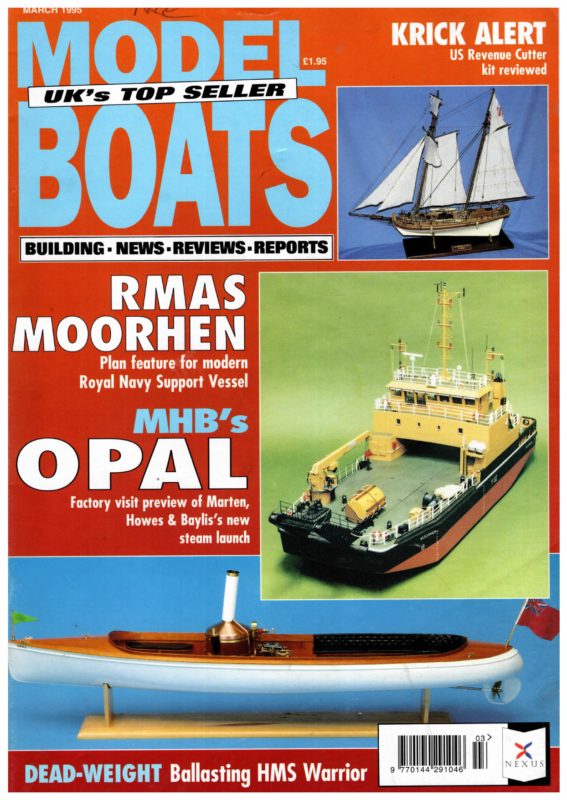
- small YACHTS – MIKE KEMP visits the Model Engineer Exhibition, looks at Rankings and the League
- Yacht Lines by Anthony Corbett discusses ‘Elite’ One Metres, Thames Heritage Centre, Housemartin kits and inexpensive yachting

701 Ih 046 | 03> / ~ NEXUS
Where has the Model Gone? Has the ‘Model’ gone out of the Model Yachting Association? This was the thought that ran through my mind when I heard that, for the second year running, there was to be YACHTING no MYA stand at the Model Engineer Exhibition; but there is to be a stand at the ‘Sailboat’ exhibition at Crystal Palace later in the year. I remember that a little while ago, during my brief and not too successful spell on the TYRU-MYRD Permanent Committee, there was a strong move afoot to remove the word ‘Model and replace it with something else ‘Remote Controlled’ for instance. This failed, I guess, because it didn’t sound right. From the MYA point of view it seems that much of the push ‘from the top’ is to try and encourage a cross-over from the full sized yachting world. While I believe this should be encouraged I wonder if it should be at the apparent neglect of the ‘Model’ fraternity. It is true that much of the ‘organised’ activity does indeed revolve around racing; and that racing is every bit as exciting, keen and involved as at the very top of the ‘full-sized’ sport. Never the less there is a streak of the modelmaker’s art and skill running throughout our sport. Many of those who come to our end of the yachting spectrum equip themselves with the very best of commercially available yachts and parts and do some pretty impressive sailing with them. But, I wonder whether they do so just because they do not have the time and are prepared to pay for it; or is it because they are not driven by the ‘model makers bug’. There is something about modelmakers that makes them proud to do many things for themselves, even it is only some small modification to a purchased part. Are these types being deliberately ignored, snubbed even? I understand that there was insufficient interest in manning the potential stand at the M.E.: where are all those stalwarts from Birmingham and Bristol, from Reading and Reigate and from the ‘home counties’ who used to come to Wembley, and then Crystal Palace, for the day, armed with flasks and sandwiches. They came to meet old friends, to swap gossip, to marvel at the masterpieces from John Gale, Oliver Lee, Graham Bantock and others as they hung precariously on the walls of the MYA stand. Sometimes it was difficult to determine who was manning the stand and who wasa visitor: and anyone showing the remotest interest in one of the yachts, a picture, or the map of club locations was quickly brought into the conversation. They were briefed on the different types of yacht on display, where their local club was, where they could lay their hands on those elusive parts; and, sometimes, they would even find themselves talking to someone from their local club – or someone who knew a man who was! Every now and then there would be a pilgrimage to the pool where a 6 Metre, R36R, or similar yacht would demonstrate just how effectively it could be propelled around the restricted area by a small group of fans and watched by more. Submarines may be mysterious, fast electrics furious, steamers deceptively simple, but a 6 Metre in a king sized soap dish is something else! Have we really reached a stage where there is no-one now prepared to have a day out at ‘the show’? Many of us used to go there Sylph goes for a sail. Jack day’s beautiful interpretation of Graham Welch’s design begins its development programme with a work-out at Two Island’s Guy Fawkes meeting, sailed by Nigel Gilson. anyway, many even paid to enter – and then spent some time ‘helping out’. Modellers go to Olympia in January Yachtsmen go to Earls Court – some of us go MIKE KEMP visits the Model Engineer Exhibition, looks at Rankings and the League 48 to both: time it right and you can get to them in the same day. 2000 by 2000 – I wonder!?! Model Engineer Exhibition Having just ‘got that off my chest’ I went along to the M.E. on opening day and found myself beinga little more disappointed. Although there were several sail powered MODEL BOATS MARCH 1995
craft in the marine sections of the displays and competitions there were no ‘yachts’ of the sort normally featured in this column. Nor did there appear to be any sail powered medal winners, although a 1/32nd scale model of ‘Britannia – The King’s racing cutter’ a ‘Large’ yacht of pre-J Class design built by Sandy Cousins from Glasgow gained a commendation. Another, the only other entry in the class for sailing ships of any period working, also gained a commendation fora ‘scale’ model of a topsail schooner. The sail powered club stakes were being upheld once more by the Scale Sail Association with a fine display of Thames barges and the like all complete with nicely coloured cloth sails that were suitably crumpled and definitely not the smooth, efficient shapes that we are used to looking out for. So it would appear that all those in our fraternity who build beautiful and functional craft were not persuaded to display the results of their skills this year. Perhaps next time? I did spot one yacht loosely resembling something that would normally grace these pages: it was tucked away up on the balcony in amongst a display of work from technology students from various schools. This ‘One Metre’ yacht was built as a technology project by thirteen year old William Beckerson while at Guildford County School. The mould had been ‘found’ so a hull was moulded in Glass Fibre, then filled with polystyrene (foam?) – presumably to avoid one of those heart stopping visits beneath the waves. A rather novel approach had been Everyone who enters gets some points, in proportion to where they finished in the regatta. Basically there are one hundred percentage points up for grabs and they are awarded according to one’s position on the ladder. Top dog gets 100%age points, the next might get 98%age or only 78%age: it all depends on how many entries there are. The bigger the entry the higher will be the equivalent place on the ladder. The system is a ‘rolling’ one such that as the season progresses and a new ranking race passes, the earliest from the previous season drops out of the scoring. Each District in the MYA has to allocate one ranking race for each of the two main classes, thus there are six of each in any one year plus the National. The allocation of events around the districts slowly rotates, the first district in one year may be the second or third the next and so on; so it is quite possible for there to be two from the same district being included in the qualifying series. The average entry for the One Metre class is in the order of twenty to For the spectator who wants to see what this is all about a ranking race is a good one to go and watch: the entry will usually be among the best skippers in the neighbourhood, the yachts will often be among the best there are, and the Race Officer often has a pretty good idea of what the whole thing is about and will keep them all moving along. However the spectator should not expect to be able to monopolise the time of a ‘hot-shot’ in conversation about the merits of this piece of kit or that – the last thing anyone at a ranking race wants is to miss the start of a race. Having said that, if all is going well and the said ‘hot-shot’ is not in a state of ‘tiggering’ (bouncing up and down between the A and B heats ‘cos he or she is too good to languish in B but can’t seem to hold on in A), then talking time may indeed be available. A great deal can be learned at such a meeting. As new Six Metre designs appear to test the rule, it is worth looking back to see how the rule has been ‘stretched’: few have gone smaller than Peter Somers’ Micromorph. Started life as a 36R and grew, but not much! forty, generally around thirty: that for the RM. slightly less. These days they will almost certainly sail according to the EORS arrangements, which will mean there are two fleets sailing typically around ten races in a day between 10.30 am and 5.00 pm occasionally with a thirty or forty minute lunch break – depending on the closeness of a local hostelry. Racing will usually be fairly frantic and to a pretty high standard; after all these are potential International skippers. However, a newcomer might well be pleasantly surprised to find that it is actually less hassle sailing with this bunch because adopted to get a moulded polystyrene fin most are more aware of what other yachts are which was then filled with lead and resin and about and do adopt the maxim- it is quicker fitted, by description, in a rather ‘heavy engineering’ style. The mast and booms were to stay out of trouble. from 10 mm dia. alloy tube with rip-stop cloth sails. The rudder was brass soldered to a stock and the whole controlled by a two channel radio with 1.2 Ah. NiCads thrown in for good measure: it is apparently sailed on Shattermill ponds, where ever they are. Seems to me that young William should get to know about the Guildford Club, and they about him. Well done William, for holding up a tiny flag for Model Yachting as we know it. I started in model boats at about your age; it took me years to ‘see the light’ of sail power, you’ve got there already. The Rankings You have heard a lot about the MYA League over the past few months, you will hear more over the coming months (editor permitting) forI intend to publish the monthly summaries. For a change I thought I would let the world know what has been happening at the top of that other ‘list’ maintained by the MYA- the ‘Ranking List’. In case you were not aware, this is the list that is The Oliver Lee Trophy. At other times there ts used to decide who gets first offer of an entry in the International events to which the MYA ample wind, even for B has invitation. The points are collected from the individual’s best four performances at designated events throughout the year, as the sun sinks early. including their performance in the appropriate class National Championship. The key feature of including the National water, wind and light. Championship is that, being a multi-day event, it carries double ranking points making it almost a ‘must’ if someone wants to get somewhere near the top. The One Metre and the Radio Marblehead classes are the most hotly contested and the ones usually published. That is not to say the R10R and RA do not have ranking lists, they do. Unfortunately there are not nearly enough yachts taking part in their events to require such a draconian way of selecting international entries so their ranking races are fewer and tend to be a bit lower key. rigs, but the light goes Perhaps in 1996 there will be just enough That’s right – it is a moulded Metrick Magick, Chris Dicks’ champion One Metre now drawn in ‘production’ form by Fred Ivory. This example moulded by the other half of the ‘Two Freds’ – Fred Catt. How does one obtain ranking points: simple, enter one of the designated races. MODEL BOATS MARCH 1995 49
The League I couldn’t let an issue slip by without a little – bit about the MYA League. There was a lot of conversation at the MYA AGM about the League Championship and about its scoring in particular. The massive contribution that the extremely successful 1994 One Metre Championship made to the Fleetwood club’s League Points focused many minds on ways to stop it happening again; maybe to shift the emphasis back to the grass roots events. There were several proposals to amend the scoring system: each was ‘tried’ on the 1994 results and I was able to prove that none would have stopped the eventual winners from doing just that! However there were a couple of suggestions which, if combined, might do the trick and even out the contribution of events, large and small. The result of the voting was to put this combination to work: in simple language it goes like this. There will no longer be a multiplier of the number of days of the event: thus one will not score three times as many points if the event is of three days duration. There will be a multiplier equivalent to one tenth of the number of races in the event: thus in the typical one day event where a two fleet entry might sail nine or ten races the points awarded will be similar to previous years (a multiplier of around 1.0 would apply to a score of, say, 25 points for first place). However, if there was a very large entry which only managed to sail six or seven races the winner would still receive a similar number of points (a multiplier of around 0.7 might be applied to a score of, say, 35 giving 24.5 points for first place). It is argued that although the entry was larger the winner did not have to fight his/her way through as many races and therefore does not deserve any more points. When applied to a large National Championship the result would still seem to be quite equitable and not so biased towards an overwhelming and potentially unbeatable score. For example the winner of the 1994 Top left: a rare sight at the Model Engineer Exhibition – a model yacht. Built by 13yr old William Beckerson from Guildford as a technology project, this was tucked away on the gallery above the main hall. Top right: what no-one could sail for this year at the Oliver Lee Trophy – the half model Marblehead that is the Oliver Lee Trophy. Sometimes at the Oliver Lee Trophy there is barely enough wind, even for Marbleheads. In this meeting the fleet was During 1995 the National Championship ‘circus’ will visit as follows: Radio Event R36R National,Championship RM. National Championship ‘Veterans’ RM. National Championship R 6 metre National Championshi p RA National Championship One Metre National Championship R10R National Championship Vane Events M Team National Championship M National Championship A Team National Championship 10 Rater National Championship A National Championship (‘A’ week) 6 Metre National Championship 36 Restricted National Championship 50 Date 20/21 May 27/29 May 1/2 July 1/2 July 5/6 August Gipping Valley MYSA Kensington 26/28 August 14/15 October Venue Bournville Fleetwood Fleetwood Date 11/12 March 6/7 May Bournville Fleetwood 24/25 June 30 July to 4 August 2/3 September 7/8 October 10/11 June Bournville Bournville The first of the One Metre Ranking Races will be at Doncaster on 5 March and the first Radio Marblehead Ranking Race will be at Sandwell on 19 March. With a bit of luck we will list the remainder next time. Who should one look out for in the coming season? Here are the top ten from each of the Ranking lists, as at the end of 1994. Top Ten One Metres eventually collected by the rescue boat. Venue Market Bosworth Drumpellier (Glasgow) Birkenhead Edinburgh Fleetwood Top Ten Radio Marbleheads lst Skipper Chris Dicks Score 495 1st Peter Stollery 494 2nd 3rd 4th 5th 6th 7th 8th Rob Vice Mark Dicks John Cleave Keith Skipper Mike Kemp Graham Bantock David Taylor 459 2nd Graham Bantock 493 450 3rd Roger Stollery 459 426 4th 5th Phil Playle Martin Roberts 453 443 6th 7th 8th Mark Dennis Paul Tickner Nick Weall 403 392 376 9th 10th Graham Elliott Martin Roberts 361 9th 10th Keith Skipper John Cleave 348 346 392 369 364 363 350 Skipper Score One Metre National would have received around 101 points instead of the 230 plus. The only worry that has so far surfaced, one that I certainly foresaw and warned the meeting about, is that an over-zealous race officer might set some inappropriately short courses in an effort to jack up the race count for his/her meeting. It will be a shame if this happens and I believe this will be an occasion when ‘skipper-power’ should come to the fore and insist that we are given decent courses with an ‘on the water to off again’ time of between fifteen and twenty minutes. It should be the between-race organisation that must be improved to enhance the chance of more points. Only time will tell, of course, but I find it very heartening that the League should have developed such interest – watch this space. Oliver Lee Trophy Long established as just about the first Radio Regatta of any year, this annual frozen feast of Radio Marblehead activity was scheduled to take place on January 1st on the latest lake available to the Chelmsford Club. On the day when winter finally struck with that white stuff, close to zero temperatures and a decent northerly wind the 1995 event was cancelled because there was too much water! The access pathways around the lake were all below the level of the fluid stuff, making launching, retrieval and generally seeing what was going on too hazardous. Twenty or so skippers no longer had an excuse to dodge normal New Year’s Day celebrations to brave the cold and snow to have a sail and tuck in to the sausage rolls, mince pies and non-alcoholic punch supplied by the non-sailing supporters of the home club. I wonder who pigged-out on all that fine fodder? You will have to wait a while before I can bring another race report after my enforced break from misguiding my yachts around. MODEL BOATS MARCH 1995
of put up or shut up! The message I am trying to convey is that if one interested in any hobby, then being involved at any level can be a rewarding experience, be it at the grass roots of the clubs, or chairing international committees. Of course I can testify to the negatives. Big clubs and associations can be very time consuming and the committee work extremely frustrating but the reward can be exactly what I referred to earlier, a level of knowledge and experience that adds to the enjoyment of your pastime. Years ago I was involved with the running of a large “full-sized” sailing club which seemed to absorb so much of my time, there seemed little left for actual sailing. Whilst I can think of a lot of positive aspects, I still remember the feeling of irritation with the number of people gathering to criticise the all too few who were. willing to actually contribute. However, the experience has made me realise how much I am dependent on the voluntary efforts of others for my own enjoyment. Whilst I am now obsessed with re- the world and with it become involved and lessen the burden on the all too few who are still willing to give up their time for the benefit of the rest of us! Elite; what elite? It is with the above in mind that my attention was drawn to a letter in the December issue of Model Boats, bearing the caption One Metre Elite? This letter, whilst referring to developments within the One Metre class, touched upon and muddled up many other issues and may have left those with a passing interest in this hobby with a rather jaundiced view of this sport. Unfortunately the content of the letter made me realise how the MYAis how the sport is organised, so I hope that the following might help set the record straight. I am afraid that in considering the points raised, there is perhaps a need to go back to basics, so please bear with me. I will not repeat all the information set out in my first column, however I would remind the reader thoughts, I might encourage others to MODEL BOATS MARCH 1995 construction of the yacht. These are referred to as the Class rules. For competition, whist some might get very frustrated with the process, yachts are measured to ensure that they comply with these rules. The benefit is that we can then all be certain that we are playing the same game with the same equipment, however there would be little point in having these class rules if someone was not responsible for maintaining them and ensuring that they are correctly applied. This is where the MYA comes in, which as the representative body for all the affiliated clubs in the UK, has it’s own rules for administrating the sport for the benefit of the clubs and membership. At the current time we have six classes of yacht that have the benefit of National Status; meaning that they — ais = eye oat saea | ‘ tee ee brass tube and screwed into boom. FS, Ce 60 | mm This has exposed the flaws in the original draft of the rule which prompted quick action by the IYRU-MYRD to keep the rule on track. Other countries have proposed some quite significant changes to the rule but for some reason a few UK skippers seem to think these have somehow been promulgated by the MYA. See text for details. Figure 3. – Mike Brass or s/s tang hardsoldered to outer retained by long” ‘ has come some fast we can all be assured that these classes maintain a high standard of measurement and Kicker assembly yacht racing and travel all around the country, my sport is totally dependent on those who organise and run the actual events. By giving of their time so freely, they preclude themselves from competing in the very thing they enjoy, so I would like to take this opportunity to offer my thanks to them all. My only wish is that by setting out these failing to explain very rapidly around design development. that racing yachts are built to rules that generally control the size, sail plan and F Association, where I became involved after levelling some criticism at the way the Association was conducting it’s affairs. A case Housemartin kits and inexpensive yachting 3 enjoyable. My involvement with this publication was an inadvertent extension of my role as an officer of the Model Yachting One Metre Class popularity has grown S Ithough I have only been making a contribution to this magazine for a short time now, one of the benefits of the undertaking is that one gains a marvellous insight into the people, ideas and products that make the hobby (or sport, whichever you prefer) so interesting and Elite; what Elite? The discusses ‘Elite’ One Metres, Thames Heritage Centre, a YACHTING i ; ANTHONY CORBETT Sheppard’s simple design fora home made ball raced gooseneck, boom and kicker assembly. Ball races retained in Aa ae cae id. brass tubeby alt kicker tight Packing washers top & bottom Brass or s/s sheet fiver Internal brassor alloy” – tube as ‘spacer to suit mast Figure 3. Ball raced kicker assembly (not to scale) 39
The six rigs that go hand in hand with a racing 36. This is probably the most costly feature of this class but despite suggestions to the contrary, the rig is Fairly “low-tech” with carbon tubes being ruled out, just like the One Metre. changes to class rules. But is this true? Well the answer has to be yes but then again ……. but presently excluded by the rule, another however would have precluded the use of the no! Perhaps it’s may be? Or perhaps it’s just a latest generation of carbon fibre fins), I case that some do not take the time to wonder what the reaction of skippers would understand the reasoning behind any change. have been if these proposals had been adopted as amendments to class rules without any consultation?! By taking a great I think that it is true to say that one of the main problems is that we all just seem to hate any sort of change, whilst at the same time Right: Bob actually has another rig for his boat, which is the same size as his No. 1 but 5” taller and made out of reach certain numerical criteria. This in turn forgetting that all rules alter and develop to ensures that any owner can be guaranteed reflect various changes of circumstance. After fair competition around the country. Of these all the rules of football are hardly the same now as they were ten years ago and the laws of our parliament seem to change on a weekly basis! The fact is that we entrust elected six, four meet similar criteria on a world wide basis giving them International Status. The sport of sailing is administered deal of time and trouble, the secretary of the MYA ensured that all affiliated clubs and thereby owners of registered One Metre yachts, had an opportunity to influence the thoughts of the YYRU-MYRD. By taking this action he ensured that the MYA was able to reflect the views of the majority of it’s Melinex. Light weather Internationally by the International Yacht only for these sails, representatives to administrate our rules in members, something which I would have Racing Union (IYRU) and it is this body’s order to correct and evolve them to suit our thought was exactly what they would want the racing rules which are used in both “fullsized” and model yacht competition. As with the MYA, the IYRU is basically an association times and neéds. It’s the same with boats but MYA to be doing. Thanks should go to Henry when I understand the rig performs very well. for giving up so much of his time to complete has been shown to contain several flaws, we this exercise and correlate all the replies. of clubs, however in this instance the “clubs” are dealing with an International rule which are nations. When the MYA became affiliated which make up the Model Yacht Racing This one is an Alex thirty one other countries have a say in. The questionnaire recently circulated by the MYA’s secretary was prepared by the ITYRU-MYRD’s Technical Secretary and Division (MYRD) of IYRU. It is MYRD that covered a number of proposed alterations to Austin “Deception” has responsibility for maintaining the rules of the rules that had been submitted by other (Twyll in Welsh) those classes which hold International Status, one of these being the One Metre. I hope you’re all following this. member countries. None of these came from Above: This shot ofa modern 36 illustrates the fairly large fin chords and big rudders. completed and rigged by Bob Iles of RIG. Although this one is moulded using carbon fibre, a grp hull won the ‘94 champs. 60 in the case of the One Metre, a rule which to the IYRU some five years ago, it became one of what is now thirty one member nations Right so we’ve got to the One Metre but now let us take a step to one side. The letter the UK or anyone else involved in the MYA, so it is difficult to understand or justify the suggestion of commercial or elitist pressures. written on behalf of the Brentwood Club’s Although the proposed rule changes would not have made the boats dramatically membership touches on an issue that I hear different (one proposal was aimed at allowing referred to many times. The constant materials similar to those currently permitted Interestingly enough the analysis of the questionnaire proved a lot of what Mr Schaffer’s letter said. Generally we seem to be happy with the One Metre rule as it is and people do seem to see it, rightly or wrongly, as the simple and inexpensive way into the sport of radio yachting. As to the elite, well I am afraid I am unclear as to who they are. If they are the boat builders, sail makers, or successful skippers, the innovators, the designers, or this year’s champion, then good luck to them. They reap the benefits of their efforts and are as important to the sport as the “grass-root” skipper who supports his club at every MODEL BOATS MARCH 1995
Top left and Above: one gets to see some great sights at Childe Beale and the rather over-canvassed Emm- E-Lee was one of the best at October 94’s show. Wouldn’t it be wonderful if the Trust were able to implement their plans for new lakes and buildings where all sorts of yachts can be both displayed and sailed. Far left: We all start somewhere and the shows at Childe Beale often attract a wide variety of both boats and skippers. Here a possible future champion sails a vintage free sailing yacht, restored to better than new condition. desire to create a model yachting collection that would become the centre piece of the Centre and include yachts of all eras as well as design drawings, printed matter, photographs, information and any other memorabilia. Much better than seeing it condemned to some designer shop window somewhere. Left: Bow on shot of opportunity. But few contribute as much as troubles, so this shouldn’t preclude the use of those that give freely of their time and if this is the elite, then let us be grateful rather than the lake. No photographs I’m afraid and we haven’t been given any details of depth, size critical. Without them we would be left with or surroundings but with recreational water nothing. If you don’t like what they do, the simple answer is to become involved, in such short supply nowadays, it’s got to be worth a look. If you live in the area and are contribute to and benefit from the process, interested, Jim can be contacted on 01555 Few people could afford to personally finance the collection envisaged, especially when we all know how much the older pond yachts have appreciated as they become more and more collectable, as well as interesting exhibits in many a designer window. The same may be true of associated memorabilia, which is where I came in…………….006 666218 after 7.00 p.m. however what is being offered here is the This month Thames Heritage Centre working exhibit and what is basically needed tends to ride on the are donations of boats and any other material bow wave when the that may be cluttering up your loft, room or boat is heavily pressed. clubhouse. Whilst plans are at a very early stage, I think it is fairly safe to say that ownership of extreme as the Roar I had promised to start writing about rigs, but after one long and extremely interesting day with Graham Bantock, I find that the project has become much bigger than originally anticipated so I am afraid you are going to have to wait a month or so. Anyway it gives me some time to catch up with other letters, starting with all of you in the Clydesdale district. For the Scott’s Amongst Us A lot of modellers will know of Richard Howard, an obsessive collector of all types of model boats. Although some of you may not have had the pleasure of meeting Richard personally, a lot will most certainly have visited one of the several shows that take place on the lakes within the Childe Beale opportunity to create a historic record and Trust Nature Reserve at Pangbourne, near any material or boat would aot be transferred to Richard personally. The intention is that unless given as a gift, ownership would be Reading. entrusted to the Trust who would become Within the trust’s grounds is a summer house where a selection of Richard’s vast collection is currently on public display, however this is the tip of the ice berg when it responsible for preservation and boat club with a view to seeking permission to sail at the Bigger Park Pond. Apparently the pond comes under the control of the a trustee of the Childe Life Trust has embarked on a project to create a Thames maintenance. Alternatively a yacht might be put on permanent display with the owner benefiting from the use of the centre for special events during the year. A lot of details such as insurance etc., would have to be ironed out but personally I think the concept is worthy of support. So if you have a boat or Heritage Centre which will consist a purpose any of the paraphernalia mentioned above, Clydesdale District Council who would have built lake suitable for sailing of model boats to give formal consent but Jim has been including both re and free sailing model assured it has been used for model boating in the past. There might be a slight weed yachts as well as buildings to house a wide range of exhibits. then please write in the first instance to Richard at the following address; Mr R Howard, Senior Trustee c/o Childe Beale Yacht Lines recently received an interesting letter from a Jim Jessup in Lanark. Jim would like to hear from other people in his area who would be keen to form a model problem but other clubs have dealt with such MODEL BOATS MARCH 1995 comes to Richard’s dream for a model National Boat and Yacht Museum. Richard as What Richard would like to do is fulfil his the “Shaft” showing the very narrow canoe section hull and the bow flare. The flare is introduced as a protection against nose diving and in practise The flare is not as Edge’s but does seem to work. As another point of interest, one can see just how thin the fin sections of RM’s have become and Yacht Lines will be looking at the home construction of these types offin in a future article. Trust, Hogg House, Piggy Lane, Lower Basildon, Berkshire RG8 9NH. 61
Right: A picture of £160 which includesa fin, rudder, all deck fittings, lead, plus rudder and mast tubes ‘fitted. The rig kits which include everything needed to complete the boat except electric’s, cost another £110 which seems very good value for money. I’ll try and bring you photographs in a future edition of Yacht Housemartin’s Marblehead “Shaft” design which now sports a carbon fibre fin section made by Paul Tickner and a Lines. fairly deep rudder. Finally Martin is also now offering the R10R Bentley design which he sailed into second place in ‘94s National Championships. Price is £300 for hull kit to the same spec. as described for the RM. The rig kit consisting of three suits of sails with carbon mast tubes Right and below: The one advantage of the retired is that they may well have a lot more costs £170. time to actually build Further details of all Housemartin products are available by sending an SAE to 51 Edinburgh Drive, Preston, Merseyside LA3 their yachts from the ground up. The photograph of Mike ORJ. Sheppard’s work shop What Else Can I Say? shows several very interesting projects underway including, in the other photograph Mike’s RM for ‘95 (the right hand plug for the hull). In the text I have referred to the extreme flare of the Roar Edges bow but Mike’s design for an “anti-plunge bow” is radical in comparison. Let me know how it tacks Mike! Below right: Mike Sheppard also uses 6 = — \ rigs on his Solarkraft hull but in a shroudless conventional format designed to make them extremely quick to change. Compare this photograph with the ones of the swing rigs and you can see the different proportions of the mains and jibs. IfI get the chance to build another 36, then I think this is the route that I would also follow, although one needs to find an answer to the light wind advantage of the swing rigs. 62 Better Late than Never Details of Housemartin’s kits and products were conspicuous by their absence in my recent review of MYA class yacht kits. However I have just recently become the beneficiary of Martin’s new catalogue for 1994 (or is it 1995?!) and there are several things worth bringing to the attention of the readers. aS As most people who live in the vast expanses North of Watford know, Martin Roberts produces some very competitively priced sails and rig kits. His range of products has been gradually growing and I am pleased to see that he is now offering a kit version of the RM Stark which he sailed to second place in 1994’s World Championships. The Stark is one of the new breed of narrow hulls and strikes me as a more extreme version of the canoe concept developed with Paradox and Roar Edge. Results to date seema little inconsistent but there can be little doubt that the design is on the pace and worthy of consideration. ° A hull with fin box, mast and rudder tubes, fin and lead will set you back £300. Five rigs (an A max. area swing, B max. area swing and three various sized shroudless conventional rigs) will costs another £407 but then all you need are the electric’s and a bit of time to glue it all together. On the One Metre front Martin will be sailing and selling a new design from Chris Dicks, the Widget. Not surprisingly the boat is narrow, being a development of Martin’s 1994 boat with a much narrower stern and flared bow. The kit costs a very reasonable Well quite a lot actually but as I am writing this during the run up to Christmas (you’ll hopefully be reading it in the March edition available in February – Yes I’m confused as well!) you can imagine that other more precious matters are more demanding of my attention right now. However recent photographs sent to me by Michael Sheppard and Bob Iles over in Wales give me the opportunity to demonstrate that rc-yachting is not the expensive hobby that some people would have you believe. Bob runs a business known as RIG making some competitively priced sails and rig packs for 36r, 1M and M class yachts and Mike builds his own boats from the ground up. See his design for a home built ball-raced gooseneck illustrated in Figure 3. The thing they have in common is a passion for the 36r class which, as this column’s more regular readers will be aware is one of this writer’s favourites. So far there has only been a small response to the idea of setting up a 36r Class Association, however at least it’s a beginning, although it is made a lot more difficult by the misinformation spread by those that favour other classes. It was only recently that I read a reference to the “hi-tech” 36 class, something that I believe is far from the truth. We have touched on the rules of the 36r class before. It is actually the simplest of rules in that it limits length, beam and most importantly draft of the boat. Weight is restricted to a maximum total of 12 Ib. and you are not allowed to use carbon fibre in the rigs. Other than that anything goes, so I suppose that some might argue that the class is hi-tech because some hulls are made of carbon. This is probably a hangover from the days when carbon was an expensive material but nowadays, if you can mould a hull in GRP
Far left: Shots of the shroudless rig being fitted to the boat. The first illustrates the mast dropped in the hull mast tube and the forward deck boom loose. This is then locked in position using a home made slide, amplified by the illustration in Figure 1. Left: The rig installed in the boat. As the 36r rules preclude the use of stiffer carbon tubes, Mike utilises diamonds on the taller rigs to keep the mast standing up. This means he needed a way of detaching the spreaders for travelling and he came up with the home made quick install spreader illustrated in figure 2. The hook for my next article. Rig and especially jib forestay tension is the key to racing success in any class of model yacht. Can you spot one ofthe secrets to achieving this illustrated in this photograph of a One the only real difference is substituting carbon for glass mat. The gain is a much higher strength and stiffness for any given weight. Compared with the One Metre, the class has an advantage that I would have thought Metre conventional not to scale s/s slide comparatively thick fin to stop the boat going. sideways and the hull form is important to overall stability, which so far has stopped the development of the super narrow hull. However the class does have the disadvantage of needing more than the three rigs allowed by the One Metre rule but if you can build most of the parts of the boats yourself, then there is really little difference between the classes other than that the One Metre is now under a lot of competition provoked development. It is interesting to note that a 10 year old design moulded in sheet on formed curved s/s bolts 12 v 45 mm 10 mm planked hull was used to win the One Metres. Is it “hi-tech” or good sailors that win races? Anyway I suppose that although it is an interesting debate, the battle is almost lost as the One Metre replaces the 36 as most clubs small boat. Perhaps the photographs of a . modern 36 with swing rigs alongside a home —— s/s sheet formed _—-}_ atound drill shank bracket formed out of rigged boat with a lot of innovative features hobby, make new friends and win races but have the satisfaction of knowing that you did it all yourself. Isn’t life great! Thanks go to Mike and Bob for sending the photographs. Bob can be contacted at to strip mm GRP won the R36r ‘94 Nationals and a timber want to, you can build virtually everything yourself. That way you not only enjoy your Yacht Lines. Sketch of foredeck clip, made from stainless steel sheet. would have appealed to those that cry out about the expense of “hi-tech”. Deep thin fins are precluded by the limit on draught and the so called thin carbon sections don’t appear to work anyway. One needs a fairly large and might go some way to redressing the balance. The beauty of rc-yachting is that if you rig? More in the next Figure 1. 30 brass angle — and | hardsoldered to sheet of Sketch quick release spreader brackets mm RIG, 16 Trenchard Estate, Parcllyn, Cardigan SA43 2DL. If you are waiting for the article on choosing and setting up rigs, then see the photograph of the One Metre rig for one tip to help tighten up that forestay. Figure 2. MODEL BOATS MARCH 1995 Not to scale brass tube with flattened & drilled end 63