
- Yacht Lines by Anthony Corbett covers a variety of subjects – plus an interview with guru Graham Bantock on rig construction, tuning and Marbleheads
- small YACHTS – At last we go sailing. The first of the season’s ‘biggies’ is reported by Mike Kemp and One Metre rules changes are summarised, but first, we complete the Match Race Course

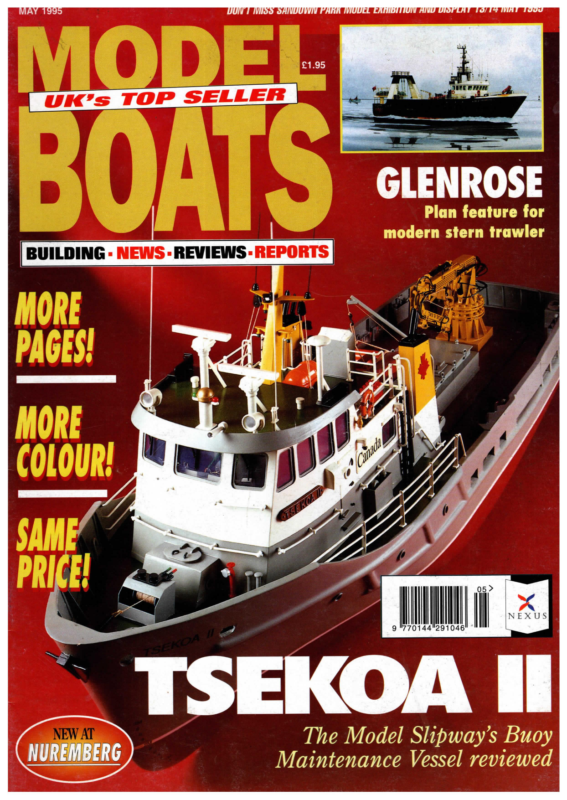
GLENROSE Plan feature for BUILDING – NEWS – REVIEWS: REPORTS | saddles n stern trawler un | TSEKOA i” Newar’TM NUREMBERG The Model Slipway’s Buoy Maintenance Vessel reviewed
YACHTING Right: I’ll try and get the whole boat in next time. No. 19 is a Paradox using a shroudless conventional rig. This is a “C” rig, the shortest luff length for a full size rig used on today’s Marbleheads. The rig is fitted to the yacht in a similar way to a swing rig but one can see the forward yard that is locked ANTHONY CORBETT covers a variety of subjects plus an interview with guru Graham Bantock on rig construction, tuning and Marbleheads down to the bow deck beam and takes the tack of the jib. Below: the boot referred to in my missive on the One Metre rule changes. Although the picture is not brilliant, you should be able to make out the sheeting line that winds around the “heel”. The clip at the front fits around the fin box and the back has a half tube which locks against a post in the hull. In the other half of the shot, you can see the position of rudder servo and winch as well as the hatch cover removed, allowing access for battery and F my article in the March edition of irst a number of minor corrections to Yacht Lines, errors probably caused by the combined efforts of an exhausted scribe and an over exuberant spell checker. My thanks go the kind reader who demonstrated that he actually reads what I write by pointing out that the R36R design was a “Deduchan”, Alex Austin’s follow up to the “Taxachun” and not a Deception. The next error was the reference to Housemartin’s latest RM offering as a “Shaft” rather than a “Stark”. My apologies to anyone that was confused by said errors. One Metres “God not again!”, I here you cry but after all the recent correspondence regarding this class, those that actually read the rule, design and build the boats, will wish to know about the recent rule revisions that have been promulgated by the Model Yacht Racing Division (MYRD) of the International Yacht Racing Union; see the March edition for more detail about these organisations. As I have said before, there were a number RX changes. The RX is of flaws in the One Metre rule, many of held in place by Velcro. which came toe¢dight when yours truly wrote The unit is completed by cutting a waterproof material like fablon to shape and taping to the unit to seal it. A clever idea that can cut down on equipment costs. to the then MYA Technical Secretary asking for a ruling on the use of a carbon fibre “Yacht-boot” to contain the radio gear and winch. Those new to the hobby will probably have no idea what this “boot” is and others will perhaps just say that carbon fibre is banned anyway, however the latter is certainly not true, with many builders using c/f rudder post tubes and mainsheet posts. Anyway the point is that the boot, a device developed by Roger Stollery for use on his own boats, allows all the electric’s to be contained within one reasonable watertight unit and more importantly, transferred from yacht to yacht. I will include a photograph of a typical unit so the reader can get an idea of what it is all about but it is unlikely that you will have missed the potential for savings on spares and back-up. Most of us who sail the latest generation of Stollery Marbleheads have two of these boots that can be quickly changed over in the event of an electric failure. This means that a winch failure need not necessarily mean one being out of any more than one race. Now if you can design all your yachts to accept the same container, then the outgoing on winches alone (£100 a time) can be drastically reduced. Given that the One Metre is supposedly all about reduced expenditure, it was quite a surprise when the boot was ruled out. However the subsequent debate indicated that all sorts of other fittings and practice did not comply with the rule, so it was known that a major revision would be required. Please indulge me and my ramblings about this case but I think it is a good example of the difficulties involved in writing a rule to make a yacht class “simple”, as the One Metre is intended to be. In my experience of both full sized and model yachts, the simpler the intended boat, the more complicated the rule as the creators are forced to exclude everything that it is felt might conflict with the intention of the rule. In the case of the boot, I suggested that as the rule allowed plastic radio containers then a carbon fibre boot to contain the electric’s was in class. Look up the definition of plastic and you will perhaps start to understand. The Technical Secretary didn’t agree and I must admit to some sympathy with some of his concerns but in principle, everyone seemed to go along with the idea that a boot should be permitted. It’s worth noting that it wouldn’t have fitted in the boat anyway as the hull I used is quite shallow! I set out this little story to illustrate one of the reasons behind the most recent amendments to the One Metre rule, as there are bound to be those that will automatically switch to whinge mode. Those that belong to MYA affiliated clubs will of course have received the excellent leaflet issued by the Technical Secretary of MYRD. This explains the reasons behind the rule revision and highlights what might need to altered on your boat to comply with the 1995 rule, which incidentally comes into 56 affect on 1st June. For the rest of you I duplicate the main issues that have been addressed: 1. There is no keel thickness limit (This deals with the German proposal to control the thickness of fins). 2. A second pair of shrouds is not permitted (For some reason it was suggested that this should be permitted as an alternative to spreaders). 3. Corrector weights of lead are now permitted in rigs (The One Metre rule sets a minimum weight for the yacht and rigs in sailing trim. The No. 3 rig weighs far less than the top No. 1 rig, so some skippers have been inserting weight, or building heavy fittings to equalise the weight of the rigs. This means that the yacht can be built to it’s minimum weight and displace the same whichever rig is used. The practice of inserting lead weights in rigs was prohibited, however it was argued that there was little difference between this and building heavy fittings, so should be permitted.) 4. “Formica” and similar wood based products are now permitted construction materials. 5. Readily removable RC containment is permitted (Hooray!) The rest of the amendments are basically permissive so although interesting, will have little affect on anybody other than the keen designer and builder. It is unlikely that anyone’s yacht will have to be altered (some will actually now measure!), however we are advised that certainly for YYRU-MYRD events, yachts will have to be checked measured and issued with a new certificate from 1st June onwards I am sure that the One Metre class will continue to grow and be the beginners boat for the many new people coming into the sport. The reader will hopefully agree that in general terms. these changes are pretty sensible, however why anyone should want to stuff lead up their masts beats me! I return to my earlier point, if the boat is simple, then the rule is complicated. If you want to sail a boat with a truly simple rule, then choose a 36R or a Marblehead. Solarkraft Staying with the glorious One Metre, I have heard from Squire Kay who has apparently bought out a new design and kit called the Minnow. Squire quotes a kit price of £110 for the GRP hull with fin box fitted, plywood deck, carbon fin and rudder, pot and 3 suits of sails which seems exceptionally good value (check the bit about the sails!). From the photographs it appears that the hull sports a slight flare at the bow deck MODEL BOATS MAY 95
Far left: The Minnow One Metre kit from Solarkraft. Left: The dummy for the new One Metre boom section from Sails Etc., sporting some of the simplified fittings number of items specific to the Sails Etc. rig kits that are costly to manufacture, which helps keep the costs down for people like you that will be supplied in their new rig kits. and I. edge, typical of the RM Roar Edge and seen most recently on both of the Dick’s designs. I also see that a price of £170 is quoted for a ready to sail boat with one No. 2 rig. Not quite ready to sail you’ve got to add the cost of electric’s but as Squire also quotes £80 for the two other rig kits, I suspect that there are a few people out there who would like to give Squire a call (if you can find his telephone number!). Write enclosing an SAE to Mr S Kay, Hillside, Pinock Brow, Euxton, Chorley, Lancashire PR7 6LR. consider as this season will go by a lot quicker than you think. For those of us that are fortunate enough to belong to an extremely well supported club, the winter season does not bring with it the fear of sitting indoors without an excuse to avoid those dreaded chores. However, the less fortunate would do well to follow the example of the Northern Area who have set about establishing a league championship that runs between November and February, with a race held at each of seven clubs in the district. This year, the venues were Cleveland, Leeds & Bradford, Fleetwood, Huddersfield, Ashton Quay, Platt Fields and Birkenhead. 58 skippers competed in this years league, with the best 5 results to count. Points are awarded in a similar way to the MYA ranking system, with the winner of a one day event scoring a maximum of 100 points. From the results it looks as if the league was well supported with most of the events attracting in excess of 25 entries. John Taylor, sailing his own Parasite design, took the league title with a score of 478 points, Derek Priestley used one of John’s “Squeak” designs to get into second with 440, closely followed by Andy Kissick also sailing a “Parasite”. Along with these results, John also sent me a copy of his 1995 catalogue, copies of Performance Model Yachts which can be obtained by calling him on 01436 671723. End of advert and race When I reported on the latest addition to this stable’s list of yachts, I was unable to give details of prices on the “Single Malt” One Metre. However this doesn’t seem to have stopped a lot of people rushing to order reports! to the Graham’s own “Red Wine” design, I have already waxed lyrical about the quality boom section. The photograph that will accompany this article is actually of the the hull, the design for which was prepared by Graham Bantock. Not obviously dissimilar of Robert Brown’s products and the design pedigree will go along way towards ensuring that a lot of these boats be appearing on the circuit this coming season. The hull, moulded in woven glass/epoxy What’s new? On the fittings front, whilst I was inclined to say that there doesn’t seem to be a lot of new ideas about just now Sails Etc. have launched a new One Metre (not them again!) dummy profile but by the time you read this, the extrusion should be in actual production. Of course you may be asking why should anyone go to the effort of producing a special laminate with integral transom, stem and rolled deck edge is £130. A complete yacht excluding rigs and electric’s will set you back £467 but there are.so many intermediate section, however one has to remember that Sails Etc. is not a garden shed business. Given the quantities of product sold, they have set about developing a boom that makes is easier for someone with the most stages offered that I suggest you contact Robert Direct on 0131 333 2173 for a quote reduces weight and does away with a basic of skills to complete successfully. It also suited to your own specification and pocket. Winter Sailing Most of my more regular readers will no that I avoid specifically reporting on race meetings and even I’m beginning to get fed up with going on about these blessed One Metres, however it would be ungracious not to mention the Northern area clubs of the MYA and the effort put into the organisation of their Northern District Winter League. Whilst it might seem a little premature, this is an idea that a lot of clubs would do well to MODEL BOATS MAY 95 He @ Following Graham’s success in winning the R10R Nationals with a Marblehead measured to the 10R rule, Sails Etc. are now selling a large shroudless conventional style rig that converts the Paradox for R1OR competition. On a smaller scale, they are also manufacturing a smaller and stronger bowsie. Call 01376 571437 for a catalogue. You will also see a not too brilliant photograph of a new deck pulley being imported by P J Sails (01202 744101). This is a bit larger than the more aesthetic Pekabe fitting, however it has the advantage of being water-resistant it not totally water-tight. Worth considering for those horribly wet One Metres at £8.80. What next? In my most recent articles I have referred to a number of other things that I would be writing on. Recent letters about (dare I mention it again?) the …………… (no you can guess) class and proposals to control the thickness of fins made me wonder what all the fuss is about? Roger Stollery told me that it is actually easier to mould a fin than make one out of timber, so I asked him to prove it. Watch this space as this is going to form a major part of one of the future editions of Performance Model Yachts’ One Metre the “Single Malt”, first seen at the ‘94 Nationals. Yacht Lines. For now, I am going to stick with setting up your boat. I know that so far, I have restricted myself to looking at the hobby of model yachting in fairly general terms. However I am concerned that when it comes to racing, a lot of people can be put off by the number of things they have to learn. It’s all right for us sailors, as we do not have to face the first test of actually learning to sail. We probably also have a reasonable understanding of the racing rules but for anyone else, I can imagine the process could be quite intimidating. The MYA is about the promotion of model yachting but as it was pointed out to me only recently, what we don’t say is that most of our efforts are directed towards model yacht racing. Now I’ve never made any bones about this as model yachting is an extension of my interest in big boat racing, however for others there may just be too much to absorb before they get disheartened and look to another hobby. It is for this reason, I now want to look at setting up and tuning your boat with the intention of helping both the beginner and the average club sailor improve their understanding and performance. This was my reasoning behind going to see Graham Bantock, current Marblehead and One Metre World Champion, to talk about rig construction and tuning. My intention was to pick the bones out of our conversation to compile a list tips, however the chat grew into an interview that I am more inclined to report in full, allowing the reader to extract various ideas and tips. This interview hasn’t focused on just rigs but takes an overview of the Marblehead, One and Six Metre Classes as well as a few general bits about the man himself. Space will probably prevent the reporting of the whole discussion in one go, so I’m going to start with the Marblehead and cover the rest next month. I hope that the reader will find our discussion informative. The new through deck turning block from P] Sails comes in kit form and is claimed to be watertight. It’s going on my next One Metre which seems to be a horribly wet boat. of
Without expecting you to give the game away entirely, are there any other ideas or areas that you would like develop? I believe there is potential for utilising the “Gizmo” on shroudless and conventional rigs. It could be mounted on the deck and I have considered the idea for my R6M. (Whilst GB has introduces many innovations, his solutions seem to aim at being simple and reliable. As an illustration of this his R6M was originally fitted with several rig adjustments, however these have now all been dispensed with in favour of simplicity without sacrificing speed or competitive advantage.) The Gizmo controls twist luff tension and alters the jib slot in one action and was the end result of something totally different in concept. This original idea proved a dead end and was abandoned. The good bits of the device were refined into a reliable way of Above: The Editor is going to have to pay me more so I can get a decent camera! I’ll offer you a better shot next month but for the moment this one will have to do as an Interview with Graham Bantock So that the reader can understand the following more easily, my questions are emboldened, Graham’s answers are in normal type face and my own additions or observations are in italics. illustration of the Stollery style yard fitting which rocks up and down on the bearing (that can just be seen on the front edge) as well as rotating around the centre line, of the mast. Good advert for Peter though! One can also see the “rotating” forward yard that is sometimes referred to as a break back, allowing the tack of the jib to be set on the centre line of the yacht. In the other shot, yes it’s a picture of a bowsie. Actually this is the main control for the Stollery rig as explained in the text. You should be able to make out a number of Radio Marblehead Rigs What are the restrictions emanating from the rules on rigs for this class? The RM rigs are virtually a one design rig although the proportions of jib / main are free. The rule does not actually restrict the sail cross widths but unless you use a roach approximately 50 mm wide, you lose sail area. Basically everyone uses the “minimum” cross width, although a few people have experimented with larger roaches but without any significant success. Everyone uses the maximum jib hoist. Boom angles are also free, so are normally chosen to avoid the boom dragging in the water at large angles of heel, which can cause a broach. What other factors affect the design of rigs and sail plans? The stiffness of the masts, therefore the structural performance of the tube and rigging used is very important. RM’s utilise carbon fibre tube (Later in our discussion Graham illustrated the different performance characteristics of different types of carbon cloths. In simple terms the performance of a tube is a function of the type of carbon strand. the tube thickness and hence weight, balanced against the cost of the material.) Until recently we were not able to make a successful shroudless rig with a mainsail luff over about 1600 mm. Now that the tubes are of higher stiffness carbon we have been able to design taller shroudless rigs. (Witness GB’s big rig for converting an RM to a R10R which is a full height shroudless conventional rig.) Conversely tube stiffness was not a limiting factor in my style of swing rig as the sideways bend is far less in comparison with the bend induced by the backstay. You have often innovated in the design and development of classes. The “Gizmo” is an excellent example of this. adjusting the RM top rig for the varying conditions expected at the ‘92 RM World’s in New York. When we have better material available for keel manufacture, we will be able to think about another fin design, something I think we will be discussing later. What do you perceive as the major differences between your style of swing rig and the Stollery type? Which came first? Why did you develop your alternative? The idea of a swing, or balanced rig, is an old one, however Roger Stollery was the person who put all the effort into developing the concept and making it work. Having originally used mains and jibs of conventional proportions it was Roger that recognised that the proportions of jib to mainsails had to be altered (the jib is smaller than it’s conventional equivalent) to make the rigs behave properly. In the early 1980’s, I started sailing in radio-controlled events with converted free sailing yachts. At the 1983 RM European Championships, I learnt that carrying large numbers of rigs long distances from the boat storage area to the lake was a real pain, so started looking for alternatives. I also realised that if I was to learn about rc-racing, I needed to be able to concentrate on the tactical side rather than the technical side of boat tuning. Something simple was required. These requirements all seemed to lead to the swing rig and it seemed an obvious development to add a backstay to give extra control to the mainsail and increase forestay tension. marks that give an indication to the skipper of some rough settings. Above right: A good example of how not to take a photograph, however one can still clearly see the affect of tensioning the forestay on the Stollery rig. With little tension the sails have a lot of twist and the jib slot is wide, just what you wantin light winds. Right: In the next shot, the forestay has been tensioned. Nothing else has been touched and you can see that the leeches have tightened on both sails and the slot has closed. The Roar Edge and the swing rig powering downwind on a Broad Reach. As referred to in the text, both sails are presenting their whole aspect to the wind. In addition, one can also see the bow wave coming off the deck flare of the hull. Whilst it might be thought that this creates drag, in reality the Roar Edges seem to plane on this wave when pushed to the limit, staying under control while other designs submarine. 58 MODEL BOATS MAY 95
Photos 1,2 & 3: Two ways of measuring the forestay tension on the initial set up of a Bantock style swing rig, using a reasonably accurate spring balance. The other shot shows the simple gauge GB uses much in the same way as a Loosse tension gauge used on the big stuff. The tension in the forestay is adjusted and the deflection of the line checked against the markings on the gauge at a given load. You’ll have to ask the editor nicely if you want me to produce a sketch of it. Photo 4: Adjusting the backstay of the rig which induces mast bend and twist in the main sail. Photo 5: Having set the backstay, the sail will drop between the attachment points to the mast. This sag is removed by tightening the luff tension. In (The Stollery system works by controlling the mainsail leach by forestay tension via a cantilevered yard or boom. Tightening the forestay pulls up on the yard at the front whist pulling down via the same yard at the back, thus tightening the mainsail leach. Air pressure affects this process, making it difficult to set up the rig other than by the water side in the prevailing conditions. Many would consider this an advantage as it means that one tunes the rig to suit those conditions, however many find the concept difficult to set up, perhaps because they have not learnt the process by either sailing full size or vane boats which, require similar disciplines for success.) How many rigs do you have for your boat and what type are they? I planned to have eight rigs for my current boat but in fact never got around to making the smallest which was intended for the extreme conditions sometimes experienced at venues such as Fleetwood. My top rig or Al is swing and I now use shroudless conventional for all the other rigs. I used to use a swing ‘B’ rig up (our B+ rig) up until the ‘92 Worlds. What is your rationale for deciding between swing and conventional style rigs? When considering my choice of rigs for “the ‘92 Worlds, I tried to objectively compare the two different style of rigs by awarding points out of ten for various aspects of performance, e.g. ease of changing rig, convenience for travelling and their performance to windward, reaching. running, tacking, gybing, executing penalty turns and so on. This lead me to the conclusion that shroudless conventional would be better for B rig and below. As a check, I also applied the same test to the top A rig and found that I reached a similar conclusion, however it is well proven that a swing top rig’s performance is actually better than a similar conventional rig around a course, except perhaps when over-pressed. This seemed to show that my method of analysis was ill-conceived, so I refined it until I got the “right” answer for the top rig, then applied it to the “B”. This left my conclusions for the lower rigs unchanged. A conventional rig came out best for B rig and below mainly Al Swing 2150 mm hoist Bl B2 B3 Gi C2 C3 S/C 5/C S/C S/C S/C S/C 1700 mm hoist 1100 mm hoist 1000 mm hoist 1600 mm hoist 1400 mm hoist 1200 mm hoist A2 S/C MODEL BOATS 750 mm hoist MAY 95 because it is 800 sq. in. area 300 sq. in. area (The Fleetwood Rig) 800 sq. in. area 595 sq. in. area 300 sq. in area 800 sq. in area 625 sq. in area 455 sq. in area relatively easy to handle when it is overpressed and becauseI believe it to be better on reaching legs. As there are few tactics to employ on this leg of a course, it is really a matter of choosing a rig that gives the best speed for the least effort, allowing you to put the remaining strong winds the sag concentration to gain a tactical advantage. forget to loosen the luff Having said that, I suspect that the Stollery swing rig is better suited than my own to reaching legs because the greater twist makes it more powerful off wind. The use of the Gizmo seems to have redressed the balance for the A rig and might well do so on the lower rigs as well. The pros and cons of swings rigs are often debated, however the UK norm of an A swing rig is well established. The probable reason is that the swing rig is equal to windward and. dead down wind but has superior broad reaching performance in all but the strongest winds. This is because the rig’s maximum area is always well presented, not the case with a conventional rig where the jib is at least partially overshadowed by will reappear but don’t when it drops (and especially when storing the rig). Photos 6 & 7: The same process is applied to the jib, tightening to remove the sag but in this case you have to be careful not to tighten the jib so much that the rig loads are transferred to the sail rather than the forestay. the main. It also cannot be relied on to goose- wing when running. Phil Playle actually used a S/C top rig for the ‘92 Worlds, without much success. He changed to an A swing rig for the ‘94 Worlds and placed 4th with the same boat, all be it with a changed fin too. Your RM’s have two rig positions. Can you explain the reason for this? The area ratio of jib/main is different for swing and conventional rigs because there is a maximum possible jib area for a normal swing rig (where the jib pivots around the mast) which happens to be a lot smaller than size normally chosen for a conventional jib. The centre of effort is therefore in two different positions relative to the mast, which necessitates different mast positions. To simplify the construction of our boats we 59
Photo 8: The swing rig 6. Having done this, tighten the luff tension (cunningham) just enough to remove the slack from the leading edge of the sail. ready to go with jib slot and twist tweaked to match the mainsail. 7. Adjust the camber in the foot of both sails (the distance between the leading and trailing edges at the bottom of each sail) so Photo 9: Setting the sail that there is a similar section throughout the body of the sail. (This is easier to see when camber so that the shape is similar along the sail horizontally from the foot. Easy with a swing-rig but you might have to view a throughout the body of the sail. conventional rig from the top down. Do this with the boat on it’s side). Photos 10 & 11: Now that this process has been carried out, it is just a matter of fine tuning. Tune the mast bend and thereby the set of the Additionally, a racing skipper needs to think mainsail by small adjustments of the backstay and leech control, remembering that each tweak can affect another. (Tightening the backstay will induce more about other aspects of foot adjustment. Flattening a sail opens the leech, particularly mast bend which will loosen the luff and leech of the sail. To explain, the top and bottom of the mast get closer together, the centre section and backstay further apart. This flattens the the bottom third and putting more fullness in has the opposite affect. width or chord of the sail and introduces more You need to think about this in relationship to sheeting angles which I have tried to demonstrate here by going to extremes on a One Metre sail. Nothing but the foot of the sail has been touched and yet with a lot offullness, the leech is actually hooked “upwards”, causing a lot of turbulence in this area. With a flat sail, the hook has gone. Neither extreme would work well. The latter is too flat to produce any real drive and the leech turbulence in the full sail could only be resolved by sheeting so far out that the boat would never drive to windward. The solution is between the two. When you’ve got your sheeting angle about right, check that the clew of the sail (and the bottom part of the leech) is almost parallel with the centre line of the yacht. Photo 12: Good old 38 and 86 hammering down wind nicely illustrating the differences between conventional and swing rigs. 60 developed and a combined fin box and mast tube moulding in 1989. We have been using basically the same moulding ever since done and the gauge used.) which now incorporates a facility to rake the conventional rigs. mast. In simple terms, when designing a yacht, the designer positions the ballast to balance the completed boat to it’s design waterline. Subject to structural considerations, the position of the fin under the yacht is a fairly free choice, however the rig has to be positioned correctly relative to the fin if the yacht is to sail to windward with a fairly neutral helm. With the facility to rake the rig, it is then possible to fine tune the mast rake to balance the boat when sailing. 2. The jib boom should be sheeted out so it’s aft end is about 40 – 50 mm form the 3. Then with the rig heeled at about 30°, adjust the jib leech line until 50% of the leech is parallel to the mast. 4. Now tighten the backstay to bend the mast to an even bend suited to the luff curve of the mainsail. This is not a process that is as easy describe as it is do. You will probably see some creasing in the sail if the backstay tension is either too much or too little. 5. Now adjust the mainsail leech tension so that the leech (trailing edge of the sail) falls some 50 mm maximum distance from the backstay. twist by loosening the leech. Loosening the backstay will have the reverse effect, however it is easy to miss the tightening of the luff. It is sometimes easier to reduce the luff tension before adjusting either backstay or forestay and then re-tightening to remove and sag.) The important thing to remember is that controls should be adjusted to keep the same basic sail twist regardless of wind speed. Slacken the mainsail leech control and both luff tensions and raise the aft end of the jib boom as wind speed dies so that the same twist and camber settings are kept. Do the reverse of this when wind speed increases to stop the sails from twisting off too much. Can you consider the same process for shroudless conventional rigs? The process is very similar and the tension that has to be applied to the forestay about the same. The objective is to keep the forestay tensioned sufficiently whilst not Tuning Assuming that someone made a swing rig from one of your kits. Can you describe the process of setting it up (we are not talking about the nuances of tuning for the race, just setting up)? From what point does one start ? What adjustments work against each other? Firstly we have amended all our kits lately so that there is independent adjustment of the mainsail leach and backstay tension. On earlier rigs the mainsail leech tension (or twist) was controlled by the backstay and tuning was more difficult. It is easy enough for anyone to modify an existing rig to control the leech independently. Once this has been done (see the extract of the Sails Ete. plan) the tuning process goes like this:1. Having made the structure of the rig and attached the sails, with none of the adjustments tightened, you should tension the forestay by tightening and applying 4 kg of tension. (See photograph for how this is MODEL BOATS MAY 95
stiffer for the same weight have permitted the development of deeper and thinner fins, increasing the yacht’s stability for a given weight, the same is true of rigs. Stiffer carbon fibres permit the use of smaller, thinner and lighter masts, which in turn affects the design of the rigs, contributing to a decrease in the total displacement of the yachts themselves. With this reduction in weight whilst maintaining stability, one doesn’t need such stiff masts and the circle of design considerations rolls on once more. As far as I can see from my limited experience of the sport, after some rapid development of the RM hulls and fins ready for the ‘92 Worlds, design effort has appeared to stop. Do you agree and if so, why do you think this is? I don’t believe that development stops. It is always happening but the rate of progress bending the mast so much that it no longer matches the luff curve of the mainsail. If the mast bends too much, either the mainsail will not set properly, or the forestay tension will have to be reduced. Either will reduce the efficiency of the rig sailing to windward When carbon masts are involved, choosing a mast stiff enough to match a mainsail with a fairly straight luff curve, or having a mainsail with sufficient luff curve to match the bend in the mast are alternative solutions regardless of the class of yacht. Of course stiffer masts are invariably heavier or larger in diameter, adding both drag and weight which is a preoccupation of most sailors. Fortunately the 36R and 10R classes do not restrict the number of rigs and the Marblehead has virtually no limit, so one can change the rig to suit the prevailing conditions which allows close matching of mast and sail. However the One Metre rule restricts the number and size of rigs, which creates a more difficult set of problems. Basically follow the same procedure as for a swing rig, remembering that the mainsail leech tension is controlled by a kicking strap, or compression strut. (One has to be very careful offlexible masts as the opposing tensions and compression caused by the backstay, forestay and kicker, can produce a reverse bend in the lower mast section. This problem can occur on any conventionally rigged yacht. As GB has said, the objectives are to keep the forestay tensioned whilst bending the mast too suit the luff curve of the main. If the mast is forced to bend any direction by the compression, but particularly backwards, then the main will not set properly and the forestay will not be held tight. The solution, apart from reducing the rig size, is too hold the mast straight by either strengthening the mast (different tube diameter or wall thickness) or adding rigging. This in turn adds weight and drag). Are there any specific differences between RM rigs and other class rules that are not covered under the more general questions on tuning? RM’s generally use higher aspect ratio sails than other classes. Mast bend is thus a more critical factor. _ On a high aspect ratio mainsail, because the chord (cross width of the sail) is narrower, any displacement of the mast either fore or aft, or sideways has a much greater impact on the section of the sail, making the whole rig much more sensitive. It is always attractive to use the smallest diameter and lightest mast reduce both weight and drag, as well as cost but one must not lose sight of mast and minimum mat stiffness requirement. Although viewed as rejects by some carbon tubes which have a degree of natural forward bend permit greater forestay/backstay tension for a given mast bend. In the same way that materials which are MODEL BOATS MAY 95 towards wider boats with shorter waterlines. As I have said before, the design concept of any yacht is very dependent on the materials available at any given time. It is fin design and construction which currently limits development. You spent a lot of effort developing a more effective fin for the Paradox design. When we discussed this previously, you said that this was probably a major contribution to the success of the design. Do you believe that there is anymore scope for development in this area? What influences this development? It’s easy to design narrower boats but the art is in making them tack when there is so much boat in the water. I plan a narrower development of the Paradox with a deeper, narrower and thinner fin but to make this varies. For instance Roger Stollery is always experimenting with the rigs and fins on the Roar Edge, sometimes with much more success than at others. Sometimes development does not produce design successful we first have to have better, that is stiffer, carbon fibre to make the fin from. To explain this dependency, let’s look at the material closer. Carbon cloth and unidirectional tape is made from tows of carbon fibres. In the cloths that we use for moulding hulls, each tow, or bunch of fibres, will have normally 1000 or 3000 individual fibres a boat, works as a whole. An example of this is Walicki’s Scalpel where the concept of the of the individual fibres, that is their ability to resist stretch, varies depending on the competitive boat. However, the separate grades. any great improvement when elements are tackled in isolation. But real break-through can be made when everything that makes up hull, foils and rig has produced a very elements do not appear to work as well in isolation on other designs. Other examples are the Roar Edge and Paradox (J would add that several skippers have had as much racing success using all swing rigs on the Paradox as those that use the mix preferred by Graham, although GB has the World title!). The Paradox and Roar Edge designs continue to dominate UK events and have been well placed at International Events. Do you believe there are any other designs that challenge this apparent superiority? It is quite possible that the Scalpel might be modified to improve it’s performance in light airs and the Stark design sailed by Martin Roberts appears to have potential. (It would also be worth mentioning the Whisper, another of Graham’s designs moulded by Performance Model Yachts in Scotland. I am «also informed that Jansusc Walicki will be moulding a variant of the Scalpel, the design of which Alan Robinson of Perth appears to have been involved in). Obviously a skipper’s skill is one of the major factors in any successful campaign, however a competitive boat is perhaps even more important. Are you aware of any designs that depart from the recent narrow beam trends that may in turn produce a real threat to the dominance of designs like the Paradox? I don’t believe that there is any life in the existing wide beamed designs in top level competition. However the narrow boats are not easy to sail and we have had to go through a process of learning what makes them tick. There is still a lot more to be learnt. (Whilst it did not occur to me before, it strikes me as I write up these notes that we in the UK have also benefited from competitive pressure. Bantock and Stollery both designed new narrow boats for the 92 Worlds and have probably pressured each other to refine their concepts. Since that time, a lot of other able skippers have taken these boats and learnt to sail them in a wide range of conditions which has probably altered the parameters in which the boats have a design edge.) Where do you see future developments of the RM hull designs occurring? I see the hulls heading towards a maximum water line beam of 4” and an all up weight of 8 Ib. Then the development may be (designated 1K and 3K tows). The stiffness manufacturing process and there are many Most commonly available woven cloths are made from high strength fibres rated at 235 GPa (Giga Pascals). In order to make the thin fin on Paradox work successfully, we have to use high modulus carbon rated at 400 GPa, which is the stiffest we can currently obtain economically. It is much more expensive than high strength. Carbons exist that are rated up to 600 GPa, probably beyond that for non-commercial applications, however those that are needed for building stiff long, narrow and thin fins are too expensive or unavailable in commercial quantities. Thus all aspects of yacht design, particularly for rules like the Marblehead, are directly dependent on the quality and cost of the material. We are always looking for better materials for moulding hulls and we make up samples that are tested for weight and stiffness. Most of the cloths that are now available have been developed for use in F1 racing cars and the aerospace industry. The best cloth is 125 grams per square metre woven from 1K tows of high strength carbon fibres. Ideally we would like 60 grams per square metre cloth woven from 0.5K tows of high modulus fibres but that is really asking for the moon. There would be four times as much weaving in such a cloth (and we would need 50% more for each boat!) and the smaller tows would break too easily making it impossible to weave. Perhaps we have gone as far as we can using woven carbon cloth and conventional hand laminating. (It should be of interest to the reader that Graham actually lectures on the development and selection of composites.) This huge variation in fibre stiffness and the high cost increase for the better materials was really’the problem with the French proposal to allow c/f masts in the One Metre. Whilst it is true that carbon tubes can be cheap and readily available, the stiffness can vary immensely. Allowing c/f would have permitted the use of the very stiff but expensive materials and created the opportunity for improved performance for those that could afford it. Even the America’s Cup Class rule limits the quality of the carbon that can be used. I would like to take this opportunity to express my thanks to Graham who has willingly given up so much of his time helping in the preparation of this article., which will be concluded next month. 61
YACHTING At last we go sailing. The first of the season’s ‘biggies’ is reported by MIKE KEMP and One Metre rules changes are summarised, but first, we complete the Match Race Course Covering The practice of covering another yacht is quite an art form. At one extreme it can appear as if the two yachts are actually trying to give a demonstration of synchronised sailing – even if the skippers don’t wear nose clips, make-up and frilly swimming caps! At the other extreme it can appear as if there is absolutely no intent by the leading yacht to stay in the same stream of wind as the trailing partner: indeed I am convinced that many have no intention of doing so. At a very basic level the aim is to place the leading, defending, yacht in the same air stream as the trailing, attacking, yacht so that there are few chances for it to make any significant gains by getting ‘better wind’. There are also some psychological gains to be had by persuading the trailing yacht to sail further and into less favourable wind so as to consolidate a leading position. There have been many treatises written about the pros and cons of close and loose covering, whether to stick strictly with your trailing opponent or to try and maintain contact but plot your own shortest route to the windward target. Experiences on the Radio match racing circuit seems to me to suggest that you let your opponent go his/her own sweet way at your peril. From the trailing, attacking, yacht position the process of covering has a different perspective. The main aim must be to break loose from the cover because it generally limits your attacking options – its very purpose! Nevertheless it can be used, like some martial arts, to bring down the opponent. If the trailing yacht can set up a ‘tacking duel’ knowing that it can tack better and accelerate quicker then it will surely overhaul its opponent. It may even be able to force the opponen t to become nervous and fidgety and make a mistake during tacking sometimes even stalling the yacht; producing even more gains for the trailing yacht. It may be able to convince the leading yacht to sail where it didn’t really want to – way beyond the lay line to a mark for instance. Such a move can also put the trailing yacht in a position, particularly with starboard rounding courses, to get just that little bit to windward of its opponent on the starboard tack approach to a windward mark. This leads to the ‘kill them off’ prospect of Match Racing – port and starboard. The yellow yacht, with no numbers!, is going to have to take some pretty drastic evasive action if she is going to avoid a collision. The black yach t must also avoid a collision resulting in damage so… . who will ‘chicken-out’ first? small YACHTS preventing the leading yacht from tacking to round that all important buoy or even – on some occasions – of finding your opponent on port tack in front of you! If the cover is loose enough the trailing yacht may be able to find better wind, sail faster using fewer tacks, etc. All of which seems to come as a complete surprise to the opponent as what was the trailing boat sweeps around the windward mark ahead. Thank heaven for loose cover! The Finish The approach to a traditional Radio Yacht match race finish is similar to a shortened windward leg. It is often slightly biased to one end or other of the finishing line because it is frequently set just to one side of the . main course to prevent interference with other yachts starting or in midbeat. This means that there is usually a shorter route to one end of the line – all you have to do is to find it before your opponent! Many full sized match races use a running or off-wind finish to give the final chance to a yacht that might have been suffering from a severe dose of basically they are like this. As already noted elsewhere any infringement noted to have taken place between the preparatory and start signals must be exonerated after the start signal. If the penalty is not accepted then a protest hearing will almost certainly follow with the inevitable risk of disqualification. Also relating to the start is the fact that the ‘rules’ come into force at a certain time, which can be dependant upon the actions of the skippers and when they complete their required entry to the start area from the course side of the line. Another fundamental change to the general rules regarding collisions is brought in to protect the yachts. In the full sized world of match racing the organisers often make arrangements to provide the competitors with the racing craft. This is to try and take away any by the organisers. In the Radio Controlled version that rule is invoked whether the yachts belong to the perpetrators or not so as to try and preserve the superb state of some of the six metres coming to the water. The change made to rule 35 regarding giving room and opportunity to keep clear is made so that, although an opposing yacht has more freedom to change course while having ‘right of way’ in order to inconvenience its competitor, ultimately the poor victim must be given at least one escape route to avoid being driven aground, into a bank or even another yacht. We have already mentioned the change to the ‘bearing away’ rule whereby a yacht may bear away even if there is another yacht within close proximity, two overall lengths, as long variability in the performance of the yachts themselves. Understandably the as it gybes onto the other tack and can do so without inconveniencing the other while it does so. after the event so the rule 32 regarding serious damage is modified to call upon There is a specific statement that when the yachts are on separate legs of the course: usually when the leader has already rounded the next mark: one organisers would dearly love to be able to return a ‘complete’ yacht to its owner skippers to avoid collisions resulting in damage when the yachts are provided yacht shall not interfere with that yacht. This is to stop the terrifically cover right from the start. Now that might be a good idea! The Rules There has been quite a lot of interest shown lately over the rules for match racing. Just like our own branch of the sport and the Sailboarders, the Match Figure 1 The tack into a Lee-Bow Position Racers have their own appendix to the International Yacht Racing Rules. It is found immediately before our in most publications and rejoices in the title Appendix B6. Like B7, the Remote Controlled Yacht Racing Rules, it modifies the main rules in some aspects. Unfortunately its modifications do not quite meet the needs of us that ‘do it’ by remote control so a different version has been drawn up for and quietly been used by the 6 Metre Owner’s Association over the last couple of seasons. Where they go from here is currently the subject of some debate. How are the rules different? A whole book could be written on that but 62 MODEL BOATS MAY 95
Figure 2 Figure 3 Ducking from Port to Starboard Typical ‘Shut the door’ tactic seems around the other even more relevant yacht’s stern at match race starts -* – cote eomwesenes Mee mescaconsocssseee® seonTM – oo Ps – The best this yacht may be Take this course to avoid a Starboard yacht, but watch out for the Luff! Figure 4a – The ‘Bearing Away Rule’ This yacht can bear away because the other yacht is clear astern and not yet considered to be to leeward able to do is follow the leader over the start Figure 4b – The ‘Bearing Away Rule’ This yacht cannot bear away because there is a yacht within two ‘lengths’ to leeward… Unless she can do so and gybe onto the other tack without interfering with the other yacht tempting opportunity for a trailing yacht to spoil the progress of a leader who has managed to make the break and gain a bit of a lead. The same rule applies when one of the yachts is exonerating a penalty: avoids the temptation to ‘kick a man when he’s down’ which might come into the mind of some skippers. Despite this rule a leading yacht would be well advised to avoid a course which takes the yacht close to a trailing yacht on its way up the previous leg: after all Port still has to give way to Starboard! In the full sized rule there are two quite large sections devoted to match races where the pairs are shadowed by umpires who watch out for and call infringements. This is a bit like many Radio Yacht regattas except that in addition to calling infringements like our observers the umpires make a collective ‘God by Committee’ decision and announce the penalty there and then. I do not believe’we will ever get to this stage with Radio Yachts because the whole thing happens so fast that a committee decision would be impossible, especially if the committee were continuing to monitor the behaviour of the yachts as they raced. It sure would be one hell of a way to train umpires to react and decide quickly! One of these sections has been simplified and incorporated into the Radio version to make it clear what, where, and when the penalties are and may be taken. Another significant difference between the full sized and Radio yacht penalties is that after an MODEL BOATS umpire pronounces; the penalised yacht has to effect a 270 degree turn. When on a beat this equates to one gybe, when on a free leg it is one tack. This.slows the opponent down and forces them to split from their opposite yacht, breaking any cover they may have; and may eventually come to Radio Yachts. With the small yachts we stick to what we know and do one complete turn: i.e. one tack and one gybe taken in any order but both in the same rotational direction. It is when we get to scoring that a big difference appears. In the full sized game a winning yacht gets one point: a losing yacht gets nothing zero. With Radio Yachts you get twice as much for winning and, as long as you lose gracefully, you get one point. If you get disqualified or do not start or finish, then you get zero. OK, it penalises failing equipment but it also dissuades the habitual protester: ‘cos to go to protest risks loss of all points which in the close world of 6 Metre Match Racing could make the difference of several places at the end of a day. I am not sure if it is the only factor but the 6mOA probably that the first of this two day invitation event should be conducted using Match Racing. The scores from the first day are then converted into a percentage and added to the scores from the second day’s fleet racing, also converted to a percentage. During my first experience when the Leicestershire club were running it and Barry Jackson and David Andrews were winning things it became obvious that the Match Racing carried too much weight in the overall result. This idea also passed through the mind of Elizabeth Andrews and, independently, we set about seeking a solution. Much electronic spreadsheet bashing was done and there emerged an idea that, if the winner of a match was awarded 2.2 points and the looser one point, when this score was matched to the best ideal – all wins and converted to a percentage it directly equated with a skipper who wiped the floor in the fleet racing section. In later years additional, Stollery type, minds tackled the same problem and came up with the answer of two which is a reasonable approximation to the ideal and easier to averages less than two protests a year in its match racing. It could be, of handle at the lakeside with soggy bits of paper and the human calculator. minded gentle persons!! Another reason for the scoring system is historical: to many of us the first experience we had of formal match racing with Radio Yachts was the MYA Champion’s cup. A competition initiated Champion’s Cup course, that all 6 metre sailors are fair by a certain Mr. Hollom who laid down The 1995 MYA Champion’s Cup gave me an opportunity to report on this annual invitation ‘bash’ from very close quarters – I was the Race Officer!. The invitations initially went out to the holder, Martin Roberts, and the six District RM. champions with the balance of the sixteen being drawn from the top of the MYA Ranking list. Not all the champions accepted so invitations proceeded further down the list until a complete set of sixteen keen types turned up at the side of Furzton Lake in Milton Keynes, home of the Two Islands RYC. One, Vernon Appleton, had responded at only 60 hours notice following a desperate search after one of the original ‘notables’ had sold his current yacht. The meeting had caused a bit of a fuss when we decided to make use of the draft Match Racing Rules for RC Yachts, described above. This decision certainly focused a few minds on the draft and helped to iron out a few inconsistencies in the original. A full schedule, or round robin, of match races had been drawn up using the latest pattern to ensure as even a spread of Port and Starboard end starts as possible. Racing got under way at 10:45am- a little later than some had expected but on target to complete the schedule before 5.00pm if there were no hitches. Unfortunately the North West and later Northerly wind didn’t know this and temporarily came to a _ halt during the early afternoon so we dropped behind schedule leaving us with some seventeen matches to complete during the second morning. These were polished off before 10.30am on Sunday leaving enough time to get in 10 fleet races, each of about twice the duration of a normal radio race. MAY 95 63
the sailing than standing around arguing in a meeting. Over the whole weekend I had only one cause to call a protest meeting: that was one I had to ‘give away’ to a committee of three wise heads as I actually witnessed the incident. Look out in another issue for a ‘I learned from that feature’ on that one – we can all learn from it. I would like to give them all a public vote of thanks for making my job relatively easy. To make it just a tiny bit like old having a Marblehead to use but borrowed one. The radio installation turned out to be not as effective as it should and prevented Phil from taking part so we were left with fifteen; who all saw out the weekend despite some occasional equipment problems. The uneven, and gluey, lake bottom claimed a number of victims mainly during launching and retrieval. One that will probably be talked about for some time was Martin Roberts who, frustrated by having his yacht parked just out of touch, leapt into the murky mess to free it not once, not even twice, but three times: and then once for John Cleave! Saturday night in a small hotel somewhere in the area saw radiators drying clothes – is that another place where model yachters might not go again? Rob Vice had a less than successful weekend’s racing though he probably revealed most of the ‘bugs’ in times, just as we were packing away who should turn up at the lakeside? None other than my partner Race be working properly. Officer from the last time the Champ’s Cup came to Milton Keynes – Martin Mickleburgh: we tried something just a little bit revolutionary then as well. All sixteen skippers sailed on both days then, rather than eliminate four after the Match Racing. This year it was a rather more formal application of Match Racing Rules than the competition has seen before: how many more years and what other development before we see this elevated mob come back again? The Result MYA League By 4.00pm on Sunday the scores had been bashed into the computer, percentages calculated and printed and all the skippers drawn together for some group photographs in the low winter sun. Following the festivities the Cup was presented to Peter Stollery who had held off a determined challenge by first Nick Weall and then Paul Tickner. All competitors received a glass ‘Milton Keynes’ paperweight to remind them of their two days in MK and went their separate ways. There is no doubt that the ‘right’ person won; Peter had won both sections of the event, by one point from Nick Weall in the Match Racing and by nearly six points in the fleet racing. In Not too much about the MYA League this time because there have not been many additional events. As mentioned elsewhere the Guildford club have launched a significant campaign which has been strengthened by the ‘defection’ of Nick and Lindsey Weall from Chelmsford. Since they moved house from the Gosport area they have been facing a fair journey around the M25 – Al2 to their ‘home’ club. Now they go the other way around the M25 his new Roar Edge with its distinctive paint job to match its name of ‘Roar Egg’. By the time he joins the others in Portugal for the Europeans it should all Match Racing control. Match Racing skippers often patrol the bank in pairs; although they rarely look where they are going, such is the concentration required to avoid or produce a change of position on the water. John Daines and Paddy Chambers at the Cotswold water. The Weather good view of the proceedings. In many Saturday had been prefaced by a night of considerable rain which left us with a very slippery grass slope down to the water’s edge: this rapidly turned to slippery mud which got everywhere. Fortunately there was little rain during the day but the North West wind was brisk and cold! The sun broke out for a, cases the combat continued around the course giving cause for some cheering, if not applause, as some almost classic was much better but even colder: the frost had hardened the mud a little so that it was less slippery but clung, cake the stern and tack at the same time as entire entry were from that Club. They the opponent’ manoeuvre. In other were no doubt flexing their ‘muscles’ in races husband Nick was demonstrating _ readiness for the 1995 League season – few minutes but soon receded to leave us in a rather bleak afternoon. Sunday like, to one’s boots. The sun shone for most of the day but the wind did its usual trick for such occasions; once more we could sav “it’s not normally like this” as it came in from the North or even North East and gave me a head ache trying to set a suitable challenging course which could be seen. 2 match racing manoeuvres were executed in full view of the watching and waiting competitors. Lindsey Weall managed to draw several cheers, first for a magnificent – and apparently unexpected – luff while beating away from the start and secondly for a ‘duck how to trap skippers of faster off-wind yachts attacking him on the run; several of them suddenly finding themselves delayed by a penalty following a successful luff. Meanwhile Peter Stollery was quietly winning standings are as follows: Paul Tickner, just 0.6 points ahead of Roger Stollery with Mark Dennis a further 4.4 points adrift. Paul was however two clear points behind Nick Weall in the match racing which was enough to drop him behind Nick in the overall result. The whole weekend was Top Five Clubs & Individuals in ‘95 Radio League a bit of a Club outing for the Guildford members; no fewer than eight of the Top Five Radio Clubs Club see later. 4th 5th Ist 2nd 3rd The Race Officer Bit several who could be expected to make 1st Nick claimed his ‘scalp’ while losing By their behaviour during the day racing. One unfortunately did not a Match Racer this group, containing a serious challenge for the European 9nd believed for some time, and said in this 5th Championship, gave me quite an easy time. They proved something I have Skipper Club Design Nick Weal 42.3 Anthony Corbett Fleet Total Place & Sage Racing Place & %age score 47.1 39.9 35,9 35.5 %age Ist Peter Stollery Guildford Roar Edge 3rd 4th Paul Tickner Roger Stollery Guildford Guildford Roar Edge Roar Edge start line a little way behind. The die 2nd entered into the spirit of aggressive 5th 64 Score Match Racing trapped into a penalty-worthy error match racing which, as the start area was close to the bank, gave us all a 134.9 125.3 57 26 Skipper Roger Stollery Shed Mark Dennis 4th — Roy Pearson column before: the top class group of skippers really do prefer to get on with 1995 MYA Champions Cup – Top Five Place Score 408.6 Despite a very few constructive grumbles about the Match Racing and a few ‘decisions* necessary while determined Martin. To the former’s credit he managed to avoid being was cast, that was the way they finished. Other skippers thoroughly Birkenhead Three Rivers three of his own matches. however; Phil Playle had accepted the entry invitation despite not currently although he did eventually cross the Guildford Chelmsford Swanley Top Five Radio Individuals Cup holder Martin Roberts who has been known to exhibit a little belligerence in his sailing. From the very moment of entry into the start chased all over the lake by a the second section the runner up was getting them all trained into the ways of most skippers appeared to be enjoying the hectic on and off activity of match zone Vernon found himself being combination, eight of whom made their presence felt at the Champion’s Cup, promises to be a tough one to beat despite their lack of weight in some of the non-Marblehead classes. Following the first actual league event of ‘95 the more races than anyone else, although The Racing The very first match was between Vernon and the defending Champion’s and down the M3a little. The Nick Weall Mark Dennis Guildford Skalpel Chelmsford — Paradox Ist 96.7% 3rd =4th 86.7% 83.3% 2nd =6th 93.3% —-80.0% . Ast 83.4% 90.1% 2nd 3rd 79.6% 79.2% 83.1% 81.3% 5th 4th 75.2% 76.1% 84.3% 78.1% MODEL BOATS MAY 95
Is 1995 to be the year ofthe wooden Six Metre? Another hull waits delivery to its designer for completion. Who does it belong to? You will have ta wait for a future issue to find out. The boat is investigating the properties of a large underwater transom and as close to the old ‘shelf’ as possible. One Metre Rules Shortly after submitting the text for the last issue my copy of the new One Metre Rules arrived: by the time you read this every MYA club should also have a copy so this might be seen as a little redundant. However I am sure there are many ‘out there’ who will not have seen them yet so a brief note on the main changes may prove interesting and even useful. The first question to be answered must be – Why change the rules? The useful explanatory note makes this clear and goes on to detail more about when and how the rules will be implemented. No doubt partially as a result of questionnaires there were four specific proposals to make significant changes to the rules: two of them have been adopted. The first now permits ‘corrector weights’ to be added to the rig, although they must be applied below the lower measurement band who would want to apply them any higher? By general definition no material, other than in the remote control equipment, may be of a higher density than lead so the prospect is now that the bottoms of lower rig masts will be filled with lead. What will be interesting will be the tools required to check that it does not stray above the measurement band; a ‘calibrated’ piece of straight wire perhaps? The second adopted change permits additional hull construction materials, which had been questionable in the omissions and incorporate amendments that had been made in response to questions for clarification. One major clarification made is to still prohibit tunnel hulls and other hollowed hull shapes without unnecessarily penalising those with sagging fabric decks or who had their radio pot sunken into the deck. Another small but significant change which seems quite logical corrects the original situation where eyelets were not actually permitted in the construction of sail clews and tacks. Clarification of ‘rule bender’ potential options include a subtle change to the past, such as paper and melamine rule governing the relationship between the tack and clew points of a sail and the boom to which they are attached. This should prevent the materials are now laid out in a better construction of very short booms and very large fittings possibly of a materials similar to and including fibre. laminates like ‘Formica’. The permitted form but still do not allow foamed ‘Divynicel’: which is a bit of a shame because this sort ofstuff is not particularly ‘hi-tech’, quite durable, easy to use and – I am sure for some – relatively cheap. This material constraint also outlaws the type of construction demonstrated to the world at a Fleetwood RM. Worlds by Leon Tailac: the carved polystyrene foam hull, while allowing the same carving techniques in balsa or other light weight woods. Building foam is cheap and moderately easy to use so could have provided the Do-it-yourself type with more potential. Other changes have been made to the text of the rule to correct errors, MODEL BOATS MAY 95 prohibited material such as carbon Another clarification, almost, comes with the stipulation that the panels of sails shall be joined by seams. Many might think this somewhat less than surprising but to others it is supposed to clearly specify that the panels should overlap at the join rather than be butt joined, as some have been thinking about. I believe this clarification to be slightly less than it could be because the word seam is defined in the IYRU Sail Measurement Rules: which everyone reading the One Metre Rules has of course. Just in case you don’t have that publication immediately to hand the definition goes a little like this: seams are described as overlaps of the Ply where two parts of a sail are joined together. As this description could equally apply to reinforcements, tablings and batten pockets these items are specific exceptions in the definition. Two make total sense of this you also have to study the definition of Ply as applied to sails. A Ply is defined as a layer or layers of sail material. The point is made that the word ply is considered to be both singular and plural. Thus if someone tried to build a One Metre sail using a butt join between two panels where the join was made using sticky tape to bridge the gap an astute measurer could say that there were four plies involved in the join: the two main panels and two small strips. As an aside to this, all measurers should really have a copy of this small booklet – without it you cannot really complete your job. In any case it is really quite useful and informative. What do these latest changes means to those of us with One Metres, old or new? Broadly, if your yacht successfully negotiated the current rules you are unlikely to have to make any major changes – if any: there are Grandfather clauses built in to protect existing, registered, yachts. If you are building a new yacht which has external flange type joints – the Comick springs to mind – you may have to pay particular attention to the size of the joint to avoid the hollows trap. No hollows in plan form greater than 3mm are permitted. If you have booms that are not of a truly constant cross section within a 0.5mm maximum deviation you should make some more that are. Also connected with the booms is the ruling regarding sail tack and clew fittings: if yours are of the type that extend beyond the true end of the boom you should check that they cannot extend more than 25mm beyond that end. I have no doubt what so ever that this new set of rules will trigger yet more questions for clarification: indeed one sprang to mind during the day that I typed this text but I will leave that one for next time. What I have written here is a paraphrased extract from the official explanatory document which concludes with the following: ‘Tf you have any questions concerning the 1995 rules please contact the Chairman of the YYRU-MYRD Technical Committee-at the following address: Graham Bantock, 141 High Street, Kelvedon, Essex, CO5 9AA, England. Phone & Fax =44 (0) 1376 571437’. Next Time The 1995 Ranking season starts in the cold at Doncaster and the 6 metre Match Racing starts in the Cotswolds – it was blown out last year – reports on both of these: and what can we learn from some of the early season events? 65