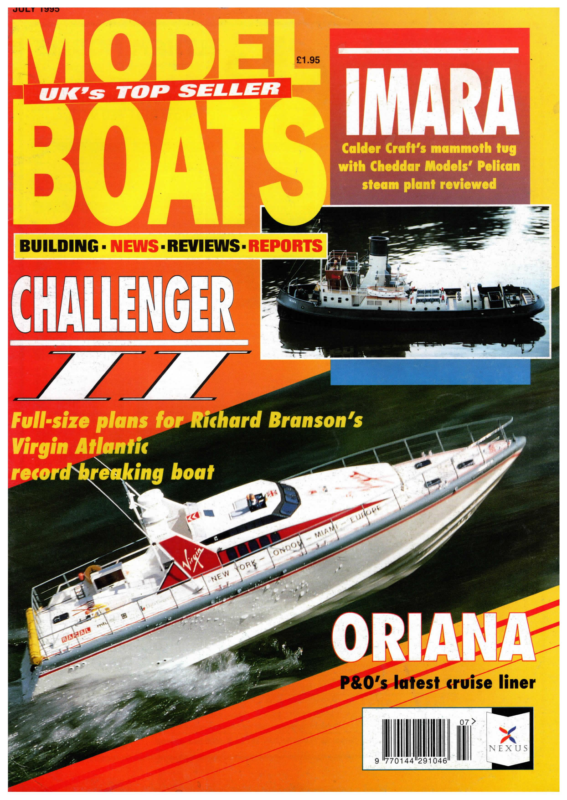
- A Day at the Lake by DAVID WIGGINS reflects on altogether gentler times. Photographs by Tim’ and Sybil Wood and Max Cockett – printed by Peter W. Roylance
- Yacht Lines by Anthony Corbett
- small YACHTS – Mike Kemp tries a bit of racing this time – minority group racing

JULT 1999 £1.95 BUILDING – P&0’s-tafest cruise liner 9 “770144°291046 | | b INEX US
reflects on altogether gentler times. Photographs by Tim’ and Sybil Wood and Max A day at the lake. All dressed up in their bank holiday ‘Sunday best’, here are members of Southend Model Yacht and Railway Club at Southchurch Park on March 26th 1948. What a contrast to today’s jeans and track-suited crowd! I don’t know what the laddie is up to but that’s no boat in the water! Shown are (front to back) Joss’ Starkey, Tim and Sybil Wood (and dog ‘chummie’!), plus Lester and Hilda Mendoza. Note that long line of bikes in the background, as the predominantly working-class residents of 40’s Southchurch enjoy a post-war Easter bank holiday springtime ‘walk in the park’ and, no doubt, enjoy the sailing regatta too. Cockett – printed by Peter W. Roylance ello readers. From last month’s look at 50’s electric power we kick-off this issue by moving a bit further back in time to the year 1948, in particular, to Good Friday, March the 26th of that year – a Bank Holiday of course – and what better excuse could a boater have to get out his boat and pop down to meet his this time at Memorial Park, Herne Bay, Kent in 1958 or so! Well, a full decade has passed since Tim’ and Sybil and friends sailed their Yachts on Southchurch Park Lake and the chaps down at Memorial Park lake – in this case at my own venue, Herne Bay, (immortalised often enough in my features for ‘Boat Essex. years), are still boating but have fellow clubsters at a rally on the local Southchurch Park in Southend-on-Sea, Collectors’ invites you to spend ‘A Day at the Lake’ with Southend Model Yacht and Railway Club back in 1948 Southend Model Power Boat Club (SMPBC) was formed as a power club that very year but these chaps (yes, and their ladies too), are not members for these are Yachtin’ folk – members of the club that broke-up shortly after SMPBC formed – the old Southend Model Yacht & Railway Club. Regular readers will know that I am no yacht fan happily admitting to not knowing the difference between a bowsprit and a poop but these pictures showa well known venue over 45 years ago. Modern Southchurch Park certainly does not look quite like it did then – a different world to be sure – and therein lies the charm of these pictures. The happy looking gaggle of boaters are Tim’ and Sybil Wood now living in Barling, Essex, Mr and Mrs Lester Mendoza, and the late Mr Joss Starkey and I’m told that Tim’s boat (seen sailing) is a ‘6 metre’. Beyond that, I shall restrict my caption comment to Here’s a fine bow-on view of Tim Wood’s lovely braine steered ‘6 metre’ class racing yacht Joyce’. Time to put down that camera and turn her around Tim old Son! Another day at the lake, the locale which I have visited and loved (‘lived at’ my late Mother used to say!), for over thirty years but now Let’s Go Power-Boating as we spend; Modeller’ and ‘Model Boats’ over the discovered the diesel engine and radio control! A major radio regatta is in progress by the looks of things and is that ‘Taps’ (Colonel H.J. Taplin) looking on? – yes, I think so, and John Taplin is also to be seen in one shot. One suspects that ‘they’ – the luminaries of the period Ivor Morgan, the Taplins, Vic’ Smeed etc. are all there on what is clearly yet another ‘Big Day’ for Herne Bay in the formative and halcyon days of R/C boating but whose is that big model? My guess is that this is one of Culver Wooley’s boats probably fitted with a 21cc Ohllson and Rice sparker but I don’t really know. I hope you enjoy these old pictures (literally dug out of the bottom of a drawer in the Wood’s case!), for which I offer my thanks to Tim’ and Sybil, to Max’ Cockett, and to Peter Roylance and – next month ? Simple as ABC – August in Collectors Corner Next time it’s back to hardware, and continuing a run of shorter features, we shall be highlighting an old ‘hybrid’ R/C system for boats manufactured by a small outfit called ‘ABC’ as well as examining a comparable outfit from the USA so do look into ‘Collectors Corner’ – Southend’s premier collectors shop for our August issue – until then, Bye! MODEL BOATS JULY 95
What a nice view of Tim’s Yacht, a sailing Galleon (look harder Blenkinsop – it is there!), and a most unconcerned looking swan just as well those noisy and new fangled ‘petrol boys’ aren’t here. For goodness sake mate, she’s nearly there and you’re still on the wrong side of the lake so get cracking! Another yachtsman is moving to recover his scale sail job so perhaps he’ll give a hand? Yet another yacht is starting offfrom the bank on the left and I wonder if the occupant of that aged perambulator is a boater now? Well, Joyce’ has arrived safely enough and is that our Tim’ looking on? – yes, I think it is – so I guess Sybil was taking the pictures all the time! This is a lovely view of the original boathouse (the present building is the third), and yes, that old shelter is still there too as the camera looks across towards Kensington Road. Just look at that crammed park bench – still there also – I’ve sat upon it many times over the last 30 odd years! MODEL BOATS JULY 95 1S
Almost a full house now, the sun’s out, the contest is ‘on’ for real at last, and a fast cruiser is racing past the judges table over on the left as a competitor concentrates hard on clearing those markers without a ‘touch’. The very latest hand-held valve radio gear – perhaps an E.D. ‘Black Arrow’ or R.E.P. outfit (January 1993 and February 1994 issues respectively), – is in use but whichever, George Honnest-Redlich (designer of both), could hardly lose. Relaxation in the sun at this Herne Bay regatta scene back in 1958. A fast noisy model is about to go on the water and there’s no need to go to work – who could ask for more? Is that a ‘Taplin-Twin’ or a Now, a full decade later, let’s hop aboard the Tilbury / Gravesend ferryin order to travel via the GANnet being started? As John Taplin (Taps elder son), is nearby Southern railway for the Kent Coast – Herne Bayin particular. Goodness, is that Colonel ‘Taps’ Taplin – one might reasonably guess at the former but when it barks into life, my hero – scanning Memorial Park lake as the first spectators start to take their deck chairs for the big we’ll know soon enough! Our apologies for the severe marking on this event – radio controlled model power-boating in the 1958 season? The first boat is on the water and it’ll super old print which was caused by a badly scratched negative. soon be a full house as always thinks Taps. Wish I was there? – you bet! Big boats and big engines are exemplified in this photograph of a model built (I think) by the late Culver Wooley. Note the very casual approach to storage and field support in the old attaché case — and cardboard box. Both are very typical of the years when a few screwdrivers, a set of cheap and cheerful ‘mag’ spanners – did they fit anything ?! – a large pair of worn-out and rusty pliers or Well, it’s time to bid our 40’s yachtsmen farewell with this lovely view of grips (a proper spanner only if you were very lucky), and a leather bootlace’ starting cord plus a Scale-Sail / 1948 style with at least four vessels on the water and yet more spot of oil and a bottle of petrol or diesel fuel were all that ‘Mr Average’ bothered to take to the on the bank – what lovely models they are too and what a strange co- lake with him. Nowadays an electric starter, a stack of large batteries to power it, and an incidence it is that our other contributor this issue, Mr Max’ Cockett ‘though elaborate Field Box’ bedecked with multiple ammeters and even digital displays is considered once a power boater, is now Secretary of the Scale Sail Association! essential – such is ‘progress’! 16 MODEL BOATS JULY 95
Yacht Lines YACHTING by Anthony Corbett Vic Bellerson’s Comic design One Metre powering to windward during the recent Scottish area ranking event. The reader should be able to just make out the leeward tell-tale streaming perfectly whilst the windward one (probably not visible in the reproduction) is just lifting. It is probably better to have the jib sheeted a little too wide than too close, so almost ideal trim at this particular moment. However the photograph also illustrates the One Metre problem, look at the size of the waves in comparison to the yacht! For best speed in these conditions the yacht needs plenty of drive (see last month’s article) to get through the waves and ideally, both tell-tales should be streaming for most of the time. Vic was doing something right though. He had a good weekend and dominated this particular race. pologies to all readers just in case the continuity between my contributions breaks down. Last month Yacht Lines continued with the second instalment of an interview with Graham Bantock. Unfortunately space prevented the inclusion of the whole piece and this will disrupt the schedule for the other articles to follow in the series. This month sees the completion of the interview with a superficial look at the 6 Metre and some facts about the man himself. And to the gentleman that YACHT LINES : Sketch 1 SAIL INDENTIFICATION made some muttering about there being a lot of information about one person and his products, this column MARKS AND TELL-TALES Tell-tales of makes every effort to impart light Figure SK1.2 ~~ Once sailing to windward, the breaking away of ass Lancashire. And all for the price of a bit of wool! I want to tell you a story……about tell- tales ……. and sail numbers. Starting with the numbers; we all realise that there are a lot of modellers out there that sail yachts built to M.Y.A. rules, without bothering to have their pride and joy either measured or registered. Whilst many of us would love to see them affiliate to the M.Y.A and enjoy the many benefits and events, one has to accept that some do not see the point and are quite happy to potter about at their local club. Measured yachts have to comply with the Sail Identification Marks rule to be awarded a valid certificate, a prerequisite for entry to the bigger regattas. Whether you measure your yacht or not, most clubs employ similar systems to help identify each member’s yacht. The size and positioning of the numerals is important, especially when the yachts are some distance away, as this can often be the only way a skipper can keep track of his boat in closequarters sailing. The use of such a system also helps identify the yachts when they are involved in incidents Talking of which, around the race course. Whilst it is not unknown for even some of the better skippers get the placing of their sail numbers wrong for all those fans of Taylor Made Boats and the Parasite One Metre in particular, news that John Taylor is off picked up by a measurer during on them! (and to filibuster unnecessarily when it is pointed out), any error should be H ag 2 oe 3¢ 4 8 the windward tell-tale can be used to information in an objective fashion. If people don’t wish to let us know about their ideas or products (including photographs. Free samples always gratefully received! Maybe I’ll start writing about wine?!), we can’t report to Gibraltar for eighteen months does not mean the demise of this particular venture. As from 1st July the business will be in the hands of Mr Derek Priestly. There was some talk recently of John developing a Six Metre design but presumably this is now on hold, however kits can still be obtained for the ‘A’, Marblehead and One Metre classes, in addition to several mouldings at reasonable prices. More information from Derek on 01253 779764 (after 6 pm) or send an SAE to 120 Abercrombie Road, Fleetwood, number to add a numeral one in the event of duplication at an event. This means that you need to and the rox. mm between the numeral 40 e—app _leav or luff. 12 – 18 mm thickness A profile shot of Nigel Gilson’s latest One metre design, with the water-line giving a good idea of the static water-line. 24 MODEL BOATS JULY 95
measurement. Such errors are not difficult to correct and avoid a lot of problems for race management and observers. This is whyI raise this point. I have now been to two events where problems have been caused by incorrectly marked boats. What was even more infuriating was that the observers/race officers ended up carrying the can for a skippers error, in one case having to back-track through all the race results to identify the correct finishing positions for two yachts sailing with the same number (one skipper having changed sails to a suit without the additional “one” required). All we skippers have to do is read the rules and even more importantly leave space for that additional one in front of the yacht’s allocated number. To help the reader sort out their boat, I have drawn Sketch 1 to help show how the system should work, however the real intention was to help explain the advantages of jib tell-tales in tuning and sailing your yacht, as this was something I skated over in my previous articles. Whether your yacht is 40 feet or 40 inches, tell-tales are probably the most cost-effective piece of tuning kit available to the racing skipper. They don’t really cost anything! On a fortyfooter, a crew will use tell-tales to help tune both the genoa and main-sail, David Cousin’s has built a sister ship (86) to Nigel’s and one can see that the yacht soon takes up it’s full water-line length once pressed. where they can act as an accurate guide in not only adjusting the camber and twist in both sails but also for the skipper helming the boat to windward. I believe that they are just as essential for a model-yacht, however I suspect that they are not of much use in setting camber or twist because they are comparatively large in proportion to a model yacht’s sail area. Tell-tales work by indicating turbulence in the air flowing over the sails of a yacht. If the air is flowing without turbulence, the tell-tales will stream in the air-current. As soon as there is any turbulence, caused by the breakdown of the air-flow on either side of the sail, the tell-tale in that turbulent air will stop streaming, breaking away Bow & transom shots showing the narrow beam, raised bow, tumble-home and deep rocker, the latter typical of the current crop of One Metres. The interesting point is that Nigel has not opted for the knuckle or deck level flange favoured by some other designs as a prevention against nose-diving. from the horizontal. Now on a large yacht’s genoa, which after all is a pretty big piece of cloth, the air-flow can actually re-attach itself soon after an area of turbulence, so the positioning, number and size of telltales is fairly important. They need to be large enough to see but light enough to lift in the slightest breeze. You do not position them right on the luff of a jib as the forestay of luff-track can often cause enough turbulence to prevent them giving any accurate guide. Further tales can be added through the camber of the sail but I would have to say from experience that it is best to keep numbers to a minimum, otherwise you can spend more time playing with the sails than steering the boat. As in all things to do with yachts, it is the right compromise that often leads to success. Anyway back to our tell-tales. Whilst I have seen some model yachts with tell-tales all over the jib and main, it is probably best to stick with one pair properly placed on the jib of each suit of sails. Position them somewhere around 20mm away from the luff and preferably in the larger lower middle of the sail, away from a seam (they will catch on the stitching). See Sketch 1. MODEL BOATS JULY 95 As referred to in the interview with Graham Bantock, once the boat is properly set-up and balanced sailing to windward, the tell-tales will give an excellent guide to the sheeting angle of the jib. With the boat sailing on a beat, aim to set the jib so that both tell-tales are streaming. If the jib is in too tight, then the leeward tell-tale will be breaking away, as the air current over the this side of the sail is unable to “attach” itself. The opposite is true if the jib is not in tight-enough. Once you have mastered this, then you will find that the tell-tales become a useful tactical guide and part of the yacht’s throttle. If all is set up well on the windward leg, and the jib’s windward tell-tale lifts, the breeze is heading and you should think about a tack. Equally if the leeward tale lifts, you’re being lifted and will probably hang on excluding any tactical considerations. Off-wind, the jib tell-tale will help in adjusting the sheeting angle of the sails. If the leeward tell-tale lifts, the sails are in too-tight and vice-versa. However, if on a reach you cannot set the jib without the main flapping, then you need to look at the geometry of the jib and main sheeting. And all for the price of a bit of wool! More Metres I am pretty sure that my friend Mike Kemp will be following up his photograph of Nigel Gilson’s latest Six Metre with a photograph of the finished yacht which was first seen sailing competitively at a recent Six Metre match race competition. Nigel’s boat was an example of all that is good about radio-controlled yacht racing. Bristling with different ideas, the yacht was almost totally designed and built by Nigel and his friends. I met Nigel for the first time at last year’s One Metre National’s where he was sailing a hull of his own design with a fair modicum of success. Not content with his assault on the Six Metre class, Nigel also appeared at Brentwood’s Coventry trophy meeting (finishing 2nd overall) with another new design which follows the trend towards minimum beam. The reader will see from the photographs that the hull has a raised bow, circular sections and even tumble-home! The yacht’s static water-line is quite short, with about 50 mm of overhang at the bow and the transom just touching the water. The water-line extends to the full-length of the hull as soon as the yacht is driving. See photographs. Whilst I am still not a great fan of the One Metre (there’s nothing wrong with it another metre wouldn’t put right!), one can’t escape the fact that the rule does, to some extent, control costs by restricting the number of rigs. It’s weight restrictions also allow the home builder to design and construct competitive yacht hulls without the need to go to the trouble of producing a mould. However it is killing off a perfectly good class like the R36R and is consistently quoted as being much cheaper than a Marblehead. I am not convinced by the argument of cost, however one has to recognise the amount of effort now focused on this particular class; so good luck to Nigel and all the others like him. Let’s hope the One Metre rule will continue to encourage them to innovate, build and develop, hopefully to the stage where they can really prove their skills in the Marblehead class! (What bias?) With all the rumblings about the cost of a competitive Marblehead, fact or fiction, I wonder whether the combined effects of an influx of competitive skippers into One Metre competition, plus the profusion of differing hull designs, will start to force some skipper’s to look for an alternative class. After all there has been a fair amount of grumbling about the 25
development of carbon-fibre fins and their performance advantage over the original and cheaper timber variety. Neither have these pages been short of a few comments about recent changes to the One Metre rule. So what could be the next step? In recent years, both the dinghy and keel-boat world have seen the development of “mass-produced” one designs. Such designs as the Sigma 33 and J-24 have sold in comparatively vast numbers, establishing large International fleets and giving some extremely close racing at reasonable cost. Anyone who has an interest in sailing could not have missed a similar approach being adopted in the dinghy world, the best known of which is of course the Laser. Recently we have also had the one design concept applied to a new breed of skiff-like dinghies, all of which have one thing in common; they are built and marketed usinga strict one design concept and rule. Over the past eighteen months, we have heard rumours of similar ideas being applied to a radio-controlled yacht however, these murmurings have not, as far as we know, evidenced themselves in the form of a finished boat. Well now we can put rumour to one side as Sails Etc. are now marketing the idea of a one-design class based on the One Metre rule and a development of last year’s World and U.K. National championship winning, Red Wine hull. Now I wouldn’t rush to get your cheque book out because the initial marketing is to potential builders but I can assure the reader that the project is well past the drawing board stage, as your scribe has seen the mould plug. The project is called Tinto (Red Wine ~ Tinto; quite clever really!) and is a development of several One Metre related projects aimed to culminate in an Iberian One Design but using the cheaper timber foils. The Tinto hull form is “similar” to the Red Wine but it does not have the curved deck edge, reverse sheer or moulded deck of it’s complicated sister. The proposed construction method of flat deck and all the internal components such as the fin box and servo trays, bonded to the hull in one unit, is a repetition of the process used on the Jazz. However, although this method is inexpensive and easy to 26 your Tinto into a Red-Wine clone and jib will vary with wind strength. It may race with the best of them in the One Metre class. What this scribe hopes is that the project avoids the pitfalls of similar fullsized designs. Here we have seen certain builders gain performance advantage by the optimisation of a particular class within construction tolerance and scantlings. This has not always been in the interests of either the owners of the class and whilst I suspect that there is not the same room for playing these games in a small radio-yacht, unless there is some rule to cover the lay-up for instance, there would be nothing to prevent a less reputable builder constructing “optimised” boats for himself and favoured clients. You might feel inclined to dismiss this as the One Metre rules do try to deal with such issues by restricting weight but let me ask, if the same product is available from a number of builders but one dominates all the racing, who are you going to buy your boat from? Anyway I am convinced that this is a be worth experimenting with the location of this tab to ensure that your Nol suit sets in all wind strengths. produce a deck mould at a later stage, presumably when the class has become established. The apparent advantage of the Tinto project is that it keeps all the good points of the One Metre rule but then goes a stage further by doing away powered. Like the One Metre, this causes broaching. The design of the rig is therefore a compromise between maximising area, lowering the C of E and keeping the boat under control. It is worth noting that the luff measurement is also taken to the intersection of the luff with the boom. This means that the use of an inverted area. such issues, I am sure it is Graham. Sails Etc., are initially marketing the Tinto to potential builders, so the information package is all about the moulds, components and finances (which for those of you jumping to the telephone will not be confirmed until the project has been properly costed!) Those interested can obtain more information from the company by telephone or fax on +44 (0) 1376 571437. The rules only allow one mast, but do not restrict the fittings. The warning…… manufacture, it is time consuming when one is in the business of building yachts. So there is a proposal to be very few variations in the rig. What are the restrictions that control the design of the rigging? In the model class the booms can go down to deck level, however the main clew has to be kept high or they would drag in the water when the boat is over- and if anyone is capable of resolving But befcre that a health the form of the Tinto? Of the few R6M’s I have actually seen in the flesh, there appear to project that will have world wide appeal Bantock, the end of Will the Red Wine provide the basis of a Rigs kicking strap (compression strut), that is one above the boom pushing down to control the leech, sacrifices some sail Volume 1! successful radio-yacht one-design class in Six Metre In last month’s article I made a reference to removing forestay tabs at the tack of a jib. Whilst I have proved to myself that the set is affected by the location of the tab (a friend and I compared two jibs by the same sailmaker with the lower tab in different locations), I have also found that there is enough tension on the foot measurement rules for the jib basically measure the triangle formed by the forestay, deck and mast. The area of the jib should therefore be maximised to fill this with the boom and foot taken down to deck level. However the head of the jib should not be taken too close to the top of the forestay as this kills performance. No closer than 150 mm to the measurement band is a good rule. The boats that I have seen have all sported the now conventional balanced boom. Are radial jib fittings prohibited? What are your views on this type of fitting as there seem to be some advantages to their use? Radial fittings are not precluded and are wonderful if they work properly. The problem is that they need to be exceedingly well engineered and very rigidly fixed in the boat, which usually increased enough to pull the forestay results in addinga lot of stiffening to the hull and deck. This, combined with the fitting itself, introduces a lot of complexity and weight (and cost!) especially in comparison with a bit of string! They also need to be carefully used and constantly re-trimmed. I believe that the maximum sail area is a function of the rule, however your boat utilises a kinked back straight, then the camber in the jib boom. What is the reason for of the jib to pull the forestay aft if the tack is just tied to the forestay. (See last month’s photograph). I assume that this is because a tie will give a point load rather than spread it like a tab or taped luff. Whilst this might not seem important, unless forestay tension is with differences in hull and fins. The kits are to be manufactured to standard patterns, which will include one-design timber fins. The class will also use any rigs permitted under the One Metre design rule, which although eminently sensible makes me question what would happen if the members of LY.R.U. – M.Y.R.D voted for a major revision to this part of the rule? (See March 1995 edition for an explanation of the workings of this body). Initially Sails Etc., are proposing to administer the Class until numbers and interest allow establishment of an Owner’s Association “capable of doing the work”, very similar to the approach adopted in the case of the Laser. We are also sure that the reader will not have missed the possible opportunity to have a dual purpose yacht, in that by simply having interchangeable fins, one could change Six Metres come in a huge variety of shapes and sizes. The wonderful planked example I think is “Flair” built in 1989 by Ken Jones to a John Lewis design. It looks even better in real life and has been on display at the Childe Beale Trust. MODEL BOATS JULY 95
Tuning In looking at the general setting up of rigs, we really didn’t go beyond putting the rig in the right place. What other factors affect the fine tune? Firstly, I would refer back to my comments about the RM rigs and the importance of the tube stiffness. This is a concept that can be applied to all rigs in that the stiffer the mast, the less you need to adjust the fine tune to suit the varying conditions. (Don’t rush out and stick a telegraph pole in your yacht and think it will now be consistently quicker than the rest. Like a car, the weight will slow the boats acceleration and reduce the top speed. It might also sink!) Sheeting angles need to be adjusted to suit the boat and conditions. I probably set the jib boom between 10 and 15 degrees and the main between 2.5 and 7.5, on reflection perhaps between 2 and 5 degrees. We have discussed twist and you This yacht had not been registered and I was unable to determine it’s history, although it is suspiciously reminiscent of the line drawings for the “Tern”. I am sure the Six Metre bunch will set me straight. less sail area. Likewise it is likely that a straightforward 5/36 scale model of a full size 6M would also get beaten by RC designs except in light airs. Correct choice of scale would be important. A final consideration is that the model rule has not kept up with windward course. Continue to twist off Is it possible to summarise the workings and the various considerations that go into the sails and sheet the booms further Generally Rigs On a more general note, the swing rig does appear to be a must for the RM class although the WALICKI rig does seem to be able to compete on equal terms in all It is interesting to note the amount of effort that has been put into developing what the “full-sized” fraternity would consider high-tech keels and ballast. this and is it something to do with gaining free area? The boom shape shortens the luff and loses sail area and neither is useful. The reason for the kink is that, if the boom is straight and close to the deck, as soon as you sheet out the boom hits the deck edge. The alternative is to have the whole boom higher which is less desirable, or to use a radial jib fitting perhaps! How many rigs or suits of sails do you have for your boat? Three. Tuning Are there any differences in the setting up of a R6M from the general procedure that you have described for setting up the 1M above? I would adopt the same approach as for the One Metre. MODEL BOATS JULY 95 One of the differences between the 6M rule and the other recognised classes in the UK, is that the 6M is the only one that is but the lightest of breezes. Swing rigs are also allowed in the 36r, 10r and A class, but I am told that in the two bigger boats, they are just not competitive. Is this true and if so why? Swing rigs are not permitted in the A Class now so this isn’t a consideration. As to the 10R, I am sure that the swing rig would have a competitive edge if more energy was put into it’s a scaled version of the full size development. One should also remember that a 10R’s sail plan is rule. Do you think that the model designs might be just as successful at full size as they are at model size static water line length. The shorter this and vice versa? If so couldn’t the MYA. and Owners Association promote the idea of building scale versions? A model design scaled up would probably get thrashed. There are two reasons for this. Firstly the modern 6M is very highly developed having benefited from a lot of very expensive tank testing. Secondly full sized Six Metres, even though designed close to the minimum beam, are very stable compared to their sail area and scaled up model versions would be significantly longer and heavier, with “power up”. Flatten the sails and allow the sails to twist off a little as soon as designs have been very successful. cannot give any more information.) one in my lounge every day, which is almost as good as my first experience of sailing it. maintain virtually the same twist in the varying wind conditions. If you’re sailing within the limits of any particular rig, the boat is undercanvassed and you can add camber to the wind increases to the extent that the boat is heeling more than 40 degrees or needs a lot of helm (more than a few degrees) to keep a good have not had the benefit of seeing it, so The Renaissance, a Bantock design and the one most favoured by the current crop of considered. Generally there is a need to adjust the kicking strap tension to amendments to the full-size version which do not allow notches within 75 mm of the static water-line. Your Renaissance and Revival designing a competitive R6M? Yes, but not in the time we have today. (I am told that Graham has produced an article on this subject for the Six Metre Owners Association but I competitive skippers. I must admit to having the pleasure of sitting and looking at this have set out some ideas that need to be much larger (the maximum sail area is a function of a rule which is focused on is, the more sail area allowed), so mast stiffness is an important factor. It’s possible that early experiments with swing rigs in the 10R class failed to give results because the design was flawed. Ian Cole won the 1988 R10R National with swing rigs and Phil Playle finished 2nd with it the following year. The No 1 rig used was built specially for the boat and below that they just used Marblehead rigs. Providing mast stiffness is sufficient and the hull has sufficiently long forward overhang to permit driving the boat hard off-wind there seems to be no problem. off the centreline as wind speed increases to maintain the ability to sail to windward with only a few degrees of helm until it is clear that a lower rig is called for. As far as waves are concerned, ripples are big waves to a One Metre so one applies the same rules as for big yachts – flat water, flat sails, little twist; “big” waves, full sails and more twist. How long have you been involved with model yachts? Since I was about 5 or 6. What provoked your initial interest? My parents bought me a toy Star Yacht when we were on holiday in Walton on the Naze. I built my first ‘class’ yacht, an own design 30” Restricted, when I was twelve years old and was always to be found in my father’s shed thereafter. Later I discovered that the 30” Restricted class was not quite as active as its larger brother. Were you interested in full size sailing before model yachting? Do you sail full size? My interest in model yachting was not provoked by sailing full-sized. I have crewed big boats occasionally and sailed in a Lark whilst | was at university, howeverI find it difficult to understand putting all that effort into getting cold and wet! Choose three of the biggest changes you have seen in the sport of radio yachting since you first became interested. Not in any particular order, I would firstly pick the introduction of carbonfibre in hulls, fins and rigs. This has allowed dramatic reductions in overall weight at the same time as increasing strength and stiffness. The commercial side of the sport has also developed dramatically. If one goes back to 1983, Squire Kay and Oliver Lee were the only ones providing 27
competitive model yachting goods. There are now far more sources of well built and technically developed products. Finally the increasing reliability and sophistication of the boats themselves and their equipment, as well as the improved standards of the participants’ skills and, consequently, the racing. You have been involved in the administration of model yachting for sometime and have only recently stepped down from your position as Technical Secretary to the MYA. What do you feel has been your major contribution to the sport? a Some would say stepping down! Within the MYA I think I am most happy with the contribution made to improving the documentation of our hobby at all levels from sailing instructions, class rules, officers’ terms of reference, etc through to the constitution. Most of the credit for this goes to Ian Taylor who has put in an amazing amount of work and without whose help and enthusiasm it would not have been possible. At MYRD level I am simply carrying on where the previous Chairman of the Technical Committee left off, principally routine maintenance of the class rules. It seems to me that you have attracted undue criticism to yourself because you have derived a living from a business serving the sport, whilst at the same time being involved in the sport’s administration . My next question is not one where you are asked to defend this position as I do not believe that one is necessary. Commercial interests are involved in all aspects of sport and it is not beyond the membership of any organisation to prevent it being bent to commercial pressures. My interest is more with how you perceive commercial interest affecting development. Is it fair to say that a commercial enterprise can spend more on developing new designs or ideas than any other model yacht skipper? However, I can see that with the sport still perceived as perhaps an esoteric sport, there is not an enormous market for a product and the life of say a moulding, might be quite long if you wish to achieve a reasonable return. Does that therefore restrict the incentive to develop new designs because of the associated production costs? What is your own major motivation in developing new designs? This is a big question to which there is simply no simple yes or no answer. If I put time into developing a “Gizmo” then I’m not earning any money and therefore can’t pay the bills. The selling price of the ‘Gizmo’ covers the cost of its production but usually not the cost of its development. In some way the amateur skipper has an advantage as the sport is a spare time activity to him and he can dedicate such time as is available to developing an idea without loss of income. Whilst some of our company’s products have been developed from my ideas where I have been seeking a solution to a particular problem or a performance advantage, these would usually be difficult to justify on a ase commercial basis. What some people do not appreciate is that our business is not huge. It employs only three full 28 This photograph is included to illustrate the additional rigging that some feel is necessary to support the more flexible aluminium tube. The rig is held up with an additional set of lower shrouds that go up to beneath the spreader position. time staff and therefore has neither the time of financial resources to put into significant research or development. It would, in fact, be difficult to justify the cost of some of our tooling if it wasn’t for my desire to compete at a high level. An example of this is our new One Metre, RED WINE, which was time consuming to develop and is costly to build because of its complicated design. The royalty element of its price will never pay for the cost of producing the design, plug and mould; this is also true of less complex, more popular, designs. As to motivation, it would be misleading if I did not admit to the feeling of achievement in winning big events like the ‘94 One Metre World Championship. There is no point in bringing out a new design unless it is faster than the old one, because it is no fun for me to sail a slow boat. There is certainly no commercial benefit. For us each mould is a major investment in terms of time and money and is not something we can embark on lightly. Finally, as someone new to the sport, it looks like you have achieved everything that anyone could wish for. You have won the RM World Championship twice. A nicely made radial jib fitting installed on the bow of “Flair”. The disadvantage of this fitting on a Six is that it digs in to the area of the jib, however it is easier to use this type of arrangement on the bigger yachts as the all up weight of the fitting and substructure is a small percentage of the overall displacement. You have won the RM title several times since 1987 (race officer in 1988) and won last year’s inaugural 1M World Championship against some of the very best. What challenges are left? I haven’t won the R36R National Championship! (For the benefit of the reader I should point out that your scribe has, although I’d be the first to admit that GB and others weren’t there.) It would also be interesting to have a go at the R10R and RA Class world titles next time. At the end of it all, I suppose I just want to continue to enjoy my work and play with model yachts. I would once again like to take this final opportunity to express my thanks to Graham who not only gave up a considerable amount of his time to the construction of this article but has shared many of his “secrets” without fear or favour. A very simple and effective gooseneck and luff adjustment. “Flair” is close to being a work of art. MODEL BOATS JULY 95
RADIO YACHTING small YACHTS _ J-Sann 6, Nigel Gilson’s new Six Metre was planked in lime by Jack day. During the Milton Keynes match race meeting it received a T-bone collision and suffered only minor damage. Jack has always said lime was more resilient than cedar. _s. Aust Consulting Li * Meds enrpisgust MIKE KEMP tries a bit of racing this time – minority group racing I t has long been my aim to take another look at multihulls in this column. A long-felt interest in these slightly odd-ball craft was renewed last year when the British Model Multihull Association brought their racing circus to our lake in Milton Keynes. This year, in April, a small group came back for another meeting that gave me another chance to have a closer look and, thanks to Andy McCulloch the Association Chairman, I even had an opportunity to race one. Andy was unable to come along to the regatta as he was preparing for an even more imminent testing time so he sent along his yacht, ‘Express Train’, with permission for me to have a go. The yachts competing all fit the ‘rule’ that is likely to become the international standard for ‘small multihulls’ and is known as the Mini 40 Class. The BMMA is currently working along with the FFV to crystallise an international set of rules for the class: completion, I have heard, is not far off. So what is a Mini 40? It is a multihull development Remote Control Class. The intention of the rule is to provide the designer and builder with the freedom of design and construction, within the scope of the rules, to build competitive multihulls within certain measurement limitations. These are a maximum overall length of 1220 mm; a maximum width (beam) of 1220 mm, and carrying a maximum sail area of 0.9 square metres. The rule states that anything not specifically prohibited is permitted; it also states that boat decoration is allowed and may The three hull set for Mongoose 4 available from Anthony Wright. £75 will get you a set like this. It is claimed they are strong enough to stand on. They are certainly very light. 54 nited [221 ~e My yacht for the day, Express Train – Andy McCulloch’s trimaran spent most ofthe day on two of its three hulls. be derived from ‘real’ multihulls. Presumably the models are ‘unreal’! Any kind of multihull is allowed, although the rule actually defines several specific types. There are ways defined in which multiple sets of floats can be controlled. This conjures up pictures of skippers arriving at the waterside, studying the conditions and deciding to use the ‘B’ floats today: although we used the ‘A’ floats last week. Much as some of us do with sail rigs: yet another variable for the development skipper to play with could be interesting! The maximum dimensions have to be checked across the extreme ends and width with the yacht being held so that they are measured as parallel to the water-line as possible. In a way, checking one of these beasts must a bit like fitting a 36R in its box although all it has to do is fall through a large square frame with both the frame and the hull being held parallel to the water-line. Interestingly, compared to just about every other class of Model Racing Yacht, these yachts are allowed to have both fixed and moveable ballast. That ballast may even be changed during a race or series of races: now that is something different! Of course no ballast may be of a greater density than lead (see elsewhere) and any liquid ballast must be fresh water or water drawn from the sailing area – should be interesting at Fleetwood! The sail rigs are controlled a little more closely than the hulls and appendages and in a way that I assume allows considerable freedom in sail shape while trying very hard to stop any attempts to gain extra, unmeasured, area over and above the rule limit. As multihulls have traditionally tended toward wing masts etc. the spars are measured if they get above a certain average width: thus the rule would let experimenters try out some of these more ‘exotic’ forms of wind propulsion. I wonder how they would measure a kite type rig? Current yachts have a wide variety of construction forms, from moulded hulls through balsa planking to even stranger methods of construction. There are moulded hulls available from some sources, the latest in the UK being Peter Wiles who has glass fibre hull sets for the Trimaran ‘Freight Train’ for sale at about £132.00 and Apollo Boat Services who have glass fibre hull sets for sale at £75.00. The latter are to the Mark Beighton ‘Mongoose IV’ design and include an equipment tray moulded into the main hull. Although many will undoubtedly purchase these as complete sets they are actually sold at the rate of £25 per hull so two could be acquired for a catamaran. For details of the ‘Freight Train’ mouldings contact Peter Wiles at 1 Courtenay Road, Poole, Dorset, BH14 OHD, Tel 01202-744101: for details of the ‘Mongoose IV’ hulls contact Anthony Wright at 14 Lindridge Close, Winyates Green, Redditch, Worcestershire, B98 0QJ, Tel. 01527528352. Other hulls have been available from the continent for some years and have been used successfully although design forms have advanced considerably over the past year or so. To those of us who dabbled in model aircraft in the past the construction of multihull floats, and even the main hull, MODEL BOATS JULY 95
Andy Little’s White Light trimaran actually seems to sail like a cat as that centre pod, which carries all the ‘works’, including that intriguing rudder with its almost universal foil, hardly touches the water. The outer hulls each have a step, like a powered hydro. contain carbon elements but can be made of a similar mix of material to the rest of the yacht. How many of these craft are there? The BMMA membership is currently a shade over thirty with a number of active yachts in the mid-twenties and they have a series running through 1995, a bit like the match race series. There are eight regattas spread throughout the year with the best four counting towards the National Championship. Over on the other side of the world (where else?) in New Zealand there is an embryo Mini 40 fleet of about eight with one of them even being an old One Metre which has been converted to a catamaran by adding a considerable amount of fresh air between the left and right hand halves! Now there’s another thought! Another New Zealander has been actively developing a foil supported catamaran – apparently it goes well in a breeze and in a straight line although it has some serious problems tacking Will they catch on? I have no doubt that they already have. Unfortunately, at the moment there appears to be a minor rift between the BMMA and the MYA: whyI cannot imagine. These are serious model yachtsmen just as much as anyone who sails a 36R or a 10 Rater, MODEL BOATS JULY 95 they should be brought ‘into the fold’. The Milton Keynes, Two Islands round of the Multihull series saw only three of the association arrive with their yachts although several others came to watch and support. A ‘committee’ decision settled on a triangle and sausage course around our existing marks although the usual match racing start was widened a bit: at least with multihulls it is easy to judge the required length of the line – you just line up the fleet side by side and plant the start marks at either end. The whole fleet was put on the water for each race with races back to back and a break between each pair. At least that was the intention but with the tendency of these yachts to trip over their leeward float the early part of the meeting saw considerable rowing to retrieve yachts who had succumbed to a ‘premature termination of racing attitude’ the BMMA term for falling over. The first race winner was Andy Little who travelled all the way from Penzance for this meeting and who went on to take second place overall with his ‘White Light’. It was a pity that a few more from somewhat nearer didn’t come along for a sail in the sunshine. James Ellison, the BMMA secretary also came from the deep South West – Liskeard in Cornwall – to have a slightly less than successful day when he suffered terminal radio on his failure ‘G.FI.’ during the afternoon. Chris Neale came from Great Leighs, near Chelmsford to sail his scale model of a Tornado catamaran ‘Banana Bunch’ with considerable success: far more than is usually the case with a scale model. James brought along Andy McCulloch’s yacht for me to sail: it proved to be a successful partnership: I suspect that the others are so used to seeing Andy’s yacht in front that they have been brainwashed into thinking that is where it should be: either that or they were being particularly kind to their guest competitor. ‘Express Train’ certainly has a fair turn of speed when its sails are set into the correct shape: unfortunately I could not always get the number 2 mainsail to tack correctly when the wind went light during the later afternoon. I know I should have changed up but felt that playing safe was a better option while the wind still had any gusts left. The acceleration of these yachts has to be experienced to be believed. In one race I came off the line to leeward of Andy’s ‘White light’ and fully expected to find myself really disadvantaged when we arrived at the windward mark. Suddenly my yacht got a lift and just shot away from its sheltered position to arrive at the windward mark several lengths ahead. Never have I found my race position so dramatically improved as with that little puff. In a similar way however I have rarely found myself so subjected to ‘going backwards’ througha fleet as whenI got a tack wrong and literally went backwards, sideways, and in fact any way but forwards for so long that a significant lead vanished. My only comfort was that I was not alone; at one time or another all the others suffered a similar fate: it must be a trait of the class. Racing these yachts is fun: it also calls for more concentration than many put into sailing a monohull: you cannot afford to relax for a moment, particularly when there is anything like a real breeze. Take your mind off the yacht for a moment and you are likely to find yourself with a premature termination of racing attitude. Alternatively your yacht will have stopped and the others have streaked by: these multihulls seem to have just about zero momentum, certainly compared to a Radio 6 Metre. Among the things you cannot easily do include: going head to wind to ‘shoot’ a mark, pinching up to cross the finish line ahead of a near competitor, rely on port tack crossing ahead of an incoming starboard tacker or doing a last minute tack to get into a lee-bow position. I tried them all and failed miserably: at least I found that ‘Express Train’ can execute a penalty turn reasonably quickly. It also doesn’t pay to try and shave a mark too closely; get if even marginally wrong and you have straddled the thing with two thirds of the boat on one side and one third tantalisingly hooked over the mark – unless you are sailing a Cat -the proportions are different but the dilemma is the same: they are moving and you are not! Throughout the ten races there were two winners, but Andy Little only ever occupied first or second: the rest of us all gained at least one third or fourth place; still we 55 [SS Ses has much in common with the balsa plank around cut out bulkhead type of fuselage. The largest forces appear to be reserved for the cross beams, particularly now that yachts are being built to the very edge of the width ‘envelope’. Cross beams frequently
Chris Neale’s scale Tornado catamaran Banana Bunch has retracting dagger boards they are spring loaded to stay down. It would be more stable with its beam increased to the maximum permitted by the rule. The float on top of the mast stops the yacht capsizing. had one discard so we could throw it away. I hope that we can see more of these yachts: the dedication of their protagonists deserves success, so does the efficiency of the BMMA committee organisation. If you want any more information about joining this growing and merry bunch contact James Ellison, Hon. Sec. BMMA, Pyramid House, 1 Jubilee Road, Pennsilva, Liskeard, Cornwall, PL14 5QL: the latest newsletter is a good example of the type. If you fancy seeing these yachts, or even having a go with your own, the next in the series will be at Yeovil on the 7th May, at Poole on the 17 June (Saturday) – both of these before you read this – and Salford Quays on 16th July. Match Racing latest Milton Keynes Sunday 2nd April saw the 6 Metre Match Racing circus move to the Two Islands Club in Milton Keynes for round two of the Marine Modelling Match Race Series. Sixteen yachts arrived on a bright and sunny morning which belied the chill of spring. Unfortunately the racing group was reduced to fifteen almost instantly as Lee Valley skipper Chris Isham went to extract ‘Rigel’, his quick Dolphin, from his car. That ever vulnerable component of a*model boat, the rudder, lost an unequal battle with a bit of the car and broke. Understandably Chris didn’t hang around for long after making his apologies to the rest of the fleet, he returned home to effect repairs in time for the next round at his home water at the end of the month. With an uneven number of entries we were down to seven matches per round with one skipper having a ‘rest’ each time. It looked as if we might be reduced further when ‘string failure’ struck Paddy Chambers during preparation for his first match of the day. Feverish work and a slight Ist 2nd 3rd 4th 56 Skipper Mike Kemp Andy Little Chris Neale James Ellison running order saw Paddy back in action to take his first win against Tony Riley. The opening match was due to feature Chris and local skipper John Daines; John took his ‘rest’ early and it was left to Anthony Corbett and myself to lead the way for in excess of one hundred starts which had to be packed in during the day. Having managed to trap Anthony into a penalty worthy incident during the countdown I was presented with a moderate lead which I succeeded in maintaining around the course. This nearly was blown away on the second beat as J set about tacking and covering on the way to the original windward mark instead of the proper target. Fortunately Anthony almost fell into the same trap and the opening presented to him to take the shorter route to the proper mark failed to materialise. Match number five saw the debut of Nigel Gilson’s new 6 Metre for 1995. ‘JSann 6’ is a lightweight yacht and takes a few penalties to arrive at a sail area comparable to the Renaissance on a Yacht Express Train. White Light BananaBunch G.FI. performance although Dave was complaining of difficulty turning the rejigging of the second and third round Multihulls in Milton Keynes – Result | Place David Cousins and exhibited similar Total Score 12 14 33 ros James Ellison’s G.F-I. showing its blue foam outer hulls joined together by ply skinned crossbeams with a foam core. smaller and lighter hull. As a result it was seen to have very good acceleration when the ‘puffs’ arrive but lacks the stiffness seen on some of the other yachts in the class. In fact there were times when it demonstrated a tendency to become just a little unstable when over pressed off the wind. Jack Day’s hull construction has resulted in an attractive looking yacht, particularly when matched to Nigel’s home built composite construction sails. In its trim as used at this meeting the yacht was blindingly quick downwind in a moderate gust but, I suspect from Nigel’s view, a little less than satisfactory when going to windward. Those of us matched against this latest six to hit the water were happy to take advantage of its shortcomings: in the back of our minds there is the thought that they are unlikely to last. The second of the yachts built to the ‘Dann 4’ design was in the hands of yacht during later stages of the event. Another yacht making its competitive debut was the ‘Sylph’ design in the hands of its builder Jack Day. This yacht has already gone through a period of development and is more competitive than its lowly finishing position suggests: Jack was sailing in the meeting as his first match race session for a long time and showed that he is a little rusty. He also suffered some gear failure later in the meeting which meant that he had to retire during the early afternoon. As the squad moved on to the second of the six regatta series sailing skills are rapidly being brushed up and yacht states of tune being tidied up. This means that competitiveness is moving up a notch and finishes are getting closer – not to mention the starts. Somewhere along the line, with only two yachts racing each other at a time, someone has to win and someone has to lose. The results after each meeting belie what is happening, but some skippers are noticeably getting better: one of these is Mike Robinson who acquired one of the present day 6 Metre legends from Brian Corley ‘Rival’, Alan Bright’s original heavy Revival. When Brian took over this Graham Bantock designed yacht from Alan he almost completely refitted it with many of his own, model engineer built, fittings and shaved off some excess weight to end up with a sprightly very competitive yacht which caused the downfall of many a match racer. Mike is now beginning to learn how to bring out the best of this boat and claiming more and more wins. Another fast yacht, I suspect underrated by many, is ‘Aquarius’ – Roy Whale’s John Lewis Tern. Roy only lost five of his races on Furzton Lake, four of them to Renaissance ‘mounted’ MODEL BOATS JULY 95
Marine Modelling Match Race Series – Two Islands Top Five Place 1st 2nd 3rd 4th Skipper Club Mike Kemp _— Anthony Corbett Two Islands Guildford John Daines Charles Chambers 5th Two Islands Two Islands Roy Whale Bournville Valley club water at the end of April. Will the wind conditions live up to their usual performance at this pond in the middle of a park? Or will we have to worry about carrying our little suits over from the car park? Report next not-too-distant future. skippers; the fifth was to another Tern in the hands of Brian Decker. Roy has been making a name for himself in an unassuming manner which his competitors ignore at their peril: that Tern is quick on most points of sailing and Roy is proving that he has the skills to put it in the right place during a race. Brian Decker’s ‘Red Star’ is the Tern with which 6mOA secretary, Mike Wareham, rose to fame. Like ‘Aquarius’ this is a yacht that should not be ignored. The latest new face to join the ranks of the Match racers is Peter Cousins, Dave’s brother, who has taken over Dave’s old yacht ‘Etive’ – yet another John Lewis design, this is a Petrel which has proved to be competitive. We had the feeling that Dave was wishing at times that he had control of it as he struggled through the development process witlf his new Gilson design. Among the leaders of the meeting the top four were all sailing time. Renaissance designs, two carbon and two glass. Anthony Corbett continued his short lived Radio Match Racing the way the league results appear. Although Guildford and Chelmsford still hold sway at the top of the Club Championship a long time winner of myself. Two Islands Club Chairman, — Charles Chambers, sailed his black the championship has moved into the frame. Woodspring are preparing to glass Renaissance into fourth place after a particularly successful day which ended in a tie with Roy Whale which went in Charles’ favour as he won the match between them. I had my most successful day for a long time, with a complete set of wins, when I finally got my new Bantock sails to work properly and returned ‘Red Dwarf’ to a level of performance close to that I remember having with its original Dennis Lippett sails. The next round sees the troupe trek trek across the grass?) to the Lee Tern Total Score 28 Aquarius 23 Top Five Radio Individuals Skipper Score 1st Mark Dennis 62.2 2nd David Taylor 61.4 D Maple 60.2 Keith Skipper 56.8 Nick Weall 5th 99.9 Top Five Radio Clubs Club Guildford 1st Score 466.7 2nd Chelmsford 3rd Woodspring 4th 5th Swanley Bournville 356.35 204.8 1923 161 meeting at Sedgemoor. With results More match racing from Lee Valley and the first of the major radio Nationals will have taken place. a a like this Mr Maple could find himself in contention at the end of the season; although, of course, the ‘big guns’ have yet to wind up their performances at the various Nationals. Yes, 1995 could be a bumper season for the MYA Radio League. a i ee | Please quote subscription number if renewing/extending nefit from your magazine with a ; Special Subscription Rates 1 Year (14 issues for the price of 12!!!) | U.K Europe & Eire Sterling O/Seas U.S. $ O/Seas subscription. Not only will you be able toenjoy the ; £23.40 £30.70 £31.90 $50.00 luxury of having your favourite magazine delivered to i! enclose my cheque/M.O. for £……cc000.:. your door, if you subscribe now you will receive two imade payable to Nexus or debit my Access/Visa: 1 WOOO O00) OO) oo Take advantage of this special give away now! ALIA ither send off the coupon or order now on:01858 435344 a : __ ee CE ee cc. Pe a ae lines open: 9.00am – 6.30pm.) (Enquiries: 01858 435322). MODEL BOATS JULY 95 Ewe Us aw Me 016 680) 6’sEis bin GEG ps ‘w\nie’oewiaiele’s.o.m oie o’-u.alae eb ne POSUOIOG: hoc eccsseimtoichcdan. AIOE Please post this coupon with Nexus Subscription Department, ;! ac corti at ga piyour iatayment eeto:hint renin peel: vel LE16 9EF. Please tick this box if you do not wish to receive information from any other companies which may be of I interest to you. 0 L.. This offer must close on: 8/9/95 (MBO9) ea LEB SERA ‘C.0 00:42 e WS TO i’s £040 e4\0 «8:0 C6 C1010 © 018 a 25 23 Next Time a | ZY ‘Vie Clementine mount their challenge and Bournville have now appeared in the top five. In the individual League Championship the top five have all changed over the last couple of months. Four of the top five are ‘old hands’ from previous years but holding third place is a new name on the scene for ‘95; D. Maple from the Solent Club took fourth place in his first event at the Original Vulturesoft Trophy meeting at Lee Valley. These points from a reasonably sized meeting were doubled up to join another fourth place result at the Wessex Trophy across the long grass; (or is it the long Renaissance Renaissance 3rd Following an early season of little to report the Spring 1995 results have been arriving to have their influence on craft into third place losing only to Nigel Gilson, Anthony Corbett, and Red Dwarf Mr Plod 4th League career with an almost complete set of wins, losing only to myself. John Daines piloted his Dark Lilac coloured Name Renaissance Renaissance oe Tess, Jack Day’s Sylph ‘motoring’ along at the Two Islands’ match race meeting. Subsequent piloting of this yacht has convinced me that it will be ‘one to beat’ in the Design yi