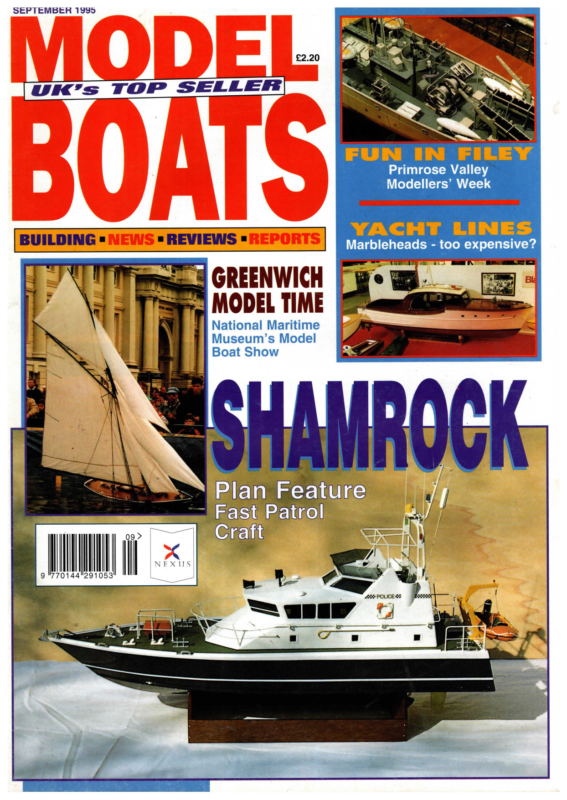
- Tom’s Legacy by RICHARD WEBB describes the restoration of a family model
- small YACHTS – It’s racing and reading this time: not necessarily at the same time though! Says Mike Kemp
- Yacht Lines by Anthony Corbett ANTHONY CORBETT on Marbleheads- is the class dramatically more expensive than others?

SEPTEMBER 1995 £2.20 UK’s TOP SELLER FUN IN FILEY Primrose Valley Modellers’ Week BUILDING = YACHT LINES Marbleheads – too expensive? “REVIEWS = A | National Maritime Museum’s Model Boat Show a 09> |<. NEXUS : —= UE - be A POLICES?
READER’S MODEL boats. His main theme is to restore what you have and not to replace and rebuild. So with this in mind I stripped off the deck fittings that seemed out of character, rubbed down the deck and filled the screw holes with plastic wood. I used wet n’ dry used wet with a bit of soap to remove the lumpy Dulux but I was careful not to go through the original paint. I sealed the deck with a couple of coats of satin Ronseal varnish and gave the hull a couple of coats of Humbrol Gloss White with a light rub down between coats. I am pleased with the deck and it looks right. The hull is not perfectly smooth but it looks a lot better than whenI first saw it. The sails arrived in a large round cardboard rube and they are perfect and beautifully made. Peter has used cream coloured material and they look in keeping with the type of yacht. I made the mast from 15mm ramin dowel and tapered the top half with a hand plane and finished with emery cloth. The booms are 12mm dowel. I stained the mast and booms with Burmese Teak Colron wood stain and gave them two coats of Ronseal Satin RICHARD WEBB describes the restoration of a Varnish. I made the gooseneck fitting family model in brass. Mrs Hooper had told me she hoped her grandchildren would use the boat so I had decided to use modern rotproof rigging and sail material. I interest I volunteered. With a phone call a visit was e lifeblood of any successful model club is to have a steady influx of new members, and the best way of attracting members is to hold exhibitions and gain local newspaper publicity. And so it was last summer when the Eastleigh model boat club held their 10th anniversary exhibition at Ocean Village Southampton. The Southern Evening Echo covered the exhibition with a large photo of three club members and a selection of models all standing in front of the Calshot Lightship, which is the focal point of Ocean Village. About half a dozen new members joined the club and the secretary received a letter asking for advice about restoring an old pond yacht which the lady explained was a family heirloom. Now we don’t have any vintage yacht fans in the club so with my scale sail 36 arranged to see Mrs Hooper. On calling I was shown the boat which, I guess, must have been made in the late 1920’s or early 30’s. It was well made from one piece of wood, carved to shape and hollowed out inside; the deck was 1/8in sheet wood not ply and marked neatly to depict planking. I think the boat was built by someone who knewa fair amount about sailing as she looked right and is certainly worth restoring. The hull is 36ins long and the keel is 10ins deep. The mast and sails had been lost many years ago. Mrs Hooper, who is now retired, explained that the boat had always been in the family and she hoped to pass it on to her grandchildren. I don’t think the boat had been a class yacht but it certainly had been made to sail properly. Sometime in its mid-life the boat had been worked on and given a thick and lumpy coat of Dulux door paint and several out of scale fittings had been added, some of which were broken. Mrs Hooper and I decided on a game plan. We needed advice about a sail plan and mast height so we contacted Peter Wiles of JP Sails. Mrs Hooper took the hull down to Peter for him to measure up for the sails. I then brought the hull wondered about the standing rigging and decided it probably would have been chord and bowsies with brass hooks, so I bought a packet of bowsies and used Dacron chord for all the standing and running rigging. The jib boom attachment is more 1 Metre than vintage but I hope it is reliable and allows the boat to sail well. The main and jib sheets are Dacron with bowsies for adjustment. The main sheet is clipped on to a reverse tiller. The latter has an elastic bank fixed to a hook near the stern. The way it works is the harder the wind pulls on the main sheet the more it pulls the rudder over to keep the boat from coming up into the wind. The tiller arm has a number of holes so that the pull can be adjusted and the elastic bands can be increased or decreased in strength. This method of sail and rudder control takes some setting up but with practice will allow the boat to hold a fair course. I was pleased with the restoration work; the boat looks right and should give enjoyment for many years to come. I was able to deliver it to Mrs Hooper just before Christmas so she could show it to her family over the holiday period. We made plans to go to the pond for on-the-water trials but that will be when the weather is much warmer. Tom’s Legacy well that is the name home and prepared the overhaul. I must admit I put the hull in my shed and looked at it for a couple of months before starting work. My excuse was I Mrs Hooper has decided to call the yacht. I discovered Tom Burgess was Mrs Hooper’s Uncle and he died during was thinking! I dug out some old World War II, leaving many fine Model Boats books and re-read Russell Potts’ articles on restoring vintage models, but this yacht is the only one still in the family. MODEL BOATS SEPTEMBER 95
RADIO YACHTING Left: ‘A’ fleet start at the Midland Champs. Photo: Glynn Guest. | K T e are over halfway through the League season and no one obvious winner has yet emerged; the championships are starting to roll by, and we have a quiet read to improve our skills. ’ current MYA Radio League positions both Club and Individual. The top four clubs have retained their relative positions with some adjustments to the points which means that things are getting tighter at the top. Meanwhile Leicestershire and the Edinbur gh club have squeezed in ahead of Market Bosworth and the ‘heavyweights’ of previous years, Birkenhead, have made their entrance are producing a much closer competition than before. In the individual competition there has not been too much change, except in points scored and one or two positional changes though previous League Champion Brian Wiles has suddenly popped into the middle of the top ten while Scotsman Robert Brown is less than three points outside the top three. Roger Stollery drops out of the top ten, just half of one point behind Keith Skipper. ; same time though! Says Mike Kemp : Top Ten Radio Clubs Club Ist 2nd 3rd 4th 5th 6th 7th 8th wings ustousid with 198 e points Gaceions | St, are being aslisdMalltiib-wey ia which the 10th League is run but at the moment it looks as if the decisions taken at the 1994 MYA AGM Fi time: not necessarily at the League The district championships and the Radio Marblehead and R36R National Championships have had their effect on the : It’s racing and reading this Guildford Chelmsford Woodspring Bournville Leicestershire Edinburgh Market Bosworth Sedgemoor Sole Birkenhead Score 807.4 722.6 630.9 363.3 336.8 303.5 296.7 278.7 e e cen ee cted 242.7 | National Championsh ip Top Ten Radio Individuals Skipper Score 1st Anthony Corbett 2nd 3rd Ath 5th 6th 7th 8th Gordon Sears Mark Dennis Robert Brown Chris Harris Brian Wiles Graham Bantock Nick Weall 9th R Rowan 10th Keith Skipper Fj 147.5 142.4 130.8 128.9 122.3 120.9 112.6 108.2 105.9 100 J 7 The latest class to be under threat from falling numbers celebrated its 1995 National Championship in the heart of ‘English Civil War Country’. Indeed there were celebrations related to that campaign going on around them over the weekend of 21st/22nd May. Sadly only thirteen skippers were drawn to the smaller of the lakes in the Market Bosworth Water Trust in Leicestershire to do battle under the control ey Ald akon damp at the Midland District Champs at Stoke on Trent; | to r, Mike Harris, ?, Peter Salt and Gordon Sears. Photo: Glynn Guest. of Race Officer Gordon Sears. Saturday saw the yachts sailing in a wind which swept straight up and down the lake Far left: No. 121 Chris Harris leads, the eventual winner at the Midland District One Metre Champs. Photo: Glynn Guest. Left: Peter Salt sailing a Bubbles has finally caught the radio bug again at The Midland Champs. Photo: Glynn Guest. MODEL BOATS SEPTEMBER 95 95
Right: The John Lewis design Mehala was commissioned by Alan Bright. This 31.5 pound 6 Metre has a ballast which weighs as much as my Renaissance. The rating rule is such that its performance is very similar. Far right: A smartly turned out 6 Metre skipper, John Daines and his sweater - complete with king-sized 6MOA logo on the Front. Right: Red Dwarf (65) closely followed by Lady Luck (70) on the off- were trying to get whatever advantage they could. Anthony had followed one or two wind leg. At this others and increased sail when it appeared that the wind was dropping: most of the moment I’m just hoping others, however, were sailing with ‘conventional’ rigs which are a little more forgiving in these marginal conditions. Bob's that the wind doesn’t drop. The Revival is deadly in the light airs. Mehala (50) is in a solid sailing during the middle of Sunday reduced his score to 33.7 points, not quite good enough to take the title away from Anthony. In third place was first day leader Chris Harris with 35.8 points and in fourth was Richard Aucott with the same score: it was necessary to count back through first, second and third places to separate these two. Less than two and a half points covering different match. aise Te aeaaie the first four would seem a pretty accurate definition of a close finish for a championship - — oe cae of nineteen races. sailing just behind the leaders and was 3.6 points ahead of Bob Iles who had an up and down sort of a day to finish with 25 points despite a couple of wins. On Sunday the wind was a little less cooperative having swung around to come from the ‘island’ end of the lake and with less force; although it became a bit gusty later in the day. This gave Gordon a few headaches as he tried to give the skippers a decent course. Ultimately they were sailing a diagonal course with a longish beat, followed by a long very broad reach, a rather short equally broad reach back to the start line. Another beat followed with a run and another beat. Because of the swinging wind the beats were rather lopsided especially the last, which most were achieving in one starboard tack after a short port tack from the leeward mark. The course meant that the fleet stayed reasonably close together during their last few races which kept excitement high during the latter stages of the championship - which was indeed an exciting affair. Bob Iles got Above: Paul Heys proceeds to persuade me to take a penalty for being on port tack in the wrong place - in front of his yacht for the weekend, Lady Luck, as we start a match. 56 making Gordon's job of setting a course fairly easy and allowing racing to be carried out at a steady pace. With the entry split into two groups one seeding race was run for each heat; Mike Rollason and Roy Burgess missed out on these and immediately collected a DNS/DNF score. Roy got into the action with race two but Mike was unable to arrive until Sunday by which time he had amassed eight sets of fourteen points to sit firmly in thirteenth place. The two seeding heats were won by Chris Harris and Anthony Corbett respectively. The remaining Saturday races first places were shared between these two, Bob Iles and Richard Aucott. Chris had a particularly successful first day to be in first place on 13.1 points with Richard in second with 14.4 - each after one discard. In third place was Anthony who had been steadily into a ‘groove’ which saw him win no fewer than five of the ten races completed on the second day; unfortunately Bob was still picking up some relatively high scores from the middle of the A heat. Meanwhile Chris Harris had dropped the level of his racing a bit, only winning one of the second day races and collecting one second place with the remainder being third place or lower. Richard Aucott, meanwhile, was having a similar day; managing to pull out a win in the last race of the competition. Anthony Corbett won the other three races of Sunday, collected three second places, one third, two fifths and threw away his eighth place in race 16. Adding this performance to his first day score gave Anthony a grand total, after three discards, of 33.5 points. Anthony also treated us to some wonderful demonstrations of what can happen to an over canvassed swing rig. His yacht’s slow motion capsizes and even slower motion recoveries caused some excitement during the final races when all Among the other ‘achievements’ of the meeting was the completion of no fewer than thirty one heats (in nineteen races!) by Roy Burgess and Simon Pope; Dave Mann was close behind these two with thirty starts. Some ‘tiggering’ indeed! These skippers, at the very least, got their money’s worth of sailing even if they did manage to get through a lot of battery packs. At the end of the meeting Gordon conducted an impromptu survey of the entry to determine that just about all were keen to return in 1996 to take part in the Championship. In addition the Race Officer, Gordon Sears, was saying he wants to sail next year and there is news of several new boats being designed by skippers who have not been seen in this competition for a while or even not at all. It seems very likely therefore that the 1996 event will see an even bigger entry, let us hope so and that this particularly British yacht class will not disappear. It does havea lot going for it as a design class, with a relatively simple measurement formula - if the hull fits in ‘the box’ and the whole yacht complete with its heaviest rig, and spinnaker if carried, weighs less than 12lbs. (5.45 Kgs) it is acceptable. The ‘box in question is literally that: a rectangular box of internal dimensions 36” (914mm) long by Yins (229mm) wide and 1lins (279mm) deep into which the hull complete with keel and rudder, but devoid of rigging, must fit. The only other stipulations are that the keel must touch the bottom of the box and the rudder must be fitted but may be rotated: the hull can be tilted to enable it to fit. There are only five prohibitions written into the rule, centreboards, moveable keels or trim-tabs, masts or spars other than of wood or metal, more than two channels of radio control, and spinnakers on radio controlled yachts. Considerable freedom of construction is permitted, yet with some material restrictions which can help to keep down the cost. Its only drawback would seem to be one of its strengths, the very limited draught MODEL BOATS SEPTEMBER 95
Pd allowing it to sail in almost any ‘puddle’ significantly reduces stability compared with the marginally bigger rival, the One Metre. Thus a racing 36 inch Restricted probably needs more sail rigs than the One Metre is allowed to cope with the varying wind strengths. However swing rigs are permitted on a 36R and help to cut down time spent on rig changing: the fact that Carbon Masts are * prohibited helps to keep down the cost of all Top five at the R36R Nationals Place Skipper Club 1st Anthony Corbett Guildford 2nd Bob Iles Pembrokeshire 3rd Chris Harris Bournville 4th Richard Aucott Woodspring 5th Dave Mann Market Bosworth Design Taxachun Deception Deduction Deduction Pronto Mk.II Designer Alex Austin Alex Austin Alex Austin Alex Austin Oliver Lee Total Score 33.5 oat. 35.8 35.8 Fie these rigs. The 36 inch Restricted class is a peculiarly British yacht, or perhaps I should say Model Yachting Association yacht. Despite the onslaught of the One Metre class it has a lot going for it, being able to sail in just about any old pond - even a reasonably deep puddle! It is still being evolved by way of minor revisions to the rule as we were recently informed by an MYA acquaint. The rule is essentially very simple with an absolute enveloping boundary within which almost anything of a monohull form is permitted. Over the years there have been proposals over the years to introduce composite materials for masts which have been opposed with great vigour. Indeed I have a vivid recollection of my very first MYA Annual General Meeting, with Norman Hatfield in the chair, where the 36R rule was debated at great length. One of the arguments for composite masts was that some ‘cheap’ mast materials included redundant fishing rods: imagine what we would now be seeing on 36Rs had the rule been amended to permit ‘redundant fishing rods’ - umpteen metre roach poles. Such proposals have been vehemently resisted through the years with the result that, although many consider that 36 Restricted racing needs more sail rigs than most others, those rigs are potentially fairly inexpensive. There are tales of new designs emerging from the work areas of the ‘famous’ in readiness for 1996 so there would appear to be life in the old class yet. There is also talk of something else that could, like the 6 metre, help the salvation; an owner’s association. Whilst there is not yet a clear focus for interest in such an organisation I have even heard my colleague scribe Anthony Corbett claiming an interest in one, so perhaps in his ‘official role’ as MYA Publicity Officer he might welcome voices of interest. ‘Mehala’ returns (or two days of Match Racing) One damp Saturday morning in June a small group of Radio 6 metre skippers gathered alongside the lake of the Cotswold Sailing Club for the start of the 6 metre Owner’s Association Match Racing Championship. Competing for a trophy named in memory of Roger Neeve, one of the founders of the modern era of the 6 metre yacht racing, we were gathered at the club that formed his base. With an entry of just ten skippers, this year’s event was to see a rapid rotation of heats with only five matches in each board. As the last to arrive my entry number was 10 which meant that I was to be the ‘anchor’ yacht around which all the others would rotate. There is an advantage to this position in that my match would be the first in each board and thus somewhat predictable in its timing. There was also a disadvantage, my match in each board would be the trail blazer whenever a course was set or changed. After the briefing, which was to have a much more significant effect on the overall memory of the meeting than we all realised, Mike Robinson and I took to the water to fight our way around the first of 135 match races. The course was a big one which gave plenty of scope for attacking sailing and dogged defensive tactics and avoided the prospect of a win at the start guaranteeing a race win. This match eventually turned my way and I notched up my first win of the weekend with some considerable relief because Mike’s ‘Rival’ yacht to the Revival design is a known good performer. Looking down the list of entries convinced me that no race was going to be won easily during this weekend. Some of the newer recruits to the Match Racing circuit joined in the mirth directed at Alan Bright's yacht ‘Mehala’; a relative heavyweight with lots of sail designed by John Lewis. They soon realised that the descriptions of ‘Tug’ and ‘Thames Barge’ directed at this yacht which carries a ballast weight as heavy as some complete six metres and heavier than others bore little relationship to its sailing performance. Noone who beat Alan during a match did so easily and only managed to do so in seven out of his twenty seven races. My second meeting with Alan produced one of the closest races I had during the whole weekend with the first off-wind leg seeing me having to resort to some very heavy defending and both of us taking a very ‘offcourse’ route to the leeward mark. Alan caused a few upsets by taking wins off three of the ‘Renaissance gang’ Mike Wareham, John Daines, and Charles Chambers (two out of three in each case): the only nonRenaissance equipped skipper to beat Alan was Paul Heys who managed to get Jack Day’s Revival ‘Lady Luck’ home ahead in their last meeting. ‘Mehala’ is back with a vengeance! For consistent close battling over the whole course one would have to go a long way to beat Mike Wareham and myself. With ‘Black Adder’ and ‘Red Dwarf’ performing at MODEL BOATS SEPTEMBER 95 almost identical speeds our races were incident laden: the first saw Mike collect two penalties for not being in the correct position during the pre-start countdown check points. Trying desperately to even up the situation Mike managed to catch me as windward yacht as we set off for the start line: the one penalty turn difference was sufficient to ensure that I could cover Mike for the whole of the race and we finished with just about the same distance between us. In the second race Mike managed to get ahead but, crucially, to leeward of my yacht as we set off on a long starboard tack roughly in the direction of the second windward mark. I was not sure how I was going to prevent Mike from sailing away on this leg until his nerve cracked and he felt the urge to tack onto Port to head for the mark, my yacht was further to windward than we both realised and Black Adder failed to cross ahead of the ‘Red one’. Result, a penalty turn for Mike and my opportunity to get far enough ahead to cover for the rest of the race. Our third meeting saw me forced into a penalty for a windward/leeward collision shortly after the start: the tables were turned. I was not sure how I was going to overcome this situation until we happened upon another pair approaching the windward mark as we came into it for the second time. Charles Chambers managed to catch both his opponent, Tony Riley, and Mike on Port tack as they sailed into the mark. The resulting penalty turn gave me sufficient time to get the ‘Red Dwarf’ bow ahead as we reached off to the ‘wing’ mark. A second contact between Mike and Charles gave me even more time to break away to complete the hat-trick; overall a very testing and nerve jangling time. Saturday remained fairly damp although it didn’t rain all the time: we wrapped up the sailing at about 4:00 pm giving those of us staying in the area plenty of time to seek out our lodgings and unwind in the early evening, which had magically become sunny and quite pleasant. This pleasant weather continued the following morning and the whole of the second day of racing was conducted in bright conditions: a lot brighter than we realised - there were quite a few red faces the following Monday as the sun’s effects emerged. A ten o’clock start saw the beginning of another board approximately half way through the second round robin; I managed to record another win and so began a gradual Above left: A cheery Mike Wareham, secretary of the 6M Owner’s Association, collects the runner’s up award from Race Officer Brian Decker. Above: Tony Riley shows the value of one of those balls on the end of his transmitter aerial as he makes some last minute adjustment Paul Heys hides me from view as we battle out one of our close matches. Paul is a big lad who claimed that he kept falling over Alan Bright - who isn’t! ey
of us would be seeing Brian for two or three years because he is to be posted overseas for a while by his employer - look out Cyprus. We don’t yet know where the circus will recelebrate our remembrance of Roger Neeve next year but the suggestion, directed at some of our shorter sailing colleagues, that a minimum height limit for skippers should be imposed, to be overcome by high heeled wellies or an attached pole with a flag on top shows that his sense of fun lives on! Midland District One Metre Championship It has become the norm over the past few years for the major MYA district championships to be conducted on the same day. This practice started some years ago when the Radio Marblehead District Top six at 6 Metre Owner’s Association Match Race Championship Place 1st 2nd 3rd 4th 5th 6th Skipper Mike Kemp Mike Wareham Alan Bright John Daines Paul Heys Charles Chambers Club Two Islands Cotswold Bournville Two Islands Two Islands Design Renaissance Renaissance Mehala Renaissance Revival Renaissance \/l9 nae alt} Top: 6M Owner's Association Match Race Championship - the contenders, minus two. Mike Wareham was getting a speech ready, Alan Bright was hiding. From the left, Jim MacDonald, Mike Robinson, Tony Riley, Paul Heys, Yours Truly, Denis Bret, John Daines and Charles Chambers. Above: MYA R36R National Championship. Deduction leads Taxachun. Defending Champion Anthony Corbett chases challenger Richard Aucott during the latter stages of the regatta. gradually improving record over the weekend. Saturday evening had seen some remedial work carried out on the rigging of ‘Lady Luck’, temporarily in the hands of 6mOA Registrar Paul Heys. Paul had been having a relatively unsuccessful sailing session on Saturday: the change in the rigging and the slightly lighter winds of Sunday saw the sort of performance some of us have come to expect from this yacht which is soon to change hands permanently. After only two wins on Day one Paul notched up nine wins on Sunday including two against Jim Macdonald whose Petrel ‘No Name’ is another yacht which is a lot more competitive than first glances would suggest. Paul also gave me one of my closer races on Sunday. I suspect the yacht’s Sunday performance whetted one or two appetites to become the new owner of ‘Lady Luck’: the Revival design has always been a competitive yacht in the right hands and this one is among the quickest - a yacht to be feared in light wind conditions and to be careful of in others. for a starboard end Sunday sawa flurry of protest committee activity, a rather unusual function at 6mOA events. This came about, I believe, as a rather literal translation of the Race Officer’s start while Anthony words at our initial briefing where we were Right: At the R36R Champs, the bunch go Corbett tries the port end with Taxachun - he didn’t cross them. 58 increase in the pressure through the day as I became a ‘marked man’ as skipper after skipper tried to wreck “Red Dwarf’s” reminded that non-sailing skippers would be expected to observe the activities of those competing. Unfortunately we were subjected to the worst side of something that some tried to enforce on the Radio Sailing world a few years ago - passive observing. Skippers Name Red Dwarf Black Adder Mehala Vie Lady Luck Clementine Total Score 54 49 47 43 38 38 found themselves being protested for alleged offences without any warning that they were considered, by the on-shore skipper(s), to have committed some misdemeanour. In some cases these were for pre-start situations when the protester was not in full knowledge of which ‘side’ a skipper should be entering from or at what time the ‘entry’ took place. Careful reading of the rules being applied later showed that most of these protests were erroneous and should not have even been considered by a committee. Unfortunately they brought an unsavoury taste to what was otherwise an excellent two days of sailing during which every one scored at least one victory: even Denis Bret sailing his yellow ex-Nigel Gilson modified ‘Force Six’ yacht now named “Charlotte II”. Denis has yet to discover the full potential of this Adrian Brewer designed yacht which used to be the scourge of the six metre circuit in Nigel’s hands; something which many of us have good reason to be quietly thankful for at the moment. Denis had the misfortune to drop the yacht as he retrieved it up the sloping and lumpy bank rather than lift it out via the jetty. The crack as the carbon rudder shaft broke was heard all along the bank and I am sure that Denis felt that was to be the end of his sailing for the weekend. Feverish activity during the Sunday lunch break saw some suitable material found, together with relevant tools, to insert a steel tube into the broken carbon tube. Quick acting glue was applied and the whole re-assembled to put Denis back on the water to catch up a couple of races that had been missed immediately following the accident. This reflected the friendlier side of Match Racing that generally prevails despite the close and very competitive racing. When the points were totalled it was revealed that placings were pretty close although there were only two skippers tied on points, Paul Heys and Charles Chambers both with thirty eight points. Paul gained the decision because he triumphed in two of their three matches. Mike Wareham gained a total of 49 points, losing only to Alan Bright (twice) and in all three of our matches: Alan brought “Mehala” into third place with 47 points some ‘Tug’! Another Renaissance, the deep lilac coloured craft of John Daines took fourth place with 43 points. At the prize giving kind words were said by all to our Race Officer for the weekend, Brian Decker, as this could be last time many Championships were all ending up in the hands of a select few who were trundling around the country showing their superiority. In an effort to curtail these ‘pot-hunters’ Council decreed that, henceforth, all RM. District Championships would take place on the same day; usually around the end of June. As the One Metre grew in interest the annual calendar became more and more packed with events so, by general agreement, the One Metre District Championships also gravitated to one day in the year. In 1995, however, that symmetry was broken by a protective swan! The scheduled event date of May 14th tied in nicely with the hatching time of a pair of swans nesting on Smith Pool in Mount Pleasant Park, Fenton, Staffs. This lake is considered to be home by the Staffs and Cheshire Model Yacht Club; a home that the swans were not prepared to share! Those of us model boaters who have had, or seen, a close encounter of the swan kind will be only too well aware that these birds are not to be trifled with so the host club for this event went looking for an alternative venue at the last minute. In an effort to retain the local nature of this event so as to make the most of any publicity for the ‘local’ club they wanted to find a lake nearby. The alternative was the home water of the Potteries Model Boat Club at Westport Lake: much to the frustration of the model yachters this is the smaller of two lakes on the site and Race Officer Simon Cornes was faced with a less than ideal wind direction. To avoid clashes with other events, including a scale meeting organised by the PMBC the regatta was postponed for two weeks which brought it to the end of May Bank Holiday and the inevitable weather conditions. Wind, blustery and variable which was OK, and rain, at times torrential which was not! The twenty one entries arriving for competition were split into two heats and quickly settled into EORS and fought their way througha total of twelve races, with about fifteen minutes per heat. Because of the layout of the lake, its island, and the wind direction there was only a sho MODEL BOATS SEPTEMBER 9:
beat from the start followed by a reaching and running course - well suited to the faster yachts although I suspect that the wind swirling around the island made some parts of the starboard rounding course pretty interesting! No one skipper appeared to domina te the proceedings and nobody stayed in single figures. Mike Weeks from the Leicest ershire club emerged as leader at the end of the day with a total of 23.4 points with Gordo n Sears from Market Bosworth less than four points behind; Bournville’s Peter Moore took third place with thirty two points. That club’s hero Chris Harris who has featured in these columns before and who took the Northern District Championship a fortnight before could only manage to scrape into seventh place overall. Because of the rain there were The fall and rise of Taxachun. Anthony Corbett found out that very few spectators in what is normally a very public place which was expected to raise considerable publicity for the sport in when a R36R with a big swing rig on gets knocked down it stays general and the Staffs & Chesh ire club in particular. However Carl Evans Platt, Deputy Director of Leisure and Recreation for the City of Stoke-on-Trent, came along to present the prizes and spent quite a lot of the day watching the antics of the Radio Sailors. With the venue creating a good impres sion on the skippers and they creating a good impression on Mr Evans Platt we might be seeing some down...and down... as Anthony waits in the background, blue jacket -..@nd down... until, eventually it comes up to sail on again and more Radio Yachting activit ies in the park in take the championship by a narrow margin. the future - perhaps on the larger and potentially more suitable adjacent lake. Another visitor to the park for his first taste of Radio Yacht Racing was fellow occasional columnist Glynn Guest who also happened to have his camera handy to produ ce a few pictures: something which is tricky to do these days when you are either officiating or competing in the hectic operat ions of EORS. Book review During those lazy windless summe r days that are fast slipping by and into the Autumn which is fast approaching as you study this many turn to a book to while away the hours. What could fire up the Radio Racer’ s imagination better than a book on tactics? Part of the Sail To Win series by Fernhurst Books ‘Tactics’ by Rodney Pattis son was originally published in 1983. In the second edition published in 1992 the topics covered have been extended to include five new chapters. Racing near the shore and Yacht racing with electronics are unlike ly to be of particular use to the Radio Sailor. On the other hand Off-wind starts, Team racing, and particularly Match Racing all contain material that could be quite appropriate to our racing ‘in miniature’. Much of the origina l book which remains basically the same also contains material of use to our end of the racing spectrum. The race is taken apart by Rodney and studied section by section to consider what might be the tactics and options available at each stage. One of the few original sections which stil] have little to offer the radio racer are the sections on the Gate Start and Sailing in a tide. As far as I know the last time a gate start was used in a major Radio event, and possibly the first time, was in a Mickey Finn Nation al Championship at Dovecote lake some years ago. If the water is big enough , the wind awkward enough and the fleet large enough a gate start might be worth trying again but until then.... The author, Rodney Pattisson, certainly has an impressive background from which to draw for his advice. Two Olymp ic Golds and One silver in the Flying Dutch man class plus three World and four European Championships will do for a start. Add to that world championships in Cadet dinghies and Quarter-ton keelboats and close involvement in racing 12 Metres and he would seem to someone worth ‘listening’ to. In the latest version of his book he draws in assistance “from Lawrie Smith “one of the greatest helmsmen in the world” for the match racing Top five at Midland District 1 Metre Champs Place Skipper 1st Mike Weeks 2nd 3rd 4th 5th Gordon Sears Peter Moore Mike Harris Andy Kissick Club Leicestershire Market Bosworth Bournville Bournville Fleetwood Total Score 23.4 27. 32 42.1 44.4 section. Unfortunately such is progress in the world of rule development that the book makes the odd reference to rules which are by now out of date: but the basic sailing principles behind them remain as valid now as when they were first written . The match racing chapter is a very neat and concise description of the key elements of what goes on during such a meeting between two evenly matched racing yachts. It is such that it might almost be considered a mandatory part of the Radio Match Racer’s tool kit. Don’t all rush out and buy this book or my work in the Match Racing Series will be even harder than it currently is! One or two of the tactics described may have to be revised slightly to adapt to the latest versions of the rules and the way in which things are done with Radio yachts but overall it is well worth reading. This latest comment just about sums up the whole book of ninety four pages thick with pictures and diagrams: I bought the original many years ago and have enjoyed my session studying this latest edition. At £9.95 it forms an excellent easily read reference for newcomers and ‘expert s’ alike in radio sailing who want to expan d their options for racing improvement. I have seen the Sail to Win series of books on the shelves of the high street book shops as well as in my local dinghy chandlery so you should be able to get hold of it easily. If not, Fernhurst books are based at 33 Grand Parade , Brighton, East Sussex, BN2 2QA. Happy reading! Next time At least one more ranking race will have passed, the sixes will have been to Scotland to thrash out the Nationals and there will be more from the league and elsewhere. MODEL BOATS At the R36R Champs, formation port and starboard tacking. Dave Mann’s Oliver Lee Pronto leads the fleet in @ tacking duel away from one of the last starts of the second day. Dave eventually took 5th place behind Richard Aucott (second in this picture). SEPTEMBER 95 59
by Anthony Corbett ANTHONY CORBETT on Marbleheads- is the class dramatically more expensive than others? Development of the Marblehead within the U.K seems to have settled into some easily defined schools of thought. Generally hull forms are now pretty thin, light and in design terms, unstable. simplisticly the obvious differentiation between the current crop is whether the boats have a flared bow (to delay or prevent nose-diving) or are fair like the Paradox. So far, no U.K designer has followed the French path that you will see illustrated elsewhere. Here we see a collective of the most competitive U.K designs. The narrow fair hulls of the Paradox (77 & 47) to leeward ofa Whisper (61). Both are from the board of Bantock. Vilamoura marina in Portugal was the location and backdrop for the 1995 L¥.R.U - M.Y.R.D European Championship which attracted 64 skippers representing 13 countries. nen a <= 2 [= I said I was going to write about moulding your own fins and yes, I did promise but....... with the Radio Marblehead European Championship held in Vilamoura just a week before the UK Nationals in Drumpellier, I think now is the time to take a serious look at this class. Also, as I’m currently in the process of seeing how much I need to add to my collection of coppers for the new RM So I might as well let you, the reader, share in the assimilation of the information on which any of us might base a decision. Anyway, there’s been far to much talk about One Metres recently! Marbleheads I find it strange that even though I am a great fan of this im 62 The prominent bow and turtle-back of the Roar Edge have for some years now appeared at the front of the RM fleet. These yachts are now available commercially class, I have really had most fun sailing a One and Six Metre this season. This is probably because having sold my boat, I have remained undecided about what to replace it with and of course, there is always the question of cost. One has to accept that the current crop of model yacht skippers are turning to the One Metre and there is a lot of talk about the cost of a competitive RM. But I’ve often felt that a lot of this was, well how can I put it? ..... frankly garbage. (Oops, there goes my place on Council). Of course you can put together an One Metre for peanuts and can spend a fortune on a Marblehead but it seems that people rarely question the real differences. Both classes are made up of basically the same bits; electrics, The Stark (22) is best described as canoe shaped without the same amount of rocker as some of the other designs. But it does incorporate the bow flare similar to the Edge. MODEL BOATS SEPTEMBER 95
This all leads me to suggest that perhaps it is not so much that you have to have a moulded hull, as that peoples attitudes and skill levels are changing? If what I hear from manufacturers is indicative of general trends, then people are preferring to buy complete boats rather than kits. So the trend to moulded hulls may be distorted by a change in the participants approach to the sport and even the modelling hobby in general. Results in the Marblehead actually demonstrate that you do not have to have the resources of Sails etc. to own, design or win in This Whisper (61) is an evolution of the Wafer/Paradox. The aft chines have been rounded off and the bow-raised with perhaps a touch more rocker in the forward sections. Other than that, it is as close to a Paradox as you can get. the Marblehead class. Proof of this is that the Roar Edge is very much an amateur (only in the literal sense and not in quality) effort, designed, moulded and built by Roger Stollery. Although a one-off, or two-off actually, the Blade by Chris Dicks is also another home designed and built project, using Sails etc fins and GB displaying the latest in sartorial elegance for the International rc-yachter! Firstly it has to be said that Chris Dicks may not rank amongst us six footers but neither is he just over 50” or his RM oversized. rigs. Where the class really does differ from others is in the number of rigs needed for competition. I suppose we also can’t ignore their size and construction as here again, carbon-fibre tubes proliferate. But again, like the yachts themselves, a lot of the costs arise because the rigs are nowadays bought from manufacturers. Even here, prices vary wildly. In amongst this article, I will try to take a rather general look at these variations and from the Europeans, try to The Blade (33) seems to have been impressive straight out of the box. Shame you can't get one! fins, hull, rigs. If you’re looking at moulded boats, then I am not convinced that the time investment is significantly different and this perhaps highlights the first major difference. Because of the weight restrictions it is possible to plank rather than mould a competitive One Metre. This raises the learn a little about what is in my opinion, the best of the radiocontrolled yacht classes. The Blade is thin and from visual inspection seems to have it’s centre of buoyancy / rocker further aft than other designs. RM Europeans Vilamoura The event itself might not have gone quite as planned but as a location, I am told it had much to commend it. Sunshine was one of the major ingredients, especially when compared with the lack of it at the Nationals in Scotland a week later. question of time investment. If you are going to build at home, then you might well cost your time at zero, whilst someone producing a moulding tends to charge. It is here that the costs can vary almost as much as the quality! The next question I asked myself is, do RM’s have to be moulded? If race results are anything to go by, then the answer has to be yes. But I then wondered how many planked boats do well in the One Metre class and whilst I haven’t done an objective analysis, from memory I would say that most skippers use moulded hulls. The difference is that there are a lot of skippers such as Chris and Mark Dicks who have had great success with planked prototypes. MODEL BOATS SEPTEMBER 95 Competitors said that the control area at Vilamour a was a little too cramped but I don’t know whether it was that (or someone a lot bigger than him) that pushed GB to the back of the pack. He can just be made out peering from beneath his sombrero. Bow on illustrates the flare in the hull. The photograph reminds me ofa photograph of the Stark that I published some months ago. 63
= — The Merge & a Paul Lucas design and is Szveured by several of the top French skippers. ome of whom finished fourth at the Vilamoura event. From this shot one cam see that 57 uses a one piece yard on the ng which almost seals the gap between the rig and hull when sheeted in. The hull is moulded in a carbon/Kevlar mix. Taking a plunge, this photograph illustrates how easily the high deck camber of the Margo sheds water. The result of a collaboration between We can see how much effort has been Australia and Germany, Walicki put into reducing the weight of even the appeared with a new boat that although boom sections. Quite a lot of rocker as narrower than the Skalpel, retains well. enough beam to support his favoured style of conventional rig. The Berlioz design of Torvald Klem does The Berlioz has a swing rig for top suit not appear as narrow as current U.K and seven conventional rigs which I can designs. I’ve seen a finished hull which only describe as Walicki in style. Ifyou has pronounced U-shape sections. The look carefully, one can just make out that picture here illustrates that Torvald is the rig incorporates a trim on the foot of continuing with the elliptical shaped fins, the main and this may well be replicated examples of which look just as nice in the on the jib. The yacht uses two winches for flesh. controlling the conventional rigs but I The 1995 European Championship’s ran from the 14th to 19th May and were held within the marina at Vilamoura. As with all good championships, “the wind doesn’t normally come from this direction” was the cry of the race organisers. However in this instance it apparently resulted in a less than satisfactory event, with reaching starts and pile ups that would have embarrassed most banger racers. I am also told that it was difficult to lay a good start line within sight of the control position, which in itself was too restrictive. Having said that, it is interesting to note that the same old faces ended up on the top of the pile, probably by avoiding the pile everyone else seemed to get into. Other’s will be writing about the event in detail, so I do not intend to try to give a running commentary on the races. What I 64 cannot confirm how the top rig works. Lots of mast bend though (See other picture). will do, aided by Keith Skipper and Graham Bantock, is have a look at the results of a survey of the yachts to try and pick up on any trends in this class. I will support this with some pictures of the more interesting yachts. So let’s have a look at some facts. Sixty fours skippers actually competed in the event, representing 13 countries. Hardly a class in decline! Forty four skippers completed a simple questionnaire about their yachts, not a bad sample, which asked about the design of the entry, type and number of rigs, fin length and weight, number of radio channels and type of winch. (Vested interest?!) There were a few notable exceptions from the survey. Whether this can be put down to Collisions and entanglements were the order of the day at Vilamoura. See text. paranoia, commercial interests or simply not getting the form I don’t know but I was surprised not to see a single response from the French participants, none of whom seem to have any particular axe to grind. What could be gleaned from the survey in general terms was that Whirlwind winches were fitted to the majority of the yachts. Advert over, the exceptions were some of the Skalpels supplied by Walicki, who appears to make his own winch. There were also three yachts using a Graupner Regatta winch, which I have no knowledge of. Most seem to have settled on two channel control for winch and rudder, although there were a number sailing with three channels. In these cases the additional control was either used MODEL BOATS SEPTEMBER 95
to adjust sail camber or in the case of the Skalpels, camber, slot and leech tensions all in one go through the ingenious syst ems Janusz Walicki has develope d for his yachts. The lightest ballast was fitted to a Croation yacht of whic h I have very little knowledge. I am told new boat designed by Paul that the Italian team also had Robinson and sailed by Walic ki had five channels, adding control some very light yachts with some fairly deep fins and may be this is reflected in the fact that the on backstay tension to the typical list for the Walicki rig. Torv ald Klem sailing his own Berli oz design had four channels as he highest placed Italian boat also had the largest number of rigs. used a winch for both main and jib plus a devise for controll ing leech tension. As to keel length and ballast, it was not clear on the questionnaire as to whether the leng th was to be measured between hull and average length works out as 493mm with a minimu m of 445 mm (17.5ins) and a max imum of 958 mm (21.97ins). The average ballast weighs in at 3.78 kg (8.33 Ibs) with a minimum of 3.20 kg (7.05 Ibs) and a maximum of 5.80 kg (12.79 Ibs) ! To get any real idea of trend s, other than the general sugg estion that displacement is redu cing, one probably needs a control. As Sails etc do not suffer the same paranoia as some of their competitors, I can quot e the statistics with some certa inty. Overall draft of the Para dox is 580 mm (22.83ins); hull draft is 58 mm and the ballast is 55 mm diameter at it’s maximum. This give s a fin length of 467 mm onto whic h is hunga ballast of 3.60 kg (7.94 Ibs). As an aside the target weight for a fin is 180 grams (6.35 ozs). It is interesting to note that the quoted weight for a Roar Edge’s ballast is 3.29 kg (7.25 Ibs) set on a fin of some 530 mm deep (including ballast) which suggests to me that the Edge and Paradox are not too far apart in overall draft. The reduced weight (if this is correct as I thought the standard arrangement for UK conditions was an 8lb ballast) might go someway to expl aining the Edge’s down-wind stre ngth (see previous articles for the other factors) and the Paradox’ s advantages to windward. Add to this the fact that the new Blad e lesign seems to be blistering ly under license, by Walicki. It has a declared ballast of 3.80 kg anda fin length of 480 mm. One entry sailing a twin to the ballast, or overall from hull to bottom of ballast, | suspect that the responses actually consi st of both, with a few quoting what I hope to be the overall lengt h of the hull! For those interested , the Australia and built, pres umably Nine swing rigs in total! This brings me neatly to the rigs and back to my diatr ibe on the cost of Marbleheads. Analysing the survey seem s to suggest that the average number of rigs is just over five per yacht. Most sport a mix of rigs with notable exceptions such as our Italian friend and the Wali cki style rigged boats with seven I couldn't resist including a pho tograph of the smile on Keith Skippers face when he eventually won an ‘A’ fleet race. conventional rigs. We know that the common mix in the UK is now one or two max. area swing rigs plus three or four shroudless conventional rigs of differing luff lengths and sizes. This gives a common total of about five rigs, although the Roar Edge is actually designed with four to the Stollery patt ern (plus a fifth for Fleetwood and Plymouth!). The exception to this at Vilamoura was Torvald Klem ’s new design which carr ied one swing rig and five conventi onal rigs, very similar to the Wali cki style and seen on some Southern hemisphere 10 Rater’s. Looking at the results was also interesting, although I suspect most people know that Graham Bantock has now added the Marblehead European Championship title to the rest of his accolades. But it wasn ’t as clear cut as it might seem. The first three positions went to Graham, Chris Dicks and Janusz Walicki in that order and these skippers were well clear of fourth placed Remi Brés with, or without discards. The interesting bit is that Chris had the lowest total score and next was Janusz, but Graham took the title having discarded 55 point s, almost twice as much as Chris who discarded a total of 28. From Blowing, blowing .... gone. Drump ellier exposed the RM hot-sh ots to some very demanding conditions and ..... Space allowing ....... I have some shots that help illustrate the difference betwe en flare and fair, 95 and 08 are both Paradox’s. 22 is a Shaft. 95 seemed to avoid the wipe-out but I suspect that this was quick to windward and carri es a vallast of 3.90 kg (8.60 Ibs) and it ul starts to get interestin g. The heaviest ballasts all seemed o be recorded by the Skalp els Ithough even these varie d. The ghtest appears to be Janu sz’s old oat now owned by Nick Weal. anusz sailed a new boat at ‘ilamoura, although it is actu ally esigned by Paul Robinson of ODEL BOATS SEPTEM BER 95 65
the results it looks as if GB had a bad spell fighting his way out of B heat, a problem with the MYRD International system. Chris and Janusz were never as consistent as GB in the A heat. As to the event itself, I have heard very mixed reports. The race organisers managed to get twenty races completed during what was in effect only four days of sailing. However the problems with wind and start lines were made worse by (and perhaps it has been suggested contributed to?) something close to 130 protests lodged with the LY.R.U jury. Although I am afraid that this part of my article is now based on hearsay rather than clear facts, I am told that the majority of protests were for redress. I suspect that this problem is somewhat magnified in that using the International system, a skipper is only demoted and promoted to the next heat after the completion of a race, unlike E.O.R.S with it’s system of promotion during a race. Apparently redress in this system also allows for the award of position rather than points, a fact that if correct, staggers me as awarding redress to one wronged competitor may well prejudice another who has sailed the course without infringing a rule. That isn’t equitable and makes me wonder how long MYRD can continue to cling onto such a system when the solution might well rest with the adoption of E.O.R.S. Now I know the phone will be ringing as soon as this appears on the press with protests to the effect that racing grinds to a halt as soon as there is a protest using E.O.R.S . But is the alternative any better? The Equal Opportunity Racing System is now in use throughout the UK and it is also common in New Zealand and South Africa. At the risk of compounding my sacrilege, I question whether the International system has that much support? Anyway this is for wiser men than me to decide. What one can conclude is that it probably didn’t affect the final result. The top three were clear winners of the major places and Blade (66) against Edge (17) . Again I wanted to include this sequence as even though 17 is not quite in focus, one can see the effect of both yacht’s flare on the bow wave. Whilst 17 did actually sail right through 66, I think with the benefit of photographs, 66 might well have been sailing by the lee. While the yacht did not actually submerge, perhaps because of the hull shape, it did actually slow, the rest of A better shot of the Roar Edge deck flare and raised bow in action. the sequence showing another yacht sailing past. MODEL BOATS SEPTEMBER 95
The fact that there were so many Paradox’s is not surprising given Graham’s success with the boat over the past three years and the fact that Sails etc have sold over 100 of the hulls world wide. I also feel that this reinforces my suggestion that there is a strong trend towards skippers purchasing completed or manufactured products. The Whisper was also well represented, which again isn’t surprising as Performance Model Good old GB wins again but this time by a convincing margin. Yachts are based in Scotland. We might also have seen more Roar Edges if the hull had been more widely available before this year. As far as I know there are no plans to market the Blade design unless someone manages to twist Chris’s arm. ° As far as the Stark is concerned, this continues to be an unknown quantity with Martin Roberts having varying degrees of success. It certainly seems to have potential but all the reasonably good designs have their moments when sailed by the better skippers. Nick Weall and his Skalpel (a mid 80’s design) are a good illustration of this. To conclude ..... Like many others I am conscious of the money that I need to invest in a competitive RM. This actually seems to be true for all re-yachts, mainly TM everyone else said that they really enjoyed themselves, which after all, is the real objective. Amazing the difference some sun makes .... Which wasn’t the case when the circus reappeared in the Drumpellier Country Park for the Radio Marblehead British Championships over the weekend of 27th, 28th and 29th May. And this was a shame really as the team from Drumpellier Model Yacht Club had gone to a lot of effort to make sure that the competitors got the very best sailing. Not only was the event to be run well but the generous support of the local authority through the Monklands Festival, allowed the organisers to provide marquees and barriers that helped give the event the right impression. The army also tipped up and built a marvellous launching platform away from the gently sloping Loch banks, so all was well founded, except ...... well I am sure you can guess, “The wind doesn’t normally come from this direction”! Having said that, the race management team lead by Robert Brown coped well to ensure that generally the competitors got fair and demanding sailing over long courses that only favoured skill. The down-side was that only twenty eight skippers actually appeared at the event, which surely must be causing some concern about the way forward for this class in the UK. It would be a disservice to the efforts in Scotland to suggest that it was the location that contributed to the low turn out. Even the entry in ‘94 for Eastbourne, which included many European skippers, was well down on the previous year. I am not sure whether this reflects a decline in UK support, or just a concentration of effort into the more prestigious events. The obvious factor must be the increasing popularity of the One Metre, which as a Rule is very successful. Where it fails, at least for now, is as a feeder into the Marblehead class and perhaps this is in some part due to the fact that many of the One Metre exponents seem to be the first to complain about the cost of an RM, which is both where I came in and where I realise my digression ....... At Drumpellier, twenty three races were run over the.three days and whilst the general wind direction was consistently South, there were some fairly dramatic shifts and changes in strength. This made rig selection important but not as vital as the skill of the skippers, several of whom were in the running for the major positions. However, it was Graham Bantock, back in both form and Britain, who stood head and shoulders above the rest, winning the event with a total score of 39.6 points, ahead of Mark Dicks in second with 103.1. In third place was Chris Dicks (111.1), 4th Phil Playle (113), 5th Paul Jones (115.7) and 6th Roger Stollery (115.7). On the design side, there were 11 Paradox’s, 6 Whispers, 2 Roar Edges, 2 Skalpels, 2 Blades, 2 Starks, a Swag, Slick, and a Remix. Except for the Skalpel, this seems to be a fairly representative sample of the designs currently available in the U.K. Although this sequence of the Paradox under bressure could have been reduced for the comparison of hull profiles, I’ve kept most of the shots as it interested me to see that the start of the nose-dive came with the Failing of the jib, which I assume means that the wind backed (or headed) at the same time as increasing in strength. The boat just seems to plough on and probably stays up as the gust passes through. It just makes me wonder whether “lift” from a jib as rigged on the conventio nal set-up, is a contributing factor to the all round performance of the fair hulls when compared to flared deck of the Roar Edge which is designed for swing rigs? Food for thought. MODEL BOATS SEPTEMBER 95 67
of the Paradox have seemed to have risen along with Graham Bantock’s personal success, which is again true of any other product, many of which are promoted by competition. Currently in the U.K we don’t see many designs appearing in this country from overseas. This trend will probably continue as long as British designs appear at the front of the major competitions. PJ Sails are actually set to import the new Berlioz, which I am told is a fast hull but as yet prices are undetermined. What I hope I have demonstrated is that like the 1M, it is actually possible to build a competitive RM on a budget. For me, the very success of the Roar Edge and the Blade support this argument. However I accept that many out there will be like me and because I rarely build them myself. The difference for me is that by being involved in racing a number of classes and by trying to be argument that the Marblehead is dramatically more expensive than any other class. My analysis of the results of influences on the cost of your yacht both the aforementioned championships leads to me conclude that firstly as a peer group we are influenced by what happens locally. I justify that statement by pointing out that a lot of Whispers appeared in Scotland, the Roar Edge appears in large numbers at the Stollery’s are the rates paid for labour and this reduces in proportion to individual effort. Other than that and the rigs, I can detect little justification for the home club in Guildford and most of the touring members of Chelmsford sail Sail’s etc. yachts. On an International basis the sales objective in my analysis of the sport, hopefully for the benefit of the reader, I get to see a number of products and get a good idea of the cost. What I am trying to suggest in this article is that the true 68 want to just go out and buy a yacht that will be competitive. As I have said, I am currently thinking hard about my next Marblehead. My conclusions and I must here stress the fact that these are personal rather than a recommendation to the reader, are as follows. The only readily available and affordable option from outside the U.K is the new Klem design but this is still an unknown quantity and is designed with 6 rigs. Having watched the boats at the Nationals fairly closely it was not easy to point to consistent weakness in any of the designs. The choice would therefore seem to be between the Stark, Paradox, Whisper, Roar Edge and Blade. The latter can be discounted because it is a one-off. The Whisper and Paradox are similar boats both designed by Bantock, so the choice then comes down to one of approach. On the rig front, the Roar Edge package was conceived with four rigs and the consensus of the other options seems to settle on a package of 5 rigs for serious competition. I can add to this by saying that having now the had the pleasure of actually sailing Bantock’s own Paradox, I can testify to the fact that one of the reasons for his success is the preparation of the yacht. It is seriously well sorted and very reliable. The rest of it is down to the skipper, which is why Graham beats others using the same gear. It is also why others such as the Stollery’s and Dicks give him a run for his money with different designs. They both prepare and sail well, so there is little to stop any of us emulating them if we concentrate on our skills. As space is limited, I cannot go on to offer a detailed analysis of the costs of the various options in building an RM. But I will do in this in a subsequent article, so that the reader can perhaps look at choosing a class of yacht based on some facts rather than hearsay. I will also take a look at the response to the recent Marblehead rule survey and some different ideas on rig set-ups that appeared in Vilamoura. In the meantime it would be really nice if this article prompted some of you to think more seriously about having a go at building your own RM. I can promise you that it is a much quicker and more enjoyable yacht to sail than some of the alternatives! MODEL BOATS SEPTEMBER 95