- BERLIOZ – D.E. MOORE builds Torvald Klem’s Marblehead
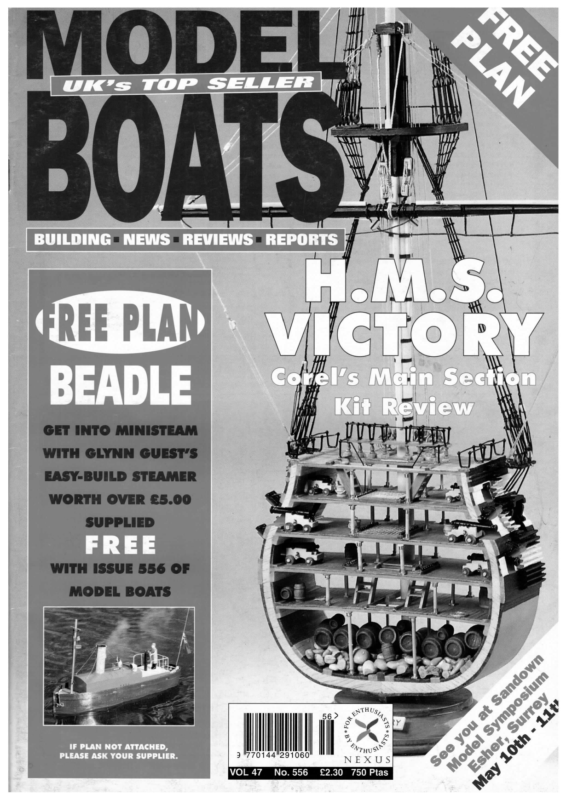
- small YACHTS – New Zealand keeps on coming – reports MIKE KEMP. Also, the Europeans have been to Guildford again and we cast a sideways glance at the latest heat racing system MIKE KEMP’S fingers have been busy walking over the keyboard with Part Two of the World Championship Report plus the start of the MYA racing season: and we have new rules to look forward to

rel’s Main Secti Kit Re=view A 56>ee” 6] IF PLAN NOT ATTACHED, PLEASE ASK YOUR SUPPLIER. Re VOL 47 No.556 £2.30 _ae oo, = >ies RX of € P90 y ee ¢
BERLIOZ D.E. MOORE builds Torvald Klem’s Marblehead boats and has a notable lack of trendy bumps and protrusions. It was designed to sail with conventional rigs as well as with swing rigs or any combination of both. A new carbon fibre mast was designed, having the lower 6ins in a round section gradually changing into an oval section and tapering to a slender 6.5mm at the top. The booms are also made from carbon fibre, the main boom is a round section and curved to the foot of the sail. The hull is moulded in a 2 ply carbon/ Kevlar pre-preg cloth and produced in an autoclave at a temperature of 175 degrees Centigrade. The deck is made of Nomex, a honeycomb sandwiched between films of grp. This is very light and very stiff but is not waterproof so needs either painting or covering in a self-adhesive film. A removable carbon fin and rudder which makes transportation easier, are made, as is the hull, in Sweden. A cheaper alternative YACHTING fin and rudder can be supplied by PJ. Sails and in practice have proved very successful. The hull comes with a selvage flange which needs to be cut off and this is easily done with a pair of sharp scissors, although Photo 1; Berlioz with a good lead in a drifting match. Photo 2: Graceful and tall. this does tend to blunt them in the process. Marblehead that would sail faster than any other Marblehead, under most ind conditions, and stay ahead of anything anyone else could come up with in the foreseeable future. This was the impossible brief given to Torvald Klem by a Swedish manufacturer. Torvald Klem is Norwegian and an architect by trade, nearly The hole for the fin is already cut and the made more than a few people sit up and take hole for the rudder tube is marked with a pip. The carbon fibre fin box/mast tube come in two halves and are joined together and to the hull using epoxy resin and notice. He later became the first foreigner to win the British Championship two years running and the Race of Champions in the same years. The Europian Championships was his next achievement and in the 1996 World Championships in Melbourne he was fifty years old and has had an obsession with second with Berlioz, losing by only 1.7 points beats since the age of five. His career in model yachts started in 1978 in Oslo with a after six days racing. Torvald has also won the Nordic, Norwegian and Swedish “Nylet Challenger” when early successes championships. were considered as beginners luck, but not for long. In the 1982 World Championships he achieved a creditable third place with an own design called Lost Love. This design was the 12 start of a new era in model yachting and The boat Berlioz was the design Torvald came up with for his impossible brief. It has simple lines and tends to buck the trend towards narrow Fairlight filler. This box automatically takes care of the mast and fin angles. Platforms to support the winch and rudder servo and rudder tube are cut from surplus Nomex (left over from deck) and glued to the hull with epoxy/filler. The Nomex deck sheet is approx. 13 x 55ins and needs to be cut and shaped to fit the hull. This is easily done with a Stanley knife. Cut lin pieces of 1/4in square balsa wood and glue them 7mm from the top of the hull MODEL BOATS VOL. 47 – No. 556
at every 6ins. This is to locate the decking. The deck is then epoxied to the hull and top of the fin box. The plan shows a solid Nomex deck with just one hole cut for access to the winch and rudder servo, with the radio and batteries Velcroed to the underside of the deck. I cut a hole above the rudder to make fitting and adjustment easier. I also fitted a conventional radio pot. Avery nice through deck ball raced pulley fitted with a gland to prevent water entering the hull is supplied by PJ. Sails. I fitted eye bolts and cord triangle instead of the carbon post supplied for the main sheeting as I find this far more flexible to adjust. The removable rudder is simply pushed home and there is a positive click when it is locked in position. This is another PJ. Sails fitting which could well be of interest to scale and power boat enthusiasts, as any rudder is always very vulnerable during transit. Sailing Although Berlioz cannot be described a novice boat, it has no vices, in fact it is very docile and tends to go exactly where you point it. When correctly trimmed it points higher than any other boat I have ever sailed. I have yet to find wind conditions that doesn’t suit it, and holds a top suit when others are on working and storm suits. Berlioz is easy to build and easy to sail and in the right hands Photo 3: Berlioz, no. 48, in action in very is capable of beating anything. This is destined to become a classic and stay at the top for a long time. Did Torvald achieve his impossible brief? In my opinion he did. Berlioz is available from PJ. Sails, 1 Courtenay Road, Poole, Dorset BH14 OHD. Send sae for catalogue. N.B. I have been trying a gadget to aid pointing on an A rig. It consists of a ballraced swivel holding a mini boom to support the jib leech. It is attached to the foreyard and replaces the normal jib boom. In theory it places the jib luff nearer the centre line of light conditions. the boat. In practice it does exactly that. Tension on the leech is obtained with a downhaul as well as an uphaul. As yet there is no name for this gadget, but should be available from PJ. Sails by the time you read this. Photo 4: Carbon Kevlar hull, carbon fin and rudder as supplied. Photo 5: Mouldings assembled showing proportions of hull and keel. Photo 6: Winch and rudder servo mounted on Nomex platform. Photo 7: Hull and deck complete. Photo 8: Close up of mast foot and boom. MODEL BOATS VOL. 47 – No. 556 13
R/C YACHTS MIKE KEMP’S fingers have been busy walking over the keyboard with Part Two of the World Championship Report plus the start of the MYA racing season: and we have new rules to look forward to fter the opening ceremony and the ‘raising of the flag we got down to hat we came for, sailing. The seeding races were finished by around 3.00 pm and we had a short break while the heats were sorted and things were made ready for Race 4 which saw us revert to the more familiar D heat first procedure. By 3.40pm the heat was under way and saw Lisette Verschoor from MYC Oostburg in the Netherlands sneak off around the wrong side of the far end mark and tack away on to port in an effort to get some clear air on the way to the first mark. This was to be one of several instances to most were feeling just a little damp from the fine drizzle which was driven close to horizontal by the number three suit wind. everyone had retreated to the little rigs. Race 9 offered some hope to the Bantock The Race Officer must also have been feeling it as he called an early end to the day’s proceedings with the completion of race 4. This allowed the first of the social events to get under way more or less on schedule although it was to be conducted in the Lowry Bay Yacht Club House as we ‘met the fleet’; mounting severe campaign to take the trophy back home. We were to see an enthralling race between the two sailmakers, Graham and Trevor Balmforth, which saw the boats side by side on many legs until the 2nd or, at least part of the fleet for some went off to dry out and settle for a bit of a rest. Wednesday – Day Two traumatic first day when his ‘Two Dogs’ racing during the latter part of the day was inside the marks, so no call was made; in fact the lady certainly didn’t realise it either. It’s yacht started taking in water at an alarming rate from what was eventually diagnosed as a split fin casing. Noel concluded that one of how the New Zealand ‘Two Dogs’ design viewing from a completely different angle. skipper arfive with a different yacht after a special dispensation from the Race Organisers. Noel Heerdegen had a bit a of a Tuesday’s vicious gusts had just been too much for the craft and it failed. Late on Neville Beetson’s TS-2 Racing Appendix specifically prevents protests from skippers not taking part in the heat in question. It was during this time that Monday he heard that one of the Australian skippers had brought a second boat with him and was looking to dispose of it: Noel shows how many people someone decided to turn on the celestial imagine an ‘Aussie shower and brought out a diverse array of water resistant clothing. Although the UK became the new owner of a ‘TS-2’ and proceeded to work his way up through the wind. It’s not like this ‘skinny’ boats sometimes get up and fly! group were as prepared as any, no one had fleet into A heat by the end of the second day. the full waterproof outfit, we just did not expect to meet these familiar sort of conditions: and that sort of gear can really well as being just a touch lucky. As we came eat into one’s luggage allowance. By 4:30pm was shining but the blustery winds of the He was certainly a very ‘happy bunny’ as together for the skippers’ briefing the sun previous day had gone away to leave us with what someone described as a Bournville gale! By 10.20am when the A heat took off for race 5 our Martin had warmed up his reactions to make a successful Port end attack. He started on starboard but soon tacked to cross the fleet of port and arrive at the first mark with a lead which he was to hold all the way. Craig Smith now knew he had a battle on his hands! As race 6 progressed the wind slowly decreased to what might be described as a Bournville breeze and was swinging as well such that the finish of heat B was a broad reach. For the A heat Craig Jones changed the course which sawa slightly longer than usual between heat break of around twenty minutes which allowed the wind to settle to its new direction and start building again. The A heat skippers were all carrying no. 1 rigs but by the end of the first beat some 48 yachts had to tack to round the mark and Graham, as windward boat but slightly ahead, had control. In the windy and choppy conditions his boat went head to wind and The second day of the competition saw one This is the reason that the Radio Yacht all the time, just as our rounding of the windward mark. Approaching it on a long port tack both illustrate the problems of sailing, and controlling, model yacht races. From the perspective of where the skippers and officials were watching no one would have realised that Lisette had just failed to come amazing what the spectator can see when skiff’ always goes off fans that the defending champion was just stopped: allowing Trevor to get by and into a lead which he held all the way back down and up the course to the finish. One thing that struck me watching the seemed to handle the extremes of no. 3 rig slightly better than the Australian ‘TS-2’. Particularly at that crucial point just after rounding a windward mark before the yacht is up to speed. The leading skipper, Martin Roberts, had a bit of a shock when about to start race 8A. Like many, I suspect, Martin frequently handles his transmitter by its aerial: this time the aerial decided to extend under the weight of the attached transmitter. In so doing it dropped the bottom of the transmitter into the water: not a recommended procedure. I saw this from another angle as Martin arrived like a whirlwind in the ‘team tent’ to seek out a replacement transmitter, swapped crystals and vanished. The whole incident made him some 12 – 15 seconds late for the start and that, in a heat as hot as A had become, could have seen him disappearing to B heat but for his determination which drove him into twelfth place at the finish line survival! After some less than memorable first day antics, which saw Messrs Cleave and Dennis getting in each other’s way at the start of at least one heat, both were making progress up the fleet. In complete contrast, yours truly was making very steady progress backwards with almost complete brain fade as far as sail trim was concerned. John Cleave drew some applause for the only really successful port tack start of the day: these were particularly rare at this meeting for the start line rarely showed any port bias, let alone enough to tempt those of us who were having a little trouble tacking; and the relish the challenge. After the completion of race ten ‘our hero’ Martin Roberts was in almost as secure a offwind legs saw a few rudders being exposed! These antics persuaded everyone out of no. 1 for the next race and some went straight down to no. 3. By the end of the day the regatta. He was just a shade under six points clear of Geoff Smale: the next eight points covered Geoff, Simon Kellett, Trevor lead as anyone was going to have throughout MODEL BOATS VOL. 47 – No. 556
Norrie Taylor (25) and Gordon Sears (47) keep Geoff Smales (61) company during an early windward leg. Balmforth, and Craig Smith. Graham Bantock was a further ten points back in sixth place at this stage. Thursday – Day Three The third day of competition saw the weather drifting away from what we might have expected had the meeting been held at Fleetwood. It was important during the day’s six races to be in the correct rig, number 1 or 2. The difficulty was that it became a bit of a guessing game to determine which was correct: there was not much to be gained from watching the preceding heat for one could be in the correct set of sails as one sailed off down to the start, only for the wind to rise or drop dramatically – depending upon which rig one had set – as the countdown proceeded. Those that got it right reaped the benefits: for example when race 11A set off the right rig to be in was number 1: by the time the fleet had set off up the beat the only sails to be carrying was number 2 suit. There were only two skippers who had the foresight, or couldn’t be bothered to change from their previous settings, to carry the appropriate rig. They were Robert Wattam and John Cleave who went on to finish a secure first and second with the rest flogging their way to the finish. It was in this race that Graham made an exit to B heat for a spell of five races before he found the correct form to make ready to start Friday in the A heat once more. Martin Roberts put together a string of two fifths and two sixths until he too found himself in just the right rig at the right time. In this case it was number 1 rig when everyone else had number 2 up: as a result Martin romped away to win race fifteen as the winds went light for a spell. Gordon Sears suffered with one or two others during Thursday with failing radio gear, much of it as a result of too much exposure to the extremely clean, clear, and very salty water of the harbour. Gordon’s rudder failure cost him a trip to D heat; although he instantly bounced out again to start Friday back in the C heat. Others who retired with some sort of gear failure during race fifteen were Trevor Balmforth from A heat, Gary Banks and Andrea Chisholm, both from the C heat. Fifteen also saw Robert Wattam take a Retired, Rule Infringement score while in the A heat for his yacht’s involvement of a very close kind with that of Trevor Balmforth. As the event progressed the jury finally got into their stride and became more familiar with the operation of the SYRPH blown hearing. Quite a number of skippers took that lesser score option where they were less than sure of their case. By the end of the day, after race sixteen, the top order was similar to the previous day except that Martin’s lead over Geoff had decreased to less than five points and Craig Smith had moved up into third place only 2.4 points behind Geoff. Graham’s trip to B heat had cost him dear; it saw his final chances of retaining the title disappear as he slumped to twelfth place around ninety points behind Martin. At this stage the eleventh to fourteenth places were all occupied by UK skippers with Rob Vice, Graham, John Cleave and Mark Dennis being covered by about ten points. Friday – Day Four Friday finally saw the sun out from the word go: the wind, instead of being from the south as forecast was from the north and not very strong. Number 1 rigs prevailed with the wind dropping to the sort of light weight that we are familiar with for many of our home events. Visits to the drinks tent were accompanied by a topping up of the sun screen which was on tap, being supplied by the local cancer society. They take skin melanoma very seriously indeed in New Zealand. take a lesser RRI score instead of throwing After the skipper’s briefing where cards and presents were presented to the Race Officer, Craig Jones, who was celebrating his birthday, the morning racing started with race 17D and saw Dieter Halle-Krahl climb out of D after a full day there. The race rate continued at to be reasonable despite the lighter winds. Race 18 B saw another of those moments which usually collect a little cheer or even a round of applause as their chances into the cauldron that is the full someone escapes across the front of the fleet system. This is where a protest hearing can be abbreviated if both parties are shown the opposing evidence and offered the chance to MODEL BOATS VOL. 47 – No. 556 on port away from the start. In this case it was no 47, none other than Gordon Sears, A brace of ‘skiffs’ who went on to climb up into A heat even in the early No. 3 suit though he was eventually caught and passed by Phillip Page and Noel Heerdegen. The first heat to go in race 20 saw ‘Frenchwoman’ Andrea Chisholm sail a little more like the way we might expect by starting close to the back of the fleet but climbing into third place around the first mark. From there she went back to fourth at the second rounding of the windward mark but found a better way back up the beat for the finish to win by a boat length froma fast finishing Michael Garden. Andrea was finally out of the D heat for a short spell: most unusual for someone who the New Zealand champion but a very few years back. The next D heat sawa similar ‘climb-out’ powering to windward winds. Geoffrey Kiernan (35) (TS-2) eventually finished in 25th place while Struan Robertson (40) (Fat Dog) came home in 37th overall. Dog Gone, Martin Firebrace’s own 2 Dogs gets going off wind during the early part of the championship when No. 3 was the suit to be in. Martin started well but, like some others of us, faded later in the competition. 49
When the Aussie Skiff, a TS-2, heels, one gets a dramaties Martin simply set off and sailed through the lot to win the race: with form good look at its rudder like that there were many who were tipping and, eventually, the fin. him to take the title. By the completion of the day’s racing with race number twenty one, Martin had a lead of nineteen points over Craig Smith who had managed to overtake Geoff Smale by 2.6 points. Trevor Balmforth looked fairly secure in fourth place ahead of fellow countryman Alan Hayes with ‘skiff’ designer Gary Cameron in sixth place. It is often at this stage of championships that the positions start to be consolidated and it still looked promising for the Champion’s crown to come back to the UK. Here, Trevor Bamforth’s example makes its way to windward in No. 3 suit. Below: Plan view of Neville Beetson’s TS-2 Saturday – Fifth and shows the point of Penultimate Day maximum beam well Saturday again started sunny, but this time aft. The shot shows off there was even less wind and what there was did not initially come from the forecast direction. Eventually it settled to more or less the southerly direction predicted and filled in by the time the second race of the morning had started. Indeed the A heat of race 22 had quite a good Number 1 suit breeze to contend with. Martin Roberts started the morning in B and could only manage to the shape of the Trevor Balmforth sails. finish in sixth or seventh place in the first race of the day: there was apprehension around the camps about whether he could hold on to his precarious lead. Time, at this stage of the game, would tell. 23C was the race when I finally failed to hold on in there and fell into D. My boat speed was comparatively non existent and there were people crossing me on Port and I couldn’t do a thing about it. I was not alone in the ‘poor performance’ class for Graham managed to hit a start mark in the A heat and found, like us who normally populate the middle fleets that such a mistake can be costly. In this case Graham only managed to ‘hang in there’ by pipping John Cleave as they crossed the finish line. Martin Roberts, on the other hand made progress in the opposite direction and climbed back into A. 24 D was a another bad experience I would rather not have had: still lacking boat speed Norrie Taylor from South Africa and I were fighting our way through the pack into third and fourth place when we were effectively Above: One of the ‘back door’ entries? Colin Field’s TS-2 seems to be a bit confused over its nationality but gives us a good illustration of a skiff layout. taken out by number 72 who, in our opinion, failed to round the leeward mark at his earliest opportunity, in fact he bore away and forced Norrie and I together. I protested and got a turn out of 72 and Norrie went off to do one as well for our entanglement. All this activity slowed us down enough to stop either of us making it out of D this time. At the other end of the fleet we saw probably the closest thing to a dead heat for first place throughout the whole regatta. Ian Vickers was credited with the first place while fellow New Zealander Trevor Balmforth collected second. From an observation point very close to the line one could easily have decided the other way: I would hate to have supported any strong argument from either skipper that I had called it wrong if I had been ‘on the line’. The next time I went on the water, race 25, was better but still not good enough and so at 2.00pm on Saturday I remained in D in readiness for race 26. By the time heat 25 C hit the water the southerly wind had risen sufficiently to persuade most of the participants to change to number 2 rigs. Those that remained, Gordon Sears, Bruce Edgar, and Scott Chisholm seemed to have neither a significant advantage or disadvantage at the start of the race. Gordon didn’t help his cause by being early but managed to claw his way back into contention for a promotion position. Bruce made it out but neither of the others did. When the B heat went on there were fewer sporting number 2 rigs, though it looked as if the wind had moderated a bit. Among those who went for control rather than sail area included Graham Bantock, John Cleave, Geoff Kiernan, Geoff Smale, and Keith May. Their fortunes were mixed: with Graham winning; John and the two Geoffs finishing in the high middle of the fleet and Keith May bringing up the rear. Race 26 A saw tempers flare a bit. The story that hit ‘the paddock’ during the race was that two skippers had come to blows over an alleged incident. As ever when the rumour machine flies into action, reality was a little different. What is certain is that three skippers found themselves getting a ‘dressing down’ from the Assistant Race Officer for the incident and more especially by Peter Haworth, Editor of “Radio Waves” the Australian Radio Yachting Association Inc. Newsletter. In similar vein Peter started in the middle of the pack but found his way in and around the opposition to make it up into 22C before slipping back for race 23. Among the memories that many of us will have of Friday 14th February was a rather lean and hungry feeling. This came about after race 18 when the A heat went on just before 12.00pm: immediately they finished they heard the announcement that ‘lunch was served’ in the Club House. While the Right: New.Zealand’s favourite sailmaker, Trevor Balmforth took third place in the Worlds. There were nearly as many skippers using Trevor’s sails as were using Graham Bantock’s. rest of us contemplated what sail settings to carry for race 19 the A heat went and attacked the lunch before the rest could get there with the inevitable result. This was one of the very rare ‘drop-offs’ in the organisation and saw the lower heats feeling just a bit peckish by the time we got to the evening “Valentine’s Dinner”. The lunch time binge must have provided Martin with some much needed inspiration for in the next race, 19 A, he hit the start mark. As a result of getting back to do his turn and start properly he was some way behind as the fleet disappeared towards the first mark. With no particular 50 MODEL BOATS VOL. 47 – No. 556
Back Track Follow my leader around the leeward mark: Alan Hayes (32) got to the four boat circle ahead, then overstood it a bit – so everyone else has to turn late as well, or risk being caught for barging in. as we launched which went light: by the time the two minute signal sounded the wind had the verbal exchanges. Having located some visual and audible evidence I would venture to suggest that, again as is often the case, what actually happened is quite different to the version that any of the parties concerned would tell when in a protest situation. One yacht appears to have claimed that it had to tack to avoid an incoming starboard tack yacht which was so far aft that both port tack yachts would have cleared easily. This is evidenced by the fact that when the windward of the two port tack yachts had tacked in response to the call to tack, both new starboard tack yachts were to windward of the alleged ‘reason to tack’. All three yachts then went to round the windward mark with some muttering from the second and third of the yachts, both from one national group, about the one that was ahead, from another national group. This ‘muttering’ John Cleave, Cameron Clark, and Graham Bantock. As the start drew near several yachts could be seen pirouetting on their bows as the wind rose: half way up the first beat Graham Bantock was in a fairly secure continued until the leader of the three lost first with Cameron being challenged for it has acquired the the cool normally witnessed and forcefully second place by Simon Kellett and Rob Vice. Martin was inexplicably struggling back in Aussie Skiff. Terry addressed the others. The Assistant Race Officer became involved with a cautionary: “Gentlemen….!” In some previous championships such behaviour has been interpreted as ‘team sailing’ by some national groups. Fortunately this was the only time during the meeting when such thoughts came close to the surface. It is a shame when such happenings mar an event such as this. Racing continued into the evening to complete race 28 in a fairly uneventful fashion; although another skipper was caught by the unexpected and seemingly random weight checks of a boat as it finished a race. Around a dozen yachts were checked in this way during the week: and two were found to be underweight as they came off the water. This was particularly alarming as they had been underweight at the initial checking and had been ballasted to pass that initial inspection. To be found to have lost weight during the event left questions in people’s mind again: it is surely the skippers who should lose weight while chasing up and down the lakeside – not the boats! In both cases the penalty was the same: disqualification from the proven affected race. As with several previous evenings the weather and wind conditions remained pretty good right up to the end, in fact the late afternoon and early evening were better than the early morning. At the day’s conclusion we were looking at the prospect of Martin Roberts having to mount one of his famous last minute charges to keep his grip on the championship. Geoff Smale was now in the lead just 4.4 points ahead of Craig Smith while Martin had slipped to a fourteen point deficit in third place. Not an impossibility but certainly a challenge! Sunday – it’s now or never Sunday dawned bright but with the threat of cloud cover which soon materialised and brought with it some more wind, making 29 C really a number 2 suit race, although there were a few of us that tried to persevere in number 1. We were fooled by the conditions MODEL BOATS VOL. 47 – No. 556 picked up and I had officially capsized twice. Most seemed to think it looked quite dramatic but those of us who are used to some of the English conditions would not find it at all unusual, although an equally hopeless situation to be in – even though the sun was shining and the wind was much warmer than at home. My race then went to pieces and I found myself back in D heat again. 29 A went on and saw the main contenders all carrying number 1 suits: in fact there Above: In profile the TS-2 designed by Gary Cameron doesn’t look particularly extreme. It is the relatively huge maximum beam well aft that has earned it the nickname of Aussie Skiff. were only three skippers carrying number 2; last place around the windward mark. That poor race would appear to have handed the championship to Craig Smith, unless Geoff Smale could do something about it. By the time race 31 B took to the water at about 12.45pm all were in number3 rig to suit the increasing wind. Martin started to get his act together again but, alas, it was too late and the damage to his score had been done. The A heat followed suit and split into two distinct groups as they proceeded up the beat, half to the left and half to the right: as they came together Craig Smith was leading into the first mark, followed by local Wellington hero, Tod Olson. Race 33 ended the meeting with a win for Gary Cameron after paying very close attention to Martin Roberts who had led this final race almost from the word go. The eventual champion finished in 4th place; keeping his eye on his nearest challenger, Geoff Smale, no doubt. Left: The stern shot of Gary’s TS-2 shows why alternative name of Bracken from Northern Tasmania sailed this example. The most successful New Zealand design at the Worlds. Martin Firebrace designed the 2 Dogs One Metre. This example was built and sailed by the ‘moulder’ Carl Weatherill. Watch out for one or two on the UK circuit later in the year. The Celebrations The Sunday evening prize giving took place at the Plaza Hotel in Wellington, a pretty prestigious place! The opening to the evening was not without its humour for some for we were directed, on entry to the hotel, to a first floor lounge area already heavily populated with drinking holding and chatting, smartly be-suited, groups all dutifully wearing their identity badges. Rather subtly smart little badges which, on close inspection, showed we were sharing the function areas with a large party of funeral directors! Now what is it about such upon one’s point of view) that brings mirth? Their function started before ours so when it came our turn to return to the lower floor departed for their respective homes. As a result there were some boat exchanges and money changing hands: not as much as some would have liked, I suspect, but sufficient to ensure that some cross-fertilisation of yacht design ideas takes place on both ‘sides’ of the and ‘our’ area there was no chance of any of world. an important profession or trade (depending them getting carried away with the yachting festivities. The rather restrained gathering Statistics brought the official organisation of Sailing’s Big One to an end, although contacts continued to be made and explored during the days after before everyone had finally I have been able to gather a memorable volume of information about the happenings in New Zealand: much of it thanks to contacts I have made who have Internet Despite first impressions, Martin’s design is no more extreme in its hull shape than many other One Metres of UK origin. ot
The Australian way of protecting from that sun time by the ‘average’ skipper, the – modelled by Craig Smith is pretty Number Two rig for 24.7% and the Number Three rig for 21.8% of the time: despite many have an impression that it was a pretty windy regatta. comprehensive; whilst the New Zealand approach is Geoff Smale’s natty, floppy, style; I have developed a few individual statistics for this as well: The first six did as follows: Craig Smith: No.1 – 64.5%; No.2 – 19.4%; No.3 – 16.1% but the English is minimalist, epitomised by long time leader at the Worlds, Martin Roberts. The latter style is complimented by copious application of sun screen cream. Geoff Smale: No.1 – 64.5%; No.2 – 19.4%; No.3 – 16.1% Trevor Balmforth No.1 – 64.5%; No.2 – 16.1%; No.3 – 19.4% Alan Hayes No.1 – 58.1%; No.2 – 25.8%; No.3 – 16.1% Martin Roberts No.1 – 61.2%; No.2 – 19.4%; No.3 – 19.4% Gary Cameron No.1 – 64.5%; No.2 – 19.4%; No.3 – 16.1% Just for interest! Graham Bantock No.1 – 51.6%; No.2 – 29.0%; No.3 – 19.4% I have an absolute gold mine of statistics which I could print but I am not sure that John (Editor) would stand for it and I also not sure that everyone would want to see them. Not only that but I just haven’t had the time to pull them all together: if you want to see them in print, let us know. Oliver Lee Trophy Sunday 2nd March saw the running of the Chelmsford Club’s Oliver Lee Trophy meeting. Originally conceived as a mid-winter gathering of Marbleheads for a trophy presented by Oliver and run on the last Sunday of the year, this regatta has slipped a little over the last two years. In 1995/96 it was because cold weather made the water too hard to sail in: it was a similar story in 1996/97. Several well known regular participants missed this year because they had only just returned from their frolics in New Zealand. One who didn’t however was the Race Officer, Mark Dennis who broke out of his jet-lagged state to officiate over the twenty four entries. The weather wasa bit like the early stages of the World Championship, wet with sufficient wind to bring out the number 3 suits: the one significant difference being that Chelmsford was many degrees Centigrade below Wellington – it felt cold! Anyone that tried the number 2 rig during the pre-race practice session changed down before racing started. In Henry Farley’s case this change was enforced by a mast failure on his number two which was to test Henry’s sailing ability later in the day. E:mail access. Thus we are in a position to share the information around: I want to thank them for their assistance in the contributions that has made to this, and probably, future column. I hope that which I gathered and make available will be equally helpful to them. Among the revelations are these: Sailing time Excluding the last three races of the event, (I didn’t get the evidence) each A heat lasted and average of 8 minutes and 19 seconds to such an event. Despite the much vaunted ‘delays due to protests’ the average between race time was 14 minutes 25 seconds with the longest wait of 46 minutes being between the first two seeding races. The next longest was 43 minutes between seeding and the start of heat racing: the greatest delay between actual heat races, apart from over night of course, was between race 20 and 21 on from start gun to first yacht finishing. The B Friday evening and took 32 minutes. The heats were one second less, while and average C heat lasted 8 minutes and 26 whole thing boiled down to a total ‘on the seconds: this extended to 9 minutes and 6 seconds for a D heat. Interestingly there was an average of just over 12 minutes waiting time between the first finisher in a D heat and the start of the C heat. This reduced to 11 minutes 32 seconds between C and B; and further to 9 minutes 44 seconds between B and A. These figures could be made to look even more favourable if we subtract the prestart time on the water (slightly over 3 minutes) and the time between the first and last boats to finish in each heat from these 52 ‘delays’. Overall this gives quite a respectable proportion of our time on the water and that, after all, is one of the prime reasons for going water’ time of seventeen hours and five minutes: the best value was the D heat who got a total of 4 hours 33 minutes of sailing time ignoring the countdowns and pre and post race time. Our average daily ‘sailing involvement time’ was just over six and a half hours. Sails Rig statistics are another area that I suspect will get some attention by the theorists and designers. Well, here they are in brief. The Number One rig was used for 53.5% of the The fleet was split into two dozens for seeding on a course which started between what was to form the early leeward mark and a pole on the bank. From there we proceeded right to left up the lake in a roughly Northerly direction to a windward mark over the far corner of the lake, rounded it to port and charged across the top of the lake to a wing mark which formed the near end of the finish line. At this point we turned to port once more and headed off to the leeward mark, the outer end of the start line. After rounding it to port we made our way back to the windward mark, to return to the leeward end one more and back to finish across the line drawn between the windward and wing marks. In the third beat there were plenty of opportunities to try different routes, to the left, right, and even up the middle: each gave ample chances of gaining and losing many places. Some managed to do both, within the space of one race! Later in the day the wind swung slightly so that Mark brought a mark laid further to the right of the start line into play as the leeward mark. The second reach and running legs of the course gave lots of opportunities for place changing as well as different wind patterns hit the boats and different boats reacted to the effects of more or less than ideal off-wind strengths. MODEL BOATS VOL. 47 – No. 556
One of the early leaders, Phil Playle sailing a Red Wine, started the seeding in the B heat on number 2 rig while the rest of the heat were on number 3. This suggested that the wind had dropped a bit and it continued to do so for a while. I had the pleasure of seeing my Dann-3 out in front in the second of the seeding heats; what was even more pleasant was that I had control of the transmitter! The first of the EORS heat races was won by Nigel Gilson, sailing a very distinctive, Jack Day planked, ‘Dann-3 + 1’. Another of the three ‘Phils’ sailing, Phil Newman with Keith Skipper’s old ‘Tango’ notched up the second of his three second places in this race to quietly sit close to the top of the fleet all day. In race three it was Ian Cole’s turn to lead home the fleet while Phil Newman was tucked in there in second place again. For the remainder of the eight races there were only two yachts that appeared across the finish line first: mine and that ‘Tango’ being sailed by Phil Newman. Meanwhile Phil Playle was having a bit of an up and down day with results which looked liked bursting through to the top and others which looked much less satisfactory, and uncharacteristic. Another of the ‘names’ who was having a less than satisfactory day was Keith Skipper who had only just taken back possession of his Bantock ‘Scream’ after Graham had borrowed it for the World Championship. Keith was having just a little trouble getting to grips with the bits of ‘string’ associated with the rigs that Graham had substituted for the championship: by the end of the day it looked as if Keith had finally mastered them and was somewhere near where one would expect him to be. By then, however, it was too late and he finished the day in 10th place. The 1997 Oliver Lee proved to be quite a test with most skippers using all of their available rigs at one time or another: even the last race proved a bit of gamble. Both Phil Newman and I changed up to number 1 for this last race; although, at times during the race, it was really just a bit too much sail to be comfortable. By this time both Ian Cole and I were thinking that we ‘had a race going on’ and I set out with the intention of finishing ahead of Ian; which I did by three places. However both Phil Newman and Keith Skipper got ahead of me up the final beat but the difference between Phil and me was just not quite enough for him to overtake for the overall event, even though he had a larger score to discard than I did. In the end the margin was just about the smallest one could have in such circumstances, just one tenth of a point! As the prizes were distributed from the top down, when it got to Phil Playle’s turn he was left with the thermal socks: however he was not there to receive them. Let’s hope that the rest of the year is not cold enough to need them. With the experience of using all available rigs the 1997 Oliver Lee proved to be an excellent opening to UK sailing season. What will be the impact of the ‘down-under boats when they start appearing on the scene? MYA Information In the last but one issue, in the midst of my frustrated ramblings, I included a plug for the various Model Yachting Association publications that might prove useful to the newcomer: or even the not-so-new comer to our sport. I forgot to include one vital address: that of the newly appointed Information Officer: I did actually mention his name for he has been involved with production of several of the MYA publications over the last few years, notably the Yearbook and diary of events. If you want more of this sort of information Mike Hounsell can be reached at 4 Old Fire Station Court, North Street, Nailsea, Bristol, BS19 2SE. If you have access to an E:mail account you could also try him on 101637.2036@compuserve.com One of the radio sailing world’s characters Leon Talaic – holds up his MM1 design. Unfashionably slim – for Australasia – this started life, as do most of Leon’s yachts, as a block of polystyrene. Originally from New Zealand, South African Norrie Taylor designed his own Impi One Metre much in the style of the current crop of UK yachts. The only French entry at the Worlds; Andrea Chisholm sailed this Elderberry design with less than her usual success. Her performance suggests that this yacht needs some development. Top Five at Oliver Lee Trophy PLACE _— SKIPPER CLUB DESIGN DESIGNER TOTAL SCORE 1st Mike Kemp Two Islands Dann-3 N Gilson 13 2nd Phil Newman Chelmsford Tango G Bantock 13.1 3rd Ian Cole Chelmsford Red Wine G Bantock 22.4 Ath Nigel Gilson Gipping Valley Dann-3 + 1 N Gilson 33 5th Rupert Jefferies Chelmsford Single Malt G Bantock 39 MODEL BOATS VOL. 47 – No. 556 53