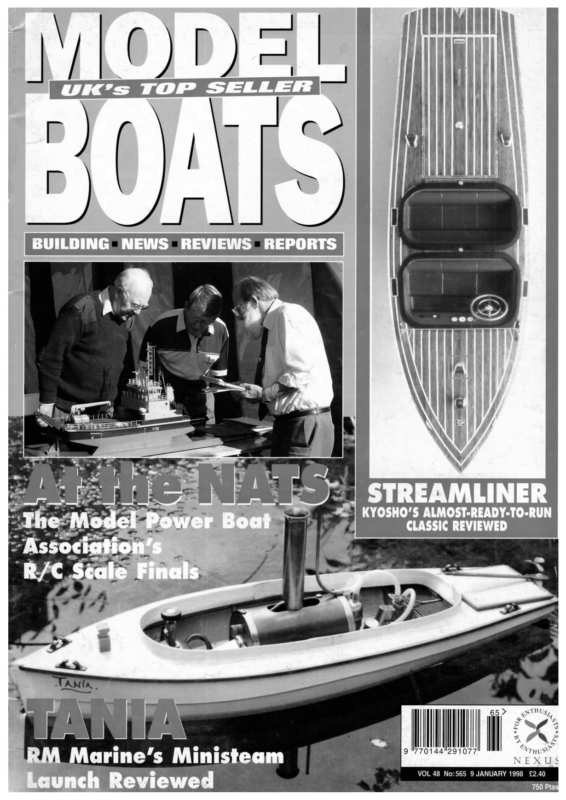
- Bluebottle RUSSELL POTTS’ Vintage Model Yacht column, Curved Air, returns with a tribute to the innovative mind of ALFRED TURNER
- The 1.5 Metre Yacht – Otter A design proposal from respected designer JOHN LEWIS

MODE AAC s | dal BUILDING NEWS REVIEWS _~ \ REPORTS STREAMLINER — _ #2] KYOSHO’S ALMOST-READY-TO-RUN CLASSIC REVIEWED 65> Se: Nt > VOL 48 No:565 9 JANUARY 1998 £2.40 750 Ptas}
CURVED AIR —— Left: Large suit. Above: Small suit. RUSSELL POTTS’ Vintage Model Yacht column, Curved Air, returns with a tribute to the innovative mind of ALFRED TURNER Aine occasions, was a marine Ifred Turner, of whom I have written on engineer. He served in the Royal Navy for all his working life, retiring in the late 1930s as an Engineer Rear Admiral, of which there was a very small number, even in the much larger navy of those days. This suggests that he was a rather effective engineer. He followed a fairly conventional career, serving in the minelayer Abdiel during the First World War and in a capital ship based at Rosyth in the early 1920s, when he was briefly a member of the Inverleith club in Edinburgh. Following his promotion to Engineer Captain in the mid 1920s, he came ashore and, among other things, worked on the hydrodynamics of propeller design. He was also a model yacht designer and a major source of new ideas and theoretical insights into the problems of the art. Like many model yacht designers, he followed the development of full size practice closely and during the 1914 war his writings on model design appeared from time to time in Yachting Monthly. The distinctive style of his designs, and even more of his approach to the task of design is unmistakable and is marked by a degree of thoroughness and organisation that is rare, or at least rarely recorded, in the writings of other designers. The years immediately following the 191418 war seem to have been a time of high energy and output for Turner, at least so far as his model designing went. For instance, when the YM 6-metre (A Boat) Rule was introduced in 1922 he drew half a dozen very different speculative designs straight off the reel in the course of a few weeks as a way of getting to understand its possibilities and of familiarising himself with the rather subtle trade offs between length, displacement and sail area that the new Rule permitted. In doing so he produced a nomogram which enabled him to read off graphically the relationships between the three main design elements. This was a technique that he had used earlier in analysing Length and Sail Area Rule and in testing to destruction the BRA 18 footer Rule. So far as I can determine, he originated the use of this technique to handle the balancing of the design elements of a yacht. 58 MODEL BOATS VOL. 48 – No. 565
The New International Rule of 1920 In 1919 the full size yachting world was concerned with getting the show back on the road after the war and the first task was to attend to the review of the International Rating Rule. This had been introduced in 1907 with the intention of running it for ten years and revising it in 1916, for a new ten- year period to run from 1917. Obviously yachting activity had ceased during the war and was unlikely to revive until owners and designers had a clear idea of what the rating Rule was going to be for the next ten years. The original rule of 1906 and its immediate predecessors, the Linear Rating Rules of 1896 and 1901 used by the (British) Yacht Racing Association, had been concerned to enforce a ‘proper’ form of hull in place of what were regarded as ‘improper’ and even immoral styles of racing yacht developed under the Length and Sail Area Rule. You have to read the correspondence columns of the yachting journals of the day to appreciate just how far this was a moral, as well as a technical issue. In the eyes of the Rule makers a ‘proper’ yacht had sufficient body to offer accommodation and even if it was not large enough to be more than an open keel boat ought to be of a shape that would give good accommodation if enlarged. A ‘proper’ yacht had overhangs fore and aft and, what is more, overhangs of a ‘desirable’ V-form rather than a U-form, which lent itself to ‘dangerous’, ‘unseaworthy’ and undesirably flat scow like forms. The second version of the International Rule abandoned or reduced the impact of most of the fancy measurements that had characterised its predecessors and reverted to something very close to a length and sail area formula. It sought to enforce its view of a ‘proper’ yacht by requiring minimum displacement and beam and took a rather different approach to the control of overhangs, but there was no doubt that a boat without overhangs was not what the Rule makers intended. Partially planked, showing backbone’ fitted into shadows. Planking nearly complete. A stealer needs to go in just above the lead line. Turner’s ‘Bluebottle’ and her Design Features Early in 1920 the London MYC, independently of the national association, which was in a pretty moribund condition immediately following the war, introduced a 10-metre class to be built at a scale of one inch to the foot. The full size Rule was followed very closely. Before this however, and before the full size Rule had come into effect, Turner had designed ‘Bluebottle’. In doing so he looked at the words of the Rule rather than what the Rule-makers had said over many years that they wanted designers to do. The design follows the provisions of the Rule so far as hull form is concerned and her midship section is a very early, and entirely typical, example of what full size and model designers were to make of the Rule in the inter war period. But, as will be seen from the drawing, Fig. 1, she ignores completely the unstated intentions of the Rule so far as overhangs are concerned. Though the provisions of the Rule did not actually prohibit a snub ended boat, they included ways of measuring a bow and stern tax that were intended to strongly encourage designers to provide the right sort of overhang to minimise the additions to waterline length that would otherwise be necessary. The Rule simply did not envisage a snub ended yacht. Turner had a tendency to design big and often brutal boats. One of the major lifferences between the old and new International Rules was that the latter put a zreater tax on sail area. One way of wreserving the sort of sail area that f40DEL BOATS VOL. 48 – No. 565 Interior view with joints caulked. An additional 4. designers were used to under the 1906 Rule was to reduce the measured L to a minimum. Turner’s design does this well. The L measurement, taken a specified distance above the actual Iwl, is exactly the same as the lw] at 41 inches; there are no additions for bow and stern taxes to add to the L dimension, so the actual lwl can be greater than in any other 10-m model that I know of. The rating also benefits from the subtraction of a generous freeboard, so there is plenty left over for sail area. The permitted sail area is also larger than any other comparable design. Because the Rule imposes a minimum displacement that is linked to the Iwl, Turner’s boat is necessarily heavier than any of the plank is being glued in to form an inwhale. contemporary designs. ‘Bluebottle’ seeks to maximise the length and sail area and accepts a heavy displacement to do so. So far as I know, no full size designer attempted to persuade the measurer that a boat with no overhangs was admissible under the Rule. Turner clearly had no difficulty in persuading the measurer of the London MYC. The club’s Measurement Books survive, but not in a complete form, so I can’t determine what happened on the first occasion ‘Bluebottle’ was presented for measurement. On 19 September 1925 the measurer simply recorded — No overhangs: Bow tax 0, Stern Tax 0, and went on with his calculations. I think that this is a perfectly fair interpretation of the 59
2 . “] o a 4 < | d e: Loe 4-1 — &7 xg W356 Total + Dift tres per Seale Ligih ope
ee O1234 56769 WN i2imcnes the boat to see how it performed. The rest of this article is given over to a description, not so much of how to build it, but of how not to. Because I am lazy, I look for short cuts and ways of avoiding some of the more tedious parts of boat building. Some of my short cuts were successful, others were not. IfI were to do it again, I would go about some parts of the task in a rather different way. So read, learn and inwardly digest. The wise man learns from the experience of others. Weights and the Square/Cube Law Fig. 250.—Body Plan of Fig. 253, The original design was 41 inches long and 24 pounds, 8 ounces; the lead ballast weighed 16 pounds, giving a ballast ratio of 65%. The sail area was 1636 square inches. The corresponding figures for the half size version would be 20.5 inches, 3 pounds, one ounce, 2 pounds and 409 square inches respectively. I intended to fit radio gear, so even if I made strenuous efforts to keep the weight of the radio gear down, the total displacement was certain to be more than it ought to be by scale. Regardless of the final displacement of my model, the square/cube law meant that so small a version would be grossly over canvassed if the sail plan was simply scaled down from the drawing. ee Building and Some Short Cuts formulas gave models that were fairly close in size and reasonably equally matched. The idea was to run this mixed group together for a few years so as to help decide which combination of size of boat and scale was the most suitable as a model. In 1930, the MYA decided, not very surprisingly, that a small boat modelled at a larger scale gave a more practical model and the 6-m at 1.6 became the recognised model Metre class. The 12-m, under severe competition from the A Class as the big boat of model yachting, also lost its MYA recognition at this stage. Only in Scotland did the 12-m persist until the 1950s. Advanced Sail Plans I had been struck by the design ever since I first saw it some years ago; not only was the hull apparently unique in designs to the IRR, the rig was, by the standards of the day, extremely advanced. Bermuda rig is so common nowadays that it is hard to realise that ‘Bluebottle’ is almost certainly the first competitive model yacht designed to use this style of rig. In the full size world, Bermuda rig had been first used on a very small number of experimental 6-metres and other day racers designed just before the 1914 war by Linton Hope, who had used trials with sailing models to help him in the development of his designs. He, like Turner, was interested in the concept because pre 1914 studies of aerodynamics at NPL and in Eiffel’s laboratories in Paris had shown that longer, narrower wings of high aspect ratio had better lift/drag ratios and were thus more efficient than shorter styles. Translating this to sail aerodynamics, the more educated generation of yacht designers like Hope and Nicholson argued that a tall narrow sail plan would be more effective going to windward than the lower gaff rigs that were then the norm. But there were problems in making masts that were both tall enough and strong enough to carry such efficient rigs. In Hope’s full size 6-m, bamboo was used, but there were limits on the mast length that could be obtained in a single piece. In yachts larger than 6-m, taller masts in solid wood were too heavy and too difficult to stay and keep upright with the rigging techniques then available; built up hollow masts in wood were not attempted at MODEL BOATS VOL. 48 - No. 565 this period, possibly because of the lack of suitable water resistant glues. Hollow masts became possible again in the very largest yachts which used masts built up from steel plate, though the earliest and largest examples of these, the America’s Cup yachts of the turn of the century, were clearly pressing the available technology to the limit and suffered a large number of mast failures. The great majority of full size yachts that used the Bermuda rig in the 1920s did so in relatively low aspect ratio form and primarily for reasons of economy in crew numbers rather than in a search for greater racing efficiency. Most model yachtsmen followed suit, partly because they had similar practical problems of weight and effective support, but more likely because they followed the fashions that they observed in full size practice. An Extreme Sail Plan But not Turner. He knew why sails should be tall and narrow and as an engineer, he would have had a better idea of how to hold up the mast than some of his colleagues. ‘Bluebottle’ has a designed sail area of 1636 square inches, with a 77 inch mainsail hoist set over a hull that is only 41 inches on the waterline and 24 and a half pounds displacement. Despite the fact that she is heavy by comparison with other 10metres, the first impression is that she is all sail and not much hull to hold it up. The small bowsprit is needed to give sufficient base to the sail plan. Ten years later Jim Steinberger’s Phoenix 10-rater, herself regarded as a breakthrough boat, carried a 1300 sail area on a 43 inch waterline with a 70 inch hoist, but of course with a narrower base to the sail plan. You can see how radical Turner’s approach is by comparing ‘Bluebottle’ with a 10-m of similar date from the board of Bert Littlejohn. This must have been one of Bert’s earliest published designs and is a much more conventional type of design to the IRR.. In particular note how stumpy the rig is by comparison with Turner’s approach. Building a Model My interest in the design might have stopped there had I not quite recently come across a half size copy of the blueprint and been taken with the idea of reproducing a small version of TT A hull this size, only 20.5 inches overall, could sensibly be built plank on frame in balsa and, by using modern adhesives, I hoped to avoid the tedious task of bevelling the plank edges and the fit to the fore transom. The shadows were cut from foam centre mounting board, because as well as being lazy, Iam mean and I had some old showcards that I had no further use for. This was a mistake. The foam is not sufficiently dense to hold a pin effectively and where the planks needed to be held in to the form rather than located on a shadow round which they were sprung, it just didn’t do the trick. I had to substitute a balsa shadow at station 2 where the bow form sweeps round into a very snub nose form. Another mistake; nothing I could do to make the planks bend to the shape was wholly effective, not even saw cutting the inside of the curve, so the final form of the bow is a little leaner than Turner intended. To build it to his intended shape in the small size I had chosen the bow would need to be solid balsa block, as far as station 2. On the other hand the idea of simply butting plank ends and edges together, without too much attention to faying and bevelling the joints, worked well. There is no proper backbone. I planned to plank down to the lead line, using a 3/32in balsa plate against which the lead would fit as the keelson to which the bottom planks would fit. The small area of deadwood aft of the lead is solid balsa block. Fore and aft of this bottom plate, I simply slotted 1/8in strip into the shadows, leaving it to stand proud of the finished hull shape. The planks were simply butted against this and the surplus sanded off as part of the initial finishing of the hull. I used mainly waterproof PVA white glue for the initial fixing of the joints. At this stage, the planked hull was treated inside and out with Burgess Wood Sealer. This is a product that should be better known to modellers. Originally intended to provide a weather proofing for wooden garden furniture that could be applied to damp wood, it is now ~ widely used in the full size yacht industry and can be obtained from yacht chandlers. It is a water based resin, which carries the resin particles in sub micron sizes which will easily penetrate the wood by capillary action, particularly a soft and open structure like balsa. As it dries out, the resin goes off, adding strength and waterproofing to the structure. A couple of coats will add a lot to the structural integrity, for a small addition of weight. It also gives balsa a pleasant, if slightly gingery, brown tone, which would come up well under 61
been, but I decided not to reduce it nor to take anything off to compensate for the radio installation. The boat has enough of a job to hold up the very large and tall rig without reducing the righting moment. One advantage of building at this sort of size is that the lead is light enough to be fixed with epoxy glue direct to the cut out in the deadwood. No messing about boring the lead and fitting bolts through to the interior of the hull. After the epoxy had set, the gaps where the fit was less than perfect were filled with a goo of micro balloons and undercoat and sanded down. Some Pretty Bits Because I intended painting the boat, I Above; Large suit main thought it would be pretty to have a veneer onlay on the transom to give just a touch of visible real wood. A further mistake. The transom is curved in two planes and foolishly I had shaped the balsa transom at an early stage. When I came to fit the veneer, it sail, showing battens. wouldn't go on without a great deal of Right: At the Round persuasion and sticky tape. Trimming the edges also gave problems, with the result that the topside paint had to be extended to cover some exposed balsa where there ought to have been veneer. If I hadn’t wanted to have her finished for Vintage Day at the Round Pond, I would have done it again. Obviously the proper way to do this is to use a piece of 1/8in mahogany for the structural transom and shape that to its double curve immediately before it is varnished. Another bit of apparently real wood is in the toe rails round the deck edges. These are in fact balsa trailing edge section, sanded down to reduce their height and coloured with teak wood dye before being Pond. The sticky tape positioning the mast has since been replaced with a mast tube which looks much neater. Similarly, the radio hatch hardly needs tape round the edge except in very heavy weather. varnished. a varnish, if the exterior finish is uniform enough. In my case, the use of PVA initially had left a rather patchy surface and I felt that it would have to be painted. When Wood Sealer was dry, the open joints and funny shapes that were left by my crudity of technique were filled, inside and The radio installation was designed out, with a goo of PVA and glass microballooons. The outside sanded down easily to a good finish and | left the inside as specifically for this boat, though with a view to possible use in other future models of similar size. I wanted to use a drum winch it was. More attention to interior finish would have reduced the weight by a little, but as it is all balsa, by only a very little. The deck is 1/8in balsa, pieced together to get the necessary width, and faced with aircraft tissue on the underside and bookcloth on the top. This makes it amply strong enough to do without deck beams except to position the mast and rudder tube. If you choose carefully you can get a bookcloth that is an acceptable colour and simply varnish it, but as it needs to be for its neatness and the one | have used is by no means the smallest or lightest currently available. It is in fact a Whirlwind dating waterproofed, there is no difficulty in using what you can get easily, (from the throw out box at the local bookbinding night class in my case) and using a suitable paint to combine the waterproofing and colouring job. Casting the Lead When the hull is decked and the undercoat finish is sufficiently good, the lead can be cast and fitted. The shape of the lead is not the easiest to cast in an open top plaster mould. I managed to get the plug out without damaging the plaster, but, because of the long tail running deep into the mould, you will very probably get only one chance to get the casting out. If, as I did, you find the first casting is not good enough, you can try again, accepting that the damaged mould will produce an unwanted excrescence on the back of the tail that will have to be sawn off to get back to the design shape and weight. The lead came out a couple of ounces heavier than the two pounds it should have 62 The various deck eyes, the sheet horses and the stem head fittings to take the bowsprit are simply bent up from brass wire and Superglued into holes drilled in the deck. There is a slip of pine under the foredeck to take the bowsprit fittings and the pulley for the winch lead, but otherwise I have relied entirely on balsa, so far with no ill effects. Radio Installation from the early 1980s, which has passed through any number of competitive boats and vintage models since then. The rudder servo saves a bit, as it is smaller than the standard, though not as small as the smallest currently available. I decided to save a bit more weight and space by using small capacity batteries. The layout was designed and built round some sub standard fourpacks that I had bought many years ago. This would have been fine if I had not forgotten that the winch needs 6 volts to run. WhenI tried the system to work out the winch movements, it refused. My standard battery pack, a six pack of AA cells, giving 7.2 volts ran it beautifully but was a great deal heavier and, even more important, was too big to fit into the space I had so carefully designed for the battery. As is the nature of these things, I discovered all this about ten minutes before the shops shut on a Saturday night. A rapid rush to the high street produced six AAA batteries which work well, fit the space and weigh only one ounce more than I had planned. This brings the total weight of the radio gear to six ounces and the servos and winch will be amply powerful enough to run much bigger models than this. The battery pack seemed to have ample reserves after about an hour of intermittent sailing in very light weather. Quite enough for a Vintage meeting. Sails The sails are made from a cotton fabric that . used to be used for typewriter ribbons. (Remember typewriters? They come after quill pens and before word processors.) This was found for the Vintage Group by Ralph Nellist, the VG’s textile expert. The edges are doped to keep the stray threads from wandering and the stressed edge bindings and corner reinforcements are from sticky back terylene; this produces and effective and reasonable looking sail quickly and within the bounds of my levels of skill with a sewing machine (i.e. no sewing required). The battens are plastic card cut in strips and stuck to the sail with more sticky back terylene. There are two through battens at the upper positions. The MYA didn’t adopt IYRU sail measurement procedures, which limited batten lengths until some time in the 1920s, after this design was made. I made two suits, one to the size designed by Turner which must have been a handful even for the 41 inch, 26 pound original, never mind for my version. I had little expectation that she would carry such a rig, but I wanted to see what it looked like in the flesh and to have some photos to represent what Turner’s 10metre would have looked like when she was new. Because I was so doubtful of her ability to carry such a rig, I made another smaller suit, reducing all the dimensions by 20%. This gives an area about 60% of the original and, while retaining the proportions of the original rig. brings the base of the sail plan within the hull. The Proof of the Pudding As I expected, the weights came out too heavy, but not excessively so. The total displacement was 3 pounds 13 oz, 11 oz (22%) over the design weight. Most of this was attributable to the radio, with 6 oz. of radio gear and a couple of ounces of lead stuffed into the bow to preserve the trim of the boat from the effect of the radio being mounted well aft of the CB. As mentioned earlier, the ballast lead as cast was an ounce or so over the intended 2 pounds, so the structure weight of the hull was about one oz. heavier than intended. A more careful building technique and more sparing use of fillers and paint would have brought this back to where it should have been. The larger of the two rigs weighed 2 oz. Everything was just about ready for the Vintage Day, which turned out to be sunny and with a very light breeze, so I tried the big suit first. She carried it remarkably well, without at any time being visibly over pressed or putting her deck edge in the water. The comparatively high freeboard helped here. But when I tried the smaller rig, she was very much happier and this is undoubtedly the size of sail plan that I shall be using in future, even if it doesn’t look as spectacular as the original. Otherwise, ‘Bluebottle’ was a real pleasure to sail. She looked the part and moved nicely through the water. Steering with the petal form rudder, which Turner used in a number of his designs at this period, was easy, though the turning circle was larger than I had expected, given that this is a form of the spade rudder normally used on modern radio boats. The relatively long keel form tends to hold the boat to a straight course regardless of what the rudder is doing. From a purely aesthetic point of view, I now think it was a mistake to use black terylene to bind the sail edges. The idea was to pick up the black and white hull colours, but the effect is a bit overpowering; it would have been better to have used the black only for the corners. All in all, I regard this as a success. Rolf Faste, one of my US contacts, was passing through London recently and was much taken with her when he saw her in the workshop. He went away with a copy of the plans and we may eventually hear of another tribute to Turner sailing on Spreckel’s Lake in San Francisco. Contact Address: Russell Potts, 8 Sherard Road, London SE9 6EP. Tel: 0181 850 6805, L MODEL BOATS VOL. 48 - No. 565
A design proposal from respected designer JOHN LEWIS here appears to be an immediate need Ter an up to date radio controlled model yacht satisfying a number of requirements which may be summed up as: 1. Not too large (say 5ft LOA). 2. Not too heavy (say 19/20Ibs). 3. Removable fin and ballast. 4. Not short of sail area. 5. A thoroughly up to date image. 6. An impressive sailing performance. YACHTING 7. The ability to be developed by not being a one design. 8. To have a readily understood set of rules. By adopting the principles of the popular One Metre class it is possible to satisfy the above criteria and produce the most exciting model yacht seen for many years. (The exception being the 2 Metre I designed a year ago and which was beautifully built by Bill Sykes.) The 1.5 metre yacht is controlled by a hull depth measurement which is chosen to restrict the narrowness of the hull whilst satisfying a minimum displacement. Other _= Ms simple limits hinder exploitation and the max. draught and ballast limits ensure that the yachts do not run to seed and can sail on most reasonable lakes. The draught of about 16 ins is just about right for those who sail on lakes with shelving banks and have need to wear thigh waders. The sail plan is virtually one design thus having obvious cost advantages. Comparison with other classes is inevitable. With the 1.5 yacht there is the sail area of an A class, the hull length of a 6 Metre ,a displacement and wetted surface considerably less than either, a LWL at least equal to an A boat and obviously longer than a 6 Metre. Stability is provided by the bulb keel and extra draught. There is no question that it is a fast yacht under all conditions. In fact the performance is wonderful. In common with the Americas Cup class The 1.5 Metre Yacht - Otter MODEL BOATS VOL. 48 - No. 565
yachts which also have a powerful rig and a fairly light displacement, the 1.5 Metres have to be sailed more like a full size racing yacht than the average R/C model. For example in strongish winds it is not possible to bear away without easing the sheets and tacking in similar conditions can be tricky if boat speed is lost. A thoughtful use of rudder/sail combination is required and there is no doubt that scope exists for design development. Reducing mast height when using the smaller suits of sails is not prohibited so that windage may be reduced. On the water the appearance is impressive with its big rig and freeboard to match so it looks larger than it really is. For those who have a nostalgic yearning for elegant overhangs there is no reason why such a design cannot be produced within the rule but performance will suffer. There is nothing more traditional than a straight stem. The prototype 1.5 was built by Dr Norman Smith of the Bournville Club and his boat immediately showed its attractions. I have since built MK 2 and have been testing at Bournville and Fleetwood in a wide range of weather conditions. These notes would not be written if we were not satisfied with the results, the complimentary comments from many observers, and those who have sailed the boats. Two more are under construction and I will shortly be starting another. Soon we may be able to set up some racing but in the meantime we are having a great deal of fun which is what it is all about. A copy of the draft Rules can be obtained from John Lewis, The Barn, 4 Monument Lane, Rednal, Birmingham, B45 9QQ. Tel: 0121 475 7423, for £2.50 - or the Rules and a complete design pack for the 1.5 Metre Otter costs £15.00. The design pack is produced on computer and is supplied as an A4 pack. | SCALE BRASS PROPELLERS Our catalogue doesn't just contain scale brass propellers! It also contains over 200 running sets for lifeboats, warships and merchant ships. Hundreds of fittings in various scales all drawn to full size for easy identification. New in — J R HAYNES ORIGINAL SHIPS FITTINGS, these include 1:192 RN fittings and are exclusive to us. Also the usual motors and electrical fittings, paints, styrene sections, etched brass, timber, hulls, plans, semi kits, tools and draft markings in 1:96, 1:72 and 1:48 scales. To obtain our FULL CATALOGUE, send £4.25 to: E. RADESTOCK DEPT 1- 2 GOVERNMENT ROAD - HOYLAKE WIRRAL - MERSEYSIDE L47 2DB d Masterpiece, jn ard marcle /IUE/S M & T Norton Cross 34" 11" Beam Telephone 01494 765910, 24 hours. Access and Visa accepted. “The Nangee” 28" Finch Lane, Amersham, Bucks HP7 SNE. 1:250 scale: SMS Baden £33.95 SMS Viribus Unitis £19.95 U-Boat U-35 £5.95 SMS Panther £8.95 SMS Emden £10.95. SMS Scharnhorst £17.95 SMS Goeben £19.95 SMS Konig, £19.95. SMS Seydlitz, £19.95. Schleswig-Holstein, £27.95. Russian cruiser Aurora, £23.95. And Many More! Send your order with cheque, PO or credit card details to the above address. All prices include worldwide P&P. Overseas airmail surcharge, £3 per order. Illustrated catalogue, £2.50, (overseas, surface mail £3, airmail £4). 14 day, “no quibble” money back guarantee (if returned ina saleable condition). HCTion Kit Electronics for Model Boats Diesel & Steam Engine Sounds, Bells, Horns, Mixers, plus a whole lot more in easy DIY Kit form, or Built-to-Order, Rapid Service, sales and after sales Send two First Class Stamps for 1998 Lists. (overseas two I.R.C.) ACTION 140 Holme Court Avenue, Biggleswade, Beds, UK. SG18 8PB Tel 01767 314732 Internet _hittp://members.aol.com/actionkit Portgarth 381," Eldergarth 39%," Arran Mail 39%." NARROW BOATS Margaret (Motor) Joy (Butty) 36" All available under our Budget building System Full Catalogue £1.50 The Old Stables, Drinsey Nook Gainsborough Rd., Saxilby Lincoln LN1 2JJ - 01522 704485 Or P.O. Box 303 Lincoln LN6 OTR 01522 689209 Sirmar’s 1998 Releases Our 48th Scale, WW/2 series will be further expanded during the early part of 1998, by the following ships:(1) Saint Class Rescue Tug (2) Fairmile Whistles, Servo Test & Control, Sound & Motor 1 MOBILE MARINE MODELS 4. MODEL TUGNOLOGY AT ITS BEST Lady Wooes 391," Lady Jan 39%" Rosegarth 3612" Marcle Models (MBD),Turnagain, We stock a wide range of scale model card kits including: 1:400 scale: HMS King George V £12.95 HMS Victorious £18.95 HMS Cossack & HMS Lance £8.95 HMS Hood £14.95 HMS Nerissa & HMS Myrmidon £8.95 HMS Norfolk, £8.95. HMS Dreadnought, £8.95 HMS Sheffield £8.95 RMS Mauretania, £14.95. TUGGING AHEAD... B Motor Launch (3) HDML (Harbour Defence Motor Launch) Please watch our adverts over the next few months for release dates and prices. WW2 CATALOGUE (1/48th illustrated) £4.50 MODERN CATALOGUE (various — not illustrated) £4.50 SIRMAR MODEL SHIP FITTINGS P.O. Box 127, Stourbridge, West Midlands, DY8 5XY Telephone/Fax: 01384 263252 (24hr ansaphone/fax)