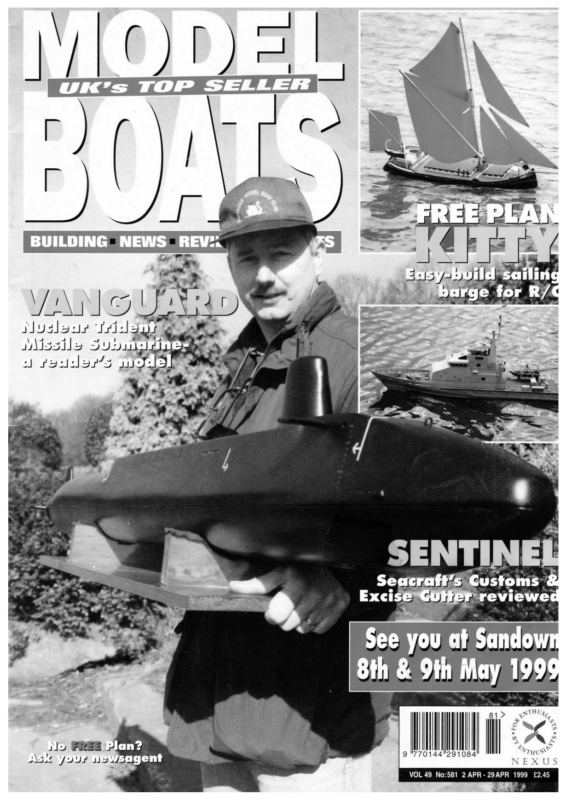
Model Boats: Volume 49, Issue 581 – April 1999April 15, 1999Archives, Model Boats (1966 - 1999) BOWSKI An R36R from Start to Finish by MICHAEL J. SHEPPARD Part Three Vito up BUILDING on REV: Wn oua. Nueloue weds i irs:Sie SUF ine in La w FeauetAers mpg a Sth & Oth May 199 —| |5 oF ~ THY, Se, a i, aK 2 me aq ASK YOur. newsobit iJ) FREE |; » a, ee VOL 49 No:581 2 APR-29APR 1999 4 8 > £2.45 _ = == iin. — ee wae ee ~ Ga gid wee LEAVE BURR me bat aca rm ion Wipes Me a a – ~TM i * a oo ite == sie SS A, te — i O S REMOVE im Se — i ~ las eta Wem an O is, a —-.: — i ‘e st TEETH STANDARD 10″ OR 12″ HACKSAW BLADES SEE SKETCH |(1) HOW TO USE RADIO YACHTING An R36R from Start to Finish MICHAEL J. SHEPPARD takes us through a detail build of a Radio 36 Restricted yacht using grp techniques – Part Three Final finishing Photo 28 shows the mould, rested and with all grinding finished. Hands up now those who think it’s time to start churning out boat hull mouldings by the dozen? Wrong, sorry to disappoint but that is far from the case. It’s Ts 62 fe elbow grease time again and, not with wax either. That lovely shiny surface so painstakingly moulded in has to be destroyed with wet-n-dry paper to form the base of an even better finish. Do use plenty of soapy water and be most careful not to pick up even one grain of grit during the process. The grit paper will require to be hand supported. Start with a new piece of 1200 grit, finish off with 1200 grit well used. Any bad spots found in the mould surface, use your discretion regarding how coarse a grit paper you resort back to for that patch. And, if it should be filled in then jolly well fill it in! Use resin for this, not car body filler ‘cos that stuff will only come out again later. Should you hear a squealing, scratchy sound, stop faster than you can. Even better stop before you hear the squeal. Scratchy being the operative word for scratchy in, oh botheration, I’ve managed to pick upa little . grain of grit and it’s carving dirty great swirly patterns of a Picasso nature all over my nice clean mould face. Have a good cry and after it has happened once, you will go to extreme lengths for it not to happen again. It’s called experience. Plenty of soapy water to flush the job at all times. Any grit will then be washed away before they change the mould surface landscape. Let’s go back for a moment to cover filling in any indents in the mould surface. They will show like a big dog’s whatsits. Only you can decide, do they need filling in? The indents, not the whatsits. Thankfully the moulding that comes of them will have a bump, opposite to an indent. Bumps are far easier to treat than indents. Only if the indent is deep enough to effect the full depth of the gel coat on the moulding, by cutting down the bump, is it really worth the hard slog involved in filling in and making good any indent. It is a case of, each to his own opinion on this one. Any filling is best done with gel coat resin. Don’t forget to cover it with a piece of Sellotape to keep the air out while it hardens. The resulting bump on the surface of the mould is best scraped smooth, rather than trying to rub it away with grit paper. A most useful scraper for this exercise can be fashioned from the end of a hacksaw blade, ground square across the curve end. Leave the burr on as it helps the cutting action. Sketch I will explain better. While at the grindstone it is also a good idea to remove the saw’s teeth as well before they somehow manage to leave unwelcome marks when using the scraper in wood chisel shaving action, i.e., flat to the surface and push. When working with the wet-n-dry paper be particularly careful not to round off any of the seam join edges. If you feel comfortable with it, i.e., can you get at the job area, maybe even bolt the seams together to protect them. Then comes the job I positively hate. T-cut time and with more elbow grease needed than my birthdays really allow for. This is the stuff that puts the smile back on the face of the tiger. It’s very hard work. One, two, or even three applications may be needed. Go electric? Let’s go electric and see what happens. A couple of months ago my old electric hand drill expired with a loud bang and stink plus a huge puff of smoke. Nearly took me with it, in fright, as it were. The drill was replaced by one having an electronic trigger. That is, one that can vary the speed of the drill down to a very low R.PM. Having then dug around and found my mop arbor, long time no see, I managed a bit of boo-boo. What to do for cloth discs to make up the mop? In the rag bag was some handy looking piece of towelling, which I thought, being bulky and soft would make up into a mop very nicely and quickly. It made up well y MODEL BOATS VOL. 49 – No. 581 enough, but became un-made-up just as quickly when put to work. Most of it over Ready at last yours truly as well. Crapped on, from a rotary height if there is such a thing. The weave is Photo 28. Standing proud and ready at long far too loose in small pieces, should have known. It requires umpteen and more layers of a closely woven cloth. A sheet or as I used, some ex-curtain lining. No need to be too fussy about the shape of the pieces. If possible use a hollow punch to put the centre hole in as this allows the discs to sit that much closer together when clamped up. Rub T-cut compound well into the mop with fingers and spread a thinnish smear over the mould surface itself. Don’t apply it in odd pools, it just gets spread all down your front and over the workshop wall. There’s nothing to beat experience, is there. Adjust the speed rate on the drill to its slowest rate to start and the job becomes easypops. Never again will the job of T-cutting be such a drag for me. In other words it works. Not yet experienced is what happens when the steel drill chuck rubs against the mould surface. Doesn’t bare thinking about. Do not attempt polishing with a standard, one speed drill. The RPM required is in the region 50-60 with a fair degree of pressure. It’s about concrete mixer speed, if that’s of any help. And yet more rubbing. Final waxing time is here at last. No, I’m not prepared to try the drill on this one, it’s far too important. Remember, six coats at two per day for the first couple of pulls from the mould. One early morning and one tea/supper timeish. The mould should be waxed a few times in its sectional state, i.e., before deck sections are bolted on. Flanges as well, or at least a good percentage of them in width. This is to discourage any resin that seeps between them from sticking. Most important, it is. Do also wax all raw edges of the mould that will come into contact with resin. Like the deck inner edge. Press wax into join seams when they have been bolted up to discourage seepage and continue waxing, say the last two coats. After six or more coats of wax the seams and angles are best treated with a light, carefully applied trail of release agent applied with a child’s paint brush. It is a bit belt and braces like, but worth the extra protection. Never forget though, release agent never enhances any finish previously achieved by hard graft. It does however protect your investment of effort and time. Your choice. MODEL BOATS VOL. 49 – No. 581 rudder, deck moulding and radio mouldings Now in Photo 32 events have jumped ahead rather. With one notable exception, nothing has been done that has not been covered at some stage during the mould making process. But to recap: six carefully applied coats of wax, at two per day; release agent along seams and corners; two thin layers of pigmented gel coat and one layer of 300 gram CSM were applied to each half of the mould. Should you shy away from knifing the are all in the, yet to be done stage. More material along the centre line an alternative about them in due course. important, what shape do the lay-up is possible. Great care must be taken that the material fits properly along the centre/keel line. It is better that it underfits last to make a hull. For the prototype I’ve decided to use one layer of 300 gram CSM. This will be a cheaper way to test out the pattern accuracy. Production hulls later will be in carbon. (Ha, if it’s any good that is). For the keel, the mould is also in the photograph, CSM will also be used. At this stage the What shape is the mould, or more materials need to be? Photo 29 shows how I than overfits. An overfit will produce a get a basic pattern. A light textured cloth, in this case ex-curtain lining is torn into handlable strips and draped with generous wrinkle in the moulding (difficult to get out) overlapping edges inside a mould half. Small dots of PVA glue are then used to hold them together in shape. The deck to hull join in C.S.M. is always a torn edge overlap. Lay-up material along the centre join is laid out over the edge of the mould and knifed back flush at the green stage of curing, i.e., when it’s still soft. Take great care in that operation that should you disturb the material away from the mould, you lay it back down again even if it requires a touch of fresh resin to do so. Both ends, pointed and blunt are put in after the mould halves have been bolted together. It saves some cutting and is easier to do as far as Iam concerned. It’s a matter of choice. They are a torn edge patch that covers the ends. The deck edge pattern is made in a similar manner to the hull pattern but using overlapping strips of cardboard, all glued together in the same way. Photo 30 explains. Both patterns are then spread flat to make proper, stiff, cardboard copies of them as in Photo 31. More than likely one or both will need modifying after use. They will however produce an excellent start to your required shape. Bow and transom can be done in a similar manner, but taken from the plug is a far simpler process. Just had a minor brain storm. Why not make these hull patterns when the mould surface is non-slippery and less vulnerable to mishap. When it’s just had a bashing with wet-n-dry paper. Next time. Make it properly is the best advice on offer. Should it become necessary to get the knife and an underfit will just need a slight filling in afterwards, and be difficult to detect. out to trim along the edge, The knife must be sharp. Do not cut through the wax coat protecting the mould. A very carefully applied dab of release agent can be applied to the wound should you do so? The exception to previous procedure is this. Mopping out. Any excess resin beyond requirement is just unwanted weight and no advantage strengthwise so get rid of it. How? Two ply toilet tissue, colour to taste, is very appropriate, you will agree and works very well. Use it like you were taught by mummy, well nearly. Use a few panels joined together and lay them out flat on the wet resin. Roller them with your dry lay-up roller and the underneath leaf will become impregnated with resin. When the top leaf starts to skid around and crumple, peel them both out as carefully as you know how. For some reason only the bottom leaf gets soaked in resin. Possibly the paper manufacturers can explain this one. I suspect some sort of moisture barrier on the inner faces of the two leafs, to um, keep one’s fingers clean – now that’s what I call thoughtful. Kitchen roll paper is not so successful because it disintegates into a pulpy mess. Go over the whole lay-up. However, don’t get carried away with the good work, please leave some resin on the job or your efforts will become, er, collapsible. Yes, that is the keel mould in the foreground of the photograph, being dealt with on paper as a separate project later. 63 Coming together Now it’s choice time. Two methods of bringing the mould halves together are open. Or rather two time lags. Option one, slap the mould together while each lay-up is green and uncured, or, as I do now, wait until both halves are cured before bringing together and bolting up. I seem to get less reject upsets by this method. It does not appear to matter whether the two moulding edges are wetted before joining with gel or not. When bolted up the join line is then stippled hard using a chopped down artist’s brush of a suitable size with pigmented gel coat. Work at it, keep jabbing away until the crack must surely be filled up. When joining up while the moulding is wet or green care has to be exercised not to damage the lay-up by any stippling action. Fill the crack with gel then carefully wipe of the dribbles and blobs to either side so as to leave a Smooth, clean finish. Allow to dry, say three hours minimum, depending on temperature then put a splint along the join line to cover it. If CSM is used then a torn edge each side is neater which can be worked in with ye ole roller so as to be undetectable. Carbon fibre is a quite different animal and will show whatever you do. It’s even near impossible to get it straight. Success Fig 33. First one born. The blue afterbirth stains are of course traces of release agent and will wash off very easily with soap and water. Yours truly is very happy with this result. Just like our coming into the world, it is not always plain sailing. Sometimes a struggle is performed getting the thin moulding out of the heavy and stiff mould calls for patience. The two deck parts of the mould will come away fairly easily by splitting open with a chisel and working along the seam with thin wooden wedges. Even the keel line seam will come away without a lot of panting and heaving. That applied muscle has nothing whatever to do with the panic going on in one’s head and heart – has it stuck? Have all my efforts come to nothing? How bad? Could it be repaired? Is the mould OK? Is it worth repairing? Only those who have done it, gone through it, will understand the actual pain. One half of the moulding will always remain tight inside one half of the mould. It goes without saying, it will of course be that half which sticks the most strongly. Easy enough to understand when one stops to think about it. The first few pulls from a mould, pulls being tec talk for items being moulded and extracted from a mould, are usually more difficult to get out until the mould is sort of run-in as it were. How to get the moulding out of the last mould part without anything strong enough to lever against is the problem. It cannot just be pulled because it will most likely tear. For full size hulls they use compressed air and very long thin wooden wedges which are driven in with hammers, water, rubber mallets to pound the outside of the mould to flex it to break the suction. Even, moulds are bolted to the floor and blocks and tackles are rigged to exert a sustained pull on the moulding over a long period of time – like over night. What can we do? Long thin plywood, spatula style wedges are very handy. They can though if used harshly cause cracks in the gelcoat, even crack the moulding itself if used with muscle and no brain. A kettle full of very hot water is a useful aid, poured between mould and moulding and inside the moulding as well as over the outside of the mould to expand it. Good advice getting it apart is, make haste slowly. Then when it eventually pops out and you are able to take a proper breath of air again, all is forgiven as one’s eyes dart frantically all over looking for damage. This moulding hada tiny ripple of cracked gel which was carefully picked out, refilled, wet-n-dryed, T-cut back to a near perfect finish. The patch of glass tissue inside is the only real give-away. Back to the photograph. The inboard deck edge has to be cut back. I use a piece of junior hacksaw blade silver soldered to a jigsaw shank and used very slowly. The slightly chipped edge this process produces is sanded clean with a sanding board. A small, fine, sanding board will also make short work of removing the flash on the seam lines. Warning – do not be tempted to break these flash pieces off by bending sideways. Chances are they will break where you do not want them and holes will appear which will make you most unhappy because of the extra work involved in filling in and finishing again. Finally, vigorously applied T-Cut will restore all to an overall admirable gleam. Toilet tissue hint! Also in Photo 33, on the shelf behind, is an ice cream container unmarked, used as a dust free toilet paper dispenser. It has a few lumps of lead in the bottom to stop it sculling around when in use. Good tip – nick a spare 64 roll while you are at it, you know how embarrassing it can be running out at an unfortunate moment. This unit is nearly as good an invention as the talc-powder box which my grandson has now christened, granddad’s ponk box. Fitting Out Photo 34. Different workshop now for fitting out. It is vital to establish the exact centre of a hull before installing keel and rudder. Stick some masking tape on the hull in the appropriate places to draw on. The hull is here supported on two steel bars while some form of square needs to be pushed up against each side of the hull. Halfway between the two verticals, just gotta be the middle. The photograph shows the rudder position being marked in. With a 36 design the rudder can project beyond the back of the hull so the tube can be well aft, which allows for a better moment arm. Don’t forget though that the tiller arm needs room to swivel without fouling the transom. The keel centre line has already been marked, as has the fore and aft positions. Going back for a moment to Photo 27 confirms that the centre is just alongside the join line. In fact it’s touching. Near, but not near enough, as they say. A word on my home-made squares might be worthwhile. Sturdy blocks of wood give them stability and the verticals, made from Paxolin, Formica or plywood are screwed to the sides and adjusted square. Another view of them can be seen in the next photograph. Photo 35. Crunch time. Don’t be tempted to take your previous efforts for granted, check them properly. As that old chestnut suggests – measure twice, cut once. Use a straight batten or better still a steel straight edge to line up between all five marks. bow, two at keel, rudder position and middle of transom. Do not bend the straightedge to suit your marks. Don’t laugh, it’s an easy enough thing to do. If they don’t all line up in proper fashion, somfink, somewhere has gone up the creek. So start the ruddy process all over again, even to taking the masking tape off and applying fresh. It must be got right. The batten in the photograph is shown clamped down. This was only for ease of photography. It did not show what was intended without being clamped in place. Pleased to say I didn’t need to tweak the batten to line up the marks. Fig 36. This is a good example of where an octypussy has distinct advantages over us mortals. The job needs to be still and solid for the surgery work. My method – yes of course it incorporates G clamps – is to tape the hull to a piece of wood and clamp that to the bench. The reddish coloured protective material is off-cuts of sail bag material which we will come back to in due course. Continued on page 70 MODEL BOATS VOL. 49 – No. 581 Bowski continued from page 64 Shaping up the hole Of interest in the photograph, seen laying on top of the hull is an abrasive profile board, purpose made for the job. It is not good trying to form an accurate slot with a tool like a halfround file that never is going to be even near to the right shape. OK it can be done, but it’s a sod-of-a-job and prone to slips at any stage. Select a piece of alloy sheet about 70/80 mm long, 20/30 wide and approx. Imm or about 20swg thick. Not too thick ‘cos it needs forming with your fingers – not with pliers as they will produce a crease line, so a file would be just as good. Put a very very gentle curve across the whole width, then increase the curve down one edge to as near the section shape of your keel as you can judge. Under section rather than over is a better bet. All this of course having glued the grit paper on. My choice is about 100 grit aluminium oxide paper held with Thrixofix, jolly good stuff. It should be clamped for gluing or the paper will not sit flat to the metal all over and will wear rather unevenly and more importantly, cut unevenly. A surgeon draws a mark and goes inside with a knife cut. We need to do more or less the same thing. Start by drilling a small hole, say 1.5 mm just inside the leading and trailing edge extremities. Then drill two series of holes longitudinally inside the expected section and form these into short slots. Then saw out with a modified junior hacksaw blade or one of them ‘andy abrafile things. It is best to cut, pulling, rather than pushing. Less damage is done to the thin mouldings by flexing. Thick mouldings can be push cut with no hassle. Note the callipers on the bench, they measure width of your keel section, which measurement is then drawn onto the masking tape as parallel lines each side of the centre line. Don’t cut beyond them. You can, with a little bit of jiggling about, arrange tapered lines to conform to your keel section, but in practice it’s not really worth the bother. The centre line is the one to watch. You could put a few marks on as a guide if you are trembling about the job. The flexing of the thin hull material can be deadened with the fingers of your spare hand, if you can find one, and a firmer pressure of the grit board on the pull stroke will make life easier. Should you be performing the operation on a hull with a Kevlar doubler, use a new hacksaw blade and be prepared to work considerably harder during sanding. No wonder that stuff can stop bullets and knives. The secret to a good fitting is: more time spent trial fitting of the keel than is spent sanding out the slot. Just a bit at a time working from the midway area out to leading and trailing edges. Keep your eyes sharply on the maximum width lines and in a very short space of time you will find the keel slips in as a nice tight fit. Impatient persons should stand back a bit more often and ponder what the job would look like should they cock-it-up at this late stage. Enough surely to kerb even the most over hasty of people. Take your time. Make haste slowly. Think, how could they possibly allow anyone to see it if done badly? 70 MODEL BOATS VOL. 49 – No. 581 Photo 37. With the model supported in a suitable manor, the keel is slipped into place and held with, in this case, a strip of masking tape while the deck moulding is trail fitted. The lugs seen in the photograph are made from thin carbon fibre lay-ups and pre-glued to the deck sides to make life a little easier. It can of course be done t’other way around, by gluing the lugs under the hull deck edges. When happy with the dry fit, main point to watch in this case was that the radio pot did not foul the cut-out in the keel; glue in place with gelcoat resin (best if pigmented) and clamp. GQ) — SAWCUTS DEPTH OF HACKSAW BLADE y PETTITT] qj BF = Ba Fae Sg 0 | Oo! r S/S SHEET — rudder have to be got in as near perfect alignment as it is possible to achieve with the facilities at one’s disposal. So important is the job that adequate facilities have to be devised before the job is commenced. Should any of them be out of tune then the model will sail accordingly, i.e., like a three legged pig. What is needed is someway of mounting and holding the model to check the squareness of the four main components. Yes, four, the hull itself being the fourth element. It is no good having the mast, keel and rudder all nicely lined up if they are not in the centre of the hull. Or the hull has a list on, or both. They have to be square to deck. Although my system may well be considered over the-top by some pundits, it must come under the heading adequate facilities. Six G clamps are used to erect T frames at convenient height each side of the bench, which is an 8×4 sheet of faced chipboard. (These T frames have now at long last been bolted up as units to save wearing out my G clamps.) For a deep keel model, RM etc., the model is suspended cantilever fashion out over the edge of the bench with the keel hanging down below. The whole contraption is adjusted level and square with a spirit level. The model is then tied underneath with a stretchy material to make sure it remains tight up to the cross rails. These incidentally are adjustable shelf bracket struts that would normally be screwed to a wall. With the model held square, the rest is easy. Photo 39. This is the adjustable mast step formed from sheet stainless steel sheet. With the model being a prototype, the mast position needs to be adjustable. Sketch J gives more detail. The holes in the lugs are not essential but do aid the bonding and adds some lightness which is the right way to go. Fig 40. Many people will be aware of using window, door frames, corners, etc., for sighting purposes. In the photograph it is possible to see a useful modification. On the window sill is a large set square standing up. This can be moved along to suit any better position that is eu d FOLD =sims “_ sawcuTs Alignment Photo 38. Somehow, the mast, keel and a ee preferable. On the bench top is a model aero engine box, Super Tigre (thanks Mick) which — MAST TUBE is expected to be square and can again be moved around to suit the best position. It does perform better if internally weighted, but is N.B.G. at all if the bench is not level to start with. Do check it properly with a spirit level the bench, not the box. The tube representing the mast is a 5/8in alloy tube with a turn or two of tape to pack it out to fit the mast tube in the boat. It is not really good enough to use a mast fitted with its PTFE bearings only, which may or may not be a proper fit in the mast tube. A piece of suitable size wooden dowel would be just as good for this. It just gotta be straight. — , ‘ The keel needs to be tied up to the hull in some way so that it is free to be nudged to PTFE OR + NYLON CONE either side just a touch at a time until square, when a small hole should be drilled through —_ rate | – $ from the deck area into the top of the keel. A Tes — At joe THIN PLY SERRE PLUG s/s self tap screw will then secure it in place. Do not glue the screw first time in, wait until you are sure no further adjustment is going to be necessary. In other words, check it properly first. Measure twice, cut once. With the deck level, and the keel now forming a T, it should be fairly simple to establish the position for the mast. Having made sure the hole in the deck is central and correct fore and aft, move the step fitting until satisfied with the position, then mark that position with extended lines with a felt tip pen on the hull bottom. Photo 41. Mast step in place, showing the extended pen lines to help positioning after applying a base coat of your choice of glue. Here Plastic Padding with added glassfibre strands is used. The glassfibre or indeed wood of a hull bottom should be attacked vigorously with fairly course grit paper before bonding in of the mast step. 4 : — CLEARANCE 2 SHORT SLOT TO ENGAGE SLOT FORE/AFT ELEVATION SIDE ELEVATION * SLIP A PIECE OF THIN, GREASECOATED PLY OR PLASTIC SHEET IN THIS SECTION OF TUBE TO FORM THE SLOT AND FILL EACH SIDE WITH FIBRE FILLED ‘PLASTIC PADDING’ OR ‘MILLIPUT’ (HELPS WITH POSITIONING TO ENGAGE THE ADJUSTING TEETH) To be continued ACTion . 0… COMPUTER Speed controllers which are designed for Scale performance, Small size, easy build and kind on the wallet. (RM. MARINE. RM \ = ee MARINE L.O.A. 510mm : caus sacesenes = Beam 165mm Sounds include Diesel, Steam Engines, Horns, Bells, Whistles, Destroyer, Police Siren, Asdic and Gun. = Expanding range, in easy DIY Kit form, or Built-to-Order. QUALITY, INOVATIVE, COST EFFECTIVE KITS. See You at ‘CHILD BEALE Model Boat Show’ Ist/2nd MAY Send two First Class Stamps for Lists. (overseas two I.R.C.) ALL WOOD KIT, CNC CUT. LAPSTRAKE CLINKER CONSTRUCTION. COMPLETE WITH PROPSHAFT, PROP AND FITTINGS. EASY TO BUILD. INTRODUCTORY PRICE £55.00 + £5.00 P&P SEND S.A.E. FOR LEAFLET. CHESTER HOUSE, THE DINGLE, COLWYN BAY, N.WALES LL29 7SN Tel: 01492 534347 ACTION 140 Holme Court Avenue, Biggleswade, Beds, UK. SG18 8PB Tel 01767 314732 E Mail MODEL BOATS VOL. 49 – No. 581 actionkit@aol.com : \ = CALLERS BY APPOINTMENT ONLY E £ 3.00 CATALOGU et Previous Post Windling World: April 1999 Next Post Windling World: August 1999