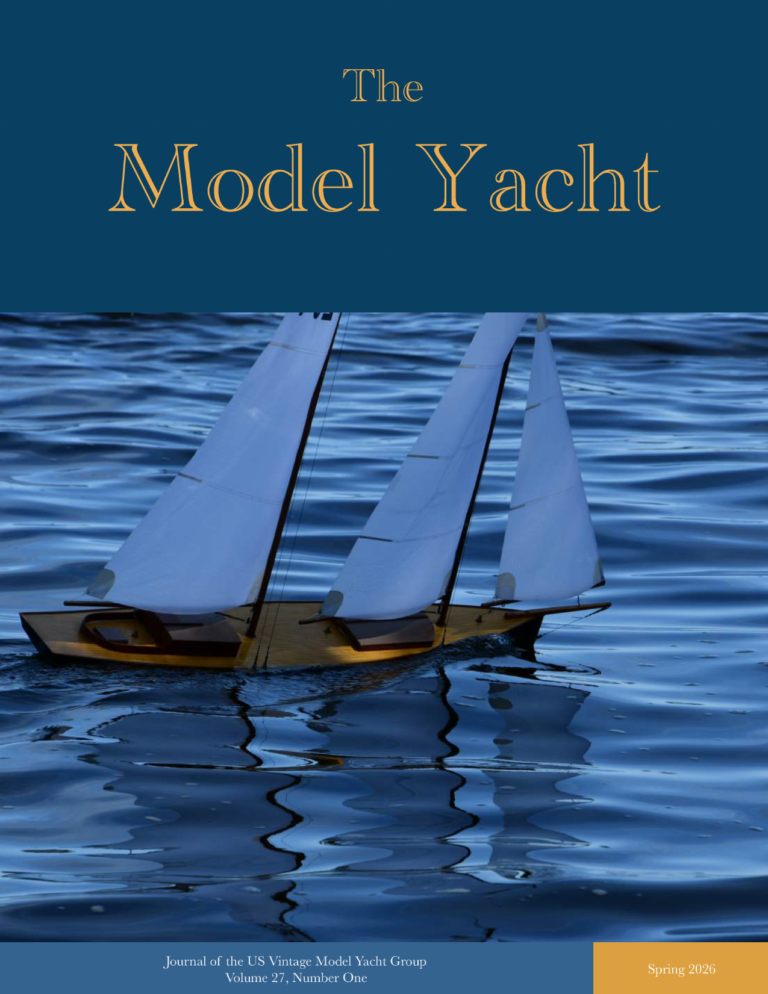
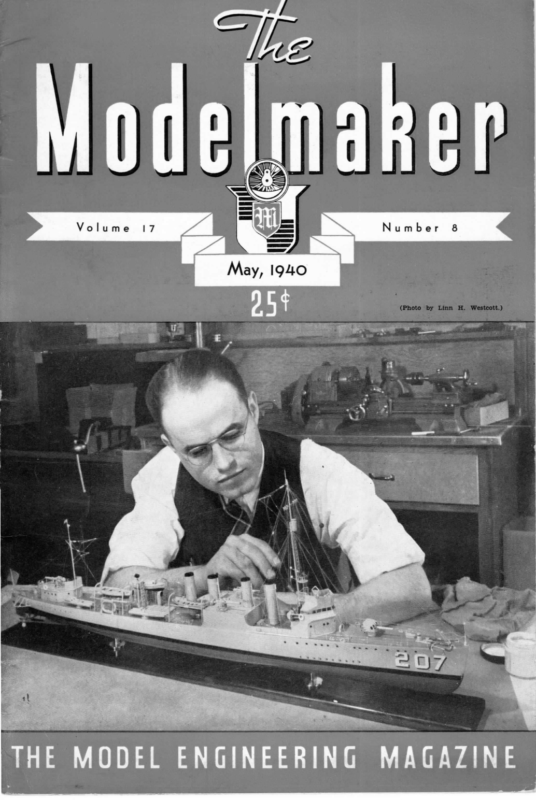
The Model Maker: Volume 17, Issue 8 – May, 1940

  • Adapting for American Winds. While British A-Class models often featured heavy displacements (55 to 60 lbs) for the strong winds of Fleetwood and Gosport, Pigeon argues that American skippers in the East and Midwest deal primarily with moderate and gentle breezes
    • The Design: Pigeon’s model is lighter with a larger sail area (approx. 1785 sq. in.) and a displacement of 41.35 lbs (with 30.4 lbs of lead), making it more responsive in “flat calms” and easier to transport.
    • Dimensions: The featured yacht has a Length Over All (L.O.A.) of 78″, a Load Water Line (L.W.L.) of 48.6″, and a draft of 11.3″. 
  • The A-Class Rating Formula. The article provides a detailed breakdown of the official International A-Class Formula, which calculates a rating based on length, sail area, and displacement: 
    • The Formula: L+S+L×S12×D34=Ratingthe fraction with numerator cap L plus the square root of cap S end-root plus the fraction with numerator cap L cross the square root of cap S end-root and denominator 12 cross the cube root of cap D end-root end-fraction and denominator 4 end-fraction equals Rating𝐿+𝑆√+𝐿×𝑆√12×𝐷3√4=Rating (Targeting a maximum of 39.37″).
    • Quarter Beam Measurement (Q.B.L.): A penalty is applied if the hull is too “fat” at the ends. The Q.B.L. is measured at a distance of 1/4 the beam from the centerline and 1/10 the beam above the waterline.
    • Limits: The rule limits the height of the sail plan to 85.3″ and ensures the hull is a “fair continuous concave curve” with no hollows between the waterline and the sheer line. 
  • Controversies and “Monstrosities”  The text references a famous dispute involving Dr. T. W. Houk, who discovered a “flaw” in the original wording of the rule. 
    • The 20ft Sloop: Houk proved that a massive, non-scale yacht could theoretically be built and still rate legally under the class.
    • Rule Revision: This discovery led the Yachting Monthly Cup committee to change the wording to prevent such “monstrosities” and preserve the class’s aesthetic as a scale representation of full-sized yachts. 

Number THE MODEL ENGINEERING 8 MAGAZINE THE COMMODORE’S / CORNER EDITED BY CHARLES FARLEY Presentation and discussion of technical and theoretical subjects related to model yachting will be the feature of this department. Material intended for publication should be addressed to “The Commodore’s Corner,” care of Tue Mopetmaker. Constructive criticism of articles and plans are invited. All such, however, must be free from rancor or personalities. A-class model owned by J. Patrick of the Washington M. Y. C. HIS issue of THE MopELMAKER presents a new A-class design by Fred L. Pigeon, designer of many successful models. Although in the past few years the A-class rule has produced boats having an l.w.l. well over 50” and with displacements ranging from 55 to 60 pounds which have had success in localities blessed Siz ‘ie Boppy crass PLAN “A“ MODEL SAILING YACHT SCALE % FULL SIZE with strong winds, a lighter model with more sail area will be found better for the general conditions found in America, especially in the 268 DESIGNED FRED BOSTON L. BY PIGEON MASS. The Modelmaker on the gradually increased, and Admiral Turner cites average, only moderate and gentle breezes. The East and Midwest, which experience, figures to show that early boats and some of the present design will be found particularly suited present-day craft are considerably dissimilar, for the latter conditions. as follows: The International A class was introduced in Great Britain in 1922 by Maj. Heckstall-Smith, the well known designer and writer, and the original rules have change. However, the size undergone practically Dayspring 66.2 Wisp no and weight have L.0.A. 76.2 Reginald Lance pounds. L.W.L. Displ. S.A. 51.9 54.4 1750 44.0 36.5 1850 Beam 15.6 15.7 sailed a boat weighing Admiral Turner’s Artis 65 weighed 69