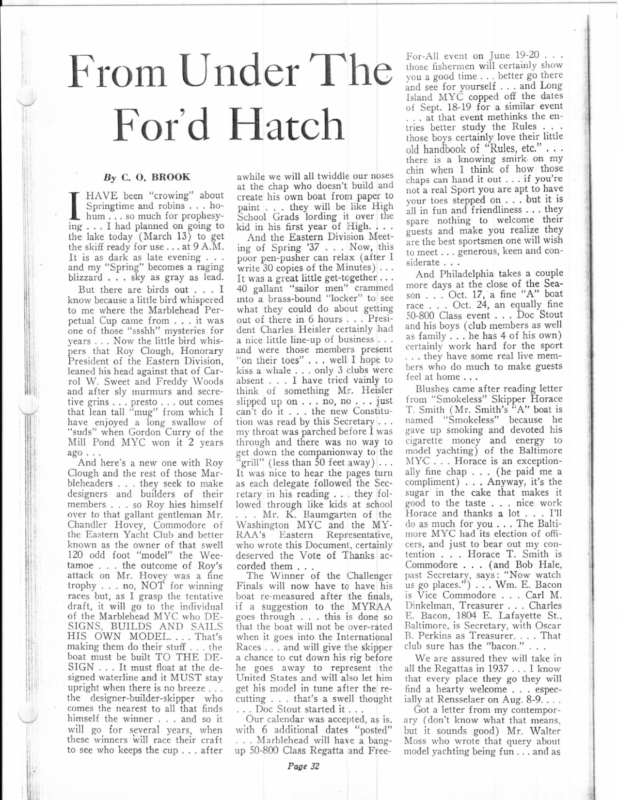
- “From Under the Ford Hatch,” C. O. Brook details the Eastern Division model yachting community’s activities, including a new trophy for designer-builder-skippers, a significant division meeting, and plans for the upcoming international racing season. The column highlights events like regattas in Marblehead, Long Island, and Philadelphia, and mentions the election of officers at the Baltimore MYC.

From Under ‘he Ford Hatch awhile we will all twiddle our noses By C. O. BROOK | HAVE been “crowing” about Springtime and robins .. . hohum… so much for prophesying … I had planned on going to the lake today (March 13) to get the skiff ready for use… at 9 A.M. It is as dark as late evening… and my “Spring” becomes a raging blizzard . . . sky as gray as lead. But there are birds out… I know because a little bird whispered to me where the Marblehead Perpetual Cup came from… it was one of those “ssshh”’ mysteries for years … Now the little bird whis- pers that Roy Clough, Honorary President of the Eastern Division, leaned his head against that of Carrol W. Sweet and Freddy Woods and after sly murmurs and secretive grins… presto… out comes that lean tall ‘““mug” from which I have enjoyed a long swallow of “suds” when Gordon Curry of the Mill Pond MYC won it 2 years ago… And here’s a Clough and the bleheaders . . . designers and new one with Roy rest of those Marthey seek to make builders of their members . . . so Roy hies himself over to that gallant gentleman Mr. Chandler Hovey, Commodore of the Eastern Yacht Club and better known as the owner of that swell 120 odd foot “model” the Weetamoe . . . the outcome of Roy’s attack on Mr. Hovey was a fine trophy .. . no, NOT for winning races but, as I grasp the tentative draft, it will go to the individual of the Marblehead MYC who DESIGNS, BUILDS AND SAILS HIS OWN MODEL… . That’s making them do their stuff .. . the boat must be built TO THE DE- SIGN … It must float at the designed waterline and it MUST stay upright when there is no breeze. . . the designer-builder-skipper who comes the nearest to all that finds himself the winner . . . and so it will go for several years, when these winners will race their craft to see who keeps the cup… after at the chap who doesn’t build and create his own boat from paper to paint . . . they will be like High School Grads lording it over the kid in his first year of High… . And the Eastern Division Meeting of Spring ’37 . . . Now, this poor pen-pusher can relax (after | write 30 copies of the Minutes) … It was a great little get-together… 40 gallant ‘‘sailor men” crammed into a brass-bound “locker” to see what they could do about getting out of there in 6 hours. . . President Charles Heisler certainly had a nice little line-up of business. . and were those members present “on their toes”… well I hope to kiss a whale… only 3 clubs were absent . . . I have tried vainly to think of something Mr. Heisler slipped up on… no, no… just can’t do it… the new Constitution was read by this Secretary… For-All event on June 19-20… those fishermen will certainly show you a good time. . . better go there and see for yourself .. . and Long Island MYC copped off the dates of Sept. 18-19 for a similar event . at that event methinks the entries better study the Rules… those boys certainly love their little old handbook of “Rules, etc.” .. . there is a knowing smirk. on my chin when I think of how those chaps can hand it out .. . if you’re not a real Sport you are apt to have your toes stepped on… but it is all in fun and friendliness . . . they spare nothing to welcome their guests and make you realize they are the best sportsmen one will wish to meet… generous, keen and considerate … And Philadelphia takes a couple more days at the close of the Season… Oct. 17, a fine “A” boat race… Oct. 24, an equally fine 50-800 Class event . . . Doc Stout and his boys (club members as well as family … he has 4 of his own) certainly work hard for the sport … they have some real live members who do much to make guests feel at home… my throat was parched before I was through and there was no way to get down the companionway to the “grill” (less than 50 feet away)… It was nice to hear the pages turn as each delegate followed the Sec- Blushes came after reading letter from “Smokeless” Skipper Horace T. Smith (Mr. Smith’s “A” boat is named ‘Smokeless’ because he gave up smoking and devoted his cigarette money and energy to model yachting) of the Baltimore MYC… Horace is an exceptionally fine chap … (he paid me a compliment) .. . Anyway, it’s the sugar in the cake that makes it good to the taste . . . nice work Horace and thanks a lot… I’ll do as much for you… The Balti- RAA’s more MYC had its election of offi- retary in his reading . . . they followed through like kids at school .. Mr. K. Baumgarten of the Washington MYC and the MYEastern Representative, who wrote this Document, certainly deserved the Vote of Thanks accorded them… The Winner of the Challenger Finals will now have to have his boat re-measured after the finals, if a suggestion to the MYRAA goes through . . . this is done so that the boat will not be over-rated when it goes into the International Races .. . and will give the skipper a chance to cut down his rig before he goes away to represent the United States and will also let him get his model in tune after the recutting . . . that’s a swell thought … Doc Stout started it… Our calendar was accepted, as is, with 6 additional dates “posted” … Marblehead will have a bangup 50-800 Class Regatta and FreePage 32 cers, and just to bear out my contention . . . Horace T. Smith is Commodore .. . (and Bob Hale, past Secretary, says: “Now watch us go places.”) … Wm. E. Bacon is Vice Commodore … Carl M. Dinkelman, Treasurer . . . Charles E. Bacon, 1804 E. Lafayette St., Baltimore, is Secretary, with Oscar B. Perkins as Treasurer. … That club sure has the “bacon.” … We are assured they will take in all the Regattas in 1937 … I know that every place they go they will find a hearty welcome . . . especially at Rensselaer on Aug. 8-9… . Got a letter from my contempor- ary (don’t know what that means, but it sounds good) Mr. Walter Moss who wrote that query about model yachting being fun… and as
MODEL CRAFTSMAN, The Home Mechanic’s Mayazine for May, 1937 33 20… ly show go there d this “‘bard’’ answered him, he was sure [ was throwing “eggs” at him, yet he was just as sure we I was “ribbing” him…I made haste to assure Walter that I was just being funny, foolish or just natural…he wishes me all kinds of luck until I meet his The DOCK YARD Notes from all over the country show increased activity and new ideas as new boats await launching try-outs. boat … Then he hopes I’m so far behind him no one will know we raced together … Well, that would be about my place .. . But as I in most races answer to Walt… I have a longer race and consequently more fun… 1 hope Walt comes to our Regatta so he and I can have the fun of sailing together. … Gosh! if I were to race with everyone I want to race with, I’d be sailing in groups of 67 for the next 50 years… I’m jumping all over the pond… back to N. Y. now… It was a treat to listen to the offers of clubs “A” boat lly fine ioc Stout ‘s as well his own) for the care of our tors the International to foreign visi- 50-800 event at Boston in Oct… . Boston MYC… the clubs in Detroit, Mich., offer to underwrite a free trip and entertainment from Boston the sport to Detroit to the visitors . . . Carrol Sweet asked to have committees appointed in various sectors to raise funds to show them a real time… There will be as many American boats in both the “A” Class and the 50’s as any one country sends over… and these Yanks will be the National Champion and run- ners-up in their respective classes . . . I’m wondering where the MobEL CraFrsMAN Trophy will land about Oct. 31… probably in Germany or England . . . possibly in Denmark… I’d suggest that the M. C. Staff take a long squint at that attractive bit of silver… We saw the plans of the South Jersey MYC Club House… methinks it’s a picture of a British Mansion … What with a beautiful pond “made to measure” and a wonderful home to go with it, those boys from close to the Penn line Carl M. . Charles yette St., certainly th Oscar .« Lhat are to be congratulated .. and Fred Pigeon told us at the meeting that there will be two pools built at John Black’s front door … lucky Down-Easters . . . I can see where John hops from bed to lake in one jump and _forsakes family and profession . . . don’t blame you John .. . save a berth forme… rt mh, Jalter ry about ..and as tt , Power Boat Activity on the pointed out in the I’ll be with you .”. . And Frank E. Snow of the S. i. MYC designed a flag for the MYRAA … he “swiped” the National Flag and made a real job of (Continued on page 58) Coast () the first official meeting of N Friday night, February 12, the newly formed Southern California Model Power Boat Association was held at the home of Maynard Clark. The only officer voted upon was that of Secretary, for which position I was chosen. We have a system to stimulate competition in the club. Once every three months, every one in the club competes for his position in the club, and at the end of the race is given a number for the position he made. Naturally the winner will hold the No. 1 until he is beaten. A member can challenge another member to a race at any time for his No. This makes the fellows work like “all tornadoes.” The pictures show two of the boats owned by club members and the lake where we race every other Sunday may be used all winter long! Clark’s job will do about 35 m.p.h., and there are two or three other boats in the club that are fast too. I will try to send you pictures of them before closing time for the next issue. My job, “Pygmy,” has only done 20 m.p.h. so far. J. B. Hastincs If you have not cast your vote in the Presidential Elec- of the A.M.P.B.A., you should do so at once, Mr. A. H. Hill is the candidate, although you may vote for anyone else whom you choose. If you are a member of this Association, your vote should be sent directly to Edward E. Thorp, Secretary of the A.M.P.B.A., 4 East 53rd Street, New York City, or directly to this magazine, and it will be turned tion, over to the nard Clark’s streamliner at a Pop-Wl- low, Cal. conclave. The Middle West Chicago We received a letter from Mr. Scott saying that their Boat and Sport Show, February 28 to March 7, at which they exhibited their model power boats, was. very successful. Mr. F. E. Ludolph, a member of the Chicago Model Power Boat Club generously donated the space for the exhibit. Sixteen power boats were shown, 14 gas and steam engines, and 3 plaques of gas engine parts and photographs of various boats in action. The display attracted the attention of a large number of people. Over 75 prospective members were HAVE YOU VOTED? tion Mr. Hasting’s “Pygmy”, top, and May- Associa- contacted. Mr. Scott promised to send the ’37 boat schedule for his club, and we will print it as soon as it is re- ceived. The date of the National Power Boat Race will be announced at the same time. We regret that the photograph sent us was not good enough this page. for reproduction on Detroit We received word from Mr. R. A. Hill, of Detroit that the members of the Detroit Society of Model Engineers have their boats pretty well in shape for the com- ing season. He has promised us photographs for our next issue. (Continued on page 34)
A “Park Avenue Boom By GEORGE E. KRAMER Working data on practical boom that gives better sail draught. Gece time ago, I was finishing the construction of a three-foot over all model racing yacht. As I commenced work on the rig- ging, it occurred to me that it would be a good idea to fit the boat with a “Park Avenue” boom like the cup yachts have. I wanted my boat to be modern, so I got out my drafting tools and worked out the design described in this article. to the other end of the tracks and the curvature is reversed. The real booms are triangular in section, but, for the model racing yacht, it may place. Before doing this, however, sail. Two ways of accomplishing this have been devised and used on large modern yachts. One is the “bending boom,” which as its name implies, actually bends itself to suit the curvature of the sail. The amount of this curvature being con- trolled by numerous struts and cables with turnbuckles. This type is very complicated and difficult to model successfully. The other rig is the so-called “Park Avenue” boom. This type has a number of transverse tracks or slides of varying lengths placed across the broad top surface of the boom. The sail is laced to blocks, which slide back and forth on these tracks, their travel being limited to the length of the tracks which they slide on, the length of each truck in turn being limited by the width of the top of the boom at that point. The wind pressure forces the sail up against the lee ends thick and triangular in shape. The large end must be wide enough to fill the space under the longest rod and the small end must be capable of getting between the bent down ends of the shortest rod. Now start at one end of the boom and push be found amply strong for the purpose. Now scribe a line 4” in from the edge of the board all around one highest efficiency then, the angle and curvature should be as uniform as possible throughout the entire make a jug of metal or wood 1/16” be made of flat board, as this will boom will have its foot standing in a straight line, while the rest of the rest of the sail is set properly. This is due to the sag or twist of the sail under wind pressure. For the between centers it’ may be better to bend them as you put them in Then the boat tacks, the sail swings To make one of these booms, take a piece of wood, preferably pine or spruce 1%” thick, 21” long and 134” wide. Lay out a centerline and the curved outline using the dimensions given in Fig. B. See that sail will belly out (if it’s a good sail). That part of the sail near the boom will lose a good deal of its efficiency, first, because it stands too flat, and second, because it cannot present the most beneficial angle of attack to the wind if the at i the wires are of different lengths In the first place, the efficiency of a sail depends largely on the angle at which it presents itself to the wind and also on the proper elliptical curvature of the sail it- self. (See Fig. A.) Now any sail which is laced to a PE ad of the tracks, the sail taking the curvature of the side of the boom. the bent ends of the wire composing the first slide into the first two holes. Then push the jig under the wire as far as it will go and push the wire down snug on top of the jig. Turn the boom over and clinch the ends of the wire after cutting them off so that 4%” remains. Withdraw the jig and do the same on all the others. Work right through without skipping any wires until all the layout is symmetrical and cut away the surplus. face. Then make two triangular metal plates with a pole at the apex of each to fit the gooseneck pin. Rivet or fasten these to the fore end of the boom. Next start at the hole in the gooseneck fitting and lay off, along the curved scribed line, spaces to suit the distance between the grommets in the sail you will use. I spaced mine 34” are in place. Next drill a row of 3%” holes along the center line of the boom. ‘ach hole should come halfway between two rods. Do not drill any of these holes near the after end of the boom, as they might weaken apart. this part. The object of these holes Then drill a hole at each of these is to reduce the weight of the boom points of such a diameter as to be as much as possible. After putting a snug fit on the wire you will use in any screweyes needed for sheets, later to take the place of the tracks clews, etc., you can give the boom a used on real yachts. Take this wire, coat of paint or enamel and it will which should be copper about be finished. To rig this boom, 1/32” in diameter, and cut it into . simply pass the sail lacing under pieces about 2%” long. Then bend each rod or wire instead of around the ends of each wire at right the entire boom, as you did with angles to the center part, leaving the old type. This allows the sail to the center part the right length to swing to one side in a curved line span the distance between the two under wind pressure. The extra holes where it is to go. Since all efficiency of this boom easily makes £ ee,an are . is/ of he / u / sail F sags * L ; L / j / a Y 7 . s/f Principle of the boom: sail draught can be effectively controlled. Page 30 to
31 MODEL CRAFTSMAN, The [Home Mechanic’s Magazine for May, 1937 ani – er —f Crd > = nt lengths be better t them in 3 oa) fr] a =| enough to wm? ongest rod be capable bent down ” “| x and push e first two under the o and push | | – – o 6) |= > 2 nN _oles = Lif = | aj zt : ul > he —_! hay < eg | % { 9 a < S top of the and clinch ter cutting ins, Withsame on all ht through res until all + S eaail =. = Seek I b oe compos- Se w nh Now start ee } r ¢ S + 8 fal ge le Q x ood 1/16” hape. The §