- What Class Model yacht Shall I Build? By C. A. Farley.
- M-Class (Marblehead 50-800):
- Constraints: Exactly 50 inches overall length with 800 square inches of sail.
- Goal: Designed for portability (fits in a car back seat) and to eliminate “freaks” by prohibiting metal fin-keels and vertical transoms.
- X-Class:
- Constraints: No limit on hull length, weight, or beam; only sail area is restricted (1,000 sq. inches).
- Performance: Noted as the fastest modern racing model due to the freedom of hull design.
- 10-Rater:
- Formula: Uses the Dixon Kemp rule
.
- Trade-off: The longer the waterline, the less sail the boat is permitted to carry.
- Formula: Uses the Dixon Kemp rule
- M-Class (Marblehead 50-800):
- A Vane Steering Gear. By R. P. Dezendorf.
- Vane Steering: By November 1939, “Vane gear” became the gold standard for heavy-weather sailing. In 35 mph winds at the National Championships, vane-equipped boats maintained course better than conventional rigs, though they remained prone to “dead spots” in light air.
- The Beating Gye: A specific technical drawing by T. Foster was published to help skippers build a “beating gye” using square brass tubing. This allowed for finer sail trim adjustments during competitive heats.

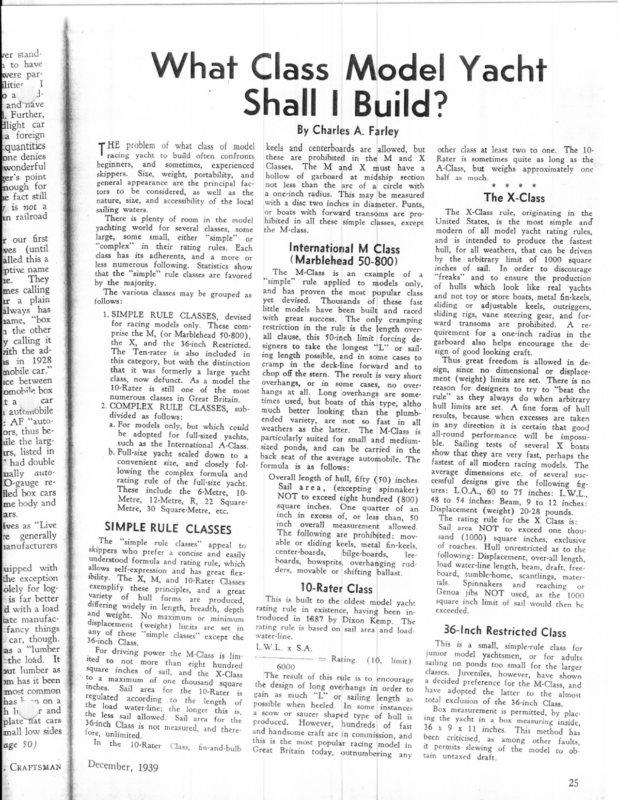
ber stand- What Class Model Yacht Shall | Build? h to have mere par- ilities J Ball iis and nave 1. Further, car dlight By Charles A. Farley ba foreign Equantities T HE problem of what class of model racing ne denies beginners, onderful to and skippers. ough for tors fact still railroad sometimes, to be considered, (until less numerous following. a more numerous car classes in Nw . COMPLEX 1 automobile Great RULE divided as follows: > AF “auto- ors, thus be- be Convenient rating rule Metre, ars. -is far better d with a load late manufac- and complex of the fol- and full-size 30 Square-Metre, variety of hull forms and are a most common has + -n ona h hr r and plate Mat cars mall low sides | age 50) , CRAFTSMAN § these “simple classes” Class. except Square a inches of maximum inches. regulated the load Sail sail, of area according water-line; one for and the thousand the the X-Class square 10-Rater to the length the longer this is of is, the less sail allowed. Sail area for the 36-inch Class is not meas ured, and therefore, In unlimited. the 10-Rater December, 1939 Class, applied the example to most Thousands of take the models only, class longest these The or in some cases, than or the ponds, and can garboard sail- in quarter of results, in center-boards, fin-and-bulb bilge-boards, troduced in existence, cessful ures: 1887 by Dixon rating rule is based on sail water-line, Kemp. area and 48 to ce Rabin. 6000 (10, gain as possible a scow much when or produced. “LTM or heeled. saucer sailing In shaped However, length some type as instances of hundreds hull is Britain today, certain will that be good impossi- etc. give 60 to of the 75 Beam, The several suc- following inches: 9 to fig- L.W.L., 12 inches: Spinnakers jibs and NOT used, square inch limit of sail mater- reaching as the would or 1000 then be 36-Inch Restricted Class junior is a model small, simple-rule yachtsmen, or class for for adults sailing on ponds too small for the larger classes. Juveniles, however, have shown a decided preference for the M-Class, and have adopted the latter to the almost total exclusion of the 36-inch Class. Box measurement is permi tted, by placing the yacht in a box measuring inside, of fast 36 x 9 x 11 inches. This method has been criticised, as amon g other faults, outnumbering any tain and handsome craft are in commission, and this is the most popular racing model in reat excesses are taken is exceeded. The The result of this rule is to encourage the design of long overhang s in order to dimensions 54 inches: Genoa load- limit). it board, tumble-home, scantlings, in- L.W.L. x S.A. de- A fine form of hull performance L.O.A., This apenas the Displacement (weight) 20-28 pounds. The rating rule for the X Class is: Sail area NOT to exceed one thousand (1000) square inches, exclusive of roaches. Hull unrestricted as to the following: Displacement, over-a ll length, load water-line length, beam, draft, free- an lee- been direction designs ials. having in the fastest of all modern racing models . This is built to the oldest model yacht in any average 10-Rater Class rule radius encourage ble. Sailing tests of several X boats show that they are very fast, perhaps the the bowsprits, overhanging rudders, movable or shifting ballas t. rating one-inch helps because when all-round The following are prohibited : movable or sliding keels, metal fin-kee ls, boards, a hull limits are set. Sail area, (excepting spinnaker) NOT to exceed eight hundred (800) One for also Thus great freedom is allowed in de- Overall length of hull, fifty (50) inches. inches. the sign, since no dimensional or displacement (weight) limits are set. There is no reason for designers to try to “beat the rule as they always do when arbitra ry back seat of the average automobile. The formula is as follows: Square is sign of good looking craft. medium- be carried rule, States, quirement variety, are not so fast in all weathers as the latter. The M-Clas s is sized * sliding or adjustable keels, outriggers, sliding rigs, vane steering gear, and forward transoms are prohibited. A_ re- plumb-| particularly suited for small and * inches of sail. In order to discourage “freaks” and to ensure the production of hulls which look like real ‘yachts and not toy or store boats, metal fin-keels, fast altho looking onc originating in the most simple and modern of all model yacht rating’ rules, Long overhangs are some- better * X-Class United forcing de“L” as the approximately much. * a popular of as weighs The X-Class have been built and raced success. The only cramping ended produced, _ For driving pow er the M-Class is limited to not more than eight hundre d ‘tO to great 36-inch any of an The 10- and is intended to produce the fastest hull, for all weathers, that can be driven by the arbitrary limit of 1000 square times used, but boats of this type, understood formula and rating rule, which allows self-expression and has great flexibility. The X, M, and 10-Rater Classes Principles, half but with over- SIMPLE RULE CLASSES these circle no The “simple rule classes” appeal to skippers who prefer a concise and easily exemplify a section inch in excess of, or less than, 50 inch overall measurement allowe d. : car, though. put lumber as om has it been great etc. -fancy things It with yacht. differing widely in length, breadth, depth and weight. No maximum or minimum displacement (weight) limits are set in as a ‘lumber models much a closely devised. overhangs, yachts, formula yet is proven little These include the 6-Metre, 10Metre, 12-Metre, R, 22 Squar e- Hed box cars me body and olely for log- size, lowing the O-gauge re- uipped with full-sized has hangs at all. such as the International A-Clas s. auto- the exception for of A-Class, chop off the stern. The result is very short sub- b. Full-size yacht scaled down to * had double ives as “Live re generally yanufacturers adopted a other class at least two to one. Rater is sometimes quite as long ing length possible, and in some cases to cramp in the deck-line forward and to a. For models only, but which could vile the largurs, listed in rule and signers Britain. CLASSES, have midship all clause, this 50-inch limit class, now defunct. As a model the 10-Rater is still one of the most ice between arc X restriction in the rule is the length over- this category, but with the distinction that it was formerly a large yacht omobile box the M-Class “simple” prise the M, (or Marblehead 50-800 ), the X, and the 36-inch Restricted. The Ten-rater is also included in 1928 =the load. The 1.SIMPLE RULE CLASSES, devised for racing models only. These com- mobile car.” than at must and International M Class (Marblehead 50-800) or show tollows: *“box garboard X M the M-class. The various classes may be grouped as has less and the or boats with forward transoms are prohibited in all these simple classes, except the model Statistics of M in a one-inch radius. This may be measured with a disc two inches in diameter. Punts, by the majority. a the other calling it vith the ad- wally not the that the “simple” rule classes are favored mes calling ta as prohibited The hollow for several classes, some class has its adherents, and iptive name in well are Classes. and fac- large, some small, either “simple” or “complex’’ in their rating rules. Each alled this a is these experienced There is plenty of room in r our first zame, as keels and centerboards are allowed, but confronts Size, yachting world always often nature, size, and accessibility of the local sailing waters. is not a wes build weight, portability, general appearance are the principal rs point in yacht it permits slewing untaxed draft. of the model to ob- 25
is: The 36-inch Class rule s 36 hts, as it has never strictly for dmotodelfulyac l-size yachts. been applie s: hes «es 7″ 9 inc The formula is as follow extreme –L.O.A., ext hes inc s 000 Ly -+0 e rem BEAM, extreme .—–+7 = Rating. 0″ 11 incunhesds Litwvs DEPTH, , maximum —-°° po 12 12 ¥D WEIGAreHTa, unmeasured. it). lim , .37 Sail (39 w: bo or e rudder d. ies are ims not includ L.O.A. doeter Many limits anusd topensetaltfor ite hib pro are here. rds boa Cen it. spr ed, too numeero # * # th pos & # * ; werful l area poave with the sai rage r de un t boa the ve dri with ts, boa l ful d an Short n bee ve ha a are l proportionately larger sai slower than possible, enough to conditions. tests to be row type proven gbyanactd ual comparativelry sainar e the lon nately smah llesmall lsaiarel a.areTh with prorrporowtiotyp is a long naed in thee, wit are-metre Swedish Squodi embodi ed type l-b ful r, rte classes, and thethsho s. sse cla 6Meter ied by e the exemplifan ity authorera American ne, Ske rm No sev d s de as en Cl mm s ign, ereSwcoedish 22 oF 30l cht des ya on Complex Rule Classe favor’ International Six-Metr4.e ago thaClat ssthbe adopted, with modie classes arewho like Adopted for models in 193 Six,’ as it yearsare-me mplex” rulyac The “cose men hts el . Skene , oF “Weere it has at- Squations, tre model. Mr The Six-metre ing ed by tho in mod d rac an 4 as ae, mul for d whe fic an s nd, ure tla er fig Sco mb to dabble intricate problems involving is known ingreatest popularity, is @ true was for many years 4asmeare nowofbethe ing work out cube root, etc. However, it is tained the of the full-size LY.RU. Boston M.Y.C. His ide ts resemblin d boa el an l mod era have been builtg sev square ary for the 6-Meter or A-Class scaleas two out and ed rk one wo of le sca 4 on not necess ae or 6M Class,hes to the foot. The rule makes the Square-metre e, and have proved d the formul n understanain inc fan to evehe ss t.rul draw thirds ion t rec cor to fix a to the new X Clafas a obt y h the skippecesr ins wit al opt d figures, asblueprma it ite ely red rem the acc ext ide me be so to read from ld the yacht, weight not exceeding 32 oun eight in of the swidintelyeresti ing or and intsimply hor aut x, Fo fa w-w Uf bui cre the ent res ke oks ma Square-metreng designer, igner yacht, to rep smaller in “Fox” yachtingbetbo is e ations to theset des etr 6-M e Th e. scal t leaving aller.calcul rec es wee cor rul te of each size than the A-Class, and accordingly comparisons Classes n (futhe s, ll-size. ) He saydeand measura sixteeThn-pe agscome ple e for the etr t te 6-M kle qui d boo an not of en and be r, e hte lig hav es res den’s naval requir in- shorter and form of the A-Class. he 30-sinSquceare190Met se rules dirhulectl,ly and by Sweed along the 8 of these theclassetyps. e The general fine ement is taken in the 6 “T d of ope m vel for OF fluence result in a tendency toward Girth measurch system tends to cause architects, who have workrea largest generally ted surface, full, or pot-bellied M Class, whi mp in the deckline in lines that with a fixed sail-a m, the am be cra mu wet large section, and heavy displacement. designers to as little as possible in the possible hull with a mini all weathethars,t midship e order to pay taxes. The rule generally could be driven fastest in from a power in the surfac are allowed L.W No hollowls bet the way of end l-bodied boats with moder’ was the best possible. Or, hull with the and .L. the n of the hul excwee duces ful and rather high free- point of view, the largest the required of e fil pro in the of meas pro rhangs sheer linrne,forwareptd ing ate ort smallest engine to givAne dit their idea is of the point ies are board.oveThi s is easier to transpmay clas s the ste alt pen ere and speed is the best. ment of “L”. Sev than the A-Class, 4 i \ i ‘ t / i ; ure arbitrary and handleended to skippers who want right. exceeding certai,n inv etres and 30 prescribed for rul olving be recomm les mes taken forStotheckh6-M tab and es , where the’ limits set by placement, maximum draft, 4 medium-sized scale model of an ex’ Squ“Ti olm at s tre -Me are ht. yac e ld were rac minimum dis -siz wor r-beam isting full a is: fastest 6-Metres in ntheCup and th difference,Mosquat rte the Gold minimum giroth mul for The se the -To of One the for s. ing 6 es length, and ered item rac 21 of may out , show that er in 8 races, andthethat to the rating, but ng L + 2d + VSF Cup ng. penalties are add rge Rati = reduci Metres were fast cha d off by ordinarily be Dis er s were faster inSca13 oth n tai cer 2.37 of ard the 30-Square-Metre reg . area es in nthe sail fiies uali r a ser of 60wherac Ove (32.80, limit). es. rac the same requirements OF limits result in disq re Many other restrictions, limits and pen: dinavia and Germany, cation. s were i * * * * International A-Class lass yacht is the The International A-C The in heaviest model now general use. of hull, m rule usually producess aarefine@ for dency to ten age ant adv dis but its A few ht. weig and th leng ing ever-increas about d ghe wei t boa e years ago the averagured about 70 inch 35-40 Ibs. and meas y successful boatess over all. Today manand run as long as weigh up to 65 lbs., 90 inches great credit for The A-Class deserves yacht racing el mod d nize orga boosting oad. Fea’ and es in the United Stat annual abr rnational turing it in the ting MonInte y Cup, thl Yach the for Races s Cup ica’ Amer the as to (often referred ed it acquire of Model Yachting), help considerable popularity over a period of several years. be This class was originally intended to, on alties are provided. * * * * Ten-Metre, Twelve-Metre Classes etre are also The 10-Metre and 12-M-siz e I.Y.R.U. full the of els scale mod 30-Square number of Sixes ande fast er in 18 cases, starting, the Sixes wer e faster in 42 cases. but the 30-Squares wer the h faster than hou muc so are The 30’s y are a qua r an of r rte Sixes that the mile race in a moderate faster in a ten ng up to one half-hour thi breeze, and any sea wing hard and thecement faster if it is blothei pla dis t ligh r h is rough. Wit instead of shallow in draft Classes, but they are too lacement when es and too light in disp tanding racing they climb overwaythethrwav outs be to n dow h, as do the ed oug scal r thei ng desmashi entirely l Yacht Racona ati models. The 10-M is now ern Int the of the 12-M, apy 6M boats Rule, which have practically funct as a model, and ass ing Union of the 30-Squares, proximately the same size as the A-Cl cement to the foot, is double the displa on a scale of two inches Scot e reserve buoyancy canmor no ing hav e and wher , land in fast dying out, even to not be expected lift half as well to the quite a following. it formerly had eee 86 6-Metres, Speed Factors and Comparisons claim ofthatmodethe A-Class, are better the ls, case h whic ors full-bodied, heavy The three principal fact the that and s, boat l yachts, as sea govern the speed of mode well as full-sized ones, are length, sail ght). Length, area, and displacement (wei class , is the most ulae form in “L” a model of the full-size 6-Metre as essed foot, but us’ exprrtan ng length saili al actu the is a scale of two inches toem the and t, impo ter-beam length not and ed, heel n ing the American syst ofgirtquar whe ined obta measure alone. th leng ne r-li wate measurement instead of meashurem ent is over-all orcallload speed, a most the get to ment. The quarter-beam force desi y, reti Theo gners said to have a tendency to should be easily driven, and“L”have the L.W.L. too hull great as to make the after ends of the a_ sailing length, or rule is one as lean. As it stands today 26 seas as these boats.” Square-metre type Opponents of the and, in the only “desirable” displacement type is the production of the rs favo up type. This gro craft, -bea wide nothing but husky, and chumed form, nky rd -boa free high with marer, long the on or horr and look with model yachtsrower types. Preferences ofbeau ty of lines, g men are varied regardinwith erences of pref ed par and may be com e artists of different schools, some of thes Tue MopeL CRAFTSMAN
delight in depicting the female form in well-upholstered and ample curves, while others prefer the slender and often “skinny” types of perhaps livelier attain- average with ments. As area is re-metre a model racing yacht is not re- _ quired to be either particularly “‘seaworthy” or “dry,” and aims for speed mainly, it follows that if speed is really wanted, the longer and narrower types of lighter weight should also be classed as jen’s models, and it has been proved that an X of long load-water-line is quite as fast or even faster than the full-bodied, heavy A-Class, except in very light winds, when along the an A, carrying approximately 1750 square ~the largest inches of sail, plus a large spinnaker, will generally out-drift an X having less than 1000 square inches of sail and no spin- beam that ll weathers, would longer but quite as beamy as the average A, and with not more than 1291 square inches of sail. She would also be found to be about one-half the weight of the A. The average modern 6-Metre yacht, on a scale of two inches to the foot, instead of one and two-thirds inches, would make a very good A-Class model; in fact the author has done this thing successfully. The above speed comparisons between different model conclusive, classes as it is possible under for are not certain entirely conditions a very small yacht to beat a much larger one, but such “twins” are nearly always fluky conditions. comparative due On speeds to the may “breaks’’ average be taken as fair estimate. ‘es instead of * * * or these a * rigs such as_ schooners, ketches, etc., and lastly the | so-called “freak” rigs, like the wishbone and others. The use of bent masts or spars are prohibited on the A and 6-Metre classes, but are allowed on all other classes. However, it has been demonstrated that bent masts, while apparently allowing better windward multi-masted work, are not entirely satisfactory on other points of sailing, and are hence seldom employed on models. The diameters of masts and spars are limited by most rating rules to prevent “chiseling’ by using an extremely wide mast or spar to The height and proportion of sail plans have changed considerably in the past the 30-Squares, few years. The efficiency of the modern _ high rig has been proven, but notwithstanding this fact, only the so-called simple-rule” classes, the M, X, and, are better A-bodied, heavy only “desirable” ae production of le-beamed craft, and _ 36-inch Restricted allow 10-Rater full free- dom in this respect, while the older and more conservative such as height the of A the | rig, so that a really modern sail plan is F not allowable. The height of the fore- _ Classes. This rule was made to discourage th preferences of 5, some of these a CRAFTSMAN F t In the A, 10-Rater, and 6-Metre Classes the position of the mast must be marked on deck, recorded on certificate, and may not be moved more than one-half inch fore or aft of marked position. The jib-stay is regulated in the same manner. In these classes the fore-triangle is measured instead of the actual area of the foresail. This is a check on the hoist and base of spinnakers and reaching jibs. The “sliding rig,” or as it has become fashionable to describe, sliding rig’’ has caused troversy thought. the “California considerable con- between different schools of This device is by no means a new invention, but has recently been “rediscovered,” and improved. It allows shifting of the entire rig as much as six or seven inches, fore and aft, and carries stays, spars and rigging, nel effect of the jib, and the set of the spinnaker as one unit. Silence allows of its the use present only in M-Class this class. rules It is automatically barred from all the other classes because of the one-half inch move- ment clause, and is specifically forbidden on the new X-Class. Its proponents claim that no yacht, however by changing the center of buoyancy by a the | which in some Were carried ere is extremely cases large before to the very top no restriction December, 1939 spinnakers, restriction, of the for mast. height of taneous shifting of the entire rig, weighing several hundred pounds as much as one-eighth of the overvall length, or slight shift several feet, fore or aft. A certai n fullon ned obtai is C.B. of the size yachts of the smaller species, and consists of mechanism which moves the base of the mast a short distance fore or aft, but generally the effect is a change of rake of mast only, and cannot be com- pared with the 6 to 7 inches of shift possible on a 50-inch model. The opposition also claims that unfair sailing is indulged in when the rig is moved several times during a board in pond-sailing, or when the boat comes ashore. They also class the sliding rig with the devices barred in all rating rules as objectionable, and including sliding or movable keels, weighted rudders, shifting ballast, etc., and regard it as a detriment to the design of balanced hulls. * the sliding rig means of which is a They claim that scientific * # makers, who know from long experience what material to use and how to cut and finish it. Their charges are reasonable and worth the cost. Such sails will be more efficient, look better, and win more races than the average home-made variety. Equip your yacht with the best obtainable. Fittings for models is a different proposition, and most of these can be made, with possibly the exception of threaded items such as turnbuckles, by the amateur himself. Brass, bronze, or stainless steel should be used, and never ferrous metals such as iron or ordinary steel. PENALTY FOR EXCEEDING ALLOWED SAIL AREA There is only one penalty imposed for exceeding allowed sail area, and that is disqualification of the yacht until the sail area is brought within the limit allowed by the rule applying to that class. In any case it is safest to stay well below the limit, so that stretch occurring after use will not make the sail too large if re-measured. A mainsail on a large model will often stretch as much as one or two inches, according to the material and the extent of its exposure to strain in heavy winds. Sails should always be slacked off when not in actual use, as leaving them taut will ruin them. Marks on Spars and Sails the balance can only be restored efficiently movement of the rig. * The art of making well-fitting sails for models is difficult, and the novice would best entrust this task to professional sail- MOVEMENT OF MAST: SLIDING RIGS the use of types, restrict sliding-rig of this scope could not be handled on full-size yachts, with instan- SAILS AND FITTINGS stay is limited in the A, 6-Metre and M 6-Metres rig state, that for obvious reasons, a & 8 * * well-balanced, will remain in that state when the wind varies in strength, or when the lap of the waves in a “chop” against the bow forces the head of the yacht to leeward. This school believes that and ing on a boat under sail can be studied, and that the sliding rig is a valuable adi. junct to the Vane steering gear. Those opposing the use of the sliding obtain additional driving force. including “synchronized sheets,” the fun- SAIL PLANS, RIGS fave practically The ga rig is definitely racing model. inferior “on the wind” (beating to wind- A 30-Square-Metre, scaled down to two inches to the foot, would be slightly , as do the mal Yacht Rac’ as “Bermuda” or “Marconi”), with a single naker. J and the sea t displacement possible to carry twice be much sail as the formula specifies. The jib-headed mainsail, (also termed ward). More than two working sails are dificult to adjust and handle, as are ments on the 6-Metre and 30-SquareMetre performances are borne out by actual tests between A-Class and X-Class naval it M-Class the with slowest, the is considerably faster, in fact the latter often hold their own with much larger models. The 6-Metre is the slowest of the larger classes, with the 10-Rater next. The 10Rater is often quite as fast as the A-Class under certain conditions. Uffa Fox’s com- ) He says, intention in this class to use working sails only, and if spinnakers were allowed desirable.” Tests between various classes of models inch . been. de- in the M-Class the size of spinnaker is somewhat influenced by the limit of 15 inches for spinnaker-pole. Spinnakers are not allowed on the X-Class, as it is the jib, is the only practical rig for a fast show that in the smaller classes the 36- guare-metre spinnaker or jib-hoist in the 10-Rater, and gear, by the dynamic forces act- On the