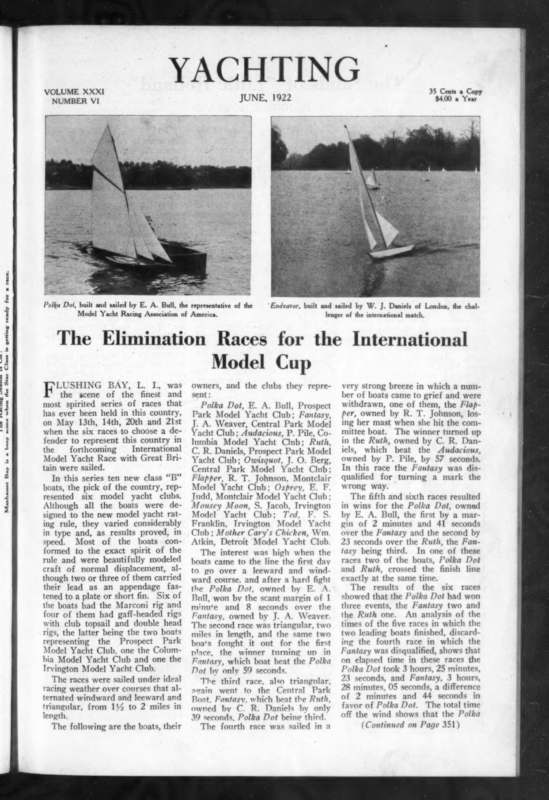
- The Elimination Races for the International Model Cup. Flushing Bay Long Island was the scene of the finest and most spirited series of races that has ever been held in this country, on May 13th, 14th, 20th and 21st when the six races to choose a defender to represent this country in the forthcoming International Model Yacht Race.
- What the Model Yachtsmen Are Doing. JO Berg, ME
- Steering Gear For Miniature Yachts.

£9 NEE oe See Sows SNS YACHTING © 35 Cents a Copy $4.00 a Year JUNE, 1922 NUMBER VI ‘ { HY } | ‘ Manhasset Bay is a busy scene when the Star Class is getting ready for a race. ate VOLUME XXxXI pa IIEO nce “pee Polka Dot, built and sailed by E. A. Bull, the representative of the ‘Endeavor, built and sailed by W. J. Daniels of London, the chal- Model Yacht Racing Association of America. lenger of the international match. The Elimination Races for the International Model Cup LUSHING BAY, L. IL, was the scene of the finest and most spirited series of races that has ever been held in this country, on May 13th, 14th, 20th and 21st when the six races to choose a defender to represent this country in International forthcoming the Model Yacht Race with Great Bri- tain were sailed. In this series ten new class “B” boats, the pick of the country, rep- resented six model yacht clubs. Although all the boats were designed to the new model yacht rating rule, they varied considerably in type and, as results proved, in speed. Most of the boats conformed to the exact spirit of the rule and were beautifully modeled craft of normal displacement, although two or three of them carried their lead as an appendage fastened to a plate or short fin. Six of the boats had the Marconi rig and four of them had gaff-headed rigs with club topsail and double head rigs, the latter being the two boats representing the Prospect Park Model Yacht Club, one the Columbia Model Yacht Club and one the Irvington Model Yacht Club. The races were sailed under ideal racing weather over courses that alternated windward and leeward and triangular, from 1% to 2 miles in length. The following are the boats, their owners, and the clubs they reprePolka Dot, E. A. Bull, Prospect Park Model Yacht Club; Fantasy, J. A. Weaver, Central Park Model Yacht Club; Audacious, P. Pile, Columbia Model Yacht Club; Ruth, C. R. Daniels, Prospect Park Model Yacht Club; Owisquot, J. O. Berg, Central Park Model Yacht Club; Flapper, R. T. Johnson, Montclair Model Yacht Club; Osprey, E. F. Judd, Montclair Model Yacht Club; Mousey Moon, S. Jacob, Irvington Model Yacht Club; Ted, F. S. Franklin, Irvington Model Yacht Club ; Mother Cary’s Chicken, Wm Atkin, Detroit Model Yacht Club. The interest was high when the boats came to the line the first day to go over a leeward and wind- ward course. and after a hard fight the Polka Dot, owned by E. A. Bull, won by the scant margin of 1 minute and 8 seconds over the Fantasy, owned by J. A. Weaver. The second race was triangular, two miles in length, and the same two boats fought it out for the first place, the winner turning up in Fantasy, which boat beat the Polka Dot by only 59 seconds. The third race, also triangular, again very strong breeze in which a num- ber of boats came to grief and were sent: went to the Central Park Boat. Fantasy, which beat the Ruth, owned by C. R. Daniels by only 39 seconds, Polka Dot being third. The fourth race was sailed in a withdrawn, one of them, the Flap- per, owned by R. T. Johnson, los- ing her mast when she hit the com- mittee boat. The winner turned up in the Ruth, owned by C. R. Daniels, which beat the Audacious, owned by P. Pile, by 57 seconds. In this race the Fantasy was disqualified for turning a mark the wrong way. The fifth and sixth races resulted in wins for the Polka Dot, owned by E. A. Bull, the first by a margin of 2 minutes and 41 seconds over the Fantasy and the second by 23 seconds over the Ruth, the Fanfasy being third. In one of these races two of the boats, Polka Dot and Ruth, crossed the finish line exactly at the same time. The results of the six races showed that the Polka Dot had won three events, the Fantasy two and the Ruth one. An analysis of the times of the five races in which the two leading boats finished, discarding the fourth race in which the Fantasy was disqualified, shows that on elapsed time in these races the Polka Dot took 3 hours, 25 minutes, 23 seconds, and Fantasy, 3 hours, 28 minutes, 05 seconds, a difference of 2 minutes and 44 seconds in favor of Polka Dot. The total time off the wind shows that the Polka (Continued on Page 351)
YACHTING June, 1922 What the Model Yachtsmen Are Doing Conducted by J. O. BERG, M. E. Steering Gear For Miniature Yachts One of the most important de- vices On a miniature sailing yacht is the steering gear, together with the sheet line arrangement operating the tiller sc that the proper amount of helm will be obtained automati- cally for the varying wind pressures on the mainsail. When a boat is running off, or before the wind, the pressure is all on one side so that if no counteracting force is brought to bear the boat would turn and would travel in a direction more or less across the wind, instead of before it. In Fig. 1 it is presumed that the vessel has no rudder at all, or one which may not be turned easily. In Fig. 2 the rudder is so controlled that its action produces a tendency in the vessel opposed to the turning tendency produced by the one-sided pressure of the wind upon the sail. If the one is equal to the other at all times the resulting course of the vessel will be straight down or before the wind. The simplest means of arranging the tiller and sheets is to point the tiller toward the stern of the boat and fasten the main sheet to it, as shown in Fig 3, and providing a spring that can be adjusted for tension to regulate its action. ing aft, toward the stern, it is reversed as compared with a large sailing vessel and so it does not. look shipshape or natural to the man accustomed to see it the other way about. To place the tiller so that As the wind increases in force the helm is pulled farther and farther over. Of course the spring tension must first be adjusted by trial and it will be found that when once properly regulated it will operate satisfactorily under the various conditions. It is well to have some limiting device so that the helm will not be put too far over. This is accomplished by a threaded rod which is made to straddle the tiller and having two nuts which may be rolled farther apart or brought together, allowing more or less act:on of the tiller on each side of the center line, as in Fig. 4. This is the simplest rig which can be had that will act properly and cover all the essential requirements. It has only one drawback, which is, that as the tiller is point- it points as it should, forward, and still have it operate the rudder in the proper direction it is necessary to pass the main sheet through blocks or fairleaders and to form a bridle of the sheet, as shown in Fig. 5. By this means: the tiller is put over to the opposite side on which the boom is carried, which in turn sets the rudder in the same direction as in the method before described. Care must be taken that the fairleaders or blocks are as frictionless as -possible so that in passing over the boom will not carry the main sheet foul of the various fixtures on deck. In both cases another shorter sheet is provided, operating on a traveler. This sheet is used in going to windward and it has no connection with the rudder whatever A miniature yacht should be so designed and have her sails so ad- RUNNING SHEET Fe AVIAIN SAIL. WHEN OWL BEFORE THE Wild BENTING TO 28 WARD.
YACHTING Jung, 1922 justed that no rudder action is necessary when going to windward as close as she can lay her course with her sails all drawing. Such adjustment is known as balance, and it is the first and most necessary essential in producing speed. The fixtures on the boom which are most convenient for sailing on a run-around pond, where poles are used to put the model about, are so arranged that upon reaching the windward bank of the lake the close-haul sheet may be cast off with the pole and the vessel put dbout and set off before the wind with least loss of time. They are shown in Fig. 6. The Elimination Races (Continued from Page 321) Dot was 5 minutes, 15 seconds better, while on the wind the Fantasy was 1 minute and 34 seconds to the good. The float of the Central Park Model Yacht Club on F lashinn Bay was a eny scene on the days of the elimination races in which ten boats, representing six clubs, competed. As many of the contestants were sailing boats of this size from row just enough so that when the air is very light you edge her out into new air, and so create a slight change of air pressure on your sails and get a trifle more push against the canvas. Many skippers, appreciating the fact that there is least boats for the first time, those that had had experience in this kind of racing naturally had the advantage and some of the other boats which did not do so well will be very much better when properly tuned and in racing trim. This was impossible with the short time allowed after the completion of the boats and before the elimination commenced. Polka Dot, owned by E. A. Bull, is the boat chosen to defend the cup by the committee which consists of James R. Craig, H. R. Robertson, R. W. Barton, Howard Griffith, and H. L. Stone. pressure Light Sails (Continued from Page 338) between them on into the headsails. Instead of steering a dead straight line it sometimes is an advantage to turn your yacht very, very little, but on the sails when going dead before the wind, go off on a Cup presented by YacHTING for the Intemational Model Yacht Race between America and England, June 8th, 9th and 10th. broad reach, jibe, and come back the other way. This is termed “tacking to leeward” and is the way ice yachts sail before the wind, only in their case it’s necessary as they cannot square away the boom. Remember we are speaking of light airs and drifting weather tactics, now. When it blows up any kind of a decent breeze, funnel your sails and steer a bee line for your buoy If there is a sea or swell that slats your sails so they spill the wind put a lashing down to the deck on both main boom and spinnaker. e => 1A ls Disquot, owned and sailed |byy J. Oo. Ber,didwell in the series, eet she Om, en – was overpowered by the larger boats. of nn cand Osprey, owned by E. F. Judd of the Montclair Model Yacht Club, in the second race.