- The International Model Yacht Race. CG Davis. Weather conditions were unpropitious even for small models on Little Neck Bay, Thursday, June 8, 1922, when the surface of the water showed a flat calm prevailing at the time for the start of the first International Race.
- What the Model Yachtsmen Are Doing.
- Steering Gears for Models, Part 2.
- Figures on the International Models.

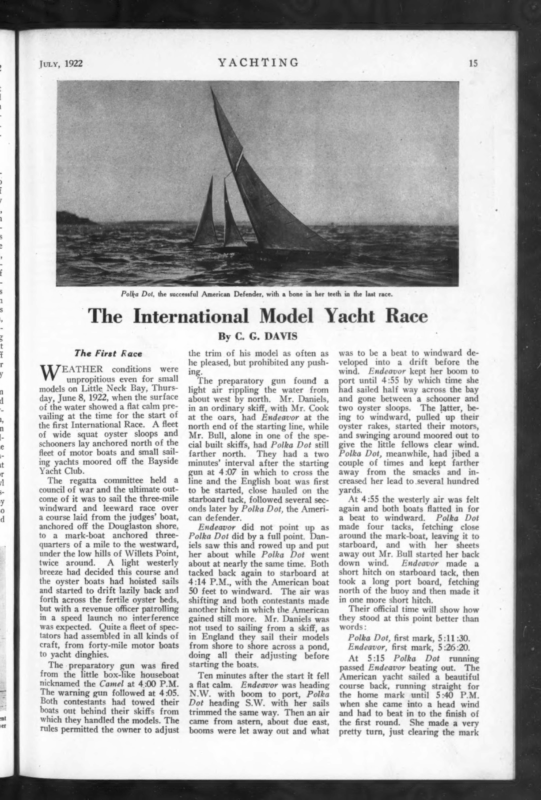
FOU . 2 eecdl ie YACHTING Ve Wa w= §¢ ewer ve SS “TM ed Co it nt er == —— a — Polka Dot, the successful American Defender, with a bone in her teeth in the last race. The International Model Yacht Race By C. G. DAVIS The First Race EATHER conditions were unpropitious even for small models on Little Neck Bay, Thursday, June 8, 1922, when the surface of the water showed a flat calm pre- vailing at the time for the start of the first International Race. A fleet of wide squat oyster sloops and schooners lay anchored north of the fleet of motor boats and small sailing yachts moored off the Bayside Yacht Club. The regatta committee held a council of war and the ultimate out- come of it was to sail the three-mile windward and leeward race over a course laid from the judges’ boat, anchored off the Douglaston shore, to a mark-boat anchored threequarters of a mile to the westward, under the low hills of Willets Point, twice around. A _ light westerly breeze had decided this course and the oyster boats had hoisted sails and started to drift lazily back and forth across the fertile oyster beds, but with a revenue officer patrolling in a speed launch no interference was expected. Quite a fleet of spec- tators had assembled in all kinds of craft, from forty-mile motor boats to yacht dinghies. The preparatory gun was fired from the little box-like houseboat nicknamed the Camel at 4:00 P.M. The warning gun followed at 4:05. Both contestants had towed their boats out behind their skiffs from which they handled the models. The rules permitted the owner to adjust the trim of his model as often as he pleased, but prohibited any pushing. The preparatory gun found a light air rippling the water from about west by north. Mr. Daniels, in an ordinary skiff, with Mr. Cook at the oars, had Endeavor at the north end of the starting line, while Mr. Bull, alone in one of the special built skiffs, had Polka Dot still farther north. They had a two minutes’ interval after the starting gun at 4:07 in which to cross the line and the English boat was first to be started, close hauled on the starboard tack, followed several seconds later by Polka Dot, the American defender. Endeavor did not point up as Polka Dot did by a full point. Daniels saw this and rowed up and put her about while Polka Dot went about at nearly the same time. Both tacked back again to starboard at 4:14 P.M., with the American boat 50 feet to windward. The air was shifting and both contestants made another hitch in which the American gained still more. Mr. Daniels was not used to sailing from a skiff, as in England they sail their models from shore to shore across a pond, doing all their adjusting starting the boats. before Ten minutes after the start it fell a flat calm. Endeavor was heading N.W. with boom to port, Polka Dot heading S.W. with her sails trimmed the same way. Then an air came from astern, about due east, booms were let away out and what was to be a beat to windward developed into a drift before the wind. Endeavor kept her boom to port until 4:55 by which time she had sailed half way across the bay and gone between a schooner and two oyster sloops. The latter, being to windward, pulled up their oyster rakes, started their motors, and swinging around moored out to give the little fellows clear wind. Polka Dot, meanwhile, had jibed a couple of times and kept farther away from the smacks and increased her lead to several hundred yards. At 4:55 the westerly air was felt again and both boats flatted in for a beat to windward. Polka Dot made four tacks, fetching close around the mark-boat, leaving it to starboard, and with her sheets away out Mr. Bull started her back down wind. Endeavor made a short hitch on starboard tack, then took a long port board, fetching north of the buoy and then made it in one more short hitch. Their official time will show how they stood at this point better than words: Polka Dot, first mark, 5:11:30. Endeavor, first mark, 5:26:20. At 5:15 Polka Dot running passed Endeavor beating out. The American yacht sailed a beautiful course back, running straight for the home mark until 5:40 P.M. when she came into a head wind and had to beat in to the finish of the first round. She made a very pretty turn, just clearing the mark
YACHTING Eodeser in a soft spot, of which there were many. boat by a few feet, and then Yankee luck attended her again. She seemed to just hit the puffs favor- ably. Endeavor was not half way home and was all but becalmed out in the middle of the bay, but no sooner had Polka Dot started on her second round than a nice south westerly puff darkened the water and, close hauled on the port tack, she rippled her way west half way across the bay before she ran into the doldrums. Her high rig seemed to fan her through these soft spots while the smaller sail spread of the English boat hardly moved her. When Endeavor did drift through the calm spot that prevailed in the middle of the bay she ran with boom broad off, had to make a jibe to pass the mark-boat to starboard and, losing considerable time by going too far to leeward, rounded at 6:02:29 while Polka Dot, which had rounded at 5:47:50, was then away across the bay making several hitches against a westerly air near that mark. Bull jibed the Polka Dot the second time around the windward mark-boat at 6:20:20 but it looked so hopeless that many spectators had left the scene. These missed the best part of the whole race. According to the Model Yacht Racing Association rules a yacht must sail the three-mile course in two and a half hours, so Polka Dot had to make the run across the bay, three-quarters of a mile, in less than 19 minutes. The question, “Could she do it?” was on everyone’s tongue. A model yachtsman on our boat who knew their capabilities said she could, and, as if to help her out, soon after she rounded the southwesterly breeze came sweeping across the bay and Polka Dot increased her speed until she was fairly flying before it with her owner bending his back trying to keep pace with her. Her sails bellied out hard and round, her gaff pressed clear around forward of her mast and her main boom lifted Polka Dot filling away to round the windward mark. high. Her long shovel-nosed bow was needed to keep her head up out of the seas as she flew through them, rolling a big bow wave and dragging a quarter wave that would curl a man’s hair to look at, had she been a real boat. A couple of hard puffs hit her and Mr. Bull had to adjust the tension on her helm to give her just the right amount, but when he got it set she came scudding for home like a homeward-bounder. Excitement among the spectators on accompanying yachts began to break out in shouts of encouragement to the winning skipper, watches were scanned closely and exclamations of “She’ll do it!” “She’ll make it!” became frequent. And make it she did. She made that three-quarter mile in 12 minutes and 43 seconds, and as the gun on the committee boat boomed the signal of her victory you’d have thought it was the finish of an international race between 90-footers instead of six-foot models. People cheered, whistles screeched and pan——o ——— demonium reigned for a moment, while Polka Dot, with head sheets let fly, lay bobbing head up into the wind and Bull mopped the perspiration off his face; a tired but happy man. Endeavor had made one long port tack, and then one to starboard but was a hundred yards still to leeward of the weather mark when Polka Dot finished at 6:33:03. We on the judges’ boat saw Polka Dot finish and then hurried across the bay and arrived just as Endeavor fetched the mark, but instead of rounding, Mr. Daniels, hearing the boom of the gun, thought the time limit was up and started Endeavor for home, not finishing the race. The Second Race This race was over a triangular course, three miles in length, a mile to each leg of the triangle. Starting from the Bayside Yacht Club regatta boat anchored off the Douglaston shore, the course was a
YACHTING Jury, 1922 little west of north to a spar buoy off Elm Point, then about southwest, across the mouth of the bay to a spar buoy off Willets. Point, and back to the starting point up in the bay. Unfortunately during all three days’ races the weather was exceedingly sultry and calm, ending, the day after the last race, in one of the worst and most destructive thunderstorms that has visited this section in years. But at the start- ing time of this race the bay was like a sheet of glass and the race after being postponed for an hour, waiting for a breeze, was started at 4:05:00 P.M. What air there was was dead astern, and Endeavor led over the line followed closely by Polka Dot. There had been some comment in the first race on the number of times the American boat had been touched by her owner in trimming sail and conning her through the calm streaks, so during the second and third race I kept accurate tabs on each touch, which, with each tack, is recorded in the accompanying charts. Mr. Bull had touched Polka Dot 43 times by the time she had started on the second leg of the course, while Mr. Daniels arrived at the buoy having touched Endeavor but 35 times. To keep the models from drifting north in the baffling airs many touches were required and when, finally, a little after five o’clock, a nice stiff, steady westerly air did strike in the score of touches was about even up, 50 for each. The challenger and defender. W. J. Daniels, (right) with Endeavor, E. A. Bull with Polka Dot. quickly to his rescue, took his skiff in tow and went full speed ahead until it overtook the Polka Dot. Daniels, in the meantime came about on the same tack and the race was undoubtedly his. About the time Bull was ranged up and close enough to swing his yacht about the Endeavor tacked for the buoy. The 55th time Mr. Bull: trimmed Polka Dot the breeze caught her and away she romped, deck edge to, as fast as he could row in the skiff, steering a course as steady and true as if she were being guided by huWhile the Endeavor was coming up it soon became evident that she was doing it at a loss in eating out to windward, as she was fetching Dot. to leeward of Polka Polka Dot came about to port first to get far enough to windward to weather the second mark then the each race seemed to be excitement and started—for with a bit of this spice. seasoned Bull, in endeavoring to keep pace with his yacht, broke an oar lock and went heels up on his back. Scrambling Commodore W. H. Johns of the Bayside Y. C., who helped make the series a success. he tried to stand up and paddle but oar held vertically in the air. Then Soon saw Polka Dot would Mr. Bull changed boats and then started a stern chase after Polka Dot, which was heading full speed for Willets Point unattended. Then things happened with Endeavor. Mr. Daniels caught her cross just to windward of the buoy and rate, and gave up disgusted. The started to slack off her sheets for a run home, but he didn’t calculate on the strength of the tide, now to his feet he made the model yachtsman’s signal of distress, an the Sound ahead of him at that regatta committee’s launch came ward of the buoy. So, trimming in sheets, he started on the port tack to beat up again to windward of the buoy. Polka Dot, in the meantime, had been caught, and with sheets broad off to go well around the buoy went scudding for the home mark with wind and tide helping her. Endeavor still had a good chance as Polka Dot had overstood the mark in her runaway career, and the former was just passing the buoy when Mr. Daniels let her go, after slacking off sheets, and everyone man hands. considerably running in a strong ebb, and both skiff and model were swept to lee- was on tiptoe of expectancy. It looked as if it were going to be a neck and neck race to the finish. Off scudded Endeavor with all eyes focused upon her, when actually one could hear a groan of horror throughout the fleet as she was seen to pass the buoy again on the wrong side. She had not gone around it. That settled it, she had lost her chance for good and all. Daniels rowed like mad, caught her again and flatted her in once more for the buoy but the three judges who had glasses watching her saw her miss it and pass again to leeward instead of to windward of the buoy. Polka Dot ran half way home without being touched. A few adjustments were made as she neared the finish line and with a noisy welcome greeting her, swept across the finish line, winner of the second race, at 6:09:19, a miniature cup defender in looks and actions.
YACHTING FIRST. RACE – Second Rounc] = Ltr JUNE -8-1822. RACE > Fst BAYSIDE 1-1- suns @ 1993 Witte Point ahve Rat don wi Jury, 1922 ward of the mark and Mr. Daniels had slacked sheets and let her go for home when the main boom jibed and, like a child that had been punished for doing wrong and warned not to do so again, Endeavor, just to show she could do as she pleased, deliberately luffed clear up into the wind and sailed back until she was on the same side of the mark-boat on which she had approached it, “Poor Daniels!” was all one could hear. If one man said it a dozen did and I did for one. He chased that contrary critter, caught her and made her round the markboat a second time, which is the time the official figures show. Both boats made a quick, straight run to the turn at the home mark. Polka Dot rounded the weather mark the second time at 4:36:25, Endeavor at 4:47 :35. Polka Dot won by a wide mar- gin, finishing at 4:56:09 amid great applause and Endeavor finished at 5:05 :54 and was given the same reception, Endeavor had gained | minute and 25 seconds on the run — i ee osem Charts of courses sailed. home. SECOND RACE 19%. BAYSIDE Ww) JU9NE The Third Race There was a breeze at the start of this race for the first time during the series and the start was made at 3:22 P.M. with Endeavor first by a few lengths, which Mr. Bull preferred. Endeavor footed and pointed higher and everyone seemed Willets Faint shove Time af Socund Buoy F826 20 pleased that she did. Daniels was a good sport and had won the hearts of the yachtsmen and all hoped he’d win some races at least. Mr. Bull made three or four changes in trim but Daniels just let his boat go about her own business and she surely was licking the Yankee fair and square. She took long tacks and few of them while Polka Dot made one or two extra hitches. When half way to the weather mark the latter managed to split tacks with Endeavor, whose owner seemed content to let her do so; but this proved disastrous, for Bull took advantage of a slight shift of wind and when up near the weather mark walked out to wind- ward of Endeavor and rounded with a comfortable lead. Polka Dot, first mark, 3:49:00 Endeavor, first mark, 3:54:12 But these official times don’t tell the story. It should have been only about a minute between the two yachts but for the persistency of hard luck that seemed to attend En- deavor every time she rounded a windward mark. She had passed clear to wind- thee? hed satin semmele slas \\\e0 TM ead Padeaver began Ty tune! CF \ endeavor af 8S pes
Jury, 1922 YACHTING 31 What the Model Yachtsmen Are Doing ing the course sailed, so that a vessel so rigged will not point as well as Steering Gears for Models 2 Part 454%, lo OO” oer Continuing the description of various steering gears which embody differing ideas, all of them which, once set, would function wind pressure. : REG ATHIG Tate FEO Very few will do = “~~ this, as all devices whose action is limited by rollers or by any other means have a common fault. Steering gears of this type do not // — operate through all the ranges of eee ae Bearing adjustment changed. The sketches shown in Figs. 1, 2 and 3 show various types, more or less satisfactory. Any steering gear should be so designed that for a distance of at least 4% inch each side of the center line the tiller will be absolutely free and not be influenced by any spring whatever. This is because in going to windward the rudder will center itself much more accurately and it will then have no influence whatever upun the course of the vessel] than if held in a more or less uncertain position by a spring or some other device. After the steering gear the next in importance is the arrangement for adjusting the sheet lines, and here it depends upon the method of sail- Fe IN OwAke ROA NING ing, whether the boats are to be handled from a row boat as in outside sailing or the sheets are to be so arranged that they may be cast off with a pole as is sometimes the case in racing in run-around ponds, In outside sailing it is very essential that the sheets may be operated from as central a point as may be, and that only one hand be required to make the necessary adjustments, the other being free to hold the model. In laying out the system of running rigging it is always best to have the sheet- lines meet the booms at or near the end furthest from the fack of the sail, on the main boom as far outboard as possible and at the jib-boom or booms as far inboard as is practical. One aeof the advantages of the Ne Ane : Marconi rig is that it is usually high * (F4 ae and narrow with the main boom well inboard and thus the main sheet may be secured well out or at its end. Where a beating sheet is attached inboard on the main boom the boom is apt to bend to leeward and thus affect the shape of the sail, that in turn affecti not so important and is less likely the pull of the boom is more positive, being stronger the nearer we approach the gooseneck at the mast, that representing the fulcrum of the leverage system. See Fig. 5. The pin rail, or so-called “cribbage board,” is one of the simplest arrangements for handling the sheet lines for outside sailing. It is made, usually, of a strip of 44” mahogany with holes bored into it into which the pins at the ends of the sheet lines are socketed, as in Fig. 6. a wind pressure; that is, they adjust themselves up to a certain point and then if the wind pressure goes higher they can no longer hold the vessel before it but she is then forced around and will go off at a broad reach until pressure is reduced or board, as the bending of the boom is t ks” saves When Sailing before the wind, while “Onusquars” Sretpule Star \__ 4 automatically for all conditions and =. Tae Se nBE on — Ea _ FULER Moves Four BAIT —— —f good, the ideal would be a gear — J a she should. See Fig. 4. The running sheet, however, may be well in- Figures on the International Models It is interesting to note that the recent race with models between an English boat and the Model Yacht Racing Association of America was the first international race between these two countries to be sailed under our Universal Rule. The two boats showed the designers’ ideas of what the rule, as modified by the Model Yacht Racing Association of America, can produce. In next month’s issue of YACHTING an analysis of the two boats by John O. Berg will appear. The following tabulations taken from the measurer’s certificate tell an interesting story and shows most clearly the differences in dimensions and design of the two miniatures: Endeavor ,; w ; 51.00” W.1. Beam 14.02″ = — Penalty 0. B.I 49.5” Le pis. (we) 44.44 Tbe. S.A 2708.6 Pf [ety fpmlty yg ate Dis. (Vol) — 1200 cu. in “= Polka Dot 1, w. 1 45.45″ 8699. BL Dis. (Wt) Rating— 39.22 ba. —— S.A. « 43.8” sifu 45.6 “Wh fits “LUING Ggyp PF > A PRACTICAL RIGGING LAYOUT OF PUNNING For Our sto£ Sauine y — BLP =, O26 wing ZA = igs, “i —_ > alod a= Wty Rowe On CLsige AONB ATT WES ROCKER ACTON aN ) et— \ OWA fp es em “Rau Gap G \, “Yo . WIEN ELATG ~ NO BORGES Acried Pp W hays 2 aNEY Ling —“tb PUNNING SWEET ATM% v= whirre Onc esccccecsD cos> open, — : CLATING 902 cont iime. (creo