- What the Model Yachtsmen Are Doing.
- Endeavor vs. Polka Dot: An Analysis of the Two Boats.
- The Balance of the Model Yacht. (Part 1)

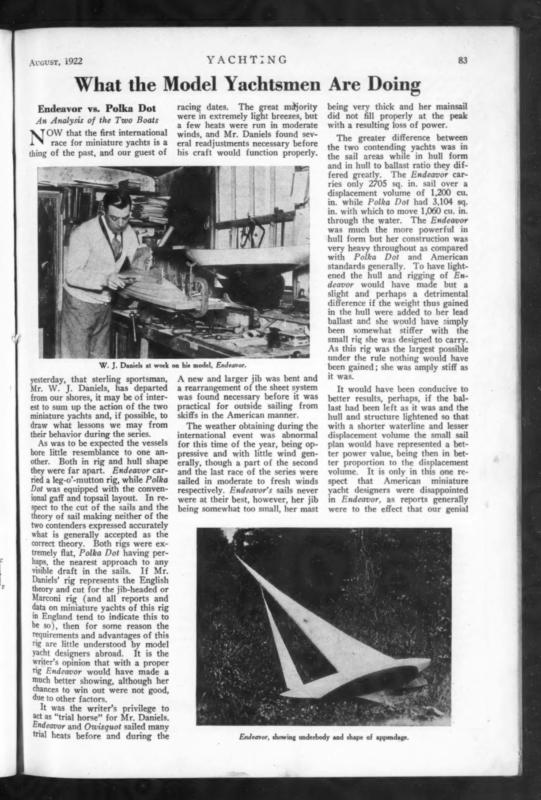
YACHT:ING Avcoust, 1922 What the Model Yachtsmen Are Doing Endeavor vs. Polka Dot An Analysis of the Two Boats OW that the first international race for miniature yachts is a thing of the past, and our guest of racing dates. The great majority were in extremely light breezes, but a few heats were run in moderate winds, and Mr. Daniels found several readjustments necessary before his craft would function properly. cm {f or ne ce me a ! | L * MI 1ip| . le a – = a | Nis oo oe > } —_ ag = ——_ ee . ate TM =. Raa | o = J ee a ne ie Cd a ee + ‘. » ) * z – he Ce ’ _ * » Ped = * ny f c and W. J. Daniels at work on his model, Endeavor. yesterday, that sterling sportsman, Mr. W. J. Daniels, has departed from our shores, it may be of interest to sum up the action of the two miniature yachts and, if possible, to draw what lessons we may from their behavior during the series. As was to be expected the vessels bore little resemblance to one another. Both in rig and hull shape they were far apart. Endeavor carried a leg-o’-mutton rig, while Polka Dot was equipped with the conven- ional gaff and topsail layout. In re- spect to the cut of the sails and the theory of sail making neither of the two contenders expressed accurately what is generally accepted as the A new and larger jib was bent and a rearrangement of the sheet system was found necessary before it was practical for outside sailing from skiffs in the American manner. The weather obtaining during the international event was abnormal for this time of the year, being oppressive and with little wind generally, though a part of the second and the last race of the series were sailed in moderate to fresh winds respectively. Endeavor’s sails never were at their best, however, her jib being somewhat too small, her mast being very thick and her mainsail did not fill properly at the peak with a resulting loss of power. The greater difference between the two contending yachts was in the sail areas while in hull form and in hull to ballast ratio they differed greatly. The Endeavor carries only 2705 sq. in. sail over a displacement volume of 1,200 cu. in. while Polka Dot had 3,104 sq. in. with which to move 1,060 cu. in. through the water. The Endeavor was much the more powerful in hull form but her construction was very heavy throughout as compared with Polka Dot and American standards generally. To have lightened the hull and rigging of Endeavor would have made but a slight and perhaps a detrimental difference if the weight thus gained in the hull were added to her lead ballast and she would have simply been somewhat stiffer with the small rig she was designed to carry. As this rig was the largest possible under the rule nothing would have been gained; she was amply stiff as it was. It would have been conducive to better results, perhaps, if the bal- last had been left as it was and the hull and structure lightened so that with a shorter waterline and lesser displacement volume the smal] sail plan would have represented a better power value, being then in better proportion to the displacement volume. It is only in this one respect that American miniature yacht designers were disappointed in Endeavor, as reports generally were to the effect that our genial correct theory. Both rigs were extremely flat, Polka Dot having per- haps, the nearest approach to any visible draft in the sails. If Mr. Daniels’ rig represents the English theory and cut for the jib-headed or Marconi rig (and all reports and data on miniature yachts of this rig in England tend to indicate this to be so), then for some reason the requirements and advantages of this rig are little understood by model yacht designers abroad. It is the writer’s opinion that with a proper tig Endeavor would have made a much better showing, although her chances to win out were not good, due to other factors. It was the writer’s privilege to act as “trial horse” for Mr. Daniels. ndeavor and Owisquot sailed many trial heats before and during the a etme. eh Endeavor, showing underbody and shape of appendage.
84 competitors were in advance of us Endeavor, in light construction. complete without lead, it was stated, weighed between 10 to 11 Ibs, whereas Polka Dot weighed between 8 to 9 Ibs. in the same condition. Polka Dot being planked up, and Endeavor a dugout the latter should have had the advantage as our dugouts are usually lighter than our planked models, and as a rule this size of dugout miniature made in America weighs from 5 to 7 Ibs., while the planked ones vary from 6 to 9 lbs., complete but without lead. In design the two miniatures showed a very great difference, the design of Endeavor being much the better in the balance of fore to after body lines and in a better distribution of displacement. To the writer Endeavor appeared very much like a modified “Prospero” fined down slightly forward to fit the rule. Where Endeavor’s midsection was rounded, but generally ‘flat, Polka Dot was sharper; but Endeavor showed easier buttocks and a resulting better fore and aft distribution of her lighter displacement. This condition in the design had the effect of making Polka Dot somewhat more difficult to handle in windward work and she was frequently outpointed by Endeavor whose body form was better adapted to meeting various conditions ‘without much change in the relative distance between centers. The writer is in the belief that a smaller Endeavor with larger rig would, for these reasons, have made the racing much more even. Endeavor \acked, however, in the area of her lateral plane and while she may well have out-pointed her rival due to better body form and to her lack of forward sail, her leeway was greater so that she was usually behind at the windward ‘mark. The best test of this condi- tion was the “free-for-all” after the major series of races were over when E. S. Tucker handled Endeavor. Lieut. Tucker’s handling, although he was strange to the gear, was in his usual expert form but he was over a minute behind at the windward turning mark. Polka Dot had a way of slipping through the water when running and reaching and these are by far her best points of sailing, although in the last leg of the last heat of the YACHTING international race with the breeze behind her Endeavor cut down some of the lead of Polka Dot. In appendage the two boats difEndeavor had an fered entirely. appendage similar to that of C, one of Mr. Daniel’s X PDN former designs, with perhaps a slightly greater rake aft and the lead well distributed along its length, fore and aft, while Polka Dot had a deeper appendage with the lead more concentrated about her center. While the areas of the lateral plane of the two miniatures did not vary much, there is the 3 in. greater draft in the in of Polka Dot and it is here that the diversity of opinion between English and . American miniature yacht designers lies. The international races would tend to prove that for outside sailing stich as is the custom here, our rule is quite satisfactory. Endeavor pointed higher at times, no doubt due to her better hull form, but she did not hold on as she might have, especially when it breezed up a bit and her angle of heel was greater, together with a rising wave action. In summing up we would give Endeavor first place in design, with the recommendation that the freeboard be less, and second place in rule application and refinement of construction. As to fittings, Mr. Daniels could not be familiar with the conditions, not having raced miniatures from skiffs as we do here. It is to be hoped, however, if the conditions permit, that the essentials of our system, which approach very nearly that of the major sport, will be tried abroad, It is to be hoped that we may return Mr. Daniels’ friendly visit here by one to his own waters accepting their conditions in the same liberal spirit in which he has accepted ours:—John O. Berg. Aucusrt, 1922 The Balance of the Model Yacht We have discussed the steering gear of model yachts and its opera- tion at length, so that one having followed the matter should be conversant with the theory and principle which governs its design. As before stated, in a model, the rudder should be used only when going before the wind. ward direction the tiller has no function to perform at all. It is obvious, then, that the sails must be so adjusted in relation to the hull, and particularly to the lateral plane, that she will lie as close as possible in the wind’s direction and travel well at the same time. The quality in a vessel of automatically adjusting herself to variations of lying close and sailing well to windward is known as balance. To arrive at the proper balance in a design of a yacht or model before it is put into the water is a matter which taxes the ability of naval architects to the utmost and is attained through experience and experiments with various types of boats and through mathematical processes. The balance of a model is influenced by the shape and profile of the under body, the shape of the whole hull, the form and set of the sails, the speed of the vessel, the amount of inclination under certain wind pressures, the wave action, and, in fact, by most of the factors moving body a by presented through wind.and water. Articles on subjects such as this one will be presented in elementary form only so that one may under- stand the major underlying prin- ciples and apply them to a design or a model and thus obtain a close approximation to the proper balance. Then, by a better understanding of make LINE needed. these principles, such changes as one may may be The first factor to consider is lat- eral resistance. fo 2 When it is intended .to make the boat travel in a wind- This is the resist- ance offered by the water against the leeward side on the underwater or immersed portion of the vessel (Continued on page 89)
YACHTING Aucust, 1922 “Plug In” from Ship to Racio Line RING the voice of the world to your yacht, schooner or wer craft, Just turn the wherever you may sail. knob of the National Radio Institute A-1 Junior Receiver and hear music, speeches, concerts, sporting events, weather reports —all the world’s news right aboard your ship. that A world of fun and entertainment costs nothing. Experts say Radio can be heard best on water. that BIG SPECIAL OFFER It doesn’t matter where you go cruising, or how long you stay out of port, the wonderful A-1 Junior Receiver will bring you Radio broadcast 25 to 50 miles from Time signals can Broadcasting Stations. be heard within a range of 1,000 miles. Double tuning coil for long and short waves. Simple to operate. No license or Nothing to renew. experience necessary. No additional expense. Sent ready to operate complete with head phones, aerial wire, ground clamp, insulator, switch and full directions how to install and operate, for only $25.00. SEND FOR IT NOW! This amazing offer is open only for a limited time. Bring the fun and pleasure of Radio to your vessel. Order your A-l Junior Receiving Set toSend money order Satisfaction guaranteed or money back. Hational Radio Institute, Dept. 1199 RADIO 1945 Pennsylvania Av., 0… Washington, D. C. The Mexan Balance of the Model (Continued from page 84) As the wind-exerting pressure forces the vessel sideways, the water against the immersed area resists the pressure in that direction. One will readily see that it takes a much greater effort to force a stick of timber broadside through the water than would be required if we moved it end first. The resistance offered by the water along its longer dimension is known as lateral resistance. In the same way the resistance offered by the water on the lee side of immersed part of a vessel acts to prevent her from moving sideways to any great extent under the wind pressure on the sails. If experimenting with this piece of timber before referred to, by push- ing it with another pointed stick, we find we may move the point along the long side until we balance the thrust exactly so that neither end swings about. This point, acting along the stick, is known as the center of lateral resistance, or C. L. R. We know then, first, that an area must be provided in a vessel to resist motion sideways, and we may find the center of this resistance by means of a string attached to the model, drawing the boat sideways through the water and adjusting the point of contact so that the longer axis of the model will always move square to the pull on the string, as in Fig. 1. If the forward part of the model moves toward one when pulling, move the pin aft; move it forward when the reverse is the case. Length, 18 ft.; beam, 6% ft.; draft, 18 inches (without board) ; outside ballast, Marconi rig, sail area, 183 sq. ft. A big-little boat with all the lines, build and finish of yachts of twice her size. Demonstration by appointment. MEXAN BOAT COMPANY Woolworth Building New York Ever-Warm Safety- Suit —on in a flash over all your clothes Essential equipment – know—Ask for copy. National Life Preserver Co. 11 Broadway New York Special Ccoan Voyagers Rental Plan—Ask Details TRADE MARR When drawing the plan of a model an easy and accurate way for finding the C. L. R. is to balance a paper cut out to the profile of the immersed portion, shifting the point of balance until the waterline edge will be horizontal, as shown in Fig. 2. In both of the above cases we will have the center longitudinally, which is all that is required for our present purpose. Now if the C. L. R. would only “stay put” a great many difficulties would be solved, but with the easy solution of them would go also one of the fascinations of the study of the art of boat designing. When a vessel is in motion the forward edge of the lateral plane is always entering solid water, and as the plane passes on it breaks up the water through skin friction and form, so that the water offers less resistance aft than at the forward end. Thus the center moves forward. As the vessel heels under the (Continued on page 99) SOUND SCHOONER “ALICIA” Wm. M. Baldwin, Esq., Owner Sails by Ratsey & Lapthorn, City Island, N. Y. SAILS TATELEC TREATED No distortion due to moisture and variation of weather after three years’ use. FURL YOUR SAILS WET AND FORGET ABOUT THEM CANVAS Treated by the Tatelec Proc- ess (Before Being Made Up Into Sails) Is Permanently Water Repellent and Permanently Mildew Proof Absorption is Impossible Sails Furled Wet on Saturday Require No Monday Drying No Rowing Out to the Moorings After Every Rainstorm TRY IT! Tate Electrolytic Textile Processes, Inc. Offices: 45 E. 17th 8t., New York Works: Cranston, Rhode Island Address all communications to New York Office TRADE MARK
YACHTING Aucust, 1922 lt is still the King cf Metal Polishes BRILLIANT It may pare cost it little a will you All M. TRAFTON COMPANY but more the Know if you comwh Vv reason Dealers 176 Federal Street, Boston Atlases Balance of the Model MODEL STEAM EN. GINES and BOILERS (Continued from page 89) wind pressure the plane foreshort- We are makers of Model Steam Engines, both marine and stationary, also ens, parts of the body near the Boilers, [Electric and Steam Boats, Yachts, and Model Ship’s Fittings. Full line of machined Castings, finished parts and Model Makers’ —— Send 20c¢ for new large illustrated catalogue and handbook (Refunded on first order). water line lie in the plane of the re- sisting force, other portions, at bow, for instance, are subject to wave action. All of these cause the center to shift. These conditions vary with Bathe Manufacturing Co., Dept. E S214 Woodland Ave. Philadeiphia, Pa. the shape of the hull, the speed, and the shape of the appendage itself. Thus, experience and experimentation must guide the naval .architect in developing the entire body. In a general way the C. L. R. may be regarded as a pivot or balancing point, about which the vessel will turn, very much as a weather vane is balanced. To this center the designer or model builder must adjust his sail plan. For this purpose it is regarded as fixed and the vessel in an erect position, at rest. (To be continued) A 65-Foot Motor Yacht (Continued from page 81) sideboard and a Pullman berth. The galley extends the full width of the ship. “ CHELSEA” — |CLOCKS tehote SHIP’S BELL— YACHT and MANTEL, etc Bay frem your Jeweler or Nautical Instrument Dealer One of the best single handed FOR SALE. auxiliary yawls of the keel and centerboard Will sleep fom 31’ x 10° x 8 6”. type. Cabin well arranged, has two comfortably. extension transoms, galley with Shipmate range and sink and large ice-box aft, toilet Very roomy and large clothes locker forward. self-bailing cockpit. Steers with Edson bronze steering gear with mahogany wheel. Has two copper gasoline tanks under seats in cockpit. Powered with two cylinder heavy duty 10 Very complete invenH.P. Sterling engine. tory, including 9 mahogany Davis dink. Exceptionally Complete salt water fittings. Particulars from Henry C. good seaboat. Grebe & Company, 6 N. Michigan Ave., Chicago. -~ The deck house makes an addi- headroom in the engine room below the deck house is 5 feet with full headroom at the after half. The power plant consists of two 6-cylinder, 534” x 634” medium duty Sterling engines. Particular attention has _ been given to the ventilation of this compartment. The exhaust passes out through the stack, which is double. Entrance to the engine room is through the deck hatch or through a door into the crew’s quarters. The boat is being built by the Matthews Boat Company of Port Clinton, Ohio. Star Class News (Continued from page 70) Maia—Linkfield, 87.09%. Dawning — Elder 83.33%. & Reeve, Altair—Willis, 73.68%. Aquilla—Curry, 70.96%. Themes—Van Winkle, 64.51%. Canis Minor—Adler, 45.00%. Scorpio—Duerr, 45.00%. Big Dipper—Robinson, 42.85%. Others are below 40%. The Junior Division— FOR SALE, Yacht “Shur,” 78 ft., two Murray & Tregurtha 80 h.p. engines, copper gasoline tanks, capacity 1,500 water FOR tank 1,000 Price gals. W. H. B., 16 Cooper Square. $5,000. CANADA’S EXCLUSIVE WHOLE- SALE AND RETAIL MARINE ENGINE JOBBERS. Dominion’s largest Distributors. Free literature, new and rebuilt engines, canoes, dinghies. EXCHANGE Yachts For Sale gals., Kelvin & Wilfrid O. White Co. 112 State St., Boston. 88 Water St., N. Y. SALE—Hand “V” bottom propellers, CANADIAN BOAT AND ENGINE tional living room but has the con- trols brought alongside the steering wheel for one-man operation. The Navigational Equipment for Yachts and Motor Boats We specialize in Compass Work and guarantee results. We carry Charts and Books, Marine Glasses, Telescopes, Com-passes, Barometers, Clocks, Yacht Logs. Catalog on Request Toronto, Canada BARGAIN—Fifty-one feet bridge deck cruiser, beam eleven feet, 4 inches. Draft 4 feet. Sleeps nine comfortably. Sturdy heavy duty 40 H.P. engine. Speed 12 miles. Well found and equipped. All inside wood work mahogany. Good batteries, generator and _ searchlight. Electric running lights, and cabin well lighted. Good galley and ice chest. run- Two toilets. Fine windshield in front of wheel. Very comfortable boat and unusually well arranged. Price very low. Address George R. Wood, 117 Cottage Street, New Bedford, Mass. about, built by Chris. Smith. 28’ overall, 6 cylinder, Van Blerck motor, 120 H.P. Complete Just overhauled. Schooner hour. Speed 31 Price $3,500.00. E. A. miles per Haynes, Port Huron, Michigan. cheap. suit of sails for 84-foot Yacht, good as new, very Send for drawing. GREAT LAKES BOAT BUILDING CORPORATION Milwaukee, Wis. FOR SALE—Sloop, 43’ x 26’ x 10’ x 7’; excel- lent condition; very fast; complete racing and cruising equipment; two suits of sails, includ; ing ballooner and spinnaker; two large bunks complete galley; near New York. good toilet. In commission Exceptional bargain, $1,500.00. N. V. Ritchey, 406 West 31st Street, N. Y. Phone, Chelsea 8388. C. 110 ft. chaser for sale—very cheap— fitted with 3 engines, electric plant, etc. Is now on storage where it can be inspected at the plant of the Luders Marine Construction Co. Stamford, Conn. September Yachting Don’t fail to read the account of the elimination trials for the International 6-Meter Cup Race in the September issue YACHTING 47 W. 47th St.. New York