
- What the Model Yachtsmen Are Doing.
- The Inter Club Races.
- The Balance of the Model Yacht. (Continued from the previous issue)

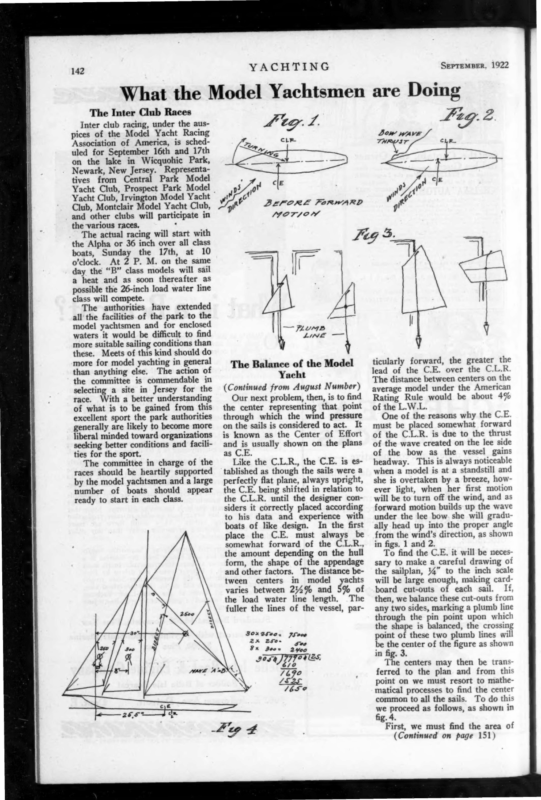
SEPTEMBER, 1922 YACHTING What the Model Yachtsmen are Doing The Inter Club Races Inter club racing, under the aus- pices of the Model Yacht Racing Association of America, is scheduled for September 16th and 17th on the lake in Wicquohic Park, Newark, New Jersey. Representa- tives from Central Park Model Yacht Club, Prospect Park Model Yacht Club, Irvington Model Yacht ~ BEFORE FaRwARD Club, Montclair Model Yacht Club, and other clubs will participate in the various races. MOTSOMW ‘ The actual racing will start with the Alpha or 36 inch over all class boats, Sunday the 17th, at 10 o’clock. Lig 3. ———$—$———” i At 2 P. M. on the same day the “B” class models will sail a heat and as soon thereafter as possible the 26-inch load water line The authorities have extended all’ the facilities of the park to the model yachtsmen and for enclosed waters it would be difficult to find more for model yachting in general than anything else. The action of the committee is commendable in selecting a site in Jersey for the race. With a better understanding of what is to be gained from this excellent sport the park authorities generally are likely to become more liberal minded toward organizations seeking better conditions and facilities for the sport. —— PLUMB LINE -— The Balance of the Model Yacht (Continued from August Number) Our next problem, then, is to find the center representing that point through which the wind pressure on the sails is considered to act. It is known as the Center of Effort and is usually shown on the plans as C.E. Like the C.L.R., the C.E. is esThe committee in charge of the races should be heartily supported ‘tablished as though the sails were a by the model yachtsmen and a large perfectly flat plane, always upright, number of boats should appear the C.E. being shifted in relation to ready to start in each class. I | class will compete. more suitable sailing conditions than these. Meets of this kind should do h¥ “| the C.L.R. until the designer considers it correctly placed according to his data and experience with boats of like design. In the first place the C.E. must always be somewhat forward of the C.L.R., the amount depending on the hull ticularly forward, the greater the lead of the C.E. over the C.L.R. The distance between centers on the average model under the American Rating Rule would be about 4% of the L.W.L. One of the reasons why the C.E. must be placed somewhat forward of the C.L.R. is due to the thrust of the wave created on the lee side of the bow as the vessel gains headway. This is always noticeable when a model is at a standstill and she is overtaken by a breeze, however light, when her first motion will be to turn off the wind, and as forward motion builds up the wave under the lee bow. she will gradually head up into the proper angle from the wind’s direction, as shown in figs. 1 and 2. To find the C.E. it will be neces- form, the shape of the appendage and other factors. The distance beyachts tween centers in model sary to make a careful drawing of the load water line length. The fuller the lines of the vessel, par- then, we balance these cut-outs from varies between 214% and 3% of SOxBleo. 2% ZFo- Fx Zeon JSeee See 2400 056 JTIFOVES. tha, 6/0 4690 SELES the sailplan, 4%” to the inch scale will be large enough, making cardboard cut-outs of each sail. If, any two sides, marking a plumb line through the pin point upon which the shape is balanced, the crossing point of these two plumb lines will be the center of the figure as shown in fig. 3. The centers may then be trans- ferred to the plan and from this point on we must resort to mathematical processes to find the center common to all the sails. To do this we proceed as follows, as shown in fig. 4. First, we must find the area of (Continued on page 151)
rs YACHTING SEPTEMBER, 1922 p You Cant Be phe! ote Pics 151 with Matinicock bell. Nothing to see but rain and that coming so hard it looked like fog. Sagola running under power with her sails down could not make headway and anchored some five miles from the fin- ish. TRADE MARA She anchored again a hundred yards from the finish when her gas ran out and there was no wind to drive her up against the tide. She must have had an anxious threequarters of an hour there, knowing that we were not far behind and Famous Fritz Mann German Ladies’ Automatic Revolver in the World 25-Cal, Smallest Cun be eonensioni in the pele of your bend, er powerful and accurate. This automatic Revolver can be pocket. hatSand. indies” bales might have some gas left. As a matter of fact we did— had a whole gallon of it—but couldn’t get it out. of the tank, so the engine went off watch at 4:25 leaving us to sail the last five miles. Balance of the Model ARCEL POST, 10 CENTS PRICE $11.00 OUR| PRICE $30 Genuine German octet Ga Seca iets, 900 box ‘Boliets Sent by Express Speneie8 German MAUSER Latest mode]; 9-shot Automatic. The World-Famous Most gat. Powerful Weapen bat fectly balanced with substan ommforte able 3 accurate and efficient: two fety Steockenswtes It in, hst-chepeds bas =x eens —— no RL e ei E 24 *° Se and re- ee blue steak; can be ee 2 900 MERCHANDISE is BRANDLo l Price No. Order one of these Specials NOW Value Prism Our Price ro = — 8-Power t Selid LEATHER CASE Included (Continued from page 142) each of the sails. This is done by dividing the sail into triangles, if they are not of that shape (as for instance the Gaff headed main sail), and adding the area of the triangles forming that sail, together. Thus we have shown in the drawing a mainsail with an area of 2,500 square inches and two jibs of 250 and 300 square inches respectively. We then draw a vertical line square with the water line any distance from the centers, and scale the distance from this line to the center of each sail, making a schedule in which we multiply the distance from the center of each sail to the vertical line by the area of that sail, and then divide the sum of these moments (as they are called) by the total areas. The result will be the distance from the vertical line to the common center or C.E. of all the sails. If the C.E. is too far forward the sail plan should be shifted aft or the area of the jibs reduced. If too near the C.L.R. then the sail plan should be shifted forward or the area of the jibs in- creased or the mainsail decreased. It is better to increase or decrease the area of the various sails or ex- SOUND SCHOONER “ALICIA” Wm. M. Baldwin, Esq., Owner Saila by Ratsey & Lapthorn, Oity Isiand, N. Y. SAILS TATELEC TREATED No distortion due to moisture and variation of weather after three years’ use. FURL YOUR SAILS WET AND FORGET ABOUT THEM CANVAS Treated by the Tatelec Proc- ess (Before Being Made Up Into Sails) Is Permanently Water Repellent and Permanently Mildew Proof Absorption is Impossible Sails Furled Wet on Saturday Require No Monday Drying tend the jibs outboard or inboard than to change the position of the mast. This should not be altered ings After Every Rainstorm 1/3, or a little forward of 1/3, of the W.L. length from the forward TRY IT! No Rowing Out to the Moor- much and it should be placed about point. Jasses me’ “and land or sea, day o Extra foodA f unti bird ra study, aastrA botanists thouse and for pantioularPeople that must havethe best kind eyes, for ., ~ ng distance. of glasses. ustable for different strength o send en receipt of, price $15.50, or will send C. O. D. by Parcel Pest. mailing charge. Wonderful Value All bi lars ha pA8. Go “3 it inspectors’ on inocu ve vernmen ACCEPTED.s’ren atry Registration ro the glass, name COLMONT ontheglass and on the case, x octoy the genuine. Every one used by Government.hee ofa lifetime to buy aIU.8.eas Government glass at one-fifth regular price. ST this advertisement as these goods are cold at tee low a price te be catalogued. THE MONTAGUE COMPANY, Inc. Fire Arms, Handcuffs, Police Dept. 371, NEW. i N. J. Instead of making paper cut- outs. of each sail and balancing them two ways to find the center, the centers may be found as shown in Fig. 4. Common practice varies some- what from that given above. The process is as follows; taking the two jibs as a group, we multiply the vertical distance between the two centers by the area of the smaller sail and divide this product by the total area of the two jibs. Tate Electrolytic Textile Processes, Inc. Offices: 45 E. 17th S8t., New York Works: Cranston, Rhode Island é Address all communications to New York Office This will give us the horizontal distance from the center of the larger sail to the common center of the two. TRADE MARK