- What the Model Yachtsmen Are Doing.
- Cutting and Setting Sails for a Model Yacht — Part I.
- A Class “B” Model Yacht.

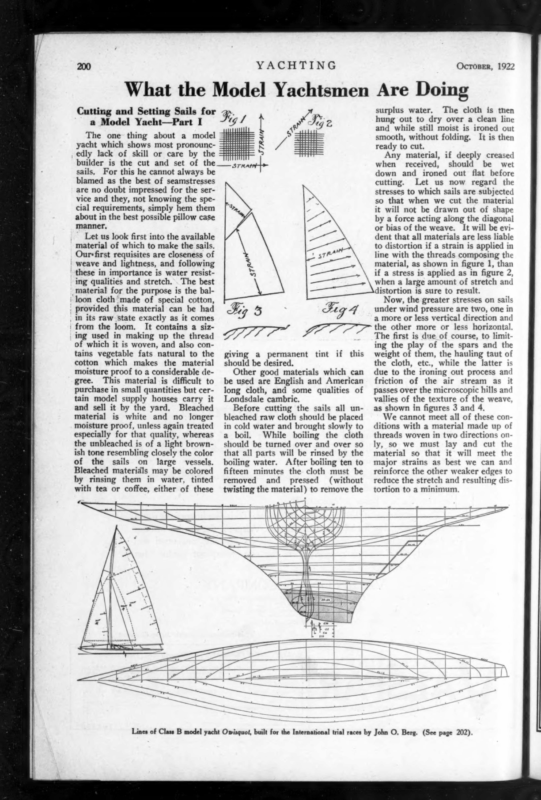
YACHTING Ocroser, 1922 What the Model Yachtsmen Are Doing Cutting and Setting Sails for _ @ Medel Yacht—Part I Fig / The one thing about a model yacht which shows most pronounc_ edly lack of skill or care by the builder is the cut and set of the__5,,, sails. For this he cannot always be blamed as the best of seamstresses are no doubt impressed for the service and they, not knowing the special requirements, simply hem them about in the best possible pillow case ot Ie é S / manner. Let us look first into the available material of which to make the sails. _Our-first requisites are closeness of | weave and lightness, and following ‘ these in importance is water resisti ; , i , ing qualities and stretch. .The best material for the purpose is the balloon cloth’ made of special cotton, provided this material can be had In its raw State exactly as it comes from the loom. It contains a sizing used in making up the thread of which it is woven, and also contains vegetable fats natural to the cotton which makes the material moisture proof to a considerable degree. This material is difficult to purchase in small quantities but certain model supply houses carry it and sell it by the yard. Bleached material is white and no longer moisture proof, unless again treated especially for that quality, whereas the unbleached is of a light brownish tone resembling closely the color of the sails on large vessels. Bleached materidls may be colored by rinsing them in water, tinted with tea or coffee, either of these a nage Fey 5 Ger Bere giving a permanent tint if this should be desired. Other good materials which can be used are English and American long cloth, and some qualities of Londsdale cambric. Before cutting the sails all unbleached raw cloth should be placed in cold water and brought slowly to a boil. While boiling the cloth should be turned over and over so that all parts will be rinsed by the boiling water. After boiling ten to fifteen minutes the cloth must be removed and pressed (without twisting the material) to remove the Z 2h ae a ie SS | a = surplus water. The cloth is then hung out to dry over a clean line and while still moist is ironed out smooth, without folding. It is then ready to cut. Any material, if deeply creased when received, should be wet down and ironed out flat before cutting. Let us now regard the stresses to which sails are subjected so that when we cut the material it will not be drawn out of shape by a force acting along the diagonal or bias of the weave. It will be evident that all materials are less liable to distortion if a strain is applied in line with the threads composing the material, as shown in figure 1, than if a stress is applied as in figure 2, when a large amount of stretch and distortion is sure to result. Now, the greater stresses on sails under wind pressure are two, one in a more or less vertical direction and the other more or less horizontal. The first is due of course, to limiting the play of the spars and the weight of them, the hauling taut of the cloth, etc., while the latter is due to the ironing out process and friction of the air stream as it passes over the microscopic hills and vallies of the texture of the weave, as shown in figures 3 and 4. We cannot meet all of these conditions with a material made up of threads woven in two directions only, so we must lay and cut the material so that it will meet the major strains as best we can and reinforce the other weaker edges to reduce the stretch and resulting distortion to a minimum. Eas o* _— | — _— fe Ro ten if Lines of Class B model yacht Omisquot, built for the International trial races by John O. Berg. (See page 202).
YACHTING A Class “B” Model Yacht For model yachtsmen who like a boat which rates up, but not at the top of, class “B”, we give the lines of Owisquot, designed by John O. Berg and sailed in the elimination trials for the International Races June 8th, 9th, and 10th, at Bayside, L. I.. Owisquot would have made a better showing but shortly before the elimination trials her deck was stove in so that she leaked considerably, although she did well against many of the larger boats. In design Owitsquot is rather fine and easy to drive. The rig is of the modern jib-headed or Marconi type and intended for inside sailing, for outside sailing a rig of about 2,500 square inches was used. She has shown herself a good all OctToser, 1922 galley stove and above deck we looked like a wet wash laundry, but had a fine drying out in the warm sun. 9:00 A.M.—Breeze holding fine. On our course close hauled. Cook Booth and Asst. Cook S. Olson fixed big batch of bacon and eggs by using the alcohol as fuel. Stove went out 17 times but the mess certainly tasted good. 6:15 P.M.—Log 255. Skillagalee Light due east. Discovered large yawl E.N.E. of us beating to Waugashank Light. We are holding spinnaker, set well forward. Wind West. Cannot figure out what around sailor, not phenomenal on yawl this is. July 26. One o’clock the Captain’s watch took the ship with a good breeze. Ship close hauled. 3:30 A.M.—Sighted Mackinac wind. Sunrise showed us two sloops, which looked like “Q’s” heading any one point, but an exceptionally steady boat, particularly before the This boat was fitted with a raffee for running and broad reaching which was set by. means of an ingenious device, the whole operation taking less than seven seconds to operate. As this sail was a departure from the conventional, a ruling by the Model Yacht Racing Association is necessary and still pending as to the whether or not it is permissable. . 68”, Lwl. 44.5”, Beam 12.6”, Draft 15”, Displacement 33.7” Ibs., He (large) 2900, S.A. (small) 80. Rating (large rig) Rating (small rig) j 45.5 42.6 Log of Spider Island Light. Wind very light. towards us, under spinnaker. Our hopes fell as we thought they were Jackson Park 2 and Gem on their way back. When we got into the harbor the crew on Intrepid invited us on Board where they had some fine hot coffee and elegant toast which tasted mighty good after having been without any warm food except the one meal mentioned on the whole trip. At Mackinac Island we learned that the other Q’s had put in at Ludington and had given up the race. Everybody hungry and dog tired but spirits were hig to think we had placed in the big race of the year. (Continued from page 195) the only boats ahead of us now Class “R” Championships (Continued from page 194 ing out things. Everything in sight was practically soaked and the few’ hours sleep that we had snatched the other nights were taken on wet mattresses under wet blankets. We brought everything on deck but the The third race was sailed in the best breeze of all, a wind of about 7 miles an hour, and was over a course to windward and return, two miles to a leg, three times around, making a total distance of 12 miles. As usual the boats got over the line together, with the gun. In fact Sir Tom made such.a close start were the two big fellows, the two Q’s Jackson Park and Gem and possibly the Vanadis. Tuesday was a fine day for dry- Sterling 6-cylinder Sea Gull model, intake side. Third Race that she was three-quarters over the line when the gun went off and had to be récalled, which did not seem to worry her much as she passed all the boats in the fleet except California before the first mark was reached, and she passed this yacht before the end of the first round, and from then on went about her business, finishing about six minutes to the good. The rest of the boats finished in the same order as in the previous race. Outside of some little luffing matches on the runs down the wind all the boats sailed the race with little or no interference, with the following results: . Sir Tom California Patricia m. 2 Angela …….. 2 Lady Gay Lady Betty -s, Points 14 18 16 13 00 10 5 4 36 : 13 This ended the most successful race meet in Southern California with Sir Tom taking the Isherwood Challenge Cup and a beautiful Gold Cup, presented by Greater Santa Monica, as her personal property. The Sterling Sea-Gull The new Sterling Sea-Gull, put out this year by the Sterling Engine Co., is ‘an all enclosed 6-cylinder engine, 4 11/16” bore by 6” stroke, designed expressly for runabouts of 26 ft. to 40 ft. in length, and express cruisers up to 40 ft. Twin screws could be adopted for boats up to 50 ft. Revolutions are arranged at 800, 1200, 1500, 2000 and 2500, depending upon the size and type of boat and the speed desired, so that the engine will perform at a most efficient propeller speed for the boat. The Sterling Company say that they are not making statements as to the horsepower developed in this engine above 1800 R. P. M., but they are satisfied that they are getting out of the engine all of the horsepower possible from one of this size. (Continued on page 204) Crankshaft, piston and camshaft of 6-cylinder Sterling Sea G#