- What the Model Yachtsmen Are Doing.
- Cutting and Setting Sails for a Model Yacht — Part II.
- Some New Mexan Models.

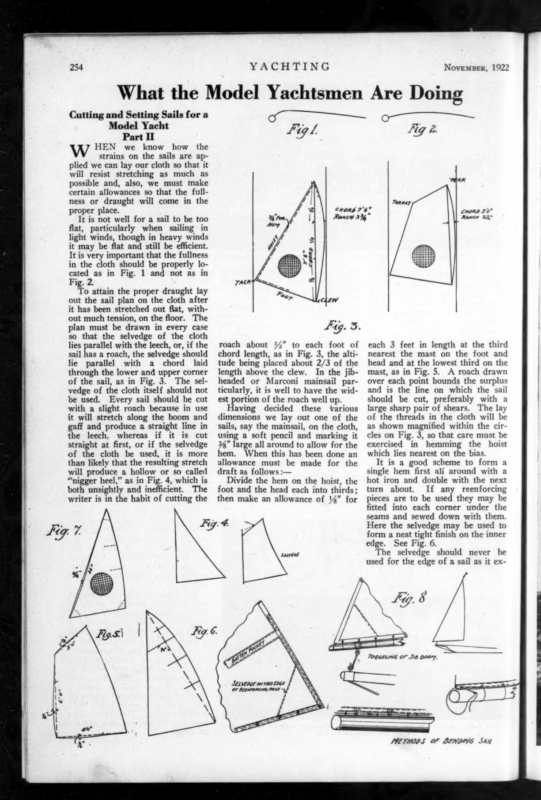
YACHTING Novemser, 1922 What the Model Yachtsmen Are Doing . Cutting and Setting Sails for a Model Yacht Part II we know how Oe to Nig 2. Fig the strains on the sails are applied we can lay our cloth so that it will resist stretching as much as possible and, also, we must make certain allowances so that the fullness or draught will come in the AM CHORD 76″ proper place. | It is not well for a sail to be too flat, particularly when sailing in light winds, though in heavy winds it may be flat and still be efficient. It is very important that the fullness in the cloth should be properly located as in Fig. 1 and not as in Fig. 2. gaff and produce a straight line in the leech, whereas if it is cut straight at first, or if the selvedge of the cloth be used, it is more than likely that the resulting stretch will produce a hollow or so called “nigger heel,” as in Fig. 4, which is both unsightly and inefficient. The writer is in the habit of cutting the CwoRD 52° Roncw 24° TACHA To attain the proper draught lay out the sail plan on the cloth after it has been stretched out flat, without much tension, on the floor. The plan must be drawn in every case so that the selvedge of the cloth lies parallel with the leech, or, if the sail has a roach, the selvedge should lie parallel with a chord laid through the lower and upper corner of the sail, as in Fig. 3. The selvedge of the cloth itself should not be used. Every sail should be cut with a slight roach because in use it will stretch along the boom and Feacw 3% Caw Lag. oS. roach about %” to each foot of chord length, as in Fig. 3, the altitude being placed about 2/3 of the length above the clew. In the jibheaded or Marconi mainsail particularly, it is well to have the widest portion of the roach well up. Having decided these Various dimensions we lay out one of the ‘sails, say the mainsail, on the cloth, using a soft pencil and marking it 34” large all around to allow for the hem. When this has been done an allowance must be made for the ftv draft as follows :— Divide the hem on the hoist, the foot and the head each into thirds: then make an allowance of 1%” for Fig. 4 Saiveet each 3 feet in length at the third nearest the mast on the foot and head and at the lowest third on the mast, as in Fig. 5. A roach drawn over each point bounds the surplus and is the line on which the sail should be cut, preferably with a large sharp pair of shears. The lay of the threads in the cloth will be as shown magnified within the circles on Fig. 3, so that care must be exercised in hemming the hoist which lies nearest on the bias. It is a good scheme to form a single hem first ali around with a hot iron and double with the next turn about. If any reenforcing pieces are to be used they may be fitted into each corner under the seams and sewed down with them. Here the selvedge may be used to form a neat tight finish on the inner edge. See Fig. 6. The selvedge should never be used for the edge of a sail as it ex- . HEN — METHODS OF BENING SA
YACHTING November, 1922 Tamarack IV—A Large New Power Cruiser The acompanying photograph shows Dr. H. N. Torrey’s new 99foot Cruiser just after she was launched recently, at the yards of her builders, the Consolidated Shipbuilding Corporation, Heights, New York City. Morris The yacht was christened Tamarack IV and will succeed Tamarack III, Dr. Torrey’s former yacht which was destroyed by fire in Pamlico Sound last winter. “ Launching of Tamarack ork. [V ‘at the yard of the Consolidated Shipbuilding Corp., New is a 99-footer, owned by Dr. H. N. pands and contracts very little in comparison with the rest’ of the material and this is very apt to be the means of producing a poor looking and fitting sail. The strip cut off with the selvedge may be used for the batten pockets and these are easily made by using the selvedge on one edge and hemming the other. They should always be placed on the sail square across the cord of the roach as in Fig. 6, and under the seam at the leach. The battens may be put in from the forward end and the end of the pocket tucked under it as shown. Sometimes, in the jibheaded mainsail, the second batten from the top must be run to the mast to hold out the roach properly. It is best to sew all edge hems three times making a hard tight hem but during the process great care should be exercised particularly during the first time around, not to distort the material by pulling. It is better if the edge hems are drawn in a bit leaving the sail full as they will stretch where required under strain. When cutting jibs the method is somewhat different. The luff being on the bias of the cloth it must be cut hollow a little otherwise the stretch will create a greater fullness in the luff of the jib then is. proper. The luff length is divided into thirds and a hollow equal to 1/16” per foot of luff length is laid off and the sail cut on that line. This is done after the usual 3%” has been added to the sails’ actual dimensions, all around, for the hem, see Fig. 7. Reenforcing pieces and batten pockets ay be used with advantage in the jib dnd are sewed in the same ag as described for the mainsail. There are many ways to secure the sails properly tothe spars. The builder must take into consideration whether he will find it necessary to take his rigging down frequently or Torrey. not. The simplest manner perhaps is to run a wire through the hem at the luff of the jib having a loose hook at the upper end so that the jib with boom complete may be removed as a unit and rolled up, as in Fig. 8. In this case the halyard need be nothing more than a short line to the eye on the upper hook used to haul the sail to its proper tension. It is well to toggle jib booms so that they will swivel from a point about one to one and one-quarter inches inboard from the outer end. This will prevent the sail from “pigeon winging’ when going before the wind. On the foot, the boom may be sectired by sewing as shown in detail or very small eyelets put through the hem of the sail and then secured with light twine in the same manner. The above applies also to the bending of the mainsail to gaff and mast. Another good method is to use eyes made of pins driven into boom, gaff or mast through which a wire is stretched taut. No. 00‘nickelplated dressmakers hooks are sewed alternately one side and the other on the sails and these are snapped on the wire. This method has the advantage of making the sails easily removable and as the hooks are slidable it is much easier to obtain a perfect set to the sails. No matter what system is used it cannot be too emphatically stated that sails should never be hauled out with a strong tension along the spars or stays, in fact far more sails have been spoiled in the setting than in the cutting and sewing of them. At first it is best to haul them out without any tension whatever, just their length and no more, and when in the course of usage they show the slackness produced by natural stretch only the slack taken out as it develops. Tamarack IV has a beam of 16 feet and draws four feet of water. She is of the raised deck type with combination living and dining room in deckhouse forward. The bridge is just aft protected with permanent roof and glass sides. All exterior joiner work, including decks and hatches are of teak. The motor power consists of two 300 Horsepower Speedway engines, developing a speed of 18 miles per hour. One launch and crew’s boat are carried on deck. There are six staterooms and two baths in owner’s suite. Crew’s quarters and galley are arranged forward under raised deck. Some New Mexan Models The Mexan Boat Company of New York City and Patchogue, L. I., which brought out the little 18-foot knockabout and one-design class boat Mexan last summer, is adding some new sizes in this line. The 18-footer proved very successful last season and they are now being sailed in a number of different localities. The new models will consist of a 16-footer called the Mexan Jr., the dimensions given being the size over-all. There is also a Mexan Sr. coming out, 17 feet on the waterline and 25 feet O. A., a somewhat larger boat than the 18- or 16-footers. Prices and specifications on this larger boat will be mailed on request. The 18-footer will also be made in three grades of finish next year, known as A, B, and C. The former consists of bright deck and mahogany finish throughout, grade C being canvas covered with straight instead of bent coamings, and grade B a finish in between these two. The Mexan Boat Company have recently completed an order of seven boats for a yacht club in Florida where they will be raced, beginning early in February. These boats may be seen at the Patchogue shop of the company by any who are interested in getting a look at the completed model.