- The International Model Yacht Race. H. B. Tucxer, Chairman, Model Yachting Association. It was with the liveliest feelings of satisfaction that we, in England, received an American challenge for the Yachting Monthly Cup. Ever since Mr. WJ Daniels made his trip to the United States in 1922, we on this side have been eagerly awaiting your return visit.

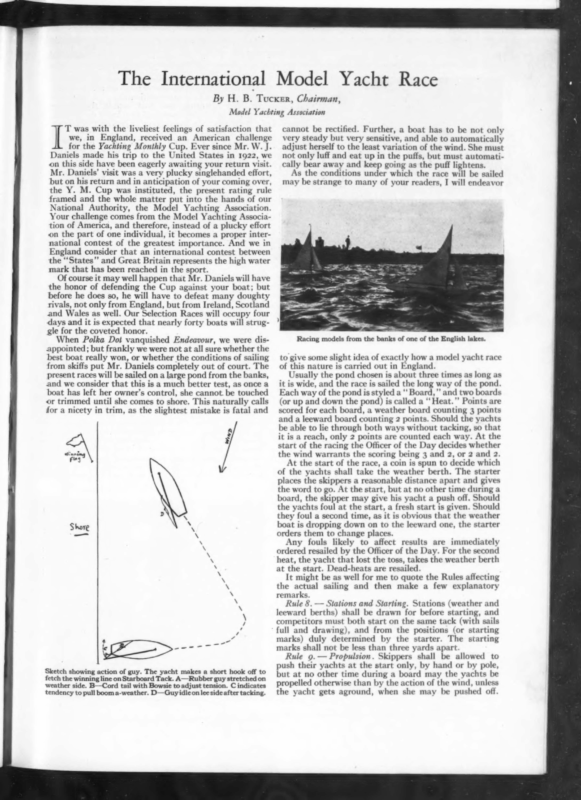
The International Model Yacht Race By H. B. Tucxer, Chairman, Model Yachting Association T was with the liveliest feelings of satisfaction that we, in England, received an American challenge for the Yachting Monthly Cup. Ever since Mr. W. J. Daniels made his trip to the United States in 1922, we on this side have been eagerly awaiting your return visit. Mr. Daniels’ visit was a very plucky singlehanded effort, but on his return and in anticipation of your coming over, the Y. M. Cup was instituted, the present rating rule framed and the whole matter put into the hands of our National Authority, the Model Yachting Association. Your challenge comes from the Model Yachting Association of America, and therefore, instead of a plucky effort on the part of one individual, it becomes a proper international contest of the greatest importance. And we in England consider that an international contest between the “‘States”’ and Great Britain represents the high water mark that has been reached in the sport. Of course it may well happen that Mr. Daniels will have the honor of defending the Cup against your boat; but before he does so, he will have to defeat many doughty rivals, not only from England, but from Ireland, Scotland and Wales as well. Our Selection Races will occupy four days and it is expected that nearly forty boats will struggle for the coveted honor. When Polka Dot vanquished Endeavour, we were disappointed; but frankly we were not at all sure whether the best boat really won, or whether the conditions of sailing from skiffs put Mr. Daniels completely out of court. The present races will be sailed on a large pond from the banks, and we consider that this is a much better test, as once a boat has left her owner’s control, she cannot. be touched or trimmed until she comes to shore. This naturally calls for a nicety in trim, as the slightest mistake is fatal and § 2 D Shore \, \ — \ \ \ \ \ \ \ \ \ \ \ \ \ 4 Cd Pi _ A il Sketch showing action of guy. The yacht makes a short hook off to fetch the winning line on Starboard Tack. A—Rubber guy stretched on weather side. B—Cord tail with Bowsie to adjust tension. C indicates tendency to pull boom a-weather. D—Guy idle on lee side after tacking. cannot be rectified. Further, a boat has to be not only very steady but very sensitive, and able to automatically adjust herself to the least variation of the wind. She must not only luff and eat up in the puffs, but must automatically bear away and keep going as the puff lightens. As the conditions under which the race will be sailed may be strange to many of your readers, I will endeavor Racing models from the banks of one of the English lakes. to give some slight idea of exactly how a model yacht race of this nature is carried out in England. Jsually the pond chosen is about three times as long as it is wide, and the race is sailed the long way of the pond. Each way of the pond is styled a ‘ Board,’’ and two boards (or up and down the pond) is called a ‘‘ Heat.” Points are scored for each board, a weather board counting 3 points and a leeward board counting 2 points. Should the yachts be able to lie through both ways without tacking, so that it is a reach, only 2 points are counted each way. At the start of the racing the Officer of the Day decides whether the wind warrants the scoring being 3 and 2, or 2 and 2. At the start of the race, a coin is spun to decide which of the yachts shall take the weather berth. The starter places the skippers a reasonable distance apart and gives the word to go. At the start, but at no other time during a board, the skipper may give his yacht a push off. Should the yachts foul at the start, a fresh start is given. Should they foul a second time, as it is obvious that the weather boat is dropping down on to the leeward one, the starter orders them to change places. Any fouls likely to affect results are immediately ordered resailed by the Officer of the Day. For the second heat, the yacht that lost the toss, takes the weather berth at the start. Dead-heats are resailed. It might be as well for me to quote the Rules affecting the actual sailing and then make a few explanatory remarks. Rule 8. — Stations and Starting. Stations (weather and leeward berths) shall be drawn for before starting, and competitors must both start on the same tack (with sails ‘full and drawing), and from the positions (or starting marks) duly determined by the starter. The starting marks shall not be less than three yards apart. Rule 9.— Propulsion. Skippers shall be allowed to push their yachts at the start only, by hand or by pole, but at no other time during a board may the yachts be propelled otherwise than by the action of the wind, unless the yacht gets aground, when she may be pushed off.
YACHTING April, 1925 they shall be re-started from their original positions. Should the foul recur, the starter may order them to start further apart, or to change positions. (b) If a competing pair foul outside the distance mentioned in (a) the board shall be resailed on the order of the Officer of the Day, except as provided in Rules 12 and 13 (c) and (d). (c) If one of the pair fouls an obstruction the board shall be re-sailed, unless the Officer of the Dayis of opinion that she had no chance of winning the board. (d) Should two yachts come to shore foul (covering each other) that which is to windward has the right to re-start first: but if either require adjustment, then that which is first ready may be re-started first, in which case the yacht must re-start from a position astern of the other. Neither may be advanced to effect a re-trim. Rule 15.— Changing Sails. Sails may be changed at any time, provided such change does not increase the yacht’s certified rating. Model of the whaling bark Lagoda, of New Bedford, at the recent Old Ship Model Society Exhibit. Loaned by Cyril Crimmings. Poles to be of uniform length, but not longer than is customary or necessary on the particular water. Rule 10.— Entering the water. A skipper shall not enter the water to turn, or start a yacht, except at waters where it is customary to use waders or water boots, but in no case shall a pole be used in conjunction with waders or water boots. Rule 11.— Handling Yachts. Whenever a yacht comes to shore she must either: — (a) be Tacked, or (b) be Retrimmed. For (a) in windward boards, yachts shall be turned fairly about by the Skipper taking a firm stand and (1) turning the yacht off by placing the stick or pole against her lee bow, and (2) he may also steady her round with the pole against the lee side of the counter as she sails out. In any case her headsail must fairly and definitely fill on the off-shore tack before she leaves her skipper’s control. Failure to do this shall entail disqualification for the board. No other part of the yacht, sails or gear may be touched unless to readjust her trim or to avoid an obstruction. When and if a re-trim has been effected, the model! shall be put off by hand only. A yacht put off on the “Guy”’ and failing to ‘‘ Break tack”’ * and returning to the shore from which she was put off shall be ‘‘ Retrimmed.’’t For (b) in leeward boards (or reaching) the yacht shall be retrimmed and re-started by hand every time she The water selected will be of sufficient depth to allow the yachts to be afloat alongside and there will be no shallows. Waders will, therefore, be unnecessary, but the skipper and his mate will require crepe rubber soles or Plimsolls, as the edges may be concrete and slope a little. With regard to the actual handling of the boats, the essence in tacking is that the skipper must not move whilst turning the boat and that his pole must be against the boat’s bow. It must not be put on her deck or hooked in the jib tack. The poles required will be provided, and they must not have any hook or other projection capable of being hooked over the boat’s deck rail 6r anywhere else. The boat must on no account be drawn forward in tacking. When a boat is being retrimmed, she must always be distinctly stopped and some alteration must be made. It is not enough to alter the trim without stopping the boat. The only other point that may require explanation is the word ‘‘Guy”’ and the use of the “‘Guy.’ The “Guy” is a piece of elastic with a cord tail, adjustable with a “‘ bowsie’’ to vary the tension. It is rigged from the extreme end of the boom to a point on the rail about amidships. When a boat is not required to sail right across the lake but to make a short leg off shore and then come about, this is used. Suppose that the boat is on the left hand side of the lake and we require her to make a short leg off-shore on the port tack, and then put herself (Continued on page 84) comes to shore. The skipper must remain stationary while retrimming or turning his yacht, and the yacht must be stopped whilst altering trim. Whenever a yacht is put about, or restarted after a.re-trim, her way must not be accelerated. The “Guy” properly applied constitutes a re-trim, but a jibe does not. The spinnaker must not be set so as to increase the measured fore triangle. Rule 12.— Avoiding Collision. Tacking, guying, starting a yacht after a re-trim, or after coming to shore foul, may not be done so as to involve the immediate risk of collision. Rule 13.— Collisions and Fouls. (a) If a competing pair foul within six yards (or a similar distance previously settled by the Officer of the Day) of the starting-point, ~~ *”Failure to break Tack” is when a yacht has been correctly turned with her headsails filled on the off-shore tack, and she returns to the same shore on the same tack, i. e. not having broken tack by the action of the “Guy.” TA “Re-trim” is a readjustment of a yachts sails, gear or rudder that will allow her to proceed fairly on her course towards the winning line. Decorative model of a Spanish ship of about 1588, exhibited by the Old Ship Model Society.