- Miniature Racing Yachts Built by Toledo High School Pupils. Alvin M Youngquist. Interest in yachting is increasing, and building and racing of model yachts undoubtedly give many their first contact and experience with sailing craft. The young sailor of today is the yachtsman of tomorrow.

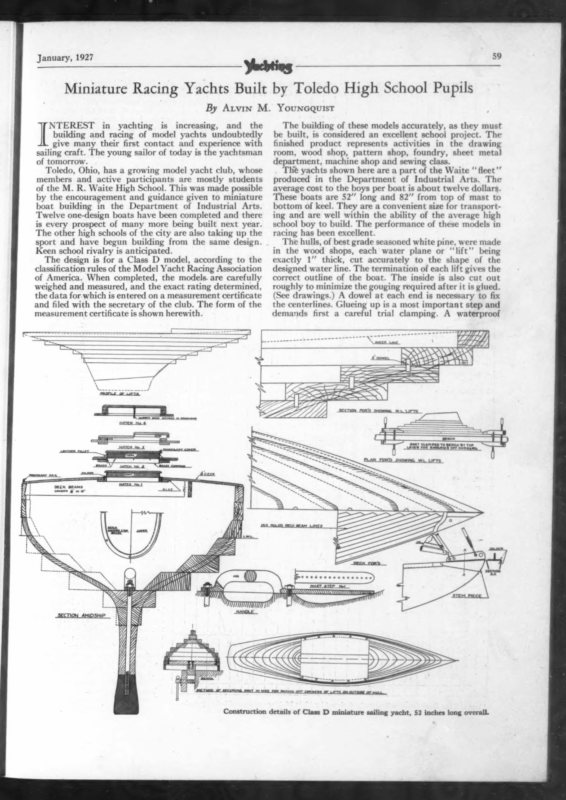
January, 1927 59 Yochting Miniature Racing Yachts Built by Toledo High School Pupils By Atvin M. YounGQuist [Posting in yachting is increasing, and the building and racing of model yachts undoubtedly give many their first contact and experience with sailing craft. The young sailor of today is the yachtsman of tomorrow. Toledo, Ohio, has a growing model yacht club, whose members and active participants are mostly students of the M. R. Waite High School. This was made possible by the encouragement and guidance given to miniature boat building in the Department of Industrial Arts. Twelve one-design boats have been completed and there is every prospect of many more being built next year. The other high schools of the city are also taking up the sport and have begun building from the same design. Keen school rivalry is anticipated. The design is for a Class D model, according to the classification rules of the Model Yacht Racing Association of America. When completed, the models. are carefully weighed and measured, and the exact rating determined, the data for which is entered on a measurement certificate and filed with the secretary of the club. The form of the measurement certificate is shown herewith. The building of these models accurately, as they must be built, is considered an excellent school project. The finished product represents activities in the drawing room, wood shop, pattern shop, foundry, sheet metal department, machine shop and sewing class. The yachts shown here are a part of the Waite “ fleet’’ produced in the Department of Industrial Arts. The average cost to the boys per boat is about twelve dollars. These boats are 52” long and 82” from top of mast to bottom of keel. They are a convenient size for transporting and are well within the ability of the average high school boy to build. The performance of these models in racing has been excellent. The hulls, of best grade seasoned white pine, were made in the wood shops, each water plane or “‘lift’’ being exactly 1” thick, cut accurately to the shape of the designed water line. The termination of each lift gives the correct outline of the boat. The inside is also cut out roughly to minimize the gouging required after it is glued. (See drawings.) A dowel at each end is necessary to fix the centerlines. Glueing up is a most important step and demands first a careful trial clamping. A waterproof – mel j GOAT PS CLANran 1°. NCH BY Toe YER FOR ROWNINE OFF CORMRAD PLAN FORD SHOWING WL. LIFTS DECK BEAMS camearn gm 2° eae % Se TMN ae ee NN == So “J = —— = JILL SS SS a —RECK fore | = _ at tn MAST STEP fet __ J ASA Up Construction details of Class D miniature sailing yacht, 52 inches long overall.
pL [[ a =e Sw ~~ Sag” o~ di Ses P9OO 84,00 Gap iaceme Fee C ave 4 MR WAITE ‘MISS_WAITETM OEPT. OF INBUSTRIA. January, 1927 glue is used. The walls of the hull are about %” thick (44” minimum) when completed; the deck, 4”. The weight of the hull without keel and fittings is between five and six pounds. The keels, of lead, were molded and cast in the school foundry, and machined and tapped in the machine shop. The average weight of the metal keels is 111% Ibs. The keels are bolted through the deadwood, or wood portion of keel, with %” bolts. A handle for carrying is fitted to the bolts. Access to the handle is through a hatch in the deck. Four types of . hatches have been developed: two with brass coaming and wood and cork cover; one with wood coaming and cover secured by a hook and elastic band; and one, a sliding wood hatch. These are shown on the accompanying drawings. The fittings — rudder, quadrant, turnbuckles, hatch rim, mast step, mast-slide, nose piece, gooseneck, cross-trees, traveler, etc., are of brass, lacquered bright or nickel plated. Most of the fittings were made by the boys at Waite; in some cases all of them. A few of them were custom made in England, where model yacht building is an extensive fine art. These were used as samples. However, considerable originality was exercised in the making of fittings, which resulted in improvements and gave variety. The mast is so fitted as to be readily shifted an inch or two fore and aft so that the relative position of the center of effort of sails with respect to the center of lateral resistance of the hull will give the proper balance for the best sailing conditions. The mast step may be fitted on deck as shown in Figure 3. A more satisfactory method is to allow the e. a mast to pass through the deck as shown in the drawing. The material for the sails is a special light-weight Long Island cotton yacht drill. They were sewed by the girls’ sewing class at Waite. The boys are given instruction in correct nautical terms and ‘ expressions, in yacht handling, in the simple technical principles of the design, and in the rules and courtesies of yacht racing. The results have been very satisfactory and a lively interest developed. A display of these models in Toledo’s leading department store windows has attracted a great deal Lines of Class D miniature sailing yacht designed by Alvin M. Youngquist and built by students of attention and comment, and many trophies have been given by of the M. R. Waite High School, Toledo. ”
January, 1927 4 61 business men for the best workmanship and finish, and for ‘ hopes to develop a boat fast enough to send East to the winning of races. Yachtsmen of the Toledo Yacht ‘Club have particularly encouraged these embryo yachtsmen and have invited the boys to feature their races at all major yachting events of their club. The Model Club Fig. I. Deck plan and lead keel. Fig. II. Sail plan and mast details. J o- L orest wer oO ~TRAVELER Y ITAL SAIL ARES = (299 %- to. J es 4 / if acetate| Ee Me. te “0 | Ri CRATER STEPH move ° re” a enter in the elimination races for the annual International Model Races with England. (Continued on page 90)
90 January, 1927 Yachting aif )= (Continued from page 61) The finish, which is most important, affords an excellent opportunity for variety and attractive combinations of color. Some of the yachts have been finished as follows: Name El Capitan Anoka Porthos Athos Aramis Lark Aloha Teaser HALL-SCOTT MARINE Deck Hull abovew.l. Beloww.l. Natural Natural Copper bronze Golden orange Golden orange Black Light tan Black Copper bronze Natural White enamel Ocean blue Light tan Dark mahogany Gold bronze Shamrock Mohawk Natural Natural Natural Dark mahogany Gold bronze White enamel ___ Bright red Natural Green Sky blue Green Black Natural Natural White,enamel Black Yellow Natural Natural Outlaw A pache ENGINES lw. stripe Black Green Green Red Sky blue White enamel Black Green Red Copper bronze Green Ocean blue Green Superior design and construction — Minimum fuel consumption — Maximum uninterrupted service — Ui control and carburetion ipped for fresh and salt water. HSM-4 50-70H.P. HSM-6 75-100 H.P. HSR-4 60-70H.P. HSR-6 90-100H.P. LM-4 125 H.P. LM-6 200 H.P. 1200-1800 R.P.M. 1200-1800 R.P.M. 6000r900R.P.M. 6000r900R.P.M. 1700 R.P.M. 1700 R.P.M. 1290 Ibe. 1590 lbs. 1750 lbs. 2200 lbs. 1200 Ibe. 1500 Ibs. HALL-SCOTT MoTor CAR CO. Eastern Branch: 461 Eighth Avenue at 33rd Street NEW YORK CITY Factory: BERKELEY, CALIFORNIA Pickwick Pale and Pickwick Stout —— — ¥ } Rudder details. Make You Forget Prohibition Name of Vacht– Owner– A. M. Design Club umber– 1 Atlantic and Pacific Coast Dealers: Slase– 2 716 Beam W.L. MASSACHUSETTS 8. 8. Pierce Co., Boston The Rival Foods, Iac., Cambridge L RR BAa Beanr Na NEW YORK Austin, Nichois & Co. Charlies & Co. Park & Youngquist Builder– id Designer– ® en = L. = = 19 Quarter Beam Length Acker, Merrall & Condit NEW HAVEN Miser, Read & Tullock — — PHILADELPHIA Jeha Friedrich L. SAVANNAH Prank Palmer, Jr. FLORIDA EAST COAST O. A.= 52″ LW Le= 34″ & Lakeworth-Fort Lauderdale-M cn je-Miami B= ax. Beam on lL. W. Le = 12” JACKSONVILLE Hagin-Peters Co. P=% of L.W.L. allowed as Q.BeL- without penalty 100-Y1.W.L. = 94.16 WASHINGTON Beitzell John H. Magruder, Inc. CHARLESTON, §. 8. Hirschmann & Son Q= Q.B.L. without penalty = R= Penalty, = 100 = 32 if any, for excess of Q.B.L.= g.B.L. -@ : 2,125 W= Weight of model yacht in full racing trim=16 ibs. a4 ANGELES, CAL. D= Displacement in ou. Young’ss Market Co. Hemilton’s Px LW. 1. L=Length for formula=L.W.1L.+ R= 34.125 PROVIDENCE Hebe Co., Inc. 2 Q Be. Ie= 32.25 D= 7.9 SAN DIEGO in.= W4-.036= 500 De Limit a b 4 \ eae 7.62 S= sail area +34, os + = 1400 xB, 2loxd V8 = 37.4 Rating= .16 x L ee 29.57; Limite of Rating Class D=26 to 31 Draught limit=.16 x L.W.l. + 5= 10.46 — == Haffenreffer & Co., Boston Excess draught to be miltiplied by 3 and added to rating=0 Date– ov. 1, 1926 = Signed “wO( ricial Leacsurer