
- Title. Author. Summary
- Title. Author. Summary
- Title. Author. Summary
- Title. Author. Summary
- Title. Author. Summary

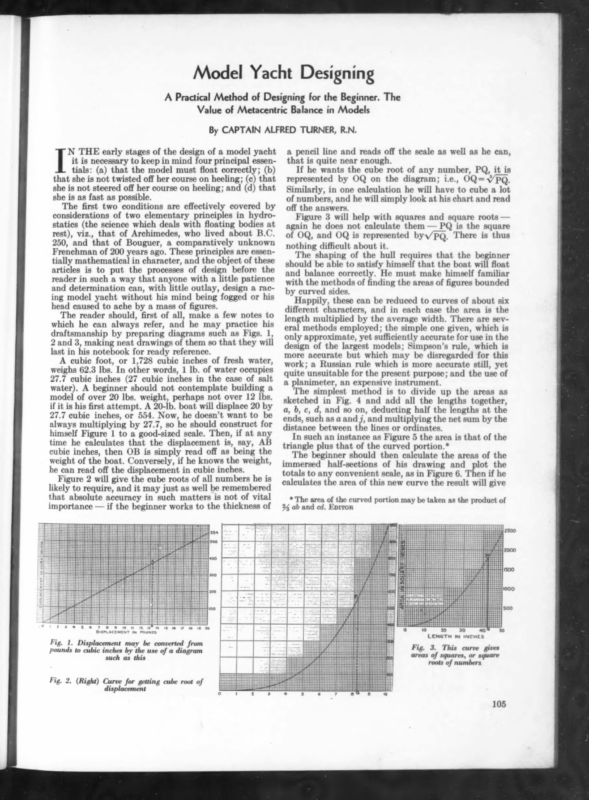
Model Yacht Designing A Practical Method of Designing for the Beginner. The Value of Metacentric Balance in Models By CAPTAIN ALFRED TURNER, R.N. [: THE early stages of the design of a model yacht it is necessary to keep in mind four principal essentials: (a) that the model must float correctly; (b) that she is not twisted off her course on heeling; (c) that she is not steered off her course on heeling; and (d) that she is as fast as possible. The first two conditions are effectively covered by considerations of two elementary principles in hydrostatics (the science which deals with floating bodies at rest), viz., that of Archimedes, who lived about B.C. 250, and that of Bouguer, a comparatively unknown Frenchman of 200 years ago. These principles are essentially mathematical in character, and the object of these articles is to put the processes of design before the reader in such a way that anyone with a little patience and determination can, with little outlay, design a racing model yacht without his mind being fogged or his head caused to ache by a mass of figures. The reader should, first of all, make a few notes to which he can always refer, and he may practice his draftsmanship by preparing diagrams such as Figs. 1, 2 and 3, making neat drawings of them so that they will last in his notebook for ready reference. A cubic foot, or 1,728 cubic inches of fresh water, weighs 62.3 lbs. In other words, 1 lb. of water occupies 27.7 cubic inches (27 cubic inches in the case of salt water). A beginner should not contemplate building a model of over 20 lbs. weight, perhaps not over 12 lbs. if it is his first attempt. A 20-lb. boat will displace 20 by 27.7 cubic inches, or 554. Now, he doesn’t want to be always multiplying by 27.7, so he should construct for himself Figure 1 to a good-sized scale. Then, if at any time he calculates that the displacement is, say, AB cubic inches, then OB is simply read off as being the weight of the boat. Conversely, if he knows the weight, he can read off the displacement in cubic inches. Figure 2 will give the cube roots of all numbers he is likely to require, and it may just as well be remembered that absolute accuracy in such matters is not of vital importance — if the beginner works to the thickness of a pencil line and reads off the scale as well as he can, that is quite near enough. If he wants the cube root of any number, PQ, it is represented by OQ on the diagram; i.e., OQ=~/PqQ. Similarly, in one calculation he will have to cube a lot of numbers, and he will simply look at his chart and read off the answers. Figure 3 will help with squares and square roots — again he does not calculate them — PQ is the square of OQ, and OQ is represented by./pqQ. There is thus nothing difficult about it. The shaping of the hull requires that the beginner should be able to satisfy himself that the boat will float and balance correctly. He must make himself familiar with the methods of finding the areas of figures bounded by curved sides. Happily, these can be reduced to curves of about six different characters, and in each case the area is the length multiplied by the average width. There are several methods employed; the simple one given, which is only approximate, yet sufficiently accurate for use in the design of the largest models; Simpson’s rule, which is more accurate but which may be disregarded for this work; a Russian rule which is more accurate still, yet quite unsuitable for the present purpose; and the use of a planimeter, an expensive instrument. The simplest method is to divide up the areas as sketched in Fig. 4 and add all the lengths together, a, b, c, d, and so on, deducting half the lengths at the ends, such as a and j, and multiplying the net sum by the distance between the lines or ordinates. In such an instance as Figure 5 the area is that of the triangle plus that of the curved portion.* The beginner should then calculate the areas of the immersed half-sections of his drawing and plot the totals to any convenient scale, as in Figure 6. Then if he calculates the area of this new curve the result will give * The area of the curved portion may be taken as the product of 24 ab and cd. Eprror iH: seESSESSSE ESSESEEEES = 400 i -O + 23 @¢ $ © 7 © 8S oO WwW 1 DISPLACEMENT IN POUNDS 7 “« —eaalites = 20 ae . yy . P fe + He —_ ~- = BREE 49 HEE Ho RBRRRRRRRESRRREREESSSeeete i eeeet treet eerie eretste ant o t & 3 HHH : +f Ex aesith t Hi o ~ heme Fig. 3. 1g. J. 30 HOIN 2000 : SHEET * Fig. 2. (Right) Curve for getting cube root of displacement Hatt SHE tf Fig. 1. Displacement may be converted from pounds to cubic inches by the use of a diagram ” an 0 * : 300 5E75; 1500 40 so INCHES This curve gi us gives ‘3! 4 CESSES 105
Fig. 4. Method of obtaining area of a section Fig. 5. Area of this section may be taken as the area of triangle, plus two-thirds of ab times cd SAE a RE lhe Ae sa OE SR en, _ a aac en Fig. 6. Curve of areas of half sections Fig. 7. The vertical curve of displacement ies Q Fig. 6. one-half of the displacement of the boat. The ordinates b, c, d, ete., represent square inches, and the distance between the lines, inches, the area under the curve being represented by cubic inches. It will avoid confusion and facilitate all calculations of areas, volumes, etc., if the individual dimensions on the drawing are read off by the scale, not as so many inches actually on the paper, but as the actual dimen- sions represented in the full-sized model. The positions of the centers of gravity of the displacement curves need not be calculated. It is just as accurate and every bit as scientific to trace the curves on thin transparent paper and cut them out with scissors, press them into spills so that the paper does not buckle, and balance the curves on the blade of a penknife. The longitudinal and vertical positions of the center of the displacement — the center of buoyancy (C.B.), as it is called, should be determined in this way. It is necessary to determine the positions of this important center both when upright and heeled, to ensure that the boat does not trim by the head or by the stern when completed. If the model is of good shape a slight trim by the bows or stern will not affect the performance, to any marked extent, of the model when sailing, but it is desirable that the calculation be made as accurately as possible. By the method given, if it be made twice, it is practically impossible to make a mistake in the arithmetic without its being noticed at once. The displacement with the model upright can be read off in pounds from Fig. 1, but it is as well to recollect whether the displacement is of the whole boat or only one-half of it. The displacement in cubic inches with the model heeled must be determined, and it is convenient to take the new ‘“‘smooth water” water line through _ the center line of the model as in Fig. 8. The areas of the immersed wedges should be added to the areas of the immersed sections, these respective sections having already been calculated and plotted on the upright displacement curve, and similarly, deduct emersed wedges. | i WEDGE padre WEDGE, a IMMERSED – ZZ “1 —_ . 8 (Left) ” _ Fig, rbDo =, cays I getthe area o, The heeled displacement curve has a larger area than the upright one, and, if they are to be the same, then the water line MN must be calculated by a trial and error method as in Fig. 9. The exact determination of the heeled displacement is unnecessary except to ensure that the center of buoyancy of the heeled displacement curve does not move either aft or forward from its upright longitudinal position. If it moves aft, the stern is lifted and the bow falls, and vice-versa, and it is desirable that it should not move at all fore and aft. It will move over to leeward as she heels. This is unavoidable and the amount it moves becomes important later on. The calculations so far given are sufficient to ensure that the model floats correctly, but in the balancing of the hull sections it is necessary to determine the position of the upright transverse metacenter. The longitudinal metacenter is somewhere up by the masthead, and its position is of no interest to the beginner, as far as the writer is aware. The position of the transverse metacenter (M) is, again, of no interest to the beginner from the point of view of the stability calculations — he need not bother about such things until he is anything but a beginner, but its position is of the first importance in assisting him to shape his model and make her shipshape. What is this metacenter? There are actually a large number of them, one for every position of any floating body of any shape. Even an iceberg has plenty of them. The upright metacenter is the point in the middle vertical plane of the model from which an imaginary string and plumb bob may be so suspended that if the model heels slightly the string passes through the center of the supporting force which prevents the model from sinking to the bottom of the pond. The string passes through the C. B. (the center of buoyancy), which shifts out to leeward as she heels. Bouguer showed that the height of the transverse metacenter above the center of buoyancy is given by the expression BM=7 , where I is the moment of inertia of the load water line plane. This is not the place to describe to beginners what a “‘moment of inertia’’ is. It is a term used in the natural sciences to measure the disinclination of a body to commence rotating, or to alter its speed of rotation about a given axis, under a twisting moment. The actual determination of the moment of inertia of any shaped water line is given by the following rule: The moment of inertia of the load water line plane is the sum of the cubes of half the water line ordinates multiplied by two-thirds the distance between the _ ordinates. The half ordinates can be read off by the scale and 106
__} + Fig.10 4 Fig. 11 Fig. 12 The skimming dish has considerable metacentric eg small angles of heel, but the height decreases rapidly as the i.nelines jotted down one under the other. Against each one, in another column, can be jotted the cube of that number after being read from Fig. 2, where the cubes of all numbers up to ten inches can be scaled with accuracy. The volume of the displacement is V cubic inches, which the beginner has been told how to determine. The metacenter fixes for us the point below it on which the model rests. Can a model balance on a point? Yes — but in a most unstable, precarious and impracticable fashion. She can balance much more firmly on a shelf passing under the metacenter. All that there is to do is so to shape this shelf that it does not fidget or twist across the hull as the model is pressed over by the sails. The position of the metacenter depends solely on the shape of the underbody as a whole, including the whole of the keel, whatever its shape or length. The underbody, when heeled, contains a portion of the upperbody when upright — it is of different shape altogether from the upright one, and it may have another metacenter altogether. That is to say, the model may be so shaped that she has a different metacenter for every angle of heel. On the other hand, she may be shaped so that she has only one metacenter as far as heeling is concerned, and only one metacentric shelf to lean on for all reasonable angles of heel, say, to rail well under. If she is so shaped that the shelf is not only fixed but lies, as far as can be arranged, in the fore and aft direction of the boat, then the surface of the hull is called a ‘‘metacentroid” —a coined word — and the model is balanced. The calculations are made as though the surface of the water were smooth. But never mind — study the simplest case first and it will be found later that, if the hull is balanced against twisting as she heels in smooth Figs. 13 and 14. In this type the metacenter shifts with little increase of heel water, nothing will be found wrong with her in rough water. For a skimming dish with a large water line plane and small underbody, it will be seen also that the metacenter is outside the boat, well above the deck, above the height of the main boom. When she is heeled the plumb bob swings over to leeward, indicating the point of support, the whereabouts of the shelf, and the necessity to fill out the overhangs with round bow sections, etc., to keep the shelf from twisting. (Fig. 10.) As she goes over and the weather bilge comes out of the water, the metacenter falls rapidly (Fig. 11), and if she goes on her beam ends, then it is evident that both metacenter and plumb bob must be well below the deck and inside the boat (Fig. 12). A skimming dish, therefore, rests on a shelf that collapses from under her as she heels; she rests on a weak reed, and such craft are indifferent in their behavior with the flat weather bilge out of the water. With smooth water and both bilges in the water, they may, on the contrary, be extremely fast, but they are not good all-round craft, although perhaps perfectly satisfactory for certain local requirements. The height of the metacenter is very susceptible to increases and decreases of beam, and a model with moderate beam on the water line can be shaped so that the metacenter (shown as M on the diagrams) can be just under the hatch and, what is more, so shaped that, when heeled rail under, its position has not altered (Figs. 13 and 14). Such a model rests on something firm, and the shelf can be made rigid fore and aft by fashioning the overhangs suitably, observing that as far as balance alone is concerned V-shaped overhangs can be arranged for as simply as circular ones. (Fig. 15.) Similarly, a circular bow, a ‘‘ V”’ section, and flat stern can be balanced. (Continued on page 126) Figs. 15 and 16. The old style cutter (right) had little metacentric height 107
126 March, 1931 Yachting A LITTLE MONEY BUYS A BIG VACATION WHEN YOUCRUISABOUT! control mechanism for this gear should be such that it can be operated easily with one hand. It is a mistake to cut up the cabin of a small boat, or even of a moderate-sized one, with more partitions than are absolutely necessary. Ventilation is very important, particularly in the galley. After the hull and the motor, the galley is probably the most important part of the boat. You cannot live on canned and fried food for an indefinite period of time. See that your galley is equipped with a reliable stove, including an oven, a refrigerator of adequate capacity, preferably iced from the deck, a sink which is actually large enough to hold the dishes, so that you will not have to use a dishpan, and above all see that the galley is well ventilated. The motor for the cruiser should not be of the ex- treme high-speed type unless a reduction gear is provided, and the general opinion seems to be that the The Single Cabin 30-foot Richardson Cruisabout has berths for four pie: cockpit space for more than a dozen. Speed 14 miles an hour. Price $3585 afloat at the factory. moderate-speed motor is the most satisfactory for this type of boat. It is certainly desirable to have a boat equipped with. at least a four-cylinder motor, and the ‘‘six’’ is much to be preferred. There is a marked difference in the amount of vibration in the six- and fourcylinder machine. Modern marine motors are most reliable and should give no more difficulty than an The Double Cabin 30-foot Richardson Cruisabout has four berths in the main cabin progr a | — two in the stateroom cabin at the stern. Speed 14 miles. Price $4185 afloat actory. Without previous boating experience a 16-year-old boy with his mother and sister for crew, travelled from Boston to Montreal and return in a Cruisabout. The cost of this 3000-mile vacation was less than that for an automobile trip of this same duration and no delays, mishaps, trouble, difficulties or privations were suffered during the entire 30-day cruise. A Richardson Cruisabout takes you new places, helps make new acquaintances and friends, creates pleasant experiences and memories and enables you to enjoy health, happiness and comfort as they never can be enjoyed ashore. Richardsons are priced from $2200 to $4385 — much less than the‘selling price of the average summer cottage, a good car or a season’s vacation for your family at the mountains or seashore. You must see the low priced, quality built Richardsons to appreciate their beauty, roominess, staunch construction and, above all, their exceptional value; or write today for Cruisabout booklet ‘‘F-31” which is free for the asking. RICHARDSON BOAT COMPANY, INC. 363 Sweeney Street Bruns-Kim North Tonawanda, N. Y. RICHARDSON CRUISABOUT DEALERS & Co. F. D. Homan Sth Ave. & 15th St., New York City Bruns-Kimball & Co. 102 So. Fourth St., Philadelphia, Pa. 78 Riverside Ave., Amityville, L. I., N. Y. Walter H. Moreton Corp. 1043 Commonwealth Ave., Boston, Mass. The Vee-Drive 30-foot Richardson Cruisabout, a de luxe yacht, has two cockpits, cabin or four and seventeen mile speed. Price $4385 afloat at the factory. automobile. Be sure, however, that your motor installation is accessible. It might be of great advantage to boat owners if we could compel every boat and engine designer to tear down and reassemble the motor after it had been installed in the boat before the boat was sold. Model Yacht Designing (Continued from page 107) A model of the narrow plank-on-edge type has its metacenter well below the water line and the ends of the boat cannot be balanced without serious difficulties arising. (Fig. 16.) As before, a slight increase of beam suffices to bring the metacenter to slightly above the water line, in which case a hull of this type can be balanced with less difficulty. It is advisable, in the long run, to arrange the shape first, so that the metacenter does not fall on heeling; second, that the shelf does not twist, and it is often advisable not to put it too high up at the start. If the bows and shoulders are too fine, then the shelf twists across towards the weather bow and the boat gripes during the process of heeling. This is the rock on which many models copied from published designs of yachts split; but yachts are not so seriously affected as the griping tendency can be nullified by a touch of weather helm, and it is a common statement that many successful yachts are ‘‘hard in the mouth” in this respect. With a model, this twisting or collapsing of the shelf is a most serious fault — it may be so bad that no one, however skilful, can handle her. Again, if the model is very stiff and powerful, she may be so jerky as the sails lever the boat one way, and the lead keel the other way over the twisted shelf, that she jerks into the wind, and the sails are violently spilled. A balanced model within reason cannot be too stiff, nor too powerful — short of a comvlete break in the wind; she will go over and right herself steadily. In the case of unbalanced hulls, the wretched C.E.’s and C.L.R.’s are frequently ‘Baby’ Richardson 24’ 6” x 8’ x 2’ 2” has cabin accommodations for four. S; 15 miles an hour. Price $2400 afloat at factory. Built as day boat price $2200 afloat at factory. blamed. The mast may be shifted, the fin altered, and so forth, but it is all of no avail if the shelf itself twists and fidgets about. If the model is unbalanced, look for the reason. If it is found that it is due to the bows being too fine, or the quarters too full, alter the trim and she may sail. If the errors in the fullness of the bow and stern are considerable, do not waste time over the model — chop it up. (To be continued)