- Title. Author. Summary

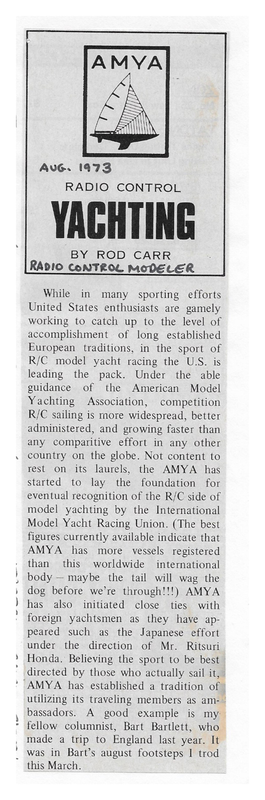
AVG. 1973 RADIO CONTROL YACHTING BY ROD CARR RADIO CONTROL MODELER While in many sporting efforts United States enthusiasts are gamely working to catch up to the level of accomplishment European of long established traditions, in the sport of R/C model yacht racing the U.S. is leading the guidance pack. of Yachting the Under the American Association, able Model competition R/C sailing is more widespread, better administered, and growing faster than any comparitive effort in any other country on the globe. Not content to rest on its laurels, the AMYA has started to lay the foundation for eventual recognition of the R/C side of model yachting by the International Model Yacht Racing Union. (The best figures currently available indicate that ee — = =, AMYA than has more this vessels worldwide bod — maybe y the registered international tail will wag the dog before we’re through!!!) AMYA has also initiated close foreign yachtsmen as peared under such the as the direction ties they have ap- Japanese of Mr. with effort Ritsuri Honda. Believing the sport to be best directed by those who actually sail it, -AMYA has established a tradition of utilizing its traveling members as am-~ bassadors. A good example is my fellow columnist, Bart Bartlett, who made a trip to England last year. It was in Bart’s august footsteps I trod this March.
Renewed contact with the members and officers of the English Model Yachting Association (MYA) was deemed appropriate on a number of grounds: 1. Rumors of a 10-Rater and 50/800 | Class International R/C Regatta to be held in England in 1974 had begun to circulate. It seemed that preparations and planning for U.S. involvement to-face required discussion MODEL YACHTING ASSOCIATION 2 | |i ‘2 : bin a ce 077 that a face- help lay the to eroundwork. . Since England holds heavy sway on the workings of IMYRU we felt that a little politicing might help establish AMYA rationale for entry into IMYRU. 3. A first hand sampling of English attitudes on one-design racing was required to assist in planning international aspects of such competition. = > ~~ ia Roger Stollery, well-known model yacht designer, mans the Model Yachting Association’s booth at the London Dinghy Exhibition. A very professional set-up which drew much interest from the crowds. 4. And there was a natural personal desire to meet and learn from the English skippers. With unmitigated luck my schedule allowed me to meet all objectives in a single afternoon at a single location. Luckily the MYA was involved in the London Dinghy Exhibition on Satur- day, the 24th of March. The exhibition was held at the Crystal Palace National Sports Center in a large com- plex that featured two good-sized swimming pools. A large fan had been rigged at one side of the diving pool and soon a wide selection of R/C yachts from 32” to the big “A’s” were plying the water. Commentary was by a ‘household word’ in model yachting circles the Stollery. world As over, Roger Mr. and | Roger chatted during the course of the afternoon, we both agreed that anything that sailed = Norm Hatfield, MYA Vice-Chairman, launches R/C “A” Class yacht at Crystal Palace diving pool public demonstration. Note sheets, winch and rudder pushrods all on deck originating in R/C box/hatch aft of mast, a typical English R/C installation. was fun — be it R/C, vane, or sport, but that cooperation among all three phases was necessary to provide co- herency in the development of the sport. Score 3/4 point for Roger, as he is strictly a vane sailer and best known for his advanced design work – – – it shows his work so stration. typical true colors to watch him hard at While he English an R/C demon- demonstrated the shock at one-design racing, he was quick to point out that if such a program brought an infusion of new skippers into model yachting, then it should be promoted on that basis alone. As a quick aside, I might mention that Roger’s latest “A”-Class design, Clockwork departure Orange, is so radical a from traditional ‘‘A”’-Class thinking, and it has done so welin l Detail of R/C “A” vessel. English use drum winches to the exclusion of almost everything else, but look at all those clever blocks and fittings!
competition, that a move is afoot to ban the change. beast Can by it a be proposed that the rule sacred freedom of the International A-Class Rule is about to evolve into a set of rather liberal one-design class specifica- tions?? As a result of my discussions we might report capsule conclusions: 1. The 1974 event looks like it will be held. The format appears to be rather loose, as there are no well established R/C competitions for 10-Rater or 50/800 class boats in England. However, new boats are hitting the water, and MYA Chairman Jennings and Vice Chairman Hatfield thought that they would be able to field a _ reasonable number of boats in ’74. They indi- cated a strong interest in finding out how we run our regattas and looking over our equipment. | pointed out, in return, that the U.S. skippers would certainly have a field day looking over the ingenious 4. Meeting and talking with many MYA members at the Dinghy Exhibition was very informative. The accompanying photographs will indicate some of the people and equipment on display to the public. I promised some information on AMYA sanctioned regattas in a past column and here is a list of the ACCR’s (Annual Class Championship Regattas). There also exist up to 3 divisional championships for each class, as well as 1 and 2 day special regattas, and local series. Space limits us to the ACCR’s for this month. They draw the top skippers, and provide exciting spectator viewing, as well as a top drawer introduction to R/C yachting as a “head-to-head” competition. July 21-22, 36/600 Class ACCR, Tennessee; Bill Mac- Memphis, Laughlin, 3197 Toby Lane, Memphis, Tennessee 38111. July 28-29, East Coast 12-Meter English provide on their vessels. So, ACCR, Tampa, Florida; Buddy Black, 3004 Samara Drive, Tampa, Florida it 33618. rigging and fitting systems that the would seem that it will be a relaxed, mutually beneficial meet- August 11-12, Santa Barbara ing between the two largest sailing ACCR, San countries and one that will be more George Montague, than worth the price of the charter Avenue, Capitola, California 95010. plane flight that AMYA is ex- ploring. 2. The politicing was successful in that I was able to point out the tre- mendous rate of growth of AMYA and the form possibility that it might a _ parallel IMYRU out organization of sheer to necessity unless IMYRU took itself by the scruff of the neck and caught up to the present state of the sport. 3. One-design racing is still not an accepted activity in England. It is possible that, in part, this is due to the lack of “pushy” individuals needed to get something like that off the ground. It might also be partly the due to unfortunate choice of the 42” Star-C as a design to be pushed. This is too small and really needs a boat better able to take heavy air in order to become a truly national one-design. | made tentative inquiries as to the feasi- bility of spreading one of the U.S. one-designs to England under a licensing arrangement. This is still under discussion. We also con- tracted for one of the 64” Radio Solent hulls produced by John Dowling in Fareham. It should arrive soon, and is representative of a modern hull in the 26 pound area that would-seem to me to be a better choice for an English onedesign. August Francisco, 305 18-19, California; McCormick 500/800 Class ACCR, San Diego, California; Mario Singleton, 3828 36th Street, San Diego, California 92104. Still to be scheduled are ACCR’s for Open Class, West Coast 12-Meter, and Regatta One-Design. That information, as well as anything else pertaining to AMYA, is available from Secretary Chuck Black, 4761 Niagra Avenue, San Diego, California 92107. And, as long as you are writing to him, enclose your $3.65 annual AMYA dues in the envelope. @ Any questions you are harboring will get a smug answer if you’ll drop them my way to Rod Carr, 2713 Blaine Drive, Chevy Chase, Maryland 20015.