- Round the Regattas
- Rara Avis John Lewis is best known for his 10-rater and ‘A’ class designs. This handsome Marblehead incorporates family features which ensure fine performance
- Readers’ Queries
- The British M Class Championships Birkenhead was host to 31 boats in this year’s event.

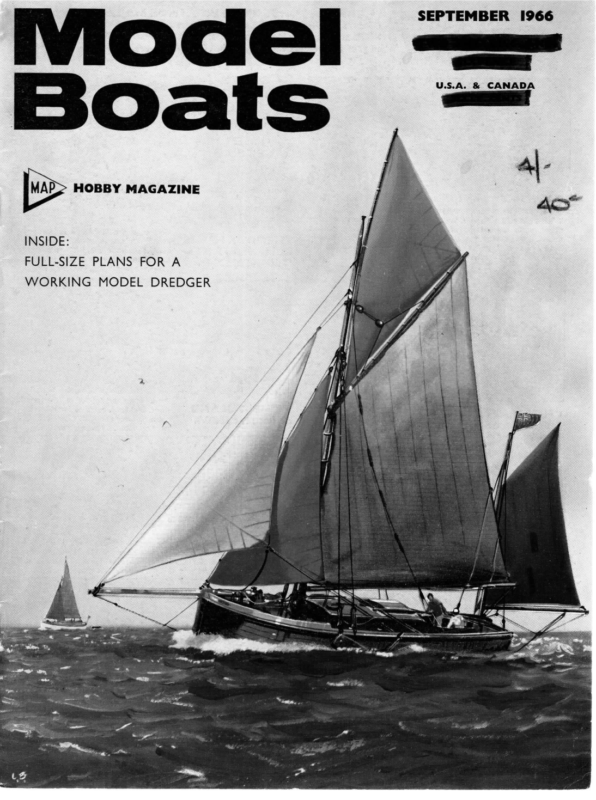
awe a a Oat & HOBBY MAGAZINE INSIDE: FULL-SIZE PLANS FOR A WORKING MODEL DREDGER SEPTEMBER 1966 —
ROUND the REGATTAS 16th Annual Sailing Ship Rally, 5 June _ The Thames Shiplovers rally produced eight squareriggers, eight fore-and-afters, and eleven assorted } in. scale barges, of an impressively high standard. The overall winner was J. Russell with his 45 in. barge Cambria, and the barge race was won by P. J. Humphrey’s Giralda, which also collected a bronze medal for work. Mirosa, by P. M. Ford, wona silver. The centenary of the famous 1866 “tea race” was celebrated by a race for square riggers, the prize (4 lb. of China tea!) being won by the 4 m. barque Pamelia by G. West, also awarded a silver medal. A bronze went to A. K. William’s well-known 4 m. barque Star of the South. Of the fore and aft rig, the silver went to the Scottish fifie lugger True Vine by B. Nee, and the bronze to J. Clark’s 36 in. Smack Fly. Poole R/C Yachts, 11/12 June Seventeen Paddle Steamer Rally, Blackheath, Jackson (Watford M.M.C.) was up for the Taplin over three Japs. a convincing winner with his River Dart steam P. S. Compton Castle, with V. Knight’s (Rochford) Colonel Lamb and S. Coventry’s (London) Dawson City tying for second, and Harold Disney’s (Watford) Anglia close behind, despite a pondside fire which caused excitement but little damage. Other models operated Position 42 5. 2 7. J. Gascoigne A. Taplin G. R. Skeates Jaquita Selma Calypso 40 40 38 9. R. Dehon Falcon i}. 11. 13. 14. 15. Retd. Retd. Ten clubs took part in this R/C regatta, visitors being Brighton, Bromley, Chiltern, E.M.I., Hounslow, Maidstone, Portsmouth, S. London, and Walthamstow. Neville Portlock’s 15 c.c. o.d. boat was the biggest present but won steering nonetheless, and also took 15 c.c. speed. Johnny Johnson won 10 c.c. speed, but Portsmouth cleaned up 33 c.c. Results—Steering, 1. N. Portlock (S.L.) 139, 2. D. Careless (P’mouth) 134, 3. H. Johnson (S.L.) 120. Junior, N. Mogg (E.M.I.) 25. 34 cc. Speed, 1. D. Careless (P) 1:57.5, 2. R. Merritt (P) 2:00.7, 3. T. Greeman (P) 2:21.2 5 cc. 1. F. Body (P) 1:34.5, 2. B. Miles (S.L.) 1:49.6, 3. J. Husband (P) 1:53.3 10 cc. 1. H. Johnson (S.L.) 1:06.7, 2. B. Pollitt (S’hampton) 1:08.8, 3. B. Thompson (P) 2:52 15 cc., 1. N. Portlock (S.L.) pee 2. A Lewis (Brighton) 2:15.4, 3. P. Shearman (Bromley) Score Sundust Popsy Arabesque 8. Southampton D.M.P.B.C., 30 May Boat R. Terrett R. T. Foster E. W. Geary 10. barges, provided additional interest. Skipper 1. 2. a 4. were Royal Sovereign, Royal Eagle, Golden Eagle, Lana, Victor, Seaham, Lucia, and Lancaster Castle. Two tugs, a 6 ft. cruiser, a cargo ship, and two :20.6. lined her win. Both boats were moulded by R. Terrett of London R.C.S. and displace 60 Ibs. All races were second rally of the Paddle Steamer Preservation Herbie yachts two for the next place. The sail-offs produced the results listed; Sundust led all the way from Popsy for 21 May A dozen paddlers made an impressive display at the Society. R/C Challenge Trophy; two retired, two tied for first, and “ G. J. F. Stalkartt J. Appi J. Merrick Moonraker Gigi Gymsy S. G. Dale N. Stonely Trixie II Nuage Blanc A. P. R. P. Poolrad Buccaneer Electra II Holrad C. Brazier Dehon Wilkinson Jeffries Chaldecott Rachelle 50 50 42 32 28 24 2 2 20 14 8 Hounslow, 26 June The first of two M.P.B.A. regattas at this club, weather was kind and clubs visiting were Southampton, St. Albans, Reading, S. London, and Victoria, producing 36 entries for R/C steering and speed. Two minutes starting and four minutes scoring was allowed in steering, a well-sorted course giving a score of 90 for a clean lap. Usual half points for a touch, but a new one—minus 20 for hitting either of the starting gate buoys. The Centurion Trophy and 378
MODI BOATS Rara Avis John Lewis is best known for his 10-rater and ‘A’ class designs. This handsome Marblehead incorporates family features which ensure fine performance Rara Avis is my present idea of a good ‘M’ class model without any peculiarities in design except those obviously produced by the rule itself. I’m particularly pleased with the lines as they would seem to me to be a happy blend of power and good looks without an excessively high displacement for the class. It is a long time since I last produced a Marblehead and so the rule has come out freshly for me and these lines have made a change from the several ‘A’ class that I’ve done this year. Rara Avis is a definite development of one of my earlier attempts and I hope will prove to be an advance on what was quite a successful unpublished design. I believe she will be able to perform adequately under any conditions and not exhibit the mediocrity of some so-called ‘all round’ boats. The keel is one of my favourite types in that it has a constant chord/length ratio and has a fine entry to the sections. The bow is full above water to supply reserve buoyancy which the short overhang type suffers from and yet the water-lines have a reasonably fine entrance. She should do well both to windward and off the wind if carefully sailed. It is recommended that the stern is fitted with a metal plate to provide a sharp lead off for the flow of water but care should be taken not to exceed the maximum tolerated length for the class of 50.25 ins. Full-size copies of the drawing below are available, plan M.M. 900, price 8s. including post, from Model Maker Plans Service, 13-35 Bridge Street, Hemel Hempstead, Herts. Note that the sheer and waterline plans are given half full-size and the body plan full-size. “RARA AVIS” vatewis penance er / (7!) | MODEL MAKER PLANS SERVICE | convaient (398 DRONE OT, MEMEL oF WOOO TEAS, neRTe 382
SEPTEMBER Could you advise me as to where I can purchase sail-cloth suitable for a 30 in. model yacht, or if special cloth is not produced, what type and weight 1966 Readers’ Queries of material you would recommend? R. F. C., Bicester. The customary material for model racing yacht models. The ballast, however, will be 1/12 x 1/12 x 1/12, or slightly under half a pound, whereas Water Baby, an MM class model of quite similar appear- sails nowadays is varnished terylene, which we understand is specifically manufactured for some form of cable insulation wrapping. The varnishing is in fact a synthetic resin-based impregnation, carried out during manufacture. Unfortunately the material cannot easily be bought—the only source we knew which sold it by the yard no longer exists, and another source which supplied only in 10-yard rolls apparently no longer does so, Professional model sail- ance, carries 3} lbs. at twice the depth. It isn’t pos- sible to add ballast without sinking the boat lower in the water, so that to produce a reasonable righting couple is impossible, even if the fin keel is extended downward, Taking the bigger boat and applying the same scale, Francis Chichester’s Gipsy Moth IV would makers may be prepared to supply it by the yard. In any event, this material is probably too heavy for a 30 in. model, and the older type of sail-cloth, known as Union silk but actually Egyptian cotton, is probably better. For small models most materials shops sell what may be termed nurses’ or nuns’ come out at 54 in., 38} in. on the waterline, draught 7% ins., beam 10} ins., sail area 854 sq. ins., total displacement 13.3 lbs., lead keel approximately 5 Ibs. An average modern Marblehead, 50 in. long though 47-48 on the waterline, has 800 sq. ins, sail, similar veiling, a fairly thin white cotton suitable for small sailing models. Some skippers use lightweight cloth of this type, and after the sail is made (and possibly stretched by use a few times) airproof it by pinning it over greaseproof paper and applying a thin coat of banana oil, a cellulose non-shrink liquid available at good model shops. R. F. C, later wrote to say that he bought nuns’ veiling without difficulty, and it proved very satisfactory and was quite cheap. He also added the valuable information that in the trade it is apparently known as tarantulle. beam, half as much again draught, and 15 lbs. of lead out of around 21 Ibs displacement. One early M with 50 in. length, 39 in. WL, 783 sq. ins. of sail, but only 9 in. beam, displaced 144 lbs. of which 9} Ibs. was lead. It will be seen that the smal] scale model is just not feasible, but that the larger model might just be sailable, especially if the woodwork could be lighter to allow a better ballast/total displacement ratio— say 5 lbs. of boat to 8.3 of ballast, Even then it would be a light weather craft in top suit. Steering Gear How can a Braine quadrant be fixed to a rudder stem that is at 45 deg.? A. D.1., Rye. Help Wanted In 1932-5 I remember a paddle-steamer I knew as Fair Maid calling at Bo’ness and running a pleasure trip down to the Forth Bridge and back again for 6d. and I/-. I think she belonged to the L.N.E.R. and the last I heard of her was in the Normandy landings in 1944. Is there any source of drawings and information to enable me to make a model of her? S. E., Bo’ness. Some form of universal joint is required, with the quadrant carried on its own bearing. This can be a short bridge of brass sheet, with the quadrant on top and its pivot passing through a bush in the bridge. At the lower end the pivot requires a square U, upside down, engaging freely but with a minimum of play, in a similar square U right way up: securely fitted to the rudder stock. The arms of the U-pieces must be of sufficient length to engage despite the change of angle, and movement of the rudder must be free for some 25 deg. each side of I am at present engaged in seeking out data and information about the tea clipper Thermopylae. I have obtained from the Science Museum a plan of the hull, but I have been unable to find any accurate deck or sail plans. Are there any sources of such drawings?—R.G., East Dereham. centre, Is it possible to obtain plans for the construction of a scale model of either the Endeavour type yachts raced for the America’s Cup by Sopwith pre-war, or the post-war Sceptre class? L, K. J., Bath. These queries are included in case some reader can offer information; in the case of America’s Cup yachts it may be worth once more pointing out that it is extremely difficult to make a scale model yacht which will sail satisfactorily. Take as an example a recent new fin-and-skeg type full-size yacht which looks a potential sailer as a model. Length overall is 23 ft. 3 in., waterline 19 ft., beam 6 ft. 5 in., sail area 207 sq. ft., carrying 850 Ibs. of ballast in the keel, giving a draught of 3 ft. 8 in. If we make a 1 in.-1 ft. model, length will be 1/12, i.e. 234 ins. Sail area will be 1/12 x 1/12, or 207 sq. ins.—very close to the 25 in., 216 sq. ins. MM class “Well, you know what a stickler I am for detail . . .” 383
MODEL BOATS The British M Class Championships Birkenhead was host to 31 boats in this year’s event. [HIRTY-ONE boats came to the starting line on Reynard, the Edinburgh Inverleith Club Foxtrot, now got going and had moved up the list into 9th position. During the afternoon the wind suddenly dropped and then changed round to the west, which is the prevailing wind on the Birkenhead lake, Racing con- the Saturday, 28th May, at 2.30 p.m., the Mayor of Birkenhead starting the holder, Mr. Chris Dicks, and his opponent. The wind was light and variable from the East with plenty of sun; unfortunately the start at the East of Birkenhead lake is blanketed by a school on the other side of the main road, Alan Bell of Fleetwood and Ken Roberts of Birkenhead with their Foxtrots soon went into the lead, closely followed by Chris Dicks with his Champion Witch- tinued with this soldiers’ wind until 6 p.m., by which time 20 heats had been sailed. The scores at the end oi Sunday were: Tin Pot C. Dicks 76 points Fandango K. Roberts Fife Wendy J G Reeves 68 ©, High Jinks . F. Shepherd 67 ,, craft, Wendy J with the two ex-champions, Graham Reeves and Dennis Lippett as crew, followed by a new Birkenhead boat, Cutlass, skippered by Bob Dunning of Stockport. At the end of the racing on the Saturday Chris Dicks with Tin Pot had gone into the lead with 30 points, but Fandango, Ken Roberts, and Tempest, Alan Bell, with 29 points each, were close behind. On Sunday the racing was started promptly at 9.30 a.m, and although the wind was still light and variable from the east, swinging all the Cutlass Charmaine Trump Tempest orn 66, A, Bell 61, E. Holt 66, Monday. The start was delayed until 9.45 a.m. due to a break-in at the boathouse by vandals, who had removed a large pane 6 ft. by 2 ft. of 4 in. glass from the roof. Most damage was done to the Club Canteen, but five boats had been damaged. With the help of members these were soon got in rac’ng trim and a start was made with the wind back to the east, very light and variable. This continued all morning, at times being so light that the O.0.D. shortened the course by 10 yards due to the area of complete calm time, Tin Pot continued in the lead, followed by Fandango, Wendy J and Ted Lathom with his Fox- trot, Bell. Dick ford, new R, Dunning E. Lathom Charmaine, who had passed his club mate Alan High Jinks, to the new Bewitched design by Priest, skippered by Fred Shepherd of Guildwas only one point behind, Fred having the British 10 rater Champion Ray Blick as mate. at the boathouse end of the lake. Lunch was taken Heading shows a general view of the finishing line at the East end. Foreground boat is Sprite, H. Young, Birkenhead, to Witty’s Hornet design. Left, Chris Dicks receives the trophy from Mrs. Taylor while Commodore J. Pemberton looks on. Youngster at left of picture is presumably Birkenhead supporter. Photo taken inside the boathouse, by the way. Below: Fandango and Wendy J. sail off for second place, with a watchful Ken Jones about to blow the whistle. 386
SEPTEMBER from 12.40 until 1.45 and during this break the wind turned round 180 degrees and a fresh north-west breeze blew up, giving a clean beat and run. Keen and close racing was now seen and some of the very tall rigs disappeared; however, the top boats still kept on with theirs and with 8 heats to race for the battle was on. Tin Pot kept her small lead, closely followed by Fandango and Wendy J. Green Top, the Birmingham boat, took a well deserved 3 off Tin Pot but then the latter boat took the 3 off Fandango which still kept Chris in the lead. Cutlass, the new Birkenhead boat built, skippered and owned by Bob Dunning of Stockport, unfortunately left her effort too late, Bob only getting her properly trimmed on the latter two days due to being indisposed the month prior to the race. The two bulb keel boats Tom Cat, a Dare Devil, and Green Top, a Vega design, proved to be two of the fastest boats to windward in the Championship. At 5.45 p.m. the race was over and Tin Pot with her 4 point lead had retained the 1966 The O.0.D. for the event was Mr. J. Pemberton, Commodore of the Birkenhead Club, the Assistant 0.0.D. being Mr. J. Blundell, Commodore of the Fleetwood Club, Mr. Bill Turner, Secretary of the N.D.C., did a yeoman job with his loudspeaker outfit in calling up the pairs for the whole weekend. Starters were Mr. J. O’Connor, Mr. J. Turner and Mr. K. Jones, with umpires Mr. E. J. Blackshaw and other members on various days. Mrs. K. Jones and Les Bruce looking after the scores and the scoring board. Special mention was made by Mr. J. Pemberton in his speech of the grand efforts made by Mrs, Taylor, Secretary of the Ladies Committee, and her band of helpers who provided a running buffet on the Saturday and over 60 mid-day Junches on the Sunday, and the same number, if not more, on the Monday, also providing tea and scones, fruit, drinks, etc., on each day from 9 o’clock in the morning until the last heat in the evening—this after the heartbreak of seeing Championship. Wendy J then beat Fandango in the tie for 2nd place bya sail off. their canteen nearly wrecked and food thrown about by the vandals. BRITISH ‘‘M’’ CLASS CHAMPIONSHIP BIRKENHEAD, WHIT, 1966 Pos.| NO. REG BOAT 1 1246 Tin Pot 2 3 1395 1353 1501 Cutlass 5 1453 Green Top 4 6 q 9 10 11 13 14 15 16 17 18 19 20 21 22 23 24 25 26 Wendy J Fandango 564 1090 1508 Floreana Trump Charmaine 1324 Tempest 1450 1489 1503 1187 54 KS1284 1466 1496 1035 1250 1491 POINTS | NO. | 112 108 108 100 98 96 93 93 Cracker Barrel High Jinks 91 90 Jack Ann 88 Gigi Gretel Reynard Perky Myth Atom Sprite Angelica 88 83 80 78 72 71 70 69 67 SKIPPER CLUB C. Dicks Clapham G. A. Reeves K. Roberts Bournville Birkenhead C. W. Sykes Bournville R. Dunning x W. H. Jones E. Holt E. Latham T. Pratt E. R. Shepherd A. Bell R. Mackarel Birkenhead 3 Fleetwood Birkenhead Guildford B. Cowan C. Edmondson I. McBride D. Parkinson | Littlejohn Adams | Dunning | Witty Witchcraft Wendy J Foxtrot Modified itty Was Vega Norsworthy McDonald Adams Witty Priest | Floreana Mithras Foxtrot Hustler Bewitched Adams Bradford Bournville Littlejohn if Elusive Shaw Nocturne Witty Priest Hornet Witchcraft Inverleith Southampton Birkenhead Fleetwood Young C. H. Colsell DESIGN Priest Fleetwood of L. Maskell R. Harris DESIGNER Birkenhead Hove | % Adams a 28 29 30 Araba Pinky Libra Skippy Tom Cat Long Tall Sally Serula Tinker Sea Witch Meld 65 64 62 55 54 53 53 52 50 45 . Reed G. Wyeth D. Bragg P. L. Whiteside F. Hunsperger A. D. Gill J. Dawson T. Lancaster R. Bostock E. Hunt Hove Southampton Fleetwood see. N’th Liverpool Birkenhead Fleetwood Birkenhead Birkenhead Hove Littlejohn Adams Priest Witty L. Stollery Littlejohn Priest McDonald Priest Littlejohn 31 1488 Porky 11 D. Keatley Southampton Priest ¥ Foxtrot co Priest 973 1465 1273 1358 1490 1467 1029 1362 1497 971 Foxtrot Witch | | Plover Foxtrot Witchcraft Manta ; Daredevil Falcon Witchcraft Mithras Bewitched prodiieg over Witchcraft H.M.S. KENT (Continued from page 393) completed. The casemates cause trouble in the model, just as in the real vessel, by admitting water in rough weather, often in surprising quantity! Some kind of screen of balsa or glass-fibre should be built behind the casemates ‘cradles’ support the hull of my model, kept together by 3 lengths of dowel and covered with leather on their edges to prevent their scratching boat or sideboard. If you wish to finish Kent in anyway other than her Victorian appearance, then she was painted dark grey before and during the first years of the Great War, light grey later and white overall when on the China station. Various modifications were made before and during the inside the hull. The radio control was very kindly built for me by my friend Michael Wilshere and I do not know very much about it. A 6-channel system is fitted, with a Remcon Miniten transmitter and Remcon Multigem receiver. Only two channels are used at the moment to operate the rudder servo (Musclemite) through 2 relays. The relays and servo motor have proved unreliable and are being replaced by a transistorised Micromax. Two more channels will be used for a speed control unit, leaving 2 spare. Finally I think a boat such as Kent deserves a display stand as well as a carrying frame. Three polished teak war. The extra-high foremasts were stepped when radio was introduced, and spotting tops replaced the search- light platforms on the mast during the war. An extra position for a searchlight was added to the mainmast, and the lower deck 6 in. guns were mounted in gun-shields on the upper deck after 1916, I have not seen a model of a ‘County’ in this state so I do not know how the guns were mounted. 387