- GOLDEN ARCHER We anticipate a golden future for builders of this attractive new Marblehead design from S. Witty’s board.
- Simple Single-Channel Radio in a Sea Queen D. C. Atkinson outlines the installation in his model
- NATIONAL & INTERNATIONAL ‘A’ CLASS CHAMPIONSHIPS GOSPORT, AUGUST 7-14
- Australian Marblehead Championship By G. Middleton

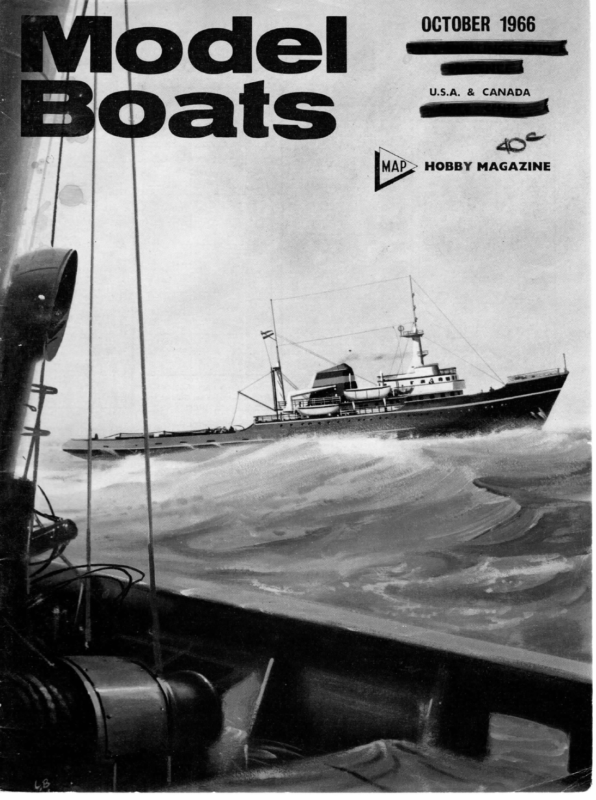
OCTOBER 1966 U.S.A. & CANADA eer HOBBY MAGAZINE ‘eome 23.22%
MODEL BOATS : FOR the Jast two or three years my efforts in the sphere of model yacht design have been largely devoted to the development of the deep bulb concept in both 10R and M. A fair proportion of sailing waters, however, have not the required depth for this type, so a bulb-keel “M” of limited draught had to be considered. Having pioneered the design of the deep bulb ‘“‘M” this was not an easy decision. The main problems of deep bulb-keelers have been solved; they are quite easy to trim and are now winning regularly, Nevertheless, the experience gained has been put to good use in the latest hull. In fact, balancing a limited draught bulb “M” is comparatively easy. After some consideration I GOLDEN ARCHER We anticipate a golden future for builders of this attractive new Marblehead design from S. Witty’s board. decided that 12 in. would be the optimum draught, for most ponds can float this depth of keel, yet the power is 30 per cent greater on pendulum stability, compared with a conventional fin keel. With the higher C.L.R. due to the shape of the fin, the actual stability gain might be nearer 40 per cent. When one considers that this is equal to an extra 5 lbs. in a normal hull, it will be seen that even draught the bulb is still well worth lower half and tail of the bulb does at reduced while. The not restrict crossflow, or contain pressure, and any lateral flow over the tail section will be at 5-10 deg. to the centre-line, thus moving around an easy streamline section. As the centre of the fin area tends to be further forward, so the mast will require to come forward also. To keep this effect to a minimum and to ensure that the hull will maintain trim through a wide range of conditions, a study of a few “Ms” which combine proven good balance with an “aft” mast position, such as Jemima Duck, Saida, or my own Wasp and Hustler, gives an indication how this can be achieved. They are all transom types for instance. The Tucker boat has a full 6 in. beam at the aft ia eee 4 % Willy , 7 ———* 4 TY \N\\ qh) TH MODE) MANET PLANS Offivice MM GOLDEN ARCHER L.W.L. end, thus giving a straight Welch Axis in – WW C.) the after hull at least. All the designs mentioned have inboard mounted skeg-rudders and there is no doubt that this and, in particular, the base length of the skeg, is a considerable factor affecting the mast position. A rounded nose also helps to ease the arc of the “W.A.” but any advantage gained is largely cancelled out by the extra resistance in a chop. The bow in the design shown is a happy compromise in this respect. The hull itself is full ended, but all curves are fair and with a midsection less than three inches deep, plus easy rocker, she will plane very fast, The fin is of 3 in. ply and is very amply strong at 410 that, being much less stressed than the proven
1966 OCTOBER to the mast root of a wide selection of designs in the “M” class including bulb-keel craft. Varying deep-bulb fin, in spite of the extra weight of keel. The rudder post is shown raked and is a little better so, the main reason being that, as in a raked fin, all drag effects are graduated, or in other words are not in the same vertical plane. This includes skin drag, or would seem to on the basis of a recent experiment, and to a degree I had not previously realized, On the other hand some do prefer a vertical post so an alternative skeg-rudder is shown. The choice of vane may be a factor here. On no account mount the skeg-rudder further aft to obtain types give different measurements, but the mast range is indicated at between 5 in. to 74 in, from the midsection, with the most likely final position about halfway between these limits. If you are perfectionists and like to have the mast in the centre of the slot, the possible movement should be a little more than usual below deck, while the deck slot can be made short and increased either way during trimming. Most designers tend to be slightly optimistic about the balance of their yachts, with the result that actual mast positions are rather forward of the a longer control arm or you will greatly narrow the range of conditions under which a good trim can be attained. You would have to choose between being able to point in light weather, but with excessive luffing in a blow, or alternatively to sail close and fast in a blow, but falling off in light airs. Those who have boats thus indisposed usually plump for the latter, as performance in a gale is estimated places as a rule. A V.H.A.R. rig is shown, and liked or not must more spectacular, whereas yachts often go astray in light conditions anyhow. It should not be thought that mast position is in itself indicative of “balance”; as mentioned, this must be correlated to the fin area. Just how good the balance of Golden Archer is may be gauged by the fact that the estimated mast position is further aft than in some fin-keel “Ms”. I must say, however, that I do not know of any realistic system which takes into account all the forces affecting the position of the mast, so the actual site may vary a little from that shown. Estimates are usually based on correlated information from known designs. A simple method of obtaining an approximate position consists of measuring the horizontal distance from the centre of the fin area be regarded as a necessity for competition in lightish conditions these days. In this year’s “M” class championships, for instance, this kind of weather prevailed throughout the meeting and those without a high plan could hardly expect to do well. As I recall, the first ten boats were all so equipped, the only exception being the lone Vega. Virtually all used positive tension control on both sails and as the force which these devices can effectively apply is largely proportionate to the distance from deck to sail it is common sense to allow enough clearance for them to operate efficiently. To sum up, Golden Archer is a husky design with a wide performance envelope, and with one third more power, well able to carry the tallest rig. Balance is good and wetted area moderate. A really serious competition “M”. Average sort of weight and beam, fast downhill and easydrive lines for performance to windward. Simple Single-Channel Radio in a Sea Queen D. C. Atkinson outlines the installation in his model THis Sea Queen represents some 70 hours work and an expenditure of around £45, including motor, accumulators, radio, Mersey Marine fittings, etc., etc. The boat weighs 25 lbs. and is powered by a Taycol Double Special fed by two Barnard 6v. accumulators. Detail goes down to saloon furniture KINEMATIC ; TAYCOL[D SERVO 12 VOLT SWITCH and curtains. On the radio side, a single channel R.C.S. trans- mitter/receiver set drives a Graupner Kinematic actuator, giving motor ahead and astern and rudder port and starboard, There is also a warning light RECEIVER SWITCH which is extinguished when the motor stops. A colleague, Eric Burrows, assisted with the wiring. The R.C.S. Mk. 1 receiver switches an 80 ohm relay, and it proved necessary to change the receiver’s electrolytic condenser to 5 mfd. to prevent relay dwell. It was at first thought that a slave relay working off the Kinematic would be necessary to keep the current through the actuator contacts to a reasonable level, but frequent running over several weeks, with the main motor current switched through the actuator, has produced no difficulties or TAYCOL (DOUBLE SPECIAL) DRIVE MOTOR FRO. fey ONLY 3 = USED ON SWITCHER, RECEIVER KINEMATIC RUDDER & MOTOR ee SWITCHER 5 WAY ft BARRIER STRIP CONNECTOR contact troubles. Initially the actuator was driven from a 4v. tap MAIN. off the main batteries, but this produced considerable interference and the current for the actuator is now supplied independently by two Varley cells. 411 BATTERY 12v 4 VOLT SERVO BATTERY ——r I I = MAIN SWITCH
MODEL BOATS NATIONAL & INTERNATIONAL ‘AD CLASS CHAMPIONSHIPS GOSPORT, AUGUST 7-14 ODERATE, fresh, and even strong winds favoured the 1966 National and International A Class Championships at Gosport, Aug 7—14th. Last-minute alterations to the schedule were caused when Philomena was badly damaged two weeks beforehand, and permission was given for Telstar to be substituted; Trilby was withdrawn a week before, due, we understand, to her inability to produce a rating certificate in time. A further alteration arose when J. Metcalf, suffering from a leg injury, was unable to prevent Greensleeves from fouling her lee shrouds on the bank and breaking her mast in strong winds on Tuesday, forcing withdrawal and causing deletion of all points for and against her; a very unlucky mishap. The fleet of 28 starters was sailed in two divisions, A sailing B on the first Sunday, Thursday, and Friday morning, the race finishing just before lunch on Friday, since only two heats remained for that day. At the start of these last heats, Odyssey had a one point lead over Bobcat, with The Saint and Satanita close behind. The result was in doubt until the windward board—with a S.W. wind, giving a run out and a beat back, this was the last board of the race—when Odyssey won to gain three points clear lead over Bobcat. Roy Gardner, the winner, sailed Debutante to win in 1964 and Nocturne in 1960, and made this the fourth time the Championship had been won by a Gosport member in the last five championships held there. He had finished building Odyssey, to Priest’s Roberta design, only about six weeks previously. Second place Bobcat was one of three glass-fibre hulls to Priest’s Highlander lines moulded by G. Van Hoorebeke, whose own boat, Bingo Cat, placed 6th in the National but disappointed in the International, though she did win the Wing and Wing Cup for the fastest run, Third, fourth and fifth boats, The Saint, Satanita, and Hamburg, were all after Daniel’s Jill design, the last showing a considerable improvement over previous years in German owner- ship, which, with Moonshine’s win last year, must reflect the growing experience of German model yachtsmen. Noticeable was the number of yachts equipped Heading picture shows Roy Gardners Odyssey sailing the German boat Hamburg, and, bottom right, winning a beat in a positive way from G. Van Hoorebeke’s Bingo Cat. Below, left, are Dennis Lippett and mate with The Saint, showing a typical example of the vast jib now fashionable for reaching courses.
OCTOBER BRITISH 1. 2. 3. K830 R. Gardner Gosport Satanita Hamburg K824 G125 M. J. Harris Fr. Jacobsen Bournville A.O.S-V. Germany 16. 17; 18. B35 K777 K754_ K817 KS21 K792 R. Burton D. Lippett G. A. ~—R.. R. H. F. Eastbourne Bournville Van Hoorebeke Frost Dehon Temperton A. Shields Ivory Sun. 20 17 18 47 27 25 20 F.M.Y.C. Belgium Gosport Gosport Gosport Greenock Bournville 51 48 12 20 5 14 12 13 Guinevere Moonraker Chaser Kfi27 K676 K822 J. Bruce R. Starkey H. Atkinson Y.M. 6m. O.A. Gosport Leeds & Bradford 11 18 7 22 18 31 Endora Patricia K832 F45 G. A. Reeves H. Boussy Bournville Y. M. De Paris 15 13 20 21 Gosport Gosport Gosport 10 11 5 Vanity Fair Colleen Dawn Barika 24. Munin Tomboy II Serenade Classic II Greensleeves B36 K679 K787 K463 K784 K810 K722 K783 K820 Y.M. 6m. O.A. Gosport Gosport 37 33 45 40 28 36 _—sA.. Levison D. Pinsent R. Fogaty 21. _ K833 K797 1966 Div. Wed. ad K789_ K809 K656 Kitty Cat 25. 26. 27: CHAMPIONSHIP, Odyssey Philippa Debutante Xarifa 22. 23. CLASS Club Bingo Cat Lady Gay Arabesque III Telstar Gaothnair II Top Hat 19. ‘A’ Skipper 6. T. 8. 9. 10. 11. 12. 13 14. OPEN No. Bobcat The Saint 4. 5. NATIONAL Jan De Schrijver 8 20 17 F.M.Y.C. Belgium C. Bell A. Schollar J. Lording Clapham Gosport Gosport ~=—«-V. Knapp Y.M. 6m. O.A D. James H. Francis M. Seear —sJ.. Metcalf with sails made from heat-treated white Terylene, manufactured for full-size dinghies, in place of the yellowish varnished Terylene we have grown accustomed to over the last dozen years; the average sail aspect ratio was also considerably higher than a couple of years ago, and where there was a chance of laying the lake length on one track, i.e. a close reach, quite enormous overlapping jibs were carried by several boats. The general standard of finish and fitting out was pleasantly high. One remarkable coincidence was the recording of a dead heat on both beat and run by The Saint and Guinevere. Bill Long, hon. sec. of the Gosport club, makes the following comments: “There was some speculation before the start of the National Championship whether the three glassfibre hulls, Bingo Cat, Kitty Cat, and Bobcat, would show any improvement in sailing qualities over the 36 46 – 864 83 78 77 75 74 72 70 67 64 62 62 284 29 18 554 >> 54 13 20 24 $3 53 52 27 26 19 12 25 17 5 99 904 22 40 33 21 13 Nottingham Final 102 40 394 41 30 24 37 7 9 6 Sun & Thurs 48 33 37 23 29 37 32 31 26 33 4 1966 52 50 26 484 — a 33 17 8 — 47 42 25 struck a bad patch sometime during the. racing, when valuable points were lost in unexpected places. Whether this was due to the variation of the strength and direction of the wind, the tension building up among the leading skippers, or the determination of the other skippers to take it out of the leaders, is a matter of conjecture. The winner Odyssey, built by her own skipper, fully justified the hopes placed in her, although her skipper had some anxious moments before the Championship was finally won. She went on to win the International Championship and at one time had a substantial lead. During the third round both Scotland and Germany put in a determined challenge, but by the middle of the fourth round there was no doubt about the result. The whole regatta was sailed in a most friendly and sporting spirit, and although perhaps there were one or two minor protests, there was nothing orthodox planked up hulls. Bingo Cat was seen out at Fleetwood last year, but Bobcat was something of a dark horse. Under the prevailing condittons throughout the week, moderate to fresh and sometimes strong mainly south westerly winds, the glass-fibre hulls showed little or no superiority. Had the winds been of a major nature to mar the friendly atmosphere among the competitors, Altogether a very successful Championship meeting.” and again at Fleetwood in 1965, perhaps a better eee as light as those experienced at Gosport in 1964 comparison could have been made. Making an analysis of the daily scores, one significant fact emerges. All the leading boats down to about the first ten, winner and runner-up included, BRITISH CHAMPIONSHIP 1956 ‘CALYPSO’ Scotland a Y.M. CUP Friday = Benvure Sat. Lunch a ee Gaothnair II Epnicis, (2+ rounds) 9 rs 12 26 (R) Totae Cop_Gdnees Oe dines elas, Wing & Wing Cup—Bingo Cat, | min. 47 secs. WINNERS SINCE 1956 A. J. Jurd, Poole M.Y.C. Final ne “454 20 “ (R) 39 30 2 Y. M. CUP 1956 BRITAIN 1959 ENGLAND ‘“CALYPSO’ 1957 ‘HIGHLANDER’ 1958 ‘NORDLYS’ xt. Priest, Birkenhead M.Y.C. R. A. Jurd, ‘Gosport MYC, 1957 ENGLAND 1958 ENGLAND 1960 1961 1962 1963 1964 ‘NOCTURNE’ ‘HIGHLANDER’ ‘MUNIN’ ‘REWARD’ ‘DEBUTANTE’ 1960 1961 1962 1963 1964 ENGLAND ENGLAND N. IRELAND FRANCE ENGLAND ‘NOCTURNE’ *“HIGHLANDER’ ‘ULSTER LASS’ ‘PATRICIA’ ‘DEBUTANTE’ 1965 ‘MOONSHINE’ R. Gardner, Gosport M.Y.C. B. H. Priest, Birkenhead M.Y.C. W. Jupp, South London M.Y.C. R. J. Burton, Clapham M.Y.C. Mrs. F. Pinsent & R. Gardner, Gosport M.Y.C. KI. Pollahn, Germany. 1965 BELGIUM ‘BINGO CAT’ 1959 ‘MOONRAKER ID’ P. West, Gosport M.Y.C. 413 *“HIGHLANDER’ *‘NORDLYS’ “MOONRAKER II”
OCTOBER 1966 Australian Marblehead Championship By G. Middleton second his receives Romeril Neil place award from Fred Ames, AMYA President. Merrimac, Right: sailing the Tempest. winner, Apart from Fes:ive derivatives, most of the entrants were modified China Boys. Boy, and in some instances so far removed from the LAst year the Victorians brought their weather with them, so this year the South Australians brought their weather to Melbourne, so it seemed. The series started at 10 a.m. Saturday in bright sunshine, a clear sky and a moderate breeze of 8-15 m.p.h. with a slight nip to it. Eleven yachts were entered, two from §.A., two from Frankstone in Victoria, and seven from Albert Park MYC. the host original as to be unrecognizable. The wind was not only light, but constantly shifting from S.W. to N.W. which at times meant more luck than judgement to make the far end. However, in spite of this, the placings didn’t alter that much, and the final scores after the retirement of Talisman, and a sail off for 3rd place were :— club. Ist 2nd 3rd 4th 5th 6th 7th 8th 9th 10th Jim Dailey of APMYC was O.O.D. and he briefed the crews on local rules necessary to minimize trespassing on other sections of the lake being used by others, as well as to prevent a mile walk to rescue craft which could get away into the main section of the lake, Fortunately a dinghy was available to help this latter purpose, and was ably manned by Peter Middleton of S.A. and a Melbourne friend. The area of water we sailed on was the St. Kilda end which gave us a 500 yard course some 220 yards across, with a forbidden area of 80 yards down the western bank. This western area was reserved for rowers, but as it turned out was not used. Down Merrimac Playtime Mischief Drabler No Name Nautilus Anon Tempest Moonraker Sirena APMYC APMYC APMYC FMBC APMYC MSPBC of S.A. APMYC MSPBC of S.A. FMBC APMYC did much to annoy the skippers. It took a while to settle down to these conditions, and it wasn’t until after lunch, which was served At the end of sailing on Saturday, the host club turned on a barbecue tea for the competitors and it was a “crisp” success, Also our sincere appreciation to the Albert Park Yacht Club (full size) for the use of the’r Club House and grounds. Fred Ames, President of the A.M.Y.A., presented the Bournville Trophy to Bert Hazeldine. The person getting second place, Neil Romeril, is making a habit of this, as he gained this place last year. Better under control first, and had things very much her own way all day, and at the end of the first day’s sailing had lost only 6 points. Playtime had lost 10 points, No-Name 13, Drabler 14, Nautilus and Anon 16, Moonraker and Mischief 21, Sirena 23, Tempest 27, and Talisman 28. Sunday was a beautifully warm day, but the wind had dropped to 2-5 m.p.h. and fading. These conditions favoured the Victorians even more so than the previous day. With the exception of the two S.A. yachts and one Victorian yacht, all the others were light china craft, privately developed from China luck next time, Neil. The Championships next year will be sailed in Adelaide S.A. I believe the skippers are preparing already. Other signs that the sport is gaining momentum is the television interest being shown, and the fact that seven yachts were entered in last year’s Championship, eleven this year, for next year. distin- reminder of the horrors of naval warfare. placing his destroyer H.M.S. Lurcher close alongside the sinking Mainz and rescuing 224 of her crew. Incidentally, an unusual photograph was taken of this vessel shortly before she sank, showing her enveloped in smoke, with two funnels and the mainmast missing, a sobering lately in the naval side of the first World War and several books have been published on Coronel, Falkland and Jutland, but none to my knowledge on this little known battle, which was conducted by Sir David Beatty with a dash and elan reminiscent of the old ‘‘cutting out” Roger Keyes 39 27 24 24 23 20 20 17 16 15 measured but not registered. by the ladies and much appreciated by the contestants (especially the visitors) that things began to show much headway. Merrimac had the awkward areas Commodore Points B. Hazeldine N. Romeril I. Romeril N. Ure I. Thomas G. Middleton E. Reynolds F. Ames (Hooker) P. Weir A. Thompson Talisman, KA 18, A. Brewer, had to retire as he was not available on Sunday which was most unfortunate. The sail off for 3rd place between Playtime and Drabler was necessary as the host club had offered a 3rd prize. No-name was an on the spot entry, and allowed by unanimous consent of all contestants “in the spirit of the game”. She was the eastern bank were some large buildings which guished himself in this action by gallantly KA 12 KA 14 KA 15_ KA 17 — KA2_ KA 11 KA7_ KA 19 KA 16 There has been a revival of interest 423 expeditions. This was the type of action which the British and Germans no less expected from the Royal Navy, and then alas came the disastrous sinking by the U9 of the Aboukir, Hogue and Cressy which profoundly affected the remainder of the conflict. Tonyrefail, Glam. G. G. Morgan.
MODEL BOATS Displacement: 13,400 tons (after last reconstruction). Machinery: 130,250 SHP; 34 knots. Armament: 10-8 torpedo tubes. inch; 8-5 inch AA; 12-24 inch Aircraft: 3; 2 catapults. Complement: 773. Nagara Class Built: Abukuma Isuzu Kinu Nagara Natori paper covered guard secured to the bottom. Various items as capstan tops etc. These little touches help to give Uraga Uraga Kawasaki Sasebo Nagasaki rails and of deck equipment can be touched out in white, such 1925 1923 1922 1922 1922 Yura Sasebo 1923 Displacement: 5,500 tons. Machinery: 90,000 SHP; 36 knots (probably not more than 30 knots during World War II). Armament: 7-5.5 inch; 8-24 inch torpedo tubes. Aircraft: 1; 1 catapult. Complement: 440. The suggested colour scheme for both models is as follows:— Hull superstructure and armament— dark grey (Humbrol matt Sea Grey). Decks: Teak decks—wood colour (Humbrol matt White with a touch of matt Brown Earth); other decks—hull colour. Waterline—matt black. Canvas matt off white. The underside of the model should be painted waterline colour, i.e. matt black, and, if desired, a description can be printed or typed on a slip of and canvas awnings— life and character to the model. Port and starboard lights can be added by applying a tiny touch of red or green paint to the bridge wings. Searchlights should have a silver face and a black body. : The modeller should note the following points: The deck of the Nachi is basically parallel to the waterline. with a sudden sheer at the bow, and a pronounced dip at the stern just aft of the rear turrets. The funnels do not rake at the same angle, the forward funnel having a more pronounced rake than the second funnel. The openings in the hullside for covered the or, tubes if can preferred, be represented can be hollow as canvas with the outline of the tubes showing. The deck of the Nagara is parallel to the waterline for its entire length. Apart from the well deck just aft of the bridge it is quite straighforward. Note the slight rise in the deck (about the thickness of a postcard) just aft of the funnels. canvas The covered as catapults desired, can in be solid and painted off white. be which represented case they as may Hannover RIC Yacht Regatta (THE pictures opposite and some notes on the July regatta for radio controlled yachts at Hannover were received recently from Altfried Kleinespel, who tells us that there were 36 entries actually sailing, 18 of which were Marbleheads and the rest 10-Raters and X class. A Swedish team took part and there was one English competitor in the person of Sergeant Gaddes of the Rhine Army. The top left hand photograph shows one of the Swedish X class boats of conventional rigging; the thickness apparent for the mast and jib luff is actually an impression created by the use of coloured tape for sail binding. The hull is interesting, since it is very much a full keeler, but cutting up to about half full depth for the rudder. The general shape of the hull suggests that it may be a very old one modernised for competition. The centre photograph is a rather plump 10-Rater which is moulded from polystyrene and is available commercially in Germany, A similar hull is available for the Marblehead class. Both hulls are very flat in the floor and beamy, and carry bulb keels. They build up into light-weight boats which are fast in the light conditions usually encountered in European regattas . Top right photograph is a Swedish bulb keel 10-Rater with a bipod mast and what appears to be a wishbone boom. A close-up of the boom and simple deck gear is shown in the centre right-hand photograph. It would appear that the heel of the boom is pivoted on what is in effect a vertical tie. The horses appear to be moulded from Perspex rod. Centre left photograph is a local boat, one of 10 identical down to the last screw, in the Hannover club; absolutely every part is interchangeable between boats. Separate sheeting motors are used in these models, which means a minimum of 6 channel radio. Bottom left is an experimental catamaran for the X class which proved fast only to windward. The hulls appear to be vertical sided with deep “V” bottoms, and short spray strips steeply angled are fitted to the bows, presumably in an attempt to relieve the usual catamaran problem of stubbing the leeward toe, Centre bottom is another X class boat with an experimental wing sail which was apparently not particularly successful. Last is Sergeant Gaddes with his entry, which is an enlarged Plane Jane from MM plans. Apparently a lot of alterations were needed, and simple enlargement is not in itself enough to ensure success, The only obvious alteration in the picture is an extension to the fin which is also modified in shape from the original design. This competitor placed X class from an entry of 12 boats. 430 8th in the
OCTOBER 431 1966