- 1967 MARBLEHEAD CHAMPIONSHIPS Reported by B. P. Hayward Photographs by R. Lutwyche
- BOATING FOR BEGINNERS STARLET 34in. R/C OR FREE-SAILING YACHT, CONTINUED

iVviodel’—=— U.S.A. SIXTY & CANADA CENTS
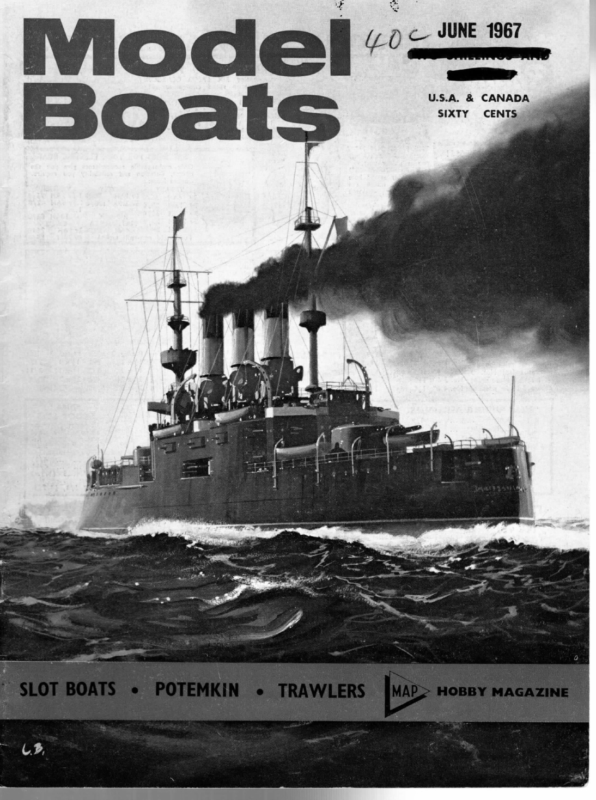
cul Mobil BOATS 1967 MARBLEHEAD | REITER aags CHAMPIONSHIPS | Reported by B. P. Hayward Photographs by R. Lutwyche URING the Easter weekend, March, 25th, 26th and 27th, the 1967 National Marblehead Championship was sailed at Witton Lakes, Birmingham, frequently described as the best inland sailing water in the country. The Birmingham Model Yacht Club was host to 19 boats from clubs in all parts of England, the entries being as follows: Guildford—5, Southampton—1, Hove and Brighton-1, Clapham-1, N. Liverpool-1, Bournville-3, Birmingham-3. Birmingham Club President Mr. W. H. Ray welcomed the Chairman of the Birmingham Parks Department— Councillor A. C. Silk, who undertook to start the race by sending off the holder Mr. Chris Dicks and his opponent at 2.30 on Saturday, March 25th. The wind was fresh and gusty from the South-West, a direction which gives a good run from the boathouse end of the pool with a very long leg back on the beat, with wind speeds 15-18 mph measured by Mr. Ken Jones, a very welcome visitor to the club. O.0.D. Mr. George Leeds and Assistant O.0.D. Mr. Dennis Lippett found the quality of sailing to be of a very high order and with the exception of a few resails mainly due to eddies of wind near the start, the race proceeded without incident. The strong running wind encouraged most skippers to carry spinnakers although with much broaching occurring in the early boards and having had two mast breakages, many boats were forced to change down to 2nd or 3rd suits of sails. When five heats were run off most people were happy with the O.0.D.’s decision to complete outstanding resails and call it a day. The match schedules were arranged so as to bring competitors from each club together as early as possible so that initial scores tend to reflect club race scores. Ken Roberts sailing his well-known Fandango, together with Bill Sykes sailing the magnificently constructed Jil] IJ and Fred Shepherd with his March Hare (which together with Brewster’s White Rabbit and Roger Stollery’s Mad Hatter became nicknamed the trio of “Little Warlords’’) jointly took the lead after three heats. However, by the conclusion of Saturday’s sailing, Shepherd and Roberts were three points ahead of Sykes who had been joined with 20 points by Graham Reeves with his Wendy ‘J’. Close on the heels of the leaders came Ann Stollery, who as the lone lady skipper set a precedent for the local girls of Witton. On Sunday, 26th, racing was commenced promptly at 09-45 but as most skippers were at the lake much earlier than this an opportunity arose to look around the boats. Mention has already been made of the Guildford fibreglass trio in which the influence of both Roger Stollery and Ray Blick is in evidence. Whilst the design has not yet been made public, it is anticipated that the lines will appear in print in due course and will then no doubt stimulate heated discussion amongst diehards. Basically the boats as the nickname implies are deckless bulb keelers designed expressly for fibreglass construction. However, a novel feature is a trim rudder incorporated in the vertical trailing edge of the fin in the case of Mad Hatter and March Hare, this being operated like a selftacking arrangement on a moving carriage vane gear. Bill Sykes’ Witty-designed Jil] IJ (Golden Archer) has had several of its features published in earlier articles (Model Boats—November, 1966, April, 1967) but no photograph could possibly do justice to the quality of workmanship which goes into the Sykes boats. As was 240
JUNE 1967 substantiated during the race, the quality of fittings is a major factor in winning points. When Sunday’s racing was started, Ken Jones again obliged with a wind speed measurement and this time recorded 18-20 mph. with later gusts of 25 mph. The wind direction was similar to the previous day so the 0.0.D. kept scoring the same and again spinnakers were carried by most boats. Under these conditions some spectacular runs were seen and particularly thrilling was the sight of Graham Reeves Wendy ‘J’ planing almost the full 270 yard course in a fantastic shower of spray. Most of the boats reached planing conditions for limited distances during their runs but particularly frustrating for R. Newport must have been the sight of Solar twice getting within yards of the finishing line then nosediving in a severe broach. Incidentally, Solar is a beautiful example of moulded veneer construction, having hull sections reminiscent of a Bewitched but a radical design of fin and bulb keel, and was designed and built by Mr. Newport. This boat carried an extremely high aspect rig of about 6:1 with sails of Dacron or similar material. Several boats preferred on occasion to run without spinnakers, typical of these being Rebel designed, built and sailed by veteran Midlands skipper Ron Harris, and Bolero sailed by the Cook Bros., which planed effortlessly in the high winds. Racing proceeded at a fair pace and after two heats George Leeds split the next heat into two halves to enable “elevenses’” to be taken by the skippers. This heat incurred several resails and took appreciably longer than anticipated, but a further heat was sailed before a lunch break was declared. At this stage after nine heats had been completed, the positions and scores were: WH TT ee nae vicines 40 March Hare …… 39 Fandango …….. 36—Bye taken Wendy ‘J’ …….. 30—Bye taken After a limited break, racing was resumed and with the weather alternating between sunshine with steady winds and gusts with hail and rainstorms, the fight was on among the top boats. A total of six heats were sailed after lunch on Sunday and with the wide variety of weather conditions, some Continued on page 243 Heading shows Tinpot (left) and Fandango at the beginning of the race. Opposite, Fred Shepherd with March Hare—note the trim tab on the fin. Top right: the Stollerys trying their trims. Right: tuning up are R. Stollery, W. Sykes, and G. Reeves Yacht Yolo Bolero Tinpot Brandy Snap Fandango Wendy ‘J’ Cracker Barrel Flying Cloud High Jinks Cutlass Skipper C. W. Jones I. W. Cooke C. Dicks Miss. A. Stollery K. E. Roberts G. A. Reeves S. Poole A. M. Jane M. Shepherd R. Dunning Bluebottle II Rebel Solar Lucky Devil R.G. Williams R. Harris R. Newport H. Godfrey March Hare Mad Hatter White Rabbit Jill I Lu’u THE 1967 NATIONAL MARBLEHEAD CHAMPIONSHIP Club Design No. Birkenhead 1021 0-20 0703’S 5S: 3 ‘3″5+3’553’5 0 O’S 7 10° 442-9 Birmingham Adams Foxtrot 1195S: ..’0 5°0..0 ‘0.55570 253’S’2/07050) 0/518) 7 (37> 12 Clapham Priest Witchcraft 12AG. 35 52: 010s 202 5 Si SuSeSeS: 5.2355) 295 1d 12 64 5 Guildford Stollery P31}, 505) 22 22.5 2) 553,00 3552-05 Orde 11 8. 462 8 Birkenhead Adams Foxtrot LSS3 5! SPSS FS 25835 Sos) ona Ss 5 5-2 1 ey St Bournville Littlejohn P3985) 5° 3:98 2 35S 25sSe5 51S) O02 Si Be 192t4 “68):2)3 Birkenhead Witty Hustler 1450) 225\3:.300)2 165.-3:3y525’5,-S 295s D5 11. 13-61 16 Birmingham Jane 1480 0000000 20020000020 3 O 6 19 Hove& Brighton Priest Bewitched 1489″ 0°0 ‘073-2’0 2°53: “3:3: 5°570°0’0 5°03 5 8 34. 14 Birkenhead Witty from Wasp £501: -25S2050 0) 00205. 2415255! 243) S23” 5°OP M0: 03 0.0:5 5.3:52:3:53.350-5 555525 <5 300532052535502030 68s 44 9 5 .8- 34 14 13 8 15°71 9 43 2 11 Birmingham Bournville Nth. Liverpool Guildford Priest Bewitched Harris Newport Stollery Lucky 151k, -2'3;,.050+0' 04055520). 352: 350: 3 5:0 2: $520°3,0. 2-0) 2.0050) 30302) 52202500 1534 2 00'S 2°6:0:5°0'0'3'0 “220000 F.R.Shepherd R. P. Stollery B. Brewster C. W. Sykes Guildford Guildford Guildford Bournville 1536) OST 1539 215.33 2.999525 5.35 5303.11 14 64.4 OLS 220°0"S 2) 5°S "2 2°35 2:0 * 3135 1110 52° 7 SeS (0:0 01022540) 20° OF8ESe2.12 02299108. S035) 23 C. Edmonson Southampton Stollery Stollery Stollery Witty Golden Archer Adams Foxtrot 15535 1566 Devil 1535, 0.320) 2-0),0 0575-32: 33, —=OOSrENNOSArHOYMNOKame SlAnSALSSSnsansaens 241 61 630» 14 7 4-236. 17 ‘63 ‘21-48 cv 424242 § 5 28 gs s sa
MODEL BOATS BOATING FOR BEGINNERS STARLET 34in. R/C OR FREE-SAILING YACHT, CONTINUED the height of the point. On Starlet } in. on the sides becomes | in. wide at stem and stern, underneath, of course. Masking with Sellotape has been discussed frequently and should offer few problems. Rather than have wrinkles in the tape where the waterline curves sharply, stick the tape down flat and carefully run a razor over the pencil line, visible through the tape, and peel off the unwanted portion. Now to continue the rigging details, cut and plane the booms from } in. spruce or similar timber. Any hard, straight-grained, and dry timber will do. Most of the additions to the timber are in the form of screw-eyes and they will take a fair strain at times, so reinforcement is desirable. The best way is to strap the ends of the booms with thin sheet metal, but thread or thin wire binding can be used on a model of this size which may not be sailed in high winds. We used .003 in. brass foil, folding rectangles overlapping on the top and soft soldering the overlap. As additional strength (in case the solder ever corrodes in salt water!) two turns of fine copper wire were wound round and the ends twisted; these were soldered to the brass. The screw-eyes were then screwed in through prepierced holes (a tap of a sharp panel pin made the holes) EPORTS are already trickling in from readers who have completed and sailed Starlets, both with and without radio, and we are happy to say that they all seem to be delighted. Several other readers have expressed disappointment at missing an instalment last month, so without further ado let us press on. The iron bulbs we have had cast were briefly mentioned last month; they total 7 lbs. so that free-sailers have the full ballast with which the yacht will take a larger suit of sails if felt desirable. Radio modellers should cut the tails off the bulbs Sin. from the front as in the photo, and glue on wood blocks to fair off—a bit of an awkward job, since the hull is cumbersome with the and also soldered to the brass. If using a fine wire (say 15 amp fuse wire) the turns can be locked with solder and the eyes soldered after screwing through. With thread, first screw in the eyes (after binding on and cementing the thread), then withdraw them, wipe the shanks with epoxy resin, and replace. The purpose of any of these measures is, of course, to prevent the boom end from splitting and to secure the screw-eyes in as firmly as possible. weight attached. Fillet any cracks etc. with Cataloy, sand, and give a couple of undercoats. The finish coat can then be applied to the entire hull. Hull colour scheme depends on the individual and many people will like a contrasting underwater colour. The waterline can be marked in the usual way by making a tick on the centre line fore and aft at the waterline endings (see plan), then blocking the hull firm and level, upside down, with the ticks exactly the same height above the working surface. The centre of a table is the best place for this. A pencil is now mounted securely on a block of wood or firm box, the point being angled down and overhanging the block by at least four inches. Adjust the height of the pencil point to coincide with the fore and aft ticks on the hull, ensure that it cannot move or wobble, and slide the block smoothly round the hull, Once sure that the solder is sound—achieved by cleanliness and a hot iron, and cleanliness means scraping the metal in the region of the joint—the boom ends can be tracing a continuous pencil line. Some yacht builders like to paint all the hull one colour and mark the waterline with a coloured band only 4 or } in. wide in the centre of the sides, but automatically widening as the hull sides become less vertical. Such a waterline can be pencilled in as above, simply by adjusting note counterbores Pictures above show bulb attachment to keel,Cataloy or similar sanded to shape and all gaps filled with be roughfairings glued and clamped in place, subsequently to or similar sanded to shape and all gaps filled witatep,Cataloy ends of fore the right, At sanding. filler resin before final (and both booms and, bottom, and after ends. Thread binding paint over soldered parts) have yet to go on, then two or three coats of clear varnish. 258
JUNE The main boom (jib boom similar) sheet arrangement for free sailing. After sheet passes through eye at tip of boom and is for beating; running sheet needs an eye about halfway along boom. Actual sheet lengths are best checked on the model. Method of reeving flat and _ circular bowsies is also shown; these can be bought with- — or =e) — out difficulty but are simple to make from metal 1967 plastic. tiled smooth and painted, the idea being that the paint will help to avoid corrosion in salt water. The gooseneck end of the main boom is rather different; it can either have a brass plate stuck to each side with epoxy or it can be wrapped with foil or wire and soldered. Whichever way, after fitting the metal, drill through and tap in a stub of brass tube (12 s.w.g. on the original) and solder to the metal. File the ends of the tube to a nice fit in the goose-neck jaw, ready to slip an 8 B.A. bolt through for a hinge pin. Beneath the fore end of the jib boom, an eye is provided in which will be fitted a fishing swivel, providing the pivot point for the jib. The main boom pivots about the vertical “pin” in the gooseneck. For radio purposes, one eye is needed for sheet attachment to each boom, and this eye must be positioned on each boom at exactly the same distance from the pivot point. Using a constant diameter drum on the sheeting winch thus means that both booms maintain their relative positions, since the same amount of sheet movement is applied through the same lever arm. The eyes are screwed in, removed, epoxied, and the booms then bound with thread at those points. The clew (bottom rear corner) of each sail is fitted with a clew outhaul (mentioned in the March issue) which is simply a length of flax line hooked or tied to the eyelet in the sail clew, passed through the eye in the end of the boom, then through an eye set a short distance forward Enterprise on the side of the boom, then passed back and made off on itself by means of a flat bowsie. The side eyes should be screwed in and thread binding applied as before. For a free sailing model the sheets will be attached to a round bowsie running on a jack-line. An eye is needed beneath the clew eye and another at a point about 10 in. forward on the main boom and 8 in. on the jib. Between these eyes is strung the jack-line, secured to the after one, doubled through the fore one, and made off in a flat bowsie which adjusts tension only. Builders of simple yachts may often have run into the snag that, with only one sheet per boom, it is impossible to free off the sails completely for running, or, conversely, if they can let the booms out far enough, the sheet is too long to harden the sails in sufficiently for a beat. Most racing models carry two sheets per boom, known as the beating sheet and running sheet, to overcome the difficulty. The sheets are made off to circular bowsies threaded on to the jack-line as drawn, and the one not in use is hooked to one of the eyes on the boom, out of the way. For consistency, it is necessary to be able to: repeat precisely sail settings, and the booms are usually marked with a numbered scale so that either sheet can be accurately re-positioned. These are usually applied with indian ink and a mapping pen, after the first coat of varnish. PROUDLY PRESENT THE NEW MARK II MARINE ENGINES ELJO ELJO 15 cc. TCP Mk II 2-STROKE PETROL Complete Specification on request NOW ONLY £14 (plus £4 P.T. in G.B.) AVAILABLE DIRECT 15) ec. GLOW (not illustrated) Leaflet on request NOW ONLY £12 (plus £3 P.T. in G.B.) ONLY ACCESSORIES INCLUDE: 14” ‘Heavy Duty Shaft with 12” Tube 16” Heavy Duty Shaft with 14” Tube 18” Heavy Duty Shaft with 16” Tube Enterprise MWI_A.S. Lid. 18/4 24/5 27/5 AT THESE ELJO 15 cc. OHV Mk II 4-STROKE PETROL Complete specification on request NOW ONLY £20 (plus £5 P.T. in G.B.) SPECIAL Exhaust Bends for 2-Stroke (per pair) Silencer and Tail Pipe Automatic Clutch 122/0 Heavy Duty Ball and Socket Coupling PRICES 15/6 42/9 Water Pump 91/6 ‘ 18/4 54, SHUDEHILL, MANCHESTER 4