- WINDWING HOW LONG CAN A TEN-RATER GET? STAN WITTY THINKS ROUND IT AND PRODUCES AN ATTRACTIVE DESIGN
- Readers Write

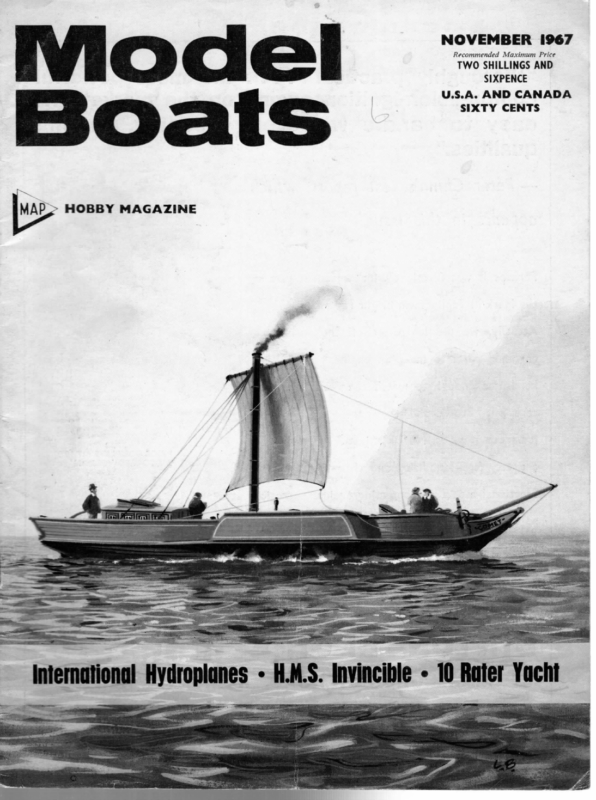
NOVEMBER 1967 Recommended Maximum Price TWO SHILLINGS AND SIXPENCE U.S.A. AND CANADA SIXTY CENTS HOBBY MAGAZINE
Pox PK Eroy tonwen wto Y sLor im mum
NOVEMBER 1967 WINDWING HOW LONG CAN STAN WITTY THINKS PRODUCES AN A TEN-RATER GET? ROUND AND ATTRACTIVE IT DESIGN GINCE the class rules were adopted, 10 raters have gradually increased in water-line length, and there is little doubt this trend will continue. For this reason we decided to approach the rule from the other end, by designing a yardstick hull at the maximum foreseeable length. The original concept, therefore, was a light, narrow yacht with a water-line of 75 in. At this length the actual sail area comes out at about the same as an M, so there is naturally a tendency to compare such factors as power and displacement with yachts of this class. It seems, though, that this is not a viable comparison, as the power of the modern 10R is in a much higher bracket than that of a good M, even allowing for the difference in sail area. The most probable reason for this is that while the average M might very well benefit with extra stability, it cannot absorb additional displacement in the limited length without loss of speed, particularly downwind. The heavier and more beamy Marbleheads are also harder to balance and may tend to luff up to windward. In light weather this shakes what little wind there is out of the sails, and further discourages extra weight. It seems that the optimum displacement is limited as much by the length on the water-line as the amount of sail area available. The logical extension of this line of thought is that it would be better to retain displacement where one might reasonably expect to reduce it. This also partly explains why an “A” class yacht can accept with advantage a weight increase of 3 lb. per extra inch of water-line, together with a reduction in sail area. Attempts to develop a good all round long W.L. ten have usually failed due to lack of power, and not because of poor light weather performance. Whether 30 Ib. is the optimum for a yacht of this beam, length, draught and sail area is a matter of opinion. I have at least tried to avoid the usual pitfalls as outlined, but without being too greedy. Certainly it is tempting to go in for a heavy displacement when stability is increasing to 7 per cent per Ib., and wetted area by only 1.5 per cent per lb. The sections are almost exactly as drawn in the original version, though due to progressive re-appraisals of wetted area and power considerations the length of the water line was reduced from 75 in. to 66 in. and this in turn required the sections to be scaled up no less than five times as the sail area grew. The sections were des’gned to suit the special requirements and characteristics of a long hull, being fai-ly shallow yet well rounded to obtain a reasonably high displacement. Such sections allow the hull to turn fairly quickly to take advantage of any wind change, besides being easier to turn off. If vee-sections were used throughout the length, crossflow over the centre-line, due to pressure transference and leeway angle, might cause cons‘derable eddy resistance. incidental advantage in using U-sections is that rudder can be carried up close to the hull. Since a canoe-body of high beam-length ratio inherent straight sailing qualities, the skeg does An the has not Ramrod, a 60 in. W.L. ten rater by the author, built by J. Hardy. Bystander was invited to hold it! need to be large. Positioning the skeg and rudder on either version is something of a compromise, as in all things yachting, between good balance and a reasonably long lever arm. Note that the vane is mounted forward of the rudder post, a feature which helps materially towards good balance. With a limited sail area, the hull must be easily driven and so is of low prismatic-coefficient. The sharp stem reduces pitching and promotes sail efficiency by providing a stable platform for the Tig. Certainly a round sectioned hull of this type will not be bounced around in a lop. Compared with the 55 in. W.L. fin keel 10R of about 35 Ib. displacement, the designs shown have approximate parity in sail area to weight ratio, giving similar acceleration. On the other hand, the wetted area, though less, is slightly greater in proportion due to the smaller sail area. The stability is exceptional in spite of the limited beam, and compares favour- ably, not only when the reduction in sail area is taken into account, but directly. The prognathous keel version may be controversial, but was decided on only after long considerat‘on of the relative merits of the arrangement. While it is true there are lakes where th’s is at a disadvantace, on most it should have a marg’n of superiority wide enough to offset the occasional inconvenience, With more freedom to streamline, the bulb shape is easier, though the length is reasonably short to limit sk’n drag. Since the ends are vulnerable it is suggested that the lead is cast around a screwed + in. dia. rod so that brass end caps can he fitted. This also allows the bulb to be mounted in a lathe or dr’ll so that a good finish can be achieved. The leading edge of the fin can be swept 40 deg. without upsetting the balance while at the same time keeping the lateral area high. Undoubtedly the main advantage of th’s type of keel is that the fin may be positioned to attain almost perfect dynamic balance. For those who prefer, an alternative version is shown with a non-prog keel and making an interest(Continued on page 472)
MOD El OVATS Readers Write PADDLER PROBLEMS Dear Sir, | would like to add a few words on the subject of paddle boats to try to clear up one or two points. Passenger-carrying paddle boats were not allow ed to use twin disconnecting engin es. This was a ruling by the old Board of Trade which refused to grant them a passenger certificate. Twin disconnectin g engines were therefore confined to tugboats with side Jever engines, which were beam engines with the beams on each side of the bottom of the vertica l cylinder. A dog clutch was used to engage the cranks to enable the separa te engines to run as one; the cranks had to be in identical positions on each engine . For a long run the engines were dogged together, but when any manoeuvring became necessary the engines were de- clutched. Passenger boats were firstly engined with oscillating cylind ers which had many advantages. Then came the diagonal engines, single cylind er and compounds. As these were for Passenger boats only they were single, so no clutch was necessary. | am glad that the point has been made that single engined paddle rs were very difficult to manoeuvre withou t a bow rudder, and here | would like to mention how we on the Tyne made the old single engined wooden tugs perfor m like twin disconnecting ones. On the foredeck just forward of the engine there was a box mounted on four wheels called ‘‘the bogie’. The box was filled with scrap iron. This helped when turnin g in confined waters. The bogie was pushe d over to cant the tug so that one paddle was more deeply immersed than the other. On paddle ferry boats it was used to keep the boat on an even keel when approaching a landing when Passengers rushed to that side. When a paddler is canted to one side the paddle out of the water does not race, and in a beam sea much because the roll to port is followed by one to starboard so a touch of the helm easily corrected matter s. No one pointed out a paddler’s worst readers of Mode/ Boats who are interested in this type of model, Prefer ably an Australian who is looking for a pen friend. Congratulations on a fine mag- feature when she refuses to answer the helm. This occurred when wind and tide canted the tug the wrong way, deeply immersing the wrong paddle. Then she azine—2/6d. well spent every month. Slough, Bucks. not only refused to answer the helm but went counter to it. The Tyne was the stronghold of paddlers, for as other rivers discarded them Tyne owners grabbed them. Alas, all are gone now. Newcastle. ONE-DESIGN CLASS? W. Featherstone, B.Sc. and am pleased to say that it performs extremely well. The design is a real credit to you. Dear Sir, | wish to correct the mistaken opinio n of Mr. Philip Connolly as expres sed in his letter ‘‘Electric Points” Published in the May 1967 edition. This type of helpful letter, giving valuable assistance to readers, can never in my opinion be too long, and is much Preferred to the space wasted on idle bickering and the popularity of certain types of models and articles, etc. There are many like myself who look | am very interested in Promoting the design as a one-design R/C class and shall be pleased to hear from other builders who are interested, especially any who would like to join a Starlet R/C sailing meeting in Bromley, say during December on a date to be agreed. Bickley, Kent. G. O. Caird. (Letters will gladly be forwarded.—E d.) OUT FOR DUCKS forward to your articles and letters which are so helpful to those interested Dear Sirs, For some time now, weat Claph am have been in touch with a small club in Christchurch, New Zealand, and | am happy to say that we have been able to help them by sending them several of the M.M. plans to the M class rule. Ina letter in electric propulsion. Those “several other points’’ which come to mind are sure to be of great assistance to those of us who cannot afford to experim ent ourselves, and are only too grateful to benefit from your experience. Many thanks for your help in the past. Port Elizabeth, S. Africa. R. Gould PEN FRIEND WANTED Dear Sir, The article on the model of a 28 in. cabin cruiser Perseut was of great interest to me. For some time | have had a Shrike glass fibre hull but have not had time to do anything with it, owing to being occupied in the buildin g of other models. On reading your article I just could not resist the tempta tion to start building straight away. | have all the fittings in the hull. Unfortunatel y, | only have a single channel radio but I have great hopes for the completed model. ing comparison. Reason for the curved leading edge we had from their secretary recently, we were told that they are busy building now and are looking forwar d to racing their new creations very soon. Up to now they have been racing a class of yacht which has only one restriction—th at of L.O.A. which is 4 ft. 6 in., and the average displacement is around 50 Ibs.!! They have asked us if we could send them the plans for the Tucker Duck design, but up to now we have been unable to obtain any. If any reader has these plans to spare and would like to help our New Zealand friends | will be only too pleased to forward them—b oth 36 in. and M class are required. Hon. Sec., Clapham Model Yacht Club, 23 Thirsk Road, S.E.25. T. Knott cut it into three or four sectio ns with half inch over- to the fin is to obtain as much rake as possible and yet keep the area low forward of the bulb. This is mainly for balance rather than aesthetic considerations. It will be seen that rake nearer the hull makes laps so that the sail can be glued up flat (along the Juff) yet allow for slight mast curvature. Other glues may be more suitable depen ding on the choice material, but must not set too hard and brittle. position of the centre of fin of A normal type roach is shown , as at the time of writing it seems probab le that the rules may be altered to curtail any excess. It is not expected that area. Note that both bulbs are drawn slightly heavier than quoted to allow for rubbing down. In order to get the maximum drive out of the sail the total sail area of the rig as shown will be much affected, but should the rules be revise d or amended, any small difference can be included by making a slight alteration in the mainsail foot dimension. The spinnaker hoist is fairly high to get the most area a double-luff mainsail should be used. A glued luff using clear “Evo-Stik Impac t” gives a smoother surface than when stitched. This adhesive has no shuffling time, so accurate layout and marking is essential. I feel that two or three row s of stitches may lead to flow separation at a critical point and cause turbulence over the mainsail proper. There is not as out of the 4 in. constant, the taller spinnaker being also more quarter. yet much experience in cutting these sails, and unless some allowance is made for the slight curve of the mast due to the pull of the taut back-stay the roach will tend to hang loose. If the luff is cut straight a similar thing happens at the foot, and it may pay to R. Pendell. Dear Sir, | have built the mode! yacht Starlet HELP RENDERED WINDWING (continued from page 455) less difference to the The engine is a brand new E.D. 2.46 Racer. | have had one for some time and I liked it so much that | bought another. | would like to know of any other the rolling does not affect the steering effective usual methods. 472 as the wind approaches the The foresail is quickly detac hable as the hoist is hooked directly in to a small hole in the alloy mast. Both versions a re designed to give a good all round performance and can be constr ucted by any of the