- Thoughts on ‘M’ design, broaching, sail plans and spinnakers and designs Elf and Wing by S. Witty
- 1967 Australian Marblehead Championship
- More Readers Write

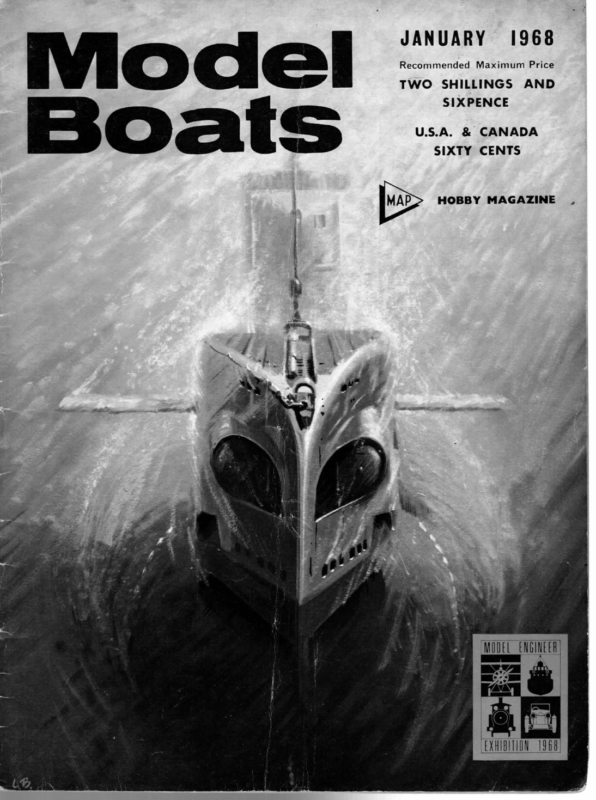
JANUARY 1968 Recommended Maximum Price TWO SHILLINGS AND SIXPENCE U.S.A. & CANADA SEER ING SIXTY CENTS HOBBY MAGAZINE f &
MODEL BOATS Thoughts on ‘M’ design, broaching, sailplans and spinnakers and designs Elf and Wing by S. Witty =e OF the three main recognized classes, the ‘‘Ms”’ are in some respects the most difficult to design, for although there are no rules relating to hull design other than the maximum length limit, in fact the designer is presented with such a mass of conflicting requirements that there is obviously no perfect solution. Special considerations, particularly those relating to the use of the ultra high rigs and massive spinnakers now so necessary for competition, require that the shape of the hull must be even more of a compromise than in the other classes. This applies in particular to bow design, for under the downward thrust of a tall sailplan, the forward sections bear most of the load and if not flat or full enough will drive under rather than skate. When hard pressed below the normal water line, the buoyancy in the bow varies largely with the area of the sections. Other factors are stem height and rake, flare, length of overhang, and rounding of the bow. This last obviously helps to give broader sections in a limited length, and reduces any ELF ~~ THE MODEL MAKER PLANS SERVICE 3-36, BMOGE STREET HEMEL ~EMPSTEAD HERTS tendency to dig in. A sharp stem tends to split the water rather than skate, and so this aspect is more a question of dynamics rather than buoyancy. Even so, the finer stem can go through a lop more cleanly, as the lee waterline at the bow is a smooth curve when heeled. There are other considerations connected with this. For instance a flat run aft will allow a hull to sit up quicker, this being of more basic importance in this class than any theoretical niceties concerning the maximum use of the sailing length and level running. In practice, one cannot flatten the run beyond a certain limit, unless the midsection is also flat and shallow. This in turn can affect the position- ing of the mast adversely, increasing the moment arm of the sailplan, and with it any tendency for the bows to bury, or reducing the amount of sail which can be carried downwind. For this reason if no other, speed on the run is also affected by the old question of hull balance. Stability is also a big factor concerning the ability to carry sail downhill, largely because it damps the rolling which may otherwise build up to a broach. The extra power of the bulb-keel more than compensates for any small loss due to the mast being slightly more forward. On the designs shown, great care is taken to achieve good balance and thereby keep the rig as far aft as possible. It can be seen that a broach is usually preceded by at least two or three wild rolls, though on occasions it may happen more suddenly when hit by a squall, especially if caught in a high A.R. suit. Each roll to “‘leeward’’ initiates a divergent yaw, until the angles of yaw and heel
JANUARY 1968 WING amy) S. Witty THE MODEL MAKER PLANS SERVICE G-3S, BRIDGE STREET, HEMEL HEMPSTEAD, HERTS two. Whether bulbs will catch on in the “‘A”’ class is much more problematical. My impression is that they might, but not in the usual circular, teardrop form, as this does not make the most of the limited draught. A keel with a semi-triangular section on a flat baseline might be the answer, though some of the problems outlined may assume even greater proportions. No pun intended! Probably the bulb-keel in Kai Ipsen’s latest ““A” is the nearest in this respect, being, like the hull, rather after a combine to allow a sudden release of air from the top “‘leeward”’ edge of the spinnaker. Since the escaping mass of air has an equal and opposite reaction, this jet effect, added to the righting moment of the hull at extreme heel, causes a kick over on the other beam. If not sufficiently reduced or damped by the normal and dynamic stability, these oscillations lead to a sudden break down in control as described. While I cannot see anything to replace the normal “Star”? class yacht. cheap and efficient “polythene” spinnaker for general use, it seems likely that self-venting and other types of anti-broach spinnaker will come into use for rough The adoption of double-luff sails on the other hand may become general fairly quickly, as this requires no basic alteration of existing yachts. With the extra available in the bulb designs shown, a _- conditions. Such developments could lead to greater flexibility in design, and allow a hull shape nearer the optimum for minimal resistance. The two designs shown make an interesting comparison, very high rig can be used with advantage. As a result the foresail hoist of the tall top suit is almost the same as the mainsail hoist of the mod. A.R. top suit, so with a little re-arranging we can have a masthead rig for all other suits, giving an uninterrupted double luff and allowing for though developed through a completely different lineage they are similar in some respects. Both are well developed types with no untried features of hull or appendages. Being of similar weight, beam and general configuration, I expect they will have a comparable performance in most respects, though possibly E/f will have the edge in light weather, while Wing may be mar- a large spinnaker. I find that the design of bulb-keel yachts is very much an art in itself, and that even the most perfectly balanced hull can be spoilt by the wrong shape and disposition of the appendages. ginally better in a blow. It seems probable that bulb-keel types will come into fairly widespread use in this class during the next season. Both designs look “‘right”’, and partly because of this the mast position is further aft than in some fin keel “‘M”’s. As yet, not all yachtsmen are fully convinced in favour though it may be some time before they reach a majority, There is a near parallel development in 10R design, so of bulb-keels, but as is becoming increasingly apparent in some areas, there is little alternative. this class will also see a similar change in the next year or 23
hi MODEL BOATS 1967 Australian Marblehead Championship The 1967 Australian Marblehead Championship was disappointing in that there were no interstate competitors, so that only six “local” boats took part. Sunshine and light breezes tended to favour lighter boats, though a strength of 14 m.p.h. on Saturday afternoon and 10 m.p.h. on Sunday morning gave all boats a chance. The winner, Thea, led convincingly from the start, and there were three dead heats. Final scores were: 1. 2. 3. 4. 5. 6 KAI KAIO KA9 KA21 KA20 KA2 Thea Ebony Wanderer Spray Nautilus II Nautilus J. Smith R. Gamlin B. Kuss N. Lockhart D. Middleton A. Dawson 85+ 614 51 404 344 25 Top, competitors line up for a snap; Festive and China Boy designs predominate. A. Dawson (ex-Fleetwood) nearest camera. First pair away, Nautilus and Wanderer in lower picture. SMALL CRAFT (continued from preceding page) and white superstructure. Mast was brown. Lifeboat was black underwater surface and white topsides, with white davits. Fore companionway was brown. Funnel was black with a yellow band between white bands. Modelling Notes: “‘Fealtie’’ drawing shows vessel unloaded. Length is 158 ft. 0.a. ture: Fore-saloon cream or varnished wood. Bridge is varnished wood. Aft saloon cream. Engine covers and ventilator: black. Masts: oiled wood. Funnel: yellowcream with black top. Note full size length is 65 ft. 6 in. FEALTIE Among a number of interesting little port service craft serving the varying needs of Thames-side are those involved in river oil and petrol cargo movement along the tideway. Over recent years the companies involved have placed in being a re-building programme, which has resulted in some fine new craft working as river tankers GASELEE COMPANY’S NAJA The author’s third drawing is of Messrs. Gaselee’s diesel tug Naja which is shown in the rig she used before coming under the colours of the combined Gaselee-Knight arrangement. Built in Holland in 1936, Naja came under Gaselee in 1947 and was given new 300 h.p. diesels in 1952. A well-known little unit on the Thames and River Medway regions, towing mostly in the lighterage business, she is of 56 tons gross. and, of course, the withdrawal of a few veterans. One such veteran replaced recently (1966) was the river tanker Fealtie. She had been constructed in Holland in 1928 by Ind. Maats De Noord at Alblasserdam and was running with motors by Motfbr Deutz for owners Shell Oil Co. Fealtie could be shown by modellers in a number of settings if required, including bunkering ships, alongside wharves or jetties or at a refinery, loading. Colours: These were simple, being a black hull, red boot-topping, dull brown-red decks, black tank tops More Readers Write ALL CROSSED UP? Dear Sir, | wonder if any of your readers have pointed out an error in the drawing of an English merchantman on page 433 of the October Mode/ Boats. The Union Flag shown is the modern one which did not come into use until 1801. Prior to this the Union Flag consisted of a combination of the crosses of St. George and St. Andrew i.e. without the red diagonals. This flag was worn On all British ships, after the union between England and Scotland, from 1707. During the reign of James 1, who ruled over England and Scotland Colours: Hull black with buff waterline boot-topping, and white trimline under toprail of bulwarks. Decks dull red-brown. Superstructure: teak brown with white ventilators and wheelhouse window area and _ top. Fittings: black. Funnel in Gaselee colours of buff with three red rings. Note. “‘Naja’’ measures 75 ft. overall length. from 1603 to 1625, the latter flag was worn at the main of all English and Scottish ships, with their respective national flags (St. George’s or St. Andrew’s crosses) at the fore. It is quite likely that the Mayflower wore such a flag, but without the red diagonals as shown in the drawing. The earlier Union Flag would have been worn by British ships during the American Revolutionary War and during the first part of the Napoleonic Wars. By the time that the Battle of Trafalgar was fought the modern flag, as we know it today, would have come into use. Incidentally, the popular term Union dack is not correct unless the flag is actually in use as a jack, i.e. flown from the Jackstaff forward. The red diagonal 32 added in 1801 represents, of course, st” Patrick of Ireland. Canada. Lt.-Col. J.M.A. London Y.M. CUP RULE Dear Sir, May | make a delayed reply to Mr. De Grouchy on the subject of an English design winning the Y.M. Cup in 1965. Every model in that race was an English design, and Mons. Boussy won the same cup in 1963. His Patricia is also a Highlander. The reason for this is very simple—the rule was changed some time ago. A foreign yacht may compete for a country provided the skipper is a national of that country, and this is the only restriction. Berchem, Belgium. G. Van Hoorebeke.