
- MONOCAT A SHARPIE TEN RATER by S. WITTY
- RADIO IN STARLET FITTING OUT THIS 34in. YACHT FOR R/C SAILING

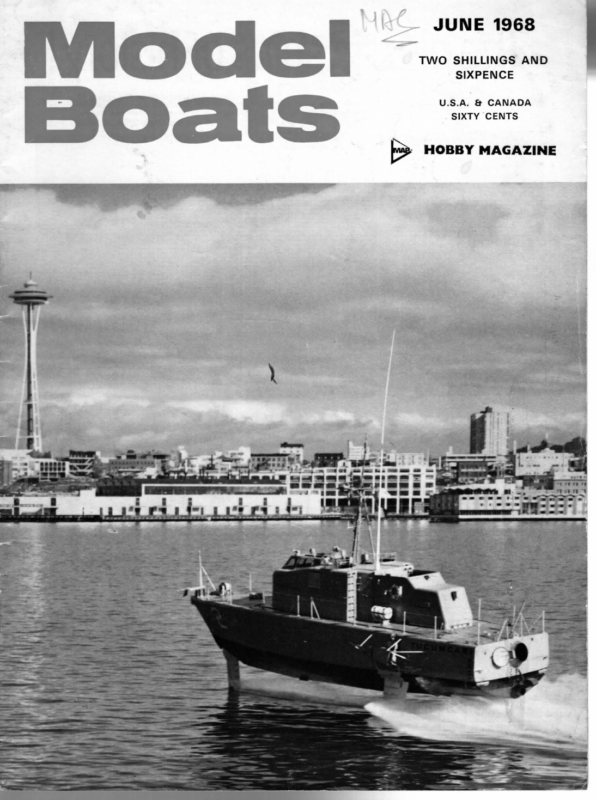
JUNE 1968 TWO SHILLINGS AND SIXPENCE U.S.A. & CANADA SIXTY CENTS fe HOBBY MAGAZINE HT
MODEL BOATS Hes the last season, several people wrote or asked whether I had designed a sharpie ten’ rater. As development seems to be in a state of flux, due to the introduction of bulb keels, double luff sails and other techniques, I felt that to draught a chine hull to the rule would be an additional complication. Eventually, however, as more time became available, I was able to make a Start, and as work progressed, it became apparent that a chine rater could be quite a viable proposition. When commencing a new design it naturally helps to have a fair idea what the finished boat will look like, but it is better not to be too inflexible on this point. The lines should be developed in whatever direction seems likely to give improved performance. even if this should deviate from the original concept. For this reason it is difficult to predict the ultimate form of the yacht. As finalised, the designed is 60 in on the waterline and of moderate displacement. The entry is fairly sharp to reduce any tendency to pound, and yet still provide enough bearing area for’d to prevent the bows being driven in when carrying a spinnaker. As in all things yachting, the result is a compromise, but a not unattractive one. It may be that a sharpie actually has the advantage in this respect, since when pushed hard to windward, the bow will allow waves exceeding 0.6 in in height to pass clearly around the fair and easy curve of the windward heeled waterline. As a very flat sectioned hull tends to bounce about in a lop, I decided not to use particularly flat floored sections, which in any case so often make a yacht too rigid and ill balanced at the light weather end of the performance. The deltoid fin illustrated has a high C of A which in itself gives a really worthwhile increase in dynamic stability, though such is the power of the bulb keel that the ability to carry sail compares favourably with much heavier designs. Using the ‘simplicated’ method of comparing the relative stiffness, consisting of multiplying together the beam, lead and depth of CG lead we get — 11 x 18 x 12.5—248. A normal size 10R of about 35 Ibs would give a figure of — 11.5 x 25 x 8.5—245. This allows a saving of 7 or 8 lbs even with a fairly moderate draught ae Enough to make a spectacular difference in planing similar size mast would cause with an ordinary mainsail, but still appreciably more. Most of the bowing is caused by the thrust of the boom, pulled forward by the tension strap, and this can be much reduced if the mast is fitted into a larger tube extending to the mainsail foot. This carries the load better and allows a mast of any length to be used without having to duplicate fittings. Under the present rules it seemed it might be possible to grab an extra 50 sq ins or so by incorporating a streamline sectioned mast inside the luff pocket. To pre- serve a good aerofoil section the mast must revolve, however, and due to loss of end rigidity and the extra complications of this arrangement, the builder may not MONOCAT (uM) S. Witty COPYRIGHT MODEL OF MAKER PLANS SERVICE (3 —35, BRIDGE STREET, HEMEL HEMPSTEAD, HERTS HARD CHINE TEN RATER ability. There is nothing unusual in the shape of hull or appendages, but this particular design would not be such a viable proposition without the prognathous type keel. Reason is that the CB is slightly ahead of the midsection, and while this is usual in many ten raters, it tends to make the disposition of the fin area difficult with a non prog. bulb. With the arrangement shown, both fin and bulb can be of low form resistance, and still retain the fin area in or near the ideal position for good balance. Thus, the light weather performance, so often the weak point of a sharpie, should be as good and better than in most yachts of this class. As chine boats can be built rather lighter, the weight saved can be put into the keel. As drawn this weighs 18 Ibs, but whether this is more or less will depend on the method of construction and the individual builder. Brass end caps can be fitted which in turn help protect the for’d edge of the fin. Epoxy bonding is specified for the bulb, but this is adequate only if the glue between the veneers of the ply is equally strong. If there is any doubt, a couple of brass pins through the lead will make sure. It should be noted that when casting the keel a very small increase in diameter will cause a relatively large increase in weight, so allow too much for rubbing down. If double luff sails are fitted it is essential to keep the mast as straight as possible. This can be done by using a large diameter mast, but will cause extra drag and loss of stability. Not in anything like the same proportion a 242 Fin ooo quatity 2 pLy DATA LENGTH OA LENGTH Wek ——— rr 7 — I BEAM DRAUGHT isp. SAIL AREA 2 BRASS END CAP SCREWED ROD OPTIONAL 4 —— c¢ (938″ = SS LEAD (@) = i8 Les SS iF —— — YA.
JUNE consider it worthwhile, although it would at least eliminate bowing. It will be seen that a normal roach is shown, but providing the rules continue to permit a eee this can be mene art if a. le the main attraction of chine boats is that they are much easier to construct, they are no less easy to design. Not wishing to become involved in the perils of conic projection, I decided to plot curves showing the rate of change of angle of floor and sides throughout the length. Ensuring that these curves are fair and easy should help the ply skin to lie smoothly. It is hoped that Monocat will fill the need for a really competitive chine ten rater. MO NOC 1 1968 A } A SHARPIE TEN RATER by S BS WITTY
BOATS Illustrations at left show modified main sheet pivot. At right, winch drum. Kinked _ kicking strap was an ex- 4 erimental move. oo E of R elow, the general installation; note rudder link tag. Opposite, tiller arm and winch mechan- ism prior to installation. RADIO IN STARLET FITTING OUT THIS 34in. running a Mini-Richard motor/gearbox, used for the sail winch, from an all-transistor receiver. The prototype uses a Kraft 6-channel superhet receiver, at present on only four channels, two for rudder and two for winch. Any similar equipment can be used, superhet being essential if inter-boat races are to be run. Serious racing types with 6-channel gear would no doubt use the two additional channels for fine rudder trim; the Graupner Trim-O-Matic, which is built into the rudder linkage, would be ideal. Two different rudder servos were fitted, either being YACHT FOR R/C SAILING UITE a few months have elapsed since we completed the constructional articles on the 34 in Starlet yacht, drawings for which were included, full-size, with the December 1966 Model Boats. In that time a considerable number had been built in several countries; one reader took his free-sailing version to Hove Lagoon and found three others present, while there is an American group which has been racing them under R/C since last summer. In this country, the only race of which we have heard was run recently between Graham Caird and a clubmate at Whitehall Rec. If anyone is hesitating about building and equipping one, Graham says get in touch with him (26 Blackbrook Lane, Bickley, Kent. Tel: 01-467 3814) and oe will arrange for you to have a go with his — a very nice offer. Two or three were sailing under radio long before we finished the constructional description; our own was tested free-sailing and radio was not installed until later. Part of the delay arose because we were trying to find a way of doing it for the non-technical, and the simplest answer finally turned up in the shape of C & L Developments’ small amplifier, which got over the problem of entirely suitable (as indeed, are most others). The RMK type was fitted in a 1/16in ply plate, cut inan L shape, the ply being cut away to allow easy insertion of and access to the receiver box, and lightly cemented on top of the lip of the deck inside the hatch, the fore end resting on the centre bulkhead. A block of softwood, glued beneath the deck on the port side, provided a mounting for the other servo, a Taplin Navigator. The change was made simply because we wanted the first servo in another model, and had the second one lying temporarily unused. A small slot must be cut in the aft cabin bulkhead and another in the cockpit outline, to pass the push-rod from the servo to the tiller. Our slot got rather bigger than intended, with changing servos, and if we ever do any rough-water sailing we shall Evo-Stik a small piece of toy balloon rubber over it to keep out the worst of the wet. An ED control-rod was just the right length, with a brass tag soldered on the servo end for connecting to the servo with a 10BA bolt and locknuts. A sawn-off bolt, sweated into the tube forming the rudder post, projects upward far enough to accept a nut, a brass strip tiller, and two locknuts; the plastic clip on the ED rod engages the tiller. Adjustments to balance tiller throw to servo throw can be made by drilling a series of holes in the tiller; a movement of 25 deg. either side for the rudder is perfectly adequate and will produce a 3 ft turn radius in only a light breeze. The winch gear on the prototype makes use of bits of old electric plugs etc. to connect the Richard gearbox drive spindle to the drum, via a coil spring. The drum is built up from three discs of 1/16 in ply with two spacers of just under 4 in dia and about + in depth, cut from dowel etc. When glued up (and trued if possible in a power drill or lathe) the centre is drilled to accept a bush; we used a screwed brass bush, but tubing epoxied in would do. The bush projects below the drum and a bearing was made from part of an old batten-type bulb 244
e holder, soldered to a brass plate and then drilled through the plate (the hole in the main part already being the correct diameter to allow the bush to rotate freely without wobble). Two mounting holes were also drilled in the plate. The bush was then trimmed so that it projected only the merest amount below the bearing, and a long 6BA bolt passed right through, washered, and nutted up tight. This locks the drum on its bush, but allows free rotation in the bearing. Another bit of electrical fitting yielded a piece of brass rod drilled and tapped 6BA, and a slot was sawn in the end of this and a hole drilled across for a 10BA bolt. This is screwed tight on to the same 6BA bolt, with a drop of Loctite, and the end turn of the spring bent up, introduced into the slot, and a bolt put through. The spring used was approx 18 swg, 4 in dia, and 12 turns to the inch. Its lower end (length is uncritical — about 2-24 ins) fits tightly over and is epoxied to a brass bit grub-screwed to the gearbox shaft; this again came from an old plug. The spring allows the drum to be driven easily, even if alignment is not perfect, and also absorbs initial shocks on the drive when a gust catches the sails. With the gearbox on its 60:1 1968 oe ot JUNE setting the sails show no sign of unwinding themselves. One Starlet uses the Mini-Richard set at 6:1 and drives a 40:1 worm, when, of course, driving back is impossible. The slower winching in, at more power, leaves one’s choice of when to sheet in rather more open; at 60:1 it is sometimes necessary to ease sail pressure by turning towards the wind momentarily. The winch should be temporarily clamped to the spring, with the drum and bearing etc. in place, and a vertical strip of ply cut to fit between keel and backbone, as sketched. The position of the motor can be marked on the ply, then ply and winch removed, the ply drilled, and the winch bolted in place. The ply can then be lightly and leads to the jib through a small screw-eye on the cabin front. Because of its geometry, this line never makes more than about a 60 deg. angle to the eye. The main sheet feeds on to the upper spool, port side, and through an eye at the cabin rear; this is usually working at more than 90 deg. to the eye, and friction is considerable. Accordingly, a brass strip was bolted to the rear cabin face, the top bent over, and a stub of brass soldered in. An eye was then fitted through the tube and a small washer soldered beneath. The ability of the eye to swivel reduces the angle made by the sheet passing through it. Moving the attachment points on the booms was con- sidered, but this means less precision in sheeting the main cemented in place and the spring drive connected and lined up before the glue dries. In the event of serious maintenance being required, the ply strip can easily be prised out and reglued. A 35 mm film can was used to house the amplifier, strapped to the same ply strip, though it would be simpler to build it into the same plastic sandwich box as holds the receiver and Deac pack. The box has three B7G sockets and an on/off switch mounted on one side, and each servo has a plug. The third is wired to the Deacs, and the appropriate plug fitted to the charger so that charging involves no disturbance of the installation. A chunk of expanded polystyrene, lightly glued in the hull, forms a mounting for the receiver box; there has to be 14 in of water in the hull before there is any danger of wetting any of the equipment, and since the boat is remarkably dry for a yacht, the odds are pretty long against running into water trouble. Externally, the sheets (normal rigging flax) are secured to the drum by drilling a small hole top and bottom, against the core, feeding the end through, and knotting. The jib sheet feeds on to the lower spool, starboard side, 245 boom when hardened in. Geometry, again. Two small brackets were fitted close to the drum, on the line of the sheets, drilled to pass the sheets freely through. Their function is to feed the sheets on to the drum and reduce the chances of tangling when the sheets are loose. The only tangle which may occur is when a bight forms between the drum and the feed, i.e. when the winch runs off line faster than the sail takes up the slack, (Continued on page 262)
MODEL BOATS STARLET RADIO (Continued from page 245) ———{ and the operator sheetsin before the bight is taken up. The effectis only temporarily to upset the angular balance between jib and main. A possible answer is to tensign t sheets very lightly with shirring elastic in some way: the moment we are prepared to accept the possibility of this form of tangle, believing that improved helmsman- ship can avoid it almost completely. Graham Caird tells us he has no tangle trouble, and uses a very limp braided flax line whichis so lacking in spring that any surplus lies flat andis thus unlikely to be caught up. Winch and amplifier The Mini-Richard motor/gearbox and Climax tran- sistorised servo amplifier are just about as simple an answer to the winch servo problem as one could hope for. The receiver employed in the radio system is a Kraft 6 channel reed type, but any similar unit can be used and the same DEAC power pack employed to drive receiver, rudder servo (a Taplin transistorised relayless in this case) and winch servo. Having worked out the mechanical problem of fitting the winch drum to the winch servo it was a simple matter to wire the amplifier into circuit. The Climax amplifier will safely pass up to # amp, and will operate on 4.8-9.6v, so the 6v receiver/servo power system employed was ideal. There are two sets of wire on the amplifier, six long ones and six short ones. Of the short wires, the white and yellow are simply tied back and ignored. Of the remaining, the blue and orange are joined, and likewise the pink and green. Of the long wires, the red and black go to the 4.8-9.6v power source, in this case a 6v DEAC pack. On the Climax amplifier circuit the wire from the reed comb (back contact) goes to the negative side of the battery, so in this case the black wire is also the reed comb connection. The green and blue wires are the reed terminal connections and the pink and orange wires go to the motor terminals. Having done this the winch servo should work perfectly — ours did first time- and the only remaining job is to fit the amplifier into a waterproof can or, preferably, the equipment box along with the battery and receiver. The Climax amplifier is obtainable from C. & L. Developments, 47 Queens Road, Weybridge, Surrey, price £3.13.8d. There is no doubt that a small R/C yacht, especially one which moves as fastin light winds as Starlet, attracts a great deal of interest among bystanders. The biggest snag seems to be that other people always want to have a go, so that the poor owner is reduced virtually to a spectator! M.P.B.A. REGATTAS North Southern June June 2 Manchester RC Sp, St, Multi, 10.30, Heaton Park 9 Crosby RC Stand SR. 15/16 Heaton and Tynemouth, SR, Hydros. 9 9 9 16 16 Midland June 3 Bourneville RCSp and Pairs 11 am. Valley Park Road. 9 Coventry RC, SP, SR 11 a.m. Nauls Mill CLASSIFIED ADVERTISEMENTS Private 4d. per word (min. 6/-) Trade 8d. per word (min. 12/-) TOPAZ fibreglass hull and M.E. Snipe £5. MacGregor ‘Combo’ radio control with servo, etc., £12. Tel.: St. Albans 57907. R. WANTED by young modeller, a radio controlled boat in good condition. State full particulars to: Michael Carlish, 72 Southover, Finchley, London, N.12. R. RA0!0 control single channel Kinematic actuator for boat rudder and electric motor-on-off control. Working perfectly, 50/-. Send oy eet instructions, Trowell, 239 Norbury Crescefit, Lae yanious BOATS, some incomplete, and single Channel gear, to be sold, lost interest, S.A.E. please for list, or callers preferred. 10 Third Avenue, Hayes, Middx. R. 10° 6″ Scale Model Cargo liner. Hull completed Ballasted painted wired R.C. Superstructure partially complete. Plans available. Offers. Details: Speakman, 2A Rutland Avenue, Toton, popston, Nottingham. R. KRAFT 10 servos. Superhet £60 Transistor O.N.O. Tx. Donaldson, & 17 Rx., 5 Bonner Transmite Highfield Close, 4. 41 01-654-6785. x 11 x M.T.B. A.M.3. 38 x 11 x 4, 49/11, very fast. 7, 59/11. Cruiser. 14 Lindfield Road, Croydon. P & P 6/6 GLASSFIBRE HULLS expertly he aliage eins gk techniques. All pulle. shove deck mounting flange. Is. 6 in. crash tender £2 15s. 464 in x 14} in. Sea Bucen £5 17s. ds = in. Huntsman (wave spray and Hannes £6 1 Od.Pein. x in. M.T.B. £9 2s. 6d.; 60 in. x 12 in. oat es “igs. ; 60 in : 14 in. Swift £9 2s. 6d., decking Fo seit“awit £5 5s. ad. Colours to customer’s own requirements. rade uiries welcomed. S.A.E. for full list. SHERVILLE REINFORCED PLA TICS, London Road, Welwyn, Herts. Welwyn 5513. extra. Tel.: warships and naval matters available. Many Latest list—two 4d. stamps. K. B. Hindly, 37 Oxton, Birkenhead, Cheshire. Street, Brighton. MODEL Racing Yacht Sails. All classes—stamped addressed env- elope for prices. Arthur Levison, 80 Weydon Hill Road, Farnham, Surrey. T/C. WANTED engines models, FOR and CASH, boilers, prints and model tin marine plate paintings. collections and and plank Single stationary on items frame or steam ship complete purchased. Will travel any distance to inspect. P. Manzaroli, 259 Richmond Road, Twickenham, Middlesex. Arthur Sallis (Radio Control), 29 Gardener ANTED—Plans, Books, any information regarding Bomb Ketch Vessels C-—1680-1750, and price of same. Andrew K. Kidwell, 10140 Cherokee Road, Richmond, Virginia, U.S.A. EROKITS, R.A.F. Crash Tender. Graupner Nautocraft Fully fitted, complete with storage case, hardly used. P. Stayton, 4 Seymour Road, St. Albans, Herts. R. Motor. Offers. R. ROBIN THWAITES will part exchange good condition used Marine Motors for Model Boat, Aircraft, Train, or Car goods. Open all week to personal callers only please. ‘The Hobby Shop’, 28 Street, Portsmouth. Arundel B. gue PHOTOGRAPHS. Fine quality post-card size ship pictures. 1s. 6d., each. Write with 4d. stamp for interesting Mannering, River House, River, Dover. KINDLY items for modellers. Christchurch gone: P.Q.R. ADIO Control Supplies, largest stockists, of R/C equipment, engines and accessories in the country. H.P., Part Exchange Transistor equipment only. Call, write or phone, ‘ISL 0473. Radio Control Supplies, 581 London Road, Isleworth, Middlesex, and at 52a London Road. Leicester. T/C! R. facturers’ electronic and mechanical surplus, also a complete new section of the latest semi-conductors and miniature components, includes a credit voucher for 2s. 6d. Send for your copy Price 3s. post free. PAC N4v4éL BOOKS. Wide selection of interesting illustrated books on 100 PAGE illustrated catalogue No. 17 of Government and manu- now. Southampton RC 10.30 Ornamental Lake, Soton Common. Southern Area Hydros. Vacuumatic SR 11 a.m. Dovercourt. Portsmouth RCSp and St 11 a.m. Hilsea Lido. Southern Area Pilot RC 11 a.m. Victoria Park, Newbury. Southend SR and SP 11 a.m. Southchurch Park. Newport Pagnell, Bucks. R. To Monoperm 5 pole motors, 6V. Accumulator, Props and Shafts 85/-. Will split. G. Oskam, 2 Llanover oh Barry, Glamorgan. R. LASS Fibre Hulls. A.M.1.. 28 x 9 x 5, 29/11. A.M.2. 344 x 94 x rea 39/11. 2 MENTION ‘MODEL lists to J. T/G. BOATS’ S N A Go & a ER TO VIC SMEED’S PLANS IN GLASSFIBRE COMPLETE ey KIT FORM — ANY COLOUR — RICES ON APPLICATION WE ALSO pebbuce A COMPREHENSIVE RANGE OF POPULAR BOATS AND YACHTS GLASSFIBRE MARINECRAFT Telephone: Sawbridgeworth 2499 WHEN REPLYING TO GREYHOUND and GARAGE Harlow 21697 ADVERTISEMENTS