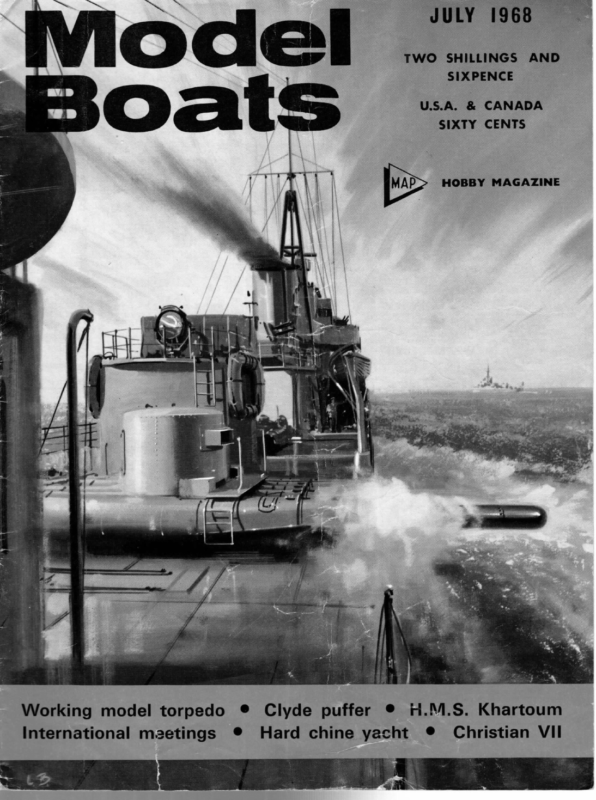
- QUARTET A series of variations on a double chine Marblehead hull by a designer who has now moved to Australia BY R. E. DUNSTER
- Readers Write…
- SINGLE-CHANNEL RADIO EQUIPMENT
- Round the Regattas

TWO SHILLINGS AND SIXPENCE > U.S.A. & CANADA SIXTY CENTS HOBBY MAGAZINE Working model torpedo International m2etings @ ® Clyde puffer @® Hard chine yacht H.M.S. Khartoum ® Christian VII
MODEL BOATS Peas read all the relevant publications on model yachting and other boats since before the war, an idea eventually began to formulate composed of several interesting designs and trends, some of which include Rip Tide by Dr. Houk about 1950, Magic by F. C. Tansley, Skylark, a 36 in. by the same designer, KN, a double chine A Class by H. B. Tucker and, of course, several of S. Witty’s excellent designs All these seemed to point to several things A fine entry with some flare to give good penetration through a chop and assist windward performance (the flare to help prevent diving, although in itself will not prevent it entirely —if the boat gets slammed she’ll dive flare or not!), followed by an after body giving a clean delivery coupled with a form likely to assist planing — all joined by a mid section of reasonable depth to decrease wavemaking properties and of sufficient beam to enable sail to be carried in fresh conditions without having to worry about changing down early. This thought leads to the ‘lead’ and when the fin and bulb of Rip Tide was looked at here was an answer, ample pendulum stability, low resistance, but an awkward C. of G. and fin configuration. Then Mr. S. Witty brought out his Vega (not forgetting his 10 rater with similar but metal fin) and one built locally proved exceptional downwind but disappointing to windward. This factor we now know was peculiar to this one example and not common to the design as a whole, but there was one factor which gave food for thought — the draft (15 in.) proved too much for most local ponds, and was a real hazard if there was anything in the water, THE MODEL MAKER PLANS SERVICE f-33, 33, ORIOGE STRECT HEMEL HEMPSTEAD, HERTS 286 weed etc. On a conventional keel these things run down the leading edge and off the bottom, not so with fin and bulb — the ‘fence’ of the bottom stops it and you tow it ashore! Could the draft be reduced without losing power? Yes, by increasing beam. Here the thought line was flared rather than tumble home to give extra leverage as the heel increased. A single chine hull was considered but looked a bit ‘boxy’ and the balance was difficult without pointed ends. Then, if one chine, why not two as K.N.? This worked out a lot better and gave a reasonable looking hull with ample displacement, moderate draft and easy lines. Applying the fin and bulb was a little tricky but it was achieved without recourse to too steep an angle to the leading edge of the fin. By nowI had a hull which seemed to fit the specifica- tions and so a suitable sail plan was applied and a pattern of the hull made from formers and plywood, as it was intended to use glass fibre as the initial medium with the added advantage that the hull would be easy to build in the conventional manner, admitting that it does seem a bit silly to build a double or single chine hull in G.R.P. (Glass Reinforced Plastic). The pattern being duly made and admired, a mould was made from it ready for casting. About this time a design appeared in Model Maker with similar characteristics, namely Flamenco by D. M. J. Hollom. A detailed examination showed great similarities, the main differences being in the profile—I used a slightly flatter profile to the bottom of the hull and deeper V’d at the end sections, also a slightly reduced displacement. Altogether this design gave me confidence that I
JULY was on the right track. So much so that I applied the conventional keel similar to Flamenco to my hull and found that it would probably be O.K. Two hulls were accordingly cast and one completed as Trion (F. and B.) and one as Jon (conventional keel). With Trion, using resin bonded plywood for the fin and carrying it right up through the hull to the deck and then encasing it with a layer of glass fibre and resin, a very strong structure resulted. The normal keel hull had a ‘flat’ moulded in the bottom and the keel bolted on in the usual way, using ‘floors’ inside for stiffening. Fairing the fins into the hull was achieved by filling the angle between the keel and hull with Cataloy or other suitable resin filler, and whilst soft, pressing in a 2 in. dia. piece of card or metal, making grooves which, when the filler is hard, forms guides for shaping the fairing which will then conform to the rule. Both models were completed at about the same time and immediately showed great promise. Trion was better to windward than any other boat in the club, and the normal keel version was also very good. Reaching they were both perfectly satisfactory. Running they showed that in strong breezes they were very good, equal at the least to other designs, and light airs showed them to be good but not exceptional. Here ‘skipper techniques’ were important, a ‘sympathetic’ skipper having no difficulty in achieving success. These two boats cieated a bit of a flutter in Scotland 1968 QUARTET A series of variations on a double chine Marblehead hull by a designer who has now moved to Australia BY R. E. DUNSTER but experience with the deep draft Vega had killed a lot of interest in fin and bulb types and no amount of telling could convince that it is not always necessary to go ‘deep’ io achieve a given result. To placate the doubters a shallow draft bulb keel ver- sion was designed which would have ample power and less draft. The draft had to be drastically, and obviously, reduced before acceptance, and having experience with Trion and Jon the extremes to which fin areas could be carried was now known, so obviously, with a slight adjustment of skeg area, anything in between Trion and Jon couldn’t be far out! This third version, Duon, was looked at again and with fresh conditions again in mind, how could the power be increased without (a) increasing weight and (b) increasing draft on a given hull? Peering at a ‘torpedo’ end on provided the answer. Cut the sides off giving an inverted kite section with a modified profile to fit the fin profile and I had Foron —to be confirmed when Kai Ipsen turned up with a similar shape at the 1967 ‘A’ Class Championship. Two more hulls were cast and fitting out began. Fitting the lead to the thin fin was a problem andI decided to try the method finally adopted, with stainless or brass bolts passing through the lead and part of the fin, with the upper nuts in windows cut in the fin which are subsequently filled, the fin, of course, being coated as usual with G.R.P. These hulls, on completion, were handed over to two different types of skipper; one an experienced man of over 35 years in model yachting and the other to a boy of 12 with very little experience. Both have come well up to expectations, both having won local races and taken part in Championships. Both were sailed in the 1967 Scottish M.Y.A. Marblehead Championships at Whiteinch in fresh to gale, very turbulent conditions. Although they were not in the prize list, one of them took a windward beat off the winner after the third resail in which it led both times before beating the winning boat, a Foxtrot, sailed by B. Cowan of Alda Club. This brings out the point that these boats, properly handled, are equal to a Foxtrot to windward and can often beat them, and downwind are very nearly as good — certainly they can give Foxtrot a fright. All this and several seasons usage have led me to believe that here is a boat which can be modified fairly 287
hl i MODEL BOATS extensively and still be used with confidence in any race one cares to enter. Other interesting points: Trion when first built had a bulb of 3 in. dia. and 10 in. long with the after end of approx. 4 in. replaced by wood to give a correct C.G. She performed to windward extremely well with this, and planed downwind in fresh breezes better than she does now with a sleeker bulb, but she was very dead in light airs! Was it shape, wetted surface or just C. of G? Also the position of the C.G. is critical and the weight and C.G. of the ballast must be as designed or the boat will not perform as predicted. The rudder shape: it is said that ‘barn doors’ are not on, but current thought in shipbuilding circles says carry the rudder up under the counter, that’s where the stream is strongest and it completes the skeg streamlines. I certainly cannot detect any detrimental effects on the boats I have built and modified to this form, in fact, they seem to be very responsive —examples are ‘A’ class to Daniels Amethyst design, Huron ‘A’ to my own design, Sybil, a Witty Norma, and one or two others. Perhaps someone would care to comment on this idea? It will be noted that Trion has a vertical trailing edge to the fin. This was in order to be able to fit a trim tab but on reflection I decided that it was not worth the trouble. On any particular occasion in which it was in action the variation in wind strength and ship speed would render it somewhat unreliable without some means of adjustment under way. Readers Write… A neat little wallet of double-ended chrome vanadium spanners in 0-8 B.A. sizes is awarded to the writer of each letter with an interesting viewpoint to ex- press, a point to be made, or a helpful experience to describe, etc.; the is not necessarily in agreement with opinions given. MORE ON ‘M’ HOISTS Dear Sir, Re Marblehead jib hoists. On the basis of Mr. Shepherd’s reasoning, if the ‘B’ suit is only 0.01 sq. in. sma//er in area, then the jib hoist of the ‘B’ rig can be as high as that of the ‘A’ rig. Not only does this seem to be taking a different position from that stated in the original letter, butit would be pedantic in the extreme to rule against a rig because one suit is fractionally larger or smaller than another, when both are within 800 sq. ins. In the case of E/f and Wing, the ‘A’ suit is slightly further inside the maximum 800 sq. ins. for the very sensible reason that V.H.A.R. sails tend to stretch more. To suggest that a rig be ruled against because atop suit is a little under the permitted area is ludicrous. Even if the case as put by Mr. Shepherd is considered, then the lower suits of March Hare would not need to be exactly 80% in the foresail hoist, for there would be no reason for this any more than there is in the 10R or ‘A’ classes. On the subject of high aspect suit foresails being used with lower or reduced mains, | did not specify V.H.A.R. or ‘A’ or ‘B’ rigs, and so the reference to the photograph is still valid. Hull S. Witty PADDLERS Dear Sir, Just a few comments regarding Commander Moore’s Devonia article appearing in your May issue. Firstly | would not consider that the ‘Glen Class’ was an improvement upon the Devonia design. Both the Glen Avon (1912) and the G/en Usk (1914) were only some 220 ft. in length and lacked both the spaciousness and speed of the former railway boats. An error appears to have crept in regarding the prototype paddler chosen by the Admiralty for the basis of the Racecourse Class paddle-minesweeper. Readers will note if they refer to the article in the August 1966 issue that these were of course based on the Glen Usk, the Glen Gower being a much later steamer completed in 1922 Editor length 235 ft.). It is of interest to note that she was fitted with engines taken from the former Campbell steamer A/bion of 1893, which gave good service up to the time of her scrapping in 1960. Incidentally it was later considered by a senior minesweeper captain that the Devonia would have made a better Admiralty prototype, as from experience in World War | she is stated to have been able to ‘sweep rings’ round any Race- course class minesweeper. | have several photographs of Devonia showing an Archimedian vent fitted to the rear of the promenade deck (roughly halfway between the deckhouse and the mizzen mast). These photographs also show a ladder giving access to the deck space on top of the rear deckhouse, a feature common to Campbell’s steamers which was available for the use of passengers on payment of a small charge. On their post war steamer Bristo/ Queen it was possible to use the space on the for’ard deckhouse abaft of the bridge. From this vantage point it was possible to view the ‘Driver’ and associated bridge activity. Whilst | have been critical of Commander Moore’s article, | would like to say, being particularly interested in paddle steamers, how much | enjoyed his articles on these steamers. | have myself constructed a model of the Bristo/ Queen, 1/16th – 1 ft. scale, from plans loaned to me by the Company. This model was exhibited some years ago in an exhibition sponsored by the firm and as a result | was presented with a ticket giving a free fortnight’s sailing in the Bristol Channel, which needless to say | thoroughly enjoyed. | am a regular reader of Mode/ Boats and would in closing, like to say that | find its contents each month very interesting, in particular the articles by Michael Ainsworth and R. Carpenter which have enabled me to construct a large collection of 100ft.-1 in. models. Bristol 7 G. F. Deane TALKING OF TORQUAY Dear Sir, | have read with interest the various letters and comments that have been published in connection with the Offshore race 288 for models held at Torquay last summer. | would like to confirm that both the assistant editor, Dave Rothwell, and Mr. Dible were quite correct when they stated that chase boats were withdrawn during the course of the event. | heard the owner of one open ski-type boat refuse to put to sea again after returning from a trip made during the latter part of the morning. A second, larger boat, one of the Torquay pleasure craft, was also withdrawn; in this instance | believe it was because it was not considered to be suitable for the task, rather than because of the unfavourable weather conditions. The weather conditions did get worse as the day grew older. Mr. Perry does, however, seem to have overlooked one or two facts himself. He did make several attempts at the course during the day, and had it not been for his early failures he too would have enjoyed the same conditions faced by H. Atherton and myself. | have a photograph of my boat taken during its winning run which shows that the condition of the sea was then far from calm however. This photograph also indicates that my model was not running at a distance from the chase boat where, | quote, ‘the water is much calmer’. | do feel that Mr. Perry is being not alittle pedantic over the matter of five seconds in view of the fact that, though he may not be aware of it, he started his final run about mid-way between the starting line and the buoy that marked the turn at the end of the first leg. His model finally stopped at the completion of the third leg of the course shortly after crossing the finishing line. Although Mr. Perry’s boat only completed about two and one half legs of the three leg course, he nevertheless deserved the third place because his boat travelled further and remained on the water longer than any boat, other than Mr. Atherton’s and my own. | chose to make my run in Mr. Dible’s chase boat because he was the owner of both a full size and a model boat. As such he was obviously an experienced chase boat driver. There is little doubt that his experience and understanding contributed greatly to my success — thank you Mr. Dible for a very enjoyable though wet trip. Mr. Dible’s boat was in my opinion a very suitable type. The absence of an outboard engine reduced the risk of damage to the model. The low free board would have facilitated easy recovery of the model had this been necessary, and the semi-decked construction added greatly to the safety factor in a boat of its size. Unfortunately, however, there was no mast to hang on to and one could not see ahead when seated in the stern cockpit. Launching from either
JULY 1968 SINGLE-CHANNEL RADIO EQUIPMENT TS lists opposite have been compiled by a Model Boats staff member, and as far as we can check be used to operate clockwork escapements etc., or special performance actuators such as the Kinematic. available in Britain. A considerable number of enquiries are received from readers in respect of single channel gear, which in many cases is the first introduction to radio control for many modellers. Next month we shall be including a booklet on radio control from the very basics, including the pros and cons of single channel equipment, but it should be pointed out that there are certain limitations, the most restrictive of which we shall mention here. For model boat work, relay equipment has much wider application. Relayless sets are primarily intended for small model aircraft where they have only to trigger, usually, a rubber driven escapement. Some of them are listed, and are not quite so likely to trigger inadvertently due to interference. show all single channel radio equipment currently sensitive to electrical interference, and in some cases even the most elaborate measures do not permit them to be used in an electric powered boat. They can, however, Winning boat ‘The Spider’, and ‘Ariel’, second placer, awaiting the starter’s whistle. Relay receivers are safe to operate in all actuators Where possible superhet receivers are preferable, due to their much greater stability and their ability to operate at the same time as other similar equipment on differing frequencies. In general, single channel equipment is best suited to small boats with small engines up to about 14 cc. or electric propulsion. Apart from the servo packs available, in which a motor actuator will operate as a secondary function of the rudder actuator, it is rather gimmicky to build up a number of controls. If a modeller wishes to obtain more than simple sequential rudder and possible engine adjustment, or to run a reasonably fast model, it is really advisable to go in for more sophisticated equipment. ROUND THE REGATTAS which made it just possible for a well trimmed boat to beat out from the clubhouse in one leg, although many skippers found the required trim very difficult and much guying was evident in the earlier heats. A few tried spinnakers on the return board but the wind coming well over the quarter tended to force the boats on to the leeward bank and had to be dropped quickly in several cases. At the end of the first round when sailing ended at 5.30 p.m. the leaders were Ariel, C. W. Jones, with 36 points, Roses of Picardy, M. Rawnsley, 24 points, Farshort, F, Claughton, and Condor, L. Robertson, with 23 points each. The following day the wind had backed to N. East moderate giving a run out and beat back again in one leg, although after three heats the wind had veered to S. East and the scoring had to be reversed. On this second day The Spider, C. W. Sykes, started to whittle away the commanding lead set up by Arie/ and in an exciting finish managed to take the title by two points with Farshort (the 1965 Champion) third. The winner is a modified Tucker Duck with bulb keel; she was exhibited at the Model Engineer exhibition this year in London and gained a silver medal. Arie/ is the first boat built by Mr. Jim Edwards in 1929. I understand that she was carved out of solid block of pine and has spent the last ten years or so in dry dock. In appearance she looks as if she had just been built. At the prizegiving, the Leeds & Bradford President, Mr. L. J. Maskell, expressed his thanks to all concerned with the organizing of the event and the O.O.D. stated that in his opinion the standard of sailing had been high. S.R. 36 in. Restricted National Championship held by Leeds and Bradford M.Y.C. at Larkfield Tarn, April 13th and 14th, 1968 Sie event attracted only nine entries but I suppose when we consider that there are less than twenty registered boats of this class in the country, then a fifty per cent entry is not too bad. Mr. Harry Atkinson, the O.0.D., welcomed the competitors, seven being members of the home club, one from Birkenhead and one from Bournville. It was decided at the outset to sail two rounds and racing commenced on Easter Saturday at 1.15 p.m. Throughout the first round the wind was light to moderate S. Easterly 299 The Spider Ariel Farshort Condor Caledonian Roses of Picardy Merganser Tiz Il Sue II C. W. Sykes C. W. Jones F. Claughton D. W. L. Robertson R. Vaughan M. G. H. W. H. Rawnsley E. Bush Short Taylor Bournville M.Y.C. 58 points Birkenhead D0 Leeds & Bradford 52 55, ,, a a 9 5 44 42.” &. a ‘ – = 33 * = 38 CO, 3D teas 29) 5 iss [ae ,, 5; Eastbourne Chamber of Commerce ‘Silver Ship’, 10R Open Twelve boats from Danson, Guildford, Forest Gate, Hove and Brighton, Clapham, and Eastbourne competed on April 21. Light S. Winds in the morning, later in-
MODEL BOATS Bill Sykes in typical stance watches his mate check on trim of the 1968 36R champion. Photos L. J. Maskell. 8. 9. 10. 11. 12. Irwin Lady M. Glenisla Boy Allan Girl Anne 642 17 636 740 734 Inverleith Dundee Leith and District Aberdeen Leith and District 20U LS) US} 14 14 %, owes wives ,, 11 Heats were sailed with a possible of 44 points. ri North London S.M.E. Regatta The North London Society of Model Engineers’ straight running regatta held at Victoria Park on the Sth May was, we believe, the first major event in this country to employ the Naviga course and a slightly relaxed version of the rules. The course was marked out by red/white and blue/ yellow buoys down the length of the pond and was 60 metres long or, for those who prefer it, just over 65 yards. Each competitor (80 to be precise) was given an entry form to fill in and then received a numbered waistcoat together with a programme giving details of the competition. The competition consisted of three runs, the first of which also counted as a nomination event. Competitors were called to the starting gate in numerical order and a starting time of four minutes was allowed. On the first run anyone in trouble was given up to 10 minutes to get started and those using steam plants were warned 15 minutes in advance. After the early protestations against Naviga, judges and numbered pinnies, the competitors settled down to enjoy the more relaxing pastime of waiting to be called to the starting gate. Some also found time to walk round the pond and see other people’s models close up or natter with the ladies in the club house. Another feature of the regatta was the separation of Scale and Experimental craft, each class alternating with first, second and third runs. creasing to force 3, gave a close beat and a spinnaker run. By lunchtime Wardance at 20 pts. led from Zebedee and Convexity with 19 each. A veering wind after lunch caused some bother in getting boats away on the run. The first three boats remained close in scores, with Phantom the only possible challenger. Zebedee emerged the winner, but 2nd and 3rd places were determined by re-sails. O.0.D. was R. J. Burton, Eastbourne providing the remaining officers. – M.R.S. Skipper 1. F. Shepherd 2. 3. 4. 5. 6. 7. 8. 9. 10. 11. 12. C. Colsell C. Dicks K. Sellings D. Arnold S. Payne R. Bonthrone G. Clark G. Seager Carter Holmes G. Libberg Boat Zebedee Wardance Convexity Phantom Moonshell Miho Highlight Blacknight Phalmac Scorchy Veronica Wato Club Guildford Hoveand Brighton Clapham Eastbourne Eastbourne Eastbourne Clapham Danson Clapham Forest Gate Forest Gate Forest Gate Reg. No. 1736 1717 1718 1705 1593 1123 1664 1728 1722 1727 1498 1700 A very enjoyable and interesting day in reasonable weather conditions (there was only one small shower) and may we hope that many more clubs will follow in the footsteps of the North London and go over to Naviga. — A.S. Pts. 41 Results 38 36 35 314 28 26 24 20 194 14 16 6 Metre Championship (Scottish) at Dundee on Saturday, 25th May, 1968 Race commenced at 2.15 p.m. Day was dry with sun but cold-—wind Easterly—- blustery and very tricky — scoring 2 and 2 for reaching conditions. 11 heats were sailed in 34 hours’ hard work. Prior to prize distribution a tea was served and enjoyed by all — because of being Nomination 1. R. B. Kirtley South Shields 2. R. Beard West London 3. Mr. Seaman Vacuumatic Steering, Scale Class 1 A. B. Dack Mayesbrook 2. H. Disney Watford Nil error Nil error Nil error 210 points 180. ,, 3. R. Johnson WestLondon150__,, Steering, Experimental Class 1. S. J. Lane St. Albans 260 points+50 2. R. B. Kirtley South Shields260 ,, +40 3. F. Southward Mayesbrook 260 ,, +20 Bradford and Shipley M.E.S.’ first regatta of 1968 was held at Bradford Moor Park on Sunday, May 12th. The weather was marred only by two heavy showers. Unfortunately, the grass surrounding the lake had just been cut, causing a little trouble with fouled props. A small raffle was held, and the sum of £5 was raised tired and cold. Thanks to Dundee Club and all S.M.Y.A. officials and helpers. in aid of the Bulgarian fund. — J.D. Results Straight Running (36 entries) 1. Mr. Hitchen Crosby 2. Mrs. Proctor Ossett & Horbury 3. G. Clark Featherstone R/C Steering (46 entries) 1. 2. 3. 4. 5. 6. 7. Lady Sheila Tsar Scimitar Tania Miss Agnes Mizpah Ally Pally No. 674 727 731 738 735 715 728 Dundee Inverleith Inverleith Aberdeen Leith and District Dundee Greenock 32 points 30) = 2810 55 28 cies, 225. ais 20 ,, 20″ “*,, Re run 9.5% Re run 18% Re run DNF Results 1. E. Hibbert 2. Mr. Townsend 3. G. Horne 300 Doncaster Featherstone Ossett & Horbury