- Longbow and Bambi By S. Witty Two interesting new Marblehead designs
- BRITISH OPEN “M” CLASS CHAMPIONSHIPS Held at Hove Lagoon on September 7/8th

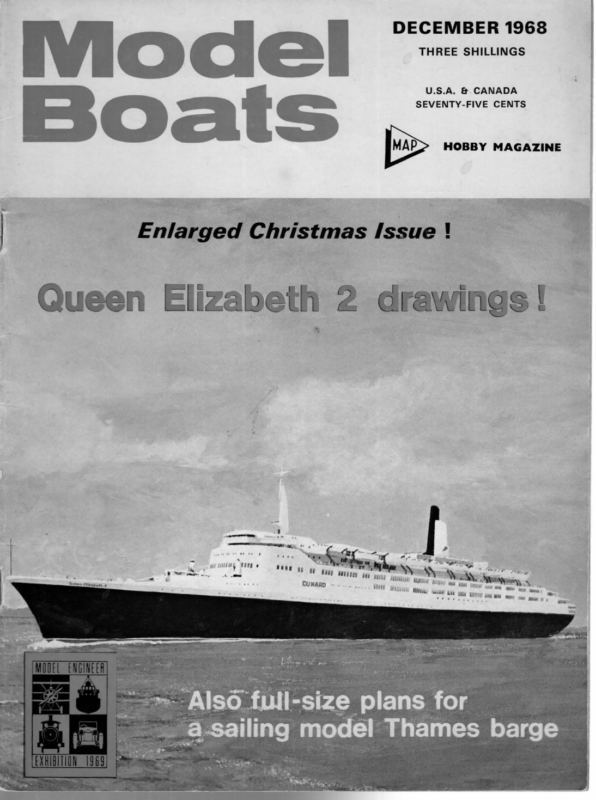
DECEMBER 1968 THREE SHILLINGS U.S.A. & CANADA SEVENTY-FIVE CENTS HOBBY MAGAZINE * j way Wifie i
MODEL BOATS Longbow and Bambi By S. Witty Two interesting new Marblehead designs HE two new ‘M’ designs shown with the following article have certain features in common, but are basically different in concept. In both, the draught is limited, for though the deep keels are more efficient in any kind of a breeze, they are too restricted in the choice of sailing water. In the Longbow design as drawn, the draught is 13.4 ins. but alternative versions are building at 12.4 and 15.4 ins. respectively. One difference to previous designs is that the after edges of the fins are swept forward, thus gaining a little extra stability due to the higher C. LR. position, and an improvement in the balance with the more centralised root. To give a better safety margin when being driven really hard the stem is fairly high in both cases. Prevention is better than cure after all, and such small extra windage as there is, being forward, improves the aerodynamic balance. With the combination of tall rig and short ends, a tendency for the bows to drive in is always a factor in this class. Actually the bulb keel is no help in this respect, for when accelerating, the thrust of the sail tends to move the yacht around the c.g. This being lower in a bulb-keeler, it follows that the bow sections will be more heavily loaded. Even taking this into account, the advantages far outweigh the disadvantages. A point in common in these designs is the incorporation of the bumper into the shape of the hull. This idea was used in Floreana, the winner of the championship in 1952, but was not taken up for many years. Possibly it was considered that the extra one-hundredth of the length was not worthwhile bothering about. Aesthetically, too, a raked stem is more pleasing and helps to deflect the waves downward. Even a slight rake shortens the sailing length half an inch though, and the rounding off to avoid injury to the hand loses more. The bumper, being usually of softer material, needs no rounding off, so the actual gain may be appreciable when all factors are taken into account. Care should be taken not to exceed the maximum length of boat and bumper however. The first design shown is unusual in that the lines and sections below the water-line were developed from those of a new ‘A’ boat. As far as I know, this is the first time this has been done, though I have heard of a development the other way round, from ‘M’ to ‘A’. Being designed for Australian waters, this concept had to be good in the lightish conditions which often prevail in N.S.W. Originally she was envisaged as a ‘heavy’, to obtain a powerful, easily driven hull which would be able to carry a main with a 90 or 100 inch luff, since performance in light conditions depends largely on the sail to wetted area ratio. Three sets of lines and sections were drawn to different scales, but my own preference was for the lighter 20 Ib. version. Alternative bulb sizes are shown, since the weight of an ‘M’ less keel can vary between five and eight pounds, the choice depending largely on the method of construction. Longbow Bambi Length Length L.W.L. Beam Length 50.25 in. + 0.5 in. (Bumper) Length L.W.L. Beam 49.5 in. 9.75 in. Displacement 20 Ibs. Draught 13.35 in. Draught Displacement 50.25 in. + 0.5 in. 50 in. 10.32 in. 12.3 in. 17 Ibs. These drawings are available from M.M. Plans Service, price 7s. 6d. each plus 6d. post, ref. M.M.1018 (Longbow) and M.M. 1019 (Bambi). Each has half-size sheer and waterlines with full-size body plan, fin, and skeg. ra LONGBOW (7) 504
DECEMBER f 1968 ca Te) | The ‘A’ class lineage can be seen in the form of the midsection, being well rounded, with low wetted area, yet fairly flat floored and not too deep. Together with the low p.c. this permits a really flat run aft and lifting sections forward, while waves of any real height are parted by the sharp stem. In both designs, the tumblehome is such that the heeled lee waterline is bisected at right angles where possible for minimum wetted area. The lines of the second design to some extent follow the trend of the latest planing dinghies, particularly the 12 ft. Nationals. With such craft, any tendency to dive is easily countered by seating the crew further aft. In the *M’, all corrective measures previously described are used, and as the c. of b. is well aft in this type, the fin and bulb van also be placed nearer the stern. Positioning the maximum depth of the canoe-body forward of the midsection as in the full-size craft seems to help to keep the bow flying, in spite of the fact that this also tends to sharpen the forward sections and waterlines. When driven hard the hull takes up the fore and aft trim it would naturally assume if placed on a flat surface. Whether this is a fair analogy or not, the converse also seems to hold good in that a hull with roughly semicircular rocker sits less when pushed, the reason being apparently that the main body depth moves aft in relation to the c.b. when the stern sits. This is at variance with what has been written on the subject, which indicates the opposite. In this design the width of the transom may seem more than is usual in an ‘M’. However, I came to the conclusion long ago that it is the straightness or otherwise of the ‘Welch Axis’ at any particular angle of heel which determines whether the canoe body stays in balance. Within reasonable limits it seems to make little difference if this is inclined at an angle to the centre-line from the hydrodynamic point of view. In fact the most likely disadvantage of a wide transom is probably aerodynamic, tending to point the yacht into the wind when heeled, but as the hydro action is just the opposite, these forces largely cancel out. As the latter varies in proportion to the angle of heel, this action is ideal in many respects. It should be made clear that in both fin and bulb-keel designs where the fin is a separate appendage, the main problem is always to prevent the boat pointing up too much and persistently luffing, for even if both hull and appendages are perfectly balanced, the curvature in the sail will supply ample weather helm. In fact I think the sloop is better than the cat rig, largely because the working surfaces are broken into two separate components, which very much reduces the turning over the barrel effect of a single surface, particularly as the foresail is usually set at a greater angle of incidence than the main, in relation to the wind direction. Since this concept is intended to be sailed in very much the same manner as a catamaran, more or less upright that is, these considerations are mostly transient in nature, as, for instance, during a squall. With this type of planing hull, it is often an advantage to use a lower rig so that the yacht can move fast enough to gain a great deal of dynamic stability. The sailplan shown with these designs is similar, with a double-luff main shown with all suits. If preferred though, a conventional main of similar dimensions can be used D. L. sails can be seen at almost every meeting now. Examples where the D.L. is glued to the main look cleaner, and if anything, seem to perform better. Sail balance is not quite so good as with a normal rig, and to compensate, the mast must be moved forward a little. Reason is that sails behave in part like a tandem wing. The flow over the foresail is smoother than the main, not being affected by mast turbulence, and gains in efficiency at a quicker rate for a given increase in the wind velocity. As will be seen, this reduces the natural imbalance of the sailplan with a normal main, but since there is little turbulence with a D.L. main the balancing effect is also less. Even so, the gain in thrust of a D.L. main is such that it cannot be ignored. For some reason, this type of sail has caught on more quickly in the 10R class, being used by three out of the first five in the championship, the winner incidentally using a stitched polythene D.L. and D.L. foresail around a metal tube forestay. In this material the sail can be doubled up to enclose battens, hoists, and clew reinforcing. Most D.L. mainsails revert to a circular section towards the hoist which must result in some turbulence and loss of stability. The mainsail shown is designed to overcome this and give a similar advantage to a gaff rig without losing the free area of the triangle under the headboard. This can amount to about thirty sq. in. in a high rig, so is worth having. As can be seen, part of the main extends within the D.L. to the headboard, allowing the sail to take up a position snug against the mast. 505
‘0 Moll BOATS BRITISH OPEN “M” CLASS CHAMPIONSHIPS Held at Hove Lagoon on September 7/8th en ee event was organised by the Hove and Brighton M.Y.C. and took place on the 7/8th September, at Hove Lagoon. Thirty-eight entries were received from fifteen clubs, but, unfortunately, one skipper decided to withdraw, thus creating an extra bye. The O.0.D. Mr. F. Jennings, had decided to sail the heats in two divisions, with the three top scoring boats from each going forward to the final. At approximately 10.0 on Saturday morning the O.0.D. welcomed all the competitors and issued the score cards and sailing instructions. The wind was easterly, mainly light, and many boats were on high aspect sails. Despite well organised marshalling and starting, the early heats were taking about an hour, but witha staggered lunch break half the heats were completed by 8 o’clock on Saturday evening, and the leading scorers in each division were as follows: In Division A, R. P. Stollery, Guildford, 38; D. Bateup, Hove and Brighton, 37; C. Sykes, Bournville, 30; D. Parkinson, Fleetwood, 30; and in Division B, R. Seager, Clapham, 32; C. Colsell, Hove and Brighton, 30; D. Reed, Hove and Brighton, 29; F. R. Shepherd, Guildford, 27. In order to give competitors an opportunity to relax in a convivial atmosphere, an informal buffet was arranged at the local hostelry, which was quite well attended. Racing started again at 9.30 on Sunday morning, after a warning from the O.O.D. that only maximum co-operation from all skippers would enable him to complete the tournament. As if to frustrate everyone’s efforts the wind died away to nothing at the end of the first windward board, and the last pair took eight minutes to clear the course. Much to the relief of all present, however, a steady breeze came in from the east and remained constant for the remainder of the race. Lunches were again staggered and as the end of the heats approached, tension increased considerably. At the completion of the divisional sailing, it was found that there were three definite finalists in Div. A, i.e. R. P. Stollery, 75 points; C. W. Sykes, 67 points; and — D. Bateup, with 64. In Division B, however, the position was more complex. F. R. Shepherd was clear with 64 points, but running for the remaining two places were R. Seager, 61 points, and D. Reed and C. Colsell with 60 and 59 points respectively. After all resails for these boats had been settled, R. Seager and D. Reed went on to the final. This proved to be the most exciting part of the proceedings, and a large crowd of spectators followed the eT 516
DECEMBER five heats to the end. After some breathtaking finishes on Far left, top, Mad Hatter, R. Stollery. Centre, two Mad Hatters, K167 D. Bateup and K1634 D. Reed. Bottom, Tremari, K1634, D. Reed, Jill Il, K1553, C. W. Sykes. Left, KI537, Roger Stollery’s Mad Hatter, K5136, Fred Shepherd’s March Hare. Below, K1608, Wayfarer R. Seager, K1617, Manito, D. Bateup. the windward boards, F. Shepherd beating R. Stollery by about 6 inches, the 1968 British Open was decided as follows: Skipper Club Boat Points Ist F.R.Shepherd 2nd R.P.Stollery 3rd_C. W. Sykes 4th R. Seager Sth D. Bateup Guildford | Guildford Bournville Clapham MarchHare MadHatter Jill II Wayfarer 1968 21 17 14 12 6 Hoveand Manito Brighton D. Reed Hoveand Tremari— 5 Brighton The trophy and prizes were presented by Mrs. W. F. Jennings, and Fred Shepherd echoed the thoughts of most people present when he made a few remarks praising the good sailing, good organisation and good catering. As a footnote one must surely give credit to Roger Stollery, who not only designed the winning boat, but also the second, fifth and two very ‘near misses’ in the heats (all these hulls are by Ray Blick of G.R.P. Marine). This was 6th a very satisfactory event one would think, both from the genera] conversation around the lake and also from the amount of work and actual sailing achieved in the time available. DIVISION A No. Yacht 1537 Mad Hatter 1553-30 1617 Manito Skipper R. P. Stollery C. W. Sykes D. Bateup 7 9 10 10 1650 1582 1592 1597 April Dancer Mohawk Blue Slipper Fantasie D. A. G. C. 14 17 1593 1292 Mojo Waltze C. Jackson J. A. Lofthouse Danson Norfolk & 47 45 18 21 22 23 24 27 27 31 33 36 1632 1483 955 1599 1590 1596 1619 1563 1628 904 Mishap Red Albatross Bacchus Tweedledee Stalker Jayess Thumper Zeua Fram Little Haste A. R. Tait H. Leask J. Topham H. Balchin E. Carter J. Stokes H. Dodd R. Edwards G. Jones W. Hart Newcastle Clapham Birkenhead Guildford Forest Gate Poole Birkenhead Bournville Guildford M.Y.S.A. 42 38 36 32 31 27. 27 23 21 12 1 4 1536 1608 March Hare Wayfarer Guildford Clapham 64 61 2 3) 5 Impromptu Parkinson D. Gill T. Austin Dicks DIVISION B F. R. Shepherd R. Seager Club Total Guildford 75 Bournville 67 Hove & B’ton 64 Fleetwood 62 Birkenhead 58 Guildford 55 Clapham 55 Norwich 6 1634 } Tremari D. Reed 8 1616 12 13 1114 1405 i Alacrity Carioca T. Knott S. Rawnsley 14 – 15° 15 20 20 26 27 27 33. 35. 1353 ‘1S501° 1535 1538 1607 1562 1564 1566 994 1304 Fandango ‘Cutlass ; Lucky Devil White Rabbit Claire Pandora Demon Lulu Pussy Galore Faun K. E. Roberts R. Dunning H. Godfrey B. Brewster J. Deacon H. Dovey | P. J. Dunkling C. Edmondson G. A. Reeves J. Cutbush Narang C. Colsell Hove & Biton Hove & B’ton Clapham Leeds & Bradford Birkenhead Birkenhead Guildford Guildford Clapham Bournville M.Y.S.A. S’thampton Bournville Gosport 60 59 50 49 47 46 46 40 40 30 27 27 21 15 CHRISTMAS INCIDENT A strange event recalled by W. Featherstone A singular incident occurred at Derwenthaugh on the south bank of the Tyne, four miles above Newcastle upon Tyne, on Christmas Eve, Saturday, December 24th, 1898. A record of it appeared in the South Shields Gazette on December 27th, but it is almost forgotten now; it happened to a well known steam collier, particulars of which I have left to the end of the narrative. Navigation further west of Derwenthaugh was barred to all but very small craft by a low suspension chain bridge at Scotswood. The ship which tried the impossible task of passing it in 1898 was the S.S. Vernon, a very wellknown local steam collier which had been on charter for years to carry coal from Derwenthaugh Staiths to London. In the early hours of December 24th, 1898, S.S. Vernon arrived off the Tyne at tide time, and when the tide was just on the ebb she entered the river and took on her usual pilot who resided at Shields, as did her captain. All the crew were in high spirits with the delightful prospect of at least two days relief from their monotonous employment. It was essential that all vessels needing the Swing Bridge at Newcastle to open for their passage to reach it with an opposing tide, otherwise it would not be opened. continued on page 51% 517 one Position