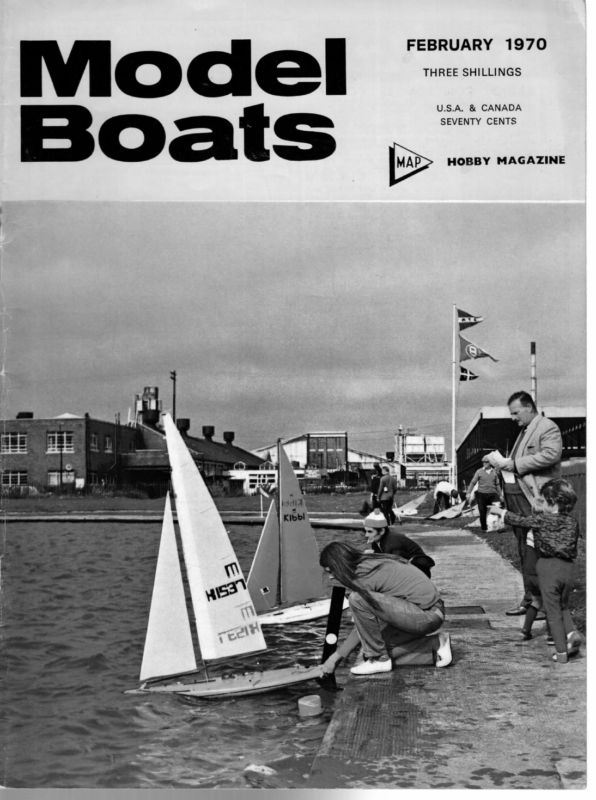
- SKIPPY A new Marblehead in the modern manner Designed by Stan Witty
- Readers Write

© st a © at S&S FEBRUARY 1970 THREE SHILLINGS eee U.S.A. & CANADA [nize HOBBY MAGAZINE
MobEL BOATS SKIPPY A new Marblehead in the modern manner Ae STOuE? [HE ‘Skippy’ design was evolved in order to pro- (Da duce a light hull which would accelerate into a full plane quickly and easily, and yet still be power- p : ful enough to carry a really high rig to windward. It is not suggested that there is anything novel in these requirements, or in the design produced to meet them, which is, in fact, well within the state of the art, but that the various factors which make up a design are, in Skippy, assembled in a highly effective com- : bination. Designed by Stan Witty SKIPPY Sesigned by ‘ime ee st hot Without doubt the requirements conflict to some SS ee = copyright of 9 a Rin Nae ao aan ORR Sia ‘er ast* | { [|] orice ee ere a S.Witty. I ipl ] i Loot ae he aoa = 8 56
FEBRUARY 1970 degree, since for optimum performance to windward, good balance and stability are to obvious advantage, while a fine entry and sharp waterlines forward enable a hull to go through a lop without too much effort. Downhill, all these factors still apply, if not in the same proportion, but the amount of sail which can be carried is largely limited by the amount of lift in the forward sections, and planing ability. A hull can usually be driven quite fast when the bow is forced down a couple of inches under the pressure of a tall rig, but this is often the prelude to a gybe, whereas if the bow will lift, the hull can plane much more freely. In fact, it might be said that once the bows start planing, the rest will follow. With the increase in speed there is usually an associated gain in dynamic stability which, together with the direct reduction in windspeed, make a broach less likely as the yacht accelerates away. For all the current accent on planing performance, stability is still a major factor, and since one is achieved to some extent at the expense of the other, it is very much a matter of opinion as to the most effective blend. The rig shown on the drawing seems to be about the tallest effective arrangement. Luff lengths of 100in. are in use, but it is doubtful whether the additional free area in the longer roaches compensates for the extra mast turbulence over the sail, and the greater angle of heel. The extra height does allow a larger spinnaker, but it seems that many Ms carry about as much as they are able already. Shorter rigs can be used, but on the whole give a smaller sail-to-wettedarea ratio, which is a disadvantage, particularly in the relative lulls which occur even in the windiest conditions. The draught of Skippy is 14.3in. or rather less than that of the Vega, Kingfin and Hammer designs, since with the reduced sweep on the forward edge and the shallow canoe, anything deeper looks excessive, though the chord is about the same. In later years fins have tended to become less raked, largely to bring the C.L.A. aft to allow an aft mast position. Vertical edges are avoided, though, since these allow no local flow adjustment. The relatively high aspect ratio of the fin, plus the end plate effect of the bulb, help minimise end loss and induced resistance. The short sections in the fin also increase the chances of laminar flow over most of the surface, providing it is smooth and free from small irregularities. The balance will be exceptionally good with the appendages as drawn. Some indication of the continued improvement in this aspect of bulb-keel design can be seen in the position of the mast, which is now aft of that in the majority of fin keel craft. The actual position of the mast in Bambi is very close to that on the drawings. On this design, some skippers have moved the lead aft to allow more sail to be carried downwind, in which case the mast position is further aft, though well within the normal inch limits. I do not envisage that this will be required in Skippy, since apart from the very much greater lift in the forward sections, there is rather more overhang forward and another half inch advance of C.B. hull over that of the lead. As will be seen, the hull sections are slightly veed throughout, though the maximum depth of the canoe is only 2.22in. The hull itself has a low prismatic coefficient, and so is fairly easily driven. The shallow sections and the narrow centrally placed fin allow responsive rudder control and a good gybing action. Except where the sections, and in particular the forward sections, are well veed, rudder response depends largely on the distance between the plane centres of fin and skeg rudder. In Skippy this is approx. 20.Sin. which compares with well balanced fin keel designs like Hustler at 19in.. or Jemina Duck at approx. 17+in. The shape and position of the skeg rudder is mainly dictated by dynamic balance considerations, but it also keeps the rudder submerged at high angles of heel. As the hull, fin and sailplan are independently well balanced, a vertical rudder post could be used if required, though I feel this should not be nearer to the transom than 4in. In this case some reduction in balance is partly offset by the extra length of lever arm, though naturally I prefer the drawn. I am very pleased with the lines of satisfied that all the design criteria have been met. In the right hands I prove exceptional. arrangement as Skippy, and am outlined earlier believe she will FULL-SIZE COPIES OF THIS DRAWING AVAILABLE, REF. MM ARE 1053, PRICE 12/6 POST FREE, FROM MODEL MAKER PLANS SERVICE, 13-35 BRIDGE ST., HEMEL HEMPSTEAD, HERTS. EEE
MODEL BOATS than producing a shattering effect. As the shell moved along the rifling the parts of the barrel in front of it supported some of the lateral stress of expansion but when it was at the point of leaving there was no support so ‘B’ tube is increased in diameter at the muzzle. The form of the slight curve leading to this is very subtle and it is worth taking some trouble to get it right in a model as it is very characteristic of British naval guns. In the model of the Vanguard in the Science Museum this point is entirely missed as the 15 in. guns are represented with no swell at the ends. If they were like this in the actual ship the barrels would crack after a few rounds had been fired. The straight end is characteristic of German guns which have to be longer to compensate for the absence at the swell ends. The pressure in the chamber when the charge was fired was about 19 tons to the square inch! The construction of a heavy gun took as long as the building of the ship designed to carry it. It was Readers Write THE M.Y.A. IMAGE Dear Sir, | was recently handed a copy of Model Boats for January, 1970, and after reading your Editorial ‘In the Tideway’ and ‘Readers Write’, | gain the impression that they are platforms for much unjustified criticism aimed at the Model Yachting Association in that it lacks enthusiasm and energy in its leadership and administration, and that it also lacks publicity and fails to write articles in your magazine to encourage newcomers into the sport. Further, the Association is accused, not for the first time, of being a secret society. Your Jeffries, correspondent, also states that Mr. the C. R. Associa- tion shows no interest in R/C yachting and suggests that it is not sufficiently competent and enthusiastic to control this branch of the sport. My reply to all these charges is that they are quite unfounded for the fol- lowing reasons: 1. The Association is fortunate’ in having an extremely competent Chairman who certainly does not lack leadership or enthusiasm. 2. The administration is efficient and is the product of a new _ constitution which is only one year old and which was adopted by all the member clubs after much hard work and _ careful thought in its preparation. The constitution is democratic and it is the Clubs who control the sport, not ‘The M.Y.A.’, erroneously thought to be a body of gentlemen who sit in conclave in to London and who change, and do courage 3. The show resistance nothing to en- anyone. Association is _ publicity-con- scious and much has been done in recent years to draw the public’s atten- tion and interest to the sport, especially at various regattas which, after all, offer the best opportunity. In this respect, | have noticed that there is a marked absence of a representative from Model Boats at M.Y.A. Championships, so losing the Opportunity of taking photographs and writing first-hand reports, so your magazine could justifiably be accused of lack of interest in promoting the sport. 4. The charge of ‘secrecy’ is sheer nonsense, because everything is faithfully a major feat of mechanical engineering and the machining of all the parts to be shrunk together required great precision. For example in the final boring operation that finished the interior of the inner ‘A’ tube the permitted ‘tolerance’ or error was minus but not plus 0.002 in. That is that it might be finished two thousandths of an inch under the required 15 in. diameter, but on no account over that size. This was in the final machining of a hole 50 feet long and large enough to pull a man through! After this operation had been gauged and passed the cutting of the 76 spiral grooves of the rifling began, and simultaneously the whole length of the outer ‘A’ tube had to be machined and stepped inside and outside to such a size as, when heated, it would slide easily over the inner tube but also allowing for the fit not being too tight when it was chilled or it might crack in contracting, and so on till ‘B’ tube, the wire, the jacket and the breech ring were all shrunk together with the right amount of tension in each. reported bi-monthly in the Association’s official publication, the ‘M.Y.A. News’, which is available for 4s. per annum, post free (or 3s. per annum if ordered through Club Secretaries), from the Editor, Mr. G. Sheward, 12 Osborne Road, Hornchurch,’ Essex, RM11 1HA. | would suggest that if newcomers wish to keep abreast of latest developments in the sport, they could not do better than subscribe to this publication which is produced at not inconsiderable expense by _ the Association, not to mention the Editor’s valuable time. | quite fail to understand your anxiety to publish the date of the Association’s A.G.M. in your magazine, because surely, this is of no interest to outsiders, and all members of affiliated Clubs know the date anyway, because it is circulated to all Clubs. 5. In reply to Mr. Jeffries’ charges, | would ask him who produced and adopted the ‘Q’ Class Rules, the ‘R’ Class Rules and the current Sailing Rules, and who stages the ‘Q’ Class Championship? The answer, of course, is the M.Y.A., its members and_ its affiliated Clubs. The ‘R’ Class, which was a fiasco since only four boats were registered, was a classic example of a class having been adopted after demand by the R/C enthusiasts without first building several boats and giving them at least a season’s trial. It costs money to adopt a Class, and this is not justified unless it can be has rule proposed that the shown sufficient appeal. | would, therefore, suggest to Mr. Jeffries that he should channel any proposals he may have through his Club, when they will receive careful and sympathetic consideration by the M.Y.A. Council, but judging from his letter, there seems to be as no to concerted what required. type action of or smaller agreement class is | would also suggest that Model Yachting matters, both ‘free’ sailing and R/C, should be viewed in the right perspective and not through rosesport a_ is This spectacles. tinted which appeals to a minutely’ small proportion of the population. It has estimated that there are only been about 400 active members of the Assomakes which Clubs, 39 in ciation nonsense of the assertion in your article on the ‘DX’ Class that ‘many’ Clubs are affiliated to both the M.P.B.A. and In fact, the number of the M.Y.A. Clubs with dual affiliation is only 6. It is also surely ridiculous to suggest 80 that the control of R/C yachting should be placed under the wing of the M.P.B.A., whose experience and knowledge of rating rules and sailing yacht design must be practically nil. _Returning to the question of statistics, it in way is impossible to judge the number of adherents to the sport from registration figures, because they of no yachts relate example, in have been in to active the actual number commission. For the ‘A’ Class, 883 boats registered, but only 73 boats have valid certificates. In the ‘Q’ Class, 44 boats have been registered, only 20 of which are_ valid, which gives a pretty fair indication of the very small minority interested in R/C yachting. So may we piease have a senso of proportion when writing about Model Yachting and less tendency to exaggerate its popularity. The chief retarding factor is the lack of suitable sailing waters, quite a few having been lost since the war to encroaching pleasure boats. | know that there is quite a lot of latent interest locally, but unfortunately, there is no suitable water, and the present economic situation, which may take years to improve, completely rules out the possibility of the local Corporation spending any money to provide a lake. In any case, the sport is not one that, in these modern times, appeals to youngsters, they have different tastes and interests and look for something more immediately exciting which requires little effort or competitive participation. My final reply to your criticism is that some excellent books have been written by Model Yachtsmen, eminently suitable for the newcomer. One example is ‘Model Racing Yachts’ by B. H. Priest and J. A. Lewis, published by your Company. So where is the secrecy? | would also make the pointed remark that Model Yachtsmen are not encouraged to support your magazine for the simple reason that they are not prepared to pay 3s. for a publication that, at best, includes relevant subject matter which can be read in the space of a few minutes. | conclude by suggesting that, if you wish to encourage newcomers to read Model Boats and buy your plans, it should be a fairly simple matier to write a series of articles for them your- self, especially as you appear to be in possession of all current information appertaining to Model Yachting at home and overseas. Westcliffe-on-Sea. Norman D. Hatfield