- 1970 MARBLEHEAD CHAMPIONSHIP FLEETWOOD, MAY 23/24/25th
- RACING MODEL YACHT CONSTRUCTION PART THREE, IN WHICH C. GRIFFIN MOVES ON TO WOOD-PLANKED ROUND BILGE HULLS, LABELLING METHODS A1, A2, ETC., FOR CONVENIENCE
- Round the Regattas

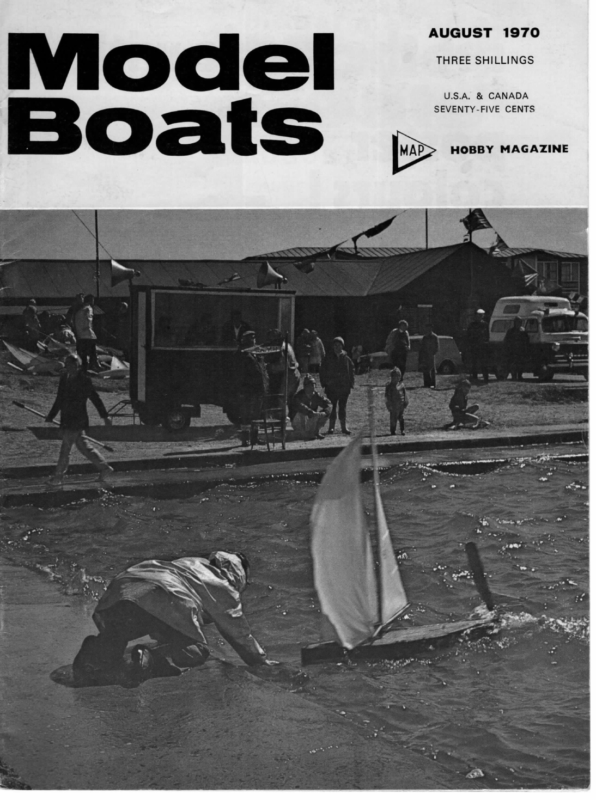
AUGUST 1970 THREE SHILLINGS U.S.A. & CANADA SEVENTY-FIVE CENTS [oi HOBBY MAGAZINE 9 ores APTS at a v4 ry ~ OY eo
MODEL BOATS 1970 MARBLEHEAD CHAMPIONSHIP FLEETWOOD, MAY 23/24/25th PPHE 1970 Marblehead Championship at Fleetwood over the Spring Bank Holiday was one of the best of recent years. There were 32 boats, following one withdrawal, and Fleetwood laid on every weight of wind—a good top-suiter on Saturday, fading away towards evening to very light airs, a light start on Sunday quickly coming up to a full nose-on limit top suiter, and increasing winds up to close to 20 m.p.h. on the Monday. The O.0.D., John Blundell, kept a cracking pace to sail right through; this involved 2-8 p.m. Saturday, 9 a.m.-8 p.m. Sunday, and 9 a.m.5.30 p.m. on Monday. Coupled with dashes up and down the lakeside for diflerent rigs as the wind strength varied, and minimum breaks for lunches and cups of tea, everyone involved certainly got their share of healthy exercise! The top six boats proved to be three of the classic displacement-type hulls and three of the contemporary lightweight ‘flat-irons’; the latter term is used by those not particularly enamoured of them, but is accepted in good part by their protagonists. We even heard it contracted to ‘flatties’—shades of power boats seven or eight years ago! A third of the fleet was, however, composed of the Stollery/Shepherd type turtle-backed lightweights, and the vast majority of all boats sported bulb keels. Walter Jones, sailing M-4-Sis, repeated his win of 21 years ago. As would be expected, the boat was well-found and beautifully handled, and it was a pleasure to see the set of the sails on any leg. She is a Floreana hull given a fin and bulb keel in place of the shaped lead which she was using ten years ago. Despite a drop in displacement (to 194 Ib.) the bulb adds to her immense power-—she was still carrying an 800 sq. in. rig when some boats were down to 400 sq. in. or less. Her ability to point very high and still keep moving involved her in a number of resails to weather, since if she had the leeward berth at the start, the windward boat, sailing further off the wind, could not usually outpace her and was therefore likely to collide. Trying to point too high still seems to be a fault which loses a lot of points and many boats would do better a little freer, especially in waves. M-4-Sis butts her way steadily on, helped by good sails and good trim, but other boats die every few feet, either coming almost into irons or being stopped by a wave on the bow. It is particularly necessary to sail off the wind with the lightweights, which are more easily stopped by waves; it may be discouraging to see a displacement boat poled off much further up the bank on the first turn, but the superior speed of the lightweight should mean it reaches its turns quicker and thus stands every chance of reaching the line first. Against the overall winner’s 194 lb., the next three were all between 14 and 16 lb., which indicates that the lighter boats can compete more than adequately when handled right. There were the usual bad spells or mishaps, some occurring where the faster model of a following pair collided with one of the pair in front; there was some inconsistency in some decisions in these cases, though no doubt for reasons not always immediately apparent to an onlooker. The officials did a hard job very well, and most would obviously have preferred to be sailing. At one point Odin’s skipper fell in, and at another Alan Bell leapt in to pull out a child who was obviously in difficulties, in front of a group of spectators. Two occasions when the final results were markedly to be affected were when Fred Shepherd dropped 10 points late on Saturday and when Mick Harris, sailing Martini, lost 17 in’ a row in little over an hour (continued on page 327) 322
AUGUST 1970 Posn. 1 2 3 4 5 6 7 8 9 10 11 M iP 13 14 15 16 17 = 19 No. 79 1677 1736 1597 1686 1353 1719 1697 995 1324 1650 1694 1696 1537 741 1726 1720 1501 1661 Yacht Ma4sIs Hector Black Rabbit Fantasie Impromptu Martini Gay Gordon Cosmos Jofuku Die Fledermaus Tempest #£Abpri/ Dancer Fiorello Bugs Bunny Mad Hatter Usiba ~=Gin Fizz Pan-Yan Cutlass Foxtrot Uncle 21 = F120 1721 Ou Pas Bis Lunhilda 20 23 24 25 = = 28 29 30 = 32 Skipper W. Jones R. Stollery F. Shepherd C. Dicks M. Harris K. Roberts R. Newport D. Lippett W. Perry A. Bell G. Carter G. Keeley J. Mitchell M. Rawnsley A Wilson H. Dovey F. Johnson R. Dunning C. Colsell Club Birkenhead Guildford Guildford Clapham Bournville Birkenhead N. Liverpool Bournville Birkenhead Fleetwood Fleetwood Newcastle Fleetwood Leeds and Brad. Victoria (Scot) Bournville Fleetwood Birkenhead Hove and Brtn. Design Mod. Floreana F. Shepherd F. Shepherd C. Dicks Harris/Dovey After Adams Mod. March Hare D. Lippett W. Perry C. Adams Stollery Daredevil Stollery Popcorn Stollery White Rabbit _R., Stollery Adams Foxtrot Harris/Dovey F. A. Johnson Witty Wasp F. Shepherd P. Krafft R.Wolfenden France Fleetwood H. Boussy Witty 1713. = Grete/ // A. Sinar 1716 Sanjo J. Doyan 1671 1632 1351 1590 = 1712 742 N1979 F78 ~— Odin Mishap Lazy Devil Sta/ker Susantu Tiki Varuna Alize I/ H. Briggs A. Tait R. Cole A. E. Carter J. Gilmour T. Mcintosh R. Tregenna D. Lahore 1722 Kaboobie D. Bragg Bournville Leedsand Brad. Fleetwood Leeds and Brad. Newcastle Guildford Forestgate Clapham Victoria (Scot) Ulster France Littlejohn/ Hansford Stollery March Hare Daniels/Parkinson Witty Typhoon Mod. White Rabbit R. Stollery Witty Hustler Mod. Mad Hatter Adams Foxtrot Mod. Witchcraft Witty Wasp 4 5 7 12 21 Score 103R22 27 43 86 134 20° 20: | 28° 52-4 79) 128 WS: 24 23, ~43-.-81 127 Th 220 aoe AA 118 18 23 26 47 77 116 17 19. 22R 34 66 114 a3 18> 23° > 34 368° 1102 LOM 2 SG 2: 98 TOR AD) ar 14_ Sis 62 95 10 15 20 28 46 85 10: 45) = 2012 (23). 3.35 84 3 ©) tulsa 44 81 10 10 13 26 46 80 Ci 498: FeO 26″ £42 75 10 ~ “10°42 R31 44 74 16. 21 26:72 a0″ o2 73 SiR 36; )e1S 205) 39 68 SRe12.” Ae 44 68 9 14 19 35 49 65 [5 en Os I 22 40 64 2 AOS AI €9 0 5 OR 0 10’ 7) O ZR 19″ “10’= 24> GE 5 0 5 7 10 10 17 5 10 17 6 6 8R 5 5 10 8 8 11 6.4 8 222 SiRya-O= ead 18 TP 31 28 23 7 11 27 ilefepees 230 745 40 i20 40 43 46 S38 23 oy: id 63 6S 55 54 54 54 52 47 37 37 25 Due to byes and uncompleted resails (R stands for resail) the progressive scores do not necessarily give an accurate picture of the position of any one boat, merely an indication. Poling a boat involves not moving one’s feet and not imparting way to the boat. Pictures above show Ken Roberts solidly based with Gay Gordon and Roger Stollery practising brinkmanship with Hector. Below, Fred Shepherd has a business-like stance with Black Rabbit while Chris Dicks gets a little extra control over Fantasie Impromptu by squatting. Right, Mick Harris sacrifices dry knees to safety in stopping Martini. Opposite top is happy winner Wally Jones and mate, bottom, Bill Perry adjusting the jib tack on the novel-finned Die Fledermaus. 323
MODEL BOATS FIG. 7 SHADOW MOUNTED ON BUILDING BOARD Notch for backbone Notch for inwale / / Building board cS be Mounting block FIG. 8A CUT OUT BACKBONE 3/8″ Slot for fin LAMINATING THE BACKBONE Wooden blocks Shape of backbone traced from plan REBATE FOR PLANKS 2 AFTER END OF HULL YPE Al. This method of construction was used in the building of S. Witty’s Golden Archer design and consisted of a laminated mahogany backbone and a separate fin and skeg with the planks spiled and fitted on to the ribs. The planks are cut from lightweight straight grained mahogany + in. thick by 3 in. wide by 50 in. long. Supplies of this wood are not easily obtained, so that this aspect must be considered if this method of construction is envisaged. A degree of experiment has been done in the mahogany planked carvel type hull and the second application of this method uses parallel sided planking varying in width from 5/16 in. to 7/16 in. It is hoped that in the following notes this particular point will be fully illustrated. From the chosen design, trace the full section at each spacing station. Mark off on this tracing all allowances for the thickness of the planks and ribs, i.e. 3/32 in. for the planks and 1/16 in. for the ribs, except in the case of shadow No. 1 and transom. Draw in the notches that will receive the inwales = in. wide by 3 in. deep (Fig. 7), remembering that where a heavy tumblehome is planned an allowance must be made for an amount of twist and reshaping of the inwales. Allowance must also be made for the thickness of the deck if an inlaid deck is desired. Notches must also be cut in the shadows (Fig. 7) to locate the backbone. Transfer the corrected tracing on to 4 in. thick plywood (the use of hardboard is not advised as one surface is not flat and this wood is easily affected by moisture). Shadows No. 1 and the transom are traced on to } in. thick mahogany faced marine plywood as these become an integral part of the completed hull, whereas all other shadows OVERLAPPING ALTERNATE PLANKS AT BOW are removed when the planking process is complete. The writer prefers to break out the shadows but split shadows can be built to facilitate easy removal, see later notes on the hard chine construction. All the cut out shadows are mounted on their respective blocks and erected on the building board, a piece of equipment that readers of the previous articles will easily recognise (see photo). Shadows No. 1 to 6 are placed with the front edge on the station line, shadows 7 to 10 and transom are reversed and again placed with the front edge on the station line. Check that the overall length does not exceed 50+ in. including the bow block, which is laminated from = in. thick mahogany faced marine plywood and fitted to shadow No. 1, or 50} in. overall length where an integral bumper is envisaged. FIG. 9A FITTING FENDER PLANK AT BOW 330
AUGUST 1970 RACING MODEL YACHT CONSTRUCTION PART THREE, IN WHICH C. GRIFFIN MOVES ON TO WOOD-PLANKED ROUND BILGE HULLS, LABELLING METHODS A1, A2, ETC., FOR CONVENIENCE The photographs show a Witty-designed Skippy under construction, and this model was built by method A2, to be described next month. The pictures show methods of clamping planking, etc., which apply to all wood-plank sysiems; main obvious difference is that fin skeg are separately added and in method A1. by glueing the edge which contacts the sheer plank and the area where the plank touches each rib and the bow and transom shadows. Repeat this process The backbone is laminated in a jig from 4 pieces of + in. thick by 2 in. wide mahogany using Aerolite 306 glue and cut away as shown in Figs. 8 and 8A. When complete the backbone is dropped into the locating notches in all the shadows and glued into shadow No. 1 and transom. The inwales, which are of 3? in. square spruce, are then steamed and bent into position in the notches, again being glued into notches in shadows No. 1 and transom. Method A2 describes an easier method of building the inwales. The ribs, + in. wide, cut from 1/16 in. ply, are placed in position, being notched and glued into the FIG. Il KING PLANK – SLIDING HATCH AND MAST HEEL AND SLIDE fl | ~~ Deck beams a a : £ / backbone and the inwales. | | U Slot for mast slide In the planking process the first plank to be fitted is the sheer strake. It may be necessary to do some reshaping of the inwales to allow the sheer strake to fit closely to the inwales and the shadows, especially if the tumblehome extends from midsection to transom. The sheer strake is usually wider than the main planking, but because of the tumblehome it is sometimes easier to fit the sheer strake in two FIG. IIA Slot for skeg KING PLANK BUILT-IN HANDGRIP AND DECK MOUNTED MAST { —fL Built-in handgrip = The process of spiling and planking has already been described in the previous article but it would be advantageous to repeat the method, stressing the point that in this particular type of construction accuracy of fit of each plank is essential. Aerolite 306 glue is a gap-filling type of resin glue but there is a limit of approximately 20/1000 in. to the gap. After fitting the sheer strake plank, which protrudes approximately + in. below the inwales to allow for trueing and inlaying if desired, mark off the remainder of the greatest section, usually No. 6, into approximately 4+ in. equal spaces. Should the section not divide equally into 4 in. spaces increase or decrease that space accordingly. Divide shadows No. 2 to transom into the same number of spaces from the sheer strake and divide shadow No. 1 into one less in number spaces. Spring a } in. square timber spline through the marks to see if they form a fair curve. Correct where necessary. Starting with the plank next to the sheer strake, slightly chamfer the edge which contacts the sheer plank, hold the plank in position with clothes pegs or insulating tape or G cramps and, from the first visible mark on each shadow, mark the plank width by stepping back one space width on each shadow. Remove the plank and connect all the marks in a fair curve using the spiling spline. Cut two planks to this shape, one for each side of the hull. Check for accuracy of fit and fix into position 331 Se Slot for fin Sia planks. Slot for skeg DETAILS OF HANDGRIP fA” Balsa «8mm Marine Plywood King plank FIG. 12 Rudder TT Short rudder post from A to B Long rudder post from A to C Full constructional details will be given later “ \ “— Rudder post \\
MODEL BOATS slots in the backbone and the king plank and glue into place. Fit either a short or a long rudder tube to the skeg, see Fig. 12, and glue into the backbone and the king plank, checking for true alignment of the fin and skeg. Fit diagonal strengthening beams to take the strain of the shrouds, see photo. Shape and sand the hull to a smooth finish using wet and dry carborundum paper graded 120 to 400, sanding across the planks. Cut away excess wood on shadow No. 1 and transom. Laminate the bow block from 3 in. marine faced mahogany plywood and two layers of + in. thick cork if an integral bumper is desired. Glue the bow block to No. 1 shadow and shape into position. Check the hull shape at the section stations by using templates and make any necessary cor- rections. Cut the deck from 1/16 in. or .8 mm. marine ply Clamping planking at bow; note also plentiful use of insulation tape to hold planks while glue dries. for the remaining planks, building up both sides of the hull simultaneously. When the planks meet the backbone they are crossed over at the forward sections and rebated into the after sections (Figs. 9 and 9A), the rebate being formed by two pieces of { in. wide planking. When the planking is complete the forward sections are cut to a flat and a reinforcing plank run from the fin root position to the bow shadow (Fig. 10). Note that the slots in the backbone have been left clear to accept the fin and skeg. Trace the shape of the fin and cut it from either 3 in. marine mahogany plywood or tufnol, allow for the fin to fit into the king plank and cut to suit either sliding hatch or built in hand grip (Fig. 11A) Photo. Fit the mast heel if this is planned and shape the aerofoil section of the fin down to where the lead bulb will be attached. Laminate the skeg with two pieces of 1 in. thick mahogany with the grain in opposite directions to prevent warping, chamfering the rudder post Retaining bow block while glue dries. and fit in either flush to the planking or inlaid. Paint the upper side of the deck or line and varnish it. Give the inside of the hull two thinned coats of polyurethane varnish and, at the same time, varnish the underside of the deck. Fit the deck into position and drill holes 1/16 in. dia. approximately 2 in. apart, around the periphery of the deck. Remove the deck and coat the contacting surfaces of the deck and the hull with either varnish or thinned Sealastic. Screw the deck into position using ~ in. x No. 1 countersunk brass screws. The positioning of fittings and the bulb keel will be discussed later in the series. Below, long rudder tube fitted to skeg. Diagonal beams for shroud strain; handgrip visible. edge to present a recess for the rudder post. Remove the hull and shadows from the building board and after placing temporary beams in position, remove the shadows Nos. 2 to 10. Shadow No. 1 and transom are left in position as they form a useful working platform, assisting in the operations of aligning the fin and skeg, the sanding of the planks and the building of the garboards. Cut the king plank or planks, see Fig. 11, to length from 5/16 in. thick spruce approx. 1 in. wide and fit into a recess in No. 1 shadow and into a deck beam at the transom. Cut the deck beams from } in. thick spruce to fit at the predetermined positions, notching them into the king plank and the inwales. Fit the fin through the 332
MODEL BOATS Round the Regattas Ten of the dozen 10-raters which com- peted for the Timpson Trophy at Wicksteed in June. Sorry, no details of any boats received. Richard’s Slaver Brigantine Raven in 1:32 scale. The silver medal went to G. M. Hill for his model of Thermopylae in 1:84 scale. Also sailing was a fine Wicksteed’s Timpson Trophy: June 1970 The Wicksteed Club’s open 10 rater regatta for the “Timpson Trophy’ produced a glorious day’s boating for the competitors. A total of 12 craft took part, including a fair number of visitors from other clubs. It was the home team that finally took the honours, with a well deserved win by Scorchy, skippered by Wicksteed’s Mr. Carter, which claimed 47 points out of a possible 55. The morning’s sailing proved to be normal for the time of the year, beautiful sunshine and a steady breeze straight down the water, giving most craft a double-tack beat one way and a straight run back. At the lunch break Mr. Carter just showed a slight lead, but Twizzle, skippered by Mr. Ross, was only just behind. The afternoon came with a complete change of wind, which either died away completely, leaving everyone becalmed, or was split by the island and came in any of three directions, separately, or all at once. Many a skipper found his boat completely turning around and heading back to the start line. Even the experts were baffled and most discarded their spinnakers in favour of a beat/run in both directions. With the change of wind came the blossom — heavy showers of it—from the trees on the island, covering boats, owners and water. Still the Regatta continued, and a steady stiffening of the wind gave a decent finish, with Mr. Carter the definite winner, but requiring a run off by Mr. Ross and Mr. Sanson’s Saggita to decide second place. With only three place prizes available, it became a straight toss-up between the new styled Poacher and Kingfisher, both with 33 29. 6. Red Star, Foster, 28. 7. Ray, Warren, 27. 8. Saggita, Sanson, 20. 9. Taurus, Holmes, 19, Chickadee, Stevenson, 19. 11. Chris Cross, Holden, 18. 12. Snow Drop, Barr, 11. Thames Shiplovers Despite the cold and wet day, 27 models of sailing wessels of various types entered the Thames Shiplowers and Ship Model Society competitions held on In Class 1 for square rigged models there were we. im class 2 for fore and aft rigged models there were 13. and in Class 4 Spritsail Barges there were Gold Medal winner in Class 1 Featherstone Regatta This year Featherstone M.P.B.C. were very fortunate. The weather was very kind to us on June 21st and we attracted a large entry and a large crowd of spectators to the regatta. Competition was really tough. The R/C Steering was won by home club member D. North, 156 points, and 2nd was C. Senior of Huddersfield with his very fast electric boat (he burnt the motor to a crisp during the attempt) 132 points. There was a tie for third place between R. Witton of Ossett & Horbury, K. Wells of Oldham and G. Clark of Featherstone; the run off was won by R. Witton. Straight Running — This event showed our Northern places. Ist was R. A. Young (Tynemouth), 2nd M. R. Young Shawcross (Tynemouth), 3rd J. Humpish (Heaton). A. was J. 336 of Heaton also won the Bill Fox won the Concours Trophy for Straight Running (kindly given by the President of Featherstone Club) which he will retain for one year. G. Daniels of Barnsley won the nomination with his converted speed boat! Three classes of speed were held and the results were as follows: 0-2.5cc ist G. L. Lindstrom, Bradford. 2nd G. Daniels, Barnsley. 2.5-6 cc Ist C. Keeling, Ossett & Horbury, 2nd W. Hudson, Bradford. 6-35cc Ist P. Smith, Portsmouth. 2nd S. Hudson, T. May 10th. on the Round Pond, Kensington. The Gold Medal and D. L. Hobden the Silver Medal with Colleen Bawn, a mackerel driver in 1:16 scale. Peter Ford made it a hat trick in the model barge group by winning the T.B.S.C. Trophy, the Gold Medal and the Pennant for the M.B.O.A. race with Mirosa, }4 in. to 1 ft. scale. P. Humphrey’s Giralda won the Silver Medal in Class 4. The judges had a difficult job, as the models were of very high standard, some of them having won awards at the recent M.E. Exhibition. friends in their true colours; they took the first four points, the honours won by Mr. White’s Kingfisher. A little one-upmanship came with a Scottish Pipe Band playing during the Prizegiving. Results: 1. Scorchy, Carter, 47. 2. Twizzle, Ross, 46. 3. Kingfisher, White, 33, Poacher, Smith, 33. 5. Surf, Hooker, mime. carrack Santa Maria by Mr. P. Algar. In Class 2 a fine model privateer Bugeye in 1:12 scale by S. A. Thompson won the Thames Trophy. E. Bunker’s Zulu Muirneag in 1:24 scale won the S. Bradford. Carverhill of Heaton d’Elegance; the Victor Ludorum of the day for the Longbottom Trophy was won by the home club member G. Clark, and the B. Brown Memorial Junior Steering Trophy was won by his son N. Brown after a run-off with another member of the home club, S.
AUGUST 1970 tions during the weekend’s racing. The whereabouts of the trophy was unknown at the time of the race and so it could not be presented, but it has since been obtained and stands proudly on the winner’s sideboard. A good result for the newest registered boat, Aquila 815, owned by J. A. Beattie and sailed Wrigglesworth, who, however, won the Junior Straight Running prize, given by H. Clifton. The Ladies’ Steering Trophy was won by Mrs. H. Woods of Oldham and the Electric Steering Prize went to C. Senior, Huddersfield. Entries were from the following clubs: Featherstone, Barnsley, Leeds, Bradford, Ossett & Horbury, Oldham, Huddersfield, Manchester, Sheffield, Heaton, by Mick Harris with the owner as crew. The Birmingham Model Yacht Club would like to thank all the officials, including Mr. C. W. Sykes, Mr. C. Edwards, Mr. P. Lock, Mr. G. Leeds and special thanks to Mrs. Janet Harris, who braved the Tynemouth, Crosby, and a member of the Portsmouth club who was on holiday up here in the North. A special word of thanks should be given to the hard working lady members of. the club who organised and served the refreshments. Judges, Timekeeper and Commentator were Mr. W. Fox, Mr. A. Armitage, Mr. H. Clifton. 6 Metre National Championship 9th-10th May 1970 Witton Lakes, Birmingham Birmingham M.Y.C. was the host for the event this elements to keep score all weekend. The final placings were as follows: dying classes. There was one new boat in the fleet, which was the eventual winner, and several of the remainder had received a facelift or were under new ownership. Our Scottish visitors did an unfortunate tour of the Midlands before ending up at Cannock and phoning Birmingham Secretary Mr. G. A. Webb to ask how far they were from their destination. So at about 11 p.m. their hosts for the weekend stood at the side of the road looking for a dark green Cortina whose occupants looked as though they were lost! 2 p.m. saw the start of racing after all present were addressed by O.O.D. Bill Sykes and also been given information about the one or two natural obstacles the host club had been unable to remove. The wind was easterly, and remained so throughout the weekend, although strength varied. The racing on Saturday afternoon was extremely close and keen, with almost everyone obeying the rules to the letter. The judge’s flags were not used very much except for the usual resails. It was agreed to finish the day’s racing at 6p.m. after the end of the seventh heat, and at that time the leading boats were Aquila 815 (J. Beattie, M. Harris) 33 points; Miss Crystal (J. Radford) 30 points; Lapwing (H. Dovey) 28 points; Heather (A. Sinar) 19 points; Chance Again (A. Farnsworth) 19 points. Sunday morning’s start was at 9.30 a.m. and as the wind had strengthened it was hoped to speed up the proceedings to enable us to complete the planned two rounds but one or two of the assembled company were feeling a little under the weather (suffering from a slight hangover). The remaining heats of the first round were completed fairly quickly and the second round started, but at about noon it was felt that insufficient time remained to complete the round and it was agreed by skippers and mates that the scores at the end of the first round would be the declared result. Racing did continue unofficially after lunch, but without the two Scottish boats, whose owners wanted to start for home, 9 hours and 350 miles away. The prizes were presented by Mrs. Janet Harris, who also scored throughout the weekend. Competitors were thanked for the high standard of racing and the friendly atmosphere with which it was carried out. To emphasise this there were only two disqualifica(holding stern) sailed the new Aquila 815 to the 6m le ha crewed by owner . Aquila 815 Miss Crystal 6th 7th 8th Helvig Omo Lady Sheila 10th 11th 12th Titania Dorset Violet 3rd 4th 5th year and 12 entries were drawn from Birmingham (6); Bournville (4); Dundee (2). I believe the last official National had five entries—so much for the Mick Harris success in 1st 2nd Beattie. 337 9th J. A. Beattie J. Radford Birmingham Birmingham 53 pts. 50 pts. Lapwing Chance Again Heather H. Dovey A. Farnsworth A. Sinar Bournville Bournville Bournville 43 pts. 27 pts. 27 pts. Oberon R. Harris Bournville 22 pts. B. Bull J. Allen J.W. Simpson G. Danks F. Day M. Lawrence Birmingham Birmingham Dundee Birmingham Birmingham Dundee 24 pts. 23 pts. 22 pts. 19 pts. ‘13 pts. 7 pts. Roses Regatta, June 14 For those not familiar with the Roses Regatta, this is a team event, between Yorkshire and Lancashire Power Boat clubs, the events being (this year) RC Steering, RC Speed, RC Relay and Multi Racing. Each team selects six members for each event and team scores are calculated by awarding the winner of each event (except relay) one point, the second place man two points, and so on. The relay is scored by giving the slower team one point for each five seconds that they are slower than the winners, who score zero. The winning team is then the one scoring least points. RC Steering was the first event, and there were very long faces in the Lancashire camp after the first four members of each team had sailed, since Yorkshire were in first, second, third and fourth places. (continued on page 345)