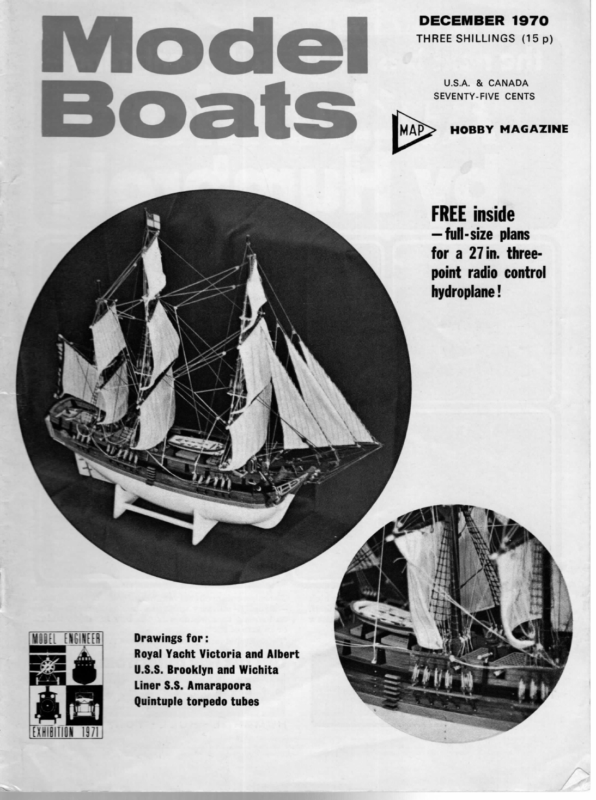
- 1970 Model Maker Trophy Twenty-two Marbleheads from fourteen clubs make a day of it at Hove Lagoon on 11th October
- ‘‘Lateral Control’’ J. D’Oyly Wright (remember his remarkable sailing conversions of plastic clipper kits?) discusses the effects of various keel appendages on the performance of scale sailing models.
- RACING MODEL YACHT CONSTRUCTION IN PART SEVEN OF THIS SERIES C. GRIFFIN TALKS ABOUT ONE METHOD OF CASTING KEELS

DECEMBER 1970 THREE SHILLINGS (15 p) U.S.A. & CANADA SEVENTY-FIVE CENTS HOBBY MAGAZINE FREE inside — full-size plans for a 27in. threepoint radio control hydroplane! MOREL ENGINEER 2 Drawings for: Royal Yacht Victoria and Albert U.S.S. Brooklyn and Wichita Liner $.S. Amarapoora Quintuple torpedo tubes
MODEL BOATS 1970 Model Maker Trophy Twenty-two Marbieheads from fourteen clubs make a day of it at Hove Lagoon on 11th October Po the first time in its history, the 1970 Model Maker Trophy resulted in a triple tie for first place, and the sail-off took place with the aid of car headlamps directed across the lake so that competitors and officials could see what was going on! Organised by the Hove and Brighton club, entries were limited to two per club, which produced 22 boats from 14 clubs. Despite the late date of 11th October the day was excellent, mostly overcast but with occasional hazy sunshine and a spatter of raindrops early in the day which didn’t really wet the ground. The wind obliged by starting off light easterly and swinging about a little before settling at around 8-10 m.p.h.; its strength and direction varied throughout the day, to keep competitors on their toes and give them the chance of airing all their sails from light weather to third suits. Most stayed in working rig or second suits, but there were times when some must have wished they’d changed. The variations also caught skippers out on trims at times, so that some heats required three or four pairs to resail. O.0.D. Fred Shepherd wisely decided to sail in two divisions, taking the top three of each for a six-boat final. This meant eleven heats, and by declaring in advance an 8.45 a.m. start, it was hoped to get through these by 4 p.m. In fact they finished at 4.10, apart from two or three essential resails to sort out the top six; unfortunately the results of some of these resails made further ones necessary so that it was past 5 p.m. by the time it was sorted out. Many of the skippers with journeys to make reluctantly departed, leaving the six finalists to battle it out. In the main race, by heat 5 it began to look as though Harebell, March Hare, Black Rabbit, Sweet Sixteen and Jester would be five of the top six, but Harebe/l began to slip a little after lunch while Lizanne came up fast. A sudden wind change in heat 4 runs had several boats broaching, and a gust in heat 8 tore Black Rabbit’s spinnaker right out, though his opponent broached and let him through. In this heat March Hare made a spectacular run, and by the following heat was established in the lead, which was clinched by wins both ways in the two remaining heats. Force 13 had meanwhile worked up, mainly on beats, while Harebell, with one bye, could only make 4 in the last 4 heats. March Hare finished on 40, with one run not resailed, having dropped only 8 (10 heats and one bye) with Black Rabbit, Lizanne, and Sweet Sixteen certain finalists, but several resails required to sort out which of Jester, Force 13, Peardrop and Harebell would join them. Eventually, with the light already beginning to fade, but the wind still around the 8 m.p.h. mark with stronger spells gusting to 15-18 m.p.h., the six finalists were away. Sweet Sixteen picked up 5 in the first heat, but they were the last she was to score. March Hare also collected 5, won the next two beats, then another 5, and wanted only Top, winning boat Lizanne (nearer camera) sailing secondplacer Force 13. Centre, Black Rabbit takes on Force 13, which has gone down a suit compared with previous photo. Bottom, Sweet Sixteen, near camera, and Jester. Light was pretty far gone even when these pictures were taken — for those interested, 1/25 sec. at F4 on HP3 jilm. 502
=e” DECEMBER 1970 Tail-enders Odin and Suzantu enjoyed their day and gained valuable ex- perience. There was some chaffing at Odin’s sails, which had 1671 on one side and 1761 on the other, but Harry Briggs explained that it was very late at night when he finished them. Right, Jester’s sails were a little confusing, too, but boat was well handled _ for someone on his first trip away from home waters. Design is Stable Mabel, an unpublished Witty development of Golden Archer. second leg, to be picked up by car headlights almost neck and neck as they were turned for the last tack. Barely a boat’s length separated them as Lizanne reached the line, a finish typical of many close ones all day. Sixteen of the boats were glass-fibre, and twenty had bulb keels. The winner was the only skipper-designed boat, a diagonal veneered hull with conventional bow and mid sections developing into a very hard-bilged afterbody. This appeared to suit the running conditions, since she 1 point from the last heat to have a clear win. As these things go, the boat lost both ways, leaving a tie with Lizanne (who had won only two beats, but all runs) and a possible three-way tie if Force 13 made three from two resails, a beat and a run, which now had to be sailed despite the onrush of darkness. If Force 13 collected 5, he would win, but the resailed run went to Jester, extremely well sailed all day by A. Webb, who was participating in his first-ever race away from his home water. It was now fully dark and sailing had been going on for lost only three runs all day. Top MM design prize went to George Blake’s Witty designed Typhoon and award for furthest travelled entrant to Harry Briggs from Cleethorpes. The whole day was outstanding for keen sailing and high spirits; mistakes were made but no-one was needled, and there were some useful officials if advice was needed — besides the O.O.D., his assistant Roger Stollery umpired with Clive Colsell, while Mike Martin was starter and Frank Jennings scored. The ladies did their yeoman work with refreshments to complete a thoroughly enjoyable meeting. more than 10 hours; the three tied skippers agreed on one three-boat beat, the first home to win, tossing for berth. The boats arrived at the end of the first leg in a tight bunch, and the leeward one, March Hare, was first alongside, leaving the skipper Roger Cole, in a very difficult position. He elected to turn, missed Lizanne, but just failed to clear the stern of the weather boat, Force 13. It was bad luck on Roger, who philosophically accepted the inevitable disqualification. The other two boats disappeared into the night on their Posn. 1 2 3 4 5 6 7 8 9 10 11 13 14 16 18 19 20 21 22 Yacht No. Skipper Club Designer Lizanne Force 13 1711 1741 R. Seager G. Clark Clapham S.L.M.Y.C, Seager Witty March Hare Black Rabbit Jester Sweet Sixteen Peardrop Harebell Metis White Knight Gretel Il Superwasp Hector Ooloo Blue Streak Valhalla Blue Marlin Procella Skippy Thor Odin Suzantu 1536 1736 1714 1692 1659 1674 1733 1598 1713 1659 R. Cole C. Edmondson A. Webb G. Austin P. Dunkling D. Daly F. Cooper M. Godfrey E. Sinar J. Slatter 1658 1710 1629 1609 1717 1725 1671 1712 R. Newman G. Dunkling 1677 1709 E. Hunt C. Daniels |. Davies H. Day R. Griffin A. Farnsworth H. Briggs J. Gilmour Portsmouth Soton Birmingham Guildford MYSA Hove and Brighton Forest Gate Guildford Bournville Danson Hove and Brighton Southgate Birmingham MYSA Portsmouth S.L.M.Y.C. Danson Birmingham Cleethorpes Clapham Not all resails were taken. 503 Stollery Shepherd Witty Stollery Stollery Stollery Witty Stollery Harris Witty Stollery Stollery Witty Stollery Stollery Witty Witty Harris Witty Stollery Design Typhoon March Hare Black Rabbit Stable Mable Sweet Sixteen Mad Hatter March Hare Skippy White Rabbit Super Wasp Hector March Hare Points 36 34 40 38 35 35 33 32 29 25 23 23 22 21 Typhoon March Hare White Rabbit Typhoon 21 17 Skippy 14 13 Typhoon Mad Hatter 10 7 17 15 16 16 16 15 7 5
MODEL BOATS ‘‘Lateral Control’’ SPEED J. D’Oyly Wright (remember his remarkable sailing conversions of plastic clipper kits?) discusses the effects of various keel appendages on the performance of scale sailing models. FIG. \ DISTANCE E is easy enough to make a model of a ship, but to make it sail, and have a performance equal to that of the original, many obstacles have to be overcome. This is especially true when sailing scale models that are subject has found a wide-spread opinion that a deep keel can cause heeling. Having simultaneously two similar models with different depths of keel but requiring the same ballast, he can say that this is not so, and suggests that this opinion is based on dinghy sailing with a drop keel, where to grossly over-scale and disproportionate forces, yet quite often the owner expects his model, which has no broaching in a squall or strong wind can lead to capsizing. crew, to behave in a better fashion than the original, and to succeed in this aim he frequently employs a false keel. In fact to many owners the only function of such a keel is to obtain a desired stability, an idea that is far from true. Showing the difference in the position of ballast between a dinghy and that of a model This article sets out to show that a false keel should not only be regarded as an undesirable but necessary evil purely for the purpose of attaching a weight to obtain stability, but should be considered as an integral part of the model, since the false keel has characteristics of its own that can be used to alter the behaviour of the model in a desired manner, and it may also affect the speed. While it is not the intention to discuss either speed or stability, it should be mentioned in passing that if two similar models are sailed together, one having a shallow keel and the other a deep keel, then the latter will appear relatively slower, because the one with the deep keel is less sensitive to changes of wind velocity. Thus the one with the shallow keel will give a quick ‘heeling’ motion and rapidly increase the distance between the models while the deeper keeled one gives no such motion and only increases speed slowly, so that in a constant wind the distance between the two models at first increases rapidly but then more slowly as the deeper keeled model gradually works up speed, until after a period of time both models are running at their maximum speeds and maintaining a constant distance apart. Thus, bearing in mind that the wind direction and velocity are never constant, the behaviour that has been described is repeated several times on a run, giving the impression that the deeper keeled model is slower. Hence, the term ‘relatively slower’ b Ballast ( crew ) of a dinghy Ballast of a model Sketch 1A shows that as the wind tends to drive the boat sideways, the keel, because of the opposing water pressure, acts as a lever. Sketch 1B shows the vital difference between a lifesize dinghy and a model; in example A the keel is acting as a lever of the first order while in B (in the case of a model) it is of the third order with the attendant mechanical disadvantage. The strutted keel (Fig. 2 e) has very little advantage over any other type of keel, though there is a very minute gain in speed on account of the aperture, and there is less side pressure of water so that there may be a slight increase in stability. is used rather than ‘slower’ which might give the im- pression that a deeper keeled model is incapable of obtaining the speed of the shallower. If it were possible to plot the respective speed against distance, no doubt the resultant graph would be as in Fig. 1. For the purpose of this article a false keel is defined as the extension of the model’s keel, being in the same vertical plane and attached by various means to the hull. Usually there is some form of rudder fastened to its trailing edge; its shape, size and position can vary con- Lateral Control The phenomenon that is to be discussed was first observed by the author when carrying out comparative trials between two models, one with a bar keel and the other with a strutted keel. Both models were fitted with a similar rudder, but to make them both go to windward the one with the strutted keel had to be used in the opposite direction to the other. Since the only basic difference between the keels was that the strutted keel was a bar keel with the centre portion removed, it was decided to investigate this behaviour by dividing the removed section into two lengths and replacing the one-third siderably (Fig. 2). Quite often the keel is extended beyond the stern post of the model, its purpose being to prevent ‘luffing’ (swinging round into the wind and the sail being taken aback); this type of keel is shown in figure 2 a, b and c, by dotted lines, and it is suggested that in such cases its descriptive name should be given the prefix of ‘stabilized’. The author | 3 —_ T s 2 ASYMMETRIC AL SS ) \ az ee KEELS C Y———— ki Nes fom it may x3 BAR KEEL D SS FIG. 2 SYMMETRICAL KEEL —— E STRUTTED > KEEL + sector in alternative positions A, B and C (Fig. 3). With the sails trimmed for beating and the rudder set in a central position, the following results were obtained. Position of sector A Ran down wind only B Reached only (i.e. 90° course to the wind) & Luffed 506
DECEMBER 1970 3 | FORCE POSITIVE | ot am Bs i T T “ POSITION | TT TT T \ 1 T \ DIA, 4 a) Tj Sa Yoed a BS ap ty eee) 0 | it A 1 HELM Te ee el Obviously what was happening was that the distance between the Centre of Effort (C.E.) and the Centre of Lateral Resistance (C.L.R.) was altering and in fact the C.L.R. was moving from behind to in front of the C.E. These two points are shown in a modern fore and aft craft OF CENTRE OF 2/3 SECTOR force (water against rudder) had to be used; note that at position two, where the L.E.C. is cutting the axis, the rudder angle is zero also the centre of the sector is in the same vertical plane as the model’s C.L.R. From this point the rudder starts to oppose the force of the luffing action and so prevents the model from luffing. It should also be noted that on the right-hand side that rudder angles have been arbitrarily converted to a ‘Force’ and in further discussions it will be convenient to divide the luffing force into two sections, negative and positive, and in future diagrams to show only ‘Force’. FORCE A | B | Cc oi J +9 CLR POS YAS ae (Sketch 2). It was next decided to achieve a better understanding of what was happening and if possible relate this to an arrangement that could lead to better control by repeating the trial, but this time using the rudder to sail the model to windward until the weather leaches of the sail were trembling (but without being aback) and then note the rudder angles. sant i 3s fal ‘| — I—-4 3S Table One (One Third Sector) Position of Sector Rudder angle Helm (1) A 9° Down (2) B 2° Down (3) Half-way between B and C in Up (4) C 4° -I— NEG BIN? The expression of “helm up’ (or down)is used to indicate which side the rudder was. The helm, or tiller, as it is now more commonly called, is swung across the deck (and the rudder being on the other side of the pintles is diametrically opposite). So ‘helm down’ means that the helm is moved to the leeward side and the rudder’s effect is to steer into the wind. Table Two Position of Sector (1) (2) (3) AandB Central BandC (Two Thirds Sector) Rudder angle 2r 0° 8° T | \ Up Helm Down Central Up 2 POSITION OF CENTRE T a, 3 4 OF |/3 SECTOR Diagram 2 shows the L.E.C. of the 1/3rd sector; the value of these diagrams is that the position of the sector’s centre can be shown against the resultant luffing force. Notes taken at the time show that when the sector’s centre is in a position that results in the L.E.C. cutting the axis, it also results in the rudder achieving its maximum efficiency, insomuch that any alteration of course needs the minimum alteration of rudder angle, and any course in relation to the wind’s direction could be achieved (subject to the limitation of the rig). Hitherto this had not been possible with any degree of accuracy using previous (Continued on page 513) measured. FORCE Up As all these trials were done in the same wind velocity it may be postulated that some (if not all) models (and some full-size versions) have an inherent luffing action, the force of which increases as the C.L.R. is moved forward. If the rudder angles are taken as a measurement of this force, then the effect can be plotted against the position of the sector’s centre. Diagram | is plotted from table two, showing a curve that the author will refer to as the Luffing Effect Curve (L.E.C.). In position 1 the luffing action had not sufficient force to send the model into wind so that an additional 507 xg Dh: Helm Down 2/3 Sector ots LLELLLL Bar keel Rudder angle 9° V3 ‘ Strutted keel +9 ao] Table Three Pico Re ma In addition the angles for a bar and strutted keel were DIA. 3 Sector
MODEL BOATS RACING MODEL YACHT CONSTRUCTION sy EFORE describing the method of construction it would be advantageous to give an explanation of the function and importance of the keel, with particular reference to the bulb keel. Hull stability, in a model yacht, is governed by the depth of the centre of gravity of the keel below the centre of buoyancy and the weight of the keel. A model yacht cannot be too stable therefore it follows that the maximum proportion of the ‘all-up’ weight should be concentrated in the keel. Also, to achieve greater stability the centre of gravity should be as near the maximum depth as is possible. The latter point illustrates why the bulb type keel has superseded the fintype keel in modern racing yacht construction. Furthermore, the position of the C.G. of the keel will affect the fore and aft trim of the yacht in that the C.G. always adopts a position in a perpendicular line below the centre of buoyancy when the yacht is floating. If the C.G. is further forward than the designed position the yacht will trim bows down and vice versa. From the foregoing it will be apparent that the keel has to be compact and accurate in weight and in the position of the C.G. Compactness is achieved by using a metal of high specific gravity; Platinum (21.5), Gold (19.3) and Lead (11.4) would all be ideal for the purpose but for economic reasons the latter is the metal commonly used. Other factors which influence the use of lead is that firstly it has a high resistance to attack by water and secondly it is easily worked. Accuracy of weight and shape is satisfied by the construction method used and, whilst it is possible to machine a lead bulb from solid, in the majority of cases the bulb is moulded. The principle involved in moulding is extremely simple. It consists of making an impression or cavity in sand or plaster by means of a pattern and pouring molten metal into the cavity. After solidification the metal assumes the shape of the pattern. Two methods of moulding will be described, each using a different pattern and medium. Method 1. Using ‘plaster of paris’ and a one-piece pattern Divide the plan of the bulb keel into 1 in. spacings, also drop a perpendicular through the designed centre of gravity as shown in fig. 46. Trace these lines together with the outline of the bulb and transfer onto hard wood, preferably mahogany, of the same thickness as the fin. Cut to shape, leaving sufficient wood at either end to enable the pattern to be turned between centres, either in a lathe or in the wood turning attachment of an electric <6 IN PART SEVEN OF THIS SERIES C. GRIFFIN TALKS ABOUT ONE METHOD OF CASTING KEELS ee r— | o— drill, see fig. 47. Glue an equal number of hard wood laminations on either side of this central piece. Ensure that the total thickness is in excess of the greatest diameter of the bulb keel, see fig. 48. Turn the rough pattern between centres to the designed shape, checking the diameter at various marked stations. A profile template will test the final shape. Smooth the surface of the pattern, ct