- In the Tideway
- CHALLENGE John Lewis looks at ‘A’ Class trends and introduces a new medium weight, medium size design
- METROPOLITAN AND SOUTHERN DISTRICT M CLASS TEAM RACE, 18th APRIL
- Racing Model Yacht Construction In Part 13, C. R. Griffin describes ‘the other type’ of vane steering gear, with acknowledgements to
- F. R. Shepherd
- TEST BENCH

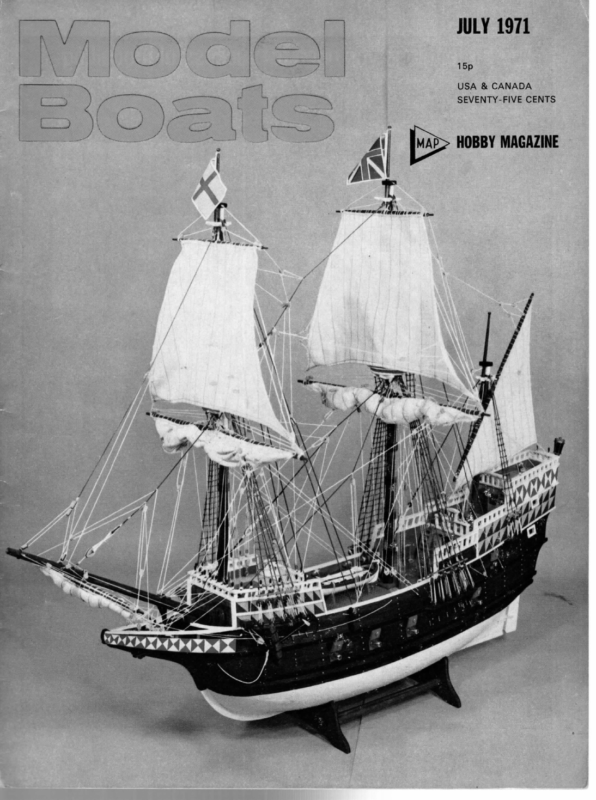
| JULY 1971 15p USA & CANADA Aa SEVENTY-FIVE CENTS HOBBY MAGAZINE EEE es cy
JULY ORGIVE us for returning to the subject of R/C yachting, but never a week goes by without we hear from someone interested in having a go but at a loss to know what to build. One point which has a bearing on this comes in a letter from Roderick Carr, Secretary/ Treasurer of the American Model Yacht Association, which came into being last June and has at least 40 official R/C sailing regattas listed during this season, most of which will, from what we can deduce, draw from 15 to 40 entrants. The AMYA seems to be far-sighted in many respects, and obviously is already thinking’ internationally. Keen interest in possible future the British moves is evident; Rod says that any help they can give will be gladly forthcoming, but, in effect, they don’t want to poke their noses in. However, they hope that our people will include in any promotion R/C sailing with A, 10R, and M boats, the latter two of which have rewarded AMYA efforts with great success. Incidentally, he says Tideway that they are now working on the A’s with two com- puter programmes in use for design work; it will be interesting to see what the computers produce. Fascinating, in fact! The feeling is that these three classes provide the best bases for eventual international competition. Since the 10R and M are the most popular R/C classes in Europe, and the Q class in this country is more or less the A, this could well be so, and it would seem that someone interested in building a new R/C yacht should consider the 10R or the M. The 10 certainly has the grace associated rules which were made known to all competitors well in advance of the entry date. with yachts; the M is more of a machine, but has the advantage of reasonable portability at 50 in. length, For years the junior American class, the 36/600, has Model Maker Trophy The Model Maker Trophy, seen above on its modified base (a second row of shields has been added for win- languished, but one recent R/C model to the rule is a close-to-scale Soling, 36 in. long and modified to have 600 sq. in. of sail and a different fin. It makes a handsome little boat and could prove extremely popular, since ners’ names) will be sailed for at the Harwich and Dovercourt club water on September 18/19 (Saturday afternoon it has the looks and size most beginners seek. We believe that a smallish and attractive boat is likely to start off a lot of people who will graduate to larger models once they’ve tried competitive sailing. 1971 and all day Sunday). Entries (there is no entry fee) should be sent off as soon as possible to the Harwich & Dovercourt D.M.Y.C. secretary, Mrs. I. Cullingford, 19 Canning Street, Bathside, Roman Barge Devotees of ancient ship types will be interested to hear that the Science Museum, South Kensington, currently has a special display centred round the 2nd Century Roman Barge excavated at Blackfriars in 1962. As one of the earliest skeleton-built vessels known (i.e. planking attached to pre-erected frame) the boat is of particular interest; previously this form of construction was thought to have originated in the 14th Century. The exhibition includes photographs, a model of the remains as found, timber, nails and articles from the site (on loan from the Guildhall Museum) plus models and photos of other ships from Viking to 19th Century examples which demonstrate the importance of this find. On show in Gallery 50, on the second floor. New Rules: With reference to our note of last month concerning the uncertainty regarding the amendments to the ‘M’ class rules, we now have the authority of the Chairman of the M.Y.A., Frank Jennings, for stating the present position. The facts are that the 1970 A.G.M. took two decisions regarding the rules. The first was to amend the ‘M’ class rating rule by deleting Rules 1(b) ii, 1(b) x and l(c) relating respectively to Metal Fin Keels, Prognathous Keels and Garboards, by imposing a maximum height of rig of 85 inches, by limiting the number of alternative rigs to three and by changing the method of determining the height of the spinnaker hoist, all to have immediate effect for all M.Y.A. events. The second decision made was to submit these changes as proposals to the I.M.Y.R.U. with a view to having them adopted internationally. There should have been no uncertainty at the ‘M’ class Team Championship, which was an M.Y.A. event and therefore governed by the rules of the Association. The I.M.Y.R.U. will meet at Fleetwood in August and there is no doubt that a decision will be taken on the M.Y.A. proposals. In the meantime the ‘M’ class Championship will have taken place at Gosport under M.Y.A. open to all Marblehead Harwich, Essex. The race is owners who have not won a National Championship: last year entry was limited to two boats per club, but the Dovercourt club has so far placed no restriction on entry. The 1970 event was memia and we hope that this year’s will prove as enjoy- able. Club Notes: New chairman and secretary of the Y.M. 6m. O.A. are, respectively, R. S. Hawgood, 1 Crescent Wood Road, Sydenham Hill, London S.E.26, and G. W. Clark, 30 : ; Carston Close, Lee, London S.E.12. Secretary of the Bournville M.Y.P.B.C., Mike Harris, has a new address, 1609 Stratford Road, Hall Green, Birmingham 28. : Secretary of Eastbourne M.P.B.C. is now N. J. Kemp, 9 Windmill Road, Polegate, Sussex. International meeting in Hungary for R/C yachts (F2DM; F5-D10, and F5-DX) is scheduled for July 23-25. Budapesti Tanacs, Modellezo Details from M.T.S. Szakszovetseg, Budapest, Hungary, XIII Dagaly u. 11/a. Three Irish clubs, Belfast, Cork and Dublin, are active and though widely separated maintain regular and friendly communications and activities. Interest is mostly competition type power boating but with some scale, and Dublin at least are dabbling with R/C yachts, Starlet being a popular choice. Irish lone hands might like to get in touch with Dublin R.B.C. secretary, Paul C. Foal, 48 Warrenhouse Road, Baldoyle, Co. Dublin, for further : information. Hove Ship Model (Sailing) Society will hold their annual rally of model sailing ships at Hove Lagoon on Sunday, July 4th, open to owners of any sailing models other than functional racing yachts, Course sailing com- petitions will be held for various classes. R. J. Wyatt, Holly Cottage, Fisherwick, Whittington, nr. Lichfield, Staffs., would like to contact people in the area interested in building and racing Q or any other radiocontrolled yacht class. Write (or ring Whittington 757) and Mr. Wyatt will arrange a meeting of interested parties. 265 Se —
MODEL BOATS maximum premium is put on the ability of the skipper. Summing up, one comes to the conclusion that a normal 58 in. LWL 67 lb. type with no unusual fea- CHALLENGE tures John Lewis looks at ‘A’ Class is fully competitive ranging over all wind strengths. The 54 in. LWL 54 lb. type is similarly rated but with a very slight overall advantage due to better performance downwind in strong wind conditions, when it will plane more readily. It does suffer trends and introduces a new medium weight, medium size design [HERE is a concern that the growth in size of the International A class model yacht which has taken place over the past years will discourage people from building due to the sheer weight and consequent physical requirement necessary to handle them. There is also emerging a conflict of opinion between the advocates of the heavyweights and lightweights regarding performance of the two types, but then argument is in itself no bad thing. Having to accept responsibility for designing some heavyweights, I thought it time for me to take stock and just see where I stand rather than to go on designing bigger boats on the simple and attractive basis that ‘a good big ‘un will always beat a good little “un’. I have therefore attempted to carry out an evaluation of various designs by using a points system designed to relate the various qualities which particular designs may have. Eight designs were chosen, each one of which was a good representative of its type, and they covered the range from 54 in. LWL and 40 Ib. displacement at the one end through to 60 in. LWL and 78 lb. displacement at the other. An allowance of up to 6 points was given for windward performance in each of the wind strength categories light, medium, strong and very strong, and up to 4 points for the same wind strengths off the wind. This made some provision for the premium put on windward performance in our system of race scoring. It is interesting to reflect whether or not designers had been putting too much emphasis on windward ability in the past and have sacrificed too much downwind. For example, there is not much point in screwing a boat up to windward in order to cross the finishing line close to the windward flag when a boat with sheets slightly eased will travel faster and can still complete the course in the same number of tacks and cross the line close to the leeward flag. The boat sailing freer might well be the winner, so how much better will the boat be that has been designed with the emphasis on downwind performance? It is probable that the answer is not the same for pools of different length/width ratios where the narrow, long pool would put a greater premium on good windward performance. Returning to the evaluation, it would be tempting to publish the actual table of points that I produced but this would be too controversial as it would mean disclosing certain designs or boats in a way which would not necessarily please the owners. However, I can assure you that I was as coldly objective as I could possibly be and did not allow personal bias to influence the scoring in as far as it is humanly possible. What did please me was the fact that several years’ results in practice do correlate with the findings and once again it illustrated the wonderful way in which boats of quite different characteristics can compete evenly over a week’s racing in such a way that the 276 somewhat in light winds in both windward and downwind directions. There are designs in the 57 in. LWL 67 lb. displacement bracket which show little virtue except in strong winds downwind, but they could be drastically improved by improved ballast ratio and/or lowering of the centre of gravity of the lead. It is probable that this feature of A boat design has not recieved enough attention in the past, generally speaking. The big heavyweight type which is so impressive in many ways does not rate as well as one might like in that she is showing advantages over others only in strong to very strong winds to windward. On all conditions downwind she is vulnerable to being beaten by the two types mentioned above. It is remarkable how well these boats will go in light airs and they probably are best suited to the skipper who is fit and has a particular interest or ability to extract maximum performance in light winds. I also considered the 56 in. LWL minimum displacement type, dimensions to which I had not previously designed, and found that this rated equal in total terms to the first two mentioned but in particular it has the advantage over both of them in strong winds to windward, though may be slightly inferior in light winds. Therefore, at this stage, I would say that it is the best choice today providing the ballast ratio is good and it has a low centre of _ CHALLENGETM Geugnes by J. Lewis Copyright of The Model Maker Plans Service 13-35 Bridge Stieet, Hene! Hempstead. Herts. p LNTEPNATIONA. A LW Loa —— — SCALE HALF “CHALLENGE” (SALT WATER) 3 740 DISPLACEMENT WL sam CLASS 56-0″ 57 82 — 140° FULL SIZE POUNDS LEAD WEIGHT 4427 POUNDS Draught Sail A Displace Full-size the ‘Chat below as ref. i price 65% tr Model TM Se 13-35 Bre Hemel # Ha (Note: @ half sez fin sail (full ple Ss
JULY 56.0 in. 74.0 in. am 14.0 in. 12.6 in. a4 sq. in. ent 57.82 Ib. sopies of mge’ plan available f 1113, post free m ker Plans nce, se Street, mpstead, ts. lines are = except sze) and (quarter =) gravity to the lead. I have therefore chosen these dimensions for my new design which appears with this article. It fits in nicely with the desire in many quarters to inhibit the physical size of these models and at 58 Ib. she should not be beyond the limits of a normally physically fit middle-aged man, although he may, I hope, have some difficulty in keeping up with it in strong winds when planing with spinnaker. Just to complete the exercise I looked at the 54 in. LWL 40 lb. type which therefore carries a large displacement penalty and a sail area in the region of 1,240 sq. in. This type rates surprisingly well as in overall terms it was a close runner-up to the best, only suffering from lack of sail area in light winds both to windward and downwind. If, however, great care is taken over wetted surface and low centre of gravity in the design and superlative sails are provided and the skipper has a flair for sailing under light conditions, it could prove to be very competitive. In fact, my next design will be one of this type. I hope my ‘heavyweight’ friends will not be too dismayed by these comments but I must emphasise that my analysis also showed what a wonderful rule the A class rule is as the differences between the type of design is so slight overall that they can be completely offset by variations in building standards, quality of fittings and sails and, above all, the ability of the skipper and his mate. I am pleased though that my findings indicate that the lighter types have their place, but there is room for all, and for the time being I am proposing to see if I can try and help to improve the breed at the lighter end of the range. If there is some worthwhile development in sails or the method of getting driving force out of them, then the emphasis may shift back to the longer LWLs and heavier displacements. 1971 The new design Challenge which appears with this article represents a compromise in dimensions which I have not previously used, but it does enable me to retain some design features which I like but cannot use in the bigger, longer waterline A boats. For example, I do like midship sections of the U type rather than the deep V, but they produce a type which is a bit slow in light air and therefore must not be short of sail area. This is due to higher wetted surface and in the form of the hull shape itself. Now one can design a U sectioned A boat at any waterline length up to 57 in. LWL at the minimum displacement allowed without penalty and without losing too much sail area. Beyond that length, if you retain minimum displacement the sail area falls below 1,500 sq. inches and this would seem to be too small for the wetted surface involved in that sized hull. If you increase the displacement above the minimum in order to get some extra sail area, you lose the advantages of the type as the hull has either to be too deep or too beamy to retain the ideal combination of narrowness, stability and shallow buttock lines which is otherwise possible. Therefore, I suggest that above 57 in. LWL a deep V hull is the only reasonable type to go for, and one concentrates on obtaining a good sail area/wetted surface ratio. This is one of the reasons, of course, why big heavy boats go as well as they do in light winds. Below 57 in. LWL one can choose between the two forms and everyone will have his own opinion, but I would suggest that the U form is desirable from 57 in. to 55 in. LWL and essential from 55 in. to 54 in. I cannot believe that any type of A class will be competitive below 54 in. LWL, but I expect and hope that someone will try to prove me wrong. Having decided to design a U sectioned type, one can see that several other factors are automatically SCALE “4 FULL SIZE SAIL PLAN MM
MODEL BOATS decided, i.e. the displacement must be close to the minimum allowed by the rule and the sail area should be on the top side of 1,500 square inches. This means that the LWL of 56 in. is thereby determined and we know that boats of this approximate length are fully competitive. I have already mentioned the importance of ballast ratio and low centre of gravity and if the new boat is going to compete with bigger, heavier boats, then it needs to have a better ballast ratio and lower C.G. of lead than they have. This is not possible, or should not be possible, but the big boats do have one disadvantage in that as the design must have small wetted surface, the fin keels tend to be without trace of bulb in section and this squeezes the lead line higher. With the new design we can put in a fatter keel with a profile which keeps the lead C of G quite low, but, of course, not as low as a true fin and bulb type. Both in model and full scale yacht design recently there has been a tendency to give the canoe body a sharper entry than that thought desirable a few years ago. There has certainly been an improvement in speed off the wind and probably to windward, too, in certain conditions of wind and waves. The new design, therefore, has this characteristic but not taken to any extreme. There is an added advantage in that the centre of buoyancy will move aft somewhat and enable the ballast keel to be also shifted back. This, in turn, enables the whole sail plan to come aft, which has the effect of further improving off the wind performance. It will be noticed that there is a considerable fairing between the after edge of the root of the fin keel and the skeg. This is an approach to the ‘bustle’ which is so popular in full scale design today. This fairing has several advantages in that, firstly, it packs away a bit of displacement which otherwise would have to be accommodated in the midship section. This reduces the area of midship section in relation to total displacement and raises the prismatic coefficient, which has a direct bearing on the speed potential of the hull. The centre of buoyancy is moved slightly aft, with advantages already described. It also has the effect of moving the stern wave further aft and thus lengthening the distance between the crest of the bow wave and stern waves. This, too, improves the speed potential of the hull and is particularly noticeable when running downwind. It is noticeable in a design without this fairing that «a considerable cross flow of water takes place from the lee side to the windward side of the hull when travelling well heeled to windward. In some boats the turbulence carried is very marked and cannot be doing anything to enhance speed. The fairing smooths out the cross flow and a much cleaner wake ensues. There should also be an improvement in the flow characteristics across the skeg and rudder, but this is difficult to evaluate. – Lastly, the side area of the fairing has the effect of moving the centre of lateral resistance further aft. and, as this centre is related to the centre of effort of the sails, this means that the sail plan can be brought further aft. As previously mentioned, this also improves off the wind performance. The overhangs of the hull have been kept as short as I feel reasonable, particularly at the bow. With the rather fine bow sections due to the sharper entry in the waterline, it is not practicable to reduce the bow overhang by too much, otherwise we will have nose diving tendencies. The hull balance has been carefully checked and when well heeled the movement of the centre of buoyancy is negligible. This should make a boat that is easy to sail and with the long skeg fairing she should be directionally stable but at the same time not difficult to guy. The sail plan is unexceptional in that there is adequate total area, a largish jib, and a mainsail of decent aspect ratio. It is probably not unreasonable to comment that an A boat with more sail area is unlikely to be com- petitive because in order to get the extra area either displacement will have to be increased or LWL reduced. In either event, the balance of performance under a wide range of conditions will be affected to the general detriment of the yacht’s overall capability. I hope this new design strikes a balance which will enable a good skipper to bring it into the prize lists under any weather conditions with monotonous regularity. In writing this article I have convinced myself that the design is good.and I hope that I have convinced you, too! Finally, an apology to the purists who believe that yacht drawings should always have the bow facing to the right. It is intended that both sides of this boat shall be similar and there is no steering oar over the starboard side, so I have done the drawing in the way which comes naturally. METROPOLITAN AND SOUTHERN DISTRICT M CLASS TEAM RACE, 18th APRIL HE weather conditions for this race were excellent. A steady westerly breeze blew all day giving a tack and tack beat in top or second suit and a fast run with the wind a little bit on the quarter. Five teams of two boats were entered, Clapham (the holders for two years), Hove, Southgate, Danson and Guildford. At lunch Clapham, Hove and Guildford appeared to have drawn away from the others and it was certain that the winner would be from these three, since there were only three heats out of the eight left to be sailed. In these last heats Alex Austin and Roger Stollery fared the best. dropping only four points of the 30 and so won the championship with 65, 10 points clear of Clapham, Desmond with Hove’s Daly third with 47. and Danson 5th. Clive Colsell and Southgate were 4th The best individual performance of the day was 278 that of young Alex Austin who aided by Roger Cole lost only 5 points all day. Alex, who is only 14, has not only won all the Guildford club races this season, but also put up the fourth highest score in the National Team Championship at Easter. Bill Dicks, the O.0.D., and the Clapham club ran the race very well and the hospitable atmosphere was enjoyed by all. Desmond Daly’s Hipster was the newest boat sailing and is a very commendable first design by Desmond, displacing 16 lb. on a 10 in. beam. The average displacement of the fleet was about 17 lb. and the average beam about 10 in., and all but two boats were to different designs. It is interesting to note that the oldest design (the five-year-old March Hare) got the highest points, showing once again that the development in the M class is nowhere near as great as it is made out to be.
re oo! a MODEL Racing Model Yacht Construction In Part 13, C. R. Griffin describes ‘the other type’ of vane steering gear, with acknowledgements to F. R. Shepherd e NHE BREAK-BACK VANE GEAR. This type of vane gear is currently in use in preference to the moving carriage vane gear. A random’ survey has shown that there are as many variations of this type of vane gear as there are skippers; however, the operating principles are constant, and it is only in the details that the variations occur. The vane gear shown in fig. 92 conforms to the main principles. Item No. Description 1 Pivot block Material Remarks Tufnol 3” or 7%” The block can be made in one part 3” thick or in two parts each 7” thick and secured by 8 BA bolts 2 Pivot pins Stainless steel, }” diameter Retaining collars are silver soldered 3 Spindle Brass, dimensions as shown Machine for greater accuracy 4 Pintle plate Stainless steel, 4” dia. for pintle. Base plate, brass Machined to dimensions shown 18 or 20 gauge stainless steel for Care must be taken to ensure that the steel wire forslider. Balance weight as the centre line of the arm base Balance weight arm & weight balance arm, 16 gauge S. 18 or 20 gauge S. steel for the quadrant. 10 gauge S. steel wire for feather strap Check that the actuating pin of the balance weight arm works freely in the slot 20 gauge S. steel Calibrate the dial in 10° intervals 8 Tiller arm 18 gauge S. steel The arm shown is suitable for use with a raked rudder. An upriaht rudder needs only a screwed collar 9 Linkage pin 10 Spacing washers Gyeing Pointer #” S. steel, brass nuts 7,’ dia. brass General notes. Whether the pivot block is cut from 3 ¢ in. thick Tufnol or made from two pieces of 3/16 in. thick Tufnol, for accuracy of bore and as an aid to more efficient operation, ream the pivot pin holes to ~ in. int. dia. Ensure that both the pivot pin and the spindle holes are parallel and on the centre line of the block. Drill a 3/16 in. hole to take the friction pin, note that there is a cutaway portion to the pin to grip the spindle. Do not make this cutaway portion too neat a fit, otherwise it is difficult to position the pivot block on the spindle. Ream the bore of the spindle to ¢ in. int. dia. and lap the pintle into the spindle, using metal polish. The final fit should be such as to allow the spindle to rotate freely without having any side play what- tive. The feather arm quadrant bracket can be either formed from a single piece of 20 gauge stainless steel sheet or formed in two parts subsequently riveted and/or silver soldered together. The 10 gauge stainless steel wire feather strap is best shaped by bending it about an aluminium former. Note that the vane feather is reinforced by two strips of + in. thick balsa in the area shown; this provides a degree of strengthening to the weak point of the feather, i.e. the horizontal plane just above the feather strap. 4 BA P.t.f.e. or Tufnol arm 4” thick balsa pin A detachable pintle pin is shown, which has the twofold advantage of being easily removed, preventing damage in transit, and avoiding slackening of the deck fixing screws due to frequent removal. If this feature is not desired, make the base plate pillar slightly longer to compensate for the reduced thickness of the base plate. Stainless steel is the only acceptable material for the pintle pin itself; however, the base plate may be made from brass, if necessary. To produce a more accurate alignment of the pintle and base plate, especially where machining facilities are available, silver solder the pintle into the base plate and then machine to the required dimensions. An alternative pintle is shown, or rather a combined pintle and spindle; this arrangement allows the pintle to work in a tube set into the hull. A ptfe bearing bush is shown fitted to the top of the tube, but a brass bush or plate would be a reasonable alterna- actuating pin is on 7 Dial 14 Friction soever. required 6 Feather arm 13 Feather 20 gauge S. steel 20 gauge S. steel a 86 –
JULY Full-size copies of this drawing are available, ref. MM1114, price 25p inc. post, from Model 13-35 Maker Bridge Plans’ Service, Street, Hempstead, Herts. 1 Hemel us — -, Wor Oud can eH a or ‘aD veo | Lo | a ‘ysoa 13a” ie wi Me jth i. | | ! ane \exSe’suot a / e | 4/3″ | aba 6 , ay setu( Tom X — WE Bra — 7 eyes a” (©) ) sna » A MOA MOLE Qu9r’7 aay – ie s OL ¢ (5 be” SPINDLE L © Weeietsion va” |) | omn4BA © FEATHER ARM if 4 he * een an ED / \ —4 > ti “Ney / ¢ ee -/ | | Yeu HOLE Pe 1971 i] ; ‘ » “eee / CALIBRATION OF FEATHER ARM QUADRANT el = we 5) (cle BALANCE WEIGHT _ na 15 | LS o_0)ie” 1 (rere ae – aw EERE” ¢_jes: + = t 3p {ve Tose hg Y TALER ARM ‘3 Sg BALANCE WOGHT Lt 12 Ye” 78″ sor OVERCENTRNG SPRING PONTER os i = e sites © ALTERNATIVE PINTLE. ARM 38 = 2 SEL 9 a fts E: Sarum as 10 4 ale a spe Linwage WASHERS. fe 48″ st fit 1 [he GYENG ARM VANE FEATHER ‘” BALSA eX. s toe td 3n6″Dia 2BA Fiction pa. Assembly Join the two halves of the pivot block, using the 8 BA screws, fitting the pointer on the two lower bolts and the gyeing arms to the upper bolts on the left hand of the pivot block. If a solid block is envisaged it is still necessary to fit the pointer and the gyeing arms. Check the pivot pin bores by running a reamer through them. Fit the balance arm assembly on to the pivot block, insert the ¢ in. thick ptfe washer beneath the upper arm and fit the longer of the two pivot pins. Tighten the 4 BA retaining nut and check that the arm moves freely. Fit the feather arm quadrant to the opposite end of the block, insert the ? in. thick ptfe washer beneath the upper arm and insert the other pivot pin. Tighten the 4 BA retaining nut and again check for freedom of movement. Note that the pin of the balance arm will now be moving in the slot of the feather arm quadrant and this also must be free from restriction. Use 1/16 in. copper rivets to attach the dial to the spindle. Fit the friction pin through the hole in the pivot block and insert the spindle into the block. Tighten the knurled nut of the friction pin. Fit the forked centre on to the curved 6 BA rod and retain in a central position by a 6 BA nut on either side. Screw an adjustable stop wheel on to either side of centre stop and fit a 6 BA nut at each end of the rod. Position the rod in the supporting brackets on the quadrant and secure in place by a FIGAUGAING 93 SKEG AND RUDDER further 6 BA nut at either end of the rod. The rod should now lie parallel to the radiused edge of the feather arm quadrant. Place the centring lock stop over the pin on the balance arm and check that the balance arm and the feather are in true alignment. This can be achieved by using a straight edge on either side of the arms. Adjust the position of the centre stop to correct, if necessary. It is advisable to place a spot of soft solder or epoxy resin on the nuts to prevent future movement. Set the adjustable beating angle stops so that they are both on, say, 35°, unlock the arms and move the feather arm to one side. Make a pencil mark on the quadrant where the centre of the pin on the balance arm rests when the feather arm is hard against the stop. Repeat the operation with the feather arm on the other side, the pin on the balance arm should again line up with the pencil mark. If there is any discrepancy, check the calibrations of the quadrant, the curvature of the 6 BA rod, that the slot in the quadrant is on the centre line, and that the pin on the balance arm is central and upright. It should be noted that the position of the centre stop can be verified in a similar manner, i.e. by setting the arms at a known angle using a template and placing a pencil mark on the quadrant where one side of the balance arm cuts the edge of the quadrant. If the procedure is repeated for the opposite side, bisecting the marks gives the point where the forward pivot pin should lie when the centre stop is locked on. 287 n
nee spring. Align the rudder and the skeg, using two pieces of similar cross section wood and two Gclamps, see fig. 93. Increase the tension of the centring spring and tighten the tiller arm _ retaining screws. Fit the linkage pin to the dial linkage arm, at the same time locating it in the tiller arm. Check that the vane gear now lies on the centre line of the hull. Remove the rudder clamping device and check that the rudder moves equidistant from centre when the dial linkage arm is moved to the limit of the slot on either side of centre. Slacken off the tension on the centring spring, unlock the centre stop, tilt the hull to an angle of about 15° heel and check that the rudder remains on centre. Fit the gyeing spring to the gyeing arm at one end and to the slider at the other end. Check that the tension in the spring is sufficient to move the balance arm to a point just before the centre line of the hull when the hull is heeled. Move the hull into an up- right position and the vane gear should move over to the opposite tack. When the centre and beating angle stops are correctly adjusted, place the feather into position and fit the 6 BA retaining screws. Fit the overcentring spring and bowsie and then screw the balance weight to the balance arm at, say, the centre of the slot. Slightly oil the pintle pin and insert this into the spindle. Hold the pintle by the base and test the assembly for balance, firstly with the centre lock on and secondly with the arms in the broken condition. If the balance is correct, the assembly should remain in any position that it is placed; if it does not, adjust the balance weight position or the balance weight, if needs be, until balance is obtained. Set the assembly into an upright position and, by blowing at the feather from about three feet, ensure that the feather moves freely. Screw the locating base to the deck on the centre line of the hull at a distance of 24 in. from the rudder post, using $} in. No. 2 countersunk headed brass screws. Fit the pintle to the base with 6BA round headed brass screws. Attach the tiller arm to the rudder post and connect the tiller arm centring MODERN SHIPPING (continued from page 285) when the lighters are pitching in rough weather. Yet another ocean transportation system is the ‘ARTUBAR’ articulated/barge concept, which is claimed to have advantages over the conventional cargo ship. Basically, the ‘Artubar’ system comprises a twin screw diesel-engined pusher tug of fairly standard design, but fitted with a pair of hydraulically-actuated hinge pins which protrude horizontally from the tug’s side at the bow. For a typical installation these pins might be 3ft. 6in. dia., by Sft. long and have an outside skin of stainless steel 2+ ins. thick. The pins locate in suitable slots in a barge, and it is claimed that a 36,000 tons deadweight barge could be handled over the ocean highways in this manner. Apart from the new and sometimes unconventional vessels and concepts described here, the normal, general cargo vessel, whether bulk or oil carrier, has reached a high standard of technical development, both in cargo handling equipment and propulsion machinery — derrick cranes with lifting and slewing movements under the control of one operator, auto288 matic tension and pay-out winches and windlasses, unmanned engine-rooms on large vessels, with automatic scanning and recording of all the temperatures and pressures, and computer print-outs, etc. Improvements in the ship-repair and maintenance fields have not been slow either; with increased costs all round it is imperative to keep the ships in service as long as possible, and many repairs which previously necessitated dry-docking are now done with the ship afloat. A cleaning system has been developed whereby a small boat with rotary brushes can clean off marine growth to a distance of 17ft. below the water-line, while frogmen can clean the awkward shaped parts around the stern. Stern tubes are of a design which allows them to be withdrawn inwards, rebushed if necessary and replaced with the ship still afloat Ships are now lengthened, shortened, widened and deepened all as a matter of course, and there doesn’t seem to be any technological problem beyond the resources of the ship-building and engineering industries today. It will be very interesting to see what the future holds.
JULY 1971 TEST BENCH JVPENTION in an issue or two back of a possible importer for Klug g.r.p. R/C yachts attracted interest, and events have marched on. Scott Fortune, Brook Croft, Great Comberton, Pershore, Worcs, are bringing them in and sent along approximate prices. Quality is superb and you save yourself a lot of work, but at first sight you may think they’re a little expensive; on second thoughts you realise that comparatively they’re not bad. Most popular is likely to be the Marblehead Ghibli illustrated; a complete hull kit with lead moulded in, mounted rudder, and deck parts with watertight hatch is around £35. A choice of mast types, including sails and all fittings, runs from £35 to £83. Fully finished boat, coloured and polished hull, rotating glass-fibre mast, sails, and all blocks, fittings, and sheets ready to connect to a sail winch, is £168. Top price in the range is the ketch Monsun, using a 10R hull, sold complete only at £245, less winch and R/C outfit. The Klug sail winch, 6lb. pull, 16 in. travel in 6 sec., 6v working, with clutched double drum, limit switches, et al., is £33, in a splash-proof g.r.p. case with mounting holes. From Ripmax is the Schuco-Hegi Oceanic tug, 40 in. long, which makes extensive use of vacuum forming. Balsa, ply, and metal are used where they are obviously more suitable —the range of fittings is impressive, and there are over 100 pre-cut wood parts, despite the hull, decks, superstructure bases, boats, etc., all being vacuumed plastic. A photo of Vosper 70 ft. M.T.B. (If you haven’t seen them, previous ones are 1. H.M.S. Dreadnought, 2. H.M.S. Cossack, 3. U.S.S. Hornet, 4. Graf Spee, 5. H.M.S. Campbeltown, 6. Prinz Eugen). The Vosper text is particularly interesting and there are some useful illustrations; the drawings are not really adequate for a model. However, all naval enthusiasts will be spending their 50p a time for what will build into an excellent record of a wide range of ships. Profile Publications Ltd. are at Coburg House, Sheet Street, Windsor, Berks. Among books received for review was another fine one from the prolific David and Charles concern, this one titled ‘Shipbuilders of the Thames and Medway’, by Philip Banbury. Running to 336 pages, this is an exhaustive run-down on all ship-building firms on these two rivers since Tudor times, listing as far as records allow ships built and potted histories of individual yards, including the Royal Dockyards. Not many illustrations, but plenty of interesting reading. Price £4.20 (or £3.75 before February Ist, 1972). Two titles from Almark Publications, both at £1.75, are ‘Ships of The Royal Navy’, by W. D. G. Blundell and ‘Battle Class Destroyers’, by Peter Hodges. The former packs into 72 pages a list of ships serving up to December, 1970, with simple drawings of many at 1:1,200 scale and a considerable number of good photos. All the photos are Crown copyright, and knowing the usual standard of these pictures, the reproduction of them leaves something to be desired, perhaps especially the half-dozen or so colour ones. Nevertheless, a useful reference. The destroyer book fares rather better reproduction-wise and includes very useful perspective sketches of armament details, etc., as well as profiles of four of the ships and a couple of dozen ships’ badges in colour. The book runs to 64 pages and though the text appears slight on a ‘flick-through’, it packs in a lot of useful data. the finished job must wait till our review kit is built, but it is one to be recommended to those who want something to get their teeth into. Kit price is £17.20 and separate fittings pack £8.30, though, like other imported German products, with the Deutschmark floating import prices can vary. Latest in the Profile Warship series is No. 7, the 289 eee a