- Marblehead Championship Gosport May 29-31 Reported by Fred Shepherd
- RACING MODEL YACHT CONSTRUCTION VANE FEATHERS, SYNCHRONOUS SHEETING, AND SPINNAKERS BY C. R. GRIFFIN PART FOURTEEN
- 1970,36 in. Restricted Championship Bournville, June 13th
- R/C Yachting in the U.S.A. Correspondents provide some interesting background to the fast-growing U.S. radio control sail world

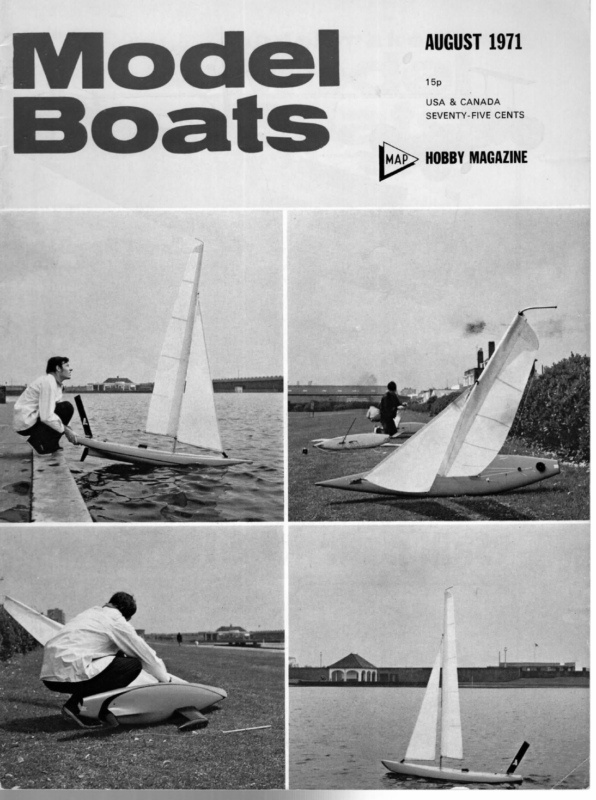
AUGUST 1971 15p USA & CANADA SEVENTY-FIVE CENTS . lesa: HOBBY MAGAZINE
AUGUST BETWEEN now and the appearance of our next issue, the European Championships take place. This therefore seems the time for us to extend our cordial greetings to all competing countries, our hopes that our Belgian hosts enjoy fair weather and good sportsmanship, and our wishes for good luck to the British team. We are in with a strong chance of medals in several events this time, though, being British, we shall no doubt enjoy ourselves whatever the results. To those who hesitate about. coming to spectate — well, you can take a day trip to Ostend, and it will be well worth it. The dates are August 16-22, if you need reminding. Organisation There are a couple of points arising in articles in this issue which provide food for thought. Neither is exactly new; in one case something is being done, and in the other there is a growing feeling that perhaps something should be. The first is Ed Shipe’s comment in the R/C yacht correspondence on the necessity at times for people actually involved to get in and get things organised. With any large body having various ‘limbs’ tending to become more specialised, the main body is rarely in a position to understand every detail of the needs of its specialists, with the result that proposals made by those in the know can be squashed by the main body simply because it does not have the first-hand knowledge to appreciate all the reasons behind the proposals. Naturally, an executive committee should have the power to veto any suggestion which might encourage dangerous or undesirable changes, but the members of such a committee should obviously be experienced enough to be able to see all sides of a question. Some years ago the activities and wishes of R/C power boat modellers were stultified by a situation where a preponderance of non-R/C modellers attended the M.P.B.A. A.G.M. and voted out many common-sense proposals by the R/C side, at the same time deploring the fact that so much of the meeting’s time was taken up by discussion of this ‘new’ aspect of power boating. The suggestion that the R/C members had a separate A.G.M., thrashed out their problems, had their proposals O.K.d by the executive committee and then more or less formally ‘rubberstamped’ at the main A.G.M., was seen as a move to split the Association and was therefore undesirable. In fact, the frustration felt by the R/C enthusiasts came closer to breaking up the Association than was generally realised. After several years of patient plugging, the idea of a separate R/C meeting was agreed to. The result was successful — smiles all round, a much better atmosphere, a marked increase in the strength and total membership of the association, and sensible and acceptable rules for the R/C side, leading to rapid progress. In other words, allowing the specialists to organise themselves under the umbrella of the main body led to improvement in all respects, and we believe that this must apply to any similar situation. At the Marblehead Championships a meeting was held to discuss the possibility of forming a Marblehead Class Association, with the basic idea that only the people actively sailing that class would be involved in its development. Nothing unconstitutional was or is envisaged. Support for the idea was over- whelming, and the Association is thus in being. Membership is restricted to the owners of current M rating certificates, and it will be proposed to the M.Y.A. September council meeting that the association be 309 1971 In the Tideway authorised to control the class rules, which would then go on to the agenda of the M.Y.A. A.G.M. The parallel between what happened in the M.P.B.A. and this new association is obvious, and there seems no reason to doubt that its effect would be to strengthen the M.Y.A. There are some 250 current M certificates, and to have 250 contented members seems very worthwhile; although these yachtsmen do have the opportunity of participation in M.Y.A. decisions, the M.Y.A. Constitution doesn’t make it exactly easy and this is bound to encourage the attitude that ‘they’ make the decisions. Marblehead owners can get full details from their nearest ‘postal suggestion box’—D. Parkinson, Esq., 15 Ettrick Avenue, Fleetwood, Lancs., H. Briggs, Esq., 25 Springfield Road, Grimsby, Lincs., or R. Stollery, 6 Little Tumners Court, Godalming, Surrey. Ballfield Road, The other point we mentioned is also to do with sailing, but has a slight bearing on all competitions in which only part of the entry qualifies for a final. For those unfamiliar with sailing procedure, where too heavy an entry is received to be got through in the time available, the boats are split into two or even four divisions, and at a previously agreed deadline, the top boats in each division go forward to a final. As an example, say 48 boats are entered. Since each boat sails every other, this means 47 rounds. With four divisions of 12, each sails only 11 rounds, The top two boats would then make an eight-boat final, i.e. sailing seven further rounds between themselves. It is generally agreed that the divisional system is not very satisfactory, but it is accepted because there seems no practical alternative. The bit that some skippers don’t like, however, is that all previous scores by the finalists are wiped out, and they all start from scratch in the final. Thus a boat with the top overall eliminating score can hit a bad patch, because of weather change, damage, or some similar factor, and finish up eighth (in our example). Of course, the other side of the coin is that a boat can qualify for the final simply because all the poorer boats were in his division, but this is a very long shot, and many race committees already seed the entries unofficially to produce reasonably balanced divisions. Luck can never be entirely eliminated, but divisional sailing does minimise its effect, It is obviouslv preferable to bashing through only a proportion of straight rounds and declaring a result on the scores at finishing time, though where there is a good chance of getting through at least 95 per cent of the rounds it is reasonable to try. It is surprising how positions can change in the last couple of rounds of a full tournament, however. There is a growing feeling that finalists being able to carry their eliminating scores through might well produce a fairer result. We do not recall this being tried. Would it be worth it? Try it with the eliminating plus final scores in the Southern & Met. report on page 332 and you will find that only one boat stays in the same place; would the skippers have felt it a fairer result? Incidentally, with 38 boats sailing in the M, 13 in the 36R, and the strong possibility of 60 at Fleetwood for the A (including 22 from other countries) yacht- ing seems to be well on the upswing. Pity the poor O.0.D. at Fleetwood, who has the decision on how to get through with so large a fleet!
MODEL BOATS Marblehead Championship Gosport May 29-31 Reported by Fred Shepherd FFNHIRTY-NINE boats were entered for this race, a very good fleet indeed. The French boat was unable to attend which still left one bye. The boats made a very colourful sight with the highly polished plastic hulls contrasting with the more traditional mahogany and cedar planked versions. Coloured sailcloth was also well displayed. Skippy, sailed by Roy Griffin, sported almost pillar box red, while others used bright blue and yellow. As well as the rather gay boats, the dress worn by competitors is worthy of comment. E. Mayhew looked the typical city gent in a smart suit, while from Poole came R. Wright in a pair of the longest shorts ever seen, or were they short longs? Just before 10 a.m. the Mayor of Gosport arrived, made a brief speech and then started the first few pairs. The wind was lightish from the south giving a reach both ways, a little freer from the club-house end, so scoring was set at 2 and 3. Scoring was changed once or twice as the wind swung around S.S.W. then S.S.E. A few boats tried spinnakers without much success. Sailing was rather difficult as the bank along the south side disturbed the wind a great deal. If one landed there getting off presented more than a problem. The lee shore was almost as bad, as here the ground rises quite sharply up to the swimming bath; this, of course, took the wind with it and produced a very dead patch up the last 80 yards or so. Near | p.m. a break for lunch of 14 hours was taken. A few more heats were sailed and afternoon tea was taken, racing continued on until around 7 p.m. and the leaders were then: George Clark 47, Tom Knott 45, Clive Colsell 43, Clem Fallows 42, Ken Roberts 40, Chris Dicks and Des Daly 39 each. The second day’s racing began in miserable conditions with heavy rain falling for the first two hours or so. Wind still mainly South. Five heats were completed by 12.45 when lunch was taken. During lunch the wind swung to almost S.E. giving a 45° reach up. In the first heat Hector took 5 points from Foxtrot Photos on left — top, the sole Danish entry with his new Longbow delivered at the start by Ken Jones, Centre, Jacobson senr,. with his two sons; G180 was well sailed by one so young. Bottom, The Mikado has a full body and slim stern, Two fins are jin. Tufnol, showing amazing strength. 310
AUGUST Ps. No. Boat Name _ Club: Skipper Designer I 2 3 1677 1536 is Hector March Hare Pterodactyl Guildford Guildford Clapham R. Stollery C, Fallows C. Dicks Shepherd Misstake Stollery March Hare Own design 4 1741 Force 13 5 Ks230 Charlie Girl 6 1661 9 10 Il 1776 1750 K79 I7IL 7 12 14 Foxtrot Uncle Danson Scotland Hove & Brighton C. Colsell T. Knott D. Daly W. Jones R. Seager 1736 1751 Black Rabbit The Mikado Southampton Birkenhead C. Edmondson StolleryWhite Rabbit K. Roberts Perry/Roberts Martini Scooby Do Bournville Bournville Cleethorpes Sva of Hamburg Ryde 20 D9 PQ) Denmark 19 1537 Mad Hatter 1739 Fire Brand 1598 White Knight 1590 Stalker 26 1650 1712 28 29 30 31 32 33 34 1758 1763 I7I7 1759 1651 1752 1489 1671 1757 GI77 Ryde KS74I Usiba Scotland 24 1629 Gosport 36 37 Blue Marlin H. Dovey A. Sinar Guildford 214 Shepherd Afterthought 16 16 DC. Dicks 18 Own design 16 Norsworthy mod. Floreana 18 Own design 16 Own design Littlejohn mod. Elusive 182 21 18 192 H. Briggs Fr Jacobson N. Buttigieg Witty Longbow Witty Longbow Witty Typhoon 20 20 21¢ J. Brandt Witty Longbow 20 Lets & Bradford M. Rawnsley 22 25 Shepherd Slip-up Clapham Hove & Brighton Birkenhead Clapham Sam Gamgee Sunschien Atilla R. Cole 14 20 18 owan Mind Bender Hipster MA4sSIS Lizanne 1686 1755 Guildford Witty Typhoon Disp. Draft Material Saturday Sunday Finish (11 heats) (23 heats) (30 heats) foretst mod, Brady and 184 Andromeda 1753 GI80 1728 23 B. Cowan 1764 16 17 18 21 G. Clark F. Scott Stollery Mad Hatter Stollery Daredevil A.Wilson Adams Foxtrot R. Fogarty Stollery White Rabbit H. Godfrey Stollery White Rabbit Forest Gate E. Carter Witty Hustler mod. Ken Jones Stollery Daredevil Stollery Mad Hattery April Dancer Suzanta Fleetwood Clapham D. Parkinson J. Gilmore Dark & Golden Wyresider Skippy Morning Mist Papegeno Blue Moon ll High Jinks Odin Salome Sabbelbudel Gosport Fleetwood Danson Ryde Poole Southampton Portsmouth Slecwpornes Poole Sav of Hamburg R. Hovells Stollery White Rabbit D. Priestly Witty Skippy R. Griffin Witty Skippy E. Mayhew Witty Typhoon C. Sayer Stollery Mad Hatter N. Sutherland Stollery Daredevil B. Goudy Priest Bewitched G. Griffin Witty Typhoon R.Wright Priest Witchcraft K. Jacobson Adams Foxtrot Uncle; several boats were now in 85 in. rigs. In heat 16 March Hare lost to a lowly placed boat from Poole, Blue Moon. Hector had a very close race in the same heat against Lizanne which she just won, but not before Dick Seager had shouted encouragement at his boat over the last 50 yards to the amusement of all the onlookers. Two heats later, Chris Dicks’ effort came toa grinding halt when M4SIS beat him both ways, then immediately March Hare took 3 off him (tho’ rather luckily). So after some 16 hours’ sailing the leader board read like this. March Hare 92 Hector 90B 1971 16 20 21 18 182 14 124 14 «14 14 134 154 14 14 15 14 I54 12 14 13 135 14 12 124 G/F G/F G/F G/F 47 G/F 4l Planked 38 G/F veneer G/F Planked Balsa resin on nylon mat G/F G/F Planked Planked Planked G/F Planked 124 Wood G/F 123 G/F 123 21 14 20 16 182 18 18 2i¢ 16 20 234 214 22: 21 38 G/F 45 G/F 39 Glassfibre 28 Diagonal 26 14 11 38 42 39 Planked G/F 90 92 76 79 794 78 74 ; 120 115 106 105 1034 102 99 74 78 62 67 99 964 91 87 34 40 69 67 86 86 35 27 72 60 84 84 39 23 20 18 25 20 23 20 14 62 59 47 49 54 52 51 52 48 79 78 74 71 70 69 65 64 63 Planked 26 50 62 14 124 G/F secre 27 29 45 52 58 58 124 124 13 12 124 124 =I =12 Ii I G/F Planked Planked G/F G/F G/F G/F Planked Planked Planked 26 12 15 19 Il 12 15 17 12 5 4l 353 43 37 33 33 33 34 21 16 57 554 53 45 42 4l4 4l 4l 29 20 eneer Foxtrot Uncle Hipster Charlie-Girl Pterodactyl 80B 79B 783B 76B With less than two-thirds of the racing completed and a short day on Monday, a finish looked very remote. Racing began at 9 a.m. on the third day in a very light Northerly wind; fortunately this soon swung to a good Sou’-wester, went for a while to South and then back to S.W., a tacking beat being necessary at times to get up the lake. The two leaders were still disputing the lead. March Hare took on Mad Hatter and lost by less than a length. Hector Heading pictures opposite, left, Foxtrot Uncle made the _ prize-list for Clive Colsell for the first time. Centre, Hector on a close-winded course. Right, Force 13 shows almost perfect sail setting; note twist in jib. Right, gent’s natty suiting of R. Wright caused more than a few laughs, all taken with a grin. Centre, not a schooner or trimaran — just Sam Gamgee, PQJ, and Hec- tor needing some _ sorting out. Far right, vane feathers still give scope for experiment. 311 wil
a MODEL BOATS sailing Mind Bender also lost, so was unable to consolidate her lead. The pressure was now really on when lunch was taken. At the restart the O.O.D. Mr. Roy Gardner said 3 heats only. Neither Hector nor March Hare dropped any more points so Roger Stollery became the 1971 Marblehead Champion, a that during the last three championships a 14 pound boat has finished second twice and first once, Zaza and Hector second to M4SIS in °69 and °70, so it would seem that the light boat built for off wind work can hang on to boats like M4SIS in beating conditions (Birkenhead 1969, Fleetwood 1970) and really excel in reaching weather, Gosport 1971. Between these two extremes there were many interesting boats. Des Daly’s Hipster, a boat he designed himself, which can compete on all points of sailing with almost anything, is a really great effort considering Des has only been sailing around three years. The two Witty designed Longbows built by Ken Jones and sailed by competitors from Denmark and Germany were superb examples of building and rigging. Chris Dicks’ new boats sailed by himself and Tom Knott must be mentioned, built of glass fibre with wooden deck. GRP moulding by Chris himself, the fin is of mahogany, the grain running parallel with the leading edge, this edge must be at least 80° to the LWL. (No signs of any luffing when hard on the wind.) Also the skeg and rudder are quite extreme, being some 6-7 in. long. Brian Cowan’s modified Foxtrot, Charlie Girl, went very fast both on and off the wind and surprised many. The gear on almost all boats was to a very high standard indeed, though one thing did stand out. This was the fact that in the reaching winds, those boats with a kicking strap under the jib were able to set that sail far more efficiently. The boats without had the jib sheeted in considerably more than the mainsail and this only led to the bow being pressed in, a definite disadvantage on a reach. One seldom sees badly made sails nowadays. Many skippers have now taken this job on in addition to building. The Ken Jones’ Longhows and Chris Dicks’ two boats really had superb sails. One wonders what will happen next in this class. Is it possible that Ken Roberts has got the right idea? Perhaps with a considerable reduction in dis- title he had won previously at Poole in 1964. March Hare was second, Pterodactyl third, fourth place went to a new face, George Clark of the Danson Club. Brian Cowan of Scotland was fifth. Brian is a rather unknown quantity here in the South, but he quickly proved that he and Charlie Girl were a forc2 to be reckoned with. Clive Colsell of Hove and Brighton was the sixth placed skipper. The fact that this event was not completed will no doubt be a point of discussion for some time. Probably divisional sailing would have been less satisfactory. One feels that had the racing been pushed along at a little brisker rate, more heats could have been completed. But most would agree that Roger was a worthy winner, despite the fact that only 31 heats were completed. Notes on the Boats The boats at this regatta varied from Ken Roberts’ The Mikado, 21 pounds displacement, very large and powerful and sporting a twin fin in tandem on which hung a streamlined bulb. The leading fin is approximately 2 in. wide, while the after fin is around 3 in. wide with a space of some 6-8 in. separating them. The boat was designed by Ken Roberts and Bill Perry and built by Ken. Construction is composite, the core being + in. x } in. balsa planks built over stations. When complete this is cleaned down and nylon mesh is then glued on with resin to form a sheath. The nylon mesh is then glued between the sections inside, before the removal of any jigging. The Mikado never really got going in the lightish winds; though always sailed very well she seemed to be unable to take advantage of the gusts that came from time to time. This machine needs plenty of wind, definitely not happy at Gosport. At the other end was Hector the winner, designed by the writer, 14 pounds displacement, built as a glass fibre moulding. Hector could never be described as a powerful boat by any standards, with only 8 pounds of lead to hold it up, but has ability to sprint away in the slightest puff, and in doing so keep in the wind that little longer. Worthy of note is the fact placement this concept could really show its paces. Will Roger Stollery produce something even lighter than Hector? How much deeper will keels be dropped? Have jib sails got to the limit? March Hare’s working jib is measured at 370 sq. in. and the main at 384 sq. in. The writer feels sure that March Hare is faster to windward with its new rig than the original. One just has to wait until 1972! PEDALO (continued from page 321) shape and drilled at each end for No.4 screws. Paint the whole paddle assembly aluminium. shaft and fitted into slots in BB. Check rotation, screw front bearing (on A) finally in place, and epoxy support bracket. Slide motor to rear, slip on worm, quire modifications to the mounting, but since the maintain line-up. Drill paddle bearing holes in BB, Motor Platf — Different orm motors will probably re- screw motor in place, using packing if necessary to paddle assembly height can be altered as well as the motor shaft support bracket, meshing the gears should be no problem. The motor sits in a well made from 4in. ply pieces epoxied to the seat front bulk- head, which needs a hole to clear the motor shaft. For a Monoperm/ Richard unit, the platform should be gin. down from the tops of BB at its highest point, and the shaft centre should finish tin. down from top of section A. The floor water creeping along to the motor. slope prevents The worm has a tin. clearance hole. so the shaft is extended with }in. steel rod reaching to forward member A and joined by a suitable sleeve soldered in place. A small piece of brass sheet drilled +in. forms a bearing on piece A. The motor shaft support bracket from 1/16in. brass or similar is slid on the 312 mesh worm and A rudder is aluminium and passing through wheel. fitted to one float and is cut from epoxied to a l+in. piece of tin. rod a tube epoxied through the balsa end. A jin. crank is soldered to the top of the post. The model needed 8ozs. of lead ballast diagonally opposite the accumulator to make it float level. Sloping floors protect the radio from water which could splash over the front; ply bulkheads under the false floors are also a precaution. There is room to spare for radio. Small holes drilled in the pedals allow round elastic to be used to hold the dolls’ feet. The hip and knee joints should be pivoted loosely on tin. dowels. Note that when the leg is fully extended on the pedal. it must be slightly bent, or it will not return.
a SSNS VANE FEATHERS, FIG 94 7 = SYNCHRONOUS |_leffective operating area SHEETING, AND | Contte: of -ttory dt hal gy (erent Hh Sia Ae Lit Lt NV me4\ A SPINNAKERS Va yA Hl, Tae! B ; Wi c D RACING MODEL In the preceding two articles, a vane feather has been shown with each of the vane gears described. However, even to the beginner it will be evident that the size and shape of the vane feather varies considerably from yacht to yacht. There are no specific criteria on the size and shape of feathers. As with most things connected with model yachts, there is an amount of trial and error to find the most efficient feather for a particular vane gear and yacht. Basically there are two factors which influence the size of the feather. The first influencing factor is the size of rudder that the feather is to operate. The second factor is the actuating distance, i.e., the distance between the centreline of the vane feather spindle and the centre of effort of the feather. With the deep but narrow rudders in use on modern racing yachts, a ‘rule of thumb’ calculation for the area of rudder, provided the actuating distance is approximately four inches. Alternatively, the feather area should be approximately eight times the area of the rudder if the actuating distance is approximately three inches. This ‘rule of thumb’ can be expressed R=24 mathematically as where R is the ratio of area of feather in square inches to the area of the rudder in square inches and d is the actuating distance in inches. PART FOURTEEN Cad Vane feathers the feather is approximately six times the area of the BY C. R. GRIFFIN YACHT CONSTRUCTION Having determined an approximate measurement for the area of the feather, a further decision has to be made as to the ratio of width to height of feather. This high or low aspect ratio has a bearing on firstly, the actuating distance and, secondly, the effective operating area of the feather. To illustrate this point, fig. 94 shows four ‘feathers’, all of equal area, but of different aspect ratio. It is obvious that the actuating distance differs by 14 in. from A to D, whilst the effective operating area has diminished from 18 sq. in. to 8 sq. in. Again, a ‘rule of thumb’ calculation is to make the height six times the width of the feather. One other point remains to be determined before deciding upon the actual shape of the feather, and that is whether the leading edge of the feather is to be in an upright position or not. The advocates of the vertical leading edge feather claim that a better operating torque is developed, whereas those who favour an inclined leading edge claim that less feather flutter occurs due to improved streamlining. No dogmatic attitude should prevail on this question, ex- perimentation and critical examination is the best way to arrive at a solution. The shape of the feather has relevance to, firstly, the operation of the vane gear and, secondly, the method of construction. Fig. 95 illustrates five of the more common shapes of vane feather. Balsa wood is the first choice of materials for the construction of a vane feather primarily for its light weight; however, obeche has been used with success. Care should be taken in selecting the correct cut and grade of balsa, i.e. an ultra light or light grade and a quarter or straight grain cut. A sheet of balsa 18 in. x 3 in. can vary in weight from } oz. for ultra light grade to over 1 oz. for extra hard grade. Quarter grain cut balsa is more rigid than, say, a tangential grain cut wood. The cutting of balsa is best done by using an f X-acto – should similar modelling knife. A edge of the balsa and induces splintering. vane thick knife The shapes in fig. 9SA to 95C are cut from }¢ in. thick balsa either 3 in. or 4 in. wide, and after the initial light sanding the feather is given a light, even 5 FIG 95 or not be used, as this tends to bruise the cut feathers 324
AUGUST 1971 96B shows the effect of moving the jib fitting and the mast forward by the same distance as well as the coat of nitrate cellulose dope or sanding sealer. Care should be taken to apply the cellulose evenly over the surface of the balsa, preferably with the wood pinned effect of moving the mast only. In the former case, although the sheeting is less, and thus the angle of trim is less, than that obtained on the same calibration with the mast in the original position, both sails to a flat base; unevenly applied dope can cause the wood to warp out of true. Alternatively, banana oil can be used to waterproof balsa, and this has an advantage of being easier to apply. Complete the sanding operation when the waterproofing medium are again moved by the same amount. In the latter case when the mast only is moved it can be seen that the jib boom lies at a greater angle to the centreline of the hull than does the main boom. However, any movement of the bowsie causes both the jib and main booms to move the same amount. This situation is preferable to the converse which would arise if the has dried. The use of coloured tissue and dope gives greater aesthetic appeal but does increase the weight of the feather. The feathers shown in fig. 95D and 95E are slightly more complex in their construction but nevertheless jib fitting alone was moved. well worth the effort. The first is of triangular cross section; the sides are of 1/16 in. balsa cemented to three triangular spacers and a # in. spine all of ¢ in. balsa. The lower spacer is in two halves cemented to a locating tongue. The second design has two jin. wide, + in. thick balsa strips cemented at 30° either side of the trailing edge of the 4 in. thick balsa feather. Two light coats of sanding sealer are applied Spinnakers are usually cut from polythene sheeting either 150 or 100 gauge, the latter gauge being used for very light winds. It may be useful to cultivate friendly relations with the local dry cleaning establishment in order to obtain an ample supply of 100 gauge sheeting. The three basic shapes of spinnaker in use today are:- to waterproof. . _*&tm ae SS ae PL FIG 96A : ( tol synchronous sheeting note-pl.ti = pm.tm & pl.e] = pm.em “ me a >a \ \ \ ani a sa \ yp new original jib position sg \ a FIG 96B t hull new original mast position Synchronous sheeting. This is a method of altering the trim of both sails at the same time; it is an extremely useful manoeuvre, especially when a quick retrim is necessary. Although it is not possible to give precise dimensions to suit all yachts, if the basic geometry is followed satisfactory results should be achieved. Fig. 96A shows the main requirements for a synchronous sheeting system. It is necessary to en- sure that the toggle eyes, through which runs the individual boom sheets, are equidistant from the jib boom and main boom pivot points. Two U-shaped eyes, see fig. 84 in previous articles, are fixed to the deck at equal distances from the jib and main boom pivot points, replacing the jib and main horses. A jack-line approximately 12 in. in length is run along the port side of the yacht, upon which is a circular bowsie. Two sheets, each with a ring at one end, are run through the U-eyes and a toggle eye to the bowsie on the jack-line. The sheets are adjusted to the same tension and then knotted together. Any movement of the bowsie gives equal extension of the jib and main sheet. Further adjustment of the jib or main sail to increase or decrease the ‘slot’ is achieved by use of the jack-lines on each boom. To enable repetition of settings, calibrate the deck jack-line using dry print numerals subsequently varnished. Fig. 1. The triangular flat 2. The two-panel balloon 3. The multi-panel balloon The flat spinnaker, fig. 97, is rigged with the spinnaker boom on the windward side of the hull so that the spinnaker operates on the opposite side to the mainsail. The spinnaker passes between the jib sail and the forward edge of the mast, being sheeted to the after end of the hull. It is used when the wind is acting at an angle of about 15 deg. to 30 deg. abaft of the beam or in ‘free reaching’ conditions. The basic dimensions for such a sail are given in fig.97. The edges of the sail are shown slightly curved: this allows for a better inflated shape. The corners have reinforcement of Sellotape X prior to insertion of eyelets. The balloon spinnakers, both two-panel and multipanel, are used when the wind acts on the yacht at angles from approximately 30 deg. abaft of beam up to 90 deg. to the transom, or in sailing courses of full reach to full run. The two-panel balloon spinnaker, fig.98, is made from two flat pieces of polythene sheeting sewn or welded along the curved central join, welding being achieved by using a soldering iron 325 and thin wooden templates. The multi-panel balloon, fig. 99, is built up from a series of elliptical shaped
Ne i MODEL BOATS height- \ Jib hoist less spinnake boom height | | | – 6 \ \ \ \ h \\ | Bal Sete \ \ \ Lee ge 16″ Helle: seeanee : re FIG 97 rigging a flat spinnaker ‘ FIG 97a panels and a triangular top panel to produce a rounder, more spherical inflated shape. It is advisable in view of the greater number of seams to bind the tack edges of the multi-panel spinnaker. fig.98 and 99 give the basic dimensions of the two spinnakers. For use in high winds, third suit weather, a nylon spinnaker, flat or balloon, is a useful accessory in that this material is less liable to rip under these conditions. Ensure that the nylon is suitable for the Purpose as some nylon tissues etc., are incapable of / ‘ / two panei ualook FIG 88 spinnaker struction of a model racing yacht and to a certain extent the success or failure of the complete article depends on the quality and calibre of the sails. In fact the sails of a yacht are akin to the engine of a powerboat in that they are the means of driving the yacht through both mediums, air and water. Apart from the aerodynamics of sails, which is the province of the designer, there is an art in the cutting and sewing of sailcloths. Despite the general tenor of this series of articles which advocates a do-it-yourself offering any resistance to wind pressure; full size yacht spinnaker nylon is the best material. It is a good plan to make full size paper patterns of successful spinnakers, which saves time when replacing worn out sails and ensures exact duplication of the original shape. Test a new spinnaker by rigging it whilst the yacht is on its stand, this assists close examination of the way the sail sets and shows the inflated shape. V-shape darts or re-sealing of seams may be necessary to reduce bagginess or to correct misshapen spinnakers. attitude, in the case of sailmaking, although a degree Sails. This is the last major item needed in the con- for the construction of model racing yachts. of experimentation is to be commended, it is sound advice to say leave it to the expert, at least until such times as the experimental sails give superior results. For those readers who sail mainly for pleasure, and as yet have not been bitten by the competition ‘bug’, and who feel that they would like to know how to make a suit of sails, an article will be included in the series, in the next issue. In any case, any relevant information on the subject should be included in a series of articles which propounds ideas (To be continued) fis Ny air ne L 3 fi (s. / | jet ax om \ Sy rigging i a balloon spinnaker FIG 98a cutting multi-panel -alloon spinnaker FIG 99 326 panels for multi-panel balloon spinnaker FIG 99a 5
AUGUST –1970,36 in. Restricted Championship Firstly, apologies for the absence of photos -—the camera wound merrily on and left the film behind. This is the first time the Editor has experienced this particular frustration, and words fail . . There were 13 boats entered, the highest number in this event for many years and half of them were recent registrations of new boats. A couple were fairly new registrations of older boats; the progress of registration can be gauged by No.372 dating from about 1931, 818 from 1953, 1045 about 1965 and 1062 1970. This works out around 20 new registrations a year until the middle *60s, then perhaps three a year. There were 7 new ones in 1970, and interest appears to be picking up again. Partly this is due to renewed interest in sailing generally, but some Marblehead skippers may also find 36s relaxing for a change! Although June 13 proved to the one summer day in a long spell of wet and cold weather, the skippers could have done with a steadier and slightly stronger breeze. The very light breeze was fitful and mainly southerly, though liable to swing 90 or 180 deg. without warning, or die away altogether at times. A boat would sail half-way up the lake, hang about in the wind-shadow from the clubhouse, and as like as not return to the end it started from. We thought we’d got a lovely picture of one arriving between a pair waiting to start. Under these circumstances racing was slow and skippers could never be sure if they’d found a trim. After four heats a lunch-break was called; at this point McDougall led with 17pts. but within two points were Mickey, Jean III, The Spider, and Whiter Shade, the last not having had his bye and therefore in a strong position. The afternoon stayed the same with the wind swinging between E.N.E. and S.S.W., and O.O.D. Dennis Lippett announced that sailing would cease at 5.30 and the result declared on the position at that time. In fact, 11 heats had been completed and the 14974 Bournville, June 13th Mickey dropped their beats, leaving Jean III 3 pts. ahead, all having had their byes. The winner is of the Duck design famous twenty years ago. Mickey, winner on at least four previous occasions, is 40 years old and still a fantastic boat; she carries up to 1100 sq. ins., with a bowsprit, and can stay with any company. Also a previous winner, The Spider (champion the last three years) is a design of Tucker’s dating back some 17 years. In fourth place was a brand new boat by a relative newcomer to yachting meetings, Harry Briggs. He has produced a sweet little 36 by reducing the sections of Witty’s M design Longbow by 10 p.c. and closing them to 36in. l.o.a. Oh, that camera . . . Another modern style bulb-keeler was Captain Pugwash, very attractive, but it never really got going. The Shepherd Square One designs were in contention all the time but needed just a shade more wind. Yellow Peril was a new own-design sharpie type, and Taffy had at one time been a 3-m schooner, now Bermuda rigged and fin-keeled. A well-assorted and interesting entry and an enjoyable race; let’s hope the entry will be bigger again next year. Pos I 2 No 936 372 1045 Boat Jean Ill Mickey The Spider Club Birmingham Bournville Bournville 4 1069 Puddle Thumper Cleethorpes 5 1063 Whiter Shade of Pale Guildford 1062 McDougall Brighton 7 8 9 10 1067 Be-Be 818 Harlequin 1070 Yellow Peril 1064 Juicy Lucy 1021 Taffy 1052 Jane Bournville Bournville Guildford Guildford Skipper D. Knowles A. Sinar W.Sykes Design Pts Tucker Duck 36 W.H. Davey 33 Mod. 33 Tucker Windbird 33 H. Briggs Red. Wicty 32 Longbow A. Austin Shepherd 30 Square One M. Dovey Shepherd 30 Square One N. Scarlett Tucker 26 Duck B. Garbett Reeve 25 H. Godfrey O.D. M. Godfrey Shepherd 22 18 Birmingham B. Bull 18 Bournville H. Dovey Square One ExSchooner Nason 18 race was settled in the 11th when both The Spider and 13 R/C YACHTING (continued from page 331) with PCS proportional radio with two Kraft KPS-9 servos, one for rudder and the other driving a DPDT reversing switch for the winch. The winch uses a Mabuchi RE-26 motor running on 14v and suppressed with a .l1 mfd disc capacitor. A 4.1 reduction spur gear takes the drive to a 40:1 worm, and the drum has an adjustable clutch, obviating the need for limit switches. The frame is made from ABS plastic sheet and the total weight of the follow in a row boat with a prod. And it certainly beats sailing ‘bank to bank’. Perhaps one day others will see the advantage of R/C for model yachting. But it will be hard for many to break away from the traditions of the Braine and vane sailing . . . but we are willing, in R/C, to show you the advantages.’ One of the best known and oldest-established onedesign classes (we had a photo of one in our May, 1964 issue) is the Santa Barbara One-Design. This is basically a 60-62 in. w.l. 10-rater which can be bought, with sail control unit but no R/C, for $380 (about £160). Registration numbers of these —not necessarily AMYA registered —are approaching 400. We like the maker’s slogan, ‘Fight noise and air pollution—race R/C sailboats’! Finally, one of several Starlet correspondents, M. Abir, of Cincinnati, sends pictures of his latest Starlet and a neat miniature sail winch. The model has an aluminium mast and sliding cabin hatch, and is fitted Neat and simple sail winch requires only an ‘either way’ switch operated by the second servo. Builder M. Abir also sent a shot of his latest Starlet, which is quite a popular boat in the States. 1071 Capt. Pugwash unit is 4 oz. Southgate |. Taylor O.D. 9
a MODEL BOATS R/C Yachting in the U.S.A. Correspondents provide some interesting background to the fast-growing U.S. radio control sail world Probably the oldest recognised R/C class in the States, the Santa Barhara One-desian. To 10-rater. rules, the design looks a little dated but obviously continues to give a great deal of good racing. OUR mention a few issues ago of the formation of the American Model Yachting Association has led to some interesting correspondence. The new body came into being following a number of approaches to the Model Yacht Racing Association of America by various individuals on the subject of R/C yachts, all of which apparently received a negative response. As correspondent Ed Shipe says, when you want to race competitively on a National basis and cannot get the co-operation of the recognised National Organisation, there is only one course of action — you form a new organisation that will fill the need. Ed goes on — ‘A lot of thought and correspondence went into the formation of the American Model Yachting Association, with the result that in less than a year’s time it is the largest model boating group in the U.S.A. The guideline for the group is racing with radio controlled model sailboats. The first thing they recognised is that model sailboat enthusiasts fit into several different categories and to have a successful organisation most of these people have to be accommodated. Your people in England have been trying to get a One Design Class started for years and they have not come to an agreement as to what that class should be. There is an argument going on in France between the people who are interested in scale and those interested in formula racing. The people that organised A.M.Y.A. recognised that this situation was in existence and left the door open in their constitution and by-laws so that as interest developed in a type of racing it could be included in the overall picture. ‘The first thing they recognised is that there are two basic types of model sailors. There are those that are interested in all phases of the boat, from the actual design, to racing and trimming. There are also those that are primarily interested in racing and because of available time or inclination they are not 330 interested in going through the problems involved in designing a boat. With this in mind, the organisation started out with both ‘Formula’ classes and ‘One design’ classes. ‘The Formula classes are for those that are interested in sailing boats of their own design. They range from the small 36-600 class with very simple rules to the complicated A Class. A.M.Y.A. has stipulated that a class has to have 20 boats registered before it reaches ‘Official Status’ to qualify for annual championship regatta. The provisional classes are 36-600, 50-800 (Marblehead), 10-Rater, X Class, and A Class. I don’t know how many have reached official status at this time, but I do know that an annual championship regatta has been set up for the 36-600 class. I have also heard that the 50-800s have reached official status and that they are in the process of organising an annual class championship to be held this summer in Denver, Colorado. ‘The one-design concept set up by the A.M.Y.A. follows practices set up by the full-size fleets. These classes are set up for the majority of modellers who do not have the time or experience necessary to develop a competitive boat for the development classes. The winners of these classes have to rely on their tuning and sailing skills because all other skippers are sailing identical boats. There are no ‘plans only’ boats in this category at the present time; however, the door is open if somebody is interested in promoting such a class. A.M.Y.A. officials also recognised the fact that the manufacturers of fibreglass hulls and kits would be a big help in the promotion of model sailing if their products were given association protection. A manufacturer spends a great deal of money in the development of a boat. He also advertises and promotes the class which, in turn, increases association membership. The establishment of ‘Proprietary One Design’ classes by A.M.Y.A. guarantees the manufacturer protection against somebody making a direct copy or manufacturing a similar boat for competition in that class in order to take advantage of the promotional efforts of the original company. This also protects the modeller that buys a proprietary one design class boat. The modeller knows that he will be able to race competitively in that class as long as he wants to do so. Fibreglass hulls have a long life expectancy, so if a modeller changes his interests, it is very likely that he will get a good percentage of
AUGUST his original investment back if he sells the boat. ‘The Santa Barbara One Design is a proprietary boat manufactured by Vortex. Santa Barbara owners make up one of the largest class memberships in the A.M.Y.A. and as a result, have the heaviest class competition schedule for the coming year. Several owners have registered their boats in one or two of the development classes as well as the proprietary class because with a simple change in sails, the boat will meet the development class rules. I think you can see the advantages of sailing a proprietary boat that can also be sailed in the development classes. ‘The main reason for writing this letter was to point out that there was a need for the new organisa- tion in this country. The old organisation is apparently in a state of stagnation, and most of the activity is at a local level. There are ponds that were built years ago for the sport, that are now unused. I know that the facility in Detroit is unused because our advertising brought a request for information about R/C sailing from the recreation people in that area. This will probably result in the facility being reactivated for R/C sailing. Ray Hottinger did most of the preliminary work in the organisation of the new association, and the proof that he did a good job lies in the fact that the splinter has become a plank. Ray’s address is 206 Elmwood Drive, Colorado Springs, Colo, 80907. The principal officers are: Rich Matt, Pres., 5340 S. Wolf Rd., Wester Springs, II. 60558, and Rod Carr, Sec/Treas., 2713 Blaine Drive, Chevy Chase, Md. 20015. I am sure that any of these gentlemen would be happy to respond to any questions regarding the new association.’ Ed draws a parallel with recent developments in the R/C aircraft field, mentioning problems encountered with people set in their ways or not really understand- ing the factors involved. ‘Sometimes it is necessary for the people actually involved with any phase of the hobby to set in, and get things properly organised … This was not possible with model yachts because the original organisation was not interested in radiocontrolled sailing, nor was it big enough to justify any further efforts to work with them.’ We referred to remarks made by Rod Carr, mentioned above, in last month’s ‘Tideway’. Rod mentions that he won’t be standing for re-election at the end of his term (he’s hoping to find time for a bit more action) and sent over a history of the East Coast 12Metre boat (see example in photo), which is interest- Rod feels that the boats fit the ‘graceful’ aspect of our arguments (no plumb ends and, he says, a reasonable aspect ratio for sailplans) and gives the vital statistics of the class—l.w.l. 42 in., beam 12 in, draught 9.75 in., l.o.a. 55-60 in., displacement 26 Ib. and sail area (measured triangle) 1,130 sq. in. Another letter sparked by the same reference was from Ben Hogensen, of Woodlyn, Penn., who says: ‘I was first in model yachting in 1930 and highly indebted to Tommy Moore, Deaf Wood, and others of MYRA for their invaluable assistance along with that offered by C. N. Forge, W. J. Daniels and H. B. Tucker and others of the TYRU. ‘After World War II I wanted to get back into model yachting and visited a model show where the local MYRA club had a display. I was highly distressed at their closed ranks type of operation and no offer to come and participate in their activities. And, a few months ago I wrote the national secretary asking about local clubs of the M.Y.R.A. and received no response. All this was highly distressing to a former member of MYRAA. ‘So, when the American Model Yachting Associa- tion accepted my membership I’ve jumped into the pond with both feet and am taking part in model yachting again . . . so much so that I’m regatta chairman for the First Annual Mid-Atlantic States R/C Yacht Regatta. ‘No, we in R/C are not splintering away from MYRAA . . we just aren’t given the opportunity to join. And, insofar as we are concerned, controlling a boat by the Braine gear or the self-tacking vane rig is only a poor compromise for having a helmsman aboard. (And I’ve sailed all three ways… ). ‘Insofar as I’m concerned, it is a real thrill to be able to run a triangular course without having to ing. Apparently a syndicate considering the defence of the America’s Cup for 1967 had had some tank models built, and when the plan was abandoned, the originator gave one of these to a modelling friend, Buddy Black. The hull was used as a plug for a mould and a number of people had boats to sail. Moulds were taken from these hulls—there are now four sources — and eventually the class was tied down by a set of specifications to ensure that all boats rated equally. Because of the simple specifications, new designs in the pipeline threatened disastrous effects on class stability and popularity, so the class is being split into Standard EC12 adhering to the one-design philosophy, and Experimental EC12 for other boats fitting the specs., with a few additional prohibitions. Standard can race in Experimental races but not vice-versa. At the moment 44 of these boats are registered, 34 of them Standard. Wallace Huie of Wally has since 1971 Washington, D.C., with his EC12 Jane. corrected that dog-leg.in the mast with resulting better sail set. 331 HM (continued on page 327)