- STAR-C 42 in. radio-control yacht design by Vic Smeed Part Three
- Readers Write…

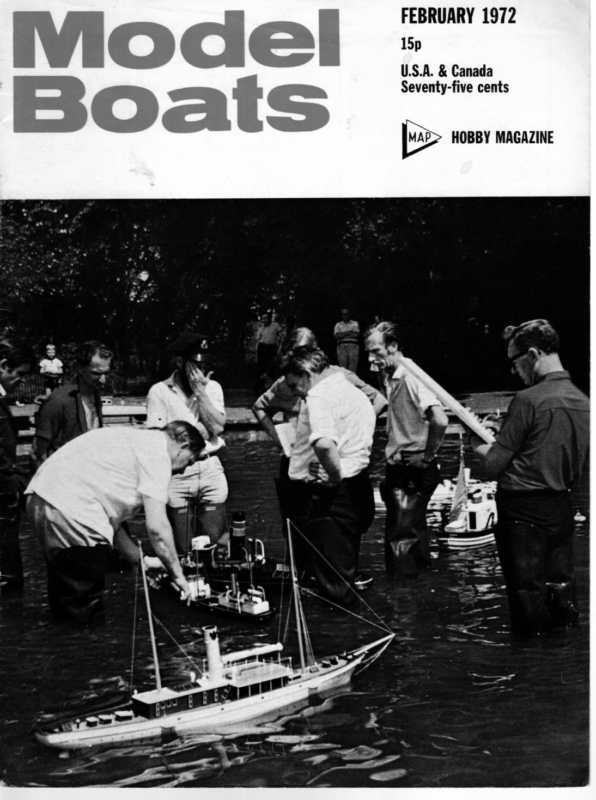
FEBRUARY 1972 op U.S.A. & Canada Seventy-five cents Mab> HOBBY MAGAZINE
MODEL BOATS 42 in. STAR-C radio-control yacht by Vic Smeed white with just the faintest hint of any darker colour used on the boat, e.g. below the waterline) and lined out for planking followed by varnishing. Diagrams of design Part Three The Deck in Once the skeg and fin, complete with lead, are place, no more construction work is involved inside the hull, so preparations can go ahead for fitting the deck. The first step is to sand the deck beams and inwales, etc., to form a completely smooth seating, sighting along from each end to ensure similar curves on each beam and also laying odd long strips of timber along the hull to check that a fair curve exists; a high deck beam will mean unsightly ripples in the deck and spoil an otherwise elegant model. Trace the deck, or lay the hull upside down and draw carefully round, on a sheet of 1/16 in. ply. Cut a good quarter-inch outside the line — it is easy to trim to finished size but frustrating to have cut undersize initially! The deck camber makes only a fractional difference to the width, and you could, of course, fit a completely flat deck, but this would look rather unsightly. Now carefully mark and drill a hole in the deck to fit over the projecting top of the rudder tube, slip the deck in place and align it, and drive in a pin or tiny screw beneath where the jib rack will be fitted. These two points give a definite alignment. since the deck will have to be removed once or twice types of planking have appeared before in our pages, but the method we used on the prototype, though not strictly correct because of the need for haste, looked very attractive. The deck was painted with two thorough coats of undercoat, in our case before it was fixed to the hull as this saved time, rubbing down thoroughly with No. 380 carborundum wet-or-dry but being careful on the second (wet), rubbing not to cut right through the paint film. A T-shape gauge was made, the stem of the T being } in. thick, $ in, wide, and about 5 in. long, and this was drilled at one } in. and then regular 2 in. intervals to accept a pencil point. A centre kingplank 1 in. wide was pencilled on the deck, opening to a ? in. strip round the radio box aperture, and then the gauge was slid round the hull, pencilling in planks parallel to the deck edge. The outer plank joined the king-plank fore and aft and the remainder simply finished on the king-plank lines instead of being joggled in. These light lines were then gone over (using a curved template) with a soft lead pencil kept fairly sharp. Time precluded inking them, but the finished result was reasonably acceptable. Tape was stuck round the hull + in. below the deck edge and the outer and king-planks painted, pale blue in our case. The paint was run over the edge of the deck to seal the edge of the ply and give a coverboard effect. When dry, the entire deck was varnished, again carrying over the edge, and the tape removed. The opportunity was taken of varnishing the skeg and rudder a couple of coats, since the underwater hull before final fitting. Large rubber bands can now be slipped round to draw the deck to its camber, and a more accurate outline can be pencilled round, although it is unnecessary to cut really close to the final line. Check all round that the deck sits on the hull, and if there would require no undercoats. The hull was then inverted and packed to bring the waterline ends level fore and aft, and a long pencil firmly taped to a wood block of appropriate height slid round to trace a level waterline lightly on the hull. This was masked above with tape, the slight joint line round the top of the fin filled with epoxy, then the whole fin and underbody lightly sanded with 380 to key the surface for the paint. This was simply one coat of the same pale blue as used on deck. One is a gap, mark it for correction. The aperture for the radio box must be measured from the rudder tube and the centre line of the deck, so lift the sheet of ply, check that the forward pin or screw was central, and draw the centre line on both top and bottom of the ply. Mark the hatch area carefully to fit your particular box, and cut out. Three small blocks about } in. sq. x 4} or ¢ in. thick, must be glued on the centre line beneath the deck, to receive the screws for the sheet eyes and the top rudder pintle. Make sure that these do not foul any of the deck beams. Give the underside two coats of varnish and allow to dry thoroughly; also apply two coats to all the woodwork of the hull, i.e. deck beams, inwales, fashion pieces, etc., but do not varnish the tops of these where glue will later be spread. Make a final check on the siting of your particular fittings (especially if you wish to fit a vane gear for free sailing), then apply a thin coat of one of the slower-curing epoxy resins, slip the deck on to the rudder tube, reposition the pin or screw at the bow, + oz. tinlet of Humbrol did it all, easily. Stand If you have got this far without making a stand, you will find further work much easier and the finished hull better protected if you now make one. Use either a sheet of ply fore and aft of the fin, cut to the appropriate body section and screwed to a timber baseboard, or two side sheets with straps or lengths of cycle inner tube nailed across them so that the hull sits comfortably in place. Pad any wood touching the hull with rubber, etc.; quite a good material is self-adhesive draught-stop, though a wet boat left to dry may find this tending to stick to it. Fittings and strap the deck down by slipping a dozen or so Most people will have little trouble in finding aluminium or dural tube for the mast and booms — this is one case where the telephone directory yellow pages can definitely be helpful. With a maximum of 52 in. mast length, sending away for tube means rail or road service charges, so it may pay to look round for television aerial tubing, government surplus tank aerials, caravan supply shops (surprisingly!) or similar possible sources. We bought ‘off-cuts’ from T. W. large rubber bands over the hull. It should not be necessary to pin the deck while the resin cures, Trim off any surplus with a sharp blade when dry, and sand the edge flush to the hull, taking care to avoid scratching the hull with the glasspaper. Painting Treatment of the deck is a matter of personal taste; some people may be content simply to varnish it a couple of coats. However, we think a yacht looks most attractive when the deck is painted white (or Senier Ltd., in London, 16 ft. for just under £1. The fitting and rigging sheet, shown with this 62
1972 FITTINGS SHEET 3 of 3 BOWSIE ALTERNATIVE ADJUSTABLE CLEW QUTHAUL FOR BOTH BOOMS | GOOSENECK ees CORD THROUGH HOLE BOWSIE Soe , be : ‘ TTT D EL 8-HOOK— q PLUG ——PISTANCE ~ B-HOOK SHEET ‘ ts ATTACHMENT as g |, 1 FOR SYNCHRONOUS SHEETING, DISTANCES ‘X’&’Y’ (IE, BOOM PIVOT TO SHEET ATTACHMENT) MUST BE EQUAL 8: EYE FOR SHEET | f1—wooo PLUG IN SLOT COKED 1 See avons RIVET OR OBA BOLT TO PREVENT MAST TWIST a ADJUSTABLE MAST STEP (ROBERTS) (J) \ \\ NOTCHED BRASS SLOTTED IN c SED CUT FROM BRASS T-SECTION «= eS Sea el eens IF REQUIRED x —(EG CURTAIN RAIL) ~ : i HOOK FOR JACKLINE = 21, i kt. FORESTAY ALTERNATIVE RADIO BOK \ ard )\ = — ALTERNATIVE ADJUSTABLE MAST STEP (JIB RACK CAN BE SIMILAR, OPTIONAL RING BOWSIE BUT WITH HOLES) CON JACKLINE \. DECK EYE FOR SHEET BR UPPER PINTLE FROM BRASS STRIP [ ~ 7 DECK EYE FOR EYEPLATE EACH SIDE FOR SHROUDS FITTINGS 26 py > |; my, BEI ON \ Veiled ( CORD \ seated > 4 & HOOK _-CORD he Ho0K ORoe! STAINLESS WIRE BOTTOM MADE BACKSTAY > -TURNBUCKLE OSSe aed TIGHTENED WITH fc TURNBUCKLE. — NOT DETAILED AS STANDARD FROM W_JONES. “alia OR SHROUDS CAN BE INATIGHTENED BY FORESTAY OFF TO SHORT CORD” MADE It SPRUNG 5 TD LENGTH, oe k BOWS. — 63 FEBRUARY STAR —C ears (ONY. Tal Se _ ‘ Ss HOLE FOR FORESTAY HOOK TOTAL MAST LENGTH—52″* c @ —— oy fa 7 HOLE EACH SIDE FOR SHROUD HOOKS » T wes t =LAVSTRATE” PLASTIC. TAPE 10. HOLD ZACHLINE LAYSTRATE STAINLESS JACHLINE TO MAST BETWEEN WIRE am 4 ye ae JPHAUL HOOK CIN 66 MAINSAIL 1 RAIL «a HOOKS HERE © CORD BACKSTAY FIXED MAST STEP ALTERNATIVE STANDARD FITTINGS FROM. J. ROBERTS (RIGGING ETC AS ABOVE) [am W28-¢ This is the third sheet for Star-C but for builders working from the available glaSs-fibre hull, only two sheets need be obtained, MM1128A is hull MM1128B is hull fitting out, price 45p, and MM1128C (above) is rigging, etc., price 35p. lines, price 45p,
MODEL BOATS article, indicates several alternatives for fittings, most of which can be made up from sheet brass oddments, screweyes, and so on, though many builders may pre- fer to buy chromed fittings from W. Jones or J. Roberts, as mentioned last month. If you make your own, silver soldering is essential. If you have difficulty in obtaining stainless steel wire for shrouds or hooks, rigging twine, bowsies, etc., either of the suppliers mentioned can help. One fitting not standard is the upper pintle for the rudder, but this is simple for anyone with a vice and a drill, as sketched. A clamp-type tiller (as made by E.D.) would enable the rudder to be removed at any time by unscrewing the lower pintle and slackening the tiller; however, since the screws will be painted over and there is unlikely to be a need for regular removal, a soldered brass strip tiller should not really prove a nuisance. Make sure that there is adequate rudder movement without the tiller fouling the top pintle bracket. We used small 1/32 in. brass rivets as pintle pins, but plated brass household pins could well do; they are usually thicker than steel dressmakers’ pins. Five deck eyes are needed, each secured with two small screws, in. No. 0 being ideal. You may have to shop around for tiny screws, but they are not too hard to buy. Drill a fine hole for each screw, almost full depth, especially in the inwales, for the shroud eyeplates. The eyes for the boom sheets must be positioned over the blocks glued under the decks; the radio box hatch is usually large enough to slide an arm in to feel that all is well. A fixed mast step can be used, but for tuning the boat for optimum performance, it is better to have a mast slide, or it may mean refitting a fixed step. On the other hand, since this is a one-suit boat, once tuned, it should be unnecessary to move the mast position. The idea of one suit is, incidentally, to simplify and also to cut down on cost. The boat could carry more sail quite easily, but then second and third suits might be necessary. The sails provide the power, and if everyone has a standard power-plant, no-one can have an advantage. The class is intended for R/C racing and the premium must therefore be on. skill in handling, not depth of pocket or willingness to chase every faintly possible means of pushing up perform- ance. ‘Development’ classes are good, but they haven’t attracted newcomers to R/C sailing, which is one reason why a simple one-design class is being mooted (and, so far, attracting a lot of practical interest!). Excuse us for sidetracking. The jib rack is an entirely straightforward fitting simply screwed on the centreline. All through, 3 in. No. 0 screws are adequate, though 3 in. No. 2 might be an idea for the mast step, especially if the boat is going to around, lying rigged on its side in a car boot. behind the mast, they can be made to length, hooked in place with the mast ‘sprung’ slightly aft, and will then come up taut when the forestay is tightened up. Vane yachts often have two shrouds a side, the rearward one being slacked and moved forward to allow the main boom to swing out square for running before the wind. Since this is not practical for a radio yacht, the shrouds are set only a short distance abaft the mast, and a permanent backstay is set. To clear the roach of the sail, this has to be stood off the aft face of the mast by means of a jumper strut, which on the original, was filed out of an odd piece of aluminium curtain rail from the scrap box. The drawing explains it. Failing T-section aluminium, a piece of, say, 3/16 in. dia. tube could be used, slipped through a drilled hole in the mast top. The down load of the stay will cause it to lock in place. The normal method of avoiding a gap between the luff of the mainsail and the mast is to run a jackline up the aft face of the mast and engage on to this opened-out plated dressmakers’ hooks riveted or sewn to the luff tape of the sail, The jackline can conveniently be the same thin stainless wire as the shrouds, and it runs from the gooseneck, or a figure 8 hook through the mast immediately above the gooseneck, up to a small hole drilled in the jumper strut close against the mast. Since it is impossible to prevent a long length of thin wire from stretching away from the mast in a breeze, the jackline is held to the mast at intervals. Methods of doing this includes fine split pins passed through the mast, with the wire passing through their eyes, or wire 1OBA screws tapped into the mast with the passing through the slots in their heads; the heads are then either crimped to close the slots or a touch of soft solder placed on each screw. However, waterproof, plastic insulation tape offers a satisfactory means of doing this job, albeit more noticeably. It is light and fairly tough, and is easily replaced if it shows any sign of tearing. A band of it should be wrapped round the mast, trapping the wire cen- trally, between the luff hook positions. The jib luff also carries hooks engaging over the forestay, in order to help keep it straight. The luffs of both sails should always be taut, and this achieved by fitting a short cord and bowsie into the head eyelet of each sail to form an uphaul. In the case of the main, this uphaul can be fitted with a hook engaging in the same hole in the jumper strut as the jackline; an alternative would be to pass it through the mast and fit bowsie and hook on the foreside of the mast, the hook in this case engaging in a hole drilled in the mast. The jib uphaul can be hooked or passed through the eye of the forestay hook, as sketched, which allows independent adjustment of tension on both forestay and jib luff. Incidentally, with deck-mounted mast steps of the tubular type, there is a possibility of the mast twisting round. A small slit in the after edge mast step to locate a pin or bolt in the mast will prevent this, and ride Surprisingly, that completes the deck fittings, so we can turn to the mast and booms. Here, some useful Suggestions, saving cost and increasing efficiency and if it is made in the form of an eye, it can also be used an an anchorage point for the kicking strap. A simplicity, have been made by Wally Jones and Jack Roberts. Most of the fittings derive from, and are excellent for, vane-sailed yachts, and some of the top screweye can be screwed into slightly undersize hole in the mast, cutting a semblance of a thread, and secured with epoxy. This eye (or peg) should lift out boats use them. Thus, instead of a mast band and hounds fitting, the shrouds and forestay simply hook with the mast, i.e. it should not be secured to the step in any way. em Apologies for lack of photographs in this issue, due to the general pressure of setting up the M.E. Exhibition, where the prototype will have been on show. We will make up for lack of pictures with a photo feature, plus remaining rigging details, next time. (note shape of hooks) into holes drilled in the mast. The shrouds are wire for strength and freedom from shrink or stretch, but turnbuckles are fairly expensive and the degree of shrink in a 3 or 4 in. length of cord is very small, so the shrouds can be terminated in a very short bowsied adjuster or, since they are slightly 64
1972 FEBRUARY | <=, | | NA DAVITS AT FOREFUNNEL MIDSHIPS DETAIL 1939 READERS WRITE (continued from page 77) dently has now been cast and a new model yachting organisation. has been formed. It may have been more fruitful for model yachting as a whole if the enthusiasm now seemingly being generated among certain R/C skippers could have been channeled through the M.Y.R.A.A. It also would have been more appropriate if the forum of debate could have been within the pages of the M.Y.R.A.A. Quarterly Report rather than in the pages of your excellent magazine, though may | extend the wish that your circulation because of it! The } or MINAS GERAIS Quarterly 200 may increase : Report of the M.Y.R.A.A. is mailed to every skipper who registers a boat with the M.Y.R.A.A, and we would have been glad to publish any comments Mr, Ed Shipe (or is it Mr. Ray Hottinger?) may have wanted to make. However, the tactics by Messrs, Ray Hottinger and Rod Carr in the published words that have come to my attention, have been of a type bespeaking of a demagoguery that seeks no beginning nor no end, but only in creating a whirlpool of confusion. The reason for seeking such 73 confusion is mysterious to me, as is to skulalso the reason for resortin duggery in attempting to destroy an Organisation which has not harmed them in the least. We have been, are now, and hope to remain so in the future, open to suggestions and criticism, but only if a modicum of sin- cerity would tained. .and honesty from those who do the criticising can be main- | hope the above facts speak for themselves and provide your readers with a more knowledgeable basis upon which to form an opinion. Detroit, U.S.A. Gerhard Muller
MODEL BOATS Readers Write... TUGS Dear Sir, | read with great interest the recent article by P. N. Thomas in the October, 1971, edition of Mode/ Boats on model tugs, and his methods of construction. | am at the moment nearing completion of an old style tug based on the drawings of the Watkins tug Badia, (ex Arcadia), which was featured in Mode/ Boats, March, 1966. The model is to # in. scale, which gives a ship of 41 in. length, As my knowledge of drawing is very limited, the finished model is not meant to be accurate; in fact, | have deliber- ately altered certain points, and, bearing this in mind, | intend to use another name for the finished model. My method of hull construction is slightly unorthodox, consisting of a solid wooden bottom with jin. ply bulkheads set into it. | then use conventional stringers running from end to end, covered with 1/16in. ply side skins, followed by a ¢in. ply deck. When the structure is dry, the bottom is shaped as in conventional bread and butter construction, then, finally, the keel is added. This system has worked well on an existing tug, which is very stable, partly due, | think, to its low centre of gravity, which results from the above building method. Reading, Berks R. B, Yeowell SCALE Dear Sir, Your coverage of the European Championship has at last given me hope for a new revival of scale ship models. Too many of our clubs rely on very old models, especially of the straight runners (some of these | know are nearly 50 years old or thereabouts and the vernier adjustments of the rudders are sO unused would work!). now, that | doubt they Maybe after seeing some of the electric propelled models of the Continentals, the attitude of most club members to. electric models will change. | remember sailing my + in. scale trawler (which has an electric motor) shortly before the local club regatta and a visitor, on seeing my model on the lake, asked what machinery | was using. When he was told, he commented that it was a pity it was not steam. | explained that the model had had a steam unit, but the grease and general messiness on a_ scale model, coupled with having to refuel and fill the boiler every 25 minutes, was in my opinion too much bother and spoiled an afternoon's sailing. He, of course, said what | knew he would say, that | had converted a good scale model into a toy. | have found that this is generally the attitude among clubmen toward electric powered boats. Far too often club regattas are marred by the parade of the same old models and even a few new ones off an old mould, | believe it is time for a rethink by members of clubs and more time should be used in building new models instead of refurbishing old and in the main ugly models. Of course, it is highly dangerous to generalise and undoubtedly there are a lot of new models about, but | find that those who build new models are not as active on the running side as is needed. Maybe they get discouraged by the few who usually take over the ponds and lakes with their planks on edge and flatties? The answer seems to be more scale models. | sincerely hope the coverage and photos shown over the past couple of months wake up the modellers. of Britain. There is room for improvement all around. Maybe the straight running enthusiast will do more experimentation regarding hulls and more shapely models will result. Hendon, Sunderland Jack Green R/C YACHTS Dear Sir, Mr. C. S. Gould, in his article on ‘Tornado’ in your September issue, remarks on the lack of organisation of R/C yachting in this country. | would agree with him to a certain extent but my experience over the last seven years as an R/C yachtsman has been that, apart from three clubs in the south, namely Poole, YM6 and my own club, Gosport, no other club has shown any active interest in the sport. These three clubs, together with the London Radio Control Models Society — of which | am also a member — have done their best to get things organised over the past 10 years or more and have been responsible for having drawn up R/C yacht racing rules which have been adopted and published by the M.Y.A. They each run two Open Regattas during the season as well as the National Championship on behalf of the M.Y.A. and each club has a number of Sundays during the season when the club waters are reserved for R/C sailing. These clubs have done their utmost to spread interest in the sport but over the past seven years | cannot recall any entry for the Open Regattas or the Nationals being received from any members of the other clubs or from free-lance sailers, with the exception of two members of the Bournville club (| believe that they are the only two R/C members) and one from Derby who participate regularly. At present, ‘Q’ is the only officially recoqnised R/C class, if one excludes the ill-fated ‘R’ class, which was introduced a few years ago, and only about 30 of these are officially registered, 25 of which belong to members of the clubs mentioned, which would appear to indicate that this class is stagnating and | am convinced that until such time as a smaller class is officially recognised, the sport will not spread and country-wide organisation will be impossible. More of that at a later date, however, when | hope to let you have my detailed and reasoned views on what that class, in my opinion, should be. The lack of interest and co-operation so far experienced is demonstrated very well by an experience of mine earlier in the year. Mr. Gould will no doubt remember a letter of his that was published in your April issue, in which he issued an _ invitation to other R/C yachtsmen to ‘come and have a go at us’ at Gillingham and gave the name and address of their sailing secretary. This letter appeared at the time of one of the Poole Open regattas and those present, about 21 entrants, were all very interested and hopeful that here was another club with an active R/C section. Several, in fact, were pre- pared to take their boats to Gillingham for a day’s sailing and a get-together. | was deputed to contact their secretary, and wrote a long letter giving a report of the Poole regatta, dates of subsequent regattas and sailing days at Gosport and requesting details of the boats they sailed, etc., and ex- 76 pressing the hope SECOND LETTER that a get-together could be arranged. Unfortunately, received no reply to my letter, which, to say the least, was extremely disappointing. Could this be a sign of the lack of interest and non-co-operation which has held back organisation in the past? On the day following my last letter to you, for your reply to which many thanks, in which | said that | proposed to let you have my considered views on a smaller class of R/C yacht, | received the December issue of Model Boats, in which you announced the introduction of your 42 in. hull. | like the lines and specification of the hull and commend the neat way in which you have overcome the problem of keel casting, and certainly hope that your initiative in introducing a small size R/C yacht will meet with the success it deserves, although | personally would have gone for something a little larger for the reasons stated below. The most popular size of yacht for free-sailing is undoubtedly the Marblehead, and anything much smaller will, to my mind, be incapable of withstanding sailing conditions met only too frequently on our coastal waters. | am thinking mainly of Gosport and Poole, being the two main R/C yachting centres at the moment, for Poole in particular can be extremely choppy under prevailing wind conditions and anything smaller than an ‘M’ can be brought to a sudden halt by wave conditions which can make sailing rather difficult and unpleasant. Your 42 in. hull is smaller than the Continental Naviga and D.X. classes and the American 50/800, and in the hopes that we may have some_ international sailing in the future, something nearer these classes might have been more acceptable. Charlie Brazier, of Gosport, has recently been appointed as_ International R/C Yachting Secretary, and we have this past season entertained two German R/C yachtsmen at a sailing day at Gosport and at the two-day regatta organised by the London Radio Control Models Society, granted they sailed 10-Raters, but it was a start. We have also heard that two or three American R/C yachtsmen hope to come over either in 1972 or 1973 to sail against us and | would have hoped that any new class might have approximated a class already sailed both on the Continent and the U.S.A. The Marblehead class as sailed at the moment is, as you say, not aesthetically satisfying but is a good performer under all conditions and | would have liked to have seen the new class with specifications approximately as below. L.0O.A. 50 in., L.W.L. 40 in. (measurement of this is nowhere near as ‘fiddly’ as you infer), Beam at W.L. 10 in, Displacement would be about 16 or 17 pounds, which is the most favoured weight of ‘Ms’ at the moment. At this size there would still be no problem of control with present-day commercial equipment. However, as you have taken the initiative and done something concrete in introducing this new class, | feel that all R/C yachtsmen who are keen to further the sport should give you their full support. A lot of my fellow ‘Q’ class sailors feel that they have had, or soon will have had, enough of humping about 56 pounds dead weight on and off car roofs and in and out of the water, we are not getting younger or more sprightly. | propose that we give our full support to the proposed new class—a_ smaller R/C class must be introduced, so let us get
| | 1972 FEBRUARY down to getting some of the new boats on the water and give it a trial. Finally, may | implore you not to talk about an intermediate class at this time. This will only lead to different classes being sailed in different parts of the country and we will be back to square One with even less hope than before of getting one National Class. As | look forward to the day in the not-too-distant future when our National R/C Championship can be truly National and draw entrants from all over the country, instead of just three clubs as at present. There will be a lot of work ahead to follow your lead and to get our sport popularised, and | hope that my colleagues will give this project their full support as | am prepared to give mine. By the way, where can | obtain one of the new hulls other than at the M.E. Exhibition, as | would like to get one fitted out for next season? Burpham, Guildford. E. W. Gearey STAR-C Dear Sir, May | once more be permitted to have a little stir re R/C yachts. Firstly, as a club we can boast of 14 yachts sailing on R/C, in competition between ourselves. This year and last, we sailed nine rounds over a triangular course with two over a steering course. In 1969 the cup was won by an ‘M’, in 1970 a Stormvogel 57 in. won, and this year a Warlord, but it is getting hotter all the time. We have no boat or S.A. rules, only sailing rules, and all are happy to compete on level terms. So, with the Stormvogels (five were moulded), a fine 6m given to our club for finishing, plus the five 59- and 60inch boats | have designed, built and bored you with, surely we have done as much or more than our friend Mr. Dowling, of Cowes, for the case of the intermediate-size boats. You also state in your interesting article that you have ‘Shopped Around’ — where? Not in our direction, because if you had asked any of our dozen or so sailing members they would have convinced you that anything smaller than ‘M’ is out, the reasons are: (a) Size alone, Even an M _ looks small at 100 yards, particularly, as stated, the difficulty of seeing if your sails are set at best for the course you are on, (b) Speed — there is naturally a craze for speed these days but a boat such as a 42 in. would not give satisfaction to anyone who has sailed an M or larger. (c) A one design class as suggested will of necessity stultify the basic principle of model yachting — hull development, shape, etc. You also go on about bulbs; there is nothing easier than moulding half a bulb. Our club has, thanks to a member, an aluminium mould of a half Warlord bulb which will give a satisfactory half of from five pounds to ten pounds or more, if anyOne in this area wants to pour, they can always visit me, our fire is always alight. (Bring your own lead). (d) Transport — these days most people are fairly mobile and although | own a modest B.M.C. 1100 | can carry a 60 in. boat in the passenger seat and two on the back, also an M in the boot when we have a local show. Our members are in favour of a class at least the size of an M up to 60 in. l.o.a. Let's have some individuality and not a lot of hulls differing only in the colour. (e) Interestyou may be a little mistaken here as, apart from our lone effort in country, the south-east corner of the no interest is shown among the free-sailing clubs in this area to go over to R/C sailing. This summer | had a run down to Eastbourne for a sail, arriving at the end of a competition, yet my new effort, Tornado, never got a glance. This | thought strange, as there were one or two elderly gents compet- ing who could have benefited from R/C —as they certainly could not steer by a vane-—enough said. Our waiter also houses a moderate-sized dinghy club, they sail in the river yet they never even give our boats a glance, this has been further confirmed when you kindly anyone who showed the slightest degree of interest in model sailing into joining our club, including, of course, R/C yacht skippers. Prospect Park MYC, Belmont Country Club MYC and other clubs have members sailing R/C yachts and exclusively Orlando MYC is devoted to sailing R/C model anyone yachts. Mr. Rod Carr, now secretary/treasurer of the new organisation, was answered at least twice on the basis of an open letter published in a modelling mazazine, once by Mr. Fred Frey, on February 8, 1970, and once by myself, Feb- rules and regulations for ‘Q’ class from Gosport. Having been destructive, may | now invited to join the M.Y.R.A.A. and providing him with other pertinent information. | have engaged in lengthy correspon- printed my last letter inviting to come to our water to have a go. We had one reply with about six pages of ruary 4, 1970, in both instances being be constructive and offer a suggestion for a class; | think the standard sail plan is a good idea (it is the principle | have used for five of my boats), but with a max. hull length of 60 in., an all up weight of 22 Ib. This could, of course, include an M for persons not wishing to break out into a new class, and no doubt others loafing in attics, but please at least let us have a boat big enough to justify the installation of ilson, of Dendence with Mr. A. G. ver, Colorado, R/C skipper, pertaining to my suggestions regarding R/C in model yachting, as also with Mr, John course, My suggestions pertaining to R/C yachting have been published in the Quarterly Report of the M.Y.R.A.A, At this point, however, | would like to stress that at no time have I, either as an individual or as President of the M.Y.R.A.A., ever been addressed directly by either Mr. Ray Hottinger or Rod Carr on the subject matter. (The reply referred to above to Mr. Carr was in response to his open letter). Evidently, neither of these two gentlemen entertained any particular desire to publish information that did not reflect their type of thinking. There never should have been the slightest doubt that R/C model yachtsmen have always up to £50 worth of radio gear. We, of would have Several hulls to this rule in our club, but none of our members will want to know about a boat of 42 in. May | once more repeat that if anyone has an R/C boat he wants to try out who may wish to visit our water to have a go at us, they will be most welcome, but please contact me by phone or letter beforehand. How about if this new class, whatever it is, gets off the ground, arranging a meeting on our water in 72? It only needs a phone call. After having written this | arrived home to find a letter from two friends — funny, they are ex-R/C glider enthu- siasts, Our these races designed two this and lads year built have with supported a _ home- semi-circular arc boat of 42in. A very nice little boat and in their letter they state that they are both building a 60 in. boat for 72, in order, as they state, to try to get higher up our points table. | hope this letter will be taken in the spirit in which it is written, whilst not wishing to decry your worthy efforts but to express a general club opinion in the hope that we may at some future date have an organised and flourishing class of R/C sailing, we, after all, have gone it alone for three years with an Oraanised series of racing. Gillingham, Kent C. S. Gould Reynolds, manufacturer of radio controlled yachts and hon, sec. of the I.M.Y.R.U. (Radio Control). These two gentlemen's suggestions have always been welcomed and their efforts on behalf of radio controlled model yachting have been entirely constructive and sincere. been welcome to join the M.Y.R.A.A., and that if the degree of their activity that a separate chair it, warranted would be provided for them within the framework of the M.Y.R.A.A. to allow them a voice in the policy making of the M.Y.R.A.A. In answer to the allegation made in the article, of Mr. Shipe being unable to gain information from the City of Detroit regarding sailing activity there, the facts are these: a held has M.Y.C. (1) Detroit National sailing event in its pool every : year since 1961. have we period this (2) During enjoyed participating in some of the most memorable National races held in the post-war period and | feel proud and fortunate part of it. THE SECOND SIDE Dear Sir, As President of the Model Yacht Racing Association of America, | feel some clarification is warranted to charges made in the August, 1971, issue of Model Boats by Mr. Ed Shipe against the officers of the M.Y.R.A.A. Through the reading of this article an impression may be gained that the officers of the M.Y.R.A.A. (governing body for model yacht racing in the U.S.A.) have been neglectful and nonco-operative in helping the skippers of R/C yacht racing to organise. Nothing could be further from the truth. The M.Y.R.A.A,. has had radio controlled yacht club representation for 20 of its 50-year history. Since 1953 it has published in its government an excellent set of rules and regulations pertaining to this phase of model yachting. This booklet can be obtained by anythe of Registrar the from one M.Y.R.A.A. for $2.00. In Detroit we have always welcomed 77 to have been i an c active ‘ (3) We have had during this period the usual problems connected with model sailing ponds; weeds, rocks, boardwalks, etc., but on the whole can report good co-operation from the City. (4) Unfortunately, this year (1971) the weed problem in our pond has got the upper hand. The City added the 2.4D weed killer in the spring, as it has done in previous years, but this year, for unknown reasons, this poison had little or no effect on the weeds. Bethe cause of this weed _ problem, National Class M Race originally scheduled to be held in Detroit this year, was transferred to Chicago, May | extend my apology to Mr. Ben Hogensen, who did not receive a_reply to his inquiry, for the National Secretary not answering him. If he will send me his address | will furnish him the information It is he desires. unfortunate that the die 4 evi- (continued on page 73)