- STAR-C Our new 42 in. one-design class R/C yacht looks like catching on! Part Four By Vic Smeed

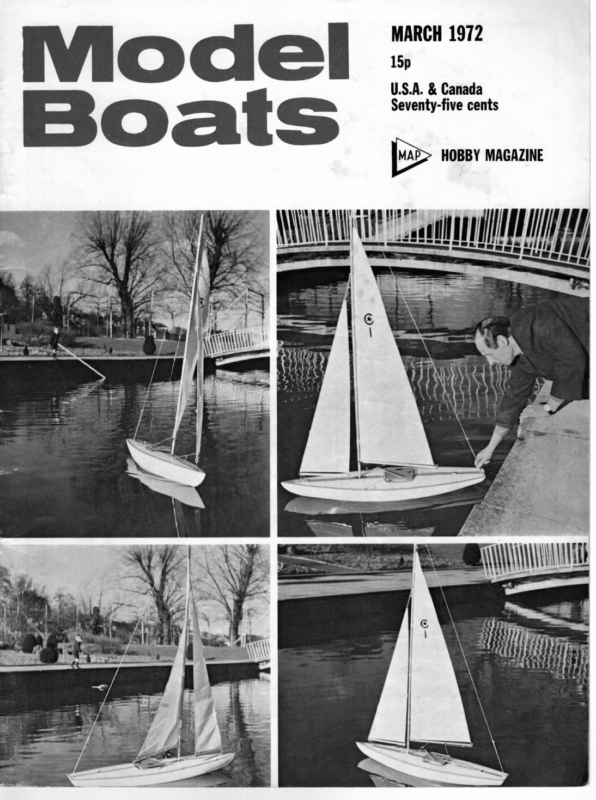
MODEL BOATS Left is picture of class insignia on sail of prototype; numeral 1 makes it look a bit like STAR-C Our new 42 in. one-design class R/C yacht looks like catching on! – Bottom, details of various fittings. Opposite, top, the prototype in light – airs, the first picture showing the effect of a _ puff – which didn’t even fill the sails. Botexperithe rotary-arm installation using the 9} Ib. pull Launch Link servo. Part Four By Vic Smeed be fitted —it was a question of getting it afloat quickly for trials. Many builders will probably be just as happy to buy their fittings, which come ready-chromed and really cost little more than the price of having one’s home-made bits chromed and polished. Prices for finished fittings are: W. Jones (57 Forest Road, Birkenhead), heavy stainless rigging hooks, as drawn, 3p each, plain gooseneck £1.20, jib rack 35p, deck eyes 10p each, flat bowsies 3p each, stainless rigging ‘] P[SHERE is really very little left in the matter of fitting and rigging after last month’s instalment. A main-boom kicking strap is desirable, and is simply rigging cord with a bowsie as shown. A similar strap on the jib boom is unnecessary, since the forestay pulls on the end of the boom while the tack hook is set slightly further aft, so that the tension of the stay pulling up on the fore end tends to hold down the after end. It is really desirable to be able to adjust the tension in the foot of each sail, which alters the ‘flow’ of the sail; the lighter the wind, the more flow or curve should be permitted in each sail. The boom lengths drawn allow a slight extra length to accommodate a clew outhaul, and methods of fitting one are included. The prototype model simply hooked the tack and clew of the sails in place, but outhauls will 118 wire for shrouds and jackstay 17p, ditto for hooks, etc. 17p. If required, slim turnbuckles are 49p each, and detachable bottom pintles £1.24. Suit of sails in hotrolled nylon, with luff-hooks, battened main, etc. £3.10 plus 15Sp post. From J. Roberts (180 Crown Lane, Horwich, Bolton, Lancs.) a set of fittings is available comprising gooseneck and six boom bands, fixed mast step, jib rack, five deck plates, stainless wire for shrouds and hooks, and five flat bowsies, for £3.90, or with a sliding mast step, £4.10, including post. Another supplier wishing to help is Nylet Ltd. (118-122 Station Road, Fordingbridge, Hants.) who sent along a nicely cut and made suit of sails (price is £4 post paid) and who also supply aluminium alloy tube, } in. o.d. in 78 in. lengths at 66p plus carriage, which by coincidence is just the diameter and length required for mast and booms. Rail carriage, packing, etc., is 5Op for one or even two or three lengths. For ‘new readers’ perhaps we’d better mention that glass-fibre hull and fin mouldings are available from Wavecrest Boats, Alexandra Road, Hemel Hempstead, Hertfordshire, for £6.70 plus 80p carriage. Thus it is possible to buy hull, masts, fittings and sails for just over £14 (plus any carriage), leaving only sheet lead (about 15p), deck ply, and what timber is needed inside, say another 75p, plus epoxy resin, and varnish and/or paint, in other words, we’re in the region of £16 for a going concern. Apart from the radio, of course! As a point of interest, nearly 30 hulls have now been supplied and there are at least a couple of wooden boats being made. This seems a very promising start; we even have a firm developing a small sail winch suitable for the class, and of course for similar
MARCH boats up to Marblehead size. Our sailing trials have been plagued with weather problems — since the prototype was sailable there has been a remarkable spell of light conditions over several weeks, although we have also been able to try the boat in a near-gale force wind. Never a sign of the good steady breeze which is so desirable for trim- ming! However, the extremes of conditions have allowed us to assess the merit of the one-suit-only idea; the area is enough to keep the boat going in very light air, but in a wind which was blowing down trees, etc., the model was not grossly over-canvassed, though it did heel to around 60 deg. in gusts. It remained controllable, however. The rudder area shown on the plan seems adequate when the angle of operation is at a maximum of 40 deg., the boat then turning in a circle of some 10-12 ft. diameter. One would use less than this angle normally, but it may be that some builders would prefer slightly greater rudder area and some would no doubt wish to experiment with a skegless or ‘spade’ rudder. The pros and cons of the latter are not yet fully resolved for R/C yachts generally, and in the case of the former, Bob Jeffries, who seems to be a big-rudder proponent, has a Star-C ready to sail 119 13.72 and has promised some notes on his findings. Radio The simplest method of control is to fit a conventional radio and two servos. One servo operates the rudder and the other has a micro-switch mounted each side of its output arm so that operation of the servo simply physically operates one switch or the other. It is an advantage to have proportional rudder but not essential; the second servo mode is unimportant. Thus reed radio can be entirely suitable as long as it is of the superhet type, i.e. capable of operating at the same time as other sets on different frequency spots. The rudder servo is connected conventionally and no doubt we shall see some fancy under-deck linkages, although for simplicity the conventional pushrod as seen in the photos is best. The switch servo is used simply to switch on and off, in either direction, the sheeting mechanism, and the most obvious way is to use a drum winch which can be simply and relatively inexpensively made by fitting a drum to a Monoperm motor with Richard gearbox. More radio details including a report on the experimental rotary system next time.