- 1972 MARBLEHEAD CHAMPIONSHIP by Joyce Roberts
- Sailplane II An attractive new Marblehead by Geoff Draper
- Let’s Go Sailing 2 – Choice of a boat
- TEST BENCH

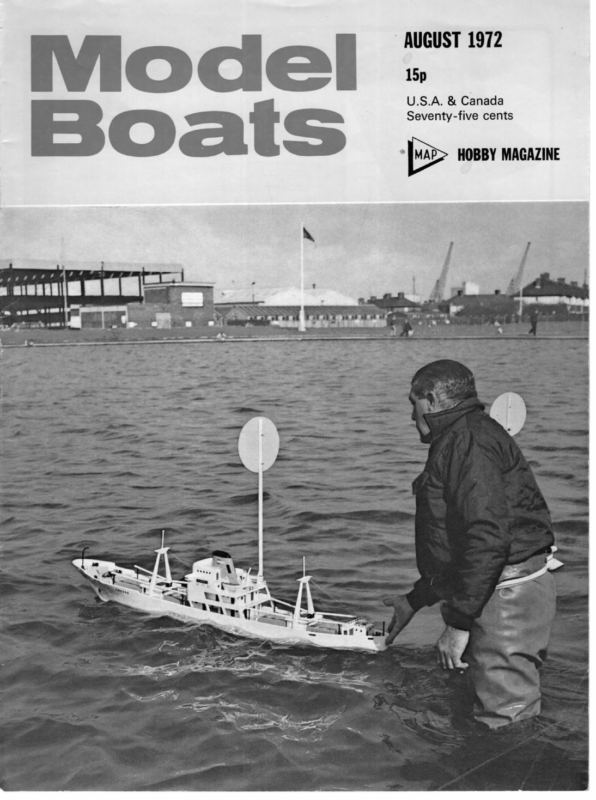
AUGUST 1972 15p U.S.A. & Canada Seventy-five cents HOBBY MAGAZINE pee * ed ad F | . Z ; eee
and Go demonsirate starting problems; start was changed to ‘staggered’ start illustrated right. Corner was more sheltered but curve necessitated one boat’s release before the other; here, Varoomshka waits for Capella. Bottom, Wally Jones with, |. to r., Gordon Keeley, Bill Poole, and Dave Knowles. Two new boats are, upper, Dick Seager’s Aeolus, and lower, Fritz Jacobsen’s Loop-to, a John Lewis design beautifully built by Ken Jones. by Joyce Roberts 1972 MARBLEHEAD CHAMPIONSHIP 1. Sweet 16 2. M-4-Sis 3. Pterodactyl 4. Aeolus 5. Hector 6. Hamster 7. Cachucha 8. Fiorello 9. Varoomshka 10. Shazzan 11. 12. 13. 14. 15. 16. Loop-To Foxtrot Uncle Cosmos Jester 16 Skipper Club 1692 18 173 18 Disp. Fred Shepherd 79 1775 1811 Guildford 13 1677 Walter Jones Chris Dicks R. Seager 143 183 1694 1822 1800 G. Keeley Tony Gill Harold Dovey G187 1661 1719 1714 1676 1821 Fr. Jacobsen C. Colsell R. Newport G. Webb |. Taylor J. Gilmour 16 173 183 16 213 Zaza Bernice 17. Andromeda 18. Arga 19. Brand X 20. Capella 21. Ichthyosaurus 22. Binky 163 18 164 No. 1831 1797 1764 Roger Stollery D. Daley K. Roberts R. Cole 1754 1793 J. Major M. Haines 1804 J. Beattie 1818 1697 G.L. Danks G. Reeves Designer F. Shepherd Slip-Up Birkenhead Clapham Clapham Jones/Norseworthy C. Dicks R. Seager Guildford Fred Shepherd Score % 124/145 85:5 129/160 110/145 102/145 80:6 75:8 70-3 100/145 D. Daly C. Dicks Newcastle Guildford Bournville R. Stollery Tony Gill J. Lewis 94/145 89/150 88/150 64:8 59:3 58-6 Hamburg J. Lewis F. Shepherd Slip-Up Mod. Stollery S. Witty F. Shepherd R. Stollery 86/155 95/160 87/160 76/145 +R 76/145 76/145 55:8 54-9 54:3 52:4 52-4 52-4 Hove & Brighton Birkenhead Birmingham Southgate Clapham Guildford Birkenhead Norwich F. Shepherd Afterthought 100/145 95/145 69:0 Hove & Brighton Birkenhead 77/150 69-0 65:5 51-3 78/155 71/145 Birmingham R. Stollery S. Witty F. Shepherd Step-two 78/160 50:3 49-0 48-8 Birmingham Bournville Witty/ Harris J. Lewis 70/145 68/145 48:3 46-9 23. Scooby-Doo 24. Jillandy 25. Die Fledermaus 193 1755 1342 955 A. E. Sinar D. Armitage J.Sixsmith 26. Lady Goldberry 153 1794 H. Briggs D.Priestly Fleetwood S. Witty 52/145 35:9 20 1770 1728 1470 1590 F. J. F. E. Birkenhead Ryde N. Liverpool YM6 F. Batty S. Witty Mod. Witty S. Witty 52/155 48/145 51/155 51/155 33-6 33-1 32:9 32:9 1827 V. Bellerson 27. Enterprise 28. 29. 30. 31. Kathy Attila Sheriboo Stalker 32. Blue Flame 33. Go 34. Atacop 35, White Lady 17 1820 Batty Buttigieg Jones Carter Bournville Birkenhead Birkenhead Cleethorpes Bournville Littlejohn/ Harris R. Stollery W. Perry H. Briggs R. Stollery 72/155 68/155 64/150+R 57/155 47/145 46:5 43:9 42:7 36:’8 32:4 1792 G. Griffin Cleethorpes S. Witty 39/145 26:9 1535 Russell Cooper 1768 Guildford R. Noble Cleethorpes R. Stollery 35/150 23°3 19/135 13-1 S. Witty LTHOUGH 42 boats were entered for the 1972 Championships only 38 started on Saturday morning, and 35 finished on Monday evening. It can be seen that this state of affairs must have proved a headache for the O.0.D., but Ken Jones coped with it in his usual calm manner. He decided that it was no good trying to rewrite the starting schedules — a decision that was proved correct when three boats dropped out on Saturday. The 7 byes that had to be taken during the racing proved an annoyance to most competitors, but in the circumstances could not be helped, and final places had to be worked out on a percentage basis. The 38 boats that started on Saturday morning found that Birkenhead had provided a really strong gale force wind blowing straight down the lake towards the boat- house. This wind got stronger during the day, and boats sailed with the smallest sails that they could find, some competitors returning home at lunchtime to cut down existing sails or else to find a smaller suit put away at 320 2a Left, winner Fred Shepherd jumps in to stop Sweet 16. Below, Cachucha and Brand X. Opposite, top, Hector
AUGUST osm 1972 e ONE home. The lightweights looked as if they had pocket handkerchiefs fixed to the masts but they performed very well only losing out on the runs when their sail area was not enough against a well trimmed boat with more sail area. There were quite a few spectacular runs, and most skippers jumped in to save their yachts, as the waves piling up near the finishing line made it very difficult to judge the catching of a yacht by hand, and there were a few bumps against the concrete. It was very exhausting weather, especially when the rain joined the wind and the cold. It was in this weather that breakdowns occurred, and three yachts could not complete repairs in time to race again; at this stage the O.O.D. wondered if any boat would finish the race! Any fittings that were not strong soon broke, and skippers who could reduce mast height when they reduced sail found boats a lot easier to handle, if only in the carrying of them. Very thin masts broke, and very thin hulls cracked; there was a lot of patching to be seen by the end of the weekend. Boats who did well on this first day were M-4-Sis, 39/45, dropping 3 runs. Sweet /6 28/30, having 3 byes, and only losing the run to Prterodactyl, although Fred Shepherd waslucky to have the weather over Chris Dicks, as this gave him the advantage all the way up the lake. Pterodactyl had 26/35, losing 3 runs as well as the one beat. Aeolus got 19/30, losing beats to team mate Chris, and also to Loop-to and Foxtrot Uncle. Hector 24/35, Fiorello 17/25, Hamster 30/45 and Cachucha 27/30, only losing the beat to twin Prerodactyl. After this hard day’s sailing everyone was glad to relax in the evening, having a good meal at the Heatherlands with members of the Birkenhead Club, and the President of the M.Y.A. John Lewis, and the President of I.M.Y.R.U. Fritz Jacobsen, who was competing in the championships. Sunday morning at 8 a.m. was a complete contrast, hardly any wind coming from over the houses. Everyone changed into their tallest rigs, then the morning was spent struggling in difficult conditions. Reaching winds at Birkenhead are not easy to sail in, the houses on one side and factories on the other make for calm and windy patches. Fiorello went through a bad period in the morning, but the other top boats did not have too much trouble. Rain came before lunch, but soon afterwards the wind came round to a beat and run, and gradually freshened so that by evening some boats were in 2nd suits. Hector lost the beat to Aeolus and M-4-Sis, and finished 58/95. Sweet 16 and Aeolus were most successful, and after 23 heats had 84/95 and 72/95. M-4-Sis 87/100, Pterodactyl 75/100, Cachucha 75/100, Hamster 61/95, Fiorello 46/90. It was a reaching wind again on the last morning, although a force 9 gale was forecast. Knowledgeable locals said ‘The wind will come up with the tide’, but
MODEL BOATS that was not due until 2 p.m. It was a more difficult wind than that on the previous day; fluky patches were spread out over the lake, some very flat, some made the boats alter course into the wind. Skippers had to find a trim that would even out the changes of direction, and this proved very difficult for some. Luck also played a large part in the proceedings, and skippers needed a great sense of humour to overcome the frustrations of the morning. Having a bye every other heat did not help either, a new trim was needed after a rest. Pterodactyl and Cachucha did not have a very good morning, but Chris did manage to find a trim in the afternoon, whereas Ken did not find his until much later. Sweet /6 also lost a few points in the morning, but in the afternoon when the wind direction altered slightly Fred only lost 3 to Die Fledermaus. M-4-Sis had a good morning, but after losing a run to White Lady, much to the delight of the other competitors, Walter then lost a number of beats, M-4-Sis going too high into the wind every time. Cachucha returned to the battle at this stage, getting a beat from M-4-Sis. By 5.30 36 heats had been sailed, and only one resail needed to be taken. The officials then had to retire to work out the percentages, a tricky job with varying numbers of byes taken. Fred Shepherd emerged with a good lead over M-4-Sis, showing that Fred had sailed Sweet 16 exceptionally well in a good variety of conditions, which surely proved that skipper and boat were an ideal partnership. A skipper had to know his boat well in the tricky winds, and the boat had to be capable of fast speeds in the strong straight winds. Walter Jones and M-4-Sis nearly achieved another victory at Birkenhead, but the final afternoon found that one weak spot in M-4-Sis. Chris Dicks and Pterodactyl were also another good combination, and probably Ken Roberts’ lack of knowledge of his boat prevented him being as high as Chris. The boat is virtually the same, only the skeg is different in Ken’s boat, Chris having altered his original design this winter. Dick Seager and Des Daly both seem to have designed promising boats, and Tony Gill’s new design was a wonderful sight in the strong winds, sliding through the water with great ease. The new Lewis designs also seemed to have good possibilities. Speeches were short at the prizegiving, most competitors had a long journey ahead of them and rain was threatening again. The O.O.D. thanked all competitors for sailing well, and expressed pleasure that so many had entered, and many had entered from the Midlands and South. There were the usual thanks to the officials who had worked so hard in wet, cold and windy conditions, and without whom no race could be held. The Canteen ladies were also thanked for their non-stop refreshments; they are also an invaluable part of a Championship. A REMARKABLE TOOL-BOX built by a newcomer to model powerboats This astounding and ingenious starting stand/toolbox/workshop/storage cabinet /lakeside seat has only one drawback — it must be quite a lump to lug to the water at those lakes where one can’t take a car up close! The pictures, sent in by Geoff Heward, show a new member of the North Birmingham Club, Trevor Corbett (seen in the photo above) with his first at- tempt at an i.c. boat. A man who obviously believes in doing the job properly! The workmanship on the boat is remarkable, but the stand defies description. Hope he remembers to undo the strap before launching the boat…. 322
MODEL BOATS Sailplane Il An attractive new Marblehead by Geoff Draper BALANCED (in association with Gilles Gelinaud) Copies of the drawing opposite (half-size sheer and waterlines, full-size body plan, etc.) are available, reference MM1145, price 50p post free from Model Maker Plans Service, 13-35 Bridge Street, Hemel Hempstead, Herts. The photograph also shows the long wavethrow with the ge design was originally produced to meet the need for a bulb-keel Marblehead in France, but unfortunately, as far as I am aware, it has only been used so far in radio-control racing, where it was successful in winning a Naviga Championship. I spent more time in developing the lines than I care after crest well behind the transom. The centre of buoyancy was now falling between sections five and six, and relative to the new water line this was well aft, meaning that the fin could be placed almost centrally. This in turn suggested that the rig would also be further aft than usual, thus tending to reduce the pressure on the bow when running witha tall rig. It was time to make another rough check on the hull balance, and this showed a straight but slightly inclined ‘shelf’ relative to the Welch axis. Every designer likes to trust his eye when it comes to fairing up the lines and these did not look too happy where I had filled in the area under the forward overhang. The bow sections had a double-curvature (Fig 1) and this characteristic was repeated in the waterlines. During the fairing up the waterlines were sweetened to a point where the double curvature was just removed from the forward to admit; the extra work was due to investigations into how a set of lines changes when one alters the position of the centre of buoyancy by depressing the stern. Many years ago H. B. Tucker produced his famous ‘Duck’ series. Basically they were ten-rater types with the overhangs ‘chopped off’. This meant that the long easy lines of a well balanced hull with overhangs were retained on a boat of 50 in. waterline. He fitted a metal strip around the transom to minimise turbulence at the stern and rounded off the level-lines at the bow. These models were relatively wet performers and there was one particular version in the London Model Yacht Club which presented an extraordinary sight when travelling fast down-wind. sections. It seemed to me that perhaps some of the effect of the forward overhang could be retained to give a more buoyant bow, and these ideas are incorporated in the design of Sailplane. In common with Mr. Tucker, I imagined a well balanced hull with overhangs, but in this case only the stern overhang was ‘chopped off’. To bring the water-line up to 50 in. the area under the forward overhang was filled in ‘fine’. Thus the reserve buoyancy was retained above water in the bow but the fine water-lines meant that the centre of buoyancy would not move forward a great deal. If one now depressed the stern slightly the C.B. would return to the original position of the balanced hull with overhangs. I then redrew the lines on the inclined waterline and started the calculations over again. About this time news came to me from England of how two yachts had had their planing performance improved by simply moving the lead-ballast aft, and this encouraged me to continue with the drawings, as I was, in fact, on about the fifth out of a final total of ten sets of lines. Taking stock of the results so far was, at least to myself, very interesting and instructive. The first and most obvious result was that the transom was now slightly immersed (3 of an inch), but experience with Plane Jane indicated that a slightly immersed transom had little effect on performance providing the run was long and shallow. Fortunately, the depressing of the stern had created just such a situation. There is an interesting photograph accompanying the article on Plane Jane on page 236 of the June 1965 issue of Model Maker and Model Boats showing the curious ‘flat groove’ made in the wake of this boat in marginal planing conditions. It was here that the biggest snag arose. I realised that by altering the lines I had also pushed more immersed volume into the bow which was tending to bring the C.B. forward again, but more important still, the hull balance was beginning to suffer as the hull was starting to take on the warped plane shape of the classic planing dinghy. I therefore had to settle for a compromise between ‘artistic fancy’ and scientific fact. It is, perhaps, interesting to note that this particular aspect of the design is graphically demonstrated, firstly in the curve of the metacentric shelf at the bow and underlined by the fan effect of the sections forward compared with those in the afterbody (Fig 2). Incidentally, noting the relative positions of the focus points of these fans usually gives, at a glance, a very good indication of whether a hull is balanced or not. However, I became less worried when I found that the curves of areas were very similar in shape and that the C.B. had only moved fractionally aft at 20° angle of heel. Here, the curve of areas shows very well the disposition of the volume in the hull and why the C.B. is well aft in this design. Probably the most tell-tale line is the main diagonal in plan, as it usually indicates the longest passage the water takes when flowing around the hull. In this case it is agreeably long and shallow and gives the impression of terminating well aft of the transom, thus indicating how the long easy lines of the boat with overhangs have been retained. But it is the bow and buttock lines which show the inclinations of the hull to the best advantage. It will be seen that they are very flat in the run but sweep gently upwards towards the stern from the area of the fore and aft position of the C.B. To sum up, it would appear that any gains that have been made at the expense of the slightly immersed transom 328
1972 AUGUST =e Cp, == \e sis el een Alis 2 ee ge iB igit #3 *> 5li8 Slip et cz = m 28 7o SA g = He a X, WOSNYHL BGNNI $ JALLYI3Y NOLLISOd <== Q34I00W 310N isyTive dvs) 4092 l SNOILO3S OL =H (S91 NAYHO Sv 3NN Oya) SHO! LSyTI¥8 G31 W, Nia SAULWNuaLTy va Qv37 Nia GL ds ssyue OL sanng anos ONS WOSNYWHL 40 3NI7 s\¢ 2 2 S 2 7 $ 5 ay3l 30/99 SW ONY)_7 3@ aL HLM 035M 5 and the acceptance of a degree of unbalance, particularly at low angles of heel. It will be seen that I have suggested a hollow transom with a ‘streamlined’ lip to help lead the water away cleanly at the stern, and to aid the builder additional sections have been drawn. The sailplan is quite normal, but I have tried to give a reasonable chord at the head of the main-sail to reduce losses due to the high aspect ratio. In spite of the rather experimental nature of the design, its success under radio control suggests that it might well give a good account of itself in Marblehead competitions, for which it was originally designed. TEINS “Q3SuaWMI SI gM SION ~ WOSNYHL MOTT Oh Ca ashy MOTION 380 G'INOHSiS 1300W - ZL0N = = OBANZOL SW SALLVNHSLIy O3NS SNOILD3S SWAMAINI J Ly — ii 59101 ,Nid NOLLO3S) 87NG ¥yTNOwID cya] 40 99 © 3400 Jd Be a iy & TUGS IN WARTIME (continued from page 325) The full list of West tugs is given in J. J. Colledge’s book Warships of the British Navy Vol. II. Bibliography F. C. Bowen A Hundred Years of Towage. This book describes the war effort of the tugs of the London firm of Wm. Watkins. Shipbuilding and Shipping Record. Nov. Reinforced Concrete Tugs. Photographs A.T.T.144 329 1919. p.54. Standard wooden tug for barge tow- (continued on page 345)
MODEL BOATS BOATING FOR BEGINNERS Let’s Go Marblehead Sailing 2 - Choice of a boat BRACING, as briefly outlined last month, must have certain restrictions on the type of boat which can be raced. The two factors most affecting a yacht’s speed are the waterline length and the sail area: under ideal conditions, the longer the w.]. the faster is the boat’s potential and. obviously, the more sail area carried the more driving force there is. Thus, to ensure reasonable equality of performance, limitations on these two factors are primary requirements. The simplest rule of the recognised racing classes is that for the smallest boats, the 36 in. Restricted. Here the length, beam, and draught of the hull are controlled by the requirement that the hull shall fit inside a box of internal measurements 36 x 9 x 11 in. (the boat can be tilted) and the displacement (i.e. total weight of the boat) is limited to 12 lb. There is no limit on sail area, the idea being that to carry more sail means an increase in beam, draught, and/ or displacement, and since these are controlled, there is more or less an automatic limit on what sail can be carried. In practice, these boats are often grossly over-canvassed, making them tricky to sail, and necessitating several suits of sails to ensure that as much area as possible is always carried, depending on the wind strength. Thus what was intended to be a simple rule to encourage juniors became, for a time. an experts’ playground, and interest in the class declined. As a result of limiting overall length, knowing that speed is related to waterline length, designers make the w.l. length as long as possible, equal in fact to the length 0.a., producing a ‘plumb-ended’ boat. i.e. with no overhangs (Fig. 1). With no bow overhang, on the run the effect of the sails and, often, a spinnaker, is to push the bow under (Fig. 2). The rule includes minor points such as the prohibition of a pram bow (a forward flat transom); you can get buoyancy in the bow by having a fat, rounded-off bow, but when sailing in a chop the little waves slapping a blunt bow slow the boat up. It will be seen that a simple rule can bring complexities in its wake! The only other country using a 36 in. boat is the U.S.A., where the rule is basically similar but puts a limit of 600 sq. in. on sail area: the class is known as the 36/600. Whether such a limit is likely to increase popularity is difficult to say, but it obviously cuts down on the cost of sails. There are a lot of 36R yachts in England, most of which belong to people who just enjoy sailing. To these we would mention the regrowth of interest in the class. and remind them that sailing in a race is really enjoyable. No one is squashing or looks down his nose if you make a simple error — you should give it a try. 340 When interest began to flag in the 36R class some dozen years or so ago, it was attributed by many yachtsmen to the growth in popularity of the Marblehead class, the next size up. An M is only 14 in. longer than a 36, and the amount of work in it is thus very similar, while cost is only a little more. Sail area is similar, and an M can reasonably be a by a 13-14-year-old except in a very fresh low. The class rule is again simple — overall length 50 in., plus or minus } in., plus + in. allowed for a bow bumper, and sail area maximum 800 sq. in. Although the rule originated (in the 1930s) in Marblehead, U.S.A., the Americans now usually refer to it as the 50/800 class. There is no restriction on beam, draught, or displacement, but naturally with an overall length limit, the waterline is going to be the maximum possible, so again we have a plumb-ended boat with the wet sailing and even submarining that that can entail. Despite this, it is a nice size of boat to sail, with attractive performance, and the asset of easy porta- bility. There is no doubt that in Britain and in the bi at large it is by far the most popular yacht class. Some ten years ago Ms had more or less settled down to around 22 Ib. displacement, but a sudden spurt of development, in which the bulb keel (Fig. 3) was the major factor, led to rapid changes, and as will be seen by studying race reports, modern Ms now average some 17-18 lb. and some are as light as 13-15 lb. Glass fibre hulls, Tufnol fins and fittings, and different sail materials have all contributed to this change, and the shape of the hull has changed to exploit new performance aspects. Nevertheless, in average club events, a ten-year-old boat can still give a good account of itself. The next size up is the 10-Rater, where for the first time (with the popular classes raced nowadays) the actual waterline has to be measured. The basic formula of the rule simply relates waterline x sail area, so that if you look for more speed with a longer w.l., you lose sail area, and vice versa. Design- wise, and broadly speaking, the longer you make a boat the more surface area there is in contact with water. Wetted area produces drag, and there must come a point where the increased drag produced cancels out the advantages of going longer. To reduce wetted area the boat must be narrower and shallower, which means it will heel easier. The more vertical the sails, the greater their projected area and the more drive available from them (Fig. 4). To increase the power to carry sail the force opposing heeling must be increased, and since this cannot be done by widening the hull, (because of wetted area) we have to rely largely on the leverage of the
lead ballast. By concentrating the lead low down the : —— AUGUST whole of it will act through a greater moment (Fig.5), increasing the power of the boat. Which is why bulb keels are used. Obviously the deeper the draught the greater the moment, but the practical considerations such as weed, rubbish and even just depth of water in a clear pond limit draught, as does the increase in wetted area of the fin itself. One’s home lake may permit sailing with a deep fin, but racing may be on other shallower waters. It will be clear that a design is a compromise between a number of opposing re- quirements. A modern 10R is likely to be about 60 in. water- line and 6 ft. 6 in. or so long, about 11 in. beam, with a sail area of 1250 sq. in. and a displacement of 20-24 lb. Again, this is considerably lighter than 10s of only 6-7 years ago, most of which were 30-35 lb. Although a few of these craft occur in other countries, on the whole most activity is centred in Britain. They are, as a point of interest, the fastest of all model yachts. The last of the four main classes is the A Class. This is again an international class and undoubtedly up till now has produced more actual competition internationally than any other class, though numbers of boats outside Britain are relatively small. The boats are designed to a clever but fairly com- national R/C class by all countries (it already is in the Naviga 17-nation group) so that there is the pos- sibility of later conversion to radio, if this appeals to you, or, when the time comes to build another boat, a likelihood of a fairly steady demand for good Ms bought for conversion. It was mentioned that the 36R is once again beginning to attract attention, but at the moment there are relatively few open races and not many club events for this class. Obviously officials gear their programmes to demand, and we may see more races coming along next season. By all means build a 36 if this size attracts you, but if regular racing is your aim, the M must be the better choice. It is very difficult—some would say impossible— to design a yacht which is equally good on all points of sailing in any weather. Divided into light, medium, and strong winds, it is fairly normal for a boat to be good in two of these categories but slightly below its best in the third. Thus where a boat is going to spend most of its sailing life can affect the choice of design; on the coast, you may expect stronger average winds than on, say, a sheltered inland water, so that a boat designed for best performance in medium and strongs winds might be a better choice, though should you compete in light airs, you may expect to drop points to boats suiting light conditions. How do you know which design to choose? You can best rely on other people’s experience; ask several members of the nearest club, if possible. If not, read up designers’ comments and scan race reports; your Public Library plex rule which relates sail area, waterline, beam, draught, and displacement and other factors such as quarter beam length. This is the length between “points on a line halfway between the centre line and maximum beam measured at 1/10 of the w.l. beam above the w.l. A yacht can be designed so that its sailing length increases considerably as it heels, compared with its static waterline length; bringing /-+——L.W.L. the q.b.l. into the rule restricts a designer from producing a freak hull in this respect. Other limits cover freeboard, rise of deck beams, etc., tying the designer down in such a way that although he can tw. produce a very wide range of boats fitting the rule, none is likely to have a clear cut all-round advantage over any other. Thus A boats range from 35 to 90 Ib.. most being in the 54-65 lb. area, on waterlines averaging about 56 in. and overall lengths up to 7ft. 6 in. They are big boats and really need two to handle them. LEAD TO FIN SHAPE There is one other class, the 6 metre, which is a boat roughly between a Marblehead and a 10-Rater, but there is very little interest in this class except =L.0.A. “ = (4 Fig 3 y . LEAD A newcomer to model yachting can either build a boat or buy a secondhand one and sail it for a time until he has formed an idea of what he wants to build. This will depend on his personal inclination and whether he enjoys building more or less than the the idea of sailing. Which class of boat he chooses must primarily be dictated by what classes are sailed by his nearest club. A few clubs sail all four of the classes we have outlined, but some sail only perhaps | Fig4 MOMENT = BULB in one or two clubs. Choice. / / PROJECTED AREA Fig AL g 5 ‘o, two of them. The most frequently sailed class is the Marblehead, without any doubt. Of the 76 open races listed in our May issue, 27 are Ms, which is nearly 40p.c., and this proportion is maintained or even increased in the majority of club events during a season. Next in popularity is the 10R. On the grounds of portability, storage, building time and cost, and opportunity to sail, the Marblehead wins hands down. A bonus, to some people at !east, is that it is anticipated that the M will be widely accepted as an inter- 1972 ly NN 4, Pw. f 60 ozs. x 10 ~ 160 ozs. x 8 ins. = 341 1280 oz/ins. s = 1600 oz./ins. (2596 MORE POWER) YY 128 oz. x 10 ins. = OR 1280 oz./ins. (i.e. 2Ibs. or 2096 LIGHTER FOR SAME RIGHTING COUPLE)
MODEL BOATS should be able to obtain for you two or three years’ issues of this journal from County H.Q., which may give some ideas. Alternatively, if you are buying a M.M. Plans Service design, we are always happy to make a brief recommendation on receipt of a stamp. If you are buying a secondhand boat, it may be a question of only what is offered. An M might be bought for anything between £5 and £35 or so, the lower the price usually meaning the more you'll have to work on it. If the hull is sound, refitting need not be a particularly laborious process, though you may have to buy or make some new fittings. A remarkable number of letters are received from people who have been given an old boat, or found one in the loft, or picked up one at an auction sale. Usually there are no spars or sails, the boats are of no particular class, and their designs (if any!) are so antiquated as to suggest they must have been built from gopher wood. Most of these boats are just not worth the time and trouble of refitting, and there are no existing plans to follow anyway. In the age of fretwork (say 1900-1930) a number of books and magazines published drawings of really appalling models (most of which had never been built and sailed) and many of these old finds originated from them. Even class models of pre-war vintage, often with gaff rigs and bowsprits, are rarely worth rebuilding except possibly as museum pieces. If you want a boat to sail without the trouble of building a hull, it is infinitely better to buy a modern glass-fibre hull (of known design) which will often cost no more and which will be infinitely better to sail. in the end Some immediately post-war class boats could be worth rebuilding. Most would be built for Braine steering, and designs using this system normally used a long horizontal skeg, often merging into the after edge of the fin keel, with a broad, shallow rudder. It was found that to sail such a boat efficiently with a vane, it is necessary to remove the skeg completely and fit a narrow, deep one in conjunction with a narrow, deep rudder (Fig. 6). It is probably inadvisable to alter the fin shape; although fitting a bulb keel is a temptation, it may affect the boat’s overall balance and reduce rather than improve its sailing ability. Such an alteration must therefore be regarded as a bit of a gamble. Probably the only class where a rebuild might result in a competitive boat is the 36R. There have been many advances in design in the last twenty years and a modern M or 10R could well sail rings round a pre-vane pre-synthetic-sail boat, especially a 10 where waterlines have gone from 50 in. or less to as high as 66 in. The difference would not perhaps be quite so marked with an A, but whether you are consistently beaten by 30 feet or 50 yards, you still aren't competitive. The moral is obviously if you want to sail efficiently and enjoyably, forget the idea of refurbishing a very old boat. In general, anything under 10-12 years old could be worth considering, older only if unbiased expert advice recommends it. TEST BENCH foot hull for H.M.S. Norfolk or other County G.M.D. or a ‘private venture’ ship. Drawings are available with the hull, which comes in grey with two bulkheads moulded in. Price is £9 and distributors Simrich Mouldings, 32 Myrtle Road, Heatherset, Norwich, Norfolk. A range of ¢ in. scale castings in Britannia metal is available from the quaintly-named Chocolate Chip Ships, of 783 Linden Blvd., Brooklyn, N.Y., U.S.A. Shown in our pictures are, top, a 37 mm. German IRST off, a clutch unit, or to be correct, several. That photographed above is for 24 c.c. engines, specifically Super Tigre 15 but adaptable to others. Usual two-pivoted centrifugal friction shoes, and as visible, terminating in a slotted drive dog. Price £4.25, other sizes available up to 10 c.c. from World Engines, 97 Tudor Avenue, Watford, Herts. A new French power drill, running off two 4$v. batteries or 12v. from batteries or transformer, is available from Daytronics Ltd., 119a High Street. Teddington, Middx. Comes in a neat plastic ‘suitcase’ with a couple of dozen or so grinders, polishers, cutters, drills, etc., price £8.50. Super for very small work in plastic, wood, and softer metals; plastic kit reworkers and military figure enthusiasts on M.A.P. staff were delighted with it, but except for fine detail on, say, period ships or warships, the average model boat builder would find it insufficiently powerful. Latest glass-fibre hull to be shown to us is the five- 342