
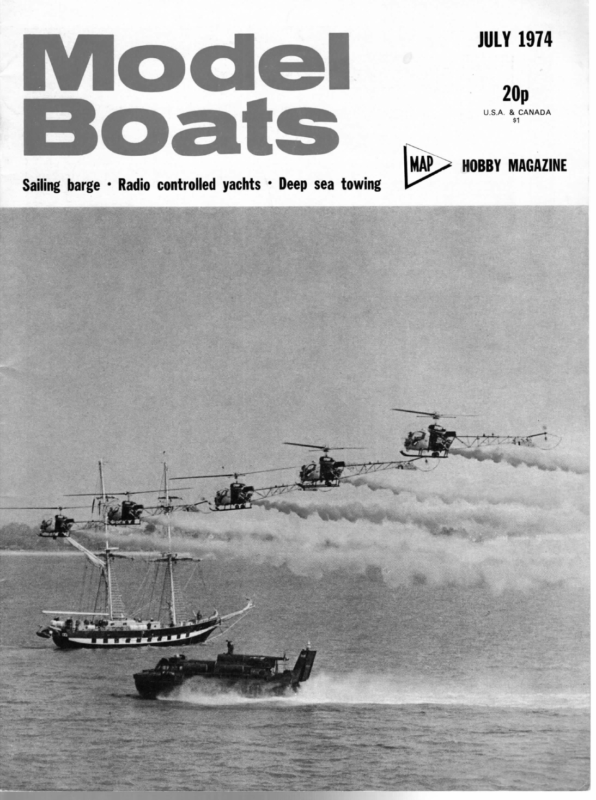
- In the Tideway
- A Proportional Sail Winch Mechanism An easily-made switching device, ingeniously simple, which is completely reliable By Norman Curtis
- MOONRAKER II We build up one of Nylet Ltd.’s kits for a Marblehead class radio yacht — Part Two
- GENIE Part 7 of Vic Smeed’s ultra-simple Marblehead class yacht for vane or radio-control sailing.
- ULTIMA THULE When Andrew Rutter of Seahouses saw his barque photographed on our March cover, he sent in the following account of how he came to build the model.
- POSTSCRIPT TO ‘R/C YACHTING IN THE U.S.A.’ by Lawrence V. Goodrich (secretary, Model Yacht Racing Assoc. of America)

Model Boats Sailing barge – Radio controlled yachts – Deep sea towing Ue a HOBBY MAGAZINE
JULY APOLOGIES to those of our readers who received the last issue a day or two late; our printers were just beginning to pull back from the effects of the three-day week when they were affected by a national overtime ban by one of the major print unions. Like a string of railway wagons slowed suddenly, the effect ran back through all the printing schedules, so that even innocent publications like this one were affected. At the time of writing a second major union is involved in industrial action, but we hope that the dispute will be short-lived and that we shall be back on time as usual from this issue onward. Other and different troubles are never far away, however, and the latest is a 25 per cent increase in the price of paper, which, coupled with about 10 per cent on the printing bill and a large (and variable) jump in the cost of metals, etc., for blocks, plus all the other cumulative increases in the last couple of years, has meant that we have been forced to seek approval for a cover price increase. It is a month or two short of five years since we last raised the cover price (subscriptions more recently due to postal rate changes) and there aren’t many things which have remained static in price for the past five years. New prices are 20p per issue, annual subscription, including packing, new post rate, and annual index £3.15 ($8.50 U.S.). Naturally existing subscriptions will be honoured for their full term. Now the good news — we shall be including regularly the extra eight pages which we have only been able to add occasionally in the past two or three years, so, on the whole, the reader should be no worse off — he just gets more reading for a little more expenditure on each issue. Which is an appropriate time to remind everyone that articles are always needed, preferably practical ones which help fellow-modellers; everyone has some useful experience, even if it’s only mistakes he made. We know several people who’ve said they’ll write something for publication — how about starting it now? World Yacht Championships? Preliminary discussions have been going on in the M.Y.A. Council on a proposal to stage a World Championship for vane yachts in both ‘A’ and ‘M’ Classes for 1975. What has been suggested is a nineday International for these two classes from July 26 to August 3, at Fleetwood, by courtesy of the Fleetwood Club. This would be the time when the normal British Open Championship and International ‘A’ Class event would be expected to be run, and in lieu of this there would be a British Championship, for English skippers only, over the three days of the Spring Bank Holiday (May 24-26), plus the World Championship, which would be restricted to a maximum of 36 ‘A’ boats; it is reasonable to think that at least half of these would be English entries. The World Championship ‘M’ would also have a similar number and would, of course, be a new event. Since no skipper could enter both World events, the number of British able to sail at Fleetwood for the nine days would seem likely to approximate the number who might wish to sail there for the customary week, except that not all would be sailing ‘A’ boats. Overseas competitors wishing to plan 1975 activities are asked to note this proposal, arrangements for which will have to be finalised by September. The M.Y.A. A.G.M., incidentally, will be at 11.30 on Saturday, December 7, in the Reading Room at the Regent Street Polytechnic, London. With such 1974 In the Tideway early notification, a good turn-out can surely be expected? Water at Stoke As part of the general tidying-up of Stoke-on-Trent the council has turned an old marl-pit into a small sailing lake and adjacent to ft has provided a model boating lake, large enough to take a Naviga course and nowhere deeper than 1 metre. Unfortunately a pair of swans chose to nest on part of the intended excavation, so that there is now a small island in one corner, but at least it’s a pool for model boaters and not anglers. Named Westport Lake, it is about 1-mile from the Tunstall roundabout east of the D500 turn-off from the M6; the water is in fact visible from the motorway access road. Local boaters make an effort to be there on the first Sunday of each month especially, but there are usually boats running on all Sundays, and it is a case of the more who use it the better. Thanks to Paddy Hamill for the information. Turi Sails A club measurer has queried the three smaller rigs shown on the drawing of the Turi Marblehead in our May issue, which shows the luff of each sail drawn on a common jibstay line, i.e. all on the same hoist. M.Y.A. rule 6(e) lays down that the height of the jibstay of any alternative suit shall not exceed 80 per cent of the headboard height of the mainsail of that suit. Builders of the design may wish to note this and we will endeavour to seek a clarification. Club Notes George Clark, secretary of Y.M.6m.0.A. and Danson M.Y.C., has a new telephone number 01-318-3737. A new name is Acton/Ealing Scale Group, which is a scale-only group with exclusive use of a small pond on Sunday afternoons. Anyone with similar interest is invited to get in touch with D. Wiseman, 8 Woodhurst Road, Acton, London W3 (01-992-7575). Maidenhead Model Makers Club has _ recently registered a boat section with the M.P.B.A. The club caters for all forms of modelling, and will welcome new members on any Friday night at its own club house in Holmanleaze, Cookham Road, Maidenhead. Details from the Secretary, Maidenhead Model Makers Club, ‘Highwood’, 52 New Road, Twyford, Berks RG1O 9PT. FROM FLEETWOOD’’S SECRETARY Dear Sir, The M.Y.A. Council have proposed that in 1975 the ‘A’ Class British Open Championship Regatta be changed to a 3-day event in May, restricted to English Clubs only, to be followed in July with an International World Championship for ‘A’ and ‘M’ classes, restricted to 36 entries in each class, skippers being only allowed to enter one of the classes. Since this proposal, if adopted, will radically change the ‘A’ Class Open National, as we have known it, we feel that those interested should have an opportunity to express their approval or opposition to the proposition. Please write to me at 18 Greenfields, Caton, Lancaster LA2 9QY. W. K. Rodrick, Hon. Gen. Sec., Fleetwood M.Y. & P.B. Club. 257 HINT
i es a MODEL BOATS All photographs of the works are taken from beneath, i.e. the lid of the food-box is reinforced with ply and receiver, servos, etc. are mounted to the underside of the lid. Visible at right is Harringay Electronics motor with worm. Note use of studding pillars to space ‘deck’ which _ provides second bearings for shafts. OE KLE RTE BOGE ER OC sie A Proportional Sail Winch Mechanism An easily-made switching device, ingeniously simple, which is completely reliable By Norman Curtis A RELIABLE winch is still the big stumbling block in R/C yachting, especially if proportional control gear and 50:10 spur gears (RipMax), giving a total reduction of 165:1. In mounting the gears, use 3/32 is required. Here is a simple proportional switching gear used successfully and with complete reliability over the past 12 months or so. Besides simplicity it has the advantages of adaptability to any size boat in. silver steel for shafts and file flats on them for grubscrews. Replace the grubscrews in the gears with 8BA steel setscrews. Back the SOT gear with a Formica disc epoxied to the spokes. With these can be made on the kitchen table. slip-proof. and any radio equipment, and wife permitting, it Basically it consists of a cam superimposed on a segment, both pivoting on a common centre. The cam, A, is moved by a conventional proportional servo by means of a wire push-pull link. The seg- ment, B, is moved by a braided Terylene cord fastened to the shaft of the winch drum and is returned by a spring or rubber band sufficiently strong to operate the two small light-pressure microswitches mounted on B. Movement of the cam by the servo will close one or other of the microswitches, switching on the geared winch motor and revolving the drum shaft which will wind up the cord and move B until the switch opens. The winch will stop and remain at rest until cam A is again moved by the servo. Looking at the sketches, it will be obvious that measures the gears will be adequately strong and Make up the winch drum from discs of Formica and ply after you have checked how many revolutions your particular switchgear gives you and what distance you have to move your particular sheets. Use a gear boss to fasten the drum to the shaft. The cam and segment in the photographs are made from + in. Paxolin sheet but any stiff insulative material, even plywood, could be used. Note in the pictures the use of a Meccano–type pulley to take the cord round a corner and a second one, grubscrewed to the bottom end of the winch shaft, to secure the end of the cord, which passes straight through both flanges of the pulley. Cord Return spring the number of revolutions of the winch drum can be altered by altering the (radius of the) attachment mommt of the servo link on A, altering the (radius of the} attachment point of the cord to B, and /or by moveasang the ameter of the drum-shaft by sleeving pr oaseds ay Es seme oe the G@stance between the switch- mestt—seil Sor Ge acer emf 2 wack) eoee?t Heeomess goes Glecrrosexs stor wk 2 33-1 worm B To servo
JULY 1974 The cam and segment clearly shown; winch servo is obviously at top left. The rudder servo is mounted on its side beneath the moving segment; note that it operates a vertical rod through a bush, the tiller being on the outside end of the rod. Use of tight plastic sleeving to lock wires against disengagement is noticeable. The exterior of the radio box has only the tiller and double winch drum projecting. Aerial emerges from a hole and is sealed, on-off switch is operated through the rubber membrane clamped in place by the brass circle visible. To reach frequencychange switch, the corner of the lid has to be lifted, and the word ‘Crystal’ is a reminder of which corner needs to be opened. Drum diameter is calculated from number of revolutions given by individual unit and distance required for sheet movement. View of switcher from oppo- site side. This installation uses a rubber band instead of a spring return. Lower for segment pulley is on lower end of winch shaft and traps end of cord, which actually winds round shaft. Receiver is bottom left, fits in cut-out in ‘deck’. Whole unit is simple and inexpen- sive to make. (All photos by Simon Johnson.)
MODEL BOATS MOONRAKER II We build up one of Nylet Ltd.’s kits for a Marblehead class radio yacht — Part Two GQHORTLY after our last issue went to press, Nylet Ltd. sent us a set of their new instructions for the Moonraker kit. There are one or two slight modifications, notably to deck beam layout and the option of insetting the transom, but these points are adequately detailed in sketches and words in the instructions, and builders should have no problems in following them. A beginner might, however, find that the rigging details are not sufficiently comprehensive for him, so we propose to cover this part of building the boat fully; it is difficult for a manufacturer to cover every tiny point without writing a fat book, and many people building the kit would not need it. Most of the deck fittings were in place before finally securing the deck, so all that remains to be positioned are the shroud plates and two eyeplates (fairleads in the instructions) for the sheets. One advantage of a Formica-type deck is that it is strong enough to bolt the fittings in place without additional reinforcement, although the shroud plates bolt through the inwales or an additional short piece glued to the inwales since these are usually the most highly-stressed items. The mast is a substantial jin. dia. anodised tube to which is joined a topmast by means of a machined plug tube. On this plug is slipped a threeeye mast band (the eyes are for shrouds and jibstay), the band being epoxied to the plug which in turn is epoxied in the main mast length. The topmast needs a slot sawn in the top for the masthead plate (or jumper strut) which is epoxied in, or the mast may be cross-drilled through the plate and a nut and bolt slipped through. A nylon plug is epoxied in the base of the mainmast — scratch up the surface of the nylon to help key the epoxy — and this has a stud which engages in one of the holes in the mast step plate. Two mastbands are fitted, one to receive the kicking strap and the other carrying a lug with a stepped pintle for the gooseneck. To finish the mast and topmast, a jackstay is required, and this is from two lengths of 24g s/s wire with the ends turned and tucked into tiny holes drilled as specified in the mast and topmast, bound to the tube at intervals with plastic tape. It is best to lay the sail against the mast and mark the sail luff hook positions so that the tape binding is applied between the hooks. The booms are cut from ?in. anodised tube and since there is a little spare, they can be cut +in. Top, mainsail clew with outhaul and gooseneck, showing sail tack hook engaged and nylon plug gooseneck. Upper end of kicking strap visible. Below, jib clew with outhaul (note wire clew rings on this and main) and jib tack. Jib tack hook engaged in eye of jibstay hook. Fishing swivel has been changed since open end will not take strain. hey 266
JULY longer than specified; this makes providing flow adjustment easier and you can always cut it off if you decide it isn’t a good idea. A solid cylinder of nylon is provided for the gooseneck and_ this is epoxied in the main boom end, leaving #in. protruding. Drill accurately across the diameter of the protrusion a hole which is an easy fit on the pintle pin, then with a sharp blade carve the nylon to a thickness which will be an easy fit on the thick part of the pin’s shank; this should leave you with a horizontal plug about +s in. thick with a vertical hole through it. Round off the end and assemble to the mastband, checking for free movement over full travel, and remove. Drill through the boom tube and nylon and secure with a 6BA bolt or eyebolt, then measure from the pivot hole centre 12in. and drill for another anchor bolt which will retain a small plate beneath the boom. The plate is simply a slip of brass or s/steel with three holes, one for the bolt, one for the kicking strap, and one for the mainsheet. A further hole is drilled at the boom end for one of the eyebolts provided in the kit. 1974 band and hook it back on itself. Check length to shroudplate including rigging screw and cut off (about 52in. is probably right). Make off lower end to rigging screw by passing wire through and hooking back round itself. Two pairs of good quality pliers, one small round-nose and the other taper or snipe nose, are really essential for wire rigging. Repeat for other shroud. The forestay is a length of 24g wire secured to a hook at one end, engaging in the front hole of the masthead plate. The other end (about 66 in.) is made off into a tiny loop and to this is tied a foot or so of rigging cord. A bowsie is slipped on the cord, followed by a hook, then the cord end is again passed through the bowsie (from the same side as before) and knotted. The hook engages in the eyebolt at the bow, and when the bowsie is slid up to bring the stay taut, the mast will stand by itself. A backstay, on the same lines as the forestay, com- pletes the standing rigging. The jib comes with a line through its luff hem to use as a jib stay, and this needs a hook at its lower end to hook in the foremost jib boom eyebolt. The Note tape binding for jackstay. Left, mainsail uphaul or halyard hooks into masthead plate. Vacant hole takes forestay. Centre, jib uphaul tied to jib head eye (left bowsie) hooks in eye of jibstay hook (right bowsie). Right, foot of mast showing gooseneck and kicking strap bands, mast step, and jib sheeting eye. The jib-boom needs an eyebolt through each end (eyes on top) and one, eye beneath, 14 in. back from the fore end. This last accepts a fishing swivel — a No. 4 barrel swivel — which comes with loops sealed by winding about three turns of the wire round itself. It is best to saw through one wire where the wind-off starts and slip the severed coil bit off. The remaining wire is enough to pass through the eyebolt and tock back on itself. The other end is best fitted with a hook to engage the jib-rack; if the swivel wire is cut and formed into an open hook it is not really strong enough to take the tension necessary on the jibstay. Now rigging can start. Place the boat on its stand and have someone hold the mast in place, or tie it to an overhead beam. Pass the end of a length of 22g s/s wire through one side eye on the top mast- tack eyelet (front bottom corner) needs a hook which hooks into the eye of the jibstay hook, to prevent the jib from sliding up the stay. At the top, the jibstay has a hook and bowsie, the hook engaging in the mast band eye, and the bowsie adjusted to bring the stay up really taut. A short line is tied to the head eyelet of the jib and this too has a hook (engaging in the eye of the top stay hook) and bowsie, so that the luff of the jib may be hauled taut. We confess to departing from the instructions for the jib clew (aft corner) and flow adjustment. A hook is attached to a short length of line and hooked into the clew eyelet. The line passes through the boom eyebolt and turns forward to make off in a hook and bowsie, the hook engaging in a hole drilled in the side of the boom. A 267 little experiment with (continued on page 281)
MODEL BOATS Close beat A yy WIND 3 GENIE Free beat / Cy Close reach Part 7 of Vic Smeed’s ultra-simple Marblehead class yacht for vane or radio-control sailing. | ~s a = ie SY Full reach =e / \ / SS al = =e Reach Full run APART from the backstay, the major differences -*TM between a radio and a vane version of Genie are simply the methods of operating the sheets and rudder. The sheets for radio just go to a winch in- stead of a manual bowsie, and the rudder is linked to a servo instead of to the vane. There could be a difference .in the rudder itself if a builder decided to use a spad> type for R/C, as discussed earlier in this series, and of course there is the provision of a waterproof housing for the radio. Otherwise it is simply a question of the additional weight of the equipment. The primary factors in radio racing are the skipper’s experience and skill and the level of performance of the boat. At present, in the smaller classes, the first still outweighs (to some extent at least) the last; an experienced skipper can win with a boat which is not necessarily the best one racing. As more and more skippers reach the same degree of decreases and the drive decreases, quite rapidly past about 15 degrees heel. Thus a boat which is stiff and sails more nearly upright is presenting a greater sail area to the wind and all other things being equal, must therefore enjoy more drive and travel faster. Ideally a yacht should heel easily to about 15 deg. and then stiffen up. One of the major factors in improved Marblehead performance over the last few years is the adoption of the fin and bulb keel, which contributes considerably to this condition. Stiffness is also affected by beam, hull section and draught. So far most radio boats are basically vane designs adapted, and in the case of a Marblehead, to achieve the same waterline, a considerable-change in weight disposition is involved, since the radio weight is some 10-15 per cent of the total, against the vane, which is only about 2 per cent of the total. It is not easy to lighten construction of the boat, so the difference has to come out of the lead, which reduces the power of the yacht, i.e. it will heel more readily and to a greater angle in the same wind strength than the unconverted design. This aspect will probably be the primary factor in any RC-only design. The change of weight disposition is aggravated by the tendency to mount all the equipment at only just below deck level, so that a concentrated lump of 2-3 lb. is perhaps 2in. above water and therefore a destabilising influence whereas, if it was 2in. below water, it would help and not hinder stiffness. It is convenient to have the gear fairly high to get at it, and comforting to have it above water, but ultimately it will go on the floor of the hull, if not in the fin, to produce a competitive model. Sorry about the digression, but it does help to explain why we show the radio installation in separate boxes on the floor of the hull in a sketch on the plan. At the very least the batteries and the winch experience, racing will become much closer and while some will always have a greater natural skill, boat performance will matter more. Quite a lot of radio- should be mounted down there. On the other hand, A norma! yacht is designed to a given waterline and is balanced carefully by the designer when it is floating on that waterline, which it will only do at the water (which is about what 141b. does) does not materially upset the balance further, but that extra 13 lb. on the lead (14 per cent of the lead weight) only skippers appear blissfully unaware that their boats could be improved, and although this is a big subject, two particular aspects are worth a few words. designed displacement. Balance is important in vane boats because of the small amount of force which can be applied by the vane. Much more power is available for rudder control with a radio servo, but rudder should be used as sparingly as possible, as applying it is like putting a brake on. As the number of R/C skippers grows, it is therefore going to be necessary for much greater attention to be paid to getting the all-on weight to the designer’s figure and therefore sailing with the hull at maximum efficiency. On RA boats the measurement requirements already assure this, but over- or sometimes underweight boats in other classes are far too common. Secondly, the stiffness or ‘power’ of a boat is important. As a boat heels, the projected sail area 276 we sanction a different displacement for a radio version, 14 lb. heavier. This is because all designs are a compromise, and in this case we have had to accept a degree of imbalance in order to produce so simple a hull shape; sinking it 3 in. lower in the makes a lot of difference to stiffness. In other words, we gain more on the swing than we lose on the roundabout; the only point to watch is that the waterline does not exceed 50} in. The method we have used successfully on other boats is that shown in Guy Batho’s notes in March 1973. M.B. The rudder servo links direct to a thwartships tiller, using an E.D. or Kwik-link pushrod, and the second servo is mounted between two micro-switches, a cam on the servo output spindle closing either switch to sheet in or out. Those who prefer proportional sheeting are referred to the switcher elsewhere in this issue. The winch itself is simply a Richard II (Monoperm Super Motor) with a drum made by grub-screwing
JULY: 79:74 should be adjusted so two Meccano bush-wheels on the output shaft. A anchorage point. The bowsie on the steering gear tension small a just is there of that stub a through up and back leads Terylene line the vane will not or much, too not central; it bias to the through angle appropriate the tube epoxied at job. its do to .power enough have then forward, lead to eye an deck, turns through divides to lead to each sheeting eye, where the lines terminate in rings to engage the sheet hooks. From Sailing Trials Comes the great day, and try to pick one with a the knot of the dividing point a length of thin hat nice gentle but steady breeze. Assemble the yacht elastic leads right to the bow, turns through an eye and check carefully that the mast is in the right place or puiley, and runs back to be made off on a shroud plate. This keeps the winch line in slight tension all and truly vertical. Bend on the sails and haul the luffs up reasonably taut; make sure the jibstay is the time to prevent tangling. This arrangement is virtually foolproof and gives really taut. Disconnect the vane centring elastic, put the boat in the water and heel it to one side. Adjust control in even strong winds. Using a two-stick the counterbalance weight on the vane so that the Horizon radio and all dry batteries, the total radio arms move freely. Check the attitude of the boat weight is 224 .0z. This is using a 1289 44 v. ‘flat’ battery for the winch, which gives a minimum of two hours continual sailing and much longer if used : intermittently. The vane gear shown in several Genie pictures is a commercial one available from J. Roberts, and one can also be obtained from W. Jones. Despite giving their addresses in this series, we have still had a number of letters asking for them, so we repeat them: W. Jones, 57 Forest Road, Birkenhead, Cheshire, and J. Roberts, 180 Crown Lane, Horwich, Bolton, Lancs. For those who wish to make a vane, there are two in our publication ‘Model Racing Yacht Construction’ and a simplish one in ‘Boat Modelling’; there was a straightforward one in Dec. 1972 issue, and one in April °71. Your public library may be able to help with these. We also hope to be publishing another shortly, so there is no shortage of information. The feather size which is fitted on the prototype is 23 x 14in., and it is cut and sanded from Lin. balsa, quarter-grained if possible. This is the stiffest type of balsa and is usually identifiable by having a curly, gold coloured flecking in the grain. Tangent cut, which has broad grain stripes and rolls easily, is not suitable, but radial cut (stiff, with thin close spaced grain lines) can be used if care is taken to avoid splits. Give the feather a couple of coats of polyurethane — we find the clear polyurethane sealer sold in Woolworths very useful. It is thin, light, and can be bought in small amounts. Check the vane gear for absolutely free movement (this applies to the rudder too) and attach to the tiller (or the forward part of the vane carriage if easier) a thin rubber band made off on a cord and bowsie run forward to an eye immediately behind the main sheet; a double eyeplate here is one way of making it tidy, but all that is needed is a light MAIN afloat: it must not be bow-down. If necessary tape an ounce or whatever of weight to the bow or stern, later to be epoxied firmly inside the hull. Now wedge under the tiller so that the rudder is held firmly central and the vane cannot operate it. For a radio version, all these checks apply except that it may be possible to adjust the trim by moving batteries etc., and of course no vane balancing is needed. The rudder will normally be held amidships by the servo, but make certain it is truly central. Ease out the sheets until the sail booms are at about 15 deg. to the centre-line of the boat, say the mainboom end just inside the deckline. Check the wind direction and put the boat in at the leeward (downwind) end of the lake. Settle it at about 40 deg. to the wind and let it sail out of your hand. Watch carefully to see whether it tends to head up into wind or wants to turn away from the wind. For vane, retrieve when it comes ashore, for radio, let it sail until you are sure you have seen what is happening, then use the rudder to manoeuvre it back to you. If the boat bears away from the wind markedly, move the mast back a notch; if it bears away only slightly, simply raking the mast (angling it) back may be enough. If it heads into wind, move the mast forward a notch. Now repeat, again leaving the rudder fixed central. Adjust until the yacht tends to head slowly into wind, gradually slowing until the sails shake, then veering away and starting to sail again, coming up to the wind, etc. This is the ideal basic trim for the vane version. Check that behaviour is the same on the opposite tack, and the tiller can now be released. Come back to the starting point, line the boat up on the same heading, and move the vane feather to line up with the wind, leaving the carriage (continued on page 284) SHEET THIN SINGLE WINCH LINE THROUGH TUBE IN DECK, RETURNS THROUGH EYE OR PULLEY. EDGE. TILLER RECEIVER AND BATTERIES ETC. PUSHROD —__ SINGLE TILLER (CAN BE INTERNAL) ‘HAT ELASTIC’ FROM JUNCTION TO BOW PULLEY, RETURNS TO EYE ON DECK / JUNCTION DRUM WINCH
LS ULTIMA THULE When Andrew Rutter of Seahouses saw his barque photographed on our March cover, he sent in the following account of how he came to build the model. them in the village. To do so meant a journey to either Alnwick or Berwick by tram, and I used to look longingly at the local joiners’ tool bags — at those lovely sharp tools! By the time I got to sea with my uncle as skipper I was put in charge of the engine, now fitted in most of the fishing boats, a paraffin burner two-cylinder job with an enormous flywheel (at least, I thought so then). I had to learn the hard way by trial and error, but it resulted in my acquiring a handiness with tools. Meanwhile my few models were getting better and I had visions of someday producing something spectacular (who doesn’t day-dream at times?). Came the war, of which I spent nearly six years in the Navy, resuming my former trade of fishing after my discharge. Those were hectic years for me, and I had little time to devote to the lighter side of life, having a wife and family to support. Eventually I left the sea for a job with a local builder, and now working regular hours could once again think of producing my mind-creations. I started on a model of a steam drifter, 3 ft. 8 in. long, made of heavy gauge tinplate, with water tube boiler and compound engine, completing this successfully in four years, but my mind’s eye still re- SUPPOSE it all began nearly sixty years ago, when as a very small boy I stood with my father on the ‘Point’, along with nearly all our village folks, watching the abandoned three-masted wooden barque, Lovespring, driving ashore in a gale. Timberladen from the Baltic and only kept afloat by her cargo, her crew taken off a few days previously by a steamer, she drifted helplessly broadside to the wind and sea, rolling violently in the troughs of the seas, yards and masts swinging wildly, as pathetic as a broken winged gull. ; E Everybody was silent as befitted the occasion of the death of a fine little ship, and there was a sound like a groan of anguish from the watchers as she struck heavily and her tall spars came crashing down — a total wreck. Today, all that is left is a rusting jumble of wire rope from her shrouds as her memorial — the last sailing ship to be wrecked in our area of the main- tained land. Of a long line of seafarers, I was born in the latter days of the ‘sticks and string’. My grandfather, father and uncles annually sailed their big, brown-lugged ‘fifie’ to the Yarmouth herring fishing for the season from September to November, their navigation instruments a watch and a compass plus that in-built instinct only possessed by true sailormen. Thus, my young ears were constantly filled with talk of tall masts and thrashing canvas. My mother’s father was a ‘shell back’ of the old square rig school, who after his marriag2, came back to the fishing. He had a wonderful modz2l of a small barque in a glass case which he had made himself, complete to the last bit of running rigging. One of my uncles left the sea to become a mason, but still his heart showed where it lay in his prolific output of models of all descriptions, barques, ships, luggers, smacks, yachts, all sailing models mostly, ballasted with lead keels and guaranteed to sail. Soon I was trying my ’prentice hand on odd bits of timber, my tools mostly a large clasp knife and a rather blunt. axe, the resulting effort having to stand a lot of criticism from the professionals! In those far off days there was little money to spare for good tools, in fact, it was almost impossible to purchase the image of tall masts and white canvas. The big snag was suitable timber, as my proposed ship was to be at least four feet from taffrail to figurehead. (I even had the name Ultima Thule for her picked out.) However, everything comes to him who waits, so it is said, and one memorable day I was able to acquire just what I had been waiting for, two pieces of old yellow pine, four feet long by eight inches by three inches. Having removed various nails, etc., and set to and planed two surfaces dzad smooth and screwed them face to face, I marked off the outline of the ship and set to with axe and chisel. As it was intended as a working model it was decided that the rig would have to be a barque for handiness; a square-rigged ship having the mizzen braces leading forward to the mainmast meant an added complication when swinging the yards over, and anyway, nothing would be lost in sailing qualities, as some of the ship-rigged tea clippers when cut down to barque rig showed very little alteration in speed. Speed being at the back of my mind, the hull was to be on typical tea clipper lines, always keeping in mind the fact that when making a working model to scale or near-scale, one is contending with over-scale winds. Consequently, I decided that the more ballast carried meant more stability plus a little extra displacement, plus a little pruning aloft, the results being more than justified during trials and after. Many model makers are very disappointed after making a scale model and finding that she will not 280
JULY stand up in wind like a real ship, and I have seen some very nice models fitted with a (to my mind) clumsy lead cigar beneath the keel which can only add to the resistance of the water. Far rather would I make a ship which although a wee bit over scale, Jooks right both in and out of water, so by increasing the beam only one inch and the depth only one inch plus a flattish deadrise amidships, without sacrificing her very sharp entry and keeping a generous fullness of the quarters, I was able to ballast her with 28 pounds of lead. The lead keel is 1 inch deep, running from the stern post to within 3 inches of the stem and tapered from 1 inch in the middle to 3/8in. forward and aft; cast in a mould, it was screwed on from inside the hull with stout bronze screws. Inside the hollow hull are two ingots screwed to the keel line and adjustable to fair the fore and aft trim. The two thicknesses of the hull are glued and screwed together as sketched. 1974 Turning a deaf ear to my wife’s remarks, I started setting up the lower masts, and after reeving the lower standing rigging of Canadian black nylon and fitting the tops and setting up the fore and main topmasts, I was a bit pleased to hear her say ‘It’s going to look nice’, and by the time the ship was rigged several nights later, both my wife and daughter astonished me by asking who would hem the sails! By some strange alchemy, both were now eager to see the Ultima in full dress! So I lost no time in preparing stiff paper templates of the various sails, and the cottage resounded with the chatter of the sewing machine. As I said before, this was to be a real working model so everything was kept as simple as possible. The braces, of cotton twine, are made taut by white Perspex bowsies, the royals, top gallants, jibs, staysails, mizzen and mizzen topsail are fitted with sheets and halyards so I could shorten sail if need be. The flying jib was purposely kept on the large side to reduce the tendency of most models to fly into the wind. After hollowing out to a side thickness of 5/16in. average, except for ribbing pieces to hold the screws, the keel, stem and stern post were screwed into place followed by the deck, bulwarks and pin rail. The lowish poop and forecastle decks wzre next and then the capping rail of elm heart. All spars are of straight grained pitch pine varnished and white tipped. The figurehead is of a Viking complete with sword and round targe and a moustache and beard! (Took me three nights to carve him with the point of a broken knife.) The mast rings, cheeks, lowermast fittings, yard slings, etc., are all of brass, drilled and filed to shape, this being the most hard-slogging job of the lot. Space prohibits me from describing all the various small items, including the turning of the poop and forecastle rail stanchions, but at last came the time for setting up the masts and rigging. The hull, painted and varnished in the famous Aberdeen livery, was brought home from my workshop to the dismay of my good wife, who declared in no uncertain terms that such a large ship could not be accommodated in our house! My daughter remained neutral, as usual, being more tolerant of her dad’s little failings! MOONRAKER (continued from page 267) length and angle of the hook will produce one which virtually clips into the hole; the aim is one which will stay firmly in place but which can be removed if necessary. Removal of the sail simply involves unhooking the clew eyelet, leaving the flow adjuster (or clew outhaul) in place on the boom. The mainsail needs a short line tied to its head eyelet, made off with a bowsie and hook to engage I fitted a loose rudder on proper pintles and gudgeons operated by a heavy brass tiller under the poop deck cabin top, and by soldering a toothed gear to the head of the rudder, the theory was that when she heeled to leeward the tiller would automatically fall to leeward and operate against the rudder, to pay her head slightly off the wind. However, as Rab Burns once said, things ‘oft gang agley’, and on her very first trial held in the harbour I found she was so well balanced that a set of the mizzen sheet would make her lie to her course like a witch, so the tiller was fixed fore and aft and has never been used since. I’ve had her out in a force 6 with only the royals off her and the mizzen topsail stowed, she will run before with mizzen topsail stowed, will point up into the wind with the mizzen sheet tight, in fact, she has no bad habits that I can find yet, unless it be that she mustn’t be sailed in the open sea in any wind over force 2 with only a rowing boat in attendance or she’d leave it standing! Should any readers visit my part of the world this summer I’d be pleased to have a yarn with them and show them the original. I now derive part of my income by painting ships and old-time fishing boats in oils and water-colours and try to recapture a little of the spirit of those times when ships were the embodiment of grace and beauty, whose designers and builders reached out to grasp the sublime. Sic transit gloria mundi! the ends together, to hold the sail to the boom. A ring should be fitted to both jib and main, just large enough to slide over the boom end. At least 20g wire is desirable to prevent elongation by the sail pull. To ‘bend on’ the main, slide the ring over the boom end, hook the tack in place, hook the head, and tighten the bowsie at the top to pull the luff taut. Hook the luff-hooks to the jackstay and don’t forget to engage the outhaul hook in the clew eye. The kicking strap provided is a Kwik-link which snaps into the hole in the plate beneath the boom, the other end being simply bent to hook into the eye provided on the bottom mast band. All that is now needed is the sheeting system and the radio installation, which we will cover next in the masthead plate. A hook in the tack fits the hole in the pintle pin, and the clew is treated exactly as the jib. Since a cord outhaul on a sail clew allows the clew to lift, thus negating to some extent the effect of the kicking strap, a wire ring is passed through the clew eye and round the boom, hooking time. 281
JULY HE M.S. Eagle is owned by Southern Ferries, an A ‘simplified’ 100 ft. associate company of the General Steam Navigation Company, which is itself a part of the P & O M.S. EAGLE The Eagle runs between Southampton, Lisbon and Tangier and it is an interesting fact that the increasing demand for holiday facilities has made it possible for a passenger service to be established over a route where nothing similar previously existed. Many passenger liners called at Lisbon and a few called at both drawn and described by R. Carpenter of over 400 ft. and a capacity of 750 passengers (all of whom can be accommodated in cabins) and‘up to 270 cars, the Eagle is the largest British car-passenger ferry in service. Her engines, which produce 20,400 b.h.p., give a service speed of 22 knots. The Eagle is also capable of carrying out extended voyages and the layout and equipment put her in line with modern cruising liners generally. Lisbon and Tangier, but these ships were nearly all engaged on long voyages and it was not always possible to arrange the return journey to suit personal needs. The Eagle was built in France by DubigeonNormandie SA and is typical of several liners and ferries built in France in recent years. With a length (XHE reaction here to my articles in the March, April POSTSCRIPT TO ‘R/C YACHTING IN THE U.S.A.’ and May issues has been quite pleasing, but since I finished them in late December I have wanted very much to make a few corrections and to add some things we have learned since. Progress on developing the ideal sail control unit has been disappointingly slow. As to the modified servo SCU, Ted Kuron kindly modified a Kraft servo and adapted it to my MRC receiver, but I have by Lawrence V. Goodrich (secretary, Model Yacht Racing Assoc. of America) decided that it is much too slow and too weak to try in competition this season. The full travel time (without load) was at least 35 seconds and towards the end of the travel it was agonisingly slow as it searched for the null point. Electronically, as Ted explains it, the problem is that when you modify the ‘pot’ to extend the travel from 90 to 720 degrees you greatly magnify the time required to find the null point. I have been toid that in Europe small integrated SCUs are available from Graupner, Simprop and perhaps others, but that none of those SCUs is compatible with the electronics of the R/C equipment eight inches long with an effective jockey travel of six and a half inches, giving 13 inches of sheet pull if the lines are doubled on the deck. Without batteries it weighs about 12 ounces with a heavy Pittman motor or as I have pointed out, the most difficult part of a conversion remains the SCU. If R/C equipment manufacturers would take an interest, _.MYRAA would be glad to work with them to define the specifications for an integrated SCU. As to the standard SCU I have been using, we have not over the Winter been able to get the weight down to the point that all the on-board equipment weighs as little as one pound, and I now think that a more realistic target for an M is a pound and a half. Some of our experiments using glass fibre mounting boards and slotcar motors turned out to be too fragile or too weak as far as I am concerned, although a few plan to use them this season. Incidentally, it is no longer true here that good, reasonably priced six-volt motors are readily available, and we would appreciate any advice from your readers as to their availability abroad. I did not anticipate another development in SCUs types which are quite light and have more than adequate power. The smaller of the two is about eight ounces with a small 12-volt motor like mine. It consists of two aluminium endplates connected together at the bottom by an aluminium T-bar. The threaded rod is made of stainless steel and is mounted in a bushing at each endplate. The rod extends through one endplate where a spur gear is attached which meshes with a spur gear mounted on the motor shaft. The motor is mounted on the inside of the endplate with the shaft going through the endplate so it can take its spur gear on the outside. Thus length is reduced by mounting the motor parallel with the rod instead of on the end of the rod, as in the Dumas. The jockey is made from an aluminium block. For perhaps three-quarters of an inch at each end of the rod the threads are filed down smooth and a short spring is placed at each end so that the threaded jockey will simply idle at the end of the travel if the control key is held too long. The spring has to have just enough tension to kick the jockey back to the threads when the control is released so that the jockey will travel in the other direction when the opposite control is used. (See April 1972 MB for sketch of this system — Ed.) To my mind, this is simplicity itself with very little to go wrong. It eliminates the set of limit switches I use to limit the travel of my drum, an important factor because limit switches can be expen- readily available here. In this case, your European readers seem to be much better off than we are since, By careful attention to selection of materials and to design, two of our members have produced proto- French-built modern ferry group. which took place in the Spring. Several really ‘fine craftsmen, working independently, have developed quite impressive SCUs, using a jockey riding on a threaded rod to trim the sheets, the basic concept of the commercially available Dumas SCU, which we have found is much too bulky and heavy for an M. 1 in. 1974 sive and they are prone to jamming and failure from moisture damage. But this type of SCU is not so easy to mount in a hatchbox like mine, and that leads me to another refinement of what I wrote earlier. My completely contained hatchbox is still the basic concept to work towards because it allows you to use the same equipment on several boats and it is easy to take home to work on. However, I have a modification to suggest based on recent experience in heavy Spring winds. Water has been leaking through 283 Se Sa 2 ee ||
MODEL BOATS allow a dangerous amount of moisture to reach the fashioned an extension for the battery pack and pushed it all the way aft, cut a new 43 per cent jib and trimmed back on the roach of the main and took about three-quarters of a pound of lead off the front long rod to the rudder if I keep the rudder servo in the box, whereas quite a few of our members have fraction too low at the transom but that is much better than having the bow down. I made these changes in the reverse order to which I have stated them, I should not have started hacking away at the bulb first because that would have been the hardest item to restore if I went too far. Try the easiest the top of my hatchbox where the drum shaft and the rudder servo shaft go up through the top. Although only a few drops, it is enough over time to receiver. At least in my rig, the servos and the winch motor do not seem nearly so sensitive to moisture and some of the newer servos are being manufactured waterproof. Another factor which I do not like about my hatchbox is the fact that I have to use a rather mounted a servo in the deck just a few inches in front of the rudder post, running an extension cable under the deck back to the receiver. Also, some of our members have mounted their SCUs below deck on a platform to keep it above the bilge, in which case the lines are usually strung through a hole in the deck and do not go through the box with the receiver in it. Since I have had trim problems with a new conversion I sometimes take the batteries out of my hatchbox and with an extension cable place them in the bottom of the boat at the point where I get the best trim. Combining all these ideas, you would end up with four separate yet easily removable parts to the on-board equipment. The hatchbox would contain only: (i) the receiver (which should be wrapped in a plastic bag with a rubber band around the top through which its cable and the antenna must pass), (ii) the servo reversing switch, and (iii) the waterproof on-off switch. (It would not have any holes exposed on top and the wires could be run through holes in the side which could be waterproofed with rubber or silicone cement.) The battery pack would be separate as would the winch and the rudder servo, but it is relatively easy to mount them in a way which would make them easy to remove in a matter of a few minutes to another boat. In my eagerness to convince a lot of vane sailors how easy it is to convert a vane boat to R/C, I may have given the impression that bringing a vane boat back to a good trim is easier than it actually is. In January, I was lucky enough to acquire an Ains Ballantyne designed Arrow VI which had been built in 1958 and stored in an attic for the last 13 years. I had been told it would fly, and I wanted to see if I could make it fly on radio. But when I got it rigged up with the hatchbox, the bow was too low in the water so that I could not keep it off the wind to windward and I could not get it to plane downwind, as I was toid it used to. In the process of getting it back to a good trim I came dangerously close to ruining a fine hull and I might have, were it not for the sage advice I got from George Bersuch. I GENIE (continued from page 277) locked. The feather has to take account of the wind of the boat’s motion, so turn it a couple of degrees towards the stern (on this course) and release the boat, which should delight you by sailing straight and true. A radio model requires one further step, as a slightly wandering course, heading into wind, is not ideal. Try either taking out any backward rake you introduced, or move the mast forward one notch from its luffing position, luffing being the working up into wind we aimed for. The sketch (based on a diagram by A. Wilcock) shows approximate sail and vane settings for various courses, the dotted lines showing spinnaker settings. A radio boat will not have to worry about vane or spinnaker, but boom settings apply equally. All these of the bulb. The result is quite a nice trim, still a modifications first! Now that our MYRAA clubs have started their racing schedules, you might be interested in some new developments. The Executive-Committee this year adopted the IMYRU international Ten-Rater Rule, and four members of the Central Park MYC showed up at the opening of the season with handsome new 10Rs. One beautiful Excalibur with alternating planks of mahogany and pine was built by a 14-yearold! Alan Wasserman’s Whirlwind, pictured in the April issue, now sports an experimental 10R wing- mast in bright blue and yellow, Other members of the club plan to build 10R rigs to mount on their American X hulls (often built from English 10R designs) so that they can race in both classes. For the first time this year, MYRAA has scheduled National Championships for R/C and in all three of its traditional classes, A, X and M. The Eastern Division schedule has nine vane races, six R/C races and eight open races (any control but pond rules). Since the open races are well attended by the R/C skippers, it is possible for R/C enthusiasts to race in 60 per cent of the races in the ED. On the club level the pattern varies from vane only, a mixture of vane and R/C, and R/C only. MYRAA has also adopted the MYA R/C racing rules on a triaf’ basis for this year with the intention of reviewing the results at the Annual Meeting to see what changes, if any, should be made for the U.S. Many of us think that the rule specifying disqualification for hitting a mark or running aground is too severe a penalty, and undoubtedly alternates will be proposed.* I hope from what I have written that your readers abroad will have a better picture of what MYRAA is all about and will not continue to think of us as a vane-only organization. (*The MYA is using a penalty point system in lieu of disqualification experimentally this season, and chances are that it will be a permanent amendment to the rules — Ed.) courses should be practised. Finally, for vane boats, a spinnaker boom is needed. This is limited to 15 in. length, measured from the boat’s centre-line, and the spinnaker may not be hoisted higher than 68 in. The boom simply pivots in the hole provided in the gooseneck plate, and its outer end needs a bowsied support line, hooked to the eye of the shroud hook, a forehaul, again bowsied and hooked to the eyeplate at the bow, and a backhaul, bowsied and hooked to an eye on the gunwale aft, or to the backstay eye. These lines enable the boom to be adjusted in angle; a spring or strong rubber band is sometimes incorporated in the backhaul to cushion the effects of wadteh gusts. The other corner of the spinnaker is hooked, again on a bowsied line, to the shroud plate on the opposite side of the hull. 284
MODEL BOATS Whilst the races were being continually monitored, several people having the M.P.B.A. meter checked this against the meter we used and the M.P.B.A. meter was found to be between 5-10 dB. low. This will obviously cause a problem where other clubs do not have the facility of an accurate meter and competitors who think their boat is within the noise level will be disqualified at other regattas. We feel out the day. A big improvement on the earlier events when it was an achievement to even finish a race!—B.J. The full results were as. follows: 1st D. Waugh, Caprial K1936, 18 pts., New Forest M.Y.C. 2nd CE Jeffries, Electra X K1901, 20 pts., New Forest M.Y 3rd N. Curtis, seiter resail). Frantic K1968, 20 pts., Guildford M.Y.C. there must be further discussion on this subject which 4th N. Charman, Red Hot K1961, 22 pts., Danson M.Y.C. 5th R. Green, Red Barre! K1875, 25 pts., New Forest M.Y.C. is best left to another time. 6th J. Clark, Aeolian K1878, 26 pts., New Forest M.Y.C. Several visiting competitors welcomed the firm line taken over the enforcement of the M.P.B.A. noise regulations and hoped that other clubs would do the 7th T. Abel, Moonraker K1956, 28 pts., New Forest M.Y.C. 8th D. Robinson, Pinkey // K1873, 30 pts., New Forest M.Y.C 9th J J. Cleeves, Knut K1948, 31 pts., New Forest M.Y.C. pts., New Forest M.Y.C. J . Ayles, Jonda K1947, 31 G. Coombes, Sandpiper K1949, 32 pts., New Forest M.Y.C. 12th J. Pulfer, Lady Anne K1516, 33 pts., Danson M.Y.C. same. Prizes were presented at the close of the regatta by Mrs. Peggy Millett, wife of the club’s chairman. J. Robertson, Sceptre K1878, 33 pts., New Forest M.Y.C. 14th R. R. Potts, Early Bird K1969, 35 pts., Danson M.Y.C. Results 15th J. Foster, Panic K1954, 48 pts., New Forest M.Y.C. 16th D. Ranger, Fulmer K1946, 52 pts., New Forest M.Y.C. aan Se ee Swatton, Jeanie K1966, 55 pts., Andover Steering 18th L. Batten, Dorrie K1967, 57 pts., Andover M.Y.C. (15 Class A (under 4 c-c.) Although the day was cold, with a north wind blowing down the lake and occasional light rain, there was a very good turnout of boats for this, the first regatta Class to be held by the Kingfisher Club. In fact, a total of 24 boats was entered for the steering event and 80 for the multi-racing. In the morning session, the steering event proved to be a walk-over for Cygnets, with J. Bennett a clear winner, and two of his club mates taking second and third. After lunch, the multi-racing was preceded by a demonstration of electric multi-racing given by the Palmer lads and J. May. Due to lack of support, the electric M.R. class was cancelled. The first of the 14 15-minute races had what could only be described as a star line-up, with A. Hazeldean, T. Skinner, J. Fagan, J. Stidwill, R. Abbott and M. Lilley. After a really tremendous race, R. Abbott ran out the winner by one lap from J. Fagan (37 to 36 laps), which was good enough to place him third in Class A. B. Furlonger and P. Palmer were joint winners of Class A, with 39 laps apiece, while R. Lowder managed 38 to gain second place. The best race of the regatta was in Class B when J. Melville (49 laps) fought off F. Carr (47) and J. Pallett (45) to clinch first place in this class, with others taking second and joint third, respectively. Throughout the regatta, the 80 dB. noise level was strictly enforced, resulting in 20 boats being disqualified. Because of the high number of boats disqualified, we feel we should describe the way in which we operated the noise tests. 1. The meter used for recording the noise levels was a Bruell & Kjaer precision sound level meter type 2209. 4 c.c.) Class C 170 pts. 110 pts. 85 pts. minutes) 1st B. 2nd P. R. Furlonger Kingfisher Lowder Kingfisher Palmer 3rd R. Abbott ist J. Melville B (over Cygnets Cygnets Cygnets 2nd F. Carr 3rd J. Pallett |. Boyle (petrol) 1st I. Boyle 39 laps Mortlake 39 laps Mortlake Cygnets 37 laps 49 laps 38 laps Stevenage Stevenage Stevenage 47 laps 45 laps 45 laps Stevenage 38 laps First Fleetwood Open Regatta of 1974 Fleetwood’s first open regatta of 1974 was attended by good numbers from Glasgow, Macclesfield, Man- chester, Ormskirk, Sheffield & Wigan clubs. The weather was excellent to begin with but broke into rain about 3 p.m., marring a very good day’s sailing. Three heats of 7 min. each were run in each of the three classes 0-34c.c., 34-10 cc. and 10-35 c.c., the best two out of three heats to make a total score. There was some very good racing with plenty of thrills and spills; one such incident occurred when John Platt’s boat ran out of control after the radio receiver was turned off when in a bit of a bump with another boat, after racing for over six min. out of the seven. John’s boat hit the side of the pond very hard, jumping out and narrowly missing a lady spectator and almost hitting Keith Wells’ car. Jim Patterson from Glasgow club gave an awe-inspiring run in the third heat when it was an all-or-nothing attempt with his O.P.S. Speed 60 in a modified Opus 40 hull. With the slight ripple that was now on the lake, the boat soon became the master and took control only to disappear in a large flurry of spray down to the dark depths of the Fleetwood lake, only to re-appear some seven to eight sec. later stern first in a final death throe. It was a very good attempt 2. A tolerance of 3 dB. was allowed and boats that were disqualified were in excess of 83 dB Where boats were in close proximity, an allowance was made for a higher level recorded. Where boats slowed down past the noise check area and speeded down to meet the noise level required, his pit number and a black card was displayed indicating he was to be disqualified. Naviga) Bennett Cundell Bennett Multi-racing Kingfisher M.P.B.C. up at a later part of the course, these were disqualified. Each competitor had a pit number allocated to him and when the boat exceeded the noise level his pit number was held up which indicated a warning. If the operator did not slow his boat (Non ist J. 2nd J. 3rd E. to be the first model boat enthusiast to break the sound barrier! The results of the day’s sailing were as follows: 0- 34 c.c. 1st F. D. Crampton (Wigan): 25.5 lap Draw for 2nd won by |. Chadwick (Ormskirk) 22.5 laps (toss of a coin) 34-10 c.c. 1st P. Dengate (Fleetwood), 33-3 2nd B. Ayres (Wigan), 33.1 laps. laps. 3rd D. Hully (Macclesfield), 30.3 laps. 10-35 c.c. ist B. Brook siserwood); 2nd J. Faux 286 (Manchester) 29.3 laps. 28.0 laps.