- In the Tideway
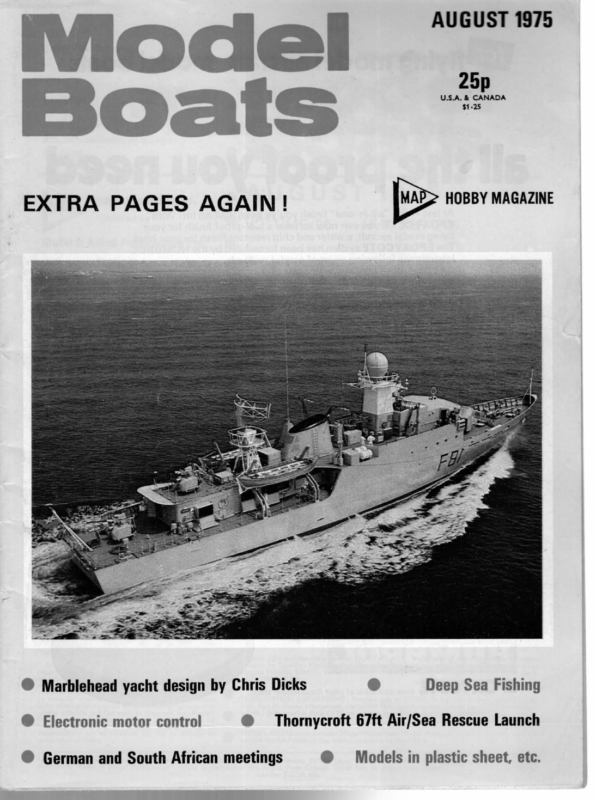
- 247 A new Marblehead from the board of leading designer/skipper Chris Dicks, intended for radio but with vane conversion details if you wish.
- THE 1975 SOUTH AFRICAN M CHAMPS By M. Colam
- and Chris Dicks gives his view of their MODEL YACHTING SAFARI
- Electra XII Bob Jeffries continues his account of his new radio-controlled M class yacht in part two.
- 1975 RM CLASS CHAMPIONSHIPS Setley Lake, New Forest, June 14/15

AUGUST 1975 25p U.S.A. & CANADA $1-25 Ps ® Marblehead yacht design by Chris Dicks ® Electronic motor control Deep Sea Fishing ® = Thornycroft 67ft Air/Sea Rescue Launch © German and South African meetings ae te ® HOBBY MAGAZINE @ Models in plastic sheet, etc.
AUGUST 1975 In the Tideway This is the actual moment when David Waugh won the 1975 RM Championship. He held his nearest challenger, David Andrews (2 points behind), to a line inside the first mark, tacked at the last possible minute, and has just tacked again to round the mark. Andrews, forced well to leeward of the mark, has tacked but must give way to the fast-approaching Norman Hatfield and John Cleave. He was fourth round the mark but could not recover his lost distance and scored 6 to Waugh’s 12. OME quite remarkable statistics are beginning to emerge already from the Naviga European Championships (Welwyn Garden City, Aug. 3-10). Latest although he did not sail in his later years. He appeared most Sundays at the pondside and viewed with special interest the conversion of the class to radio. news, with a few days still to go, is that there are so far 454 entries, including, for the first time ever, entrants In Britain, we have also sadly lost a veteran—Cecil Adams, of Nelson Gardens M.Y.C., who died aged 88 on June 20. A notable footballer in his early years, he went to America to work as a carpenter in 1923, was introduced to model yachting in Chicago, and became a highly successful skipper. He returned to Britain in 1931 and continued to design, build, and sail yachts, winning the 36R Championship in 1948, and the M at Hove in 1953. His best-known design was undoubtedly the M Foxtrot, but he was responsible for many fine boats and will also be remembered for his encouragement of newcomers. He sailed until very recently, and retained a keen interest at all times. He will be very much missed. from Finland and Greece. In addition, a chance to run (outside the competition) is being given to one or two representatives of non-affiliated Australia and Canada. countries, notably The biggest team is, not surprisingly, Britain, with 78 (53 sen., 25 jun.) closely followed by West Germany at 74 (47, 27), then France 42 (41, 1), Bulgaria 36 (30, 6), and East Germany 34 (27, 7). The most popular events (so far, at least) for seniors are FI-V15 (R/C speed up to 15 c.c.) 31 boats, FSR (multi-racing up to 15 c.c.), 30, A3 (10 c.c. hydroplanes) 25, A2 (5 c.c. hydros) 22, and Al (24 hydros) B1 (24 airscrew hydros) and FI-V2.5 (24 c.c. R/C speed) with 21 entries each. This, incidentally, is a total of 97 hydroplanes, surely far and away the most ever brought together. A third loss to modelling was the death in May of Charlie Smith, President and long-time member of Southend M.P.B.C., who will be remembered especially for his superb metal models of Royal Daffodil and Royal Sovereign and his wins of scale trophies in both static and working competitions. Again, his considerable experience and contribution to the hobby will be missed by his club and his many M.P.B.A. friends. Juniors are most numerous in F3V (i.c. R/C steering) with 15 entries, followed by F3E (electric R/C steering) and FSR15, with 13 boats each. We understand that Chris Cornell, accommodation officer, has fixed up 580 people so far. Programmes are now available but if your order is not correct or not received by the end of July it will not be dealt with until after the meeting. Send 10p, and stamped addressed envelope not smaller than 84 x 6 in. to G. A. Colbeck, 19 Lea Walk, Harpenden, Herts. And it is still not too late to volunteer your assistance at what is clearly the biggest international boat meeting ever in Britain .. . Club Notes Telford New Town M.B.C. (previously Shrewsbury M.B.C.) is running an open regatta on Sept. 28, 10.30 start, for multi racing in classes A, B, and C, plus unlimited electric (if sufficient entries). Strictly 80dB. Entries at 25p per boat to A. Arbon, 30 Preston Grove, Trench, Telford, Salop, with S.A.E. for confirmation and map if required. Please state frequency; splits allowed. Trophies and/or prizes for first three in each class. Yachts We hear than one overseas entry has had to drop out Sept. 14, Leicester M.B.C., Wanlip Park, Syston, Leics., open regatta, steering and multi. Pre-entry by Aug. 31, 25p per boat plus S.A.E., to S. Drew, 72 Ringway, Queniborough, Leicester. of the R/C Yacht International at Gosport, Aug. 3-9, but this still leaves 100 yachts competing. Some really exciting racing is on the cards, and in years to come we will surely look back on this meeting as the occasion on which truly international R/C yacht racing arrived. As this issue is published, the World Championship for vane Marbleheads is finishing at Fleetwood, to be followed (July 26-Aug. 1) by the similar event for A class yachts. There seems only one snag in all this feast of events—when do we sleep? Obituaries We regret to record the death in Marblehead, U.S.A., of Roy Clough, at the age of 84. Roy was the father of the Marblehead class yacht, conceiving the idea in the late 1920s to replace a restricted sail area class sailed locally. Its world-wide acceptance was gradual but complete, and its originator retained keen interest Northern Models Exhibition, Aug. 23-30 at Preston Polytechnic, Corporation St., Preston, Lancs., is the sixteenth organised by the Northern Association of Model Engineers. Open 12-8 on the 23rd, 10-8 24th-29th, 10-6 on the 30th, adults 20p, children and O.A.P. 10p. Leicester again, this time Leicester M.Y.C., who will hold an open RM meeting on Sept. 21. Entries by Sept. 13 to D. Andrews, 49 Aberdale Road, Leicester (tel. 883309), giving frequencies, please. Port Talbot Docks will be the scene of the third Welsh International half-hour Team Endurance Race on Oct. 5. Entry £1.50 per team to Noel Morris, 17 Eagle Street, Port Talbot. This is an open water event—the Docks can be quite rough at this time of year. 389
AUGUST 1975 | recent years there has been a large increase in radio 247 controlled model yachting. However, the majority of boats used were designed for use with vane steering, the only modification normally being an alteration in the rudder to give more manoeuvrability. It has not been proved that a good boat for vane steering will necessarily be a good boat for radio control. A vane steered race consists of sailing against one other boat at a time in one direction of the lake whereas a radio controlled race is sailed against six other boats around a normally triangular course. It therefore follows that a vane steered boat which is outstanding to windward but rather poor downwind could possibly win every beat and a few runs and thereby win the overall race. The same boat in an RC race may lose so much distance on the downwind legs that it is unable to make this up on the windward legs, and would therefore not win the overall race. This is not the only dissimilarity, but is purely quoted as an example of the differences between the two types of model yacht racing. A new Marblehead from the board of leading designer/skipper Chris Dicks, intended for radio but with vane conversion details if you wish. Full-size copies of the plan below (body plan full-size, other lines reduced) are available reference MM 1206 from Model Maker Plans Service, P.O. Box 35, Hemel Hempstead, Herts., price 80p including post and VAT. 247 designed M_CLASS — *247″ LOA BEAM by Hemel V2‘ MOULDED a BUMPER a ae LWL ive 3 \ XI ue 0 2 of \ HER | i SITION, 9 g 7 = a 6 IS \ | if BOOYPLAN— FULL SIZE & ‘ \ 2 4 10 ae V/2 SECTION | — SS = 9 | Ley1 LWL : <| 4 ! 7 | . | : Aie = | 1 aa \ \ A] § : ALTERNATIVE FIN | ata | ——F ( ww 1| 5 PROFILE ~ 1/2 FULL SIZE i \ 3 | 4 Ty T \ ; < 5" BUTTOCK WATERLINE —==—= Hempstead, Herts, 0-5" BUMPER 15-0" 15-0L8S SECTION SPACING The Model Maker Plans Service 13-35 Bridge Street, 50-25"+ 10-1" DRAUGHT DISPLACEMENT C.Dicks, copyright - “of ALTERNATIVE SKEG VANE STEERING x LEAD 95ibs 5 ! a [aa ] 2 i. é a es fee MAIN Ji8 RiG [ MAIN AREA A {80x12 B__| 65 «16-75)4025x13 (555 «115 | 7793 [77951 | = ;—— 2nd_|55 * 1475/4250x13 | 68188 68" FROM DECK (| =~ HEADBOARD i a / / / | / | SAIL_PLANS FOR VANE \ SCALE 1/8th Fue / / / / / [48 JIB «10 [AREA mo Us | [800 | HEADBOARD | {65 ‘x 17 [41-25 «12. [800 | [55 * 17 1365012 [68650 \\ j See \ \\ \ \\ \\\ / i RIG.A, nd | 56"FROM oecx/ size j : —e———e——— \ 80 «14 [B__ SAl SCALE 1/8th : FOR RADIO FULL SIZE | | \\\ RIG.B. 4925) / / | Lee -|/ I / / / | |] A Bt : ass RIG | a “wlan 85" FROM DECK TO) US HEADBOARD ee
MODEL BOATS It was therefore decided to design a boat specifically for RC racing. Before commencing the design a brief list of basic requirements was drawn up as follows :— (a) Good performance to windward, downwind (without spinnaker) and reaching 3 (b) Good manoeuvrability combined with controllaility (c) Easy to sail and not requiring too precise sail trimming as this is difficult at a distance (d) Able to cope with all conditions from a flat calm to a full gale. In the design of any Marblehead yacht, the length being fixed, the first dimension to be decided upon is the displacement, coupled with the beam and canoe body depth. For this boat a displacement of 15 lb. was selected as it was felt that a light displacement boat would offer the best possibilities of satisfying requirement (a). It was hoped to couple this weight with a moderate beam of 10 in., a canoe body depth of 2 in. and a fairly easy midsection. In the final design the beam has been fractionally increased above the intended figure, as the maintenance of the 10 in. beam would have meant either reducing the displacement slightly or hardening the bilge, neither of which was felt desirable. The shape of the canoe body is slightly more symmetrical than has been fashionable, having a narrower transom than the majority of recent designs. The transom width was adopted as, in order to maintain good volumetric balance with this type of hull form and a wide transom, a very flat hard-bilged section is often used at the stern, which seems to impair windward performance slightly when compared with narrower-sterned yachts such as Walter Jones’ M-4-Sis. However, wide flat Ushaped sections are still maintained well towards the stern of the yacht in order that the downwind performance should remain unaffected. The forward sections are fairly conventional by recent standards, having vertical topsides giving fine waterlines above the water, but are rather flatter below the waterline as this is the type of forward section favoured by the designer, having previously been used in a successful “A” class design. The easy sections and more symmetrical hull form, coupled with a good volumetric balance, should give a boat which is easier to sail than some of the more extreme wedge-shaped types. One of the useful by-products of using radio control is that there is no longer the necessity to provide space for a vane gear on the stern of the yacht. The rig may therefore be moved aft so that the downward component of the wind forces acts vertically above the volumetric centre of the hull, and will therefore not tend to depress the bow. This should aid the balance of the boat. Once the centre of effort of the sail plan has been fixed, and the position of the lead bulb is also fixed, the fin profile shown becomes the logical solution to moving the centre of lateral resistance to the required position. The moving of the centre of lateral resistance aft should also tend to aid the manoeuvrability of the yacht. The majority of radio controlled yachtsmen appear to favour the use of a spade rudder. However, this configuration seems to lack control when running or broad reaching in strong conditions. A small skeg has therefore been drawn combined with a semi-spade rudder in order to combine the best of both types. The small skeg should also aid water-flow over the upper part of the rudder a this from stalling as quickly as the spade type rudder. It has been evidertt that in vane steered yachts larger jibs have become more usual, but for radio control where spinnakers are not used downwind, the loss of mainsail area has a noticeable effect on downwind performance. The rig drawn has therefore been given as large a mainsail as is considered practicable. As some readers may wish to build the design for use with vane steering an alternative fin layout has been indicated together with sail plans and also an alternative skeg and rudder configuration. THE 1975 SOUTH AFRICAN M CHAMPS By M. Colam A outstanding entry of 27 ‘“‘M”’ Class yachts were received by the Durban Model Yacht and Power Boat Club who successfully ran this Championship at Easter. Twenty of the competitors came from Durban, five from the Randburg M.Y.C. (Johannesburg) and thanks to the generous sponsorship of the S.A. Government, Chris Dicks and Wally Jones of England were invited to compete. Their visit to South Africa was of great benefit to S.A. model yachtsmen as they gave lectures to the competitors, showed slides and cine films of overseas regattas and were of great help in sorting out tuning problems. It also 394 gave the South Africans an opportunity to test their skill against yachts of the calibre of J/lusion and M-4-Sis. A full set of officials under the leadership of Mr. Charlie Cole—DMYC President—took care of the four days racing in which a full tournament was sailed. The use of walkie-talkie radio, loaned by Rothmans, between the O.O.D.s and umpires and starters was a great help for the efficient running of the regatta, and the Rothmans P.A. system was also used to good effect. The Durban Corporation also did a magnificent job in extending the pond from 165 yards and 50 yards to 220 yards by 50 yards in record time—three months from start to finish! The Club also had the sponsorship of Gilbeys Vintners who provided the magnificent trophy (floating)—the Hennessy Bowl and miniature—and a worthwhile array of prizes, including one for the highest placed Randburg member and the highest placed junior member (under 17 years), of whom there were nine competing. On the first day seven heats were sailed in a moderate north easterly wind providing good beat and run conditions, and it became immediately apparent that we were going to see a hard fought race between Wally Jones and Chris Dicks; both scored a full card—35 out of 35. Highest placed local yacht at this stage was Mike de Langes’ Orange Rabbit (Stollery’s White Rabbit), with 27 points. The Saturday was a perfect day—cloudless with a light north-easterly wind—which remained all day giving again a beat and run. Seven heats were completed and
AUGUST 1975 Wally Jones dropped two beats. Then came the big match when he and Chris met. Everyone was on their toes and a big crowd followed the race. Wally had weather berth but Chris, pointing slightly higher, worked his way to windward. Then came the fateful tack with J//usion hesitating in the light air, and M-4-Sis, carrying her way through the lulls, sneaked through and Walter turned just in front of Chris while the spectators held their breath. He then went on to take the beat. Wally then followed this by taking the run, both yachts using their largest spinnakers. Now Chris was leading by one point. The Sunday saw a change in direction to a south westerly which brought a reach and fetch and many close races. Michael Coulon, youngest competitor in the race, took a beat from J//usion in her first race when Chris became becalmed near the finish line. Wally Jones then dropped a beat to Peter Coulon and then a run to Dick McKay’s Osprey. Chris lost a run to Tony Goodwin’s 3.D’s. So it went on with the reaching wind difficult to read and assess. A further seven heats were completed. Then came the final lovely, sunny day with the wind back in the north-east and light—tallest suits being used Place Opposite page, Erica Brunicke, only lady skipper, and with an own-design, too. Above, Wally and Chris (of the sunburned nose) with Keith Gerson, Durban’s Commodore, Major Dixie Adams, and O.O.D. Charles Cole, Club President. Below, our intrepid heroes, who did an enormous amount of good. (Photos courtesy Wilson of Durban). Name of Yacht Skipper Club 1 M-4-Sis W. Jones Birkenhead 2 Illusion C. Dicks Clapham 3 4 Shazzan Orange Impala D. K. Gerson B. van Dijk Dbn Dbn Loop-To White Rabbit White Rabbit (modified) Kingfin (modified) White Rabbit (modified) Witchcraft Own Design 5 Orange Rabbit M. de Lange Dbn 6 Snoopy R. Coulon Dbn 7 Blackjack L. Wright Randburg Silver Spray II 3 D's J. R. Mellville T. Goodwin Dbn Dbn 8 9 10 Gazelle il Scram 13 Aureus B. Rich Dbn 14 15 16 16 18 19 Bunny Girl Piri Piri Red Devil Ebb Tide Hocus Pocus At Last G. Thompson T. Viger Rene Coulon Michael Coulon J. E. Hughes P. Haffern Dbn Dbn Dbn Dbn Dbn Randburg 21 Oot-Ehs 12 20 22 . A. Coleman Springtide . R. A. Coulon Co-operation Merlyn P. Coulon : T. Griffiths S. Wright B. R. Young Design Floreana (modified) Dbn Dbn Dbn Randburg (modified) Kingfin (modified) Own Design Cormorant Cormorant (modified) White Rabbit Cormorant Cormorant Kingfin Witchcraft Kingfin Own Design Rara Avis Osprey D. McKay Dbn 24 Falcon M. Birtwhistle Dbn 25 She-Too Bachelor Boy (Miss) E. Brunicke . Colam Randburg Dbn by most skippers and largest spinnakers much in evidence. The duel between the two English skippers was maintained to the end. Chris Dicks only dropped two points during this period and Wally a three but M-4-Sis held on to her lead of two points to win the Championship with 112 points with J/lusion finishing on 110 points. Durban Club Commodore Keith Gerson sailed well throughout the regatta—sailing his Loop-To design Shazzan into third place on 91 points. He was 12 points clear of the next yachts, the two White Rabbits of Bert van Dijk and Mike de Lange, which finished on 79 points. A sail-off of two weather boards and then a leeward board had to take place to settle 4th prize, which went to Bert van Dijk. The next seven yachts all finished between 70 and 79 points. Highest placed junior skipper, who won a Wally Jones vane, was Robert Coulon, and the highest placed Randburg skipper was Les Wright. 395 142 110 Lewis Stollery Stollery 91 79 79 Witty 78 Stollery 77 Priest 76 75 Witty Littlejohn 74 73 72 Littlejohn 70 Stollery Littlejohn Littlejohn Witty Priest Witty 59 50 54 54 52 45 43 37 Lewis Rip Tide T. Houk Rip Tide (modified) Own Design Pterodactyl T. Houk (modified) Score Dicks Own Design Randburg Dbn 23 Designer Norsworthy Jones Dicks 36 35 34 27 Withdrawn
MODEL BOATS Capt. Robbie Coulon, top Junior skipper, is also current Durban club ‘M’ champion with his modified Kingfin design. A wonderful prize-giving took place jointly with Durban’s Point Yacht Club in their clubhouse, after the completion of their Easter Regatta, sailed at sea off Durban. In his winner’s speech Wally Jones paid tribute to the excellent manner in which the regatta had been run and said that the Durban Pond was undoubtedly the second best in the world behind Fleetwood. It is hoped that in 1977 a bigger International ‘‘M’’ Regatta may be organised in Durban with visits from leading “*M’’ Class skippers from the U.K. and Europe. and Chris Dicks gives his view of their MODEL YACHTING SAFARI AST year Walter Jones and I were fortunate to be invited to visit South Africa for Easter 1975 in order to participate in the first South African Marblehead Championships. We were of course only too pleased to agree to this proposal and accordingly visited Durban for the two weeks around Easter. In order to participate in this event we took with us our Marblehead yachts, Walter taking his well proven M-4-Sis and I taking a new yacht built for easy shipment, with a detachable fin, and called ///usion. Our flight out was by South African Airways Jumbo Jet to Johannesburg and upon our arrival we were met by two members of the local club to welcome us to South Africa. From Johannesburg we took the local flight to Durban, where we were met at the Airport by the whole of the Durban MYC, or so it seemed! From the moment of our arrival in Durban to the time of our departure from South Africa we were entertained royally by members of both model yacht clubs, and we must thank everyone concerned for their overwhelming hospitality. At the present time model yachting in South Africa is mainly concentrated in the Durban area as this is the only suitable lake for free sailing. However, there is a small club in Johannesburg, and these yachtsmen travel twice yearly to take part in the Durban club’s open races. With the advent of radio control it seems that the number of lakes suitable is quite large and this is undoubtedly a branch of the sport which will expand rapidly in South Africa. While we were in South Africa we met some of the radio control skippers who will be coming to Gosport in August and they, while inexperienced, would un- doubtedly put a lot of people to shame by virtue of their enthusiasm. The lake in Durban is rectangular in shape, approxi- mately 610 ft. x 150 ft., with no obstructions or hazards, and had only just been lengthened prior to our visit. It is open from all directions and about half a mile from the beach on the northern outskirts of the city. The water is brackish, as it is filled from the estuary of the Omgeni river which runs alongside the lake. During our stay we only saw two different wind directions, a north easterly coming in from the sea giving a beat and a quartering run, and a south to south-west wind which is rather variable and gives a swinging reach. The conditions were undoubtedly ideal for model yachting with temperatures in the seventies, and moderate to fresh breezes; rather different from the conditions experienced at Dovercourt for the M championships at Easter! For the Sunday prior to the Easter weekend, Walter and I were kindly loaned two of the Durban members’ 10-raters in order to participate in a race. This was held in a fresh reaching wind and I managed to win with Walter third; this was mainly because I was loaned a Cracker whereas Walter was loaned a local design boat known as a Folly. This boat is a modification of the Littlejohn Marblehead design Cormorant with a 60 in. LWL and a bulb keel but a very low freeboard. In general the standard of 10 rater yachts was slightly below that of this country, most of the boats being around 60 in. LWL (Red Herring, Warlord etc.). One interesting boat was a hard chine scow type hull, similar to a Fireball dinghy, with twin fins. This boat was reputed to be very fast in a strong breeze, but I feel that it would not be able to cope with big waves very well due to the blunt entry. The South African Marblehead Championship was held over the four days of Easter With a beat and run for three of the days and a reach on Sunday, the wind strength varying from very light to a good fresh breeze. From early on in this race it became apparent that either Walter or I would win, and Walter eventually won by two points by making one less mistake than me. Both of us lost a large percentage of points in the reaching wind where it was very easy to get caught out by the sudden changes in wind direction. Third place was taken by Keith Gerson of the Durban club, who arranged most of our trip, with his Loop-To design. The fourth place was only decided by a sail-off between two new sister ships which had just been finished. These boats were White Rabbits with a deeper draught. Sixth place was taken by the top junior, Robbie Coulon, with a modified Witty Kingfin while in seventh place was the top Johannesburg boat, Les Wright, with another modified White Rabbit which had only just been launched. The remainder of the boats were mainly English designs, mostly with bulb keels. The main reason for our success was undoubtedly the greater experience which it is possible to obtain in this country with the number of clubs within fairly easy reach, and the high standard of our domestic sailing. In addition the majority of the South African boats have deckmounted masts and this makes the mast extremely difficult to keep straight in stronger winds. A large number of juniors were sailing and their standard was very high. This can only be good for the future of the sport in South Africa. In addition to the boats, we also took with us slides and films of model yachting in this country, and held a question and answer session with the Durban skippers. We hope that our visit has benefited the sport in South Africa and that all their efforts on our behalf have proved worthwhile, and we look forward to seeing some South African entries in our championships in the next few years. 396
AUGUST 1975 Electra XIl Bob Jeffries continues his account of his new radio-controlled M class yacht in part two. Ts new hull weighed a bare two pounds, and required virtually no further attention save cleaning up the flash from the joint between the two halves of the mould. Those readers who know of my series of Electras will be surprised in my choice of colour. All previous boats had been green, and I felt it time to make a change. I mentioned earlier I wanted my new boat to bear a strong resemblance to the full size counterpart. I do not claim it to be a scale model, but a model which if built in full size would look right. I decided it would have a cabin, cockpit, and footwell similar to those fitted to small ocean going racers. I was able to obtain a very nice “‘offcut” of thin Formica for the deck in simulated wei finish. This blended well with the colour of the ull. I fabricated a wooden “plug” for the cabin. This time I used polyurethane paint from the start, and after many coats and rubbing down, I got the finish I required. I made the mould personally, and it slipped off easily, leaving me with a nice shiny finish on the mould. A casting using the same colour resin as the hull made me a very nice cabin, highly polished without any further polishing. I had learned my lesson! The Formica deck was cut to size, an opening to take my fibreglass cabin, footwell and cockpit was finished, and the whole assembly was fitted to the hull. I was careful to scrape the top of the hull to remove the gloss of the fibreglass where the cement would adhere, and the whole was assembled. So far I had not decided exactly where the keel should go. A trial run in the domestic bath, with the hull weighed down with weights equivalent to the weight of the keel and radio gear, showed the boat would float just on the waterline I had drawn on my original drawings. The centre of balance was carefully recorded, and a hole was cut in the hull to take the fin. A glass fibre “box” was made to take the fin and well resined in. Subsequent hulls will have this box cast in, now that I know exactly where it should go. At this point in the construction, the whole hull with deck and cabin completed was returned to the fibre glass expert, and he, using my boat as a mould, made a fibre glass mould of the entire deck assembly. Subsequent 411 Bob holds his model to demonstrate the differences in his three suits of sails, left to right, rough weather, working, and high aspect ratio. boats can now have the whole boat complete in two mouldings. Two fins and keels were made, one with a keel bulb of 10 lb., and drawing about 15 in. of water, the second with a bulb of 8 lb., and drawing about 13 in. of water. The fins I made in mahogany, and after finishing and assembling the bulbs, I completely encased them in glass fibre. I made a pattern of the bulbs and made glass fibre shells which were resined on. The results were keel/fin assemblies finished in the same colour as the hull, and well polished to avoid water friction. The rudder was again in glass fibre. I made it by laying down sufficient area of glass fibre on a sheet of plate glass, which when removed gave me a sheet of mirror finish and about 34 in. thick, again the same colour as the hull. I cut two shapes of the rudder, and clamping them each side of the stainless steel rudder shaft, I filled the intervening space with liquid resin. The result was a rudder of nice streamline section, light, and stiff. Normally I fit the rudder servo adjacent to the radio equipment, and use a long drive. This time, I fitted it right adjacent to the rudder spindle, and extended the leads. There is no likelihood of deterioration of electronic performance provided the distance is not excessive. This made for a nice neat assembly, and avoided the backlash caused by a long springy drive shaft. I cut a hatch in the cockpit to gain access to this assembly. Normally I am against any openings in the hull other than those absolutely essential. I found that after completion, before the hatch is finally fitted and screwed down, if a gasket of Fablon (sticky shelf covering) is fitted over the opening, a completely waterproof seal is made, that can easily be opened for maintenance and service to the rudder and servo. I mentioned I had made a footwell in the cockpit. It was necessary to fit drain tubes to clear the water that was bound to collect; I used the very thin brass tube used on transmitter aerials for this purpose. Most of us have a damaged aerial around the junk box. A hole was cut in the roof of the cabin for access to the radio, winches and batteries. I originally used the piece of glass fibre I had removed, but eventually replaced it with a thin piece of transparent Perspex. This is sealed
MODEL BOATS with plastic tape which is renewed every time the hatch is opened, a simple way of getting a completely waterproof opening. On the rear wall of the cabin I have fitted the on/off switch, the charger socket; and the switch for crystal changing. The advantage of mounting these on a vertical surface is there is much less likelihood of water getting in. I used waterproof switches, but do not rely on their waterproof characteristics. I well recall the trouble a pattern, and the proportional control gives an unlimited number of settings to considerable accuracy. I have made many sail winches, but really feel I have at last reached almost perfection with this unit. Another club member has made a winch of the drum type using a similar amplifier, with equal success. My Soling has the Vortex type sail winch which is a double affair giving control over the sails and also a second control which I have used as a trim control on the jib. I got so used to this undoubted advantage, that it was essential to fit such a control on the new boat. The jib trim servo was built using one of the tiny units normally sold for undercarriage retraction on model aircraft. A feed-back potentiometer had to be included, and the unit is operated by a conventional three wire amplifier as fellow club member had with his boat: he had used two of a similar type of switch, but following a bout of persistent unreliability with his electronics, I traced it to water in the switches. When I dismounted and dis- assembled one the water ran out! He now has switches assembled inside his boat, and operated through a push rod. The reliability of his gear has improved considerably. I mentioned earlier that all my radio equipment is home-made. It is a five channel digital based in the main on the well-known ‘“‘Microtrol” design which is available in kit form. The rudder servo is a conventional commercial servo, but the sail winch is home made. Originally it now used on most commercial servos. The control again is proportional, and enables the trim of the jib to be quickly changed whilst actually racing. [ mentioned earlier my intention to make two completely separate rigs, one of conventional aspect ratio, and a second one with high aspect sails. Actually I now have three separate rigs, as I have included an exceptionally low aspect rig with only 500 sq. inch area for use in virtually storm conditions. It takes less than three minutes to remove one rig, and replace with another, so this can easily be done between races. was operated by a conventional digital amplifier through relays, but thanks to the co-operation of a fellow club member, the relays have now been discarded, and a fully “solid state” amplifier is now used, using a bridge circuit and power transistors switching a separate 9.6 volt supply to the winch motor. This winch is of the lever (To be concluded) 6 Ber 1975 National Championships for the “RM” class 1975 RM CLASS CHAMPIONSHIPS of radio yacht was held on 14/15 June by the New Forest MYC at their sailing water at Setley Lake, in delightful surroundings in the New Forest. After weeks of inclement weather, just in time summer arrived, and the event was held in hot, sunny weather with just enough wind to make sailing interesting. The event was well Setley Lake, New Forest, June 14/15 publicised beforehand in press, radio and TV. Both BBC and ITV gave it good coverage on the preceding Friday evening. A total of twenty-seven yachts was entered, but due to illness, one was a non-starter. Each competitor was given computerised schedules covering the two days, differing for each day to prevent the same sets of boats racing 4 nnn. NEW MAME OF FOREST 1275 Ate. Pi Ye together, and giving the frequency colour each competitor should use in each race. Mr. Trevor Reece, the Radio Secretary of the Poole M.Y.C., kindly agreed to be O.0.D. for the whole event. He controlled the meeting in an excellent manner. His decisions were fair but firm, and his interpretations of the new MYA racing rules were accepted by all. A triangular R/c es a486 1835 10 18 12/13 14 48 18 ¥ sae acct pee es course was laid out; at the start, boats sailed with all buoys to starboard, but later when there was a change in the wind direction, the direction was reversed. This was done so that the first leg was always to windward. The schedules called for six boat racing, each boat sailing two laps, and a total of twelve races each over the two days. Some exceedingly competitive sailing was enjoyed by skippers and spectators alike. Following the advance publicity, there was a considerable number of spectators, and on the Sunday afternoon it was estimated there were several hundred cars around the lake. The visitors were able to watch the racing in hot sunshine. On the Sunday morning a BBC camera crew arrived to film the event. This delayed racing somewhat, while they filmed boats racing and took various shots of yachts and their skippers. Bob Jeffries, the club Commodore, was The smart New Forest scoreboard makes clear where everyone has got to. Picture above it shows a typical start, with no boat very far from the line as as the “gun’’ goes, while bottom picture is typical of the close positioning at the first mark. 412
AUGUST 1975 How it’s done? An absolutely typical start for Teacher's Pet, taking the line full & by and, second picture, getting to the first mark well ahead of the other boats. interviewed, and on the transmission on the Monday night, they gave the whole event very satisfactory coverage. Bob was questioned over the forthcoming Internationals, and in particular the attendance of the Japanese. He was able to give the forthcoming International a good plug. In spite of the delay caused by this filming, the whole schedules were completed by teatime on the Sunday, a total of 54 races. The results of the Nationals were a remarkable coincidence in that the first four competitors in 1974 finished in that order in 1975! The event was won again by David Waugh, a Christchurch schoolmaster and founder member of the New Forest Club, sailing a new boat, Teacher’s Pet. He made the quite remarkable score of 140 points out of a possible 144, winning ten races. and coming second in the remaining two. David’s boat is of his own design and construction and is a modified version of his last years winner Capriole. It is of very light construction weighing a fraction over 13 Ib. all up, including a 6 lb. bulb. The fin was much deeper than the earlier boat, thereby giving greater stiffness without an increase in weight. High aspect double luffed sails were used throughout. The radio was from the earlier boat, except that a third channel is now used as a vernier jib trim. The new glass fibre hull was made so thin that it was porous, and had to be waterproofed! Everything possible had been done to cut down on unnecessary weight. After winning the Nationals two years in a row, one might be satisfied. Not so, as David is now designing next year’s boat, and intends to try and make it a hat trick in 1976. As five awards were to be presented, there had to be a sail off for fifth place between John Clarke of the New Forest with Aeolian and Ian Harrison of Leicester with Cygnot. There was a good start with both boats crossing the line together. Approaching the last buoy John had got into a lead of some six feet, when he touched the buoy! Whilst he was re-rounding it, he was to see Cygnot sailing to win. The ‘“‘RM” Cup and other prizes were presented by Mrs. Ruth Robinson, wife of the Hon. Secretary of the host club. Norman Hatfield, the radio secretary of the MYA, spoke on behalf of the MYA and the visitors, and thanked the New Forest Club for their efforts in organising such a successful event. Posn Points 1 2 3 4 5 140 132 122 110 106 vf 8 94 88 88 88 86 82 76 74 74 74 68 68 { 62 62 58 46 { 40 40 11 12 13 14 17 19 21 22 23 106 25 28 26 4 Non-Starter Skipper Reg. Club D. Waugh D. Andrews J. Cleave N. Charman I. Harrison Teachers Pet Voom Knut Red Hot Cygnot K2059 K2095 K1948 K2070 K2029 New Forest Leicester New Forest Danson Leicester J. Foster J. Ayles J. Curtis N. Hatfield N. Curtis R. Gerrey G. Jones A. Abel G. Coombs R. Jeffries Mrs. E. Andrews M. Smerin D. Stevenson D. Taylor D. Robinson M. Colyer R. Potts A. Wood Panic Jonda Frantica Troll Blood Orange Sea Witch Second Step Moonraker III Red Wolf Electra XII Teazle Snoopy II May Bee Mellow Yellow Pabri IT Limey Early Bird Jilda K1954 K1947 K2035 K1010 K2103 K1953 K2000 K2031 K2060 K2058 K2018 K2128 K2067 K1985 K2057 K1716 K1969 K2113 New Forest New Forest Reading Basildon Reading New Forest Leicester Guildford New Forest New Forest Leicester Guildford Danson Guildford New Forest Leicester Danson New Forest Blood Hound Andover K2102 Reading J. Clarke J. Pulfer D. Brown J. Wild Yacht Aeolian Lady Anne Sally Anne III The winning boat, very light & with barely 6Ibs. of lead in the fin. Note shape of bow, which David says does not appear to be necessary, & the large & very deep rudder. Right-hand picture shows David with the Model Boats Cup, obviously feeling very happy. MI K1878 New Forest K1561 K2129 Danson