- The 1975 World ‘A’ Class Championship Report by Joyce Roberts Photos by the Editor
- International R/C Yacht Championships Gosport, Aug. 3-9 by Norman Hatfield R/C Secretary M.Y.A. and .M.Y.R.U. (Europe) Photos by the Editor
- CAIR ANDROS A scale model of a full-size pipe dream with notes on moulding ing,.r.p. Part 1 By J. Gifford

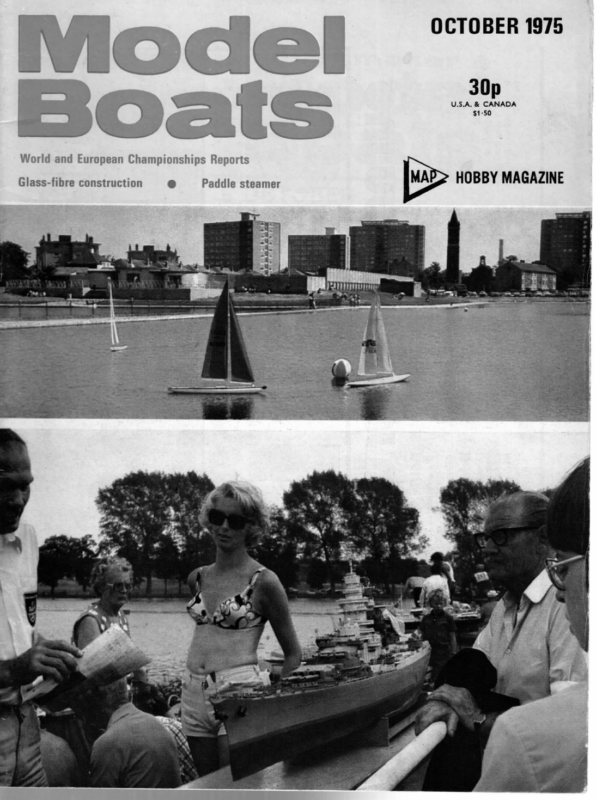
OCTOBER 1975 am é anil are a Be MIE 30p World and European Championships Reports y> * * 4. ey| Paddle steamer in @ au . a aa awe Glass-fibre construction Sa as ace HOBBY MAGAZINE
MODEL BOATS The 1975 World ‘A’ Class Championship Report by Joyce Roberts Photos by the Editor ORTY-ONE yachts entered for the 1975 World “A” Class Championships, including 14 European from the hotel corner, then coming round to the sea corner. There was hardly any weight in the wind at first, boats. This was the largest proportion of foreign boats but it strengthened later in the day very slightly. Boats with various suits of light weather sails had a few sail changes, and the sails with an extra piece on the foot gave a bit more speed to the lighter boats. Heavy boats with more sail area had an advantage in the light airs, especially on the run with their very large spinnakers. Unfortunately the day was spoilt by the number of blue flags obtained by competitors, as too many were taking unjustifiable risks on turn-offs, though the light winds did not make it easy to judge just when a yacht was going to get in the way of a tacked boat. The same difficulty in judgement must occur from a bank judge’s point of view, and competitors should realize that they are very likely to get a blue flag if they do not take avoiding action in these conditions. Other disqualifications were obtained by putting a boat out on a run into the approaching opponent, pushing out into the ap- seen in an “A” Class Championship, but there was a general feeling of disappointment that the British entry was a small one; many skippers had obviously decided not to race two boats in two weeks, and so both Marblehead and “A” Class entries suffered from the two weeks’ sailing. At the 0.0.D’s “briefing” on Saturday evening, Roy Gardner told competitors that he was sailing the race in two fleets, all sailing on Sunday and Monday, with two half days on Tuesday and Wednesday, then all out on Thursday and Friday. Mr. Gardner reminded skippers that rules would be strictly adhered to, but it became obvious from questions then arising that a number of people were not sure about the differences between I.M.Y.R.U. and M.Y.A. measuring rules. A number of queries were cleared up, and also the usual question about a resail/disqualification distance after a collision after turning off from the bank, or retrimming on the run. Mr. Gardner also reminded competitors that there was to be no retrimming in the water; even if someone fell in, he was to get out before touching the boat (see proaching opponent, and just pushing the boat on these retrims. Although sailing conditions were so difficult, sailing standards were not very high. Seven heats were completed, although one yacht did not sail in the last heat of the day—the sun had been too much for Pentangle, and the fibreglass was getting soft! Top boat on paper at this stage was Dandy, sailed by Harold Dovey, with 30. 1973 race reports!). From all these questions and answers it became obvious that the 1975 race was not going to be as lighthearted as the previous week’s Marblehead race; competitors and officials seemed to be taking Peter Pim had 26, Spartacus 25, Executioner (one of the Revolutions) 25 and The Streak, in spite of losing the things more seriously. Sunday morning arrived with light westerly winds, and first five to Twist, 23. In comparing all scores during the week there could be a difference of 10, with some boats having had two byes by Tuesday and others having none. This occurred because of two fleets, with an odd number of boats in one, and sailing half A v B, and then starting sun. The wind was from the far end of the lake, first on Av Aand B vB. Monday started with no wind at all, so sailing was delayed for half an hour. Even when racing started it was very slow, especially the running, with many resails being taken. Skippers seemed very tense, and a few disagreements with bank judges arose, and protests were put in. A halt to the racing was called at 12, and because of the friction arising between skippers and officials a meeting was called between the skippers, who agreed to try and calm down. It was also made clear that no way at all was to be put on a boat after a retrim, so it was difficult for boats to sail off the shore on a run. Racing re-commenced after lunch and there was slightly more breeze, but only four heats were completed all day, the last one taking over two hours. Competitors who had finished sailing at six (but not the officials who Top, lining up to ensure no delay in starting. Boats setting off are Storm Vogel and top-placed foreign boat Neptune. Waiting are Albatross, Norwest, Peter Pim and Mistigri; all six are overseas entries. Left, Big Bother, the winner (light boat) sailing Kami Sama, the runner-up. 510
OCTOBER 1975 were still taking resails) watched the B.B.C. T.V. news film of the race. All agreed it was a very good news item; 10 minutes were given to the report, and all aspects of the race were well presented. The I.T.V. one was filmed during the day and shown on Wednesday evening, and after both showings there was an increased crowd round the lake the next day. The leader was now Peter Pim with 44 points, Execu- tioner 42, Piggy Malone 39, Dandy 35R, Kami-Sama 34, Maverick 34. On Tuesday morning the A fleet sailed, while B fleet recovered from a good night out at the Conservative Club. Conditions started dull, with not much wind again. At least there was not so much sitting round on the bank, as only 20 boats were sailing at once, which seems a happier arrangement in light wind conditions. Five heats were completed. Nordwind got 20/25 to give a total of a2, Peter Pim 18/20, giving a total of 62, and Neptune and Lutt Deern had 50. In the afternoon eight heats were sailed, and in a few heats leeward boats at the start found it nearly impossible to win; a skipper nearly always had to hold on the first turn, except (and there is always an exception) Big Brother beat Revolution from leeward berth. This occurred at a time when starting on the beat was particularly difficult with the pump working to fill the lake from the sea. Skippers had to put their boats under way, but sometimes they found that they held their boats too high into the wind to try and counteract the push of the water, and the yacht would then flutter, the jib would not fill, and if you were unlucky a disqualification would follow. Harold Dovey had this happen to him. Chris Dicks was not disqualified but lost the advantage of weather berth to Mike Harris by going too high at the start, and Revolution never made up the lost first leg. In spite of Big Brother beating Revolution, Executioner then beat Big Brother. With three days gone and not half the points sailed for, it looked as if there was going to be some effort needed to finish the race. Wednesday was still fleet sailing, but no more heats than Tuesday were sailed, so that everyone ended up at the same point (except for byes). The wind was moderate again, dull in the morning, but still fluky, strength altering all the time on the lake. Revolution lost the beat again, to sister ship Executioner. Big Brother was sailing well, 22/25, Piggy Malone also sailed well, skippered by Tom Armour, 20/20. Executioner had 18/20 and Revolution 20/25. In the afternoon the mostly foreign fleet sailed, completing eight heats to finish with 24 heats sailed. Peter Pim was the leader with 89 points, Piggy Malone 85, Executioner 84, Nordwind 81, Maverick 80. This race was not going to be a walkover for anyone, and not many people would have liked to forecast the eventual winner. As light relief a film show was put on in the evening. First of all some old films were shown of races before and just after the 1939 war. Then a very good film was shown of the 1973 Fleetwood A regatta, the one with all the wind. It must have been an eye-opener for skippers who had not experienced that week, and were now suffering with the calm weather of 1975. Thursday dawned sunny, light winds, and horror of horrors, it was Easterly. This meant that a light wind was blowing under the bridge from the boathouse end. On the run spinnakers will not fill, and on the beat there First photo, Revolution (3rd) leads Barbarosa. Second, Executioner (4th) pulling away from Apollo. Third, Solitaire (white boat) making a close race of it with Piggy Malone, which was well up with the leaders on Wednesday; the boat is a Clockwork Orange with a conventional deck. Fourth, leader for a long time was Peter Pim, heaviest boat in the fleet at 75 Ibs, here you could say one length ahead of Toss up, a new Fred Shepherd design (note stern) known throughout the week as H2O from its sail number. Fifth, Dandy, a new Roger Stollery design which led the first day’s score, sailing clubmate Spartacus (6th). 511
Top left, The Streak (7th) sails sister-ship Maverick (5th); both of these were always|pressing thejleaders. Below, Twist, another new Stollery boat,’sailing Ansta.’| Note Twist’s stern. Like other of this iyear’s boats, better ‘things can be expected as skippers get used to them. Eight heats were sailed in the day; the afternoon became more tricky with the pump working again. Big Brother was still going well; Mike had really got the boat on trim, and was not making many errors, especially beating, he lost a few runs though. Tom Armour could not get Piggy Malone to go as well in the changed wind conditions, having a spell of four heats without a point. The Dutchman, J. Van Santen also had a bad day, only is a dead patch for yards at the finish. Fortunately Mr. Gardner shortened the course for the beat, but nothing can be done about the running starts, and boats are either lucky or they go in odd directions at the start. Competitors were told at this stage that there was no chance of finishing the race. On top of the frustrating wind it seemed like the final straw to some people. All competitors would have given up their lunch hour, and sailed all evening, but that means that the officials, who do so much work, do not get any rest at all, unless they can arrange to split their duties at lunch time. There were always so many resails to be taken either at lunch or in the evening that most skippers were resting long before any official had finished. picking up eight points, three in the last heat of the day then three in a resail. Racing finished soon after seven, although competitors would have been willing to -complete another heat. However, the wind was dropping as usual in the evening. Peter Pim now had 116, Big Brother 112, Maverick 111, Kami-Sama 105, Revolution 105. It looked as if Friday would be an exciting day. On Friday there was the usual windless start, then a bit from the clubhouse end. Only the first pairs had to suffer this though, as halfway through the first part of the heat it swung round to the west again. It took 14 hours for this part of the heat, then as the wind strengthened racing became more rapid, and the competitors found that they had more enthusiasm for racing. The Pollahn brothers discovered that this was the day nothing went right for them. The only two points they looked like getting, they had a beautiful course down the lake, well ahead of Neptune, but unfortunately Peter Pim collided with a tangled up pair in front, and a resail had to be taken, which they lost. Dave Latham, as on the last day of the M champion- ship, achieved 100%, 25/25 (he had a bye). Other top boats dropped a few points, Executioner losing five to Walter Jones and Black Tarquin, Maverick three to Twist. The winner of the Championship, however, only lost two points in the day, Mike Harris seeming unaffected by all that was going on around him. Big Brother during the final two days went up and down the lake nearly always in a winning position; certainly Mike never had a poor trim during the Thursday and Friday, and never seemed to lose his determination to win, in spite of the uncertainty of knowing exactly where he was, due to the general uncertainty about number of heats sailed with byes to be accounted for. Four heats were unfinished at the end of the Championship, and because of byes results had to be worked out on a percentage basis. Because of the closeness of the result it was a bit unsatisfactory to finish in this way— four more rounds could have affected a lot of top boats. The Dinner/Dance/Presentation of Prizes took place in the Sea Cadet H.Q. This was a very suitable setting for a model yacht championship, as it was set out like the deck of a ship. The only disadvantage was that people could not easily see the prizes or cups to be presented, as they were on the balcony above the dining ee area. Thoughts about this race are many and varied. First, the winner. Mike Harris had the same determination as Roger Stollery had shown from the very first heat. Neither of them looked as if they were going to be diverted from their aim, to win the first World Championship, one for Marbleheads, the other for A Class yachts. Although Mike did not have a clear lead, with a much smaller percentage of total points than Roger, he was a worthy winner. His first day was a minor disaster, but Upper left, two Clapham boats, Ricochet (a decked Orange) and Dick Seager’s Havana Womble, both of which found the ‘wind too light. Left, Pentangle, a Shepherd Longshot, survived near collapse due to softened resin to place 10th. Here sailing Spinaway, which Keith Armour is still coming to grips with. 512
OCTOBER 1975 Position Reg. No. Yacht Club Designer Skipper Points 1 K984 Big Brother Bournville C. Dicks (Revolution) M. Harris 140 3 K939 Revolution Clapham 5 6 7 K961 K937 K960 Maverick Spartacus The Streak Y.M.6m OA Bournville Hove & Brighton 9 10 11 12 K981 K959 G142 2 4 8 K876 K950 F65 G138 13 14 15 K929 K962 K926 17 G140 19 20 K977 B47 16 17 21 22 23 24 25 26 27 28 K974 Kami-Sama Executioner Neptune Peter Pim Pentangle Piggy Malone Nordwind Anita Apollo Mandator Havana Womble Norwest G132 Lutt Deern K919 Spinaway B42 Storm Vogel KS12 Dalquhurn K971 K975 K877 H20 K941 Dandy Mistigri Roulette Fleetwood Fleetwood Fleetwood Leeds & Bradford Hamburg Hamburg Leeds & Bradford Eastbourne Emperor Fleetwood Toss Up Ricochet Scottish A Class Netherlands Clapham 29 K982 31 32 B45 K945 Albatross Longshot Antwerp Fleetwood K930 Alberta Birmingham 30 33 33 35 36 K693 H13 FS1 H21 37 K980 40 K947 38 39 41 Y.M. Cup My “‘A” Black Tarquin Snoepie Doos Mimi Toi-Toi-Toi Twist Birkenhead Viborg Reims M. Harris Spartacus Dandy Executioner Kami Sama Emperor Scrutton Cup 140) 119 75.67 >66.11 Bournville 70.00 }+72.87 Fleetwood 96 ) 53.34 126) 131 Fleetwood M. Harris 85 ) 47.22 Fr. Jacobsen 110 57.89 P. West C. Williams R. Seager 101 103 97 56.11 54.21 53.89 96 100 92 97 53.34 52.63 $1.11 51.05 106 V. Knapp 103 G. Kullick W. Meyer Dovey Van Hoorebeke Armour Burton 102 102 58.89 Sean 53.68 53.68 H. Shields R. Walsh J. Hoogewerff J. Hyde A. A. Day 90 85 89 84 85 47.36 47.22 46.84 46.67 45.96 G. Peeters J. Gibson J. A. Van Santen 80 70 70 42.1 38.89 36.84 M. Lahure J. G. Hoogewerff K. E. Roberts 67 59 58 35.26 31.85 31.35 K. Vandael G. W. Clark W. Jones Lewis V. Bellerson Boussy Lewis J. M. Bertoux J. O’Connor Wing & Wing Cup C. Dicks (Runs) Tots Trophy Ist Peter Pim Spartacus Executioner D. Bragg A. Durand 95 864 78 70 54 49 45 29 Johnny Cup 50.00 48.05 43.34 36.84 28.42 27.22 25.00 15.26 M. Harris (Beats) 116 119 126 performed their duties for two weeks running, put in many hours of unrewarding work; they had to stand in hot sun for six days, with not one day with any strong wind to add interest. The O.0.D. did a magnificent job running two races with entirely different conditions. He did not even have time off on either Saturday, as he ad! Secondly, designs. In spite of Chris Dicks not repeating his 1973 performance, he must have been well satisfied to see three of the top four boats Revolutions. This is a record that cannot have been achieved before. Although Chris himself did not win, and Big Brother had the most beats to get the Johnny Cup, Revolution got the most runs for the Wing and Wing Cup. The other Revolution was extremely well sailed by Derek Priestley. The boat that upset a clean sweep of Revolutions was not a new design. Kami-Sama, sailed by Alex Lamb, has seen many A Class Championships in the past years. Its registered number 876 shows that it has been going for a number of years. Maverick is a Fred Shepherd Streak. Clive Colsell sailed The Streak in 1974 at Gosport, and was in the prize list this year as well. Spartacus is oe boat that has sailed before, especially at Fleet- spent his time looking at all the competing yachts, making sure that all looked as if they conformed to the rules. The people who put most time and effort into the Championships, however, were Mr. and Mrs. Rodrick and Mr. Keeley. They worked for weeks before the races, they worked out schedules, kept score sheets, sold badges, typed reports, and were still working when everyone else had left Fleetwood on Saturday morning. They saw very little of the racing, just skippers’ faces coming in with score cards. The other heroes of the fortnight were of course the ladies in the canteen. Mrs. Mackarel and her faithful wood. band of workers. From crack of dawn until nightfall noone was turned away. Dinners were cooked every day, sandwiches available, and how many cups of tea and coffee? Mrs. Mac, however, had her moment of fame, though, she was starred on the I.T.V. film. Her only complaint, she missed seeing herself! Thanks must be given to Fritz Jacobsen, who conceived the whole idea of the race, and to Fleetwood Club for organizing it all. Perhaps the final comment should be taken from Clive Colsell’s toast to the O.0.D.s and Officials and Ladies. ‘“The Officials pleased most of the people most of the time.” 513 ne T. Armour 61.57 H. Shields C. Dicks F. Shepherd R. Stollery coins by other top boats’ bad days it was not all that EC 117 H. G. K. B. J. Meir Daniels (Jill) It will be seen by studying the complete results list that 1975 new designs did not do very well. There were a number of lighter boats, of differing lengths and shapes, but none of the skippers of these designs could get any consistent speed out of them in the light wind conditions prevailing during the week. This championship turned out to be a difficult one to sail in, and obviously to officiate at. Possibly competitors and officials treated the race too seriously, and possibly the complete change in wind conditions from one week to the next upset skippers who would have liked to sail in stronger winds. The officials, three of whom J. Bertoux 72.87 71.67 70.00 68.94 66.11 63.95 R. Stollery (Dandy) B. Burton (Roulette) J. Meir B. Burton Priest (Highlander) Shepherd (As Toss Up) Stollery (Twist) Reims Netherlands F69 Solitaire J. Lewis J. Lewis F. Shepherd J. A. Van Santen Netherlands C.O.B. France Birkenhead 61.05 60.54 Norsworthy Birkenhead 3 JM Red Gauntlet Neptune Trophy Ist Big Brother 2nd Gosport F56 K779 116 112 Lewis R. Seager Antwerp Danson K. Pollahn D. Latham Lewis Lewis Hamburg Barbarosa J. Lewis F. Shepherd (Longshot) J. Meir (Spartacus) Lewis (Challenge) R. Seager Bournville Antwerp 75.67 131 129 126 131 119 1214 Daniels/Levison Clapham points A. Lamb C. Dicks D. Priestley E. Carter D. Liprett C. Colsell R. Stollery (Orange Peel) Gosport Birkenhead Harwich & Dovercourt of possible J. Lewis C. Dicks C. Dicks (Revolution) F. Shepherd (Streak) J. Meir F. Shepherd Boussy C.O.B. France Hamburg Percentage
MODEL BOATS impressions of the International R/C Yacht Championships Gosport, Aug. 3-9 by Norman Hatfield R/C Secretary M.Y.A. and I.M.Y.R.U. (Europe) Photos by the Editor LL GOOD THINGS come to an end, and I must confess to feeling a sense of anti-climax after the ee, Snisrraied progress of racing throughout the week. most enjoyable week I have ever spent in forty years of model yachting. It is no exaggeration to say that the Each competitor was issued with a wallet containing a very nicely printed sailing programme, course plan, 44 organisation of the event under the direction of Charlie Brazier and the Gosport Regatta Committee was absolutely superb and, from the very first evening when all competitors and officials met in the marquee to receive the instructions of the O.0.D., Gordon Wood, it was foolscap sides of the O.0.D’s instructions, a triangular plastic name badge and a souvenir guide of Gosport. The marshalling of boats was most efficiently carried out by Arthur Ott, a member of my own Club, Basildon & District, with the aid of two frequency allocation boards and coloured wooden “‘lollipops’. Competitors soon got into the swing of collecting their lollipops and taking their boats from the boat park to the start line where they exchanged their lollipops for their impounded transmitters and recognition flags. No problems were experienced with this excellent system and there were only a few delays caused by radio interference or gear failure. Nothing in this world is perfect and, although we could not have had a week with more sunshine and high soon apparent that nothing had been left to chance and everything possible had been done to ensure the smooth temperatures, rivalling even the Mediterranean for cloudless skies and scorching hot sunshine, the winds were mainly light to moderate. This militated against Frank Walker’s carefully planned 5-boat per race schedules, so that the RM class which, on Sunday, Tuesday and Thursday, had less wind than the RIOR class, was able to complete only 8 out of the 12 scheduled heats compared with the latter’s 12 out of 16 heats, although there were 49 boats in the RM class compared with 33 RIOR. Unfortunately, too. 19 skippers scratched from the original total entry of 101, which left gaps in the schedules. Consequently, many of the races were reduced in boat numbers so that, instead of 5-boat races throughout, many were reduced to 4,3 and 2 boats and, on a few occasions, some fortunate skippers found themselves required to sail the course for a gift of 10 points. All this resulted in some fortuitous scores because, obviously, if a skipper was in, for example, a 3-boat race, he could not score less than 6 points, unless he was careless enough to collect a 5 point penalty or disqualification. There were a few grumbles in the RM class because all boats did not meet each other and some were disappointed at not having the opportunity to race against the eventual winner but, on the last day during the sail-offs to resolve ties and in the informal races afterwards, most people were able to satisfy their urge for competition against those they had not previously met. It might have been a good idea to introduce the A.M.Y.A. system of Above, the control tent up on the south bank, and an idea of the crowd which took a keen interest in the racing. Left, the remarkable Swedish R10R winner Look Ahead; Lennart Akesson, in hat in background, talks to Tony Abel. Note competitors’ numbers carry Model Boats slogan, as did those at Welwyn. 524
OCTOBER 1975 Right, frequency allocation board in boat park, with RM winner Don’t Touch in centre. Below, the 10 rater winner shows utter simplicity (e.g. no turnbuckles, bowsies, kicking straps etc.) — we hope to include a photo-feature on both winner next issue. having pace boats to fill the gaps in the schedules, thus providing more competition, fairer scoring and more sailing time to the pace boat skippers. This is something that may be borne in mind for the future. I think it was also proved that, in an event of this importance, there is a strong case for limitation of home entries on a selection basis, in spite of the problems involved in organising it. During the practice sessions on the first Saturday when the wind, force 4-5 S.E., was stronger than it was all week, it soon became apparent that we had a most formidable competitor from Sweden, Lennart Akesson, with his RM Don’t Touch and RIOR Look Ahead. Both boats seemed remarkably fast, especially the 10 Rater, which “‘surged” at phenomenal speeds on a quartering wind. Had this been a betting game, I would confidently have backed this boat as the ultimate winner of the Canada Cup and so it proved, with a score of 118 out of a possible 120. The two points were dropped in a resailed race after winning the original race. Lennart also steered his RM to victory with a possible score of 80 points and a 4 point margin over his nearest rival, John Ball (Canada) with Comedy of Errors. Undoubtedly then, Lennart Akesson proved himself to be the complete model yachtsman, with that uncanny sense of correctness and degree of talent that Scandinavians seem to possess. We have seen it all before in the “A” Class with Sam O. Berge (Norway) and Prins Charming before the war and Kai Ipsen (Denmark) with Revanche, Laila II and Fascination during the past two decades. They seem to have a natural ability for design, cut and setting of sails, neat and simple fittings and rigging and, above all, they are outstanding skippers. Lennart’s two boats are the product of five years’ development. Their lines have not been drawn on paper, but the GRP hulls are built over expanded polystyrene plugs marked out and carved by eye with a hot wire and the aid of a powerful light from a projector. He makes his own sails and has designed and built his own radio equipment, including transmitter. The radios are installed right aft in both boats, with twin winches for independent proportional jib and main sheet control, plus fine trim control of each sheet. The boats are similar in design, the RM Se having a light displacement of only 134 Ib., the RIOR being short waterline with masthead rig and jib and main of nearly equal proportions, the jib being broad based to obtain an efficient slot for the whole length of the leech. With rotating and bending masts stepped on deck of both boats, particular attention has been paid to sail shaping to obtain correct flow over the whole surface of the sails. Shrouds are tensioned by very neat mast jacks and, instead of kicking straps, jib and main boom lift and tension are controlled by cleverly designed screw adjustments. These fittings are so neat and simple that it is difficult to see at first glance how they are made and work. Lennart, however, was obligingly forthcoming with his explanations and was busy answering questions from intrigued onlookers all week. Lennart expressed the opinion that we, in this country, still appear to be reluctant to depart from the conception of vane boat design and seem to be obsessed with making sure our masts are straight. I am sure he is right in saying
MODEL BOATS that R/C needs an entirely fresh approach to design. Straight masts are out and deck-stepped, bending masts are in. Weight in the hull must be placed well aft, C.L.R. moved back and it doesn’t seem to matter if the boat is unbalanced. He admits that both his boats are not balanced and tend to nose dive, but they go so far and then lift, no doubt due to the weight being kept aft. His designs show a distinct leaning towards those of Roger Stollery but the RM is faster in light winds. It may be that, in the RM class, it pays to go either below 15 Ib. displacement to as low as 134 Ib. or above 15 lb. to 18 Ib. The intermediate weights seem to stick in light airs and light winds, especially the RM Soryu and R10R Hiryu sailed by Tadashi Kato, they proved to be rather tender on the few occasions that the wind strength increased to force 4 or 5 and Mr Kato faded to a respectable 4th place after a sail-off. He displayed calm skill as a skipper and his wins were generously applauded. The team was very popular and there was much swapping of badges, ties and other souvenirs, the language difficulty being charmingly overcome by a young Japanese lady inter- preter. Incidentally, the craze for badge collecting really seems to be catching on and the variety of badge- adorned headgear was probably the most colourful seen behave like logs. at any regatta. Charlie Brazier took first prize for wearing a Japanese umbrella hat, a gift from the visitors, which provided him with welcome shade from the hot sun. The Canadians and Americans found wind conditions too light for their liking, although they did well to get three boats in the RM prize list. John Ball won the 2nd, 3rd and 4th place sail-off in the stronger wind of the final day. Byron Sansom (U.S.A.) finished in 6th place with an interesting and unusual design by his son, Steve, when he was only 16 years old. In the U.S., Steve Sansom is current and 1974 National Champion in the Santa Barbara O.D. and West Coast 12 Metre classes. Byron’s boat, Tic Tac Toe, carried an unconventional sail plan with a large jib, which one would think is the reverse of what is required for R/C, but the boat sailed consistently well. Kenneth Kendall (Canada) gained 7th place with Concordia II] after a sail-off for 7th and 8th places. Our other friends from abroad—France, Germany, Holland and South Africa—failed to appear in the prize lists, but admitted that they learnt a lot from having Part of the Japanese contingent, with interpreter standing by; they were all a little quiet to start with, but finished up enormously popular. Hirokazu Shikitani here holds his tx. on his head to increase range. Lower, no, it isn’t Robinson Crusoe, just top British performer John Cleave. taken part in the regatta. The best British performance came from John Cleave (New Forest) with his German designed and built Klug boats, finishing 5th in the RM class and 2nd in the RIOR after a 3-boat sail-off. Both are similar in design, but the 10 Rater is remarkable to behold, with a short W.L., extreme beam, ultra deep fin and sail area larger than many ‘“‘A”’ Class. Earlier in the week, before the water level in the lake was topped up, John was heard calling for water yards from the bank in the S.W. corner and his boat went aground, necessitating a quick plunge to push her off. The Klug designs are certainly very competitive but, although they were ahead of their time when they were designed several years ago, they seemed to lack the edge of the Swedish boats and could not match them in the prevailing conditions. Of the two Bloodaxe designs, Norman Curtis (Reading) with Blood Orange and David Andrews (Leicester) with Voom, the former finished 3rd after a 3-boat sail-off. Blood Orange has a una rig which did not show any noticeable advantage over the conventional rig, perhaps I have dwelt at some length on the winner because this article is not intended to be a report but a summary of my own impressions. Lennart Akesson certainly impressed me most and I was not alone, judging from the number of other people seen crawling about on their hands and knees, brandishing cameras and even tape measures. Lennart modestly says that his boats are not all that good and that he has a new RM on the way, so the mind boggles if she proves more successful than Dow t Touch. The Japanese team was unfortunately reduced from their original 13 entries to 6 boats (3 RM and 3 RIOR), but their boats and gear did not lack quality, they were finished to a high professional standard. Their radio gear was, as expected, built with that high degree of precision that we are accustomed to see in Japanese electronics, but the functional equipment in their boats looked to me as if it was rather too heavy in total weight, though I had no opportunity to question them about this. Although in both classes their boats performed well in because it has to be carried too far forward. Both boats were not really happy in the light winds and would have fared much better in a blow. The current British RM Champion, David Waugh (New Forest) with Teacher’s Pet, also did not find conditions much to his liking, but managed to scrape into the prize list in 10th place after a sail-off against his clubmate, John Clark with Aeolian. Howard Dodd (Birkenhead) did very well to finish 8th with Archaeopteryx, considering this is his first season in R/C and he had trouble with a burnt out winch motor which lost him some points. Neil Charman (Danson) with Red Hot was well up during the early part of the week, but faltered towards the end to gain 9th place by one point. The writer had the doubtful honour of being No. 1 in both classes, so found himself in the first races watched 526
OCTOBER 1975 by a large and critical gallery. It was not, therefore, without those “butterflies” in the stomach and an increased pulse rate (which many skippers admit to having in this game) that he got Troll off to a good start by winning the first RM race quite comfortably, but an unfortunate gear tangle in the second race put paid to any chance of finishing in the prize list. Having the longest (91 in.) boat in the 10 Rater class was also a handicap in turning marks and collecting 10 penalty points did nothing to improve the score. The extreme length of this 10 Rater does not pay in round-the-buoy racing because so much room has to be given to other boats when turning. In any case, it is doubtful if the increase gained in W.L. on heeling more than compensates for the counter drag and suction when sailing upright. These ideas seem fine in theory but do not always work out in practice. The design, by Dave Knowles, has good possibilities, however, because the boat showed her paces and was exciting to sail in the stronger winds of the last two days. The boat was built by Dave in the three weeks prior to the regatta, so was very much a last minute effort, but she is well worth persevering with and could well be improved with some modifications, including a reduction of the after overhang. Also in the 10 Rater class, others deserving mention were three local skippers from Gosport and Poole who won prizes for 3rd, Sth and 6th places—respectively David Buxton (Gosport) with his consistently good Huntress, Brian Askell (Poole) who sailed Len Thompson’s Hercules and Roger Dehon with his well-known Mimi. Apart from the racing, other highlights of the week included the Mayoral Reception for all competitors in the Town Hall on the Monday evening, an I.M.Y.R.U. meeting on Wednesday evening, which was attended by representatives of all the competing Nations and the Regatta Dinner and Prizegiving at Thorngate Halls on Saturday evening, which was attended by well over 100 guests. The I.M.Y.R.U. meeting gave our overseas competitors an opportunity to air their views and problems and all were unanimous in praising the organisation of the regatta and expressing their complete satisfaction with the racing rules. During the meeting, Roy Gardner, Commodore of Gosport M.Y.C., was elected a VicePresident of the Union in recognition of his services as 0.0.D. in the World Championship “free sailing” stop all day to ensure that the wheels kept turning smoothly. He also relieved the O.0.D. for meal breaks and was responsible for arranging the refreshment marquee and licensed bar, which did a roaring trade all week. At the Regatta Dinner, after the prizegiving, Charlie was presented with the framed autographs of all the competitors and officials as a token of their appreciation, but on their behalf, through these columns, | would again like to say: “‘Thank you, Charlie, for all you did for us.” (Please turn to page 537) Top, top-place Japanese M, broad-sterned, lead in fin, but most remarkable for loose-luff mainsail (2nd picture) attached to mast only by top halliard, and boom pivot is 3in. back. Note chain loop sheet control inside, common to Jap boats. Third and fourth, Japanese 10R’s looked like small A’s; deck of this one was all transparent panels. Beautifully built. Fifth, John Cleave’s short and beamy 22in. draught 10R compared with a Cracker. Bottom, the immensely long Knowles boat sailed by Norman. Gains about 20in. w.!. when heeled! 527 an Regatta at Fleetwood during the previous fortnight and the writer was also accorded the same honour for his services as R/C Secretary for Europe. Mere words are insufficient praise for the great efforts of Charlie Brazier in organising the regatta. At the age of 68 he worked like a man half his age, and each morning waded out in the lake in swimming trunks to lay the marks for the modified Olympic course and worked non-
OCTOBER 1975 CAIR ANDROS A scale model of a full-size pipe dream with notes on moulding ing,.r.p. Part 1 By J. Gifford FRIEND of mine is possessed of a dream and the dream is this. At some time to come she will build, or cause to be built, a yacht, sixty feet long by sixteen feet beam by nine feet draught. This splendid vessel will be ketch rigged and fitted with a powerful auxiliary engine. It will be glutted with unashamed luxury and will wander tropic seas for ever. Back to reality. Until more prosperous times, superyacht is just a lot of little sketches on scrappy bits of paper that get burnt, stepped on and lost. Very frustrating and not very useful. However, one day last summer, as the wind howled and the rain went sideways, we were discussing just such a drawing when it was suggested that as an initial and economically feasible step a model of the proposed craft should be made. Scale? How does an inch to the foot grab you? Two weeks’ ration of midnight oil later we were at twitching point. The thing just would not come right. Most of the versions would have sailed like bricks and the ones that might have moved looked like pot-bellied dredge barges. So we put it away for a bit. Time brings calmer councils and a fresh approach solves the initially insoluble. The error of our ways became apparent; in trying to follow full size practice too closely the boat had become unbalanced. A yacht with a helmsman can be sailed much more upright than a model under vane or even radio. Anticipation is the advantage, for the helmsman can see the approaching gust or breaking crest and action has been taken before trouble arrives. Leastways, it should have been. While a radio man will sometimes achieve this, it’s not the same as being on the boat and the poor old vane sailor can only watch and pray. The model must therefore survive knockdowns without loss of control or, ideally, speed. Bearing this in mind a further attempt was made with more promising results. A much more even ended shape was drawn with attention being paid especially to heeled waterlines and diagonals. Maximum beam was brought near midships and reduced somewhat to keep a long heeled boat and cut down bow dig-in when heeled. Draught went to nearly a foot, to drop the ballast, and a The heading pictures show that the completed model sails, though that stage isn’t reached in this article. Right, photos 1 and 2 show the basic frame for the plug and the frame half planked, almost ready for attachment of the fin and skeg. 533 more steeply veed and harder section produced a basically stiffer boat. The sums said so anyway. More important than any of the above, she now looked reasonable. A move from cruiser to racer ’tis true, but that always happens, almost in fact into the sailing machine class but not, I hope, quite. So, we have a shape, sixty two and a half by fourteen by eleven and a half inches, thirty five pounds and, say, thirteen hundred square inches of sail. Reefing? Perhaps we had better. Having arrived at a rough idea of what we wanted to build the next task was to devise a system of construction. Friendly interest made it seem by this time that there would have to be about four of these hulls carrying various top hamper, so g.r.p. was the obvious choice and, with an edition to do, proper moulds rather than oneoffs would be worth while.
The bow of the half-planked plug; visible is the hardboard deck with its extra inch all round. Gaps in planking (very few in this picture) can easily be filled. It was apparent that the hull would have to come out of a split mould, due to tumblehome and the integral fin and skeg, and this being so, a flange could be moulded in around the gunwale, stiffening the structure and providing a shelf on which to sit the deck. As will be seen this provides, at the cost of more preparat ion, a very swift assembly process. The ballast goes inside the hollow glass fin, which eases a lot of casting and finish problems but creates others which I may yet live to regret. To complet e the structure there are two glass bulkheads in way of the masts to take the compression loads and provide three watertight compartments just in case. Main and aft cabintops are fitted and these double as hatchcov ers with the future use of radio in mind. The Plug And so to the plug from which the moulds are to be made. This was made plank on frame! No, really, it’s true, I tell you. Hardboard planks on chipboa rd frames with a deal backbone. This turned out to be quicker and easier than I thought possible, indeed I might do it again someday. It goes something like this. First one cuts out a deck in hardboard with about one inch extra all round. Second, cut a series of shadows for the hull sections and third, a stem, keel and sternpost from any old rubbish to hand. These bits are set up as shown in photo one, checked for squaren ess and fixed together, nails, glue, or anything. I used glass fibre resin because it was handy. While the frame sets a friendly circular saw is cutting a bundle of hardboard strips, threequarter inch is about right and from this point shipwrights of a sensitive nature should skip a bit. Having cut a few planks to length, mix upa bit of resin and stick them on. A few will need taper, turn of bilge and round the skeg mostly, but the bulk can be put on straight. This does not have to float after all, just be the right shape. Photo two shows the principle; shortly after this stage the fin and skeg profiles were added. When the planking is complete any errors in the original lines will become woefully apparent . Small hollows can be dealt with later but anything else should JOINING a FLANGE be dealt with directly by trimming or packing the shadows. Somewhat shamed I recall that certain frames did require so packing. The lines drawing was amended accordingly. The ease with which a two dimensio ned indiscretion can become a three dimensioned disaster never fails to amaze me . . Brushing this doleful admission beneath a convenie nt carpet, let us continue. The skeg is a wooden profile padded to section with filler, the fin is built up like an aircraft wing and skinned in thin ply. An almost boatshaped lump is the result of all this labour, which is attacked with Surform and glasspaper until smooth and fair. The dust fills the plank seams and the paint keeps them full. The paint, when hard and rubbed down, also provides a nice smooth surface to mould off, which is important as the amount of sheer hard graft required to make the moulds shine is inversely proportional to the amount put in on the plug. Photos 3, 4 and 5 show the plug finished. including the deck, ready for mould-making, and two views of the mould, showing the extent of the flange. Note the deck mould lying separately in the bottom picture. 534
OCTOBER 1975 Moulding A word on moulding technique. Polyester resins, gel coat in particular, are versatile adhesives, especially when not required to be. Steps must therefore be taken to prevent plug and mould, and later job and mould, from becoming united in an unholy wedlock. The ritual of the release agents must be followed without fail. These come in two types, PVA and wax polish. Both are necessary. Mould release wax is applied like any other wax polish and rubbed shiny, pva comes as an alcohol solution which is wiped onto the mould surface and leaves a thin film of non-adhesive plastic when the solvent evaporates. The deck was the first mould made in this case. After “releasing” the plug’s deck a gel coat was applied and allowed to harden, then glass was laminated to a thick- ness of six ounces (this denotes the weight of glass per square foot—the resin makes the actual weight of the object considerably greater) and stiffened with wooden strips. When cured this mould was removed from the plug and the excess deck cut from the plug’s gunwale. The first step in the hull moulding was to make a fence down the centre line of the hull. The fence was made of hardboard and provided a mould surface for the flange joining the two halves of the mould. The moulds were made as before, first one half, turn over, remove fence, then the second half, using the existing flange as a fence this time. Gently prise the moulds off the plug, polish to a glistening sheen and you’re all ready to make a boat or two! Photos three to five give some idea of the steps involved. The next article will cover hull assembly, ballasting, deck details and rig. I might even get to sail the thing. ” LOA 62-5” LWL 54-5” 14” BEAM DRAUGHT DISPLACEMENT SAIL AREA 35 Ib. 12809″ TRANSOM Th)