- Lightweight Marbleheads for R/c? Gosport and Washington races point in different directions, say Larry and Niel Goodrich of Central Park MYC
- RADIO CONTROL YACHT RACING Charles Brazier first wrote these beginners’ notes for the M.Y.A. in 1965. Now, updated,
- Pacemaker Building the Nylet radio 10-rater kit. These notes apply to all ‘open top” g.r.p. hulls
- ARTHUR JOHN GORDON LEVISON A tribute by Norman Hatfield, Vice-Chairman, M.Y.A.

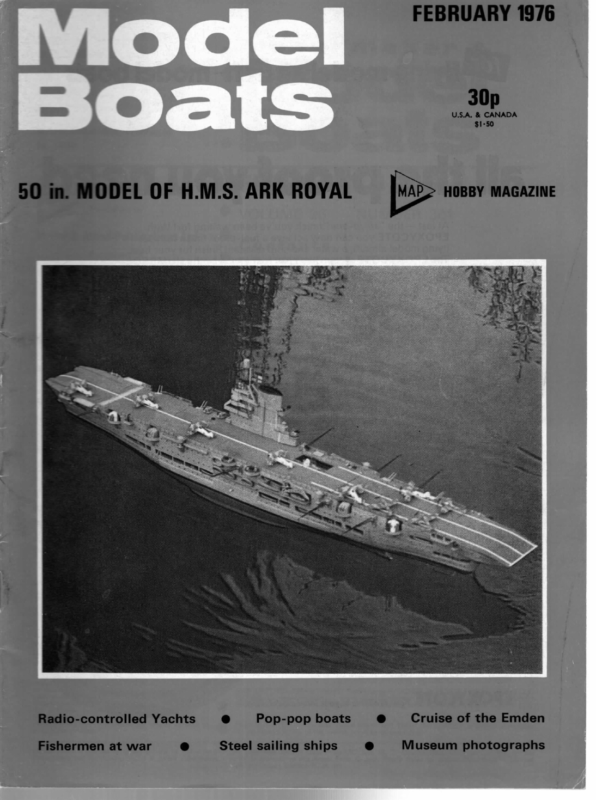
FEBRUARY 1976 30p U.S.A. & CANADA $1-50 HOBBY MAGAZINE 50 in. MODEL OF H.M.S. ARK ROYAL Radio-controlled Yachts e Fishermen at war Steel sailing ships Es] Pop-pop boats @ & Cruise of the Emden Museum photographs
—~ == = oo eS A estas Lightweight Marbleheads for R/c? Gosport and Washington races point in different directions, say Larry and Niel Goodrich of Central Park MYC eS OST skippers would like to have the best RM in the world, and after every major regatta there is a tendency for all of us to assume that the winning boat is the one to build and a tendency to forget that only a few new designs become classics. Typical is a recent letter from abroad which wistfully speculates that Model Boats may publish the drawing of Don’t Touch, the RM winner at Gosport, designed, built and raced by Lennart Akesson of Sweden. (Since the boat was not built from any drawing, it is unlikely we will ever see one). Don’t Touch was in fact a convincing winner at Gosport, and Akesson was deservedly the celebrity of the event for his marvellously inventive designs and virtually flawless tactics. Does that mean we should all try to duplicate the win- ning boat with its Stollery type hull, rotating bendy mast and an all up weight of only 134lbs? We honestly do not know, but we dearly wish we did. All we can do at this point is to state the evidence, which raises doubts in our minds, and hope that future races will point us more clearly in the right direction, To put the issue precisely, will a well designed and well balanced displacement boat of 18lbs or more be superior to Don’t Touch over a reasonable range of racing conditions ? Niel was fortunate enough to see one day of the RM racing at Gosport, and he came home (as did everyone else) with glowing reports about the event, the hospitality extended and particularly the Swedish RM entry. How- ever, his private impression was that, with the exception of the winning boat, the RMs entered at Gosport were not quite on a par with the RMs he knows well here in the Northeast of the United States, such as Stan Goodwin’s Warrior I and Ned Wagner’s Armida, a George Bersuch design of a decade ago. Neither of us was at all confident about that impression since it is obviously very difficult for even a keen observer like Niel to ‘eyeball’ separate fleets on two continents and come to any sound conclusions about relative performance. Certainly Don’t Touch at Gosport had taken on and beaten a very wide range of designs from all over the world, and that fact might have been enough for us to go to lighter displacements over the winter with confidence that that was the right direction. However, on August 23-24, 1975, the American MYA RM Championships were held in Washington, DC, and the heavier displacement boats dominated the competition. Here are the results of the top six placing skippers: Skipper Design Dp Points 1 Chuck Black Bingo 18lbs 184 2 Rich Matt Bingo 18 24 3 Stan Goodwin Warrior I 204 282 4 Bert Lott Warrior II 183? 43 5 Forrest Godby own design 18+ 45? 6 Bob Harris Warrior IT 183? 46 The top six RMs (the Bingos, the Warriors and the Godby design) are all well balanced displacement hulls weighing at Heading, two top I8lb US RMs. Ahead is new Doug Petersen design, Bingo, 1975 AMYA winner, followed by Warrior Il with 85” rig. Although very similar, note rounder bilges, reverse transom and bustle of Bingo. (Photo by Doug Petersen). Left, Bingo built by Rich Matt shows brightly polished bottom. Designer has given it very clean lines and a 15” draft to make it stiff enough to carry top rig up to | 7-18 mph. Authors feel radial jib rack would be superior to fishing swivel type shown. (Photo by Rich Matt). Opposite, Chuck Black’s winning Bingo proto- type, commercial production of which began in December 1975. Travellers on both main and jib are used to control high rig. Main sheet passes through deck far aft to avoid influencing traveller action, and jib sheet enters deck far forward for the same reason. Except for ‘vang’, all fittings seem to be commercial items available in US from A. J. Fisher. Bingo’s excellent performance is probably more the result of subtle refinement of the conventional displacement hull than its most unusual feature, the bustle shown, which is intended to flatten the wake and give some extra longitudinal stability. (Photos Bob Harris).
FEBRUARY least 18lbs and are very reminiscent of the vane versions from which they have evolved. Each has been meticulously refined and tuned for R/C and may have brought the development of the conventional displacement hull about as far as it can go. Two skippers who placed in the first six at Gosport did not do so well in Washington and so we assume the competition at the second event was pretty keen. We obviously cannot sort out skipper ability as a factor in these races, but if you take ‘choice of design’ as one criterion of the consummate skipper, it is clear that the best RM skippers here have opted in favour of the heavier displacement boat. For us, that seems to get us back to square one with our question unanswered, for none of us can be really sure that the Don’t Touch approach will prove superior to the very different approach popular here. We have described and furnished pictures of the Warrior Tin an earlier article (March and April 1975) and so wewill try to do the same for the Bingo, a new design in 1975 from the board of Doug Petersen, who enjoys an international reputation for his full-sized racing yachts. Bingo in its first appearance on a national level surprised even its own skippers by placing first and second in Washington, and it has naturally generated a lot of interest here. (Before anyone assumes Standley Goodwin and his Warrior I has been permanently displaced as our national RM Champion on the basis of his failure to repeat this year, we note that but for a winch breakdown which affected two heats he might have placed first or second.) Chuck Black feels that Bingo and his production Warrior I[ are about ona par to windward but that Bingo is slightly faster on the reach and the run. Bingo has slightly less fore-and-aft rocker which seems to minimize bow burying downwind and it has an interesting bustle to help keep the wake flat. Both boats have the same type of rather high aspect rigs and are very close in displacement. In fact, it is hard to tell them apart in the water, as the accompanying picture shows. Black advises that he will begin production of the Bingo fbg. hull ($40), keel shell ($25), rudder ($6) and other components in December 1975 to add to his already popular Warrior IJ line. (Enquiries can be directed to: Black’s R/C Model Boats, 4761 Niagara Avenue, San Diego, California 92107, USA). Based on the experience of the Central Park MYC in stocking and selling the Warrior II, the Bambiand the Etchells 22 supplied by Black, we have every reason to anticipate that the Bingo line will be of a very high quality of manufacture but that, alas, deliveries may be relatively slow. Since there are only two Bingo prototypes at the time of this writing, we have not had a 75 1976 chance to sail one and we have no idea whether it will be as pleasing to the average skipper as the Warrior II has become here. If you personally are convinced that the heavier displacement boats are an advantage, then the Bingo or the Warrior II might be a good bet. As for the two of us, we end not being able to answer the question we posed. Right now we are racing two very different RMs in the 18lb range, but our instinct is to go lighter. Like Uffa Fox, we think excess weight is only good in steamrollers. Yet we have not been able to come up witha lightweight design which is really competitive in lighter winds or which goes to weather well. Niel has drawn some lines for a new lightweight RM intended to lick both those problems, but who knows if it will work? Just because the displacement question may be unresolved, we see no reason to be discouraged. These and other race results and our own experiments indicate that there are a number of clear directions in which the RM skipper can profitably move. Perhaps your own observations and thinking will coincide with some of these: (1) Vane and vane-influenced designs often have the keel and sailplan too far forward, apparently to allow room for the vane gear, but we find we get a stiffer, better balanced boat by moving both back nearer to the maximum, beam. (2) Our fins have been narrowed and deepened to a draft of at least 15in and carefully shaped to an 8 to 1 or 10 to 1 camber. The skeg has been eliminated and the total area of the fin has been reduced about 30 per cent from the comparable vane configuration. The deeper fin gives added stiffness with the same weight of bulb, the moderate camber improves pointing ability and the shape and reduced wetted area of the fin reduce resistance on all points of sailing. Contrary to popular notions, a deep, well shaped keel will not tend to trip the hull to a bow-down position off the wind. In fact, since a deeper keel tends to stiffen the boat in all directions, it will tend to dampen diving and hobby-horsing. Although it may be possible to drive more thickly cambered keels efficiently through the water, our experiments indicate that they give too much lift to windward in heavy air to be manageable on an RM. (3) With a stiffer hull and less keel resistance, it is natural to try to exploit the free roach of the RM rule to go to higher rigs for the extra sail area and driving power they can give. We have been going higher by small increments, and the principal problem we encounter is that as you go higher it becomes increasingly difficult to stabilize the rig and maintain sail shape under actual racing conditions. So we try to think of the rig as a combination of mast, spars,
MODEL BOATS sails and fittings intended to provide the best airfoil. A good jib rack with its own vang, a bind-free main vang and travellers are helpful for high rigs. (in England, we use the common trait — they think of every factor involved in the performance of the model yacht as contributing to the winning combination and concentrate on all the details until they are satisfied with the whole. As a consequence, they usually cannot tell you how much any one factor contributes to the whole. Akesson’s 134lb design and Doug expression ‘kicking strap’ instead of ‘vang’ — Ed). (4) Since we have observed many designs with bows that dig in downwind and even when driving to windward, we take pains to ensure that we have plenty of reserve buoyancy in the bow just above the waterline and that fore Petersen’s 18lb design are two separate approaches to the same problem and it remains to be seen which will prove superior. In the meantime, it is important toremember that you cannot simply take off 44lbs from an 18lb design and get Akesson’s results and that you have to work within the parameters of the design you have to bring its performance and aft trim is good when the hull is driving, not just in the static state in a tank. Our theory is simply that if the design lines were good in the first place you should try to keep the hull on them and not let the boat sail with the bow canted down or the transom dragging. This, of course, is elementary but we see so many RM skippers using a combination of high rigs and hulls with tender bows that we think a reminder is in order. For the same reasons, we are sceptical of some of the newer designs with tender bows. Leading skippers such as Akesson at Gosport and Black at Washington have, we think you will agree, at least one to its maximum potential. (The authors would be pleased to receive correspondence from readers addressed to: Larry and Niel Goodrich, 295 Henry Street, Brooklyn Heights, New York, 11201, USA, but they cannot promise to acknowledge each letter and, as a matter of policy, they will not make recommendations as to commercial products). R.N.L.B. Calouste Gulbenkian A 1in scale model of a 37ft Oakley type by G. W. Drew 76
I MODEL BOATS RADIO CONTROL YACHT RACING Charles Brazier first wrote these beginners’ notes for the M.Y.A. in 1965. Now, updated, they will help many new- comers to the sport. | Be racing with Radio Controlled Model Yachts, ex- perience has shown theneed for some modification to ‘The International Yacht Racing Union rules’. The radio control model yachtsman is faced with the difficulties that distance and remote control bring. It is one thing to sit on the stern benches with tiller in hand aboard a full size yacht, and being able to appreciate the various racing situations as they develop between yachts which are but a few lengths apart, but it is a vastly different matter when controlling a radio model in a race from the shore. The need has also been felt for an explanation of Sailing Rules, in a manner which can be easily understood by new- comers to the sport, who have little or no knowledg e of the you lose nothing by warning your opponen t of your intention — but having hailed your intention you MUST carry it out. Therefore, think twice for your own as well as your opponent’s sake before changing tack when close to one another. If your opponent refuses to respond to your hail and a collision occurs, he will be penalised — if, that is, the situation was such that he was obliged to keep clear. It may happen that he is not obliged to give way; if so, he has two courses open to him: (i) To give way and protest. (ii) By answering the Hail with ‘You are not entitled’, thus warning you. Hailing is used as a rule in the TYRU and is to be found in Rule 35 of their Rule Book. Our modification is — first that we hail at all times, even when luffing, and secondly the baulking penalty has been introduced. Rule 36 — A yacht on the Port Tack gives way to a yacht on the Starboard Tack rules or indeed of sailing. In writing this I set out to do those two things. It is essential — to promote skill in competition racing — to have a good working knowledge of the rules, and therefore be able to indulge in the tactics which those rules Fig. | allow. Bear in mind always that the yacht racing sailing rules The wind is coming over your Port side, your boom is to are designed firstly to avoid collisions between yachts, secondly to give advantage in certain situations, and thirdly to give the means to avoid hazards at buoys and obstructions. I will write in a conversational tone as though you, my reader, and J are sailing our model yachts in a race. starboard, therefore you are on the Port Tack Your Port side is your You shall be Red Yacht and I shall be Blue. Let us then Windward side follow through a race together, step by step, and apply the rules as demanded. To assist an understanding of the rules suitable diagrams have been included, following the explanation of each rule. Before we proceed any further there is a matter of procedure which I must explain to you. Rememb er that your Your Starboard side is your leeward side opponent may not be so good at the game as you are, so even although you have the ‘Right of Way’, always try to avoid a collision. The first Rule will compens ate you for such action. Rule 21 —A protest can be made by any skipper against another for an infringement of the Rules If in your effort to avoid a collision you are deflected from your course by your opponent’s infring ement of a Rule you may protest. But you must do so at the time of the incident by calling protest to the OOD, and keeping on sailing. When the incident is dealt with by the OOD and it is found that you were right to protest, your oppone nt will be penalised for infringement. Never protest unless you are absolutely sure that your opponent was in the wrong lest the verdict go against you and you collect the penalty. Rule 33 — Should a skipper realise he has infringed a racing rule or a sailing instruction for a second time in a particular race, he should retire promptly. Rule 35 — Hail before making an alterati on of course at all Red and Blue yachts are manoeuvring before the Start. I am on the Starboard Tack approaching you, you are on the Port Tack and must give way. Study the drawing . The definition of a tack is—a yacht is on the tack (Port or Starboard) corresponding to her windward side, with her jib sail filled. When in the act of changing from one tack to another you are said to be ‘Going About’. Fig. 2 times when close to your opponent; even when luffing a skipper must hail of his intention, by calling ‘Luff’, and having called must carry out the luff. This Rule is introduced because most Radio Controlled yachts react very sharply to given rudder and your oppo- 4 at has little or no chance to keep clear if he is required to baulked your opponent who had respon ded to your hail. If you are entitled by right of way Rules, which we will deal with as we go along, to carry out a certain manoeuvre, 2 y F i 0 SO. This mostly happens when Beating up to Windward or Reaching, so your Hail shall be ‘Going about’ or ‘Luffing you’, and having hailed you must change tack. Failure to do so will entail penalisation becaus e you misled or fA 1 ‘ ! } therefore lost her starboard ight of | o/ 1 . ; Red is returning to the starting line after the start and has rig BLUE wa way
FEBRUARY 1976 Now there is an occasion after the starting signal when this does not apply. This is covered by Rule 44. Study the drawing, Fig. 2. BLUE If you have crossed over the line early and are returning to start, on the Starboard tack, you have to keep clear of all yachts which were not over early, even although they are approaching the line on the Port tack. There is also another occasion when it does not apply — namely on a downwind leg of the course, but to avoid confusion we will deal with it when we reach that position in our race. Rule 42 — Anti-Barging; when approaching the Starting Line to start, a leeward yacht shall be under no obligation to give room to any windward yacht to pass on the required side of the Starting Mark. (Fig. 3). Red and Blue have accepted the Starter’s orders. The Starting whistle has been blown, and I have been foolish enough to get in a position between you to leeward and the Starting line buoy, without sufficient room to pass between you. I overlap you, and in other circumstances in the race in this position you would have to give me room, but in this case before the line has been crossed you are not obliged to give me room. I must therefore go about to avoid you, or risk a penalty before even crossing the line. R ED Fig. 3 Leeward yacht has right of way ~ \ x ss \ ‘ \ a =e ees ae / s \ \ \ S\N Se Pe NO \ Nw: Se 6 (To be continued) FIGHTING FLEETS (continued from page 89) and, under their senior officer Yon Mucke, they were eventually to reach Turkish territory in the Red Sea. From there they returned to Germany for a hero’s welcome. It was not until the next day, therefore, the Sydney began her work of mercy. Returning to Emden she took off the crew, providing belated medical aid for the injured, and taking the others as prisoners-of-war. Although the Emden was finished her name was to live on. A new Emden was launched later in the war, only to be surrendered and later scuttled at Scapa Flow, a far different fate from that of her illustrious predecessor. A further cruiser named Emden was built after the war and served, without particular distinction, through the Second World War. In 1961, yet another Emden, this timea frigate, joined the West German towards the Cocos, to rendezvous with Emden after the conclusion of the operation. She was now the only supply ship left to Emden, the Markomannia having been captured by British warships two weeks previously. Her impending arrival was to have serious consequences for Emden whose lookouts, expecting the Buresk, mistook the Sydney for her when smoke first appeared on the horizon. Sydney could see Emden’s smoke as soon as the islands came in view. Emden, meanwhile, paid little attention to Sydney’s smoke at first, believing it to be from Buresk. When she did realise her mistake it was too late to recall her landing party and she had to abandon them while she took on the newcomer, leaving behind men who would have been invaluable in the coming battle. Sydney was more than a match for Emden. She had the edge in speed and carried 6 inch guns which easily outranged Emden’s 4.1 inch. Despite this her commander, Captain Glossop, allowed his ship to get too close in the early stages and, when Emden opened fire, she was the first to get a hit. Sydney quickly opened the range however and, as soon as the Australian gunners got the range, they began to score hit after hit. Von Muller tried every trick in the book to get closer to his enemy but it was all in vain; after about an hour of this one-sided engagement he ran his ship up onto a reef on Keeling Island, a smoking, shattered wreck. Sydney then took off after Buresk which was still in the vicinity. She scuttled herself on sighting the warship. Returning to the Emden, she found the German flag still flying and attempted, by signal, to get her to surrender. Emden, through lack of signal books, was unable to respond and Glossop ordered Sydney to open fire again — an act for which he was to be severely criticised later. Conditions on the German ship were appalling. Her decks were red-hot from the fires that raged inside her, and were littered with wounded and dead men. Attempts to reach the shore failed due to strong currents and sharks. The renewed shelling was another torment to plague the sad end of this gallant little ship. As soon as the flag was brought down the firing ceased and Sydney sent a boat over to Emden to investigate. Water and first-aid equipment were taken to the wreck but no attempt was made to remove the crew. Glossop, instead, headed for Direction Island to investigate conditions there and to take the landing party prisoner. To his surprise, however, he found them gone. They had commandeered a leaky old schooner, the Ayesha, Navy. Tsingtao, Emden’s old peacetime base, fell to a combined Japanese-British assault on November 7th, just two days before her meeting with Sydney. As for Von Spee and the rest of the East Asiatic Squadron, they were joined by Leipzig and Dresden and on November Ist defeated Admiral Cradock’s squadron of four ships at Coronel. They sank Admiral Cradock’s flagship Good Hope and the armoured cruiser Monmouth with all hands. Just overa month later Von Spee’s Squadron was defeated by Admiral Sturdee, whose battle cruisers and armoured cruisers sank the entire German squadron with the exception of Dresden. Dresden escaped only to be caught a few months later. The particulars of Emden and Sydney were as follows: EMDEN SYDNEY Built: Danzig, 1906-1909 London & Glasgow, Displacement: 3,600 tons Machinery: 13,500 HP= 244 knots Armament: TT 8—6inch; 4-3 pdr; 2—21 inch TT Complement: 321 380 Emden was painted white with buff funnels and upper- works before the war. She was painted an overall grey before leaving Tsingtao, the exact shade of which is difficult to determine, but was probably a medium grey. Waterline was red in peacetime. Sydney was dark grey (Humbrol HN 2) with black waterline. Weather decks on both ships were planked. 95 – SS 10—4.1 inch; 8—5 pdr; 2—17.7inch 1911-1913 5,600 tons 22,000 HP= 26 knots ||
FEBRUARY 1976 Pacemaker Building the Nylet radio 10-rater kit. These notes apply to all ‘““open top” g.r.p. hulls When glass-fibre resin cures it has already flowed out into a smooth surface locally. The interior of a moulding might be slightly rough and bumpy to the touch because of the glass strands, but the actual resin is glossy and varnish-like, which does not give a very good bond with glues or resins applied later. It is therefore essential to scratch up the surface wherever a joint is to be made, to give a key for the adhesive to grip. There was one instance where a yacht sailed into a concrete bank and the whole deck assembly, with inwales, popped out on impact, and the same thing has happened to a number of wood-decked power boats. So take a minute or two to roughen the surface round the inside of the hull edge before any of the wood components are bonded in. S with any kit, the first step is to spread out the drawing and the bits and read through the instructions to make sure that you know what the various items are for and the sequence of construction. If you realise, for example, that in the final stages certain fittings have to be screwed in a particular place, you will be that much more careful to see that whatever they screw into is correctly positioned. The first constructional stage with Pacemaker is one of the more awkward jobs — cutting and fitting a bow block inside the hull, from 4in ply. It is easy to lay the hull over the wood and draw round the outside, then mark a cutting line inside the first and cut the shape out. This must then be clamped in a vice and the cut edges chamfered quite severely, with saw, rasp, glasspaper etc., until the piece is a snug fit to the hull. Then a rebate must be marked and cut (at the same chamfered angle) each side at the after end, to receive the ends of the + x 4in inwales. So far so good, but once the epoxy glue is applied, the ply is reluctant to stay in place — it either slowly slides backwards or upwards. We found that a clothes peg clamped to the hull each side prevented the block sliding back; a rubber band round the bow tended to make the block rise above the deck, but a shallow tapered wedge of scrap could be adjusted under the rubber band to hold everything level. Next comes the job of cutting the inwales, which are cut from two of the three 7ft lengths of + x in ramin supplied. A piece of this timber is first cut and fitted across the transom and allowed to set, then the inwales cut to a reasonable fit between this and the rebates previously cut in the bow block. A tight fit should be avoided, since it could distort the curve of the hull edge; epoxy resin is quite a good gap-filler if there should be a small amount of daylight anywhere. Above, the first inwale well pegged in position. Note the other temporarily clamped in place. Right, the bow block is restrained by two clothes-pegs, a rubber band, and a tapered piece of scrap, while the epoxy cures. It is desirable to clip one inwale in place with a few clothes pegs before glueing in the opposite one, again with the object of keeping the hull as symmetrical as possible. The wood inwale will try to flatten the curve in the hull side, but it can only do this if the opposite side takes a shade more curve, and clipping the other inwale temporarily in place reduces the chance of this happening. Use a slow-drying epoxy glue for this job, and use plenty of clothes pegs and/or bulldog clips, since the inwale has to be sprung to the sheer of the hull as well as the deck curve. In any event, the more clamping points the less chance there is of gaps between the inwale and hull. An alternative to epoxy is Cataloy or one of the similar filled resins, which have good gap-filling properties and a good strong bond, provided the surface of the glass hull is adequately roughened, with a broken file or coarse carborundum paper etc.
vl ARTHUR JOHN GORDON LEVISON A tribute by Norman Hatfield, Vice-Chairman, M.Y.A. This photograph, taken by the Editor in 1957, shows Arthur in typical sailing rig, including beret, turning Jill, his favourite boat. That year he placed 2nd in the A Class Championship, his highest place until he won in 1968. The sculpture was completed at Farnham and Arthur was presented to HM the Queen at the ceremony of the opening of the ship’s dry dock at Greenwich. Also a musician of considerable talent, Arthur learnt to play the violin at an early age and was in the orchestra for many of the Farnham Operatic Society productions. He idolised Mozart and had a keen appreciation of all his works, particularly his operas. In fact, he could recite whole passages from the librettos of ‘Don Giovanni’, ‘Cosi fan tutte’ and ‘The Marriage of Figaro’, and loved talking ODEL Yachting lost one of its greatest characters when, on 14th November last, Arthur Levison died just before his 83rd birthday in Frimley Park Hospital, where he had been admitted the previous day. In the mid-fifties, Arthur’s name was usually coupled with those of two other great craftsmen, Bill Daniels and Kenneth Corby because, together, all three — Daniels the designer, Levison the builder and Corby the maker of fittings — were responsible for creating a fleet of ‘A’ Class boats whose beauty of line and quality of finish have been unsurpassed to this day. Arthur was born on 16th November, 1892, in Gloucester _ and first practised his craft as a wood carver with his father, who was employed on the restoration of Gloucester Cathedral and who also specialised in the carving of figureheads for sailing ships. He joined the Army at the outbreak of the First World War and served in France with the Royal Artillery until he was wounded in his knee and discharged in 1917. Afterwards, he worked in London on the hand carving of artificial limbs. His wound puta stop to cycle racing, in which he was a keen competitor before the ped track. for which he won a number of trophies on the Arthur was married in Gloucester 55 years ago and he and his wife, Lydia, moved to Farnham, Surrey,where they have lived ever since. His workshop in Wagon Yard was well known to his many model yachtsmen friends and wood craftsmen. Between the wars, he was engaged in architectural and monumental carving. During the Second World War he worked with a firm in Raynes Park, which made small detailed models of warships and other military equipment about Mozart’s humour. He was a keen Bowls player, too, and held his County Badge, of which he was very proud. For short periods he was Captain of both Brightwell (Farnham) Bowling Club and the Ascot Indoor Bowls Club. He has always been interested in the building of model yachts as a hobby and, after the Second World War, he made this his profession. He probably built more model yachts of all classes in timber than anyone. They were all built ‘bread and butter’ on the buttock lines and so accurate was his carving that he hardly needed to use templates. His skill with carving tools was remarkable and he could take off a whole cut from stem to stern of an ‘A’ Class hull with a few strokes of his mallet, without splitting the wood. He usually worked with obechi or mahogany. The YM 6m Owners’ Association at the Rick Pond, Hampton Court, was proud to have Arthur as a member. He was also a member of the Guildford and Gosport Model Yacht Clubs. His best known ‘A’ Class yacht was Jill, designed by Bill Daniels, which was the prototype fora line of successful boats on similar lines. In 1968, at Gosport, Arthur achieved his greatest ambition by winning the British‘A’ Class Open Championship and the International Race for the *Yachting Monthly’ Cup with Philippaand was duly honoured by his Club at a memorable reception held in the YM 6m OA Clubhouse, where a shield was hung to join those of other notable model yachtsmen who achieved the same success in the past. He was also a sailmaker and models all over the country and in other parts of the world won races with his well-known varnished terylene sails, some of which are still being used to this day. Gifted in the way that few mortals are, Arthur could create in wood, stone and marble things of beauty and design and was proud of it. Many Clubs and Associations have lasting memories of him in the form of trophies carved and presented by him which, it is hoped, will continue to be competed for in the same spirit with which he, himself, competed. Arthur and Lydia Levison had two sons, Philip and John but, sadly, John lost his life at the Battle of Arnhem in the last war and his parents felt his loss very deeply. At the funeral, which took place at Aldershot Crematorium on 20th November, many of Arthur’s model yachting friends gathered to pay their respects to one of the last of the great traditional craftsmen. To end ona personal note, I feel I was privileged to have known Arthur for 25 years and will always have happy memories of the good times we spent together at the pondside and in the Clubhouse, chatting about the two subjects we loved best, boats and music. for use in training programmes. Arthur carved with distinction in wood, stone and marble and amongst his outstanding work were a Coat of Arms in stone for the Officers’ Mess at Aldershot, the copying of wood panelling for the home of Viscountess Cowdray, stone carving at Alfred, Lord Tennyson’s house at Haslemere and carved barge boards for Lady Swayling’s house. He was probably best known for his new figurehead for the restoration of the famous clipper ship, Cutty Sark, which the National Maritime Museum commissioned in 1956, when the ship was being preserved in dry dock at Greenwich. The figurehead, representing a Scottish witch, was carved from a 9 foot block of Canadian Pine presented by the Canadian Government. Arthur appeared on television when he began the figurehead carving at the first National Boat Show at Olympia and was alsoa participant in the well-known TV parlour game, ‘What’s My Line?” 98