
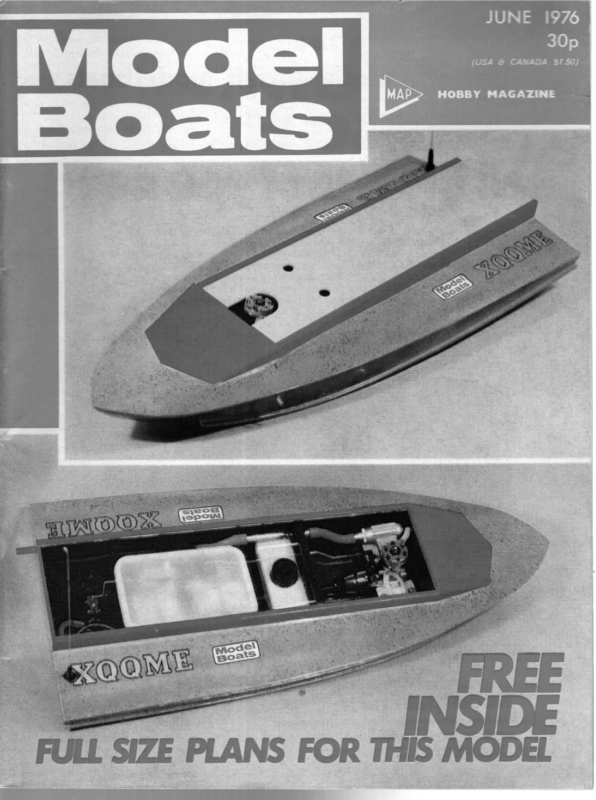
- AFRIT A 41.75lb. 54in. w.l. ‘A’ Class design by Vic Smeed
- R/C Yacht Checks plus care of nicad cells A useful paper produced by Central Park M.Y.C. “Glitch Committee”
- Polyurethane Buoyancy Foam A little experiment and calculation can save time, money, and damage, says A. Burley
- RMs-how much should they weigh? Bob Jeffries details weights of his models
- PACEMAKER Continuing the building of Nylet’s R10R Kit Part Five

JUNE 197 30p (USA & CANADA $1.50) – HOBBY MAGAZINE ‘i
MODEL BOATS AFRIT A 41$lb. 54in. w.l. ‘A’ Class design by Vic Smeed HIS design is published primarily because several people have asked for a copy of the plan, which must be encouraging! It was originally drawn up about two years ago, and Robin (Taffy) Williams of the Birmingham club, who was looking for a new A boat to build, was tempted by a print of the original pencil draught. He built it in a matter of weeks and it was registered in July 1974, since when it has been sailed regularly, and attracted favourable comment. Although it has never won anything, the fact that others want to build it is fair recommendation. There is, of course, no substitute for an actual boat in being for checking the accuracy of the design calculations and seeing whether the design aims have worked out. When the boat was submitted for measurement it was quite a relief to find that with only very minor differences from the calculations it rated satisfactorily. It was, too, pleasing that the boat sailed with the mast in the position drawn and that the performance characteristics hoped for were in evidence. At the time of the design it was beginning to be apparent that lighter A boats, carrying a displacement penalty, could be competitive, but that some of the examples sailing had perhaps gone a little too far and, while competitive in the hands of a skilled skipper, were not likely to do well in average hands. The usual handicap for light boats is in performance in light and erratic wind; in moderate or strong winds there need be little difference in windward performance and off the wind they can be fliers. In alternate puffs and calms the sheer inertia of a heavyweight tends to keep it coasting through flat patches, while a lightweight stops and starts. When it stops it LAs eh | 320 Taffy Williams guys for the line in the Chris Williams picture above. Below left, Brian Bull snapped the boat sailing against a trial horse; note the comparative slimness of line in the picture of both boats on the bank. Below, the designer’s model under construction. Several experts feel it a competitive boat.
JUNE 1376 The lead is slightly unusual, being a sort of cross between a bulb and the traditional type. Stainless steel rods locate in interior handle for easy portability. tends to drift off its desired heading, so that when a puff comes it takes time for it to gather itself and return to its proper course. This is not to say that a heavy boat never stops, but it is clear to anyone watching a race in such conditions that it is less affected in speed and direction than its lighter opponent. It was felt that there must be a combination of displacement (including penalty), waterline, and sail area which allowed most of the advantages of a relative lightweight but which would produce a boat able to ghost along in the faintest breeze and accelerate reasonably well in a puff, Doodling with some rough graphs suggested that something around 42 lbs. on a 54in. waterline (the shortest felt acceptable) would give 1300 sq. ins. of sail and appeared to provide the best “‘value for money”. The fascination of the Class A rule is the infinite variety of combinations, all of which have something in their favour. Twenty five years ago it used to be held that 1500 sq. ins. was the minimum useful sail area, but improved sail materials etc. have perhaps rendered this view too narrow. A factor in the lightweight approach to As is possibly the undeniably higher speed of the modern 10 rater, where perhaps 1200 sq. ins of sail, 62-63in. waterline, and 25lbs. displacement can produce a very fast machine. The A rule ties things down rather more, but a comparison between the performance of an old, short 10r with enormous sails and a modern small-sailed one does suggest that we shall see more development on the smaller sail area A boat. In the Afrit design, accepting a shortish waterline more or less forces hull sections which will tuck down to increase sailing length when heeled, and the need to have an easily driven hull with small wetted area for ghosting leads inevitably to the roundish, heavily tumbled type of hull which has been successful in Priest and Lewis designs. It was felt that the boat would be best left reasonably conventional in overall shape, partly because the designer prefers it that way but also because if a bustle or dropped stern etc. was incorporated and the boat was a disaster, it would never be certain why. The ballast is perhaps the least normal part of the boat, and here again it is a compromise between the advantages of a pure bulb and the disadvantages of a wetted area. An embryo seal flipper hopefully combines the best of both worlds, should have minimum form drag, and offers a simple method of adjusting the weight of the ballast, by (please turn to page 314) FULL-SIZE COPIES OF THE DRAWING BELOW (SHEER AND WATERLINES HALF SIZE, BODY PLAN AND LEAD FULL SIZE) ARE AVAILABLE REF. MM200 PRICE £1.15 INC. VAT AND POST FROM MODEL MAKER PLANS SERVICE, PO BOX 35, HEMEL HEMPSTEAD, HERTS HPI IEE AFRIT copyrgnt of The Model Maker Plans Service 295 iene Swevt, Hewat Henpeioes,, Here
MODEL BOATS R/C Yacht Checks It We be easier to follow if the simple basic idea is kept in mind: If two or three transmitters take turns on the same frequency, and ai// glitch one receiver, it’s unlikely that all the transmitters were out of tune. Almost certainly it’s the receiver which is out of tune. If only one transmitter causes a glitch, but the others don’t then that transmitter is probably at fault. Now the routine: 1. plus care of nicad cells Boat “Glitch Committee” 2. 3. Central Park M.Y.C. (New York City) recently set up a technical committee, chaired by Steve Van Ness, and among the first fruits was the following very sensible check list, plus notes on nicad cells. We have left them more or less as written — for example, we’d be likely to say “‘aerial’’ rather than “‘antenna’’, 27 mHz walkie-talkies are illegal in U.K. though other interference may be encountered, and we do not use “‘Penlite AA” or type letters for cell identification — but the majority of readers will undoubtedly find something of interest. Our thanks to Steve and C.P.M.Y.C. for permission to reproduce the lists. 4. 5. 6. 7. 8. Your Boat equipment — things to check: 1. Be sure Rx crystal is in receiver and Tx crystal in transmitter, not the other way around. Both must be good tight fit. Be sure batteries have 1-25V per cell or more. 2. 3. 4. All wiring in boat should be twisted wires or coaxial cable . . . every inch. Besure receiver antenna is not close to any other wire for any distance. (Particularly, don’t wrap antenna around a stay wire! This causes all kinds of inductance). Ifyou’rein the 27 band, you may get interference from all the cheap little walkie-talkie” sets in town. It will help to lay your antenna horizontally on the deck to reduce its receiving range. Then be sure your transmitter antenna is fully extended. Chances are that with this setup you can overpower any interference. (Unless very close). 5. If your winch motor seems to be glitching your own equipment, use Irv Brodsky’s choke and capacitor connected across the motor terminals. Wiring diagram: A B Frequency: Brown Green C A useful paper produced by Central Park M.Y.C. For example, assume five boats. The routine is the same regardless of number. 9. 10. 11. 12. 13. Yellow D Orange E Red All skippers and boats gather close together, as they might be near marks during a race. All turn on receivers and transmitters. Each skipper in turn works rudder and sail winch, reports results. If no one gets a glitch, thank God. If someone gets a glitch, say boat B, then every skipper will turn off his transmitter, but not his receiver. One at a time, each skipper turns on his transmitter, works rudder and winch, then turns off. This will reveal which boats are being glitched by which. Glitchee should first check batteries and test be run again if charge is low. Forexample, suppose it’s found that skipper B (Green) is being glitched by skipper A (Brown). Then one of the other skippers, who is neither causing nor getting any trouble, will switch his transmitter to Brown. Say skipper C switched his transmitter to Brown. He turns it on and works all controls. If C doesn’t glitch B, then A’s transmitter is at fault. On the other hand, : ? as well as A both glitch B, then B’s receiver is at ault. This principle can be used to test in turn as many cases of transmitter/receiver trouble as may exist. Working with the same example, what’s the cure? We established who had faulty equipment . . . Transmitter A or receiver B. The next step is to find out if the trouble only occurs on one particular frequency (which is unlikely but possible). Whoever was at fault now switches frequencies with a skipper who hasn’t been getting or giving any glitches. For instance, if skipper A’s transmitter was causing the trouble on Brown, he could switch all equipment to skipper C’s Yellow . . . while C would switch to Brown. Everybody goes back to step 1 and we run the test again. 14. If skipper A is still causing trouble, he should send his equipment in for repair immediately. Care and feeding of pet nicads NOTE: This is optimum. Any one component | 23 will help 10 MICROHENRY CHOKE BATTERY — Terminal ‘ THREE 1 WATT 100 OHM 1 MICRO FARAD $3 DISC RESISTOR BATTERY »>—— Pre-Race Glitch Test OOO 10 MICROHENRY CHOKE CAPACITORS 4 Terminal I’ve checked this information out with an applications engineer at Gould-Burgess. So we may take it as official: 1. Always charge cells in series. (In parallel, there’ll always be some that don’t get fully charged). 2. Recommended charge is at the rate of 1/10th the cell’s capacity (10-hr. or -1C rate) for 14-16 hours. Penlite AA, 50 ma., ‘‘C” cell, 200 ma.; ‘‘D”’ cell, 400 ma. (They’ll take this for weeks.) 3. Don’t fast-charge at more than three times this rate. (Beyond this it gets tricky . . . cell construction, ambient temperature, specific charge rate, etc. come in. It’s time for engineers.) . The following routine sounds more complicated than it is. 322 Never charge cells at temperatures below freezing point or above 115°F.
1976 JUNE 5. 6. 7. 8. flat while others are still discharging it can be driven Sealed nicads aren’t harmed by temperatures up to 115°F. They can tolerate up to 140°F. for brief into “‘reverse charge” and be permanently destroyed. Recommended cut-off voltage is 1V. per cell under load. (With a little experimenting, you can discover periods. Never solder directly to a nicad… use only cells provided with a soldering tab! what output meter reading on your transmitter corresponds to this voltage.) Batteries may be stored charged or uncharged . . . no harm done. One or two charge/discharge cycles will bring them back to peak performance. (Stored batteries lose about 0-8 % of charge daily at 30°F., 2% 10. Don’t discharge nicads in parallel without extreme caution. It greatly increases your chances of creating a reverse-charge situation. 11. As much as possible, use all cells in a battery as a permanent unit . . . charge and discharge them to- daily at 70°F., 5% daily at 115°F.) The “memory” bugaboo has no possible significance gether, so they stay “‘in sync”. This helps avoid the in hobby applications of nicads. reverse-charge situation. 9, Never run a battery down completely. If one cell goes Polyurethane Buoyancy Foam hari following words are aimed at making life easier for anybody wishing to fill model boat cavities with polyurethane foam. The main problems appear to be working out the volume of foam required to support the model, and the amount of liquid to form the said volume. Hull cavities are usually of such weird shapes that it is impossible to measure their volumes using a rule. Guessing the volumes and amount of foam required can result, if you are unlucky, in split bulkheads, decks and hulls. This problem can be solved using simple equipment, kitchen scales, rule, water and containers marked in cubic centimetres. Sources of containers ready measured in cubic centimetres are syringes and cosmetic containers for small amounts, hair shampoo bottles for large amounts. The scales are only used for weighing the hull so that the required volume to keep it afloat can be worked out. To keep things simple the foam chemicals will only be referred to as clear and brown mixed at a ratio of 50/50. The chemical manufacturers state a weight of 2.0 to 2.5 Ib. per cu.ft. and a liquid-to-foam ratio of between 20-1 to 35-1, but this can vary due to a few factors. Temperature of chemicals, temperature of mould or hull, mix not 50/50, foaming in a restricted mould and insufficient mixing of liquids. From the time the two liquids are poured together you have approximately 45 seconds to mix and pour into the hull; 25 seconds should be spent mixing. Mixing by hand is not recommended as it is not thorough or fast enough. A length of 6mm (4in.) dowel slotted in one end to which is fitted a piece of stiff card 20 x 20mm (#in. x 3in.), fastened into a hand drill makes a good mechanical mixer. The ideal working temperature is 60 deg F. The weight and liquid-to-foam ratio can be varied but involves very accurate measuring, especially with the small amounts we will be using. Too much brown and you end up with a solid blob of polyurethane rolling about the hull bottom. Too much clear and the mix will foam up fast and high and then collapse just as fast, so stick to a 50/50 mix. Before attempting to foam into the hull the liquid-toratio should be checked, and this is a simple job if you proceed as follows: Mix 20cc of brown with 20cc of clear and pour into a mould whose volume you already know; I use a 15cm length of plastic drain pipe which is convenient 10cm inside dia. There is no need to seal the end, just stand upright on a newspaper with a piece of waxed bread wrapper between them. Keep pipe pressed down until liquid has foamed. When set the top surface will be convex, so fill mould to top with water. The volume of this water should be taken from mould volume to give foam volume. Foam volume divided by volume of orig- A little experiment and calculation can save time, money, and damage, says A. Burley Foam volume 912-75 = 22-56 Always take to next highest whole Liquid vol You now require the volume of foam required to float Method of finding cavity volumes. Bow— mark on the inside of the hull the bulkhead position, a couple of thick pencil marks will do. Stand hull upright on bow, fill with water to pencil marks. The volume of this water divided by foam ratio = volume of liquid required to foam bow cavity. Dry out cavity, glass in bulkhead, fill with foam and then repeat with hull sides. Example: Silak. Futaba R/C, OPS40, 0-5 litre fuel, all up weight 2-718 kilogramme (6lb.) requires 2718cc of foam (16-6 cu.ins.) Leigh Hobby foam at Foam ratio of 23 to 1. Bulkhead across hull 155mm from bow, find volume as already described. Bow volume = 1954cc. Volume of liquids required is 2 = 84-9 call it 85cc. Liquids required are brown 42:Scc / clear 42-5cc. Before glassing in the bulkhead drill a 25mm (lin.) dia hole in it for pouring in the mixture and half a dozen 5mm (;in.) dia holes to help the foaming gas to escape. You still have to provide a further 764cc of buoyancy, which on this particular design is taken care of by the R/C compartment, that is providing it does not get holed in a collision. Personally I think it is worth filling in the hull sides as the boat will then be unsinkable, much stronger and it helps in the overall soundproofing. Example using Leigh Hobby Centre foam. Mould IScmlong inside dia. 10cm Water required to top up mould Foam Volume = = = = number, the hull. inal liquids gives liquid to foam ratio. Mix 50/50. 20ce Brown/20cc Clear 40 Liquid to foam ratio = 23 to 1 40cc total vol of liquid 1173-50cc volume 260-76cc volume 912-75cc 323 DM
MODEL BOATS certain areas of the North Sea the sea bed is of dense sand and hard clay, foundations may have to be drilled and cemented into place. British Petroleum intend to commission two platforms , each of a total height of 560ft., and utilising 40,000 tons of steel. These units are to be fabricated on shore, towed to position, then ballasted and sunk in an upright position. Flotation required for the sea passage will be provided by the large tubular leg members which can be selectively flooded, while re-usable float tanks will be used on the top part of the structure. To overcome the hard Nine internal storage tanks Perforated outer wall bottom conditions the world’s largest pile driver will be used to drive piles each 250 to 300 ft. long. Plans are for 27 wells to be drilled from each platform, and a 115 mile pipeline will keep the oil flowing ashore, using one 34in. dia or two 28in. dia pipelines, stretching from the oil field to Cruden Bay on the N.E. of Scotland, hopefully buried sufficiently to prevent damage from anchors and fishing gear. One of the most difficult and complex operations in marine history was completed successfully recently when the million barrel capacity Phillips Group Ekofisk One concrete storage tank was located on the sea bottom in the North Sea. This tank will serve two purposes, in that it will allow continuous production of oil even when bad weather makes it impossible to load tankers from buoys, and it will provide a site for a considerable amount of processing equipment on the top two decks of the structure. The Ekofisk One consists of nine storage tanks surrounded by a perforated outer wall, the holes in the wall acting as a breakwater. The tanks are 295ft. high x 1754 x 175} feet across and 12ft. wall thickness, the outer walls being 6$ft. at the top and 4ft. Sins. at the bottom, necessitating 227,150 tons of cement and 8,850 tons of RMs-how much should they weigh? EKOFISK structure a distance of 297 miles from Stavanger to site, where it was ballasted down and concrete was pumped in to fill any voids underneath and provide a firm base. When in operation the tanks will either be full of oil or water at all times. (to be continued) This type of construction will no doubt place the builder in very much better position to have an outstanding and successful boat. Bob Jeffries details weights of his models The published designs for boats usually give the recommended all up weight, and the suggested weight of the keel. It is no good building an ultra-lightweight version, if it will not float down to the designer’s waterline, and will suffer accordingly. Equally so an overweight boat, sagging in the water well below its marks, will sail somewhat like a waterlogged packing case. The correct approach is to build the boat as light as possible, and then to add weight were it will help performance, in the keel, adding the weight till the design weight is reached, or the boat is floating on its proper marks. If one wants to build a lightweight, i.e. one with a sailing weight of less than fifteen pounds, the hull will have to be designed for that displacement. My first radio Marblehead was sailed around 1968/9, years before the MYA got around to recognising this class for radio. It was an elderly Tucker designed Duck whichI purchased very secondhand. Its weight was around 26lbs, and when I hade fitted some home made analogue radio, the sailing weight was at least 30 Ibs! This boat I called Electra VII. Later I rebuilt it and got the sailing weight down to around 24 Ibs. I subsequently disposed of it to a fellow club member, who renamed it Red Barrel (I am not sure if it was because of the shape of the hull, or are so many other factors that would have to be consid- ered. He is however prepared to give some factual data on how much the various components that go to the making of a boat of this class should, or could weigh. At the outset, let me say the design of a boat is in no way connected with what the builder can make its final weight. I have seen two boats of identical design that have a weight ratio of over two to one! One boat had an if it was his favourite tipple). He sailed this boat to some considerable success. My next boat, Electra VIII, K1876, was a glass fibre version of the well known Bewitched design to M.A.P. plans. The first hull I obtained weighed 4lb 7oz, plus unnecessarily thick hull, fittings almost strong enough for a a home made sail winch so strong and massive that it would appear that it was possible for it to hoist the anchors of the QE 2, and batteries enough for weeks of sailing without replacement or recharge. The second boat, with a hull somewhat frail that needs care in handling, and fittings etc. just enough to do the job successfully and reliably. No excess weight anywhere. TANK reinforcing steel. It took nine days and six tugs to tow the 218ft. draught eae article in the February issue of ‘Model Boats’ by the Goodrich family was digested with much interest, and that and previous letters from readers in the correspondence pages of our journal shows the weight question to be one for which so far nobody has laid down firm directives. The supporters of the heavyweights (over twenty pounds) claim their superiority in light airs, due to their weight enabling them to coast through pockets of still air, whereas the lightweight fanatics (under fifteen pounds) claim their boats will accelerate faster in the slightest puff. The writer having built and sailed seven radio Marbleheads is not prepared to give a positive answer, as there full size boat, STORAGE 13 ozs. for the fin mouldings. I felt this was too much, so asked for a lighter version. The second hull came out at a total of 2lb 120zs. and was still plenty strong enough. The all up weight with a 12Ib keel was exactly to the design 336
JUNE boat. In fact a lot of that previous boat has been incorporated in this latest effort, including the keel, radio, servos, masts and sails and rigging. I am hoping to call it Electra XIIA, as it has the numbers of the previous boat on the sails, and it would be a difficult and messy business to try and change them, andI believe that provided the previous hull is no longer used, I may have this boat re-registered weight of 23lbs. This boat had a good all round perform- ance, but was somewhat ‘tender’ in windy weather, due to its somewhat shallow draught. I obtained yet another hull, cand built Electra LX, an identical boat, except that I fitted .a wooden fin and bulb keel, and increased the draught by about tins. This new boat was a considerable improvement, and -was described in ‘Model Boats’ at that time. Very many replicas are now sailing around the country and giving much satisfaction to their builders. Around this time I visited the west coast of America, with the original numbers. This boat is now finished, at a time when we are experiencing the coldest winter weather for years. It has now stood in my workshop waiting for the break in the weather that must surely come someday. I have been able to test its flotation in a neighbour’s swimming pool, and and saw something of the sailing scene there. At that time the most successful design was the Soling kit marketed by Vortex engineering. I so liked the design and performance that I brought one back with me. This boat I called Electra X and it has given me many enjoyable times ‘sailing it. Its all up weight was around 17% Ibs, with 10Ibs I know at least that it floats! Some details of the weights of the various parts may be of interest. These will give builders of radio Marbleheads generally some idea of how much individual parts may weigh. The details are as follows :— in the keel. In light airs it has a splendid performance, but in windy weather . . oh dear. . . either it is blown nearly flat on a reach or a beat, or on a run, it will keep trying to ‘behave like a submarine. I did a lot to improve this boat’s increased the draught by 3ins. The performance has now ‘been immeasurably improved. Vortex themselves admit this, as their latest version of this kit has a different keel -arrangement altogether. My lines were remarkably 12lb 12 oz 13 oz 7 oz Ooz fin. In my club we have already have one Marblehead with a 22in. draught that shows a lot of promise. One thing these deep keels need are a good pair of thigh length waders to effect recovery when the boat runs aground! I think the reason we have been so long getting round to the advantages of deeper draughts is the “‘A”’ class mentality, where the draughts is limited by rules, and the aesthetic appearance of the boats, and also the problem of habit of dipping its nose in as soon as the wind starts to latest design 247 appeared. 1 Ib and hence increased drag. Care must be taken to ensure that the centre of lateral effort & centre of gravity are unchanged. This will mean a much narrower, high aspect blow. This new design, which I called Electra XII, was published in ‘Model Boats’, and several replicas are now sailing. The all up weight was 194lbs with 10lbs in the keel. ‘similar, except that I had designed especially for glass fibre construction, and formed the gunwales to curve right over, thereby avoiding the need for inwales alto‘gether. I used this method with success on my previous Radio & Batteries Sail Winch & Servo Mast, Booms, Sails & Rigging Fittings, Switches etc. 40z 6 lb 12 oz If necessary, | am sure there are a few ounces that could still be saved. Lighter batteries for instance. A bit of weight off the keel, and a small increase in the draught to compensate for the loss of stiffness. At present the draught is 17 ins. The boat should be stiff with this. I feel we have put up with shallow draughts for too long. There is no limit in the rules to the draught of a Marblehead, unlike the ‘‘A”’ class rules which carry heavy penalties if the draught exceeds a certain relative figure. Provided the sailing water is deep enough I feel the deeper the keel the better. It will mean some slight increase in wetted surface, Readers will recall the design in ‘Model Boats’ for the Out came the drawing board, and I started to get my ideas on paper, when the article by Chris Dicks on his 2|lb All up sailing weight Marblehead Genie. I decided to build one. I made the ‘hull to instructions, but it came out very much heavier than I expected it to, so I used the hull as a plug to make a glass fibre mould. The finished glass fibre hull and a glass fibre deck only weighed 1lb 8o0z. I fitted a keel weighing ‘71b 90z, and with a two channel digital radio, lightweight home made sail winch, and 500 m/a DEAC’s the sailing weight was only 11lb 100z. This was the lightest boat around here so far, although there is talk of one around 10lbs at present under construction. This boat was Electra XI K2034. Still searching for better performance, I drew up the Soling’s lines, added lin. to the beam, and considerably increased the buoyancy up front, to stop the distressing I spent a lot of time at the Internationals studying and photographing many of the very interesting designs ‘sailing, and mentally considering the design of my next boat. I was convinced that, under those conditions, the lightweight had the advantage. I felt an all up weight around 14lbs. should be right. Hull design something with the advantages of the latest Stollery Bloodaxe, the Swedish winner, and the Dicks designed Nettle Rash ‘which I thought sailed well below its potential. Hull, Deck & Fin Keel performance. The fundamental fault was its scale type keel, which had fin and keel in one iron casting. I scrapped this and fitted a wooden fin and a bulb keel, keeping ‘tthe weight and balance the same. At the same time I ‘This boat stands up well to sailing in really windy weather, but does not have the performance of the original Soling in light airs. I well recall the week of the Internationals at Gosport, scorching heat and hardly a breath of wind. When I entered this boat in the previous January, who ‘would have expected such a summer? As it turned out I wish I had entered the So/ing, with its better light air performance. 1976 finding sailing water sufficiently deep for our purpose. The 10R class are now going for ever deeper draughts. John Cleave’s 10R Knut in the Internationals had a 22in. draught, and it was amusing to see him plunge in at Gosport to push his boat off when it grounded. I feel it went some way towards him getting second place against some of the finest boats and skippers in the world. Since this article has been written, I have had an opportunity of sailing my new boat on many occasions. Only a season’s sailing will prove my assumptions, but so far I am well pleased with its performance. In very light airs, with high aspect sails, it picks up quickly in the slightest puff, and even in a fairly strong breeze it appears to be sufficiently stiff. With an average aspect set of sails, in quite strong winds, it is entirely controllable, and shows no tendency either to dig its nose in on the run or to be unstable when beating to windward. Sailing at the same time as boats of twice its weight, its stability is at least as good, and it has the advantage of planing at much lower wind strengths. To summarise my views. Any unnecessary weight is a disadvantage. Keep everything as light as strength will allow, and keep the weight in the keel. There it is doing good, in keeping the boat stiff and stable. S37
PACEMAKER Continuing the building of Nylet’s R10R Kit Part Five fees are several suitable adhesives for sticking the { i | i Hull ready for decking, top, and inwale reinforcement for the shroud attachments, second. Marking the fin from the lead bulb halves is shown next, and the finished fin is shown on Tony Abel’s original prototype model, bottom. 340 glass fibre deck to the hull; the actual hull contact area being virtually all wood, a ‘mixed’ joint has to be made. The most obvious is epoxy resin, of the 12-hour or longer setting type, but an excellent one which seems to give an even tougher bond (if possible!) is Cascophen, available now for the first time in retail packs. This is a resorcinol resin, and although a pack costs £2.97 inc. VAT, the quantity is enough for several models; it sticks wood, concrete, melamine plastics, PVC foam ete and has no known solvent. It is a power/liquid resin mix, like Cataloy, which is another preparation which has been used for deck attachment on many occasions. Other possibilities are Plastic Padding (filler type), Isopon, and so on. Before securing the deck, all woodwork in the hull requires painting or varnishing; for preference, we use clear polyurethane varnish, and we have found that the Woolworths’ Cover Plus brand is available in reasonable size tins, is thin to soak well in and reach corners, and gives a hard waterproof surface in a couple of coats. The only other internal addition is a small block each side to widen the inwale at the point of attachment of the shroud plates, just aft of the mast. The actual point is not shown in the kit sketches, but about 2ins. aft of the mast should be satisfactory. When satisfied that all interior work is complete, attach the deck, using lengths of tape, rubber bands etc, all round the edge, plus tape round the hatches, etc. If the jib mount, mast step, and fore and back stay eye positions are marked carefully beforehand, the fittings can be screwed on to ensure that good contact is made between the centre beam and the deck. As illustrated in the April issue, the removable fin is secured, and drawn up tight, into the box by a screwed device which is installed after the mast step. It is best to wait till the deck joint is dry before proceeding with this, but the fin itself can be worked on in the meantime. Instructions for casting a lead bulb in two halves are included, with a moulded g.r.p. pattern, in the kit, and further reading on techniques occurs in several publications, such as Model Racing Yacht Construction. Alternatively Nylet Ltd are able to supply ready-cast bulbs, though inevitably with the price of lead and carriage, a considerable saving can be made by casting one’s own from scrap. Two bolts are supplied for securing the halves to the base of the fin and holes for these can be marked and drilled through one bulb half and this half used to spot through on to the fin and also on to the other half. If the rebated inside steps of the halves are not quite deep enough, lead can be gently chiselled out or, to save losing several ounces of weight, a packing piece aft of the fin can be introduced between the lead halves: on final assembly, when a flotation test has been made, this packing piece could be wholly or partially lead sheet to increase weight, or the rebates could be chiselled to reduce weight. The aim at this stage is to mark accurately the shape of the lead on the fin, each side. The fin can now be tapped gently into the box and the hull line marked on it, each side. Now comes the job of streamlining the exposed area of fin between the marked hull and lead lines. First mark the centre line heavily on both fore and after edges, or mark positively the centre lamination. Draw lines 4in. back from the leading edge
JUNE 1976 and saw carefully top and bottom, leaving the centre lamination untouched. A triangular strip can then be sand them sharp. A coat or two of varnish will help to toughen the sharp edges pending final painting or var- and make a further sawcut top and bottom, not as deep as the first, chiselling out another shallower triangle. Repeat the procedure for the trailing edge, though here the taper can be wider. The blank can now be attacked with a rasp or coarse file, followed by coarse or medium glasspaper, to produce a symmetrical aerofoil shape. Leave the centres of the fore and aft edges till last, then With the deck now dry, it can be trimmed to its proper edge. This is best done with a hacksaw blade, sawing from the top downward, but not trying to saw absolutely flush to the hull. The remaining protrusion can be filed down; you may like to stick a strip or two of Sellotape to the hull, to prevent catching it with the file. A lightsanding In the Tideway (continued from page 311) all races are full. The club have had tremendous support for this slightly different multi race, and hope to hold the event every year. With competitors coming from all over the country they have fully booked two hotels in the area. All entry money is being used to stage the event and any each. Paddock, pits and refreshments for competitors, plus an adjacent marquee for a concours event, again with three prizes. Entry 40p per class, £1 all three, concours free. Forms, SAE to Tony Goddard, 45 Blayberry chiselled away. Now draw a line say ?in. behind the first would-be sponsors should contact Jim Wilkie, 133 Teagues Crescent, Trench, Telford, Salop. Phone Telford 617209. Weston Park will be the scene for an Open Multi Regatta on September 26th 1976. The park is 10 minutes from M6; leave at junction 12, follow A5 towards Telford Pre-entry classes ABC and unlimited electric. For details entry forms etc, SAE to A. Arbon, Preston Grove, Trench, Telford, Salop. Thames Shiplovers & SMS Annual Scale Model Ship Rally will be at the Round Pond, Kensington Gardens, on June 13th. Later in the month, on the 26th, a party will be visiting Great Britain at Bristol, and in September members will have a weekend afloat in the Thames barge Dawn. Further details P. Anderson, 19 Féltham Avenue, East Molesey, Surrey. Multi-race meeting by Guisborough MC will be held on July 18th, 11 am, at Coatham Boating Lake, Newcomen Terrace, Redcar, Cleveland. The lake is close to all amenities at this holiday resort, so families will like it. Classes A, B and C, 30 min heats and 30 min finals in each class, all frequencies to be used, prizes down to third in Fairmile Type D_ (continued from page 325) Range: 1,500 plus miles at 20 knots. Armament: twin 20mm Oerlikon cannon aft, 2x 20mm Oerlikon cannon in single mountings on port and starboard, forward of the deck-structure. Provision originally made for twin Vickers .303 mgs on rear bridge wings. Construction These craft were extensively pre-fabricated and assembled in many yards along the South and East coasts. The designing company from which the craft took its name did not build a single craft. The hull was of semi-hard chine, i.e. it combined the clean entry of the hard chine’ with the easy riding sections of a round bilged hull. The chine helped to cut down the rate of roll to a moderate degree. The type of construction was the usual double diagonal mahogany hull and deck with copper sheathing under water. The deckhouse was externally covered with riveted sheet steel. Colour Standard temperate scheme, i.e. black hull sides and battleship grey deck and superstructure. The outstanding change was in the position of the roundel and the numbers. The numbers were still painted in yellow and the roundels were about normal size, but they were positioned much further aft, just forward of amidships. If the usual red and white chequers were carried together with a roundel on the deck, these are not shown on the photos I have. As these craft only saw a brief spell of war-time service and these particular markings were The last Fairmile at 101 ASRU at Malta, 005 left for Suezon May 1I5 1946. Photo via K. Sharman, taken in 1945. nishing. should leave a neat deck-edge. Close, Redcar, Cleveland. New club group mentioned above is Fairford MC R/C yacht section, affiliated to the MYA and probably the fastest growing interest in the Fairford club. There is already a gaggle of RMs, mostly Moonrakers, learning their way around the buoys, and an informal visit by Woodspring club led to some cut-throat sailing and a good deal of useful experience. The club meets each Sunday in a corner of Gloucestershire CC Water Sports Centre, South Cerney, near Cirencester; winter season meetings are on Tuesdays at Fairford School, where all activities mingle. The lake is a deep, weed-free and large gravel pit giving conditions quick to expose any gear weakness or lack of waterproofing. Sec is Pat Ward, 18 Riverway, South Cerney, Glos. Nearby, in Cheltenham, an unattached group of Genies and other RMs sail on Pittville Lakes, in winter on the excellent rowing lake but in summer on the very sheltered ornamental lake, where cases of boats sailing goose-winged on reciprocal courses have been known. Use is strictly by written permission to named individuals from Cheltenham Parks Dept, permission readily granted to sail or power but equally quickly withdrawn at the first hint of noise or oil on the water. removed at the end of the war, this would probably account for this fact. 011 as shown still has her armament and the I.F.F. aerial is still in place. The Packard marine engine There has existed a great deal of wrong information regarding this engine in the manner in which it has often been referred to as the Packard ‘‘Merlin’” marine engine. Packards were persuaded, according to my information, to build a marinised version of their powerful goods engine by Hubert Scott-Paine when he was searching for an adequate power unit for his Elco P. T. boat contract, his British Power Boat craft being built at Hythe and the MTBs under construction in his Canadian Power Boat yard. This is yet another example of the foresight of this man’s unique but still as yet untold contribution to the equipment of Allied Coastal Forces in particular and the war effort in general. Acknowledgments David Lyon for help with drawings; Frank Hanson for photos and information on 011 and 101 Flotilla: Jim Maton for information upon the Fairmile in general and, by no means least, Mr. Bing of Fairmile Construction Co. who so helpfully assisted me in 1969, reminiscing on his war-time involvement with Fairmile construction. Next month — The 73 ft. Vosper HSL.