- Danson’s Frostbite Race RMs at the Rick Pond, January 3rd By J. Fincham
- SYNERGY A new John Lewis 10-rater
- Readers write
- KRISPIE Fitting the deck and casting the lead for our 36in. R yacht

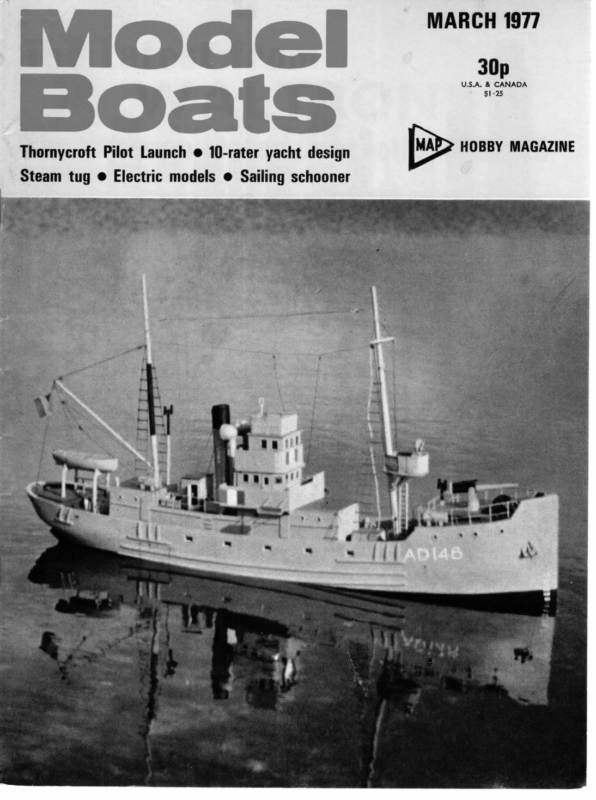
Vviodel Boats Thornycroft Pilot Launch e 10-rater yacht design Steam tug @ Electric models @ Sailing schooner MARCH 1977 30p U.S.A. & CANADA $1 -25 HOBBY MAGAZINE
MODEL BOATS Danson’s Frostbite Race RMs at the Rick Pond, January 3rd By J. Fincham THE Danson Club’s Frostbite Meeting for RMs, held at the Rick Pond on 3rd January, took place in bright sunshine and with light winds, otherwise it lived up to its title! Bob Taylor OOD arrived to find the water completely frozen at the end of the lake nearest to the clubhouse, and was very relieved to discover that there was an area free of ice at the western end which enabled him to lay a course. Despite the obvious problem in travelling at this time of the year, all twenty seven competitors arrived and racing began, in six boat races to Charles Parish’s schedules, at 10.15, to the great credit of all concerned. The first four races were held round a very short course, due to the light wind, but as the sun rose, the wind filled in and a longer course was set, and by noon it was possible for the OOD again to improve the course. Due to the very restricted area of ice- free water, some marks were placed very near to the banks and this caused problems for some of the deeper keeled boats, which tended to ground unless the marks were rounded very closely. The competitors very sportingly accepted the rub of the green in these cases, and the willing rush of the wader brigade to free any grounded boats was much appreciated. Despite the very light winds, on only two occasions did a boat fail to finish inside the three minute limit, an indication of the closeness of the racing throughout the day. The final race was won by Derek Priestley, with David Andrews in second place, which produced a tie between them for first place in the event as a whole. The wind by then was very light, and it was agreed to sailasinglelap only to decide the event. After a good start by both boats David Andrews rounded the first mark in the lead ; unfortunately Derek Priestley’s boat touched this mark agreer and then became entangled, and the _ situati leader had only to sail the course, 10 per, which he successfully did toemergeas to alte the overall winner. impro} _The day was notable for the relia- _ use of bility of the great majority of the Jane boats and, despite some vigorous whole: protests, the generally good natured _ scorer, acceptance of the OOD’s decisions, a very: not that in all cases acceptance meant _ lucky Ashanti Ashanti Sailplane N. Hatfield G. Thornhill T. Torrance M. Oxlade Squiblet J. Cleave T. Fuller A. Oxlade J. Overton A. Clarke C. Jackson A. McCulloch 148 Klug Squiblet Moonraker Sea Horse Bewitched March Hare Poppycock J. Wild R. Potts D. Hollom Ashanti Pterodacty! Ashanti O. Lee Squiblet L. York N. D. N. V. Curtis Robinson Oxlade Cooney P. Allen G. Jones D. Stevenson C. Watkins Picture above gives an indication of how tight the racing was; it got quite hectic round some of the marks. Left, full-size experience has no doubt contributed a lot to the neat and simple fittings and the remarkably uncluttered deck of Oliver Lee’s own Squiblet. Design D. Andrews D. Priestley J. Curtis Own Design Own Design Sea Horse Squiblet Ashanti Seahorse Club Leicester Fleetwood Woodley New Fore Basildon Leicester Basildon Woodley New Fore Woodley Danson Leicester Danson Danson Woodley Danson L2B Leicester Basildon New Fore New Fore: Woodley Woodley Basildon Leicester Danson Kensingto
MARCH © Bob Taylor, faced with a . Above left, OOD Bob Taylor on icebreaking patrol in his rubber duck. tof the lake, did nothesitate to starboard to squeeze between the Dt being able to use less than Se course when conditions ‘end made the best possible Above, these five boats will all be turning ark and the bank, the sort of situation that keeps skippers on their toes. water available. eCulloch, who had spent the his very cold day working as ssented the prizes and added fm Ww — of her own for the 2 Points 62 62 58 56 56 3 46 Place Bit Sail off } 3 4 4| 8 : . Right-hand Seahorse column built and top, a skippered very by nice Nick Oxlade of Woodley club. Note the smart stand, also the “bows” that keep the sheets well above deck, and the double rudder linkage emerging through the deck just ahead of the double-ended tiller arm. Second, new yacht by Derek Steven- son, 1976 National RM Champion, is a beautifully traditional turned out Ashanti. Uses type sheeting arrangement and single tiller push-rod angled through deck. Third, John Overton, Danson, makes use of a dinghy fitting for a water- tight radio hatch on his 247 design. Note 44 9 small skeg area and below-deck rudder 42 42 40 36 35 34 10) 10} 12 13 14 15 gear; sheets run through braced tubular pillars. Bottom, another Squiblet, this one by Norman Hatfield, new MYA Chairman. Breakwater ahead of radio hatch reduces chance of water through bushes of exposed winch drum and rudder arm. 28 28 27 26 26 16) 16} 18 19) 19; 26 19 ) Below 24 22 22 23) modified mounted Retired 27 22 20 20 23} 25) 25 | left, Andrew McCulloch ; sails a Poppycock, favours a deckwinch drum but under-deck rudder gear. Foot of mainsail has what might be termed a flow-fill panel. Below, Alan Oxlade raced his modified Bewitched to 10th place, proving that older designs can do well. 149 1977
MODEL BOATS Nicad 4D 1-2 volts per cell Aull 27in.—30in. Motor Ram Cell and weight (per cei!) 12-4D 5-30z 2:1 gear Prop X40 Size of cell Ali up weight 60-3mm x 32:5mm_ = 7Ib— Nicad 2-5 1-2 volt per cell 27in.—30in. Bullet 16-2:5 Sea Wasp 12 16-2:°5 Nicad 1-8 amp hour 1-2 yolt per cell 27in.—24in.—23-in. Bullet Sea Wasp Hectoperm special Cyclon dry lead acid cell 2 volt per cell 27in.—30in. Bullet Sea Ram Sea Wasp 12 18-1-8 40z 3:50z 49-5 x 25-4 6lb 20z 6lb loz 5lb 100z P35. P35 ~49°5: x 25-4 49-5 x 25-4 Slb 90z 5lb 9o0z 10-2:-5 6-40z P45 60-Smm x 34mm 6lb 5oz 130z X40 =71-9mm x 44:2mm __ 8lb 80z 6-40z P40 =71-9mm x 44:2mm __ 6lb 4oz D cells 7-5 ah X cell 10-2°:5 D cells 23 kilo boat, then add bigger cells, be over the limit, and qualify for the unlimited class. An example of this would be in multi boat racing where a person racing a 23 kilo boat weighing say 4lb 60z with 16 VR 1-2 cells could with moderate outlay slot into the unlimited class by the use of 16 1-8 cells, which would be over the limit by 4b but give the added bonus of 10 minutes duration on a P35, From a personal point of view I am very conscious of a particular class or motive power pricing itself out of the market, this does no one any good. That is why I am all in favour of a sports 34cc class with limiting factors. To rein- force John Cundell’s words, if performance model boating, and I use this in the general context, is going to survive, it needs to be made more attractive to encourage beginners. Laying out vast sums of money might be O.K. for some, but the majority of boaters find it hard keeping up, so one must find avenues of approach where the expense involved in our sport can be reduced without nullifying the competitive spirit. Next month, with the courtesy of the editor and the valued assistance of Rod Burman, I hope to cover mains charging systems, giving circuit diagrams etc., plus details and photographs of a remarkable 26 mph Sea Wasp 6 powered boat. SYNERGY (continued from opposite page) skippers. A yacht of this sort is sensitive and the margin between going fast and going slow is very fine in terms of trim and tuning. For the less experienced and for radio control I would However, the reduced LWL beam and lower displacement does reduce the overall stability, so VCG calculations were done together with an examination of the C.B. when P35 43mm x 31mm 43mm x 31mm 3-50z 3-50z It would appear there are no charging current restrictions, but longer charging times at lower constant voltages will increase further the cycle life of the battery. Initial charge rate is 250 milliamps for 14 — 16 hours. The possible boat use for such a cell could be in the unlimited multi boat class. Thoughts on Rule Changes During discussions on the proposed. rule change (when this article appears in Model Boats it will be either carried or rejected) it was pointed out to me by a younger member that the proposed addition to rule 6 “No boat can run in more than one class’ will have a counter-productive effect as far as electrics are concerned. To explain, when the rule change was proposed it was directed at IC boats, petrols in particular. However, with the introduction of a large class and 24 kilo for multi it would mean further expense doubling up on everything, new motor, cells, even new radio. If the rule stated IC only, those wishing to venture into the bigger class of electrics could do so without the burden of higher expense. As the rule stood, weight was the criterion and you could in practice race a and righting arms P40 18-1-8 18-—1-8 Approximate cost of the D type cell £2.00 Approximate cost of the X type cell £3.50 Approximate cost of the D type Nicad cell £2.92 movement P45 40z heeled. The lead ballast has been lowered to provide exactly the same stability as Cracker related to the centre of gravity change, but a bonus in stability is picked up by virtue of the change in section shape of the canoe body. Although narrower, the shallower form of midsection actually increases the inherent stability of the canoe body. Therefore the new boat can be expected to carry her sail somewhat better than Cracker. I have never been really convinced that long overhangs on light narrow yachts do much good, and a short overhang modification of a Cracker did not exhibit any loss of performance thereby. Accordingly the new design has shorter ends than Cracker and this has resulted in a reduction of hull windage above water of about 5 per cent. That can’t be bad. If anything Cracker had an excess of directional stability and so the dorsal part of the fin has been removed and the rudder post moved forward somewhat. It is quite likely that a spade rudder positioned on section 9 would greatly improve the ability of this design to compete in radio events. The sail plan is unexceptional but will require careful trimming and is intended mainly for the more expert suggest changing the mainsail dimension to approximately 64-Oins. luff and 16-5 foot. This sail will be much easier in handling and obtaining optimum efficiency. Incidentally it should be faster off the wind and, of course, can be carried in stronger winds as the centre of effort will be lower. A slight double chine effect is shown in the midsection of the hull and this obviously derives from the LWL beam reduction and shallow canoe body. I cannot see any harm in this and in fact I’m in good company as a number of very successful old ships had this characteristic! The canoe body has been faired mainly on the diagonals, as with these very long lines the normal buttocks and waterlines are not a great deal of practical help in fairing up. The most difficult job has been choosing a name, and Synergy was adopted after hours of debate. If Cracker had been called Crackers I would have called the new boat Bananas, but it wasn’t. My dictionary defines Synergy as “coordinated action” and, please, it is pronounced “Sinarji’’. This design has been a most interesting study and I wonder if it will be as good as it should be? Three of us are building new boats already and are full of optimism. Who else is going to join the rush? 158
MARCH ig is Over six years since I drew the lines of the 10 rater Cracker, which at that time was quite a departure from my previous style of design to that class. In the event it can be said that Cracker has proved to be quite popular and successful and I know of examples built in most countries in the world which have organised model yachting. Perhaps it is unfortunate that, due to the shortage of published designs, Cracker has been adapted in some areas as a radio control yacht, but the design was never intended for that purpose and in that role I doubt it can succeed as in its free sailing version. I had the great pleasure of sailing in the 1976 National Championships at Birkenhead, and talking with a number of people there made me realise the need for a new published design; I was also able to make a close appraisal of the performance of the several Crackers that were competing. Let me now hasten to add that this new design has no family connection whatsoever with the incredibl y slow boat I was sailing in that competition! In fact that particular design was the last of a series of experiments conducte d over a period of years to evaluate the characteristics of long, narrow, and totally flat-bottomed craft. Designing a successor to Cracker presented somethin g of a problem and it became obvious that a close analysis of the features of Cracker would be necessary. According ly every reasonable factor affecting speed and performan ce was re-examined and a small change made in the “go faster” direction. I reasoned that a small change in many features should add up to a plus in overall performance. In fact I am rather surprised how different the new design turned out to be! The first decision was not to alter designed waterline length. I did not dare go longer than 65 ‘Oin, at this stage and although I was tempted to reduce the length to 62 or 1977 SYNERGY Ainew John Lewis 10-rater 63in., to get more sail, I just couldn’t bring myself to do it. In any case keeping the length the same would provide more information regarding the effect of the other changes. However, it did not seem unreasonable to drop the displacement from 23-8lbs to 22-2 Ibs as this would enable the LWL beam to be reduced by some 4 per cent. Likewise the depth of the canoe body could be reduced by some 16 per cent, thus reducing “‘rocker’’, which should encourage a flatter wave formation, easier planing and some enhanced speed. Wetted surface next received attention and the surface of the hull came down by 2:7 per cent and simplifying the skeg and rudder configuration saved 27-5 per cent in that area. The fin itself shows a saving of 7-5 per cent on Cracker although the draught of the new boat is greater. The various versions of fin on Cracker have shown that there is little to choose between raking backwards and raking forwards fins, so in this case the most economical straight up and down configuration has been adopted. Taking into account the actual areas of the various parts the total wetted surface has been reduced by 5 per cent overall. Although the /n is deeper the depth of the centre of lateral resistance has remained unchanged by putting some taper in the lower parts. Thus stability has not been eroded by this change. (continued opposite) FULL-SIZE COPIES OF THE DRAWING BELOW (SHEER AND WATERLINES HALF SIZE, BODY PLAN AND LEAD FULL-SIZE) ARE AVAILABLE REF MM 1229, PRICE £1.15 INC. VAT AND POST, FROM MODEL MAKER PLANS SERVICE, PO BOX 35, HEMEL HEMPSTEAD, HERTS HPI IEE. SYNERGY Tne Model Maker Plans Service 10-35. toe Steet, Hemet Menestand roris APPROX MAST POSITION SPECIFICATION L WL 65.00″ SAIL AREA LOA 1153.1q ins 76 70″ oIsP BALLAST 22 2 ibs 13 Ties SAIL_AREA’S LWL MAIN ROACH, cGy — 70°» 15° 715″ 3° MAST = 8 BEAM 9 75″ 5250 415 385 S875″ 1525° 4480 1153.0 TOTAL FULL SIZE LEAD 13-7lbs [mm 1225 15)
MARCH 1977 and before applying firm pressure. Further experimenting is needed but what I most need to know is what ‘gum’ a real waterslide transfer manufacturer uses, as when sliding from a parcel label occasionally not all the gum would come off with the paint piece. And what glue is used on self adhesive labels such as the price labels in food shops. This would be better than Evo-stik or Copydex. The colouring scheme adopted for Lady Barbara is slightly out of the ordinary. Instead of being white all over I chose a pale coffee colour for the superstructure which I think is effective. How it would look on a real ship at sea is not so easy to imagine. It is not a completely original colour for superstructure, so it must have been satisfactory. P & O used to use a stone colour with black hulls but the only case combined with a white hull that I know of is the Union Line Scot. This latter fact I discovered after I had chosen my scheme. My funnel colour scheme is an all white funnel with a blue and orange band. The boot-topping is red. General Design The first thing I do is to draw a waterline profile. It is surprising how different a ship can look in and out of the water. If all the proportions and shapes are drawn and corrected with the underwater section included then it is more or less certain that the profile will look quite wrong when the underwater section is hidden. After getting the profile to my satisfaction for that moment I then reverse the paper and check that the opposite side looks the same. If not I make suitable adjustments and then recheck that the original sideis still satisfactory. It may be necessary to go from side to side a number of times to achieve a complete match. I then do a plan view with a waterline shape. The beam and draught will be chosen by reference to the dimensions of similar size and type ships and this work will lead on to the full lines plans. There have been a number of articles on how to do them, particularly that by P. N. Thomas in the May 1975 Model Boats, so | won’t repeat the method here. Lady Barbara’s lines were in fact done for me by a friend of Readers write STILL ON MULTI Dear Sir, I read, with great interest, the letter from the Chairman of the Stevenage club published in your December issue on the subject of a club class for multi racing. The aim of the letter is clear, but the ideas put forward to achieve this do not seem to follow a logical pattern. I have discussed this with boat club members and they too appear confused on who is eligible to take part, and with what type of craft. I do not question the writer’s sincerity — that is obvious — but feel that there are points which require clarification. Who are we aiming at ? Not, apparently, the top performers ‘‘as they can afford the expense of what we are already running’. How far down the line does this exclusion stretch ? It would appear from the second paragraph that we are to be restricted to beginners and persons of limited budgets. Yet — in the third paragraph — we havea reference to “‘the young and mature, experienced and inexperienced”’. I find the paradox of an experienced beginner somewhat puzzling. ‘“‘The multimen will want to join the fray’’. Surely the most likely candidates in the club are those already interested in multi racing and who would deny them eligibility? But, unless they are classified ‘‘beginners’” they are out? “‘The true modeller” — is eligible, but he will probably value his craft too highly to hazard it in multi racing against inexperienced beginners. What sort of craft will be permitted? No one argues with a 3.5cc power limit but beyond that I have yet to meet two people in complete agreement. I don’t agree with Mr mine, Mr John Bedford, as 19 years ago I had little idea of how to go about it, but my current design is all my own work. Construction can now start but before the superstructure is commenced it is advisable to produce the general arrangement plans just in case minor alterations are needed to fit everythingin. Generally I find that some of the detail work such as funnel shape and size, etc, is never finalised until it is the turn of the item to be constructed. This is particularly so when building is spread over a long period, as I am designing with appearance the first consideration. Ideas and fashions change with time and what is thought perfect one month doesn’t look quite right the next, and so on. When working on the profile the effect of colour and other optical illusions must not be overlooked. A funnel, for example, painted white will look bigger than the same funnel painted black, and bands may alter size and proportion. To achieve appearance of equal rake on masts and funnels an increasing amount of rake as you go aft will generally be needed. The main mast will have more rake than the foremast and the funnel’s something in between. So, in conclusion, by careful study of real ships, it is possible to design one’s own ship reasonably successfully, getting all fittings as well as the basic structure correctly positioned and of the correct dimensions and proportions. One feature that is perhaps difficult to discover from study and. yet can affect appearance are the rules for siting of the navigation lights, so care is necessary here. These rules are now in the process of being modified. Designing my own ships is I find a very rewarding hobby in its own right. I often wish I could build at least half as fast as I could think up shapes and I certainly hope my next liner, laid down last summer, will not be troubled with the same labour problems as Lady Barbara. Building these designs of course completes a project and brings alive what usually started with a doodle on a scrap of paper. Boyle’s choice, because it defeats his own object — the man on a limited budget will find that it is a very expensive business to have his boat “commercially built’’. It is also more satisfying to succeed in a craft built by oneself, but this is “‘verboten” — ‘‘no home built jobs”. A wooden kit for multi is recommended. Mr Limited Budget will find it cheaper to build a fibre glass job, and also easier and cheaper to maintain and repair damage, which, in any case, will be less severe than that likely to be suffered by its weaker wooden counterpart. Multi racing in the lower echelons can be very boisterous. I feel that Mr Boyle has lost sight of the aim expressed in his opening sentence as he concludes his letter with ‘‘surely club racing should be for the modeller, not the multiman’’. Since we are discussing ‘‘a club class for multi racing’, and people who do multi racing are multimen, to exclude all multimen leaves no one to participate. Club members join their clubs to take part in club activities. They should not be debarred from competition because of the state of their bank balance, or because of their skills. If thereis to be an imposed handicap it must be done through the levelling-off effect of a standard craft. But, as agreement would never be reached on a standard specification acceptable to all, we must compromise with a set of limitations within which to work. I am not going to attempt to lay down such standards — I leave that to experts — and the PBA have already spent much time discussing this issue. They have evolved a formula — let’s give it a trial. Only by experience can we find whether it needs improvement or amendment. The Stevenage club is to be congratulated on the diversity of its interests in the field of multi racing. Not only are they interestedin 163 those contestants at the lower end of the scale, but by the introduction of their highly successful Southern Classique event have also provided a spectacular fixture for the ‘‘top performers’. Incidentally, the winning of such a handsome cash prize must surely involve the loss of amateur status. Does this mean that such victors may in future find themselves barred from MPBA organised events ? West Monkseaton E. George YACHT MEASURING Dear Sir, I found Mr Foreman’s letter in the Dec ’76 issue very interesting; as ex measurer at Gosport I think he has some justification for his feelings. I think a lot of trouble is caused by the new designs in the ‘A’ & 10R classes with long overhangs almost parallel with the water. These boats are almost impossible to measure accurately. On one occasion last year I measured the LWL of one of these brutes six times and got six different answers, varying by as much as 3in. I eventually took the average of these for the LWL. It might be a good thing if the MYA would issue a list of equipment necessary for measurement of the various classes, and specifications for building same. This would help new clubs, and might make measuring in the clubs a bit more consistent. It would also be an advantage if they could issue a list of the tables which help to make life easier: we have sucha list at Gosport. As regards scrutinising, how about drawing three or four names out of a hat at every MYA event, any boat being out of rating getting disqualified and the club that issued the certificate getting fined ? Gosport A. E, Brown
MODEL BOATS K R i S Pl E Fitting the deck and casting the lead for our 36in. R yacht FOEENS a deck is usually fairly straightforward on a ment such as the inside of a hull used occasionally and left yacht. It can be cut roughly to shape — say not less than tin. of spare material at any point — then a centre line marked lightly along it. Mark the rudder tube position carefully, and drill and file a hole to fit snugly over the projecting tube. From this point measure forward and mark the position of the front screw of the jib rack, then make a small hole at that point. The deck can now be slipped over the rudder tube, aligned on the hull, and a perhaps in a garden shed or an unheated garage. It is desirable to decide well in advance what treatmen t you will want to give the deck, since if you want a natural wood deck, perhaps lined for plank simulation with pencil or ink, the top surface should be varnished before painting the underside. This facilitates the removal of any paint which may creep over the edge, either while painting the underside or the hull itself when the deck is attached. Remove any glue beads, preferably before fully har- panel pin or very fine screw passed through the jib rack hole into the centre fore and aft stringer. Now the deck can be removed and always replaced in exactly the same position, so you can hold it in contact with the hull and dened, from the deck/hull joint and when fully dry sand the joint flush. The hull can now have one or two further Coats of paint, including the fin and skeg, preparatory to flotation tests. We discussed the lead in the last issue, but did not go into its actual pouring. This has been discussed once or twice in the last year or two, and is well detailed in such books as Model Racing Yacht Construction, Boat Modelling, and Simple Model Yachts; your local public library should be able to help. Briefly, an iron pot (saucepan) is to be preferred, if possible with a pouring lip, and about 8lbs. of lead should be cut up into convenient pieces all ready. The wood or plaster mould, thoroughl y dry, should be stood on a piece of old ply, etc., and common- mark the finished cutting line all round from beneath, remove the deck, and cut to fit exactly. By measuring from the foreside of the rudder tube (more accurate than vaguely guessing the centre) the remainde r of the fitting positions and, for radio, the hatch area can be marked out. Pierce a little hole where every screw or eye needs to go, and make sure there is something solid underneath. The only point where you should meet thin air is under the forward eye for the sheeting jackline, and using the pierced hole as a guide, a small hardwood block can be glued to the underside of the deck at this point. You may like to reinforce the inwales where the shroud sense precautions taken to protect floors and clothing from plates are attached by gluing ona scrap of extra timber to drips of molten lead. You will need gloves to handle the prevent the screws from splitting the inwale strips. There pot; check too that the pan handle is firm and strong. You can drill the opposite side, near the top rim, for a stout wire handle to make it easier if you wish. Jumble sales or council tips are fruitful sources of suitable discarded iron pots, by the way. is quite a force transmitted by these screws. It is now time to check that everything is complete d inside the hull, since once the deck is fixed it will be inaccessible. If there is any doubt about stiffness of the skin, add a couple of strips of card, well glued and Painted, Heat the pot on an open fire, a gas ring, a radiant electric plate, or with a big blowlamp, and drop in some of the lead pieces. If they are scrap and not too clean, they will smell a bit and as they melt the impurities will form a soft crust on as extra ribs, or run ‘ribs’ of Joy balsa filler in, as suggested in last September’s issue by Jon Hudson. Check that painting is thorough and that there are no spots that water can soak through. top. Keep adding lead until you have melted about 8lbs. A clean stick should scorch but not quite char when a good pouring temperature is reached, and if you can pour onehanded the stick can be used to hold back the ‘crust’, though it is safer to remove the dross with an old spoon. Pour smoothly and steadily but not too slowly into the mould; we like a brick or two at a convenient height to rest the pot on to prevent it wobbling about. With a little care and common-sense it is a surprisingly easy matter, but Paint or varnish the underside of the deck and allow to dry; leave if possible an area of bare wood round the edge where the glue line for the inwale reaches. A bare wood joint will give a stronger result than gluing to a paint film, so sand over the facing surfaces of the inwales and beams in the hull. Then, using a generous application on all the deck beams, stringers, inwales, etc., glue the deck in place, taping the edges to ensure close contact and pushing a few pins in along the centre line to ensure complete seating overall. A waterproof adhesive such as epoxy or Cascamite etc., is to be preferred to white PVA ora contact adhesive, which will soften in water or in a damp environLAYOUT OF remember that molten lead can cause quite severe injuries if it splashes. The need for dryness is emphasised, as any damp turns rapidly to steam and can blow the lead up into the air. The casting, too, retains its heat for quite a time, so curb impatience. S.T. CHIPCHASE. GENERAL MACHINERY LAYOUT : 2.1/2″ PEAR SHAPED FUNNEL 1.1/2″INNER ETC. IN S.T. FUNNEL v7 ATIN (See article on nie pages 146/7) FIOOLEX HATCHES\ ~~ i A \ \ De) ° Be aia y J RADIO COMPARTMENT re 164 leis eae ~ PRESSURE GAUGE EQUIPMENT COMPARTMENT OIL * =