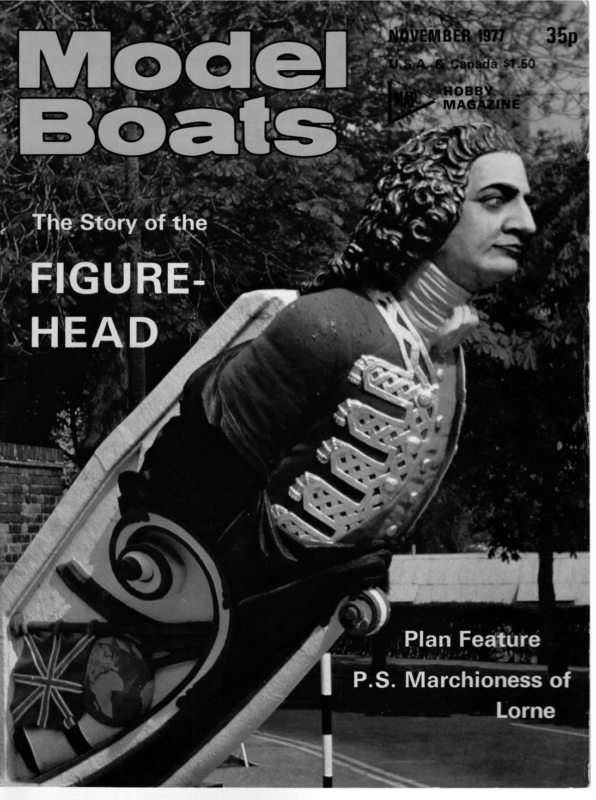
- 1977 BRITISH OPEN and INTERNATIONAL A CLASS CHAMPIONSHIPS Report by Joyce Roberts Pictures by Vic Smeed
- ROUND THE REGATTAS Reports on radio multi, sail and straight running
- Concluding Part of KOKANEE by Bill Van Dieren
- LOGBOOK Yachting Jottings from our MYA Correspondent

_ Plan Feature P.S. Marchioness of Lorne
Model Boats 642 December 1862. In 1964, she was raised in sections from this river bed. Many artifacts found on board as well as a superb model of the Cairo (Figure 15) are on display in the Vicksburg National Military Park visitor centre just a few miles from where she was sunk. The Civil War was also responsible for an incident which is not well known, considering its magnitude. After the surrender of the Confederacy on 9th April 1865, prisoners were hastily released for their return home. The side- wheel steamer Sultana, which had broken a number of records in the antebellum years, was pressed into service at Vicksburg to carry Union prisoners-of-war back to the North, with St Louis as its destination. Between 2,300 and 2,500 men were on board on 27th April when shortly out of her berth at Memphis, Tennessee, her boilers exploded and as many as 1,647 lives were lost. Therefore, of major marine disasters which have occurred since 1800, this tragedy rankssecond only to that of the St George, Defence, Hero disaster, even outranking the sinking of the Titanic in 1912. The reason why the Sultana disaster was never fully realised was probably due to the assassination of President Lincoln two weeks earlier. News of the death of say, every rivet in the boilers – quaking and shaking and groaning from stem to stern, spouting white steam from the pipes; pouring black smoke from the chimneys, raining down sparks, parting the river into long breaks of hissing foam ~ this is a sport that makes a body’s liver curl with enjoyment’, Steamboat racing came into being quite naturally. For just as it is with all means of transport, speed is of foremost concern. It has always attracted travellers and the reputation of being the fastest has always proved to be profitable. The symbol of this unique distinction on Mississippi steamboats is the privilege of ‘holding the horns’. These are gilded pairs of either deer or elk antlers which are mounted on the pilothouse or bell. When a record was broken or a race was lost the horns were forfeited by the former record holder or loser to be displayed by the new victor. This practice is assiduously adhered to even up to the present time. Note the antlers on two of the present day river steamboats which have won races in the past few years. Figure 16 shows them atop the pilothouse of the De/ta Queen and Figure 17 shows them on the bell of the Julia Belle Swain. (To be continued) 1977 BRITISH OPEN and INTERNATIONAL A CLASS CHAMPIONSHIPS JULY 30—AUGUST 5 Report by Joyce Roberts Pictures by Vic Smeed that there should be some time off, with Fleets being given half days to sail, and they were also asked by the OOD to try and make sure that everything went smoothly, and that the championships would be fairly competed, the OOD’s decision being final, on all pondside occurrences. There was no separate International race at the end of the week, and the Johnnies Cup would be awarded to the ee there was a small entry this year by Fleetwood standards, 38 boats, reduced to 36, competitors had obviously decided to try and outdo last year’s good-humoured championships at Gosport, and urged on by a determined OOD the A Class event was a very successful and friendly event. The two entries that dropped out were the Dutch boats, as unfortunately Mrs Hoogewerff was admitted to hospital shortly before the championships. Good wishes for her recovery were sent by all competitors and friends. The OOD’s meeting for skippers and mates was held on Saturday before the racing commenced. Derek Priestley welcomed the competitors, including the foreign entries from France, Denmark, Belgium, Scotland and Keith Gerson from South Africa, who was sailing a borrowed boat from Clapham. Competitors were told skipper getting the most number of beats, and the Wing to Wing to the skipper getting the most runs. The Tots Trophy was to be sailed for; the draw, however, unfortunately resulted in the Clapham boats being in one team, the same team as for the Neptune Trophy. A slight oversight by competitors nearly resulted in only two teams being entered for the Neptune, but the OOD relented and all entries were accepted. Racing started on Saturday at 2.30 pm. The wind was fresh, blowing from WSW, veering to Westerly. The wind coming from the far end of the lake is a good wind at Fleetwood, but is not usually as changeable as it was throughout the week. Four boards were sailed, A Fleet sailing against B Fleet. It soon became obvious that the composition of the two fleets was such as to make A look far superior, with a few exceptions. The final scores will emphasise this point; the A and B before each boat refers to Fleet letters. By the end of the first day two boats had 20/20, Digitalis er from the same shipyard. She was named after a small city in Southern Illinois where the Ohio River flows into the Mississippi. This boat was sunk by a Confederate mine in the Yazoo River in the State of Mississippi on 12th Lincoln and its aftermath crowded the Sultana incident off the front pages of newspapers and a shocked nation was stilljtoo preoccupied to grasp another calamity. Prior and subsequent to the Civil War, the American public had a peculiar fascination for steamboat racing. Perhaps again Mark Twain best describes this dangerous but captivating sport. “Two red-hot steamboats raging along, neck and neck, straining every nerve — that is to es shipyard on the outskirts of St Louis where she was built. Figure 14 is a model of this boat in the Smithsonian Museum of History and Technology. About mid-January, 1862 another of these gunboats (the Cairo) was launched
643 sailed by Dennis Lippett, and Shima sailed by Peter Maskell. Keith Gerson sailing a strange boat, Ricochet, found a good trim straight away and had 17 points. Sunday saw the complete fleet out again. There was no wind at 9 am so the start was delayed for half an hour. The wind gradually strengthened, and once again the direction varied from West to WNW to SW throughout the day. This meant that on the beat skippers were not certain whether they would be able to sail up in one long leg, or have to guy once or twice, or even sail across the lake. Even experienced skippers would find that the wind went against them sometime during the day. At least it was sunny and warm. The most consistent skipper of the day was Keith Gerson, only losing a beat to Ian Taylor and FairyNuf. He ended up with 49. Shima and Digitalis had 48, and young Tom Armour, sailing Long Pig very well, had 46. On Monday morning A Fleet sailed five boards, the conditions being similar to Saturday and Sunday. Longshot, sailed by David Latham, lost two runs, and Ricochet two beats, to Havana Womble and Digitalis. B Fleet sailed in the afternoon, only completing four boards, the wind falling away at the end of the afternoon. The Roger Stollery/Alex Austin combination (Alex beats, Roger runs) lost the last five points to French Mimi. During the afternoon Ian Taylor added to his list of disqualifications, poling off into yet another boat! The shifting wind made running difficult, gybing in the middle of the lake being fairly common. On Tuesday both fleets were out again, it was a light S-SW wind to start with, strengthening and straightening as the day continued, giving a period of tacking. After lunch however the wind started to shift about again. B Fleet sailed an extra board to catch up with A, and by the end of the day 20 boards had been completed (100 points sailed for) Longshot sailed Clockwork Orange, and it looked as if Longshot had a good start, coming higher up the bank for the first turn. However, Alex guyed, very near the clubhouse, and came up on a long leg, while Longshot \ost way crossing the lake, and was well beaten. Only 11 points separated the top seven boats by the end of the day, Longshot holding top place with 81 points, from Shima with 78. B Fleet sailed on Wednesday morning, the wind was from the NW and at first skippers were undecided about using spinnakers. Sometimes the solution was “do what your opponent does’. The wind strengthened as on previous days and there were a number of resails on the runs. ‘Mep’ went to the rescue of a few boats, while less brave skippers watched their boats circle in the middle of the lake. With the wind strengthening and strengthening there were some opportunities for good runs, and Jndependence, the new Stollery short lightweight, showed her potential downwind. Clockwork Orange only dropped two points, Los Dalmatos lost one beat, to Trident sailed by Ken Jones and Denis Hardwick. Trident got all the beats, but no runs. In the afternoon A Fleet sailed six boards. Digitalis once again went well, Dennis only losing two runs. Long Pig lost two beats. A Fleet leaders were Longshot 102, Long Pig 100, B Fleet were a board behind. A Fleet sailed once again on Thursday morning, starting off with the wind coming from the NE, a bad direction for Fleetwood lake, and generally quite fickle. This was no exception, and until it settled down from the other end after a couple of boards boats quite often did a circle in the part of the lake they fancied most. Rain added to the problems. However, Chris Dicks with Revolution did not drop any points, and Longshot only got five! In the afternoon it seemed even wetter for B Fleet; the wind was gusty at first, coming off the hotels, then it dropped, got wetter, and Ken Roberts sailing Independence managed to pole off into his opponent in the last two boards. Once Heading picture, winner Revolution leading Los Dalmatos on final Friday. Above, top to bottom, Tom Armour’s Long Pig is a Stollery design, a sort of stretched Orange but still only 36lbs. Independence is only 30Ilbs. and although Ken Roberts had his uncertain moments ,in time this boat should prove competitive. It requires quite a different approach from a conventional A. Latest Lewis design Trident, K1020, did very wellin first major regatta. At 39lbs another lightweight. New from Fred Shepherd was Toffee King, K1003, a 57 pounder which the Armours need to get used to, when it should be good. again the problem of spinnakers on the run arose, the right shape made all the difference. Clockwork Orange got 25/25, pulling up to 3rd place. Revolution was now in the lead. There was a fresh WNW wind blowing on Friday morning, and a number of the skippers put second suits on their boats. There were still a number of boats that could win the Championship, and even those lower down the fleet were still enthusiastic, and there was a chance to see how boats would perform in the different wind
644 Model Boats 2nd, losing the last run, so tying for the Wing and Wing Cup. Tom Armour had sailed his new boat consistently well all week, and thoroughly deserved his 2nd place. Dennis Lippett sailed well also, Digitalis seemed to be a much improved boat from last year. Dick Seager was again in the prizes, 6th place was taken by Shima, a Stollery design from Leeds and Bradford sailed by F. Teat and P. Maskell. Longshot had two bad days to drop down to 7th place, and K. Gerson did very well to finish 8th. New boats were a slim Lewis design, Trident, sailed by Ken Jones and Dennis Hardwick, looking very promising beating. It was good to see Ken sailing again, and he managed very well, surely a good advertisement for hip replacements. I think he will feel more confident after a full week’s sailing. Mep had a new Longshot, looking most unlike a Longshot however. Independence, regularly called a big Marblehead, showed promise, and looks very fast running. Toffee King, a Shepherd design, did not do as well as was hoped, but is only a new boat. The Championship ended with the traditional prize giving dinner and dance, making another social occasion to follow the events of the week. The Regatta Committee are to be congratulated on all the activities organised during the week, a night at the Conservative Club, a trip to the Lake District for wives and families, a Car Rally (perhaps they wanted to lose the visitors) and a Film Show. The canteen was very ably run by a new staff, and good hot meals were available every day. There was a very good staff behind the scenes, score boards were kept Digitalis was well sailed by Dennis Lippett into 4th place. Very fine ended. Lost a little ground in the stronger winds on the Thursday. conditions. Independence seemed more lively with the mast position changed, and had one of the closest races of the week, beating with Pipe Dream, neck and neck to the top of the lake, the leeward boat, Pipe Dream, just banking short of the line. up to date, also the Tots Trophy and Neptune Trophy boards, nothing was neglected or forgotten. The only people who did no work were the Protest Committee, surely an event to be copied in future years. There was also TV coverage, and a Woman’s Lib reporter from Manchester, who photographed Sally Armour and Margaret Keeley. One board was left until after lunch, the Championship still undecided. Revolution had to sail Black Tarquin, and win, to make certain of the Cup. Although Walter Jones had weather berth Chris sailed Revolution higher and faster, and also made sure of the run. Long Pig finished Results Fleet A A B A A A A A B Pos. 1 2 3 K1001 9 K1020 5 6 7 8 10 11 B B B A 13 14 15 12 A 17 A A 19 A B A A B B B 21 B B B Digitalis D. Lippett Los Dalmatos Fairynuf Independence Renegade G. Van Hoorebeke I. Taylor K. Roberts V. Knapp K698 B49 K992 K1024 K991 Trident Black Tarquin R. F. D. K. Seager Teat/P. Maskell Latham Gerson Maverick K962 B42 K969 D57 Appollo Stormvogel Dumbo Laulila F56 3 JM K980 Twist 35 K999 Afrit 36 F75 Asterix Neptune Trophy: Clapham: 974 941 939 76 “62 70 100115….138 85 110 130 96 108 124 AZ.) G1 -412 Birmingham Bourneville Dicks Stollery 49 |bs S5Slbs 16 16 42 , 40% 63 955 83 78 Belgium Southgate Birkenhead Gosport Shepherd Stollery Stollery Dicks S7lbs 36lbs 30lbs 47lbs 12) 7 2 18 BT 19R 18 40 SF. 48 44 56 79 96 67. 79 588, 1972″ 62-5704 G. Keeley Newcastle Stollery 36lbs 18 42 P. Mustill Birkenhead Lewis 66lbs Shepherd 49lbs Meir Lewis Lewis O’ Berge 66lbs 62Ibs 59lbs 61lbs Boussy S6lbs 0 41lbs 55lbs 3 3 K. Jones W. Jones D. Bush Birkenhead Birkenhead Leeds & Bradford Fleetwood Leeds & Bradford Fleetwood Leeds & Bradford E. Carter Mimi Thingummy jig 48 Tues. Wed. Thur. Fri. 75 98 118 143 88 90 102 96 P. Nash K. Armour Neptune Barbarosa 20 46 34° 975 78 81 7% Blue Knight Toffee King K961 S7Ibs 17 9 43° 48 45 49 J. Brooks C. Thompson Europa Dicks Sat. Sun. 1324] If 20 18 17: Pentangle Piggy Malone K938 36lbs 36lbs 46lbs 37lbs 57lbs 36lbs Zephyr Pipe Dream Weight 48lbs Seager Stollery Shepherd Stollery K981 K959 K946 Bourneville Design Dicks Stollery Stollery Clapham Leeds & Bradford Fleetwood Clapham/S. Africa K990 FS1 KS30 34 A. Austin D. Knowles H. Dovey 31 32 33 Orange Leeds & Bradford Guildford Executioner Dandy F65 K975 B Club Clapham T. Armour R. Stollery/ K950 K977 25 26 27 28 29 30 Skipper C. Dicks Long Pig Clockwork Havana Womble Shima Longshot Ricochet K900 K1003 24 Boat Revolution K974 K998 K945 K941 23 A B A B B B K1010 K921 4 A A B Reg. No. K939 Guildford Lewis Norsworthy Lewis Shepherd Stollery O’ Berge Shepherd J. Bertoux G. W. Clark France Danson Boussy Seager M. Jahure H. Shields France Scotland Priest Shields P. West K. Vandael W. Roderick Jens Brandt J. M. Bertoux F. E. Jones V. Smeed T. Bayard Havana Womble .. Ricochet .. Revolution. . KS Gosport Belgium Fleetwood Denmark France Birkenhead Guildford France 119 114 143 376 Tots Trophy: Clapham Group as above. Wing & Wing, most runs — Long Pig and Ricochet tied. Johnnies Cup, most beats — Revolution. 55lbs 45lbs ie eeekm 8 5 7 998 31R 15) 12:1″ 63lbs 57lbs 17 29 FE Pl) 3 : 66 50 22037 14 5 8 18 17: 7 2 19 LY: 0 ts 9214-56 |\325 255 13)—.370; 15) 15. 129. 0 12 43lbs 1010 1003 34 S7lbs 35lbs 381bs Stollery Smeed Boussy Leeds: 39lbs 6 0 9°: 5 119 138 83 340 49 AS 41 84 100 106 107 108 91 86 99 119 119 117 114 109 105 104 103 292 (391 91 63 68 68 65° —~75-‘485 O77. 185 62° 45 777 68 pe aml| 55.67 50 73 88 ‘88 84 84 °83 80 47 33% 66 4) 74 79 66″ == 75 34 =38 42 46 46 46 Y6e 30 47 33 19 12 §5 17 64 42 50 46 28 7 LS 22 67 58 353: 53 74 70 66 60 28 48 2 94 hinds 26 28 54 52 36
646 Model Boats ROUND THE REGATTAS Reports on radio multi, sail and straight running << Neat layout in Jerome Grainger’s ‘Sport 34 ’ design Shadow. Also at Leeds, Carrie and Paul Firmin, both spark ignition fanatics, add a glamorous touch to the pits. (Carrie, not Paul!) British Multi-Racing Grand Prix, Leeds, 27th/28th August The weather was cold on the first day but warm and sunny on the Sunday. The racing was up to the standard that one usually expects from the entrants of this event and provided a lot of thrills without many spills. Half of the prizes went south, the others stayed (with one exception) north, but only one class winner was a northerner (and he had a southern number on his boat—a moral here somewhere ?) The overall winner by a mile (actually it was 12 miles), was John Melville with his C class boat, 143 laps. It really did get a move on and was a joy to watch and a worthy winner. The B class went to a local lad, Alan Taylor, who managed to clock up 132 laps, (we let him do that because he provided the scaffolding for the extension to the landing stage — thanks very much Alan). Bill O’Gara and his wasp coloured A class projectile, which seemed to leap from wave to wave, scored 107 laps to win his class. _ . The spark ignition class winner was Ian Folkson, who left the disappointingly small number of entrants a long way behind, and scored 122 laps (and he didn’t use full throttle!). Thank you to the sponsors who provided the many prizes, Leeds Corporation for the use of the lake and last, but not least, to the many members of the Leeds Club who ‘got stuck in’ and helped in so many ways. Full Results Highest No. of Laps (regardless of class) Delft Multi-Racing Trophy; S. H. Grainger Award; Castrol Award; KMES Shield: J. Melville Cygnets Class C 143 laps Highest No. of Laps (in a different class) Arrow Models Trophy; Veron Award; Castrol Award; KMES Shield: 132 laps Leeds/Saxons Class B A. Taylor Highest No. of Laps (in remaining class) M. Drinkwater Trophy; Agnew Award; Castro! Award; KMES Shield: W. O’Gara Coventry Class A 107 laps Spark Ignition Class Elf-Sternol Shield; Agnew Award; Duckham Award; KMES Shield: I. Folkson Cygnets 122 laps Second in Each Class Class A — Racing Models Award: J. Bristow 104 laps Kingfisher Class B — Racing Models Award: C. Greedy Cygnets 132 laps Class C — Racing Models Award: W. Isard Cygnets 131 laps D. Lightley Halifax 68 laps D. Smith Spark Ignition Modeldrome Award: Third in each class Class A — Agnew Award: Edinburgh 101 laps K. Wigglesworth Ospreys 126 laps D. Hair Edinburgh 128 laps P. Firmin Wessex 43 laps Class B — Castrol Award: Class C —S. H. Grainger Award: Spark Ignition — S. H. Grainger Award: Team Award (3 boats any class) Crownson Trophy; S. H. Grainger Award; Duckham Award: Rent-a-Dent (J. Melville, W. Isard, I. Folkson) — 398 * * D.L. * Rhyl and District Model Club RM Race, 24th July The 24th July 1977 saw the open RM race at the Marine Lake, Rhyl. Ist, 2nd and 3rd shields and an annual trophy given by the Rhuddlan Borough Council were presented by Councillor McAvoy at the end of a successful and enjoyable day, to whom our thanks are given. The day started with one Bolton competitor falling in the lake, but his enthusiasm was not dampened. He borrowed another set of clothes, radio and even another boat to join the other 24 competitors from many clubs in Lancashire. Races started at 10.30 am. The sun shone intermittently, getting stronger as the day went on, and a strong breeze blew creating some difficulty in tacking and presenting exciting finishes. Storm suits were set all day. The results were as follows: 2nd R. Newport Plastic Purple Ist S. Kay TC3 3rd_ ~=B. Jackson Kalamari batter race-off PS:
November 1977 647 Andover & District Sail-In, 11th September The Andover & District Model Boat Club held its Silver Jubilee Sail-In at Anton Park, Andover, in very light wind conditions. A total of 30 yachts were entered in two classes (RMs and 36R), competitors coming from Swansea, Woodley, Andover, Cirencester and Minehead. Mr D. Brown, Chairman of the Andover Club, was OOD, assisted by Mr R. L. Nicholson, Chairman of the Andover Waterborne Association. A ‘U’ shape course was laid out and a total of 26 races run. In the Marblehead class there were 23 entrants, each sailing six races of only one lap, due to the very light winds. At the end of the day a sail-off was required to determine the second and third positions in the RM class. Mr R. L. Nicholson then presented the prizes to the winners in both classes, and thanked the OOD, and all the visitors, for attending and making the event a success. Results Position Le 2s a 4. Boat Ultrasonick Frolic Arch Mage Name . Oxlade N. Curtis M. Hopkins Lulu Ii V. Cooney * * Club Woodley Woodley Fairford Woodley D.S. * Kingsmere MPBC - Regatta, 4th September steering, which followed on after lunch, was particularly hampered by the wind, blowing down and slightly across the course. The club’s unique ‘Bingo’ steering event provided the usual fun and games for both competitors and watchers, the final score relying on the luck of the ‘Bingo’ machine as much as on the competitors’ steering skills. Finally a knockout competition was run, and despite the late start to the morning’s events, there was sufficient time left to hold two runs in the first round. Interestingly enough a scale ship won this event, and it was Mr J. Darnell’s submarine that took first place. (To put the record straight it did sail on the surface!) During the day judging was carried out for the Kingsmere Club’s new trophy awarded to the best steam powered craft of the day (scale or functional). It is called the ‘Fastier Cup’ after one of the club’s founder-members who recently passed away, and was donated by Sid Fastier’s son. Judging is made with the vessel’s construction in mind, (rather than appearance, although this is also taken into account), the emphasis being on the actual engineering of the hull and machinery. Mr A. Cockman’s fine steam launch took the trophy on this first occasion. The club managed to pick one of the better weekends of this otherwise dismal summer for their straight running regatta. The wind, however, was fairly steady, and this not only managed to keep the temperature down, but also Results Functional Craft: Ist Functional steering got the events under way after a late start, and this was followed by scale boats steering immediately before the lunch break. The scale ships Scale Ships: Below, leading trio at Andover Geoff Chick’s Moonraker leads Mike Hopkins 247 with Norman Curtis’ Frolic on the right. Frolic beat 247 in a sail-off with the Moonraker coming in 4th, after twice running aground. Right, Fairford’s Dave Pinchin, leading with the club o/d 36R, gained 2nd place in an RM race; not bad for his first ever race! Bottom, left biggest fiap in a windless day and right, each skipper looking for his own private puff, direction Knockout: played havoc with the steering. immaterial! Pictures - Chris Bowler. 2nd Scale Boats: Bingo: A, Reynolds _—siL. Phelps 3rd_—Ss«dJ. Reynolds Ist D. Reynolds Ist L. Disney 2nd 3rd_—Ss« MissD. Reynolds J. Darnell Victoria Club Victoria Club Victoria Club Victoria Club Victoria Club Watford Club Watford Club 2nd =‘ J. Darnell 3rd =sG.. Turner Watford Club Kingsmere Club 2nd = Mrs Errington Welwyn Club Miss G. Broad Victoria Club Ist R. Lane Ist J. Darnell 2nd St Albans Club Watford Club
Model Boats 648 Concluding Part of KOKANEE by Bill Van Dieren Pre-sailing check Rig the finished boat at home and check the following items: (1) Mast must be in line with the fin. (2) Mast should be a little raked — lin. to 2in. (3) Lower shrouds should not be very tight. (4) Upper shrouds should be firm but not like piano strings. Jib boom must swing easily. (5) Hook jib and main clew into a hole on the end of the boom to provide a curvature in the jib of +1in. depth and a curvature in the main of --2in. (6) Check that the sail adjustment fitting is not too far aft, if so move fitting forward and shorten boom. (7) Check sail control unit (winch), for functio ning and check sheet travel. Pull sails in all the way with the winch. The jib boom should be at approxi mately 2° to 3° from the hull centreline. The main boom should be almost in line with the centre of the ~— boat. The strain on the winch should be kept low when sails are pulled in; this is adjusted by the bowsie on the main sheet. Let the sails out all the way and check that main boom just touches the shrouds and jib boom should be angled the same as the main boom. Correct if required, by moving screw-eye on the end and bottom of the booms, or correct location of sheet on rotating arm. (8 Check that rudder is perfectly lined up with your radio on. If not, adjust with trim tab until proper alignment is achieved, then tape up the trim tab and turn off the radio. (9) Make sure everything works properl y and easily. If not, correct it now. Waterline trim Take the boat to a swimming pool, small pond or lake on a calm day. Rig the boat and place in water. Check that the waterline is on the same line as shown on the plan, or parallel to the waterline as shown on the plan. If not, correct by moving ballast fore or aft. The ballast can now be finished. Fill holes in with epoxy, sand smooth and cover ballast with resin coating, polish and paint. The boat is now ready for sailing. Basic principles of sail boat trim The most important fact to remember is that any rudder action will slow the boat down, because the rudder acts like a brake. Therefore, a boat has to be sailed with a minimum of rudder correction, which can be accomplished by several methods as will be describe d in the following sections: (a) Sailing close-hauled The boat is sailing into the wind at approxi mately 45° angle and tacks, thereby changing from port tack to starboard tack to reach a windward marker. Sails are fully in as described in ‘‘Pre-sailing check”’. The sails are kept fully in until the marker has been reached and a course change takes place. Do not work the sheets when sailing into the wind. The rudder is only used when boat is tacked. One of two conditions could force the skipper to use the rudder: (i) The boat wants to go into the wind all the time. (ii) The boat falls off the wind all the time. The boat should be considered to rotate or turn in the water at the mast location. This is not quite true but helps to explain the two conditions. Therefor e, a boat can be stopped from turning into the wind by simply moving the jib forward, and/or moving the mast and rigging one hole forward. Experiment with this until the position is found where the boat sails close-hauled without rudder correct ion. If a boat turns away from the wind or falls off, then the jib is moved back, and/or the mast and rigging is moved back to obtain proper trim. After a while it becomes natural to know where to place the jib and mast. A boat may be in proper trim in light wind in the morning, the wind gets stronger during the day, when a small forward movement of the jib will be required to keep proper trim. In case a short gust comes up, a rudder correction will be require d but do not change the trim of the boat for a gust or two. (b) Sailing down-wind A boat is running when the wind comes over the stern and the sails are fully let out. A wing and wing position can occur by manoeuvring the boat to port or starboard, which swings the jib on one side of the boat and the mainsail on the other side. Rudder correct ions are usually required sailing downwind, because: (i) The jib and mainsail may be on the same side of the boat, and the wind pushing on the mainsai l will force the bow of the boat away from the side where the mainsail is. (ii) The wing and wing position, with the jib on one side and the main on the other, require usually minor corrections, as the area of the mainsai l and the jib are not equal. It is important to sail the shortest course between markers. Wind direction will vary, which requires sail adjustments only, but keep the boat on the proper course. A sail adjustment is required when the wind directi on changes. This can be observed by fluttering of the mainsail . Pull the sheets in a little until the fluttering has stopped . One should try, now and then, to let the sails out a little at a time until the sails flutter again and immediately pull the sails in a little when the fluttering occurs. This assures maximum efficiency. A sail adjustment is also require d when a boat changes course. Sails will start to flutter and sheets have to be pulled in. (c) Sailing with the wind across the beam (reaching) (i) Keep boat on the shortest course. (ii) Sails should be let out as far as possibl e without letting the sails flutter. (iii) Rudder adjustment may be required, particularly in strong winds. A boat can be sailed quite efficiently, as long as the above rules are adhered to. Practise the basics whenever out sailing, even if you are by yourself. The basic principles of sailing must become automatic, and all functions should be performed without thinking. Keep practisi ng until the principles are fully understood. Additional tips 1. To prevent stalling the boat when roundi ng a mark, Start adjusting the sails just prior to rounding, so that the sails keep driving the boat. This is easy to do with a two stick transmitter, but takes a lot of skill with a single stick transmitter. 2. Draft in sails (depth of curvature) should be 12% to 15% of the chord in medium and light winds, eg, if the sail width at a certain point is 10in., then the draft should be in the area of 1-2in. to 1-Sin. Reduce draft to 8% to 10% of chord in windy conditio ns. 3. Maximum draft of sails should be at 35% to 40% of the chord length from the mast. The maxim um draft at the 10in. width of the sail should be at the 3-5in. to 4in. mark behind the luff and/or mast. This can only be obtained if a sail is properl y cut and sewn. However, adjustments on leach tension, backstay tension and luff tension will provide the desired effect in most instances. The most important adjustment is the /uff tension. 4. Sails must not be overtensioned in light winds. Jib (Continued opposite)
Model Boats 652 is not helped by the antics of the unnecessary noisemakers. As I write this I have reports of a case where boats are on the point of being banned in spite of the fact that a major road is between the lake and the nearest house. While I did not get all the results (as always I live in the hope that the locals will send in a complete list), it is pleasing to report that the winner of the Suzor Porter trophy for scale models was Bruce Fleet from Bristol, whose slipper launch was recently mentioned in these pages. The Maurice Franck trophy was taken back to Belgium by Jean Moins with his R/C steam pinnace. SUNDAY, 28TH AUGUST Nomination 1 R. Hough WGC 2 R. Jackson Victoria 3 K. Steers Watford Scale Boats Steering 0:1% error 0:205% error 1:15% error 1 D. Metcalf Hertford 3 J. Darnell Watford 2 Miss D. Reynolds Victoria 63-9 mph 61-12 mph 64-65 mph 115-31 mph Trophy Functional Steering 1 Mrs Errington 2 M. Reynolds 3 B. Spinks Knockout 1 K. Reynolds Scale Steering 1 Miss D. Heaton 3 J. Humpish Functional Knockout WGC | M. Curtis Scale Nomination 2 G. Turner 3 B. Fleet Scale Knockout 1 K. Hyder Victoria Reynolds St Albans 1 R. Lane 2 B. Fleet 3 T. Potter St Albans Bristol Birkenhead Kingsmere Bristol St Albans Maurice Frank Trophy — For the best R/C Scale Ship J. Moins of Belgium Suzor Friendship Trophy — For the best Scale Ship plus performance B. Fleet, Bristol B Class C Class D Class E Class F Class Ist Ist St Albans P. Hough E. Blacknell Welwyn Welwyn Mr R. Plaire RC REGATTA Victoria 3rd_ R. Savage Watford ‘LOG BOOK’ HE aim to stabilise the R/C sailing rules for four-year periods, as in full-size, will be popular with all clubs. To let them have their say on the matter and still have the rules in use for 1978 is not quite so easy, and it looks as though an extraordinary general meeting is going to be necessary just before the season starts (say in March) to approve the final form. The main problem is the Penalty System, and clubs will be asked to vote at the AGM for one of four methods. The AGM is at 11.30 on 3rd December at Regent Street Polytechnic (100 yards north of Oxford Circus) so there is time to mention the alternatives here, with pros and cons. Thus: Disqualification Advantages: Easiest to legislate for. Fairest to all competitors. Disadvantages: Some boats infringing rules may be deprived of a a small amount of sailing time. 1976 AGM decided against this system but next AGM might like to alter decision. Penalty Points Advantages: Easy to legislate for. Fair to all competitors should revision below be adopted. Disadvantages: Infringing yacht may deprive infringed yacht of rightful finishing place by putting it off course to such an extent that several following yachts are enabled to overtake. It is considered that the present method of operating the penalty points system is unfair. For example — Boats A and B in a 6 boat race both incur one penalty. Boat A finishes first and scores 12 — 6 points=6. Boat B finishes fifth and scores 4 points which with penalty makes his score 0. Thus Boat A has lost 6 points but Boat B has only lost 4 points. It is recommended that, in order to work fairly over a schedule series of races, penalty points should be ‘totted up’ and the total deducted from the final total schedule score. This would ensure that every boat penalised would have the requisite penalty points deducted. The 57-65 mph Welwyn Welwyn S. Robinson J. Mackendier N. London I. Binns 90-94 mph Birkenhead Ist 2nd 2nd Ist St Albans 64-02 mph Victoria E. Blacknell J. Hyder Steering 1 P. Lambert Heaton 2nd Ist WGC Victoria GC 3 H. Disney T. Clements J. Jones 2nd 3rd Scale Ships Steering 2 C. Starn Functional Steering St Albans | K. Hyder 2 P. Jennings MPBA INTERNATIONAL HYDROPLANE REGATTA 59-11 mph Heaton T. Clements ist A Class 52-44 mph Blackheath R. Benson 2nd Results - St Albans Weekend SATURDAY, 27TH AUGUST St Albans Speed Trophy A Class T. Clements Heaton B Class T. Clements Heaton C Class P. Lambert St Albans F Class P. Hough Welwyn GC Airscrew Fastest Time of Day and Winner of St Albans Speed J. Hyder Welwyn Garden City 77-3 mph MONDAY, 29TH AUGUST Cambridge Welwyn 2nd C. Mills Victoria * 58-87 mph 83-47 mph 67:74 mph 121-57 mph 108-59 mph 97-26 mph Belgium Steering Scale Ist 2nd S. Kirby W.Nunn 3rd_~=s«oS. Kirby * * Berrylands Kingsmere Berrylands * That is all for now. Happy boating. Jim King Yachting jottings from our M.Y.A. Correspondent logical follow up of this suggestion is that there should be no disqualification after two penalties were incurred in any one race. However, it might be advisable to continue this disqualification rule to prevent an inexperienced skipper from ‘bashing up the fleet’. 720 Degree Turns Advantages: Ensures maximum sailing. Disadvantages: Difficult to legislate for in the case of protests. Boat protesting which loses protest would have to be either disqualified or have penalty points deducted which means the mixing of penalty systems, which is not considered a good thing. Difficult to operate on some narrow sailing waters. Loss of Position A penalised boat would lose two places in a 4 or 5 boat race, three places in a 6+ race. This allows a race to be completed and produces a result whether or not a protest is upheld, but an infringed yacht may have been deprived of rightful finishing place as above, and the loss of points to a boat finishing low may be less severe, also as above. The MYA is in something of the same position as was the MPBA some years ago, when a great deal of time is spent on radio matters at the AGM. All clubs should hammer out their viewpoint beforehand, so that the matter becomes one of straight voting, either postally or at the actual meeting, which is why all propositions are circularised to clubs in advance. Among items discussed recently was conduct of MYA national championships by clubs. In publicity material the proper description should be used, viz “The MYA British Open io .6 bss Championships.” Closer adherence to prize allocation is stressed, and a minimum scale to be followed is up to 7 entries, two prizes, 8-15 three, 16-20 four, 21-25 five, 26-30 six, 31-40 seven, 41-50 eight. A number of races recently have been very short of officials, and
653 unless a club can provide a minimum of six people in addition to the OOD and Assistant OOD, they should not offer to host a championship. Manning may be something of a problem if an international R/C meeting, hosted by the MYA, takes place (at Gosport?) in late July or early August, 1979. This would last a week and would be a Naviga/MYA regatta for RM and RIOR, for all European countries. Naviga has adopted MYA rating and R/C racing rules and a gettogether regatta should be a very good thing. Incidentally, the Naviga European Yacht Championship will be taking place in Milan in August, 1978 and MYA members would be welcome. Roy Gardner has entry forms. There might be the slight technicality of becoming a nominal member of a club which has both MPBA and MYA affiliation, but this should offer no problem. It seems likely that the November closing date for the big South African R/C meeting will be extended. There is the probability of a 20+ British contingent and the possibility of charter or at least reduced party rates is being looked into. Briefs The ‘World Cup’ put up by New Zealand will be included in the M Championships in 1978. There is some talk of having four internatioal zones for IMYRU membership. Nice to hear that in the USA, the MYRAA and AMYA are having some exploratory talks. At the RIOR Championships (end of August) an innovation was seen — a TV camera giving a picture of what was going on with the capability of video-tape instant replay. There could be occasions when a play-back helped out a protest committee; snags are the inevitable foreshortening of distances due to the telephoto lens and the question of which boats the camera follows. However, the generous offer of the equipment for the next RM Championship is being taken up as an experiment. Leeds and Bradford will be staging a ‘Race of Champions’ for RMs on Ist/2nd October, one day of match racing and one day of fleet racing. Eligibility is confined to the top four District Championships and the first four in the National Championships, or if duplicated, the next in order of finishing in the National, to make up 20 entries. A trophy has been put up by Mr D. Hollom for annual competition. Secretarial changes Leeds and Bradford, B. Barber, 243 Gibson Lane, Kippax, Leeds (0532-866011). YM6mOA, W. Bailey, 49 Arundel Avenue, East Ewell, Surrey. South Shields, A. Thompson, 20 Borrowdale Avenue, Seaburn, Sunderland, Tyne & Wear (Sunderland 77597). North Liverpool, W. McGuire, 87 Bewley Drive, Southdene, Kirby, nr Liverpool, Lancs L32 9PB. The suggested move of the 1978 AGM to Birmingham looks like being a little expensive unless further investigation turns up an acceptable venue at a reasonable price. Brian Bull is positively combing the area. Some slight misgivings (not from the south!) have been expressed about early December not being ideal for motoring and November 1977 rail access to Birmingham not being as universal as to London, but if attendance is increased the move will be felt to have been worthwhile. Only time will tell. Friends of Geoff La Verne (Sheward), ex-editor of MYA News, will want to join in sending him congratulations on his marriage on 20th August to Elizabeth Chacko in Windsor, Ontario. At the time of writing, over that side of the Atlantic is John Cleave, who departed early in September to participate in the Mini America’s Cup, sailing the strange (to us) EC12m class. Rumours that he was still building the boat on the way over are not strictly true, but not too far from the truth! New Northern club is Lancaster and Morecambe MBC, chairman M. Standing, Flat 9, Gressingham House, Hala Estate, Lancaster, Lancs LAl 4RG, which is the 56th club to re-affiliate or affiliate so far this year. A letter dated 25th August suggests certain collywobbles on the part of New Forest club, who had by then received over 50 entries for their Wellworthy Trophy race on 25th September. The perfect entry is 31, each boat sailing six times, but should it be limited to this? And how? First come, or limit per club? More boats per race, even though the schedules are a headache? Limiting races to only three or four when some entrants travel two or three hundred miles doesn’t seem fair. Anyone who has thought up a good system is invited to pass the information on. Official MYA thoughts are turning to larger numbers per race, with the minimum requirement of four crystal choices, one of which must be a split. If a suggestion may be tossed in here, could not radio clubs hold three or four sets of splits for loan to skippers who can change crystals (i.e. who haven’t soldered theirs into switchers)? This could unbung things on most occasions, and should not bankrupt club funds; 10p entry fees would in any event soon recover the cost. Just a thought. We hear that Leeds and Bradford put on a splendid show at a week’s model exhibition at Bradford, with 18 class yachts displayed. The club has competed in every vane and R/C class championship (except 6m) during 1977, with up to nine entries, and with a considerable degree of success. More radio members would be welcome; the water is Larkfield Tarn, situated at the top of the rise in Canada Road, Rawdon, just south of Leeds and Bradford Airport. The club has this year divided the tarn with a bridge structure, producing in effect two separate ponds, one of which is always available for radio sailing. R/C sec is D. Hollom, Acre Mills, Acre Lane, Wisbey, Bradford 6 (0274 492742) who will be pleased to supply details of future events. Members hope for more support for 1OR Champs at Easter 1978 — 12 entries in the 1976 36R Champs and three teams in the 1977 A Team were disappointing — and urge skippers to look to their boats over the winter so that they are all ready for this early season event. Between origination and publication, something dreadful occurred in the last notes. Where it said circuit boards sprayed with WD40 would need replacing, we had written ‘relacquering’, not — repeat not ~ ‘replacing’. > Championship dates for your 1978 diary Class 10 rater M Team RM .. A Team 6m”; 36R .. RA Host Club is we ar yap nt se ae M3 e ne RIOR ag a : Little Portugal (A) F, Race of Champions (RM). . Model Maker Trophy (M) Date(s) Entry by Entry fee OOD Leeds & Bradford Birmingham Gosport Fleetwood Birmingham Dovercourt March 25-27 April 29/30 May 27-29 June 3/4 June 10/11 July 1/2 February 11 March 18 April 15 April 22 April 29 May 20 £2 £2 per boat £2 £2 per boat £2 £2 D. Hollom D. Knowles E. Geary ? W. Sykes C. Williams Gosport Birkenhead Fleetwood Hove Hove Birmingham July 29—August 4 August 26—28 August 26—28 September 10 October 14/15 October 7/8 June 17 July 15 July 15 August 26 £3 £2 £2 £1 September 23 — D. Knowles K. Jones S. Low ? C. Colsell G. Webb Poole July 15/16 June 3 £2 ?