- LOG BOOK Yachting jottings from our M.Y.A. Correspondent

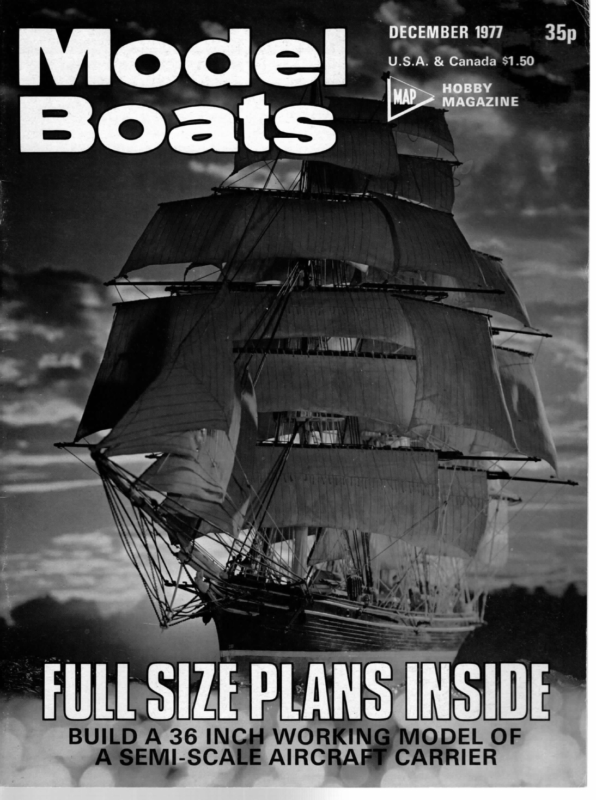
. DECEMBER 1977 ~~ N NY 35p_ U.S.A. & Canada $1.50 ¥ | “WW FULESIZEPLANSI SIDE, 36 INCH A D BUIL EMI-SCALE WORKIN: AIRCRAF Mot CA EL OF RIER
Model Boats 708 WINDSURFER by FRANK WILSON Build this nifty sailing surfboard from two sheets of balsa fee simply made sailing surfboard is a development of the smaller version that appeared in Model Boats, April 1975. The little ones scooted downwind like lightning in a breeze, but had to be lifted out of the water at the end of each run. This larger version is almost as easy to make but has a weighted keel and conventional sail plan so that it will tack across the wind as a yacht should. Two of these nifty craft can be made for about £1-50 which is pretty cheap by today’s standards. Materials required are: one sheet +in. x 3in. balsa, 3 ft long, one sheet 4in. x 3in. balsa, 3 ft long, one dowel +in. dia. x 3ft long (or two thin garden canes). Also required are 2 off 24 oz ‘swivel bomb’ fishing leads, a small tube of oe thread, polythene bag for the sails and paper clips. Construction of Hull Take an 18in. long piece of tin. x3in. balsa and mark a line along the board for the keel and rudder, slightly less than fin. wide. Check the plan for the correct measurements and mark out the slots, making sure that they lie along the centre line. It is a good idea to mark out on both sides of the board. Cut out the slots with a sharp modelling knife from both sides, so that the slots are square through the board. The keel is not glued into the slot, therefore it should be a nice tight fit. If you make the slots too wide, the keel can be glued in place but it is better not to do this because its position is meant to be adjustable. Right, we now have both slots cut so on to the next bit, the raised ‘nose’. From the in. balsa sheet, a 3in. length is cut off and one end shaped into a semi-circle. Draw round a tin to get a perfect half round shape. Cut off the waste and sand to shape. Now chamfer the ‘front’ end of the main board until the nose makes a nice shallow angle. Glue in place and hold with a couple of pins until set. It will now be necessary to sand the joint flush at the bottom (see inset on drawing). Also sand a radius on the stern as shown. The next item is the mast step. Shape a small piece of balsa to a long egg shape and glue in position on the centre line of the deck. A +in. hole is drilled in this for the mast to stand in. You can twirl a drill in your fingers as the balsa is so soft. Do not go right through the bottom, about tin. deep is fine. The mast is made from an 18in. length of tin. dia. dowel, tapered at the top for lin. A thin garden cane can also be used. Glue the mast into the step, making sure that it is upright when viewed from the front and that it leans slightly back towards the stern. Now for the rigging, which has been kept as simple as possible. Carpet thread was used on the original although nylon fishing line would do just as well. Thread a darning needle and push through the hull bottom just behind the nose and pull about 3ft through. Snip off about Hin. below bottom of the hull. Smear a little balsa cement behind the hole and stick the thread to the wood. When dry, wind a few turns round the top of mast (do not overtighten), and back down to one of the slits in the stern. Pull taut, snip off end and cement under as before. Now attach the thread to the other side in the same way. Both ‘backstays’, as they are called, should be evenly taut and the mast must be upright. A little balsa cement smeared on the turns anything slipping. Keel at the masthead will prevent This is made from a 6in. length of +in. balsa. Shape as shown and sandpaper all the edges round. Now the swivel bomb fishing lead has to be set into the keel. This was obtained in Woolworths (20p) or any fishing tackle shop would have them. Snip off the brass swivel and draw around the weight onto the keel. A neat fit is required so cut out undersize to start with and shape the hole with sandpaper rolled round a pencil. Check frequently until the weight will just fit into the hole. When it does, run some balsa cement round both sides and smooth with a finger. Sand to shape a piece of tin. balsa, 34in. x lin. and round off all edges. Both keel and rudder should be a push fit in the slots. After checking alignment, separate the items and give them all a coat of clear varnish or sanding sealer. When dry (not before!) paint the main colour all over and hang the boat up to dry by the mast. Decoration can be done in a different colour to taste. The original is white with red and blue stripes, blue keel and red rudder. Very patriotic! Yellow hull with black decoration looks good also. Sail While the paint is drying the sail can be made. White polythene (butchers bag) is ideal. Cut to shape using a straight edge and razor blade. Masking tape is folded over the leading edge of the sail. Get some help if possible and try to do it right first time, because masking tape will not peel off polythene once stuck! If you mess it up start again. din. x fin. strip of balsa is taped along the foot (bottom edge) of the sail to form a boom. Two small screw-eyes are screwed into the boom as shown. Using cotton, sew the top of the sail to the masthead to start with, then simply place the sail to mast using 2in. long stitches. Do not pull them too tight or the sail will not set well. At the foot of the sail the needle is pushed (continued on page 714)
709 December 1977 Windsurfefr,ef,A\\ THREAD RIGGING A Sailing Surfboard : FRONT neztVIEW \\ or NE i CARPET THREAD | OR NYLON FISHING LINE Ne . | S ia 16″ SOURS GEE MAST FROM eee BOOM FROM SAIL FROM BALSA, TAPED | TO SAIL WHITE END > allen li Be eEaSTIC : to 2 , ts BOWS IE OR SHIRT BUTTON _ RUODER, PUSH ASST ee SAND OFF FLUSH 2502 LEAD BOMB ea : a & RUDDER a KEEL ete 1/8″BALSA MAST STEP N OPTIONAL DECORATION SLIT FOR RIGGING
Model Boats | LO G 714 BO O K ’ Yachting jottings from our M.Y.A. Correspondent OE of the most interesting club arrangements to reach our ears is that entered into by Basildon DMYC who, when their normal water weeded up badly, were fortunate enough to secure permission to use a lake in the middle of a golf course, clear of all the fairways and free of any obstruction to the wind. The lake is about 750 x 250ft, lying east/west, and the keen club members have constructed a caravan for the race officers, to be parked at the lakeside. Not only can racing marks be left permanently in place but permission has also been given for erection of a shed in which to store the club dinghy and other gear. In addition, club members can enjoy the facilities of the golf clubhouse as Social Members for a subscription of £10.80 a year. Waders are needed to put the boats afloat, but possibly we shall hear of a small landing stage in due course ? Especially as Basildon expects to have 8 RA boats next season. If you agree that it all sounds marvellous and you live within reach of Chelmsford, the Channels Golf Club, Little Waltham is the place, and Basildon club have a few vacancies for members. Application forms are available from the hon sec, Mike Birch, 96 Highcliffe Close, Wickford, Essex. The site is to east of Chelmsford, three miles north of where the A12 becomes dual carriageway on the way to Colchester. A new club is being formed on Canvey Island, adjacent to Smallgains Creek. The water is about 1000ft long though a shade narrow, clear E-N-W, but SE to SW winds are obstructed by a sea wall. It is hoped to widen the water at some future time. Classes to be sailed will be RA, RIOR and RM, and MYA affiliation is to be applied for. New members would be most welcome — write to the hon FIGHTING FLEETS (continued from page 707) two-funnel man-of-war in sight, due to her odd funnel spacing, having been mistaken for a two-funnelled ship. The three ships featured this month include two of Admiral Craddocks original squadron, Glasgow and Canopus, and the last of the German ships to be illustrated, SMS Dresden. Glasgow was an early Town Class cruiser carrying a mixed armament of 6in. and 4in. guns. Canopus was a pre-dreadnought battleship with four 12in. and twelve 6in. Dresden, sister of the famous Emden, carried ten 4-lin. guns. Particulars of the three ships were as follows: Colours for British ships were dark grey (Humbrol HN 2), with black waterline and planked or corticene decks as noted. Dresden was painted in two shades of grey; a medium grey hull (Humbrol HU 6), and light WINDSURFER (continued from page 709) right through the hull behind the mast. Snip off the cotton and stick down; as with the rigging. Carpet thread was used for the main ‘sheet’ so that the sail can be hauled in and out. An adjuster can be made from a small piece of plastic with 2 holes in it or even a shirt button! The sail should swing from side to side without catching on the backstays. This type of boat is a sailing surfboard. In the full size version the helmsman uses his weight to balance the craft against the thrust of the sail. In our model the keel sec, who is Mrs T. Thundersley, Essex. Sandison, 18 Windsor Gardens, Over in the south west, cheering news for those seeking a Devon club. A new one has been formed at Newton Abbot, at present with some 25 members and an excellent sailing water for their prime interest, which we understand is RM, but with some RIOR. Affiliation has been applied for. Title of the club is Decoy MYC (NASC), which possibly has some connection with the fact that the club uses part of the water sailed on by Newton Abbot SC. Secretary is J. R. Walsh, 29 Old Road, Galmpton, Brixham, Devon. A little further west, by the way, is an unaffiliated club, St Ives MYC. Not much known, but the hon sec is G. Phillips, Treveneth, Trewidden Road, St Ives, Cornwall. We hear that a new Roger Stollery A boat is likely to appear for next season, and that full-size designer and RM enthusiast Oliver Lee has an RA coming up. Clapham club will have 6-8 RMs in action soon; latest recruits are Dick Seager and Malcolm Peppiatt, both sailing a development of Dick’s Aeolus which looks promising for both vane and radio. Mike Harris won an RM race at Portishead (a Pontins/MAP event run by Woodspring club) scoring five Ists and a 2nd against several experienced RM skippers in a 16-boat fleet; he was not a little shattered to find, some hours after receiving the trophy that he’d also won an 8-day holiday for two in Spain or Greece! Not a great deal of news around at the moment, but don’t forget the MYA AGM at Regent Street Polytechnic, a few yards north of Oxford Circus, on Saturday, 3rd December at 11.30. grey upperworks (six parts flat white to one part flat black). Decks were planked or corticene as noted, and waterline was dark grey (Humbrol HN 2). Next Month: Part IV, The Battle of the Falklands, featuring HMS Inflexible and HMS Carnarvon. Details of the ships Built: Glasgow Canopus Fairfield, Mar. Portsmouth DY, 1909 to Jan. 1911. 1897-1900. Displacement: 4,800 tons. 12,950 tons. (Normal) Machinery: Armament: Complement: Triple expansion, Turbines, 2 screws, 4 screws, coal fuel, coal fuel, 13,500 hp = 184 22,000 hp = 25 knots. 2 — 6in.; 10 — 4in.; 4 —3 pdr; knots. 4 — 12in.; 12 — 6in.; 10 — 12 pdr; 2 — 18in. TT 4 — 18in. TT 376. 750. (submerged). (submerged). Dresden Blohm und Voss, 1907-08. 3,600 tons. Turbines, 4 screws, coal fuel, 13,500 hp = 244 knots. 10 — 4-lin.; 8 —5 pdr; 2 -17-7in. TT (submerged). 321. does the same job. The model is best sailed as upright as possible and in strong winds the sail should be let well out. In good conditions it will plane across the water at an impressive speed. If the boat tends to turn into the wind move the keel back as much as possible. Built as designed it will sail straight but adjustments can be made to keel or rudder until the best position is found. Obviously, much more enjoyment can be had by making a pair of boats and racing them against one another. It is hoped that this article will enable youngsters to build a boat themselves and race one another. Enjoy yourselves!