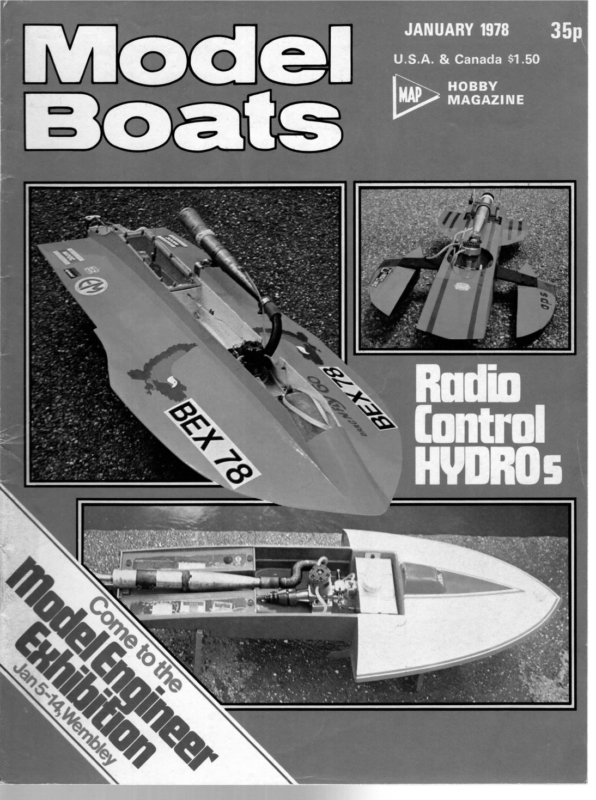
- A new contributor, CHARLES ROBERTSON, B.Sc.NAV.ARCH., discusses his approach to MODEL YACHT DESIGN PART ONE This series will culminate with a new Marblehead plan.
- RATONCILLO a new Marblehead design by Dutch reader JOOST VAN SANTEN
- ROUND THE — REGATTAS Reports on events
- LOGBOOK Yachting Jottings from our MYA Correspondent

JANUARY 1978 35p U.S.A. & Canada $1.50 HOBBY MAGAZINE Control HVDRO. :
Model Boats 28 engaged her until Cornwall arrived to finish the job, and Niirnberg by Kent, whose engine room staff per- formed prodigious feats in working her up to 25 knots, some two knots over her designed speed. Glasgow was the only ship capable of overhauling Dresden and her captain had to decide between her and Leipzig. After engaging Leipzig long enough for Cornwall to come up, it was too late to catch Dresden, which had disappeared into the mists of the south Atlantic. Leipzig put up an heroic resistance, first against Glasgow, who attempted to engage her only at the range of her 6in. guns, and then against Cornwall, whose firepower, and heavy armour proved more than a match for the little cruiser. Leipzig sank at 20.30 hours, nearly six hours after the opening shots were survivors. fired by Glasgow; there were only 18 Kent caught up with Niirnberg, which opened fire on her pursuer at 17,00 hours. The two ships fired broadside at decreasing range — it was down to 3,000 yards at one point — with Niirnberg hitting as hard as she was receiving. It was only the heavier armour and guns that gave Kent her victory and, at 19.26 hours, the Niirnberg heeled over, while the British ship lowered her boats to rescue survivors. Only seven men survived from Niirnberg’s crew. In addition to the four German warships sunk that day, two supply ships, Baden and S. Isabel were sunk south of the Falklands by the cruiser Bristol (sister of Glasgow) and the armed merchant cruiser Macedonia. Admiral Sturdee received much criticism from the Admiralty for letting Dresden escape, but it could not diminish the acclaim he received in the British and foreign Press. It required several ships, however, to hunt down Dresden. She was eventually caught in Chilean waters, at Mas a Fuera, on 14th March, 1915 by Glasgow, Kent and the armed merchant cruiser Orama. After a very brief exchange of fire the Dresden, anchored and with no freedom to manoeuvre, surrendered after setting scuttling charges. At 10.45 hours, the last survivor of the German East Asiatic Squadron slid beneath the waves. The two ships featured this month are the battle cruiser Inflexible and the armoured cruiser Carnarvo n, Readers may recall that Invincible, the flagship of the British squadron, was featured in Number 134 of this series as she appeared just after completion. Inflexible, her sister, is shown here after several modifications, the most noticeable of which is the heightened fore-funne l. The same change was not made to Jnvincible until after the Battle of the Falklands, a heightened funnel being fitted at Gibraltar on her way home. Carnarvon and her five sisters were completed in 1904-05 and were slightly more modern than Kent and her sisters. They introduce d the 7:Sin. gun which was to see limited service on sub- sequent British armoured cruisers and on the post-war improved Birmingham class. Both ships survived the war and were scrapped in the early ’twenties, Their particulars were as follows :— Inflexible Clydebank, 1906-08 Built: Carnarvon Beardmore, Clyde, 1902-04 Displacement: 17,250 tons Machinery: 41,000hp = 25 knots Armament: 8 — 12in.; 16 — 4in; 10,850 tons 21,000hp = 224 knots 4 — 7-5in.; 6 — 6in.; Complement: 2 — 18in. TT (submerged) 650 3 — 18in. TT (submerged) 2 — 12pdr; 20 — 3pdr; 780 The colours of both ships were dark grey (Humbrol HN2) with black waterline and corticene or planked decks as noted (Humbrol No. 29 and HN4). Next month: The Battle of Savo Island, Part I. A new contributor, CHARLES ROBERTSON, B.Sc.NAV.ARCH., discusses his approach to MODEL YACHT DESIGN PART ONE This series will culminate with a new Marblehead plan it has often been said that many people who try their hardest at model yacht designing are faced with the problem “Where do I start?” The methods explained below will produce a rough set of lines (which should require the minimum of fairing), possessing the required parameters of form (longitudinal centre of buoyancy and prismatic coefficient). My personal preference is to design to a certain prismatic coefficient wherever possible, because it has a direct bearing on the drag acting upon a yacht hull at different speeds. This method of designing does not start from scratch, but utilises any suitable set of existing hull lines, and modifies them to a new hull form, so that not only is it possible to design a new hull from a basic hull, but it is also easier to make small changes in form to aid the development of ideas. Although some of the calculations may, On paper, appear daunting, in practice they are very quick and easy. (It is not required to understand the formulation of these methods, just how to use them!) Sectional Area Curve Before draughting a set of lines, we require a curve of areas of immersed sections. This sectional area curve has several exceptional features, and can be prepared by comparison with hulls similar in form to the required design. The curve gives the area below the load water-line (LWL) of all transverse sections. A suitable yacht (lines plan of which is available), which displays the approximate characteristics required for the new design must be selected (displacements, hull form, coefficients of fineness, etc.). It is then required to calculate the areas of the immersed transverse sections (0-10) and plot them on the water-line plan in their appropriate position. CIRCUMSCRIBED RECTANGLE panna roaose ILWL | i Ad, : 10 \ 9 8 7 6 AREA UNDER CURVE § =VOLUME DISPLACEMENT 4 3 2 ! [e] CENTROID (LCB) WATERLINE PLAN WITH SA CURVE SUPERIMPOSED
January 1978 29 (i) Take the S.A. curve from amidship to the fore end. Calculate the volume of these immersed sections by Simpson’s rules, and hence prismatic coefficient of BODY PLAN the fore end. Cp V Entrance = LxA® L = length over which the volume is calculated. (ii) Decide upon the required fore body Cp for Entrance the new design. Divide the curve into a suitable LWL number of parallel lines (say 5), see diagram. If the Oe, area of the rectangle which has been drawn is taken to be unity, then the area under the curve = Cp; Entrance and the remaining area = I-Cp. THIS AREA BELOW LWL, BOTH SIDE, IS PLOTTED TO FORM SA CURVE FOR EACH STATION E The above curve gives the area below the LWL (load water-line) of all the transverse sections, and this fixes the longitudinal distribution of the yacht’s buoyancy and hence gives the position of the LCB (longitudinal centre of buoyancy). Since the ordinate at the midship station (5) gives the area at that station, and the curve is plotted on the yacht’s LWL as base, the ratio of the area under the curve to the circumscribed rectangle will be the prismatic coefficient (Cp). V L_ Cprotal = = volume of displacement ~ a ~ es Yo Sc ve ips ~“ ~ SS x THE PARALLEL LINES ~~ iy NEED NOT BE EQUALLY SPACED x. Ne s LxA@ = length between perpendiculars (LWL in this case) A@® = midship area of cross-section below LWL. (Also note that block coefficient (CB) = that the midship coefficient Vv LxBxD (CH) = A@®, so and Then OY* that Design basis I-Cp (basis (On the design curve.) If we substitute values for Cpp and CppB we can determine values for the new Y’p, which when plotted will define a new curve of areas having the required prismatic coefficient. BxD CpxC@® = Cp). The curve of areas also gives the position of the LCB, which is in fact the centroid of this curve (the position where the centre of gravity is situated). The volume of displacement for our formula is obtained by applying Simpson’s rules to the areas of immersed sections (0-10), as is normally the case. Now that we have obtained a basis sectional area curve, we can modify this to the parameters which we require. The first stage is to modify the sectional area curve to obtain the desired prismatic coefficient: This method is normally for the sectional area curves where the aft and fore bodies are the same. However, it is possible in most cases to apply this method to model yacht design, and should the desired result still not be satisfactory, judicious fairing of the new S.A. curve will quickly rectify matters. Because a yacht has no parallel middle body, the mean prismatic coefficient of the entrance on run (Cpm) will be equal to the prismatic coefficient of the complete yacht = OY xIL-Cp (design) = OY x constant (iii) This procedure is now applied to the aft body, and when completed, the new Cp for the whole S.A. curve is now calculated (Asa check Cp + Cp = Cp). Entrance Run 2 DESIGN. NEW Cp CALCULATED FOR THS- CURVE Cp+Cp hull (Cp), i.e., Entrance Run = Cp, which is the procedure I shall adopt. Although this procedure may on paper appear long and complicated, it takes but a matter of minutes in practice. i are now one third of the way to producing a lines plan. ete a. me i = ‘AFT Boby (RUN) 9 PRE BODY (ENTRANCE)(L) The next stage is to modify the S.A. curve for the required longitudinal centre of buoyancy. (Note: I have assumed that the midship section had the largest section area, but if it does not, all that is required is to substitute in the equations the largest section, being careful on handling Simpson’s rule when calculating the volumes.) (To be continued)
Model Boats 30 RATONCILLO The Model Maker Plans Service B35 Shaye Street. Heme! hempsinad rea Static pose shows flared bow distinctly. C- was about 1968 that Marblehead racing started a new era in the Netherlands. Although quite primitive, regular sailing and experimenting were encouraged and from 1968 to about 1975 a constant number of people were participating in the races and a number of people produced a new design every year or two. The reports of major events held in England, as published in Model Boats, provided a lot of information, as the weight and draught of most designs were given. Nowadays, vane sailing in Holland is experiencing a decline as enthusiasm fades away, and radio control seems to appeal more to the newcomers, perhaps due to its simplicity, although that is at first glance only. In the middle of 1975 it was felt that our designs could be improved a lot. The import of Pterodactyl by a wellknown Dutch model sailing family contributed to a large extent to this. One of the major problems when having only a small number of competitors is that one cannot rely on experiments of others, due to the fact that experimenting is also done on a small scale. Instead, you have to use common sense (always a good habit, except in politics). In fact, it was amazing to us to find that Prerodactyl (well known to you) was far quicker downwind than the beamy Marblehead Koekkiekoek. Looking at both designs, it seems strange that Koekkiekoek with its flared bow does not plane so easily downwind as Pterodactyl (even on flat water). We will come back to this subject later on. For a new design, it was required that— 1. It should plane easily downwind and reaching. 2. It should not bury its bow in a heavy blow. 3. It should be faster in light winds than our former designs. A new Marblehead design by 4. 5. It should be easily transportable. It should be fitted with a spade rudder just to see why that should not work. A first design was made just before the regatta at Fleetwood in 1975, where the British M-class Championships were held before the ‘A’ World Championships. The result of our trip to this event was the adoption of a sprayrail on the principle laid down by Roger Stollery. Some other minor changes to the design were made as well. First we will discuss how we tried to improve the downwind performance. Downwind performance and general considerations As the flared bow of Koekkiekoek did not help in keeping the bow up, we reasoned that the downward suction of the after bottom part helped a lot in preventing the nose from diving. It will not be so difficult to understand that the water moves upward, following the keel line, by the suction of the aft body. The larger the aftbody area, the larger the suction force will be. Meanwhile, increasing the slope of the buttocks will also increase the suction force. The result is that replacing the clean keel line by a steeper line, with more curvature in the aft hull and at the same time broadening the aft waterlines improves FULL SI OF THE ABOVE | ABLE RE PRICE £1. Lines of K. comparis: sequent Ratoncillo,
31 January 1978 MM 1245 YCILLO = a —— Dutch reader Joost Van Santen the planing behaviour. At the same time, as the two lines plans show, the volume of the underwater part of the bow was increased to a large extent so as to make the ends fuller. Thus the prismatic coefficient (cp) was also increased, which is favourable at high speeds. ae Enjoying a top-suited beat. The sprayrail is modified with regard to Stollery’s application. We thought that the slope could be decreased and thus the aftward directed force on the edge could be reduced (it imposes less resistance when going through the water). Of course it must still be placed in such a way that it is effective. As the amount of water thrown back is the major factor in its effectiveness, we made a downward directed edge on it. We do not think that only a slight outward curvature will help. Meanwhile, these things cannot prevent the boat from burying its bow when setting a too large a spinnaker, but we found that with the Ratoncillo design, the model will come out of the water again and happily sail on without any tendency to broaching. Letting the spinnaker fly in front of the boat will also help to keep the bow out of the water in a heavy blow. The sprayrail was subsequently pe ees
‘a, Running with spinnaker in a strong blow, with bow well lifted, and mate Alexander Verheus about to launch. modified a little; now the rail fairs into the hull further forward and the curvature is made less round near the middle sections. The original rail (as used during the Easter Gosport championships) disturbed the water too much at a place where the rail was not really necessary. Of course, something has to be done about the light weather performance as widening the stern and increasing the bow volume results in more wetted surface. Fortunately, a new yachting pond became available, allowing us to use keels with a maximum draught of about 47cm (18-5in.) This means that a Marblehead, gaining its stability to a large extent just by its lead, can be made less beamy and lighter. The plan shows two keels with draughts of 50 and 40cm (19-7 and 15-7in.). The lead drawn for both draughts is about 4kg (8-8lb.). We are of the opinion that 40cm draught with 4kg lead will be satisfactory. Decreasing the lead of the 50cm draft keel to 3-5 or 3kg is possible. Of course the weight and draught combination depends on the maximum allowable draught by pond depth and weather conditions. Between 5 to say 7m/s windspeed a keel of 3kg lead and a draught of 45cm (6-6lb., 17-7in.) will give approximately equal results to a keel with 4kg lead and the same draught (to windward and leeward). Regarding the widening of the hull above the water and thus ignoring the heavily applied tumblehome on British designs, we found that the hull of Koekkiekoek presented a very clean shape when the ship was heeled, beating and reaching in a fresh breeze. So although less emphasized, the widening has been applied to Ratoncillo. It must be stressed that quite different results are to be expected in, for instance, the ‘A’ class, where the waterline can be lengthened if the heeled hull is not lifted out of the water, due to tumblehome. Weights In recent years, the total weight of Marbleheads has gone down from about 22-25lb to 12-16lb (54~7}kg). There is less fear of applying a large draught and a thinwalled light glass fibre hull. At first the lead was 4kg (8-8lb) and the maximum draught about 50cm (19-7in.). Later, with a view to Gosport, where a maximum draught of 18in (45-7cm) was dictated, the lead was reduced to 3-5kg (7-7Ib) and the draft to 44cm (17-3in.). The total weight list is as follows: Hull out of mould (no fittings whatsoever) Hull worked up, inclusive of mast support, transom and main part of the jib fitting Hull inclusive of deck, etc. Hull completely rigged, inclusive of vane support, eyes, paint (one layer) and so on Jib fitting (loose) Jib boom Frame of moving carriage vane and dial Vane feather and arm plus counterweight Main boom and kicking strap Mainsail 930gr 1075gr 1400gr 1700gr 25gr 35gr 92gr 70gr 40gr 50gr Jib and jibstay Main shrouds Counter-balanced rudder, tiller arm and vane connection to rudder Spinnaker boom and sheets Mast 13—15mm tapered, and backstay Glass fibre keel fin, no connection construction 60gr Sgr 120gr (30gr) 240gr to lead 250gr Fin and lead (4kg), foam and connection 4300gr Total weight when beating: 6:737kg (14-9lb) The hull consists of two layers of woven glass fibre (160gm2) and follows the curvature of the gunwale so as to give a flange for gluing the deck (1-5Smm). Of course, the hull of a radio-controlled Marblehead can be made lighter as the greatest strength of a vane hull is required when handling it in a heavy blow, and all the additional equipment for carrying a spinnaker will not be necessary for a radio-controlled Marblehead. From discussion at Gosport, it appeared that our hulls are still a lot heavier than favoured by top skippers. The lead of the Bloodaxe type is about 5-55kg (1241b) which with a hull weight of 1-7kg (32lb) gives a total of 7-2kg (16lb). The major weight factor seems to be the heavier rigging we use (mast diameter 13—-15mm instead of 10:5-12:5mm) and the hull itself. The weight of the glass fibre hull seems to be the same, but we still have to fit a deck whereas the Bloodaxe design incorporates the deck in the hull. We hope that someone is willing to publish the figures in the same way as above. A short note has to be made re the weight of the keel. Our keels consist of lead (why not?) connected to a fin of glass fibre reinforced plastic. This fin fits into a tapered box in the hull and can be removed for transport and experimental purposes. The fin itself is made in a two-piece mould separable on the front and aft edge. One layer of 300gm? and additional reinforcement will do. The bare section collapsed when lifting 4kg at one end. Foaming the inside resulted in a considerable increase in strength. Over 12kg could now be lifted without failure. The non-foamed section weighs about 200-250gr (7-90z). Foam and connection for the lead increases the weight to approximately 300gr ((11oz). Making a mould for a glass fibre fin has advantages if you want to make more than about 3-4 keels. You must keep in mind that of the first few sections made in such a narrow mould, about 50 per cent are likely to be worthless due to faulty moulding of the front and aft connections between both sides. Our experience is, as has been mentioned, that a lighter keel (draft 45cm, 3kg lead) is favourable for wind speeds less than about 5m/sec. In higher windspeeds, when keeping the yacht upright is most important, a heavier keel is better for beating to windward and reaching. We would advise a keel with a lead weight of about 4kg and a draft of 48cm (or 4-5kg and a draught of about 40cm) as a general set-up. (to be continued)
Model Boats 38 ROUND Reports on THE — REGATTAS events tack giving him right of way over most of the approaching fleet. In the fifteenth race however Roger met John Cleave who gave an impeccable demonstration of knowing the rules inside out to advantage. He ruthlessly sailed to the weakness of Roger’s approach and caught him under Rule 42.1(e). ‘ a leeward yacht shall be under no obligation to give any windward yacht room to pass to leeward of a starting mark sur- rounded by navigable water . Roger tried to squeeze Mimi past the mark but just touched it and worse still hit the Kiug and incurred penalties which cost him his winning chance. Above, John Cleave’s Klug, ultimate victor at Nylet RIOR Trophy meeting, well on the next leg while the opposition is still beating for the mark. Second boatis J. Elison’s Pacemaker (sawn off version), with George Honnest-Reddlich, Tony Abel and Dave Ellis trying to catch up. Bottom, Roger Dehon’s Mimi (K1871) stands out in this group which had just rounded the first mark. Third place went to David Ellis sailing a Pacemaker and D. White was fourth with a Poole RIOR. The distinction of being the only boat to lead the Klug fell to fifth place man Cyril Adams sailing in his first competition. He managed to hold off the challenge for a lap. Cyril could well have done better had he not missed the first race. He was sailing a fin keel version of Maree IIJ and like the Klug, this boat has a short water line giving it a lot of sail area. It may be significant that of the first six boats only one had a water line substantially in excess of 55in. None of the Cracker designs fares too well and both M. Jones with Warlord and Derek Stevenson with a beautifully finished but untuned Pulsar expressed a desire for more wind. John Thomas, more noted for his RM sailing, was a quiet but firm and eagle eyed OOD who missed few infringements. At the end of the proceedings Tony Abel changed hats to represent Nylet and present the trophies. He thanked the Fairford Club for organising the event, and the warden of the centre Alan Coombs for his help. Chairman of Fairford Club, Chris Bowler, read a letter from Mr Frank Parsons (sen), of Nylet who was too ill to attend and wished him better soon. Report by Mike Hopkins (Fairford Club Measurer). Pictures by Chris Bowler (Club Chairman). Results — Nylet Trophy for R10Rs — 7th August Pos Points Name Reg Design 1 J. Cleave K 1876 Klug 2 62 R. Dehon K 1871 Mimi (Dehon) 3 54 D. Ellis K 1936 Pacemaker (Abel) 4 50 D. White K 1909 Poole 10R (Walker and Dehon) 5 42 C. Adam: mod Maree III (Wilcock) 6 38 7 8 9 10 G. Honnest-Reddlich K 1893 Poole 10R A. Abel D. Stevenson J. Ellison C. Bowler K K K K 11 28 D. Buxton K 1870 12 13 14 26 24 8 J. Weeks M. Jones D. Poulton K 1977 K 1782 K 1879 36 R. Brigdon —_— mod Cracker (Lewis) Retired W. Dale variable winds. Changing wind shadows, caused by trees behind skippers, together with wind variations which changed the same leg of the course from a beat to a run on successive laps gave problems to all but the most experienced of skippers. Some races took over 15 minutes to complete as boats took their own private breeze and passed within feet of others who were ghosting, only to have the tables turned on them a lap later. In three of the heats the second place boat was the only one to finish in the three minute time limit and more than half the competitors collected at least one zero score for this reason. Twice during the day the course was shortened by moving the base leg marks and later by sailing the ‘Olympic’ course. By mid afternoon however a more consistent light easterly breeze developed and the schedule was completed easily. For the second time the event was won by John Cleave whose Klug gave him a ‘maximum’ six wins. Second was Roger Dehon with his O/D Mimi who placed second last year also. Roger had maximum points from his first four races and his tactical starts gave him an advantage. He sailed up the line on a starboard tack broad reach and tightening his sheets crossed the line on the gun, with his starboard * 1894 1957 1971 1895 (Walker and Dehon) _ Retired G. Hartshorne Nylet Trophy for R10R The second Nylet Trophy event for RIOR class yachts was held on Sunday 7th August at South Cerney Water Sports Centre, home water of the Fairford and District Model Club. The weather was dull and overcast for most of the day with light (Walker and Dehon) Pacemaker (Abel) Pulsar (Lewis) mod Pacemaker (Abel) Pacemaker (Abel) owned by W. Curtis Woodley Poole 10R (Walker and Dehon) Cracker II (Lewis) War Lord (Stollery) Poole 10R 15)) 36 34 32 30 Cracker (Lewis) — * * Cracker (Lewis) M. Hopkins * Cygnets Minorities Regatta — 31st July – Mote Park, Maidstone We decided early in the year to hold a regatta to cater for the events which are usually pushed to one side. The events to be run were:— Electric Multi 24 kg 3 X 6 mins. heats Unlimited 2 x 9 mins. heats Spark Ignition 2 x 20 mins. heats Sport 34 2 x 20 mins. heats Multi-hulls (hydros, cats, tunnel, etc.. As many heats as possible. It was a long day for the organisers, as can be seen by the running list, but was well worth the effort. They would like to thank all who turned up to make the day a success. The electric heats were dotted about for charging purposes. The 24 kg was very exciting with many relying on steering and luck. The unlimited was poorly supported and Fred Martin had a walk-over. Only three entries took part in the Spark Ignition whom shared the prizes. The biggest disappointment was the Sport 34 which had to be cancelled due to lack of entries. The Multi-hull event was the highlight of the day. This was run loosely to American rules, which the reporter is not going to describe as Model Boats does not have enough pages! We had approximately 12 entries for this event and they all ran against each other at some
January 1978 Fred Baker of Fleetwood with Vicker’s Vedette. R.C. Sailing Race to Jan Sharpe of Barrow with a Bluenose. The Ladies’ Steering event was won by Mrs. Audrey Baker with her husband’s Vedette. Novelty items were provided by Wally Nurse of Crosby who moved his Noah’s Ark around with elephants on the bows spouting water, and A. Smith of Royton (near Oldham) with his live steam navy tug pulling the recovery dinghy containing two boys about the lake. Over the weekend many hundreds of people came to watch, due to good publicity by the local press, and entrants came from Barrow, Crosby, Bury, Preston, Chorley, Halifax, Brighouse, Royton, Oldham, as well as Fleetwood members from various parts of the Fylde. Out of the ordinary models included a sailing Mayflower by Ken Smith of Bispham and an African push-tug by C. Nuttall of Bolton. Prizes were presented by Derek Priestly, Club Commodore, at the end of Sunday’s sailing. Thanks are due to all who helped in any way with the events, especially the ladies who worked hard in the club canteen. C. Money. This Agnew catarmaran was run by Highgate club’s A. Walton at Cygnet’s Minorities regatta and performed wel! enough to earn third place with a K & B 3icc outboard motor, silenced by leading the exhaust pipes under water. time in the afternoon. The majority of the entrants did not finish each attempt but one must accept this due to the newness of the event and unfamiliarity of this sort of racing. The prize winners are in the results, for which congratulations are in order. But a couple of entrants must be mentioned, Fred Martin had a very nicely turned out AMPS Cat which went very well but suffered minor problems. Keith Edgar from the Bexley Club had an American Hydroplane, which was very large, looked like a space ship, powered by a 10cc engine and went very well when he could stop it from cavitating. John Bright took part with a beautiful own design hydroplane which was very fast and quite reliable, all things considered. It was certainly up to his immaculate finish and superbly turned out; with more practice he will have a boat to beat all. Although Derek Collings id not win anything with his Wing Ding he over-shadowed all other competitors. This OPS powered hydroplane, which was featured in Model Boats a short while ago, was beautifully turned out, and after a couple of dud runs he got it going well, which was a treat for the spectators, organisers, and anyone else who dared to watch his spectacle. It was superb, just like a ‘round the pole’ hydro only under radio control but just as fast. Although short, the runs left one speechless and knocking at the knees and we were spectators! Derek said afterwards that the boat had shown signs of moving on previous occasions, but he had never had a run of this length before. He was still shaking at the time! As one of the organisers I would like to thank him and everyone else for a pleasant friendly day. Perhaps we will repeat it next year. Results 24 Kilo Electric Multi Ist F. Martin 51-3 laps 2nd _ L. Jones 51-1 laps 3rd J. Cundell 49-0 laps Unlimited Electric Multi [lst F. Martin 26:1 laps Spark Ignition Multi Ist C. Firmin 66-4 laps 2nd P.Firmin 50-4 laps 3rd _ R.Walker 44-2 laps Sport 34 Cancelled — lack of entries. Multi-Hull, Cats, etc. Ist T. Johnson 1300 pts 2nd R. Watts 1250 pts 3rd_ A. Walton 850 pts L. Jones * * * * Fleetwood Week-end 13th—14th August The Tall Ships Trophy event was sailed on the Saturday in very unFleetwood like weather, almost a flat calm, but the radio-controlled sailors, taking a course covering the full length of the lake and back, finished within a few feet of each other. Ron Newton of Barrow won the Trophy with his schooner Stormy Petrel, and also the second prize for free sailors with his cutter Huntress. Bill Railton of Fleetwood won the third prize with the schooner Trade Wind. Sunday’s Jubilee Scale Regatta did not work out as planned between club groups, but was very successfully staged as a normal regatta with individual competitors. There were 35 entries and including others who had just come for a sail or to exhibit, about 50 models and their skippers were present. Calm weather again handicapped the sailors but was ideal for the powered models. The main event was a course where the ships, after starting, had to stop to pick up a pilot, navigate a buoyed channel, enter a dock and out again, back through the channel, stopping again at the outer buoy to drop the pilot. Winner of the Jubilee Trophy for the best overall performance was Bill Thomas with his paddle tug Chieftain, of Crosby. Ernie Littler of Fleetwood won the R. Berry Trophy (straight sailing) with his schooner Alice & May. Nomination Prize to Bill Hayes of Crosby with his tug Bonito. Steering Course to “Wellworthy Cup’ Twenty-fifth September was the day the New Forest R/C MYC held the annual contest for the ‘Wellworthy Cup’. This event which is for “RM? Class Yachts, was held at Snails Lake, Ringwood, Hampshire. A small advertisement in Model Boats some two months earlier, brought in a shoal of requests for entry forms, and at one time it was thought that the entry may have been above fifty! Far too many for a one-day event. However, various reasons reduced the entry to thirty-one boats from eight clubs. This was a fortunate number as 31 makes an ideal schedule. For reasons unknown, one skipper failed to turn up, so thirty boats came under starter’s orders. The OOD was David Robinson who came along and did a splendid job. His knowledge of the racing rules, and his fair decisions were accepted by all, and it can be recorded that it was a day without protests. A very happy state of affairs. The entry included a number of new boats and skippers to the area, who had not previously enjoyed a New Forest event. Special mention must be made of Chris Dicks, who sailed his own design 247, and to the club secretary Tim Fuller, sailing a brand new Aschanti, only in the water for the first time, the previous week. Tim eventually proved to be the winner. His boat called Nooky Bear used Sanwa radio, Futaba sail winch, and Sealplan sails. Second was V. Cooney from Woodley, sailing his Nylet Moonraker design Lulu. He used Fleet radio, Sprengbrook sail winch, and of course Nylet sails. Third was Chris Dicks from Clapham. Sailing his own design 247, named Mnementh, a word not found in the Concise English Dictionary, but which we understand means Red Dragon. Chris uses Futaba radio, Andrews winch and home made sail . Fourth was J. Curtis, again from Woodley. His boat Frantica, is a modified Sailplane design with Futaba radio, and home-made sails and winch. Fifth was J. Cleaves of the home club, sailing his Ghibli Klug boat Knut, not sailing up to its usual performance. Either John or the boat were off tune, or the more modern designs have overtaken the performance of this, now somewhat elderly boat. MacGregor radio and sail winch and Nylet sails were used. The meeting concluded with the Club Commodore Bob Jeffries introducing Mr. Ashby Johnson, a Director of Wellworthy Ltd, the donors of the trophy, who presented the Cup and other prizes, and also drew the raffle. The full results were as follows :— Name Score Position Club Boat T. Fuller 70 1 New Forest Nooky Bear V. Cooney 68 z Woodley Lulu TI C. Dicks 3 Clapham Mnementh J. Curtis J. Cleaves M. Oxlade G. Thorn N. Curtis J. Mountain A. Oxlade R. Jeffries T. Abel G. Webb D. Easter M. Foreman J. Soper N. Hutchins J. Foster N. Oxlade T. Brown N. Rothwell J. Cargill R. Belding D. Brown D. Voss T. Tutt A. Woods D. Belding F. Cox S. Murden 64 62 60 56 52 44 44 42 42 40 40 40 38 36 36 32 32 28 28 22 20 20 18 16 10 4 2 4 5 6 7 8 Woodley New Forest Woodley Woodley Woodley Frantica Knut Rising Damp Mokelor Frolic 9 9 Birmingham Woodley Verve Midnight Oil 13 13 13 Birmingham New Forest Woodspring Tantrum Bandit Worzel Gumage 11 11 16 17 17 19 19 21 21 23 24 24 26 27 28 29 30 New Forest Guildford Woodley New Forest New Forest Woodley Andover Woodspring Woodspring New Forest Andover Andover Woodley New Forest New Forest Andover Woodspring Electra Challenger Windracer Ultra Violet Panic Ultrasonic Sally Ann Blue Stone Ego San Toy Witchway III ~ — Jildi Condor -Chaser C. R. Jeffries
Model Boats i LO G 46 B O O K ’ Yachting jottings from our M.Y.A. Correspondent fi ia enjoyable French get-together, the international regatta run by the Yachting Club du Foyer Remois, have to be some limit, on |.0.a. or sail area, and past attempts to introduce such open categories as multi-hull craft etc. have failed fairly dismally. If enough support will in 1978 occur on June 24/25. The lake is near Reims and the racing is for vane Marbleheads. Entry is free and unlimited, and entry forms, to be returned by May 31st, are available from Mme. Michele Lahure, 2 Av. du Gl. De Gaulle, 94240 L’Hay-les-Roses, France. The large proposition (with evidence of support) was made by a club, preferably one prepared to host such a function, the MYA would certainly not object. The MYA is, of reeds) if boats get far off course, and there have been faceless committee meeting in an ivory tower. Thank lake has certain natural hazards (like vertical banks and dark murmurs about nobbling visiting skippers by encouraging sampling during visits to champagne caves before sailing . . . it is a super weekend, and everyone who’s been wants to go again. English boats have done fairly well there, too. Little hard news has come in recently, late autumn being a quietish time in racing, but one or two readers have sent in thoughts on sailing generally. For instance, ex power boater David Boothroyd from Leeds has some controversial suggestions, arising to some extent from poor support in national events at Leeds and Bradford club water, or indeed at other waters where most of the entrants have been comparatively local. David cites only one northern boat entered in the RA National at Woodspring, but this is not a good example, since there are Only two or three RAs in the north, or were at the time. To avoid too much parochialism in National races, the Suggestion is based on the success of the Northern, Midland, and Southern regions of the MPBA in holding regional championships from which top-placed competitors go forward to the National Championship. Such Nationals, says David, are too important to be decided by the cost of petrol or the accident of geography, and having the preliminary battling nearer home could help. The Nationals must be held at a point approximately central to the total MYA affiliated clubs, or circulated regularly round the Districts with a really representative entry, if the titles are to mean what they say. The point the correspondent misses here is that with half the number of clubs, and many of those centred on waters unsuitable for major events and/or insufficiently strong to host such an event, the choice of venues is very much more limited for yachting meetings. Radio yachts are a little easier in this respect, but here the champion- ships have rotated, except for the RA, where virtually the whole of the fleet has been registered in the south. The MYA Council invites clubs to offer to host major meetings, and where more than one club offers, the choice is made with rotation in mind, allied to suitability of water, of course. A couple of years ago, Leeds and Bradford club put up a proposition to restrict draught on yachts, because their water could not accept deep draught boats, and it is possible that this (defeated) proposition is one major reason for skippers being reluctant to sail there. With the improvements made to the lake, presumably this restriction no longer applies, but if so it has never been stated. With the 10 rater Championship due to be held there at Easter, the club should clarify this point. David also suggests, based on an unbiased relative newcomer’s observations, that model yachting ought to have its equivalent of the Portland Speed Trials, which would allow unrestricted experimental approaches without interfering with the class rules and thereby offending dedicated traditionalists. Well, there would for such an idea was forthcoming, and if a formal course, you and me as affiliated members, and not some you, David — now let’s see what sort of comment results? “Where are the R36Rs?” asks Michael Hopkins of Cheltenham, who then makes the following comments: “The way in which the MYA recognised and adopted radio classes alongside those for vane has proved to be a fundamentally correct move. This is demonstrated by the rate of registration of new RAs, R1IORs and RMs. But where are the R36Rs? Even a Marblehead is too big to build on the kitchen table and one would have expected a strong demand for a class the size of the 36R. Others seem to have the same impression because in the short time I have been reading Model Boats three 36R designs have been published, each with comprehensive building advice, and yet one rarely sees one at the pond side. My own club has tried actively promoting a nominally priced hull amongst its large junior membership but without much real success. In my own case I have a small son who can make a competent job of sailing an RM but he is too small to lift one in and out of the water. Why am I reluctant to build him an R36R? The basic shape of a yacht is governed very closely by its measurement rules. Draw some silhouttes of typical 36Rs, Ms, 10Rs and As, so that each appears the same size; no matter how they are mixed up, it is a simple matter to identify each class correctly. The 36R for example has a very shallow draught and here lies the root of its unsuitability for conversion to radio control; it is just not deep enough. Modern radio gear is light, but although it is possible to have an installed weight of radio, winch, servo, batteries and their associated switch gear and water proofing of less than 160z, it requires substantial skill or substantial depth of pocket or a combination of some reasonable degree of both to do so. A more realistic target for an average modeller would be 240z, while many who have home built winches would find 320z difficult to achieve. This weight can only come off the lead and if, for example, one tried to put 141b of radio in an 84lb Gosling then the lead decreases from about 67 per cent to 50 per cent of the total weight. This is intolerable so long as the rule forbids us to compensate by increasing the depth of the fin. To waive the ‘depth of box’ rule for R36Rs is clearly unacceptable if such boats are to share a common register with 36Rs. A possible alternative might be a UK version of the 36/600 rule, that is a rule which stipulates maximum length and sail area as the only major design parameters. I am not suggesting that the 36R rule should be scrapped, but it would seem that here is a case where a common rule for radio and vane is not appropriate and the two classes might co-exist happily. Who knows, we might even end up with a common register of 36/600s and R36/600s!”’ One comment here is that in vane sailing, where the problem of weight does not arise, there are still six or more Marbleheads registered for every 36R. A second is
47 that the weight limit is 12Ibs for a 36R, and the Gosling is very light for the class. There are RMs of under 12Ib, though certainly of much deeper draught. Swapping limited draught for limited sail area is an interesting thought, though many people would no doubt like to see a 9in. beam limit retained; this could lead to some attractive boats. Once again, comment, anyone? Meantime, over to Bob Jeffries, Commodore of New Forest R/C MYC, for some novelty event ideas. Bob suggests that if the weekly racing fixtures appear to be getting in a rut, an occasional event like his club’s successful ‘Sail-in’ is worth considering, and will give a lot of pleasure to skippers and spectators. New Forest Sail-in The ‘Sail-in’ is a light-hearted affair, where the emphasis is on fun, and the tensions of sailing in an important trophy race are absent. There were no entry fees, and therefore no prizes, so there was no overall winner. Individual skippers had the satisfaction of winning individual races. Being held in August this year, with the holidays in full swing, a lot of skippers were away, and therefore the entry was down on previous years. The twelve entries was sufficient to run all the events, and gave individual skippers a lot of sailing. The first event was a ‘Cloverleaf Course’, six boats per heat, best into the final. This is a course where boats, after the usual count-down, sail to the first buoy, and return through the start line, then on to the second buoy and return through the start line and around the third buoy, two laps being sailed. An event like this means there will be boats sailing the same course, but in opposite directions. Needs a lot of concentration. The second event was a ‘Relay Race’, each race consisting of two teams of three boats. Conventional triangular course. The first boats of each team start in the normal manner after the count-down, and race one lap. After passing the third buoy, and before reaching the start/finish line, they have to ‘pass the baton’ to the second boat in the team. This is done by both boats coming alongside each other and touching gently. The second boat then sails the course, passing the baton to the third boat after completing one lap. The third boat then goes on to sail its lap. First team home are the winners. An event of this type may be complicated by the OOD allowing opposing teams to sail in such a position as to prevent the baton being passed. This may make for some dangerous sailing, and the possibility of damage to boats, especially if there is a fair breeze and boats are sailing fast, A ‘Ladies Only Race’ is always a popular event. The point to watch is to prevent the owners of the boats passing instructions to the lady skippers. Leave them alone, and they will come to realise that it is not so easy to race R/C yachts as it appears. The New Forest Club’s sailing water at Snail’s Lake, Ringwood is a disused gravel pit some 200 yards wide by over half a mile long. Normally all the sailing is done at one end, but the next event was a mini ‘Fastnet Race’, and as many boats as possible were entered. It was found by using basic and split frequencies, ten boats could sail at one time without interference. The race started with a conventional count-down, and what panic there was when all ten boats arrived around the first buoy, at the same time. Cries of ‘Overlap’ went unheeded as the boats fought for position. All was well, there were in the end no incidents, and the boats started the long run to the ‘Rock’. As it is impossible to see what boats are doing at half a mile, skippers were allowed to walk the lakeside with their transmitters. After rounding the mark, boats started the long beat back, around the mark and over January 1978 the finishing line. This is the first time the New Forest club have sailed so many boats in one race, and must surely be a sign of the times, when due to the everincreasing numbers sailing, all races may be of that size. Following the success of the large entry in the ‘Fastnet’, the next event was a ‘Knock-out Race’, where again ten boats started, sailing the conventional course, and after the first lap, the last boat dropped out, and so on each lap until only three boats remained. These were adjudged the winners. The ‘Blindfold Race’ was next. This has always proved popular, and is more difficult than it might appear. Skippers are blindfolded, and have a ‘Mate’ to direct them. It is quite incredible the muddle some skippers get into. We well recall at an earlier event, the top skipper of the club hadn’t got his boat over the start line when the first boat was home! The next event caused much amusement. It is called a ‘What’s-yours-is-mine Race’. Six skippers line up by the start line, and during the conventional count down, the OOD instructed them to hand their transmitters to the man on the left. Panic ensued before skippers found which boat they were supposed to be sailing. The race proceeded, until they were again requested to hand their transmitters on again. It was intended to hold an ‘Endurance Race’, but skippers were starting to withdraw because their batteries were exhausted, so this event was not held. Perhaps this was just as well, as skippers also were feeling the effects of such a concentrated effort and were feeling similarly exhausted. The idea was to hold a race of say thirty minutes duration, and the winner to be the skipper covering the greatest number of laps. The writer well recalls a similar race held elsewhere some years ago. Only the windward and leeward marks were used, so boats tacking to windward were troubled by boats on the downwind run. Frantic cries of ‘Starboard’ and many other comments not found in the MYA Rulebook… In previous years a ‘Balloon bursting event’ was held, but because so much damage had been caused, this is no longer held. The idea used to be for boats to have a needle stuck in the bow fender, and to intercept balloons released upwind. The problem was that skippers would all go for the first balloon, and caused more damage to themselves than to the balloon. The New Forest Club sails the ‘RM’ class.exclusively. It would be possible to mix classes in this type of event, provided they were not mixed in individual races. Organisers of an event of this type can, I am sure, think of many more types of races than suggested here. Always bear in mind it is an event for pleasure, and there must be no sailing that would endanger boats. In controlling an event of this type, the OOD should explain at the outset that this is a fun event, and although basic rules should be obeyed, such as port/starboard, windward/leeward, and every endeavour made to avoid collisions and damage, such infringements as touching the buoys should be ignored, provided skippers sail the full course. Also slight contact between boats can go unnoticed. It is significant to note that through the whole day only one protest was made. This was from a skipper who, having touched the buoy, made his rerounding as the rules prescribe, and then wanted the other competitors to stop and wait for him to catch up! At the end skippers were unanimous in their appreciation of a most enjoyable day, and it is hoped that these comments may make other clubs organise a similar annual event.” Which all puts your scribe in mind of a comment heard at the RA Nats. — “Hello, Len. Which rules are you going to sail by this weekend? MYA or Marquis of Queensberry ?’’