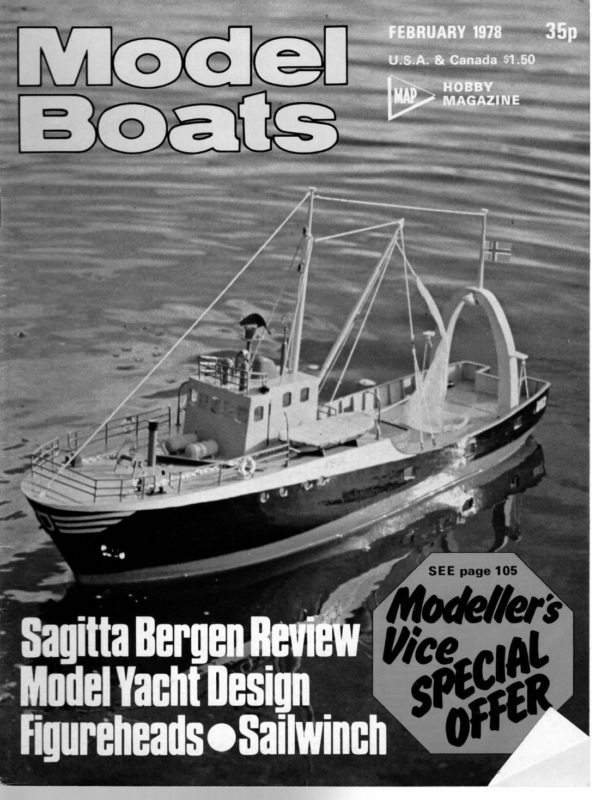
- CHARLES ROBERTSON, B.Sc.NAV.ARCH., presents PART TWO MODEL YACHT DESIGN
- Concluding part of a new Marblehead design by Dutch reader JOOST VAN SANTEN RATONCILLO
- LOG BOOK From our M.Y.A. Correspondent
- TEST BENCH A review of recent commercial products

iaspiniene iz Mode Yacht Design Figureheads @ Sallwinch
93 February 1978 CHARLES ROBERTSON, B.Sc.NAV.ARCH., presents PART TWO MODEL YACHT DESIGN OME readers may have found from last month’s article that they had trouble at the midship section, in getting the modified fore and aft body sectional area curves to meet. This would occur if there was little or no parallel middlebody. I would suggest that judicious fairing of this curve about the midships would produce the required prismatic coefficient. For those who require a more rigorous approach (I hope their maths are not too rusty), here goes: ‘ Method 2 The modification of the Cp of an entrance or run not associated with a parallel middle body. We again require the sectional area curve split at the midship section (or section of greatest area), and the entrance and run will be modified separately to arrive at the required Cp (see last month). The new curve is filled out generally with no concentration towards the ends, whereas the method last month fills the curve out towards the midships. The question now is what do we do with equation (1) which we have produced ? Well, we know the basis Cp, we can decide upon the required Cp, we can calculate the centroid of the half body (details shown later), and x is anywhere on the curve — we just substitute these values into the equation (1), ‘turn the handle’, and out ‘pops’ the longitudinal shift of the section at x, as a fraction of the maximum ordinate. All we do now is to multiply the maximum ordinate (OC) by the longitudinal shift of section and add (or subtract) this value to x (the length BD). This will be a plot on the new sectional area curve. We now repeat this procedure, selecting transverse sections arbitrarily, until we have enough plots to be able to draw the new curve which will have the required prismatic coefficient. This procedure is now repeated for the other half of the sectional area curve (see last month). I have plotted out the fore body from the Witty design Longbow, and I will attempt to illustrate this method. The original Cp (entrance) is 0-49, and say that we require an increase to Cp=0-53, the change in Cp (8Cp) being 0-04. Substituting these values into our equation (1), we have: dx = 0:04.x(1 —x)/0-49(1 — 2x) where X = 7:42/25 = 0:2968. ein. if we take the section No. 3, x=10/25=0-4, so that: dx = (0-04)(0-4)(1 —0-4)/0-49(1 — 0-5936) = 0-0482 O GC Where: Cp X X = = _ = Prismatic coefficient of half body (basis) The fractional distance from midships to the centroid of the half body (basis). (X/OC). The fractional distance of any transverse section at x, expressed as a fraction of the maximum ordinate (x/OC). d6Cp = The required change in the prismatic coefficient of the half body. 6x = The necessary longitudinal shift of the section at x to produce the required change in the prismatic coefficient. Now, 5x = c.x(1—x) where c is a constant, and to determine the value of c in terms of the change in fullness 5Cp, dCp = [“sxay =—¢ [xa —way =cC («—x2)ay. Le. SCp =c¢ [xay — | x*dy = c(Cp — 2Cpx) ee /0 0 dCp Cp(1 — 2x) 0 _, Therefore Sx = 8Cp.x(1—x) Modification of the LCB 2 = position of the LCB (centroid). 6z = Required change in LCB position. Now, 0 Hence, C — But this value 6x is a fraction of the maximum ordinate OC, so that to obtain the actual value, we multiply 5x by OC — 0:0482 25 and 6x=1:205in. This means that we increase x (10in.) by 1-205in. I have continued doing this for the rest of the fore body on graph 1, and have drawn in the modified curve with Cp=0°53. Work sheet 1 illustrates how the prismatic coefficient and the centroid of the fore body is found. Now that I have cleared up any anomalies concerning the modification of the Cp, we can turn our thoughts-to how we can modify the SA curve to obtain the LCB (longitudinal centre of buoyancy) in the desired position. (1) Cp(1— 2x) xX = Oatx = Oand |, and max at x = 4. (This differs from the previous method described last month which produced a slight overlap at x = 0, unless some parallel middle body existed.) dx shift is proportional to the ordinate y, i.e. 6x = Ky, where K is a constant depending upon the required movement of the LCB. Tan 0 = déx/y = K Therefore, 5x = y tan 0, = dzy/y… since, tan 0 = 62/y, (1) where Yy is the vertical position of the centroid of the SA curve.
Model Boats 94 Before we use equation (1), I will list below the para- meters which we require: Gnas (1) We can calculate the position of the centroid of area LCB (2) We will decide upon the movement which is required (fore or aft). (B to B’). All we now have to do is to complete the triangle BB’O, and draw through stations 1, 2, 3, 4 etc, vertical lines (OD) and parallel Design Curve(New) A Curve (Original)A j ~i_ – 829 in lines DE. We now strike lines in from O parallel to yt OB’, which will meet DE at G, doing this procedure for all stations. The intersection of these lines at G gives the spots for the new curve, which will have: (i) The same total volume displacement (and hence the same Cp). (ii) The required position of the LCB. I have drawn out a complete SA curve which has been modified for the LCB position (it has been moved 1:165in. aft), and also tabled the calculations involved — see work sheet 3 and SA curve graph 2. These will illustrate, I hope, the points which I have covered in these first two articles. These calculations I have tried to simplify as much as — y E D x eid G iS kk ) (o 6) 6} 2 12 Modification of the LCB. possible so that they can be done as routine (and you don’t have to understand how they work, though it helps), but should there be any queries, I would be glad to help to resolve them, care of Model Boats. Next month, I hope to show how to use this modified SA curve to produce a hull lines plan. Work Sheet 1: Fore Body (Taken from Witty Longbow) A B Cc D E F Station Area (ins.*) % Max. Area S.M. FS (Volume) Lever S* (Moment) 0 4 1 14 2 0 0-86 2:02 4:28 6:84 0 4% yA 20% 32% 1 4 2 4 2 0 16 18 80 64 10 9 8 Ui 6 0 144 144 560 384 63% 2. 126 4 504 23 10:06 3 47% 13-46 4 16°47 19-0 20°5 21°4 4 44 5 4 IO RA 89% 96% 100% 188 4 2 4 1 308 178 384 100 5 Xf = 1462 A x 100 F=DxE Where E = Lever F = f’ (moment) il I why Qo 2×2= 64 x 6 = 384 *Sin. N > OA D=BxC Where C= Simpson Multiplier D = f (volume) Xf = 1462 CPpentrance = 1462 — 0-49 3000 h = Section spacing Cpentrance = xf’ = 4340 21-4 5 = Max Area A = Area of any station B= % Max Area | Where Area Section 924 356 384 0 At Section (2) A = 6°84, Max Area = 21-4 .. B= 6-84 x 100 = 31:9% [Area Section 5] mam B= 940 3 2 1 0 xf = _if 3 x[No. of Ordinates—1]100 Where 100 is the area of the largest section. 3000 Centroid of fore body = 2f’ x h fwd > Section 5 =f xf’ = 4340 Centroid of fore body = 4340 x 2-5 1462 = 7-42in. fwd Section 5 Work Sheet 2 for aft body is the same except stations run from 5 to 10 and lever from 0 to 10.
95 “et pie gewit Seema eee ee witty. “LONGBOW : NEW Cp _CURVE -Fi February 1978 SECTION Bast oe, SA. CURVE~ COMPLETE HULL. / 70°53 LCB:0-835n Aft INCREASE IN Gp, =0-04 %Me SECTIONAL W POSITION OF LOB:20n Ant # iSEurRaO LES eee. +100 21-44 ao RUBE 7 L 60 Hi L 40 o 0 aor i fects) reie 4 aeAtt. et i Fore eobvtennces ri “ R sk CRE fot 40 1ce . ‘ 2 © AeECTONAL z yes uPON THkeh Line} | | } Hag TaN OF | | sg 4 IAN |; Fee +20 b27KAB ‘ THIS LINE +700 60 Pn Fut ¥(K) LCB LIES UPON “won: SECTIONAL +80 a PLOT FOR NEW CURVE NEW SA CURVE Cp 0-53 Vom Witt ‘Lonebow* cf \ | ig | | waa Siqaiaree: os (Basi | jj c ‘<— a TH a pone" ———> Graph | Graph 2 Work Sheet 3: Complete Hull (Taken from Witty Longbow) A B Cc D Station | Area (ins*) |\°% Max Area} SM \ f (Volume) 0 1 2 3 0 2-02 0 90% 6:84 13-46 a2, 63% 0 36 64 252 5 4 3 2 100% 4 400 O 19-0 5 21-4 6 20-16 94% 8 9-14 43% 9 10 89% 15-44 3-5 0 |Lever| 1 4 2 4 4 iT E 2 178 2 1 188 1 2 15842 10000 4 40000 178 7921 |XfFwa=1018 0 64 4 Xf = 1556 576 256 0 324 2048 15876 2 17672 5184 4 20736 256 4 1024 2 0 3698 1 Xf’att = 1278 0 Xf’’=117220 At Section 2 B? = (32)? = 1024 B* [% Max Area Ordinate]? G =C x B? G2 a Ge = 2 O24 = 2048 Where G = f’’[% Max Area]” ECB = 21 att – 2f’Fwd X h LCB = 1278—1018 x 5 = 0-835in. Aft Amidships (Aft Amidships [when + ve]. Fwd Amidships [when — ve]) Height of LCB from base = }Zf’’ Volume Displacement (V) = xf x [Area of Max Ordinate (A’ Max)] 100 1556 xf’’ = 117220 Height of LCB = 4 “A’ max = 21:4 Volume Displacement = 1556 x 21-4 x 5 = 555in.? 1 hb 3 Displacement = 62-4 x 555 Ibs. 1728 = 20-04 Ibs. Displacement = 62:4 x V lbs. [fresh water] 12′< 12'x 12 = 62:4V lbs. 1728 =117220 = 37:7% A.B. 1556 xf [Given as a percentage of Max Area (100 %)] - 1 4 2 4 5 4 0 0 81 1024 3969 1849 16% 1 0 144 192 504 258 2 G f’ (Moment | [% Mx Area}? | SM \f’’[%Max Area]® 3 288 0 Cc 8836 4 86 B? 188 12 2 F Cp = 1556 = 0-52 3000 Cp = Cpent + Cprun 2 Cprun = (2 X 0°52) — 0-49 = 0-55 3
Model Boats 98 Concluding part of a new Marblehead design by Dutch reader JOOST VAN SANTEN Beating with lowest suit in winds of about 30 mph. RATONCILLO Steering and Cross-section of Rudder and Keel Till recently, we favoured a skeg and flap rudder for nottoo-well-argued reasons. The simplicity of a spade rudder was the reason that we now fit such a rudder, but some measures have to be taken. With a spade rudder, the total rudder, not just the flap (today about 60 per cent of the total area) is moved and a larger reduction of vane to rudder has to be applied. Instead of 1:2, we use 1:3-6 up to 1:4 ratio between rudder and vane rotation angles. This results in about the same amount of steering power given by the rudder for a similar amount of vane offset. Second, a skeg and flap rudder can hardly be set to stagnation (i.e., a too-large an angle giving no steering moment on the hull at all, while the efficiency of a spade rudder decreases rapidly when set at larger angles than 15-20° relative to the flow. As the maximum rudder angles in which a normal moving carriage vane gear works are much larger than the above mentioned values, two movable stops were fitted allowing the preventing of larger rudder angles than a preset value (see picture). These stops were very important as will be shown later, not only for preventing stagnation of the rudder, but also in sailing tactics. The smallest turning moment on the tiller is needed if the line of rotation lies one quarter of the chord length from the front (leading edge). Any other line can generate a turning moment on the tiller when the rudder is set at an angle, except when the rotation line goes through the centre of effort. Unfortunately, this centre is difficult to find and is certainly not the centre of the area. All that is known is that it is very near the 4-chord line! (See an insect which also operates at relatively low speeds. (See Figure 2.) This change of rudder (and keel) improved the slow speed characteristics without influencing the heavy weather performance. It is thought that probably other model yachts, like A and 10r, are best fitted with relatively sharp-nosed keel and rudder sections. (The remarks of Trevor Reece in Model Boats July 1977 are only valid for higher speeds.) It also improved the guying ability as the boat was not so quick in a short guy. This can partly be explained by the mast aft rig and by the light weight. When beating to windward, the mainsail blows in the vane. Instead of 28° of vane angle relative to the hull, now about 18° is required. So, on the wrong tack, a vane setting of 218° is achieved instead of 228°, resulting in a considerably smaller guying moment produced by the rudder. One might have the impression that a skeg/flap rudder might work better. aie a SHARP | BLUNT res CENTRE 6 OF EFFORT Figure 1.) Changing the steering arrangement so drastically from a skeg to an all-movable rudder does not happen without difficulties. For efficiency, the rudder and keel were carefully shaped to an NACA 63000 series section, incorporating a fine tail and a not-so-blunt nose. In light weather conditions, however, when the speed of the boat was not high, it looked as though the rudder did not work, especially at larger angles, giving a large leeway angle due to the increased drag of the rudder and no steering tendency. The solution was found in sharpening the nose, so as to make the section more like the wing of a. LU Good YW WRONG ! FIGURE 1 FIGURE 2
99 February 1978 An experiment with such a rudder proved this not to be the case. The guying ability was no better and the quick response of the boat as obtained with the spade rudder disappeared. The skeg and flap rudder was disappointing. Another peculiar point, also coming out in light weather conditions, is the following. With a large spinnaker, the boat behaves like a snake moving through the water, going constantly from the left to the right and back. The distance travelled in one cycle in light airs (1-3m/s) is quite long — about 64m — decreasing with increasing windspeed. The ‘amplitude’ can be large in light airs unless special measures are taken. This — in fact unstable — behaviour vanishes when the windspeed is higher than about 6m/sec. The whole can be solved by: 1, Setting a smaller spinnaker. Of course, not a favoured solution, especially as it seems that Ratoncillo with its effective rudder seems to be capable of sailing with a relatively larger spinnaker in running and reaching conditions. 2. Preventing the rudder angle from becoming too large. Allowing only 5-7° rudder action (total 10-14) diminishes its ‘snake walk’ considerably. 3. Setting the spinnaker in a stiff way to the boat, so as not allowing it to sweep from one side to the other, is also very helpful. The tension of the centring spring seems to have some influence too, but it has to be quite stiff if some profit is to be expected. As mentioned before, two stops were fitted, intending only to limit the rudder angle. Later on, it proved to be very useful in preventing the boat from making a quick turn towards the windward bank in a gust. For this purpose, the windward stop was wide open, up to 20-25°, whereas the leeward stop was allowing a rudder angle (turning to windward) of 5-10°. In this way, a gust cannot push the boat so fast to the windward bank. This is only an example, but other uses can easily be imagined like allowing a boat to turn only slowly to its final course, after release from the bank on a running leg. Summarising, the spade rudder is very effective and in combination with two movable stops, can be very useful in sailing tactics. The size, as indicated on the plan, should certainly not be decreased as this will lead to difficulties when guying. The cross-section should be such as indicated on the plan. Mast aft rig Compared to Koekiekoek, we moved the rig aft about 16cm. This moves the downpressing force to the middle of the hull, so in beating conditions, the total balance will not change so much, i.e., the boat will not turn in such a way that its aft hull is lifted and its bow is pressed down. But we overlooked the fact that the wind coming from the sail is now blowing more directly on the vane, resulting in an approximately 10° smaller vane setting when beating (18° with Ratoncillo and 28° with Koekiekoek). This in itself is not very disturbing, if it were not that the guying capabilities were lessened, as explained earlier, Although for simplicity’s sake the mast has not been drawn further forward, moving the mast and finkeel about 5-10cm nearer the bow is advised. If you move the mast and fin area (not the lead!) by the same amount, no difficulties are to be expected. Three suits of sails are shown: first, our most-used top suit, although not making use of the full 216cm height; second, a lower suit, useful in windspeeds between 4-6m/sec and 10-14m/sec, and last, a reduced lower suit, useful under gale conditions. So far we have not needed a lower suit. Care is needed to ensure clearance of the vane feather, mainboom and backstay when using the lower full size suit. Top, jib fitting simply made from tube and below, the vane gear clearly showing the moveable stops described in text. It is also possible to use the set of sails as given by Dicks for the 247 design, but be careful in case of differences in mast position. New designers are warned about the following: As everybody knows, when beating in a heavy blow, a yacht has more tendency to luff than in light winds. So, we decided to put the centre of effort (2?!) of a lower suit to a more forward position than its preceding higher and larger suit. Wrong! If you take a careful look at the turning moment (luffing moment) acting on the heeled yacht, you will find that a lower suit gives a smaller to windward turning moment than a taller suit, because the centre of effort is lowered and thus the moment originating from the driving force is decreased. The result is that the centres of effort of lower suits are almost directly under the centre of effort of the tallest suit, and sometimes even aft of this point. In ‘A’ class yachts, the centres of effort of all suits are usually on one vertical line (with satisfying results). I would like to call this contradiction the ‘Gale Contradiction!’ Note that the lowest suit has the same attachment on deck of the jibstay as the highest suit. In the foregoing, instead of giving some vague feelings, the author has tried to give more insight into the design of a new Marblehead. I certainly do not claim to be complete and experienced on all points, and I hope that some fruitful discussion may follow. I wrote the article in the ‘we’ style as Alexander Verheus contributed a large part to the design and all the findings. Enthusiastic people like him are what clubs need!
Model Boats 102 ‘LOG BOOK’ From our MYA Correspondent inclusion of one amendment (limiting the rudder to a maximum thickness of 3cm.). The alterations to the rule do not materially affect it, but simply tidy up the wording in places to close one or two loopholes which someone might otherwise exploit some day, and to clarify the intention in one or two places. No existing boat is affected as far as is known. A brief run-down on the amendments will appear next month, but if anyone is anxious about a new design, his club secretary should have a copy of the small changes of wording involved. Now came the radio sailing rule proposal. Basically Bourneville’s Bill Sykes’ Sula derivative K2164 was sailed into first place and a holiday abroad, by Mike Harris at Brean Model Makers Festival last October. Most news comes, of course, from the AGM held on December 3rd and attended by representatives of about half the affiliated clubs. There was a fairly heavy agenda list, the time-consuming area being, as usual over the last four years or so, R/C sailing rules. Minutes of the previous AGM and matters arising caused no problems, the various officer’s reports showed how busy a year it had been, and financially the Association is holding its own satisfactorily. The first matter to lead to discussion was the Secretary’s report on the postal poll of opinion on the venue for the AGM, where only 15 clubs had expressed an opinion, 10 favouring London and 5 Birmingham. The geographic advantages and disadvantages being self-evident, Council had wanted to point out the comparative costs, which was briefly done in the letter accompanying the polling form. Some clubs obviously felt that providing only this information tended to bias, and there was some discussion of the matter, which the chairman felt could be resolved only by checking which way a vote would go. The result was 72 votes for Birmingham and 73 for London. Under these circumstances Council feels that the next AGM must again be held in London, but it should be pointed out that the Association’s officers are quite willing to travel to wherever the membership would like its AGM held. A clear decision by members on this point would be welcomed, to lay this perennial matter to rest. All officers of the Association were re-elected with the exception of two who had found it necessary to resign. One of these was the President, John Lewis, whose work is taking him to Canada for 5-10 years. Appreciation was expressed for the contribution he has made to the Asso- ciation and to model yachting generally during his several years in office. The new President elected is Vic Smeed. One nomination was received for the vacant post of Registrar for the A and RA classes, and club secretaries should note that the Registrar is now J. Browne, 7 Roxburgh Avenue, Birkenhead, Merseyside. The first motion, that rule changes affecting construction and/or rigging of boats shall only be enacted at the AGM, shall come into effect on the following Ist March and shall remain unamended for 12 months, was carried after only brief discussion. The second, that the A class Rules should be amended as reported by a sub-committee was also carried, after longer discussion and with the there was agreement with the principle of moving as close to full-size TYRU rules as possible, and introducing changes only when the [YRU announces changes — usualy only every fourth year, after the Olympics. However, differences between sailing full-size and model yachts do exist, and the area giving most difficulty is what penalty system should be used? Proposal (iv) of this section was to set up a sub-committee and give them a mandate (i.e. the power to take decisions on behalf of others) in respect of six or seven key questions, including penalties. The intention was to solicit opinions on these questions so that decisions made would reflect majority opinion. Some clubs and/or delegates, however, felt that the questions set out were in fact motions, though not so worded, and it all got a little confused. The upshot was that the present sub-committee of E. Gearey and R. Skeates should carry on, with the addition of D. Hollom, and opinion on the questions was decided by vote. Council had suggested a timetable including drafts going out to clubs and final rules being put for adoption to an EGM in March 1978, so that they would be effective for the ’°78 season, but after so thorough an airing the meeting felt that an EGM could be avoided by the sub-committee incorporating the decisions taken and the new rules being sailed to during 1978, giving the opportunity of finding any weak spot and allowing consequent amendment at the ’°78 AGM. They would then be ratified and would be in effect until (almost certainly) 1981, which is likely to be the earliest that any IYRU modification will occur. Relative newcomers should be assured, by the way, that alterations from the existing rules will not be considerable, since the present rules are based on IYRU practice, so they are not going to have to re-learn everything. The main points discussed were penalty system (race committees will have a choice of penalty points totted up and deducted from final score, or 720 deg. turns to exonerate sins), position of start line to give longest sailing before first mark, duties of OOD, skippers and officials remaining in one area, and four frequencies (one split) per boat to allow more boats per race. Next rules for R/C team racing, and the proposed rules will, it is hoped, be sailed to on a trial basis during 1978; there are no official national R/C team races as yet. Amendments to the Constitution — basically updating it — went through moderately easily. Two areas created discussion, and there will now be two District Councillors, one of whom should be knowledgeable on R/C matters, for each district, and no separate R/C committee. The other discussion centred on the voting system, and eventually it was agreed that there should be no basic change unless or until someone can suggest an improved method. So ended a complicated and at times very lively AGM from which emerged once more the indication that poor
103 communication is still the biggest cause of disagreement. American EC12s and who, after a couple of day’s sailing, proved a formidable opponent, especially as if he broke a boat he just borrowed the next best, broke that, borrowed another, etc. One of the most amazing incidents was when the wind piped up and John changed to a small District councillors should, via District secretaries, keep their district informed, and this is normally done to a greater or lesser extent. However, it can only be done through club secretaries, and this can be where communication breaks down. Three or four clubs were unlikely to have known what was to be dealt with at the AGM because the details were returned to the Gen. Sec. marked ‘Gone away’. It is vital that changes of secretary or changes of address are notified, the more so since it has been decided that in future, to try to keep in touch, a copy of the draft minutes of each Council meeting will be sent to each club. Communication is a two-way thing, remember! Other matters The World R/C Championship in Durban has a closing date for MYA entrants of February 28. Secretary Roy Gardner will be forwarding entries in bulk, so he’s the man to get in touch with. It looks as though the next World R/C Championship will be in Ottawa in 1980, though no details are yet available. Results of the invitation Race of Champions (RM) for 1977 were interesting — 1. Squire Kay, 2. Chris Dicks, 3. Dave Hollom. Another race of interest was John Cleave’s one-man expedition to the USA for the Mini-America’s Cup. John imported an EC12m hull, which was fitted out with the help of Ken Jones, and arrived to find that he had to sail an eliminator against a visiting Australian (a fullsize skipper) who had been offered a choice of the best February 1978 suit; it was ruled ineligible under the rules, which bar ‘unusual sail plans’. The ruling was reversed, but over seven races John could not prevail over the Australian, who went on to sail and lose to the American boat. Sailing just the two boats with a knowledgeable crowd of up to 3,000 applauding successful tactics etc., must have been quite an experience, coupled with appearances on at least three television channels. John enjoyed the visit enormously, and certainly would have been an excellent ambassador for British model yachtsmen. That matter of draught at Leeds and Bradford’s water has been resolved. Improvements to the pond closed off the one small shallow area, so any existing boat will have lots of room. The limitation of draught proposed by the club a couple of years ago was not because of their own lake, but due to concern over deepening draughts eventually restricting the number of possible waters for major events. Nice to clear it up. SECRETARY WRITES (from page 101) heeds the message to take life a little easier. I know it’s a waste of time saying that, for who can ease up when life is of so much interest. To those who have been enquiring about his well being, I know he will wish me to thank you. Here’s to another season of Happy Boating. Jim King TEST BENCH A review of recent commercial products available and care is taken in cleaning the parts to be joined, then with the help of suitable gas torches, also obtainable from Kenneth Johns, and a suitable hearth which While the art of hard soldering is unfortunately not one practised universally by the model boat fraternity, there are many who do use this method of jointing of metals. Most of those who do use this method usually contrive a crude hearth by placing firebricks on the workbench. The hearth so formed is effective to a certain extent but among the several disadvantages is the fact that after a session of work the heat loss through the base firebrick causes at the best the usual wood top of the bench to become discoloured and at the worst actual charring to occur. Many have constructed small hearths for the smaller jobs to be done in comfort but for those who have not and for those who are setting out to make use of the advantages of hard solder- ing, then a new offering from Kenneth Johns will be very acceptable. Very simple in concept, which has enabled the price to remain a reasonable one, the hearth consists of a strip iron frame welded on the joints, into which fits a steel base plate, a base firebrick and firebricks at side and rear, giving a working area of 7in. x9in. with sides of 24in. and a back of 44in. The three legs give a clearance of 2in. below the base-plate so there is little possibility of heat damage to the surface on which the hearth is placed. This hearth will be more than suitable for many small jobs, and it could well be used for the brazing of smaller boilers. Hard soldering is often looked upon as a difficult operation but if the tools are this new production is, then many will find that it is easier to silver solder and obtain a better result than from the more common soft solder. Price is £10 inc. VAT. postage extra. If you believe that a competitive fast electric model is going to cause problems with your bank balance, the introduction by Dick Palmer of a vacuum moulded boat in ABS plastic may change your viewpoint. This 20in. long by 9in. beam model, called Hustler, demonstrated its remarkable performance at the MPBA National Steering Championships last year and made most of the ‘experts’ at that event take a second look. Designed for steering and speed, we also feel that a number will be making appearances in 24 kilo multiracing. Recommended motor is a Cyclone 15 and 8 off 1-2 amp/hour cylindrical nicads, from which a very competitive performance should be obtained. By shopping around for cells, a complete hull/motor/cells combination should not exceed £25. The hull, although small, performs well in up to moderate chop conditions, and comes complete with settingup dimensions and a sheet of ABS for the lid. Price is £7.50 plus 60p VAT, post free in UK — see advert in this issue. An interesting side- light of information is the recommended adhesive, OSMA PVC/ABS solvent cement No. 2, which we understand is available from major building merchants. f you are looking for a ready-made power-pack for the Hustler or any other lightweight electric model, you could consider the Hummingbird 15 power pack, from Model Flight Accessories. The outfit consists of the MFA motor wired to a 9°6 volt, 1-2 amp/hour nicad pack, made up from two sets of four cells in plastic cases, switch and charging plug ready wired and complete with charging lead, crocodile clips, fuse and holder. The lead should be used with a 12 volt car battery in good condition for a period of 30 minutes. The motor is suppressed and is a three pole, well constructed design with quite substantial brush gear for its size. From data curves obtained from tests carried out for the recent Radio Control Models and Electronics Silent Flight Special, the motor compares very favourably with the Cyclone on torque and power and was fractionally more efficient. It would also be fairly simple to watercool using methods previously published in our Fast Electrics column. The cells are connected with heavy duty braiding to eliminate voltage losses caused by high resistance at large currents. A useful information sheet covers charging and installation, the latter mainly concerning aircraft. Incidentally, the plastic lunch-box that the pack comes in would make a radio/servo box for a larger model! The price of the pack is a reasonable £24.45 inc. We hope to test it in the Hustler hull in the near future.