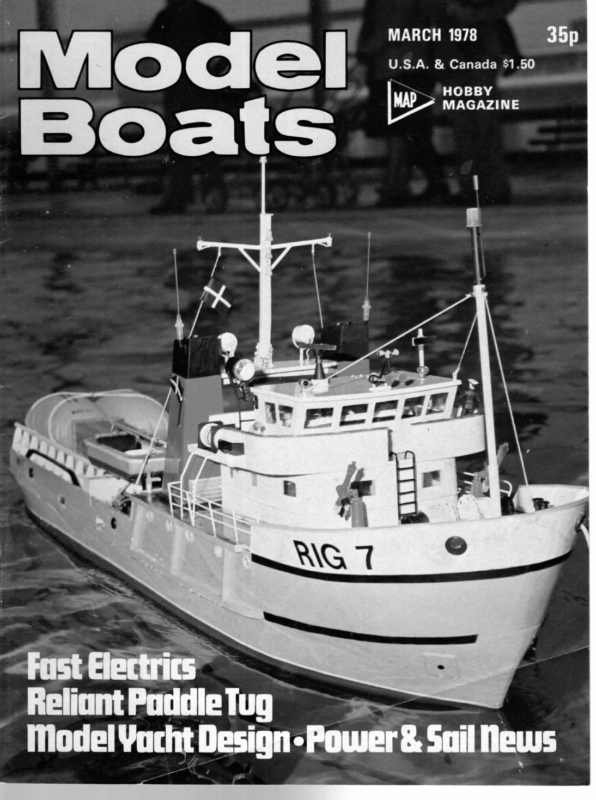
Model Boats: Volume 28, Issue 325 – March 1978March 15, 1978Archives, Model Boats (1966 - 1999) J. FINCHAM reports on the DANSON FROSTBITE REGATTA 2nd JANUARY, 1978. CHARLES ROBERTSON B.Sc.NAV.ARCH. presents PART THREE MODEL YACHT DESIGN LOG BOOK From our M.Y.A. Correspondent MARCH 1978 35p U.S.A. & Canada $1. oP 7 MAGAZINE ‘Reliant – Model —_‘Design:-Power® sail News ii 147 March 1978 Right, all six boats and three of the pilots! Not bad for one photograph. Below top, Oliver Lee’s Trapper, modified with ‘fence’ forward of the rudder. This and the standard boats were the ones to beat at Danson, taking four of the first seven places, including first by newcomer Tony Owen. Bottom, N. Curtis from Woodley Club sailed his well finished Frisky. Note the colour coded frequency switch aft of the winch drum, the adjustable lead-in rack forward of the Woodley transfer for “a Rae sheet and the long rudder-arm ink. J. FINCHAM reports on the DANSON FROSTBITE REGATTA 2nd JANUARY, 1978 The Danson Model Yacht Club held their Frostbite Meeting at the Rick Pond on 2nd January. In contrast to last year the weather was mild, and Bob Taylor the O.0.D. was able to set a long course and in the fresh wind of the morning to sail two laps, however the sting was in the tail, by the middle of the twenty-four boat schedule the course was reduced to one lap and the last race of the schedule was only completed by a drastic shortening of the course and application of the two minute rule to four of the six competitors. This enabled the area to be cleared by nightfall, but had the unfortunate effect of preventing a resail of race three, which had been the subject of a dispute, less about the interpretation of the rules than over the sequence of events leading up to an incident. The judges and competitors being completely at variance, Bob Taylor felt the fairest action was to resail the race if time permitted, and until the wind dropped completely during the last scheduled race, had planned to do so. Generally the racing was not particularly close, in many of the races the eventual winner with perhaps one other boat, achieved a clear lead by the first mark, which involved a long beat from the start line, and sailed the course afterwards to win unchallenged. However not one competitor missed a race, a standard of reliability which would have been unthinkable even three years ago, and the remark that a year or so ago one could win an event with a reliable boat with good sails, whereas now one needs to have good sails, a good boat and to sail it well, sums up the present state of the art. Tony Owens, a newcomer to model yachting from full size sailing, broke the Danson tradition of doing badly at their own event, and with five wins and a second place, proved a worthy winner. Of the first 7 boats 4 were Trappers, it certainly seems to be the design to beat at present. RESULTS Place Name Boat 2 3. 3) 3) 6. 6. Trapper Sailplane Trapper Seahorse Trapper 247 1, T. Owens N. Hatfield J. Curtis P. Freeman T. Fuller O. Lee C, Dicks Trapper Club Danson Basildon Woodley Danson New Forest Basildon Clapham Pts 70 62 56 56 52 48 48 Model Boats 148 CHARLES ROBERTSON PART THREE B.Sc.NAV.ARCH. presents OOKING back over the last two articles, we should have, (I hope), achieved a sectional area curve for the new design, which is correct for the prismatic coefficient (and volume displacement) and has the required position of the longitudinal centre of buoyancy. We now have to use this curve to develop a hull lines plan with these characteristics. There are two methods which we can utilise: From the existing basis half-girths (half-breadth waterlines). I will deal with method (1) first, because it is easier to depart from the original design master (midship) section; i.e., we can go from a planing type hull to a more displacement type section. — From first principles, and |Beal?d 1. 2. WL. WL. PLANING SECTION. DISPLACEMENT SECTION. Procedure for Drawing Body Sections from First Principles 8 C tical 3 A/T / YACHT SHAPE SECTION |OF SAME. AREA: G 8 K _ a“ ) / DESIGN The vertical rectangle represents the area of a section (A/T x T) = A); where A is the sectional area picked off from the corrected sectional area curve and T is the required draught. An additional rectangle is obtained by dividing the sectional area by the load water line breadth (A/b). Point E on the diagram is the half breadth of the LWL for a particular section. The diagonal EHK will give a straight line section having the correct area; this is then modified to give a yacht shaped section, retaining the correct area and correct LWL breadths (the final areas must be checked by a planimeter or other methods). Area ofBCDK = A/T xX T=A Area of BEFG = A/b X b=A BCHG is common to both rectangles, therefore, CEH = GHK. This area BEHK equals the area of the section, and consequently, the actual ship shape section can be drawn around this framework. It is usual to deal with the midship (master) section first. This process is then carried out for the remaining sections after which the shape of the sections above the LWL must be drawn in to blend with the lines already drawn. With this body plan, the process of fairing is carried out by running in the waterlines and buttocks, but it is worthwhile before the fairing process to have a check made upon the movement of the centre of buoyancy when the hull is inclined at a 20°-25° angle of heel, adjusting sections where necessary to negate any movement. LWL Now that I have explained the method, let us look back in detail to see what we require in its application. 1. The Sheer Plan (elevation of deck and underwater body) This we have to draw according to our requirements, i.e., yf maximum draught, position of maximum draught, deck height at aft and fore perpendiculars, amount of sheer hi required. T Fee LINE SECTION. : MODEL YACHT A:Jb REQUIRED AREA OF OT erie tue D Serial eee S.A. CURVE. ne | LWL. GREATEST | DRAUGHT. 7. SHEER SECTION. PROCEDURE FOR DRAWING BODY SECTION FROM_FIRST PRINCIPLES. : ie b: WIDTH OF SECTION. REQUIRED SECTION. w—4 | HEIGHT . LWL. CURVE. ‘ POSITION OF GREATEST DRAUGHT DECK PLAN, 2. The Waterline Plan (the load waterline is required) This again we have to draw according to the design which we envisage i.e., maximum beam, position of maximum beam (both at Iwl), half angle of entry etc,. To decide upon these parameters, it is a help to look at previous designs. From these two plans, we can now take measurements at each station (section) for the draught T, LWL beam b, and from the modified SR curve, the area A, will which enable us to draw the rectangles BCDK and BEFG and form the underwater sections which should be checked for the area. It will be seen that the LWL beam and draught will determine the type of section produced — planing or displacement Ly BeAM(o)| BANGLE 5 __BEAM MELLENGTH of LWL, 10\_ 9 PosA of Max. _| PLANING IN WEDGE, 0 J ie 8 OUT WEDGE, TYPE. l wy – adpe Une a 8 f 5 10 6} Should all be well (which the text books always say), re eure ig ig and aoe noes in ee amidships — t and fair this part of the hull up, which is followed by carrying out the same process from amidships — DISPLACEMENT TYPE. forward to complete the hull. PLANS. LWL_ ; We now have to continue the body plan above the waterline to maintain the same type of section up to the deck height (W), which we take from the sheer plan, at the correct station. On the other hand, should all not be correct (which is normally the case), redrawing of the sections above the [WL (in wedges), should normally correct matters. If not, then the underwater sections may have to be redrawn or modified. It will be seen (I hope), that the nearer the sections are to the ends of the hull, the greater the effect upon the movement of the LCB:sections 1 & 9 have the greatest effect. Some combinations of waterline, draught, and body plan, will never produce a fair and balanced hull, but the LWL knowledge aU what can be expected will only be gained through experience. It is customary to strike a main diagonal in at the rbeciraedfa turn of the bilge (also as many as considered necessary), and to plot this diagonal in its own plane on the other _v_. side of the waterline plan as an additional check upon the fairness of the hull, (this diagonal must also be fair). WATERLINE THIS SIDE OF §. BODY PLAN UP TO LWL. WATERLINE PLAN AT CORRECT STATION FROM SHEER PLAN. y LWL. DECK OF BODY MAINTAINED — = 7 —~——— UP TO THE \ DIAGONALS. ws SECTION 5. SAME MAIN DIAGONAL. MAIN DIAGONAL, LENGTH D BS HEIGHT. (k) ADDITIONAL PLANE THEIR OWNPLOTTED INDIAGONALS THIS SIDE OF &. COMPLETE BODY PLAN FOR A STATION WITH CHARACTER {| ADDITIONAL DIAGONALS. BODY PLAN CHARACTER AS SECTION 5 SECTION 5 SECTION 6 This process is carried out upon all the sections (which must exhibit the same characteristics as the midship section which is done first). A rough check is carried out to determine the movement of the longitudinal centre of Bei ce aia (LCB) _ Pr section area, in and later in this article). hi dee half the out wedges (details will be given A>B NOT HEPLEH A>B HEELED A:B. HEELED. Model Boats 150 All well and good, but say the hull now takes on a 20° angle of heel. The weight of the hull remains the same so that it will still displace the same volume of water. The problem is now evident that the hull will only 20° pivot about the point O if the amount of in-wedge is equal ao. 20° to the amount of out-wedge at all the sections, so that if 25° the in-wedge is greater than the out-wedge the hull will bodily rise in the water, and if the reverse is the case, it will sink lower until the volume of water displaced is the same as was originally the case. The other problem occurs by the bow sections being of a different character to the stern sections, so that there may be proportionally more volume in the forward in-wedges than in the aft, which will cause the bows to rise, or vice-versa, which wili cause the stern to rise. Should the former happen, then the boat will squat and head off the wind, and should the latter occur, it will bore and shoot up into the wind. It will be obvious that on heeling it would be better PLANING DISPLACEMENT TYPE: All the buttock, waterline and diagonals must achieve this and also intersect at the appropriate positions on the waterline, sheer and body plan. This is a job which cannot be hurried, and is by far the most difficult part of designing any hull. It is a process which involves a great deal of rubbing out and a would-be designer must be quite ruthless in erasing lines which are not fair and do not intersect correctly even though it may entail redrawing 4 or 5 lines again. (In a future article, I hope to show the reader how to draw a yacht hull lines plan, by a blend of mathematics and drawing which will for the boat to maintain an even fore and aft trim (LCB does not move). This does not mean that the sections fore and aft must be the same — only that the shape of the fore and aft in and out-wedges must be adjusted to give as little a movement as possible to the LCB. A full size yacht has a helmsman to counteract. this effect, but since on a model yacht the trim must be right first time, then all a designer can do to reduce any unbalanc e will pay dividends. For these calculations, the hull is considered static (plenty of other forces come into play when it is sailing but to consider all these would produce automatically produce a fair lines plan with all the intersections correct, and needs the minimum adjustment of the LCB — but more of this at a later date). All that is left to do to our complete plan is to establish what the movement of the LCB is, and as to a hell of a lot of work), and the first problem of the hull whether it is acceptable. For those readers which move- bodily rising in the water is also disregarded, the point O being taken as the pivot. A TYPE. ment of LCB means very little I will try to explain the problems which vexes many a designer of model yachts hull which is of a planing type and normally sailed as upright as possible, need only be balanced up to a 20° angle of heel (you will never do it for 25°!) whereas the displacement type which always sails heeled is better balanced up to 25°. Work sheet 4 gives all the details of how this calculation is carried out, and is used in conjunction with work sheet 3a (see figure above). Some designers attach more importance to this (but not the designer of the full size yacht)! When a hull is floating, the weight of the hull is exactly balanced by the weight of water displaced. It follows that since only the immersed portion of the hull displaces the water, the part of the hull above the waterline line need not be considered at the moment for this explanation. Now, most people will know that the centre of gravity of any object is the point at which all the weight of that object diagonal in the fairing of the hull than to the waterline s appears to be concentrated. If we consider the immersed portion of the hull as being solid, it follows that this and buttocks (I do myself), because it is this diagonal which carries the character of the midship section will have a centre of gravity. This point is not known as the centre of gravity but centre of buoyancy. In next month’s article, I will deal with the second of the methods for arriving at a hull lines plan which utilises the existing basis hull half-girths. Should anyone feel that they have been lost along the way, I would be glad to help them and sort out any problems, (if I can!), through the hull from the stem to the stern. I think a note concerning the fairness of lines is in order here. A fair line is a smooth flowing line with no sudden irregularities. If the reader looks along any lines drawn at the level of the paper, he will immediately see what I mean, and an unfair line will stand out immediat ely. Work Sheet 3a : Complete Hull (New Design) Upright A 2x A=B Cc Station 4 Area Total Area SM. Ft (Volume) Lever tf’ (Movement) 0 1 2 3 4 0 0-5 1-96 4-25 6:18 0 1-0 3-92 8-5 12-36 1 4 2 4 2 0 4-0 7:84 34-0 24-72 = 4 3 2 1 0 16-0 23°52 68-0 24:72 5 7:07 14-14* 4 56°56 0 6 1 8 6°33 5:05 2:62 12-66 10-1 5:24 2 4 2 25-32 40-4 10-48 1 2, 3 4 5 9 10 0-89 0 1-78 0 4 1 BX C=DBD 7-12 0 Xf = 210-44 E > s = F Xfs = 132-24 25+32 80-8 31-44 28-48 0 Xf, = 166-04 151 Length of LWL (L) = SOin. Section Spacing h = Sin. March 1978 Volume Displacement = ifxh=VvV x| Position of LCB = Lfa — Lf- x h Aft V = 210-44 x 5 xf 350-7in.? 3 Displacement Fresh Water = _ 62:4 x _ V 12% 12% 12 = 166-04 — 132-24 x 5 Aft. 210-44 = 0-8in. Aft Amidships = 62°4 x 350-7 12-7lbs. 12 x 12 x 12 Prismatic Coefficient (Cp) = xf [No. Ordinates — 1] x Area Amidships x 3 Displacement Salt Water 64x V = 12 x 12 x 12 = xf [11 x 1] x 5B x 3 = 64 x 350-7 = 13lbs 1728 = xf 30 xX 5B = = 210-44 30 x 14-:14* = 0-5 Work Sheet 4 : Movement LCB on Heeling (New Design) Angle Heel = 25° A Sta- 2xA=B{]+C -—-D|B+C-—D=E] Wedge F | SM Ex F=G H Ff (Volume) Gx H=I tion 4 Area Area +in out Total Area tf’ (Moment ) 0 1 2 3 4 0 0-5 1-96 4:25 6:18 0 1:0 3-92 8-5 12:36 0 0:86 2:39 4:31 5:53 0 0:24 1:14 2:28 3-31 0 1:62 5-17 10-53 14-58 1 4 2 4 2 0 6°48 10-34 42:12 29-16 5 4 3 2 1 5 7:07 14-14 6:3 3-88 16:56 4 66:24 O | Xf ’s = 170-34 6 7 8 9 10 6°33 5-05 2:62 0-89 0 12-66 10-1 5-24 1:78 0 5:99 5-11 3°59 1:93 0:05 3-64 2-84 1-62 0-52 0 15:01 12:37 7:21 3-19 0-05 2 4 2 4 1 30-02 49-48 14-42 12-76 0-05 1 2 3 4 5 xf = 261-07 Waterline Length = 5Oin. Section Spacingh = Sin. 0 25:92 31-02 84-24 29-16 30-02 98-96 43-26 51-04 0-25 Ef’g == 223-53 Volume Displacement = Xf x h/3 = 261-07 x 5 New Position of LCB = Zf’a — Zf’r x h 3 Aft xf = 223-53 — 17034 x 5 = 435-11in3. Aft 261-07 = 1-02in. Aft Note: The calculation of Volume Displacement gives an indication of the degree the hull will sink or rise in the water when heeled. Movement of LCB = Original position of LCB — New position of LCB where the original position of LCBis taken from Work Sheet 3a. = 0-8 — 1:02 = —0:22in. Aft/Forward Percentage of movement of LCB/Waterline Length = Movement of LCB x 100% <0-1%[At the maximum, though preferably 0-05 % or less] Aft Waterline Length = 0:22 x 100% 50 =0-44% Aft Unacceptable, so Redrawing of the in-wedges is required LCB Should never move forward (to be continued) Model Boats 154 LOG BOOK From our M.Y.A. Correspondent MYA Secretary Roy Gardner has a new telephone number. His address is still 6 Rowner Close, Rowner, Gosport, Hants. P013 OLY, but the ‘phone is now Fareham (0329) 282588. A new Commodore, David Waugh, was elected at New Forest RCMYC AGM. Following the discussion at the MYA AGM which brought up the point that the first leg of a race should be a long one, New Forest propose to add a buoy to each corner marker, so that either end can be used as a start line, depending on the wind. This means using either four legs on the triangle to finish on an unbiased line, or using the Olympic course. The club is lucky in being able to move the starting table anywhere along the bank. They also intend to try a ‘beginners’ buoy’ 10ft. inside the outer course mark, so that novices (or others at their own discretion) can use this buoy to sail a slightly shorter course, thus evening out the racing. Sounds as if the OOD will have to make it clear beforehand who is permitted to use the handicap buoy? Should encourage the not-so-expert. New Forest is in favour of restricting National R/C events to a 2-day, perfect schedule format, places being fought for at District level. With the degree of interest and numbers now involved, this must certainly be a likely future move. Tim Fuller, club sec. (15 Eastbourne Ave., Shirley, Southampton) says he liked a remark overheard at Guildford RM Open. ‘Full-size sailing is all right, but it’s not as good as the real thing, is it?” The Birkenhead Club held its annual prize giving on 4th December, coming to the end of a mixed year in the fortunes of the club. Walter Jones again travelled to South Africa to compete in the Marblehead Championships, with five other English skippers. It was the turn of Chris Dicks to win, Walter and M-4-Sis coming 3rd this time. At the same time Ken Roberts was visiting America, not to sail, but he did make contact with a number of American yachtsmen, and competed in Washington, New Jersey and Philadelphia in R/C races with AMYA and MYRAA; he was most impressed with the warm welcome he received and believes he managed to give the Americans some idea about sailing in England. He learnt a lot about American problems, one of the main ones being the size of the country. No one won any National trophies in 1977, but Martin Roberts was 2nd in the 36in. Championships, and Clifford Newport did well in the RIOR Nationals. A number of club members competed at Fleetwood in the A Class championships, and the new Lewis design sailed by Ken Jones looked most promising. It was good to see Ken managing so well for a week’s sailing on one of the most tiring lakes in the country. A good advertisement for hip replacement! A team went to Birmingham for the Marblehead team race, and enjoyed themselves. In Club events Peter Roberts and Trepan was outstanding in the ‘A’ Class, a pity he can never be persuaded to travel to open events . In the Marbleheads there were a number of winners, and so the Club cups were well distributed. The 10 Rater section has suffered a steady decline over the last few years, and it has been decided to cut down on the races next year, and there will be no open events. R/C Marbleheads have increased over the year, and a number of Junior members are now interested. There is to be an open event for them next year. R1ORs are flowering, with seven currently under construction. The lake suffered from weed, low water and obstruc- tions. Next year should be better, as the lake has been drained and hopefully will start clean. Lack of a caretaker has made the clubhouse and lake and surrounding area very vulnerable. Club members have taken it on themselves to celebrate the club’s 50th year of activities by building a new canteen with office and lounge above; a workroom and measuring section have been built. This work, led by power members, is prior to the local authority rebuilding the toilets, access to which will be from inside the clubhouse. Regular visitors will not know the place. The major event in 1978 will be the Marblehead Championships and New Zealand Mini Ton Cup combined. This will be held at the end of August, over the Bank Holiday. With 1978 the 50th Anniversary, the Committee are hoping that it will be a successful year, and perhaps see an upward trend in the number of sailing members in all classes. The Club sends best wishes for 1978 to all model yachtsmen, and good sailing in the New Year. Secretarial changes notified are as follows: South Wales (reorganised) A. J. Bignell, 3 Meadowland Close, Parc Seymour, Penhow, Newport, Gwent. Southgate — I. Taylor, 115 Mayfield Ave., London N12 9HY (01-446 1625). Newcastle — B. Anderson, 64 Beaconsfield St., Blyth, Northumberland, (Blyth 61092). Birmingham -. W. H. Green, 12 Adonis Close, Candlewood, Tamworth, Staffs. Bournville — B. Jones, 20 Hornbeam Close, Selly Oak, Birmingham (021-476 0270). New clubs affiliated at the January Council Meeting are: SE Essex MYC - Mrs T. A. Sandison, 18 Windsor Gardens, Thundersley, Benfleet, Essex SS7 3YF. (Southend 555691). Minehead DMC - D. M. Stanton, 95 Cleeve Park, Minehead, Som. TA24 6JQ. Cheltenham RCMYC - C. E. N. Adams, 173 Hatherley Rd., Cheltenham, Glos. Decoy MYC — J. R. Walsh, 29 Old Rd., Galmpton, Brixham, Devon (Churston 843890). St. Ives MYC - G. Phillips, Treveneth, Trewidden Rd., St. Ives, Cornwall. Kings Lynn SME - I. J. Garratt, 48, Fenland Rd., Wisbech, Cambs. (Wisbech 4102). Petersfield DMYC, A. Hartill, 20 Macaulay Ave., Paulsgrove, Portsmouth PO6 4NZ. Other business at this meeting covered the supply of a new guide to measurers to all clubs, discussion on the venue for the AGM. (Birmingham for the 1979 one), a reminder that 28th February is the last day by which 1978 fixtures must be notified to the Hon. Sec., a unanimous decision to provide an honorarium for the extremely hard-working Hon. Sec., and the acceptance with appreciation of an offer by Leeds & Bradford to provide a trophy for the boat scoring the highest number of runs in the 10R Nationals, like the Wing and Wing Trophy in the ‘A’ Class. A very thoroughly thought-out scheme for a League table, or, rather, two, one for vane and one for radio, propounded by Peter Maskell of Leeds & Bradford, was accepted. Peter will keep records for one and Brian Bull, MYA Racing Sec., for the other. Full details will be circulated to all clubs, but briefly points will be awarded to all entrants in listed major races and district and open events on a sliding scale for the top scorers, but every boat would earn some points, the club score being kept throughout the season. Thus every club member who enters a listed race would be contributing to his club’s score, and two trophies would be awarded for the top club in each category at the AGM. More details when a finalised race listing is confirmed. Mention was made of the Naviga yacht championships to be held in Italy (we understand in August) this year. Teams of up to three per country in M, 10R, X, RM, RIOR, and RX are accepted, and there is no reason why GB should not participate. 1979 is Fleetwood’s 50th year and to celebrate it the club is keen to host the proposed Naviga/MYA European R/C Yacht Championships from 22-28 July, followed immediately by the British and Open ‘A’ Class Champion- 155 March 1978 ship 29th July-4th August. The R/C week would be for RM and RIOR only, and there is great enthusiasm among club members and the local authority for such an Secretary, and available by publication date of this issue of MB. Finally, an interesting thought or two on the subject of National Championships from Michael Hopkins. Reception for 400, and a free trip to a Blackpool show for all foreign competitors. The one disadavantage — distance from the Channel ports — is offset by the number of ferries from the Continent using east coast ports, par- A limited entry for the Nationals? I was not present at the 1977 RM Nationals but I gather that this was not one of the happiest of events. One questions whether the enormous problems of handling an entry of 47 and the long waits implied by the fact that each competitor only got onto the water 8 times in a three day event might have been a contributory factor to the problems that occurred. If so, then this and similar events will need to be regulated in size in future but: 1. How big? 2. Who is excluded? From my own experience I would suggest that, unless wind conditions are very light, it is feasible (though hard work for the organisers) to get through about 30 races in a day. Now it so happens that one of the possible “mathematically perfect” schedules in which each competitor meets each other once and once only is where 31 skippers sail 31 races with 6 boats in each race and 6 races for each boat. Above this magic figure of 31 the conceivable square schedule fails on two counts, 1, Some competitors never meet (unless one admits the existence of ‘split’ frequencies and schedules 7 or more boat races) 2. All competitors have some very long waits between event. Local Council offers include permission for caravans only a short distance from the lake, a Civic ticularly Immingham and Newcastle, and certainly foreign competitors have travelled to Fleetwood without difficulty very frequently in the last 50 years. Many people are already looking forward to what promises to be a super fortnight. If you see a figure bearing a badge ‘MYA Corre- spondent’ disappearing over the horizon with, apparently half of Yorkshire in hot pursuit, you will know what happens when an attempt is made to be both helpful and succinct. What was stated in the January issue about Leeds & Bradford’s proposition to limit draught was slightly in error, we are told. Anyone who was at the meeting at which this proposition was defeated will remember that reference was made to one or more shallow patches at the L & B water, and no-one denied it. Your correspondent subsequently asked a prominent L & B member who said yes, there was a shallow area but it was hoped to improve it. Two of the batch of letters received now inform us that (a) there has never been a shallow patch, and (b) the shallow patch has been dealt with during the general improvement which has been carried out. The draught proposition was not because of any difficulty at L & B, but simply because it was felt that the tremendous increases in draught, current at the time would, if continued, begin severely to restrict the number of waters on which major races could be sailed. Fair enough; as it happens, further increases of draught have not occurred, but the intention was sensible. It is still a fact (and we are urged to deal in these) that many people left that meeting under the firm impression that L & B water might prove difficult for deeper boats, and our mention in January’s notes was simply to clarify the position. As stated last month, there is no problem of depth of water. L & B club have put in an enormous amount of effort in improving their water, and events there have a reputation for crisp organisation and warm hospitality. They were complaining that races there did not get support, and all we are trying to do was help by dispelling an erroneous impression which might be a factor in the meetings not getting the support they deserve. Should be some good sailing going on in the 10-rater Championship over Easter; why not go and watch? The location of the lake was detailed in last November’s issue. The changes to the A rules are being circulated to clubs, but they will not greatly affect existing boats. The first group concern clarification of measurement, and most of the others merely define more precisely such matters as the profile, deck camber, points of measurement, batten spacing, jib boom cross-sectional size, and such like relatively minor points. New wording clears up such facts as a bustle being allowed at the stern only, prevents local distortion intended to affect the QBL, limits a rounded foot on a mainsail to a maximum depth of lin., tidies up the question of jib roach and genoas, ties up jib luff spar measurement, and in general cuts out inconsistencies and woolly wording which might conceivably have been unfairly exploited at some time in the future. The revised rules are being printed to fit in the ‘blue book’ but price is not yet certain — probably about 35p. from the Publications races. These arguments would seem to suggest that there is merit in regulating the entry to future RM (and other R class) National Championships to a maximum of 31 with the aim of sailing a complete schedule through on each day of the event. Even were it to prove impossible for one reason or another to maintain the brisk rate implied by 93 races in a three day event there would be comfortable time to complete two schedules. This would mean that each competitor would have a guaranteed expectation of 12 races and a reasonable exp2ctation of sailing 18 times during the event. I personally would have been bitterly disappointed and have felt very cheated to have sailed only two or three times on each day as would have been the case in 1977. The more thorny question is who are the elite 31? I would suggest that the results of the previous year’s Regional Championships and Open Events could probably give a guide and would suggest the following: 1. The MYA nominates which events are ‘qualifiers* for the ‘Nationals’ of a particular class. These might bethe Regional Championships, most of the established Open Events in the calendar and, of course, the National Championships of the previous year. 2. Entrants for the National Championships should normally have competed in at least one ‘qualifier’ during the previous year and would be asked to state their best performance(s) in such an event(s) on their entry forms. 3. If the National entry is over subscribed then selection is made on the basis of best position in a qualifier. 4. The organising club may exceptionally accept a small number of unqualified entries. (This resolves the problem of the visiting foreign skippers or when last year’s ‘A’ class champion wants to enter this year’s RM Nationals). Perhaps the people best qualified to comment on ideas of this sort and to propose constructive alternatives are the organisers and contestants of last year’s event. What about it then? Can you get some views and comments and air them in ‘Log Book’? Previous Post Model Boats: Volume 28, Issue 324 - February 1978 Next Post Model Boats: Volume 28, Issue 326 - April 1978