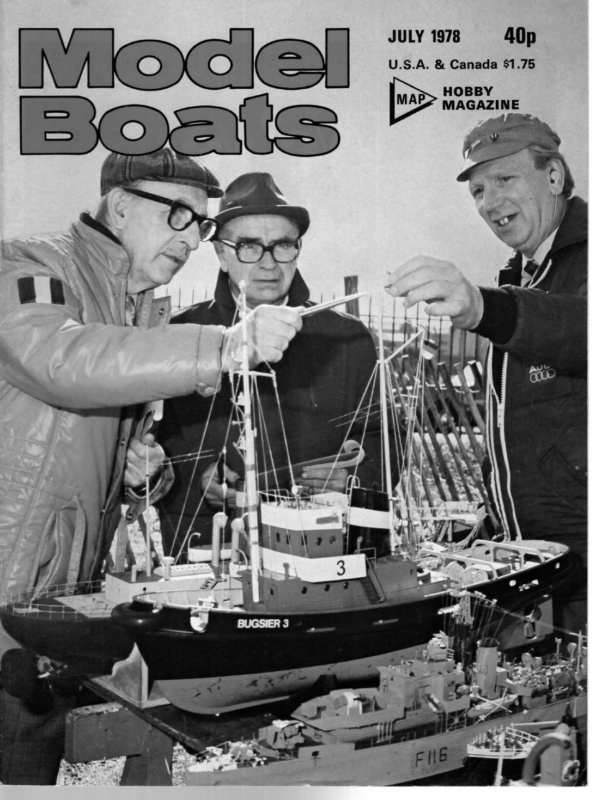
- Oliver J. Lee TRAPPER Radio Marblehead Yacht KIT REVIEW No. 2 by Bob Jeffries
- OUTLAW In Part Six of the series MODEL YACHT DESIGN Charles Robertson introduces his new Marblehead boat
- LOGBOOK Yachting Jottings from our M.Y.A. Correspondent

JULY 1978 40p U.S.A. & Canada $1.75 HOBBY MAGAZINE
Model Boats 396 KIT REVIEW No. 2 by Bob Jeffries Oliver J. Lee reek Radio Marblehead Yacht LTHOUGH the ‘Marblehead’ class has been with us for many years, as a free sailing, vane controlled class, its use as a radio controlled class has only been recognised by the Model Yachting Association for the past 5 or 6 years. In that short time it has become overwhelmingly the most popular class. Interest in the Radio Marblehead, now known as the ‘RM’ class by the MYA has produced many designs, either for home‘construction, or the supply of glass fibre hulls, which cuts out a lot of the most difficult work; later kits were marketed of some very excellent designs, some of these are good, but many leave a Jot to be desired. Recently a full size yacht designer, Oliver Lee of Burn- ham on Crouch, manufacturer of the Squib, a 19ft two man keel boat, offered a semi-scale version of this boat. This was called the Squiblet, and proved to be a very successful ‘RM’ boat with many wins in open competition to its credit.
397 Following the success of the Squiblet, Oliver Lee produced an updated version which he calls the Trapper. He offers this as a really complete kit, containing everything except glue, paint and of course the radio equipment. The hull is supplied finished except for painting. I wondered why he did not offer it in a range of colours. On examining the hull, the reason was obvious. Unlike most designs, the hull is moulded in two halves, split down the centreline. The two halves are joined by the manufacturer and at the same time the fin trunking, rudder tube, chainplates and the two hatches are moulded in. The joint is cleaned off, and the hull needs no further work other than painting. The remainder of the kit is supplied packed in large transparent envelopes. These contain the hull assembly kit, mast assembly, main boom assembly, jib boom assembly, rigging kit, sails, and drawings of each assembly. These drawings, together with the somewhat abbreviated building instructions are sufficient for the average amateur to make up a satisfactory model. One criticism here, why, when the MYA specifications are quoted in inches, must the sail dimensions etc., be given in millimeters. Originally the earlier kits had a wooden fin, later it was amended to a glass fibre version, then the design reverted to a wooden fin covered with a glass fibre skin. My version was this latest type. The lead keel is supplied packed separately, due to the difficulty of packing and transport. It is supplied with a rectangular hole cast in. This hole needs cleaning out with a coarse file to make a tight push fit in the foot of the fin. A generous coating of Araldite on both fin and the hole, and after pushing right home, a hole was drilled through the keel. and a countersunk brass wood screw made everything secure. The underside of the keel was filled July 1978 with Plastic Padding or Isopon. The fin was now shaped to a nice streamline, as shown on the drawings. No attempt was made to obtain a good finish. It will be found to be quite springy. The fin was now covered with glass fibre cloth, resined on. It is surprising how much stiffness this skin gives without adding extra weight. The skin was covered with Isopon filler and rubbed down with wet and dry paper to a smooth finish ready for its final painting. The instructions recommend that the hull is painted with a suitable primer. I used International glass fibre primer, available where International Yacht paints are sold. The hull etc., were rubbed down with wet and dry paper and then painted with International ‘Two Pot’ polyurethane enamel. When it was dry and really hard, I was far from satisfied with the finish. I therefore rubbed it down with fine wet and dry paper until I had a smooth eggshell finish. I could have then polished this, but chose to give it another coat of the International enamel, except this time I thinned it down somewhat so that it flowed easily. This gave me the finish I required, so I passed on to further stages of the assembly. The mast and booms were tackled next. The drawings made everything clear. The mast is in anodised aluminium and is supplied pre-drilled and slotted. The slot for the masthead fitting was cut at right angles to its proper plane. I was able to cut the mast by in. and recut the slot. The manufacturers assure me that this is the first mast to be wrongly cut! The main boom and the jib boom are in anodised aluminium of channel section pre-drilled and formed ready for assembly. The mast fits through a hole in the deck into the fin trunking and rests on a bracket on the front of the fin. Opposite, Trapper shows the way home in our heading picture; bottom layout of all major kit components. Pictures on this page show the bare hull and deck, and various views of the completed model. Note the reviewer’s radio hatch, ex {Ib marmalade lid from a well-known supermarket!
Model Boats 398 The deep fin, I7in. shows in this shot. The lead bulb is supplied separately and is fixed to the ply fin with epoxy and a brass woodscrew. The fin is held by a single screw through the deck. Originally the mast had a jack fitted to its foot enabling the tension on the shrouds to be adjusted. To adjust the tension, it was necessary to remove the mast, adjust the jack and reassemble. This feature is now omitted, in its place are two nicely finished and plated rigging screws or turnbuckles which are fitted to the shrouds. Tensioning is now easy. To dismantle, one just loosens the one screw, allows the fin to drop slightly, enabling the shroud hooks to be undone. This is a simple efficient scheme and assures that the same setting is obtained every time the boat is rigged at the pondside. One set of sails are supplied with the kit, the standard working suit. Three other rigs are available at extra cost, a high aspect suit, a storm suit, and a suit between the storm and the working suit. The sails are by Graham Bantock, a new name to me in sailmaking. They are made in what appears to be siliconised terylene, they are well cut, light, stiff and generally well made. The fitting of the mainsail to the mast is to me, novel. A series of rings are slipped over the mast and tied with thin nylon cord through eyelets in the luff. I found this to be quite a job, the thin nylon would keep slipping off the hooks on the end of the rings. I took the rings off and bent the hooks into small circles, after this the assembly was easy. This unusual method is quite good and over most of the sail area is the equivalent of a rotating mast. The sails took up a very satisfactory shape. The assembly of the boat being complete, I built a box for the radio equipment out of +;in. Perspex, the joints were made using chloroform as a cement. This box contained all the equipment, radio, rudder servo, sail winch, batteries, crystal switch, on-off switch and aerial plug. The box was made so that it just went through the equipment hatch. The radio I used was a home made ‘Microtrol’ which has given me two seasons really reliable operation. The radio was made from a kit which worked first go. The hatch covers are supplied in anodised aluminium. I found it necessary to trim them slightly to make them a snug fit in the moulded recesses. The instructions recommend the use of a one pint ‘Twinco’ milk flask, suitably cut down. I followed my usual practice in using the top 4in. of a Sainsbury’s marmalade tin, together with its plastic lid. This was Araldited into a hole cut in the radio hatch cover. I find it advisable to rub the tin with emery paper to remove the paint, as Araldite will not easily adhere to it. I keep a number of spare lids, so if one is dropped into the pond it is of no consequence. I also happen to like Sainsbury’s marmalade. The hatches are sealed down with a suitable adhesive tape. I had to try several before I found one that was waterproof. The boat finished and ready to sail, with my home made radio gear, weighs just 15lbs. The drawings say an all up weight of 14?1b. so I am not far out. I was unable to check the trim in the domestic bath, as the boat has a draught of 17in. which is too much for my bath. However on the first dip in the pond, the boat floated on its correct waterline. The first few runs across the pond in a fair breeze showed the boat to be quite stable, and I was able to beat to windward without having to keep giving rudder to hold the course. The wind was variable, and during one gust the boat started to plane. I had no difficulty in holding this for quite a considerable distance, then .. . wham. . . the main sheet snapped, and as I had no spare line with me, I had to conclude the first trials. I had used the line supplied with the kit, I replaced the sheets with some ‘Milward’ Searanger line. This is a terylene polyester yarn of 90lb breaking strain. The second trials coincided with a demonstration by the local club to the press. A really windy day gusting up to about force 7. The press reporter was a full size dinghy sailor, and he expressed doubts if we could sail at all. He said he would not venture out in such winds. However the challenge was on, and some quite hairy sailing resulted. The boat repeatedly planed, and at no time was it out of control, then .. . wham again . . . the heavier sheets had now snapped. The problem was the sheets were being cut by the sharp edge of the channel section boom. I had followed the instructions, but obviously a modification was called for. Back in my workshop, I made two small aluminium pieces to fit inside the channel, with the hole for the sheets well rounded off to avoid any further possibility of chafing. Since then I have had no further trouble. The same modification was made to the jib boom, as I found the sheets here were at the point of breaking also. What of the performance? This so largely depends on the ability of the Skipper. The boat will perform well in the hands of a novice, but with a Skipper knowledgeable of the racing rules, and sailing the boat to its best performance, the results can be outstanding. The performance of Trappers in the Danson Clubs annual ‘Frost Bite Regatta’ recently is an indication of what to expect. Trappers came first, second, fourth, and sixth. Four boats in the first six is an indication that this boat has the ability to win when the going gets tough. The Trapper at around £100 is not a cheap kit, but it can give years of pleasurable competitive sailing. Criti- cisms ? Not very much, although I do feel that for a kit of this quality it would be nice if the hull was supplied painted. I know everybody would want a different colour, but if say six colours were offered, even at an extra charge, it would be worthwhile. The total construction time was around 50 hours. This included the painting and rubbing down, and also making the radio box. No special tools were called for outside of those found in most households. It would help assembly if, early in the construction, a suitable stand was made. I find the folding type to be best, as they take up less room when packing the car. Perhaps the manufacturers could include a drawing of such a stand, and let the builder obtain his materials from the nearest DIY shop. The Trapper is made by Oliver J. Lee of Newton House, Park Road, Burnham on Crouch, Essex. Telephone Maldon (0621) 782305. Prices at time of going to press. Complete kit excluding radio equipment, glues, paint and keel, £92.97 plus VAT, £100.41. Keel £5.50 plus VAT, £5.94. Packing and carriage extra.
Model Boats 422 Clive Colsell, left, and Des Daly, sailed Hibiscus and Halo to victory at Marblehead Team Championships, report on page 421. Photo by Clive Colsell. Above, Mike Harris’s veteran Warbird cremated after the 10R Championships, report below. Photo by T. Armour. 1978 10R Championships, Le eds and Bradford MYC, Larkfield Tarn— 25th-27th March Seventeen boats came to the line out of a total of 18. the remaining boat’s skipper having succumbed to a bout of’flu. OOD Dave Hollom welcomed the skippers to the water for briefing, and at 11am the racing was started by County Councillor John Atkinson. The wind was blowing quite strongly over the factory at the far end of the water creating a ‘dead’ patch of considerable size close to the finishing line at that end. It was this area which came to be dreaded by all competitors throughout the whole three days of the race. Any boat sailing into this patch could be almost guaranteed to lose, unless fortune also caused its opponent to sail into the same area. It was on this day that Gordon Griffin from Cleethorpes suffered the Assegai, with a bye to come had only 5 points to sail, for XLCR had 10 and could not be caught. However, Krakatoa was close enough to be dangerous and could possibly make second place. In the event Krakatoa dropped points and finished third. Scimitar was fourth, much to the surprise of skipper Peter Maskell, with several boats only a handful of points behind. Derek Priestley scored a well-deserved and popular victory having sailed consistently well throughout. His boat XLCR, had been very much master of the situation right from the start, and a win was always on the cards. After racing ceased an informal discussion took place in the clubhouse with Mike Harris, Dave Hollom Keith Armour and Derek Priestley sitting in the hot seat answering questions on various aspects of model yacht racing. At 4.45pm as promised, Mike Harris stripped Warbird of fittings, set a spinnaker on a makeshift mast, put her on the water and ceremoniously set fire to her. With a much damaged boat Mike had obviously decided the time was ripe for him to build a new 10 Rater. up as top boat on the Saturday, closely followed by a number of other boats, all well in contention. Notable also was the excellent performance put up by the Newcastle boats, which had seen only a minimum of Priestley also taking away the new Larkfield Trophy for the boat winning the most runs during the race as wellas the 10R Championship Trophy. Gordon Griffin who had had little luck during the race, was given a huge ‘mystery’ prize for last place. When he opened it he found it contained a huge soft toy in the form of a tortoise. One wonders what it needs to make him lose heart, as he remained cheerful even ignominy (as did many others later) of seeing his opponent, Ken Roberts, sailing Boost across the winning line, do a circle, then cross the winning line again whilst his own boat Electric Soup remained immobile well short of the line. Some ofthe older boats in the fleet did well on this first day, notably Jondon, sailed by John Bush, who added steadily to his score during the early heats. Also doing well were Krakatoa sailed by Jan Wheildon ably assisted by his hard working mate John Brooks. Krakatoa ended sailing before this event, all to a design by Derek Greener. An extremely successful social evening was held at the home of Keith and Sally Armour, beer and fish and chips being the main items on the menu. Outstanding resails were taken at 9.30am on Sunday and racing recommenced at 10am with OOD Dave Hollom cracking the whip and getting skippers to the line in very rapid order. Heats were taken at a brisk rate in a wind which remained fresh but unimproved as regards direction. It became obvious at this time that Derek Priestley had the measure ofthe conditions. He remained in his top suit throughout whilst almost everyone else was either in 2nd or 3rd suit. In spite of this his boat, XLCR, never seemed overpowered and was coping with the gusts admirably. Even so, racing remained close, with no one establishing himself as a clean leader. At the end of the first round the scores were as follows: 1 2 3 4 5 6 XLCR Krakatoa D. Priestley J. Wheildon 57 53 Assegai Restinga K. Armour M. Gonzvales 50 48 Warbird Scimitar Boost M. Harris P. Maskell K. Jones 51 45 Racing continued, Mike Harris continued to break kicking straps at an alarming rate, and by the end of the second day Derek Priestley held a small lead with the pack snapping closely at his heels. A number of boats were still in with an excellent chance and interest was still keen. During this day Restinga, a boat from the new Lewis published design, had moved up the list and was showing considerable promise. Racing recommenced at 9am on Monday, with the wind very much as before. Keith Armour made his big effort with Assegai, scored the highest number of points of any boat that day and moved up into second place before lunch. Two heats only remained to be sailed. Prizes were presented at Spm by the Lord Mayor of Leeds, Derek after seriously damaging his boat late in the competition. All competitors seemed to have enjoyed their Easter weekend at the Leeds and Bradford Club. Certainly those involved put a great deal of effort and thought into making it a pleasurable occasion especially OOD Dave Hollom, his officials, and the — as usual — hard-working ladies in the canteen who kept up skippers’ and mates’ spirits in spite of the cold. Pos. Boat Design Designer Skipper Pts 1 XLCR — Shepherd D. Priestley 113 2 = Assegai Eclipse Hollom K. Armour/M. Jew 102 3. Krakatoa Cracker Lewis J. Wheildon 99 4 Scimitar Cracker Lewis P. Maskell 93 5S Warbird Cracker Lewis M. Harris 92 6 Boost Cracker Lewis K. Roberts 89 7 Restinga Synergy Lewis M. Gonsvales 86 8 Jondon = Norton J. Bush 85 9 Blue Gypsy = Greener B. Anderson 78 10 Poppet -— Dovey M. Dovey iid 11 Peddler O/D Greener D. Greener 70 12. Lady Alice Elizabeth Cracker Lewis/Noble R. Noble 68 13’ “SJ 14 Sabre 15 Krakon 16 Electric Soup 17 Taifun Larkfield Trophy ist 2nd 3rd -— Cracker Cracker O/D — Greener Lewis Lewis Griffin Lewis D. Priestley P. Maskell K. Armour A. Tait 61 F. Percival 51 J. Steels 47 G. Griffin 37 Withdrawn damaged XLCR Scimitar Assegai 22 21 20 Brian Barber
423 developments in the lighter displacements, keel con- figurations, etc. (2) Lack of lateral stability of the boat when beating to windward. This means that the lightweight has less tendency to point as high as the heavier displacement type which predominated a couple of years ago, and tends to make a good deal more leeway (the hull appears to skate sideways through the water). To counteract this disadvantage, these planing types of hulls are sailed not pointing as high on the wind, and due to their lighter weight and ability to hold sail well, will more often than not outpace a more conventional design, which although is pointing higher, cannot develop enough speed. An analysis of current designs illustrates that there are at present no ‘displacement’ type hull forms in the Marblehead class, designed to a light displacement (15Ibs or less). I felt that a lightweight displacement type hull, which should exhibit a superior ability to windward, and still, due to its lightweight, be able to hold its own on the other points of sailing, was called for. Looking back through the older designs, before the lightweights became formidable, the most outstanding OUTLAW ny) CHRobertson (&) The Model Maker Plans Service {| meee S88 1 LOA (INC 12″ BUMPER) 5075″ BEAM 97″ In Part Six of the series MODEL YACHT DESIGN Charles Robertson introduces his new Marblehead boat yacht of this period was the Dick Priest Highlander. He succeeded in producing a yacht which could plane most impressively upon an even fore and aft trim, and could also point exceptionally high when beating to windward. My own opinion is that the midship section of any design is extremely relevant to the yacht’s pointing and planing ability, and the Highlander midship section produced an ideal blend of these factors. The Outlaw design was based upon this type of midship section (see articles 4/5) and a load waterline was drawn to hopefully produce a prismatic coefficient of around 0.53. When all the sections were calculated and drawn, the resulting displacement was lower than the required 15lbs (14.77Ibs) as was the prismatic coefficient (0.505). I liked the shape of body produced, so it was decided to complete the hull using these parameters, and use this model as a good starting point for any future developments (Systematic development is required to obtain any useful data for future designs). With the very low prismatic coefficient, the very light weather performance should be good. The reader may notice that the lower waterline is more of a planing type, whilst the LWL FULL SIZE COPIES OF THE PLAN BELOW ARE AVAILABLE get NO. MM 1253, PRICE CODE F, £1.50, PLUS 20 PENCE . & P. EXPORT ORDERS FROM APPOINTED AGENTS, PRICE £3.40 ($5.95 U.S.), OR BY POST (ADD 50% TO ORDER VALUE FOR AIRMAIL) FROM PLANS SERVICE, P.O. BOX 35, HEMEL HEMPSTEAD, HERTS, HPI IEE, U.K. APPROX MAST POSITION J worth ‘considering again, especially coupled with the OUTLAW ig HAVE felt for a long time that altogether too much attention has been focused upon a yacht’s ability to plane, resulting in a subsequent deterioration in other points of sailing and other conditions. I do not mean, however, that the ability of a yacht to plane well when conditions dictate is not an essential feature. It is, but I feel that the trend which duplicates a dinghy hull form (an out and out planing machine with moveable ballast) has now swung too far in this direction. Sacrificing all for the sake of planing results in losses in the following directions. (1) Poor light weather performance. To produce a good light weather boat is a very difficult task, and I am of the opinion that the old ‘duck’ designs of Tucker (especially Jemima) are one of the best light weather boats ever designed. Their heavy weather performance, however, was another matter (the bows were too big), and thus they disappeared from the top class racing scene. Since the designer cannot guarantee what the racing conditions will be like, then perhaps a more all-round design may be July 1978 LWL ed DRAUGHT 155° DISP’14 SECTION SPACING 5° LEAD 9-4ibs. iry4lbs we |SA ba 12 | S3.3×12| 7998 4 { | \ ALTERNATIVE KEEL P| —— SETOUI, TRACED & LETTERED BY DI METCALF PROFILE
Model Boats 424 is tending towards the symmetrical displacement type. It is normally the case for all the waterlines to be of a similar type for any particular design (including and below the LWL), but when investigations were made into the hull balance of this design coupled with the heeled waterlines, this feature does not appear to have any detrimental effect. The immersed areas are calculated mathematically, and give a more accurate assessment than by using a planimeter. The method which I developed for this calculation is included with this article, and I feel it should be easy enough to follow without requiring any subsequent explanation. It saves a great deal of work for anyone who does not possess a planimeter, and I am sure that if had to count up a number of small squares on graph paper, that would put me off yacht designing for life. The movement of the C of B is outside the limits which I set on work sheet 4, and although it was felt that a 0.28°{ movement would have little detrimental effect upon the yacht’s performance, a further investigation into the hull balance was made. This was carried out by (1) a visual inspection of the heeled waterlines (20° angle of keel), and a good degree of balance for a Marblehead is evident from these, since there are no sudden changes of shape (the entrance being similar to the run). The other method adopted as a check is the plotting of the Curve of Augments. (2) This curve is constructed by taking the out-wedge area from the in-wedge area at each station, and expressing each difference as a percentage of the largest difference obtained. These are then plotted upon a suitable scale, and the points are joined freehand (a quick visual check). A fairly symmetrical curve is required, and the one which results from the ‘Outlaw’ design appears to satisfy this condition. We are not trying to be very accurate here, and a rough symmetry is all that is required. A bad balance hull though, becomes immediately evident, as is shown by the curve from a Lowestoft drifter. T 10 é I By I ee | ee. art T t Ait I | heeled), and that the water flow would be smoother around easier lines here (the pressures from the water flowing around the hull can also add to any inbalance created when heeled, and tend to help to create an unbalanced yacht). The keel has been drawn to bring the Centre of Lateral Resistance (CLR) aft as far as possible, and apart from any weed catching, a superior performance should result. I have drawn it with what I consider to be the minimum permissable area, but should there be any lacking in the lateral stability, the width should be increased to that shown as the alternative. Laminar flow sections are used on the fin and rudder, and I have tried to cut down the wetted surface area of the bulb without causing an increase in the form drag. Since the CLR is aft, then it follows that the rig will also be placed aft. This means that there is room for a bigger jib, so I have taken the bull by the horns and increased the jib size, which now exceeds that which is usually considered normal. I have not gone to the extreme, but it is a step, I hope, in the right direction. I have not included a bow knuckle, and the bow height is not so great as some designs have at present. This is somewhat going against the current trend, but I have recently come across information which seems to indicate that the windage of any yacht considerably contributes to the resistance when sailing to windward, (even as much as 50%) so I felt a reduction in this quarter was justified. All the calculations pertaining to this design are included with this article, and the reader should be able to gain from these a good insight into the way to tackle a design of a yacht (I hope!) Summing up, I feel that this yacht should be a good light weather performer, be able to hold its own in heavy weather, and exhibit a good windward performance. The design is well balanced and actually not extreme, so that there is plenty of room left for development. I hope this series has been of value to the readers, and although I have attempted to shed a new (and possibly more complicated) light on the methods available for designing a yacht hull, I feel that it may now be a much easier task for the model yachtman who wishes to try his hand at designing, but never got past the first post. I should be glad to receive any comments upon the sailing qualities of this design (good or bad), and as I have stated previously, should any readers require advice or information upon any of my articles, I will be glad to be of assistance. T In another class of yacht, where the overhangs are not restricted, both the aft part and the forward part of the curve will taper away, but in the Marblehead class, there will always be a preponderance aft. I felt that more harm than good would come from hardening the turn of the bilge towards the transom to reduce the in-wedge (resulting in a reduction of the C of B movement when The S.A. curve below for Outlaw also includes Thief design to be published in the near future. Miax: Sectional Area. (The calculations relevant to Outlaw will be included next month.) another DIAGRAM. 1. 100% ee Cp.= 0-53. 50% (OUTLAV 10 9 SA Curve 8 Z. 6 5 for Outlaw & Thief (M) 2 7 LONG SCALE -2=1
426 Model Boats Yachting Jottings from our M.Y.A. Correspondent Perfect illustration of the use of the starboard tack to advantage by John Cleave as his boat (un-numbered) bears onto a Danson club yacht. Photo taken by Nylet RM event, I4th May, at Ringwood, by Chris Bowler. LOGBOOK OE good thing about the MYA is that the major regattas are mostly settled well in advance, almost all of them for any season being positively arranged the previous May: there may be an occasional date to be con- firmed, where use of a water has to be booked with a local authority etc., but the ‘shape’ of the season is largely definite. This means that clubs can arrange their own fixtures in plenty of time, which they are urged to do, for in making up the full 1979 fixture list the Hon. Sec. will want details by the end of January 1979, i.e. a month earlier than previously. This will enable the list to be sent to clubs well before the first races listed. Confirmation is awaited from Naviga that the proposals for the Naviga/MYA R/C meeting at Fleetwood, July 22nd-28th 1979 are agreed. The 28th is a Saturday, so that if this regatta goes ahead, as expected, the A Class Championship will be starting on Sunday July 29th and finishing Friday, August 3rd. The loss of three hours sailing on the Saturday will possibly need to be made up by sailing an extra half hour each day. Settled so far for 1979 are the following: M Champs. April 14th-16th Leeds & 10r Champs. RM Champs. May 5th-7th May 26th-28th Fleetwood Leeds & Bradford Bradford 6m Champs. June 9th-10th(?) Birmingham M Team June 23rd-24th(?) Birmingham RA Champs. July 7th-8th Basildon A Champs. July 29th(?)-Aug. 3rd Fleetwood RIOR Champs. Sept. 8th-9th Hove A Team Sept. 22nd-23rd Birmingham RM Champions Cup Oct. 13th-14th(?) Birkenhead The 36R Champs. will be at Bournville, date to be fixed, and the Little Portugal Cup at Gosport, possibly during the August Bank Holiday week-end; note, by the way, that by using the new May public holiday, the August one has not been taken up for a Championship. The Model Maker Trophy should be at Poole, but this and a date have to be confirmed. These dates and venues were arranged, as is customary, at the May Council meeting of the MYA, and for the benefit of newer clubs it should be explained that any club wishing to host a national regatta sends a written application to the Hon. Sec. giving the venue and a convenient date. It might be mentioned that it is not essential that a club arranges such a meeting on its own water; where a more suitable water is under-used because its club has manpower problems, a volunteer club could make an approach and if agreement could be reached, offer to organise and man the event on the other club’s lake. This isn’t ideal, but it does spread the load and, importantly in many cases, it keeps activity going on the better water. Most clubs go through a thin patch at some time or other and it is in their long-term interests to keep the water in use. Reports were made at the Council meeting on the progress of various matters, including the Association’s growing relationships with the Sports Council, Central Council for Physical Recreation, and Royal Yachting Association, all of which have entailed a considerable amount of work for the Chairman, Norman Hatfield. One immediate result is an official association between the RYA and the MYA, an indication of the increasing recognition and prestige of model yachting. A significant factor in this is regular MYA participation in the London Dinghy Exhibition, and clubs have agreed to leave this early week-end (the first week-end of Summer Time) clear of races in future, to free more people to help with this exhibition.
427 The MYA will again be at the ME Exhibition, and at the *79 one there will be a competition category for racing yachts of all classes. Support for this will benefit this aspect of modelling. Other news is that MYA lapel badges will be available in the near future, probably about the end of June for the first batch, at 50p each, orders through club secs. please, to the Hon. Sec. Envelopes (9 x 4) carrying the MYA pennant and title are also being put in hand and will be available to any club wishing to use them at £2 per 100, plus post, and investigations are proceding into car stickers. All intended to increase publicity, of course. A couple of rulings will be of interest. A proposal to stamp and date sails was not accepted, and no change will be allowed in the A rules in respect of alternative masts. Sail measurement remains as defined in the General Rules, i.e., Sails must be measured bent to the mast and booms as for sailing and should not be measured spread on a flat surface. And an interesting one — the bumper on a Marblehead must be visible as such; the practice of fairing the bumper into the hull and painting it all the same colour means that a measurer does not know at which point the ies Cate and the bumper starts, so he cannot measure the yacht. Suggestions for a new system of apportioning votes to clubs and changes to the method of assessing affiliation fees were considered but rejected, although the possibility that some adjustment to affiliation fees may well be necessary must be borne in mind, especially in view of increasing costs. The number of affiliated clubs has now reached 69, with four new affiliations. These are Sedgemoor MBC (R. E. Draper, 6 Willow Walk, Dunwear Farm Estate, Bridgwater, Somerset, TA6 SDR), Solent RC MYC (E. Shaw, 21 Leelands, Lymington, Hants., SO4 8EY), Chiltern MYC (D. J. Robinson, Elmcroft, 206 Little Marlow Road, Marlow, Bucks. SL7 1HX) and Moorhen MBC, (W. J. Newman, 39 Park Mead, Harlow, Essex). July 1978 Southern — June 18th, Gosport, A, M & SD Champs; July 2nd, Hove, M, Corporation Trophy; Aug. 28th, Gosport, A, Bilmor Cup; Sept. 17th, MYSA 10r, M & SD Champs; Sept. 24th, Clapham, M, Harris Cup; Oct. 22, Eastbourne, M Team, M & SD Champs. * * * * There seems to have been some discussion recently on the recognition of an international one-design class, and since this is a subject on which most people hold views, it might seem an idea to use this column as a forum for debate. Most of the comment heard so far is critical, and attempts at one-design classes over the past fifty years have all come to naught. However, such classes are in existence in the USA and it seems to be one of theirs, the EC12m, which is being dangled as a possibility. This boat has been in existence for many years and does not seem to have approached the popularity of some other American one-designs; it would be interesting to know the number currently being sailed, as opposed to boats registered but not now used, and the number sailed outside the USA. It has been suggested that the first criterion for an international one-design should be that it has already achieved popularity in several countries, which must surely lead to the thought that it should perhaps be a popular choice in one of the existing recognised classes? The universal class nowadays is the M, and apart from the beginners’ design Genie, which no one would seriously suggest, the most frequently encountered boat, widely used in many countries and already almost a one-design in some places, is . . . well, what do you hink? hy There appears to be a noticeable increase in entries in both vane and R/C races as a result of the League Championship being tried this year, especially in the North. The first break-down for vane points puts Leeds & Bradford in front with 227, followed by MYSA 114, Fleetwood 96, Newcastle 92, Bournville 87, Birkenhead 52, Norwich 52, Danson 31, Clapham 14, London 12, Welwyn 10, Guildford 8, and Southgate 2. However, this will already have changed considerably. One alteration to the scoring is that District team races do not score double points (the winning team scores normal Ist place points etc.) but in the National A & M Championships the points are doubled (1st team 48, 2nd 40, 3rd 32, 4th 24, Sth 16, 6th 8, 7th 4, and 8th 2). Vane races still to come which enable club members to add to their club’s score are: Northern — June 25th, Birkenhead, A, Parks Cup; July 9th, Cleethorpes, M, Parkes Trophy; July 16th, Leeds, A,ND Champs; Aug. 13th, Leeds, M, ND Champs; Sept. 17th, Liverpool, M, Flora Cup; Oct. Ist, Newcastle, 10r, Davidson Shield; Oct. 22nd, Cleethorpes, 36R, ND Champs., Oct. 29th, Fleetwood, 10r, Mayoral Cup. Eastern — June 25th, Doverccurt, 10r, Secker Shield; July 9th, Dovercourt, M, Belton Cup; July 16th, Nelson Gardens, M, Sports Advisory Cup; Aug. 13th, Dovercourt, M, ED Champs; Sept. 3rd, Dovercourt, 10r, ED Champs; Sept. 24th, Norwich, M, Adams Cup; Oct. Ist, Nelson Gardens, M. Boro Cup; Oct. 22nd, Dovercourt, 36R, Lifeboat Pennant. Midland — July 9th, Bournville, A, Open; Aug. 19th, Birmingham, 36R, Lawrence Bowl; Sept. 3rd, Bournville, 36R, MD Champs; Sept. 23rd, Birmingham, A, Plant Cup; Sept. 24th, Birmingham, A, MD Champs; Oct. 14th, Bournville, 10r, MacDonald Trophy; Oct. 15th, Bournville, A, 10r, MD Champs. Metropolitan and Chris Bowler’s camera catches a damp and bedraggled John Cleave making adjustments to his new boat at Ringwood. Note bumber faired into hull and not easily visible for measuring hence new ruling described in text. Perhaps John will invest ina pair of ‘wellies’ one day!