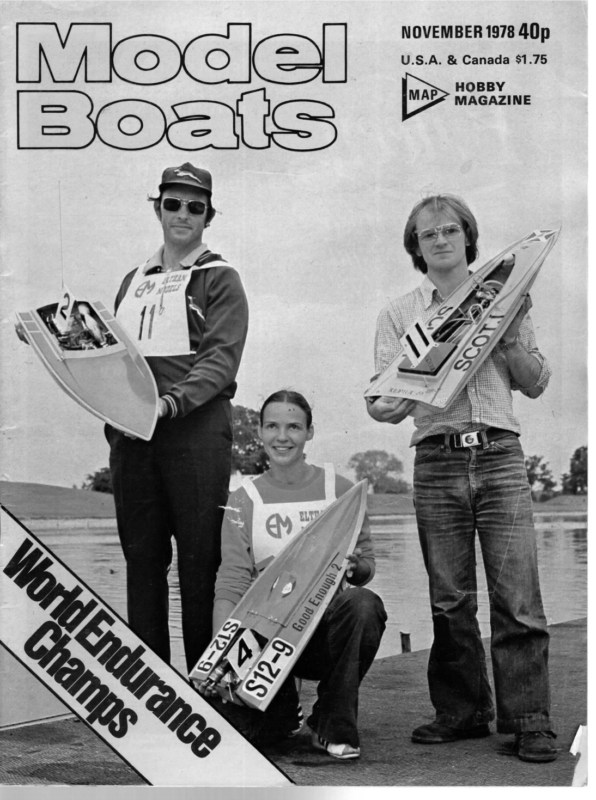
- INTERNATIONAL MODEL YACHT RACING UNION CHAMPIONSHIPS HELD IN DURBAN, SOUTH AFRICA.
- LOG BOOK from our MYA Correspondent
- ROUND the REGATTAS.
- Jim Edwards broaches a new approach to ‘FUNCTIONAL’ MAINSAILS

NOVEMBER 1978 40p U.S.A. & Canada $1.75 HOBBY MAGAZINE
INTERNATIONAL YACHT RACING MODEL UNION CHAMPIONSHIPS HELD IN DURBAN, SOUTH AFRICA, 78 WORLD AMPIONSHIPS i was at a meeting held during the 1975 International Regatta at Gosport that S. Africa, together with W. Germany, applied to host the next World Championships in 1978. All other affiliated countries were subsequently invited to apply but, as there was no further response and W. Germany: failed to confirm their original application, the event was given to S. Africa. At that time, the Durban MY & PBC was the National Authority for S. Africa and the MYA of S. Africa was not formed until the end of 1975 under its President, Mr D. K. Gerson, with Mr K. M. Mackey as Vice-President. Immediately upon its formation, the Association offered to present to the IMYRU a Cup for the RM class to be known as “The South Africa Cup’’ and this was gratefully accepted by the Union. The Deed of Gift is exactly the same as that for the “Canada Cup’’, which stipulates that it must be competed for every two to four years, Eventually, a sponsor was found for the cup, which was generously presented by Gilby S.A. (Pty) Ltd., together with a replica. The MYA of S.A. also presented a replica of the “Canada Cup”’ in accordance with the Deed of Gift. The Durban MY & PBC proved to be an ideal venue for this important event. Their sailing water is approximately 610ft by 150ft., a little narrow for R/C racing, but the lack of wind obstructions and hazards more than compensates for this. It is sited east/west, with prevailing north easterlies from the Indian Ocean, and lies near the shore on the outskirts of the City. The water is brackish and is fed from the Umgeni River which runs alongside the lake. One problem, however, is the strong salty air which can play havoc with electronic components if they are not fully protected. There were originally 31 entries for the ‘Canada Cup’’, but John Lucas of Canada scratched, and Neil Bennell from Australia did not bring his 10-Rater. Of the 50 entries for the “S. Africa Cup’’, 3 scratched, again including the Canadian entry. After the closing date, four additional skippers were allowed to enter from England and one additional skipper from Australia, through the extremely generous private sponsorship from a S. African gentleman in Cape Town. who prefers to remain anonymous. The S. African Government also partly sponsored the remaining entries from England, Sweden and the USA, but Monsieur Bicheron from France and Neil Bennell entered at their own expense, as did Mrs Britte Akesson, the only lady skipper. The proprietors of the Elangeni Hotel, one of the finest in Durban, also generously sponsored accommodation for some of the visitors and members of the Durban Club kindly offered their hospitality to other skippers from overseas. Monsieur Horace Boussy from France, a Vice-President of the IMYRU and always a familiar figure at major Championships, was a much welcomed visitor, in fact he has been such a regular attender for many years, a Championship would not seem quite the same without him. The reigning: World Champion, Lennart Akesson (Sweden) and his wife, Britte, had a disastrous start when their baggage, including the keels of their three boats, failed to arrive at Johannesburg from Copenhagen via Heathrow. Also, Britte lost her glasses and, naturally these misfortunes were most upsetting. Lennart spent the day before racing commenced in making a new keel for his 10-Rater with the help of Des Fairbank, who kindly offered Lennart the use of his workshop. However, this proved to be a wasted effort because the keels and part of the baggage arrived just before the start of the “Canada Cup’’, the remainder not showing up for another couple of days. Mrs Akesson was whisked away to be tested for a new pair of glasses, which thanks to first class service, she was able to collect in time for the start of the “S. Africa Cup’’. So, undoubtedly, Lennart’s performance suffered as a result of these unfortunate mishaps and he did not really show his true form until halfway through the Championships. He was sailing the same two boats with which he won the World Championships at Gosport in. 1975. The opening ceremony was performed on the afternoon of Saturday, Sth August, by His Worship The Mayor of Durban, Councillor Dr G. J. Hollis, when the IMYRU burgee was hoisted on the Club’s flagstaff and the burgees of all competing countries were flown below. The Mayor then started a few boats on a “‘sail past’’, after which he and all the officials were entertained to tea. Incidentally, it is of interest to mention that:Dr ‘Hollis originally came from Guildford and his Deputy, Councillor Joe Ash was born in Blackpool and recalls being taken to the Fleetwood Club as a youngster. 6-16 AUGUST REPORTED BY There follows a daily summary of the racing taken from the log maintained by my Secretary, Mrs Beryl Cockrell. It will be noted that a feature of the Durban weather was the rapid and frequent change of wind direction and strength, quite unlike conditions usually experienced in this country. Although it was nearing the end of the winter season, the weather was predominantly fine and warm, with temperatures in the high seventies at times. “CANADA CUP”’— R10r Class Sunday, 6th August. Weather dull, brighter later. Wind Westerly, light, variable. 29 starters. Schedule consisted of 8 heats, 7 races per heat for 4 & 5 boats and in heat 8 there were 3 races of 7 boats and 1 race of 8 boats. Racing started at 10.20am. Up to heat 2, race 3 at 2pm, in only one race did all boats finish within the 3 minute time limit. A break of 20 minutes was taken for lunch and by 3pm the wind had improved from the N.E., force 2-3. Racing finished at 5pm with wind and light fading. 20 races completed, 6 penalties, no protests. The main feature of the first day’s racing was the outstanding light-wind performance of a few boats compared with the rest of the fleet, many of which did not finish within the time limit. Monday, 7th August. Weather fine. Wind S.W. light, becoming Easterly, force 2. Racing started at 9.25am Close racing throughout the day but the wind began to fail during the last race of heat 6, which took 25 minutes, so at 4pm racing was terminated. 20 races completed this day, 6 penalties, no protests. Tuesday, 8th August. Weather dull. Wind S.W. force 2-3. Racing started at 8.50am. During the morning session the wind was extremely variable in direction, which necessitated no less than ten course changes. Race 3 in heat 8 was hit by a violent squall when the seven boats were approaching the windward mark and caused so much chaos that the race had to be re-sailed, with four boats collecting penalties. By race 4 at 12.25pm, the wind had increased to force 5-6. This completed the first schedule and it was agreed by the Regatta Committee to sail another complete schedule and postpone the start of the “‘S. Africa Cup’’ for one day. The leader at this stage was Squire Kay (England), runner up Barry Jackson (England). The second schedule was started after lunch at 1.30pm, with the wind moderating to force 3-4 and backing South, but by 2.30pm it had again increased to force 6. Racing for the day was finished at 4.30pm to allow competitors and officials to prepare for the Civic Reception at the City Hall at 6pm. Progress had been fairly rapid with 28 races for the day, up to heat 3, race 2 of the second schedule. 17 penalties had been awarded and there were 3 protests, all upheld. Wednesday, 9th August Weather dull with drizzle but soon clearing. Wind S.W. force 1-2. 5 races were sailed in a light wind which failed completely at 10.20am and a halt was called for 25 minutes until the wind came in from the West. but still light and variable. Again, after lunch, there was another delay of 15 minutes during a flat calm and the course was changed to one lap of a simple triangle. By 4pm the wind has freshened sufficiently to enable the “‘sausage’’ leg to be re-introduced, but by Spm it died again and the course was again shortened to a triangle to enable the second schedule to be completed before dark. Thus ended a frustrating windless day, necessitating a predominance of short courses with hardly any windward legs. Nevertheless, a total of 37 races were sailed, during which only 4 penalties were awarded. There was one appeal which was later withdrawn. The final result was that Squire Kay emerged as the new R10r Class World Champion, with Barry Jackson runner up. “SOUTH AFRICA CUP’’— RM Class Thursday, 10th August. Weather fine and warm. Wind S.W. light. 47 starters. Schedule consisted of 8 heats of 6 & 7 boat races, 7 races per heat. Racing started at 9.32am but the first race lasted 22 minutes, with 4 boats not finishing within the time limit. The wind then came in from the N.E., freshening to force 3. After lunch it increased to force 4, giving ideal sailing conditions over a long course with separate start and finish times. A very keen and highly competitive day’s racing which ended at 5.10pm with 26 races sailed, 15 penalties and 4 protests, 2 upheld, 2 dismissed. Tension had been high, with the race
659 judges hard pressed to spot every infringement in the close racing. Friday, 11th August. Weather fine. Wind W. light. A start was made at 9am using a one lap triangle, but by the third race at 9.30am the wind had increased to force 2-3 enabling the course to be changed to Olympic. Neil Goodrich (USA) was obliged to retire for the day with radio problems. By mid-day the wind had backed to S.E. with equal strength. During the afternoon session, a protest against the height of jibstay of Golden Dragon (Neil Bennell, Australia) was dealt with. The yacht was check-measured and found to be correct. Racing finished at 5.15pm in fading wind and light. 28 races sailed this day with 17 penalties awarded and | protest dismissed. Saturday, 12th August. Weather fine. Wind Westerly, very light. Racing started 9am. The last two races of heat 8 in the first schedule were completed by 9.35am. and the second schedule commenced at 9.40. The leading skippers at this stage were Squire Kay, Neil Bennell, Barry Jackson and Charles Reynolds (SA) with Eric Nuttall (England), Pip Allen (England) and Keith Gerson (SA) close behind. x Mr K. Byron (SA) from Cape Province was obliged to retire with radio trouble. At the commencement of the second schedule, the wind came in from the N.E., remaining in this quarter at force 2 until 4.30pm., when it switched to the S.E. at force 3. Racing finished at 5.15pm with 30 races completed for the day, 15 penalties, 1 protest upheld and 1 appeal, subsequently dismissed. Sunday, 13th August Weather fine and warm. Wind N.E. force 2-3. This was an ideal sailing day under perfect conditions, the wind gradually increasing to force 4, gusting 5 in the afternoon. The racing was watched by many spectators amongst whom were a number of full-size yachtsmen. It was noted that in the much higher wind strengths after lunch, quite a few boats continued to carry high aspect rigs. The second schedule was completed by 5.10pm and the first race of the third schedule was taken before racing finished for the day at 5.25pm. There were 16 penalties, 2 protests, 1 upheld, 1 dismissed. By this time the race had clearly developed into a battle for first place between Barry Jackson and Squire Kay, with Neil Bennell, Keith Gerson, Pip Allen, Charles Reynolds, Tim Fuller, Lennart Akesson, Derek Priestley, Alan Fish and Eric Nuttall fighting it out for the remaining six places. Monday, 14th August. Weather much the same as the previous day, with the wind in the same direction but not quite so strong. Racing started at 9.20am, but in the first race there was confusion about a leeward mark and Pip Allen, in the lead at the time, rounded the wrong mark and finished last. The winner, Roy Reynolds, sportingly admitted that he, also, had been confused, although the correct course was clearly shown on the course board. After hearing Pip Allen’s protest, the race judges agreed to give all skippers in the race the opportunity to vote for a re-sail. A paper vote was taken, resulting in a decision to re-sail the race, which was won by Pip. Racing for the day ended at 5.20pm, by which time all competitors and officials were beginning to feel the strain, especially those skippers who had been racing continuously for nine days. 26 races for the day with 3 protests, all dismissed. 1 appeal, later withdrawn. Tuesday, 15th August. Weather cloudy, clearing mid-day. Wind Southerly, force 1 later increasing to force 3 for the majority of the day. Racing started at 9.10am, but without the Assistant OOD, Guy Reynolds, whose wife had unfortunately been taken ill. In heat 6, race 7, Neil Bennell, who was leading Barry Jackson at the leeward mark, had an unfortunate winch failure which put him back to 6th place. In the last race of the day, a protest was made by a skipper who claimed that interference by another skipper on the wrong frequency before the countdown started had resulted in winch damage which he had not been given the opportunity to repair. Although this was impossible to prove, the Race Committee decided to award a re-sail, which was taken first thing the following morning. Racing finished at Spm. 8 penalties, 2 protests dismissed, 1 upheld. Wednesday, 16th August. Weather fine and warm. The final day’s racing was delayed for nearly an hour due to lack of wind. However, a start was made at 9.55am with the re-sailed race, the first two places going to the same boats as in the original race. Wind was very light from the S.E., but by the third race of the day the wind came in again from the best quarter, N.E., and increased to force 3-4, remaining at this strength for the rest of the day. We were glad to be re-joined by Guy Reynolds, who took up his previous position as start line judge. The third schedule was completed at 11.45am and it was then clear that, barring a complete disaster, Barry Jackson would be the new RM World Champion, as he had a clear lead over Squire Kay. It had previously been agreed that racing would end at the nearest completed heat prior to 4pm. Accordingly, two heats of the fourth schedule were sailed by 3.30pm, making 20 races for the day, including the re-sailed race, There were 16 penalties, no protests. This concluded the RM Championship and shortly afterwards the S. African Minister of Sport, Dr The Hon. P. G. J. Koornhof, arrived and was introduced to all competitors and officials. In a final speech, Dr Koornhof said that it was a great honour for S. Africa to have been given the opportunity to host the World Championships and that, as it was the first of its kind in the country, it was an historical occasion. November 1978 After the ceremony, the Minister took Barry Jackson’s transmitter and joined in a demonstration race between the first eight boats. This was followed by tea in front of the Clubhouse and shortly after- wards everyone not concerned with the task of checking scores, preparing the prize lists and writing out Honours Certificates, packed up and left to prepare for the Dinner Dance and Prizegiving at the Athlone Hotel. This was a glittering function presided over by the Deputy Mayor of Durban, Councillor Joe Ash, with the Club’s President, Charlie Cole, as M.C. The Cups and prizes made a magnificent display and in the background two RMs were on show with, as the centrepiece, Charlie’s pre-war ‘A’ Class, built to a design by the late W. J. Daniels. Among the distinguished guests were Mr & Mrs Elton Cheze, representing Gilbey S.A. (Pty) Ltd., who presented the OOD with a handsome digital watch, suitably engraved. The cup winners and the OOD were also each presented with a beautifully made plaque of the coat of arms of the City of Durban. The prizes were presented by the Deputy Mayoress, Mrs Ash and included presentation of gold, silver and bronze medals to the first three prizewinners in each class in both the World and S. African Championships. After the ceremonies, dancing and conviviality continued until midnight, when the final farewells were said. Thus ended a most memorable event for all those who took part and both the Executive of the MYA of S. Africa under its President, Keith Gerson and hard-working Secretary, Mike Colam and the Durban MY & PBC under Charlie Cole and its Commodore, Geoff Mundy, are to be congratulated upon a most successful achievement. As far as the organisation was concerned, nothing had been left to chance. Everything was provided — a daily “‘Courtesy Bus’’ to and from the lake and hotels, driven by Geoff Mundy, transport for the ladies on various shopping expeditions, storage for the yachts with an overnight security guard, a 10ft high tower called the “‘Bridge’’ for the OOD and control, with canvas sides and roof, a caravan loaned by Rothman’s for the Race Organiser, ‘“‘Mossie’’? Morsbach, with P.A. system, a transmitter tent, rescue launch with outboard, a dinghy for placing marks, score, course and notice boards, ‘““Walkie Talkies’? and powered megaphone for the Buoy Judges and catering laid on by the Athlone Hotel. Obviously, a tremendous amount of work had gone into the preparations and the volume of correspondence alone, between Keith Gerson and myself, had been phenomenal. Congratulations, then, to all concerned and I wish to pay tribute to all those who did all they could to lesson the OOD’s burden. My grateful thanks then to all the following: To my Secretary, Beryl Cockrell, who spent all 11 days on the “‘bridge’’ recording the scores and passing them to Mike Colam below, who put them on the board. As already mentioned, Beryl kept a daily log of each race, which has proved invaluable in compiling this report. To my Assistant, Guy Reynolds who, incidentally, is President of the YRA of 8. Africa and who was untiring in his efforts at laying the courses and was a power of strength in dealing with protest cases. To ‘ Mossie’’ who, as Race Organiser, was always on hand when wanted and who also took his turn as start line judge. To Ray Cockrell and Bill Reynolds in charge of the transmitter tent and who, together with Cecil Gurney, the Boat Marshall, kept the rotation of races going like clockwork. To Mike Colam who, as Secretary, bore the brunt of all the preliminary correspondence and patiently stood by the scoreboard throughout the Championships. To the various Buoy and Finishing Line Judges who did a great job in spotting infringements and making some difficult decisions, in particular Bertie Carr and Andy Stoner who stuck to their task with no relief for most of the time. To the Countdown operators and especially Fred Leveridge who pressed the buttons for 7 days continuously and to Mrs Leveridge for kindly supplying the bridge crew with tea and cakes twice daily. Lastly, to Garth Thompson, the Official Measurer who, in addition to competing every day, had the onerous task of check-measuring two boats daily, which was indeed a great effort. In summarising my final thoughts on the Championships, I would say that the winners and runners up in each class sailed superbly, with maximum concentration. They were nearly always clear of the ruck at the start and their tactics were faultless. The winning designs, Squire Kay’s R10r ‘K9’, which is a stretched Mk. 3 ‘Seahorse’ and the RM Mk.3 ‘Seahorse’ itself are undoubtedly highly competitive in the wind strengths experienced at Durban, but exactly how much of their performance can be attributed to the skippers’ abilities is, of course, difficult to determine. Squire Kay and Barry Jackson may have had equal success with any of the top eight boats in each class. Their own boats are rigged and fitted to an extremely high standard, with beautifully cut sails and these are important contributing factors to their success. Their close attention to minute detail certainly reaped the rewards and must be a lesson to those who aspire to success in International competition. But other designs showed well; in the R10r Class, Barry Jackson’s ‘Eclipse’, designed by Dave Hollom, the two Squire Kay designed ‘Sea Kings’ sailed by Eric Nuttall and Keith Mackey, who finished 3rd and Sth respectively, the Nylet ‘Pacemaker’ sailed by Charles Reynolds and the “‘one off’’ Oliver Lee design, ‘Squiblet Ten’, sailed by Pip Allen, who did very well in both classes considering he had not raced the boats at all before the event. All these designs, in the right hands, are very competitive. In the RMs, Neil Bennell looked a likely winner at one time. His ‘Golden Dragon’ is a modified ‘Magic Dragon’ from America, with panelled lightweight Dacron sails by Black and thin section mast. This boat was extremely fast in light airs and carried her high aspect rig
Model Boats Top left, Keith Gerson, S. African MYA President checks over his 247. Keith sailed well with a perfectly finished and tuned boat and came 4th in the RM’s. Top right, high spirits towards the end as Squire Kay, winner RIOR and 2nd RM, gives Pip Allen and his Mk Ill Trapper a lift to the start line. Left. Pip finished 5th in RM’s. Right. Ray Cockrell of S. Africa. launches his 247; note panel sails made from ‘Model Boats’ article, page 452 August ’76. Ray’s wife Beryl worked very hard as Norman Hatfield’s secretary in the judges’ rostrum, Below left. Keith Mackey of South Africa sailed his Mk, || Seahorse in the RM’s. Below right. Allan Fish, with his Australian 247 which featured double luff jib over 2in, tubing. Bottom left Barry Jackson with Mk I/l Seahorse prepares to enter the next race with Lennard and Breta Akisson behind. Bottom right, six boats line up ready for a start. In the front is Gareth Thompson, the meeting’s measurer. Pictures by Tim Fuller
661 well in the higher wind strengths. Keith Gerson’s Chris Dicks must be the best boat ever built to this and sailed extremely well with great concentration. new Mk, 3 ‘Trapper’ which had been launched ‘247’ designed by design, very quick Pip Allen had the only a fortnight previously. This is a somewhat slimmer version of the Mks. 1 & 2 with a slight chine on the quarter. To what extent it is an improvement is not yet fully apparent, as the Mk. 2 version sailed by Tim Fuller finished only 10 points behind, but it is very competitive and could no doubt be improved with more tuning. Charles Reynolds seemed to get new life out of the Mk. 1 ‘Seahorse’, still a difficult boat to beat when well sailed. Eric Nuttall and Derek Priestley, both with Mk. 3 ‘Seahorses’, would have finished higher up the order, but they accumulated, for them, an unusually large number of penalty points. Neil Goodrich, sailing a boat of his own design, suffered from radio trouble earlier in the race and never really recovered. His boat seemed to be going well at times but could probably have done with more wind. In the R10r Class, displacements ranged from 16 to 264Ibs, waterlines from 494in. to 674in. and in the RM Class displacements averaged 17lbs, ranging from 14lbs to 2141bs. So, altogether it was a Squire Kay benefit and he deserves the highest praise for outstanding performance and technical ability in sailing and design and in all aspects of boat construction and rigging. Noe repent the cry that went up after each race he won — “‘Up the orth!’’ I think some comments about the Racing Rules and thoughts for the future may not be out of place. The 1975 edition of the MYA Racing Rules was used with two modifications. Firstly, penalty points were cumulative, that is they were totalled and deducted from the final scores but, at the same time, the Regatta Committee decided to retain retirement after a second penalty in any one race, with no finishing score. This imposed a very severe penalty indeed for a second infringement because, for example, a leading boat in a 7-boat race which collected two penalties could stand to forfeit not only the 14 points she would otherwise have gained for a win, but would have 14 points deducted from her final score. However, this system is unlikely to be used again in future because, under the new 1978 rules, there is no limit to the number of penalties that a boat can accumulate in any one race, without retirement. Secondly, the procedure for lodging an appeal was adopted from the 1978 rules and, although there was, in fact, only one appeal, the system worked well enough. Under the 1975 rules, tacking or gybing within two boats’ lengths is an infringement and this did cause a few problems, which would not have occurred under the new rules, as this is allowed provided that the tack or gybe is completed before the yacht on a tack does not have to begin to alter course before the tack or gybe has been completed. _ The only other real problems encountered and concerned with judging were sorting out infringements in a massed start and determining the establishment of overlaps, particularly when several boats were approaching a mark together. This is where Buoy Judges proved their worth for, on the long courses used at Durban, it was impossible to make judgements from the control position alone. It is essential, however, to have the most rapid communication between the Judges and the skippers in the race, otherwise delayed decisions can only cause great confusion. The long courses employed in the “S. Africa Cup’’ with separate start and finish lines, which gave a high percentage of windward work, proved popular and abolishing the 15 yards limit either side of the control position and allowing skippers to walk the whole length of the course, caused absolutely no problems, which is contrary to some previously held views on the subject. The new schedules devised by Frank Walker of Poole MYC, which are based on the heats system, were entirely satisfactory and would appear to be the fairest that can be produced. We are grateful to Frank for the vast amount of time and effort expended on drawing up these schedules earlier in the year. Generally, the calling of boats for each race worked very smoothly and towards the end of a race in progress, boats for the next race were in the water awaiting the word to switch on. If any boat was not ready when this signal was given, her skipper was allowed two minutes before the countdown started, so that there was the minimum delay between races, except for a few cases of radio interference which were quickly dealt with. Two observations are, I think, called for. Firstly, very few of the competing yachts carried racing flags in accordance with the rules, although all the English boats did. When used as a wind direction indicator, a racing flag can be a valuable aid ina light, variable wind, especially as the wind the boat feels is not necessarily the same as that felt by her skipper and it is strange that they are not more widely used. Secondly, there was considerable inconsistency in the size of class marks and registration numbers and in some cases the letter ‘R’ was missing in front of ‘10r’ or ‘M’. There is really no excuse for this because the correct lettering and numbering, together with precise measurements, are clearly stated in the rules. It is recommended that the IMYRU should consider introducing legislation to cover certain points arising from these Championships: 1. A more realistic closing date of entry should be set and change of boat entries after this date should not be permitted. 2. Limitation of entries from the host country is desirable and it should be possible to “‘seed’’ these entries. The “‘tail’’ in both classes at Durban was unreasonably long. 3. It is not recommended that a World Championship should include a concurrent “‘internal’’ National Championship, which only serves to complicate the proceedings. 4. There should be a lower age limit for competitors — 16 years is recommended. November 1978 5. A time limit should be set to permit the cancellation of a race in the event of complete wind failure, provided no boat has crossed the finish line. 6. Minimum frequency requirements should be imposed for bands additional to 27 MHz. On a personal note, I would like to say that I found my duties as OOD in these World Championships a most rewarding experience. It was not without its problems, but an OOD must expect them and realise that he cannot please everyone all the time. It was all worthwhile for the lessons learned alone. Socially, the event was a huge success and was not without its lighter moments when, for instance, one afternoon the lady spectators, who were sitting under palm trees on the Umgeni River Bank, were being treated to a horrifying account of an Indian boy being devoured by a crocodile a few miles upstream about three years ago. Suddenly, there was a rustling in the bushes and immediate panic, but who should emerge but Monsieur Boussy! My wife and I were generously entertained on no less than three occasions by Charlie & Cynthia Cole and we were taken on conducted tours of Durban’s famous Point Yacht Club (2,500 members) and the Royal Natal Yacht Club. They also took us to see Howard College, which stands high above the City and was built by the well-known pre-war yachtsman and S. African financier, Mr T. B. F. Davis, in memory of his son, Howard Davis, who was killed on the Somme in the 1914-18 war at the age of 21. “‘T.B.F.’’ was the owner of the famous ‘J’ Class schooner ‘Westward’ and older ‘A’ Class Model Yachtsmen may recall that it was Mr Davis who presented the YM6-m. Owners’ Association at Hampton Court with their Clubhouse in about 1930. The Club was the original home of the ‘A’ Class which, in those days, was known as the “Yachting Monthly’’ 6-Metre. It was a strange feeling to see the name of Mr Davis recorded on a plaque so far from home, In conclusion, we are most grateful for all the kindness and hospitality shown to us during our visit to South Africa. Pl. 1 2 3. 4 5 6 “SOUTH AFRICA CUP” – R. MARBLEHEAD GLASS Skipper Yacht Country Score Design B. Jackson Kalmari ll England 347 Seahorse Mk 3 S. Kay TC4 England 333 Seahorse Mk 3 N. Bennell Golden Australia 321 Magic Dragon Dragon mod. D. K. Gerson P. W. Allen T. Fuller 7 C.L. Reynolds 8 E. Nuttall 9 L. Akesson 10D. Priestley 11 12 13. 14. A. Fish D.J. Fairbank R.K. Reynolds W.K. Mackey Enterprise Trapper IIT §. Africa England 318 298 288 Trapper Mk. 2 S. Africa England Sweden England 287 275 269 268 Seahorse Mk | Seahorse Mk 3 Own Seahorse Mk 3 Envy S. Africa Green BananaS, Africa Rapier S. Africa 258 256 255 Ashanti Pterodactyl Seahorse Mk | Nookie Bear II Explosion Red Rum Don’t Touch Smurf Harlequin England Australia 263 247 Trapper Mk. 3 Aust. design SOUTH AFRICAN NATIONAL CHAMPIONSHIPS R10r Class 1. C. L. Reynolds 2. K. M. Mackey 3. B. K. Rich RM Class 1. D. K. Gerson 2. C. L. Reynolds 3. D. Fairbanks PROVINCIAL CHAMPIONSHIPS R10r Class RM Class 1. C. L. Reynolds Natal 1. D. K. Gerson Natal 2. F. Rip Cape 2. G. Norris Cape 3. K. M. Mackey Transvaal 3. R. K. Reynolds Transvaal “MODEL BOATS” INTERNATIONAL TEAM CUP For the highest combined score in both classes of any one country. Won outright by ENGLAND – (Jackson/Kay) The “GEORGE” TROPHY presented by MODEL MARINE PRODUCTS For the highest placed Transvaal skipper not in the RM Class Team. Won by D. C. Stedall. “SABATA” (‘“FUTABA”’’) TROPHY For the first S. African skipper using Sabata radio in the RM Class. Won by D. K. Gerson PRIZE For the skipper with the highest number of penalties in both classes. Awarded to Mike de Lange “CANADA CUP” — R 10-RATER CLASS Pl. Skipper Yacht Country Score Design 1 S. Kay K9 England 168 Own 2 3. 4 5 6 7 8 9 10 11 12 13. 14 B. Jackson Eclipse 162 Eclipse Jelly Bean Australia Look Ahead Sweden Baba S. Africa 125 125 124 Aust. design Own Cracker Nookie Bear England 100 Eclipse +E. Nuttall C.L. Reynolds K.M. Mackey P.W. Allen OD. Priestley B.K. Rich R.P. Abel Andy Capp Sigidi Scimitar Squiblet Ten Mynzapint Tudor Blue Yellow Deg A. Fish L. Akesson R.K. Reynolds T. Fuller B.R. Young : Hustler Four England England S. Africa S. Africa England England §. Africa S. Africa S. Africa 151 142 134 132 131 129 126 102 Sea King Pacemaker Sea King One off As K9 Pulsar mod. Pterodactyl stretched Synergy
Model Boats 662 K | O BO LOG from our MYA Correspondent : Ten raters at the Andover Sail In, Cirencester (see ‘Round the Regattas , page 670) actually managed a proper start in the calm conditions, but notice that none leaves a wake, Tony Abel’s new Scimitar is nearest camera at left. Pictured left is Mrs Marion Fuller giving winner of RIOR Tim Fuller’s boat, a pre-race warm-up. Photos C. Bowler O surprises came out of the IMYRU General Meeting held at Gosport during ‘A’ Class week, except perhaps in the election of officers. Changes to the Constitution created the position of Chairman of the Executive Board, charged with the day to day running of the Union, and Norman Hatfield was unanimously voted into this position. In place of Fritz Jacobsen, forced to resign as President by ill-health, we have for the first time an American, Byron Sansom, who is a member of both MYRAA and AMYA, and who for the last two years has chaired the AMYA sub-committee seeking to establish a USMYRU embracing all American yachtsmen, which could be affiliated to the IMYRU. Norman Hatfield’s becoming Chairman leaves vacant the post of R/C Secretary, Europe, which he had so admirably filled. The new occupant of. this position is Dave Knowles, Birmingham club Com- modore, and the new incumbent of the post of R/C Secretary, Rest of World, is A. Farmer of Canada. There are no other changes in officeholders, and Ken Roberts continues as Secretary/Treasurer. Fritz Jacobsen was elected a Vice President in recognition of his past work. The foregoing, as most newsworthy, is taken out of order, since it was in fact Item 8 on a fairly lengthy agenda. Points in particular include the raising of the annual national affiliation fee from £5 to £10, as from 1st January 1979; minutes of all Executive Board meetings to be sent to all member countries will bring home the necessity for this. Prompt payment, by 15th March each year, will ease the financial position; at the date of the meeting, eight countries were currently in arrears (one for two years) and thirteen were in arrears over the small levy on registered boats. This levy adds a small amount to income but also affects the number of votes allocated to each country. Ottawa will be the setting for the next IMYRU R/C World Champion- ships in 1980 (classes RM and R10R as usual) and the World Cup for ‘M’ Class (vane) will be at Christchurch, New Zealand, in 1979. (A condition attached to this cup is that it should alternate between hemispheres). A review of the Constitution is to be undertaken; the current one was introduced comparatively recently and sufficient time has passed to expose those areas requiring more comprehensive wording. Interest in affiliation has been expressed by Brazil and Spain. * ok * * Points from the September MYA Council Meeting cover a variety of subjects, and full details will be in the hands of club secretaries in the normal way through copies of the minutes. It was a long meeting, but some of the more important decisions are, briefly, as follows. Car stickers will be available by the time these notes are read, price 20p inc. post from Roger Stollery, 6 Little Tumners Court, Ballfield Road, Godalming, Surrey. Clubs ordering in bulk (min. 20) will attract a discount. The stickers are approx. 14 2in. on the usual soft film which adheres to clean glass simply by excluding air. Lapel badges are also in hand and details of availability should be announced shortly. The MYA/Naviga R/C meeting in July °79 at Fleetwood will be open to members of any recognised club; entries are required by Ist March (through club secs.) and depending on numbers, applicants will be notified as to whether their entries are accepted, by Ist April. Forms will shortly be available from John Cleave (3 Laverton Mews, London, SW5) who is handling entries. On 13th May next there is a oneday Watersports Exhibition at Picketts Lock (London N39, just north of the North Circular Road where it crosses the Lea Valley) which is in addition to the usual Dinghy Exhibition. There is a strong possibility of water becoming available for regular model yacht sailing in the Lea Valley scheme, and any club can put on a static show there on 13th
November 1978 663 May — space is almost unlimited and free. Surely an opportunity for any club within, say, 20 miles of Pickett’s Lock? There will be R/C sailing demonstrations on the small pool. Roger Stollery is liaising. Talking of facilities, an offer has been made by the Sports Council to allow the MYA the use of national training facilities at Windermere and Holme Pierrepont, Nottingham. This is being looked into, but in the meantime, the fabulous water at Holme Pierrepont, or at least a part of it, can be used officially on Sunday afternoons from October to April. Contact E. Berthon, 3 Glade Avenue, Wollaton, Nottingham, NG8 1HN, who should be able to put you in the picture. Useful ‘A’ Class tables and a graph, helpful to club measurers, are available from Norman Hatfield, price £2 per set. MYA R/C Secretary Ted Gearey will be resigning at the end of the year, after seeing the new R/C sailing rules finalised. He’s done a fine job, and should have made life easy for his successor. It’s not too early to start thinking about nominees. Finance occupied much of the meeting, particularly the need to increase income to keep pace with ever-rising out-goings. Some officers already subsidise the Association as far as postage and telephone bills are concerned, which may be all right up to a point, but is not really fair and certainly not what they were elected to do. Club subscriptions up to £5 plus 50p a member does not seem too much of a hardship (remember that nowadays £5 is about two hours’ work at national average wage — not much for an annual subscription?) though possibly more controversial is the proposal to charge a £1 registration fee per boat. No doubt we shall also hear more (at the AGM?) on the proposal to raise entry fees to £10 for the ‘A’ Class Championship and £5 for other National Championships, £1 of which will be paid over to central funds. It is reasonable that those who do the sailing bear the heaviest expense, but is it the race was agreed on. One small alleviation is that copies of rating certificates are no longer necessary with entries, on the grounds that the class registrar will have checked the figures; it will, however, be necessary to produce a certificate before the start on the day of the race. The sub-committee set up to deal with queries in rule interpretation had been asked to look into sail measurement, and reported that the practice of measurement with the sails rigged on the yacht should be followed, which is basically what the rules say. Some clubs measure the sails laid out on a table top and are not convinced that measuring them rigged is desirable, though it would seem. logical to measure them under the conditions of use. In this connection, with more bendy masts appearing, a proposal was made to require a measurement taken at half-mast height to be recorded, thus influencing the amount of area ee might be gained in a curved luff. As a personal comment, it would be nice to impose the four-year moratorium intended for the R/C Racing Rules on all MYA tules. At present one has the impression of continual tinkering. Is this because modern skippers are less concerned with the spirit of the rules, or because technological advance is so rapid, or because the influence of the bureaucracy-laden world in which we live is such that legislation is needed for every possibillty, whether likely or not? Certainly it is unlikely that more than a handful of MYA members have fully up jo date rule books! ok her f A660 YEADON —® AIRPORT RAWDON TARN. STONE TROUGH PUBLIC HOUSE. not ship, which costs a modest £2 p.a. will shortly be distributed to club secretaries. Some criticism was expressed at the very early entry requirement for MYA events, but six weeks ahead of Nothing has come in regarding the Naviga World Championship meeting in Italy, though we believe that the RM winner was a French boat to a design by an American called Grant, living in Paris. Apparently this is a boat of only 12-2lbs. and 144in. draught with a very rearward maximum beam and wide transom; possibly we can show a sketch and photographs in the next issue. Finally, our request for details of club waters and when members are present, to encourage potential mem- bers etc. to visit, drew one solitary reply, and as might be guessed, this came from the very keen Leeds & Bradford club. The accompanying plan shows the site, which is very near Yeadon airport; the water is leased by the club and sailing is restricted to members only. With the lake divided into two, vane and radio races often occur simultaneously. All vane classes are sailed, radio is mostly RM, with a growing number of R10Rs and the “threat” of RAs in future. The boathouse is open most Saturdays and every Sunday and there is racing every Sunday. Visitors and new members are always welcome and advice and assistance are available for the asking. For further information, the Commodore is F. Maskell (Leeds 566880), Sec. B. Barber (Leeds 866011), Vane Sec. K. possible that the number of skippers who enter without any hope of making the top half-dozen will dwindle if entry fees are too high? A further scheme to augment income is to extend individual memberand has the advantage that individuals receive their own copies of minutes of meetings. Forms to make the application procedure simple Latest figures to hand for the vane league championships (early September) show Leeds & Bradford in a very strong position with 868 points, with runner-up Fleetwood on 685. Other scores (some results are still awaited, so there’s still a lot of time for alterations). 3. Bournville 476, 4. Birkenhead 462, 5. Guildford 433, 6. Gosport 389, 7. Danson 323, 8. Cleethorpes 265, 9. Newcastle 242, 10. Clapham 208, 11. MYSA 116, 12. Hove & Brighton 91, 13. Dovercourt 89, 14. Southgate 77, 15. Wicksteed 76, 16. Nottingham 74, 17. Southampton 66, 18. Welwyn 62, 19. Norwich 52, 20. Basildon 46, 21. London 41, 22. Birmingham 29, 23. Eastbourne 9, 24. South London 1. New club is Herefordshire MYC, sailing RMs on a weed-free pool courtesy of Bulmer’s cider makers, and with a stand-by being negotiated for. Sec. is C. T. Davies, West View, Sugwas Pool, Hereford, tel. Bridge Sollars 259. SEC: B. BARBER. LEEDS 866011 COMMODORE: >I MASKELL LEEDS 566880. LEEDS & BRADFORD MYRC. Armour (Leeds 582938) and R/C Sec. D. Hollom (Bradford 492742). Your club can get valuable free publicity of this type — it only needs similar information sent to the MYA Correspondent, c/o Model Boats. Wonder not at the transformation of L & B in the last three or four years — go thou and do likewise!
Above. C. Blackie proudly displays winnings gained at Bournemouth with his Waveney lifeboat Open Scale Regatta. 6th August, Bournemouth and Poole MPBC In the first Open Scale Regatta held by the club the number of entries amounted to approximately 40. The standard of boats was very high, ranging from warships and liners down to lifeboats, trawlers and tugs. Trophies were presented to the first three in each class which was closely contested, and it proved to be the navigation which tipped the scales at the end of the day. Results: Class A — 34in. and over. Ist C. Blackie Home Club Waveney Lifeboat 2nd 3rd S. Harris C. Bishop Class B — under 34in. Ist T. Andrews 2nd S. Kirby 3rd S. Kirby . Andover Berrylands Steam Drifter Liner-— Dunnotar Castle Berrylands Berrylands Berrylands HMS Aubretia USS Katahdin Chuchow Tug ‘ 2 S. Clegg RA National Championships, Poole Model Yacht Club, 15/16th July’78 For 1978, the host club was Poole MYC and the OOD appointed by the MYA was Ted Gearey who is, of course, Radio Secretary of the MYA. The final entry consisted of 22 boats from Fleetwood, Basildon, Gosport, Woodspring and Poole MYC’s and there were no withdrawals. Racing was scheduled to commence at 10.30am with the Mayor and Mayoress of Poole honouring us with a formal start to the event at 10.20am. Our Commodore, Alan Drake, welcomed the Mayor noting that his other official title was Admiral of the Port of Poole more appropriate perhaps in this particular sport. The Mayor responded with a short but apt speech and then the Mayoress was presented with a bouquet. There was one entrant from each of the Gosport, Woodspring and Bolton clubs, two from Basildon and the remaining 17 were from Poole (but several skippers belonging to Woodspring and Gosport as well).
Len Thompson with his Arabesque design Jenny, RA winner in 1976 and 1977, but out of luck this year at Poole when he was 7th. Photo, T. Reece Humbrol Let’s face it:- Those makeshift tools which seem so handy and are sometimes very useful, have their limitation. They can make an easy job hard…. a hard job harder…. and even ruin a model. That’s where Humbrol comes in. The Humbrol craft tool and its range of versatile blades not only does away with those makeshift tools used by many modellers, it gives you the right tool for the right job at the right time. The range consists of the basic craft tool handle manufactured from precision machined aluminium, with a unique locking system for gripping and stabilising the blades, a selection of 7 blades, a razor saw, file and tweezers. All are available individually or as part of two specially designed boxed kits. The Highlander was most in evidence with two Saxons, Swara and Andrea, a modified Saxon Pele, Roger Dehon’s own design Mimi and Len Thompson’s Jenny. Oliver Lee’s Natterjack was of his own (unpublished) design with the following measurements:- LWL 52in. sail area 1,414 sq. in., and weight 45lbs. The customary raffle was augmented this year by the donation of gifts by Mrs Roy Stevens, Mrs D. Ellis and Mrs Cyril Merrick and CUTS The high tensile carbon steel blades have been deeply ground to givea finer cutting edge – making cutting and scoring much easier. SAWS The standard blade _ (illustrated) fits the craft tool handle. The razor saw, ~ with integral handle and negative rake tooth cuts balsa without clogging. FILES A half round, pointed file thatis equally effective on wood, plastic or metal gives a clean neat finish. CARVES The specially honed cutting edge gives maximum ease of penetration, just right for carving and paring. (RARARS ARARS Separate winches working in unison were used for jib and main although some variation in independent sail setting could be obtained. An impish SE wind of only strength 1 to 2, under a grey sky, caused a great deal of wind searching around the standard Olympic course and no doubt those skippers who had treated themselves to new top suits were busily congratulating themselves with the light weather conditions. Indeed, these conditions subsequently prevailed over the weekend with a reversal of both wind direction and course during the latter part of Sunday morning and with some freshening of the wind towards the end of the racing. However, top suits were the order of the day and there was never any hint that a change down might be necessary. Racing was to the trial IMYRU rules including the much disliked penalty system with negative scoring. As previously reported, this system can penalise a skipper who enters for a race more so than fora skipper who cannot compete because of some technical failure. Undoubtedly the new rules produced far more protests at the OD’s penalties than would have been the case under the old rules, such items for example as ‘overtaking boat’ having no meaning or significance under the new rules. Because of this aspect, it may have been wiser to have sailed under the old rules, thus allowing all clubs to practice the trial rules for the whole of this season before the changeover. Added to this of course, in light airs there is a greater tendency for boats to remain in close proximity, leading to more collisions because of the slower response to helm. Nevertheless, there was some extremely fine racing with 15 of the 22 boats actually winning one or more of the 44 individual races. By the end of the first day, the first schedule of 22 races had been completed and also the first four of the second schedule. Our radio secretary, Peter Wiles, assisted by Brian Askell, had specifically allocated frequencies to avoid splits but even so there were a few delayed starts with interference, including on Sunday an R/C chopper who was obviously flying at his peril. Eventually the second schedule was completed by 4pm with no sail off’s being required. Then began the long job of completing the scores by the deduction of penalties and addition of bonus points and so we eventually determined that there were five leading positions without the necessity for any sail-offs. The presentation was made by Mrs Len Thompson, whose husband had been RA champion in 1976 and 1977, and assisted by our Commodore. The first prize, over and above the actual trophy of course, was an engraved neo-replica; second and third prizes were engraved plaques whilst fourth and fifth prizes were respectively a large and small dolphin from Poole Pottery. The MYA honours certificates were also presented with the prizes. The presentation included an engraved ‘pot’ for the OOD and the opportunity was taken to thank all those who had contributed to organising the event. A signed anniversary card was presented to our former Vice Commodore Frank Walker who celebrated his Sist wedding anniversary on the Sunday, and reference was also made to Mr Jack Gascoigne, our former Commodore who passed away earlier this year and who had won the RA National in the past with his boat Jaquita, now sailed by Peter Wiles. TRIMS » The Humbrol craft tool is the ideal instrument for removing parts from ‘sprue’ in plastic kits, where clean and accurate trimming is necessary to produce the exact ‘fit’ of the various component parts. Craft tools
Model Boats 672 the resulting sales of tickets by Mrs Pam Reece produced a most handsome addition to our funds. Catering throughout the weekend was provided by the same six ladies as usual and again their splendid culinary efforts produced a good financial return, much needed towards our heavy maintenance commitments. Because of the combination of weather conditions and trial rules. this was a particularly difficult event for the OOD Ted Gearey, and perhaps the appointment of a chairman for the race committee may have helped, but these things are inevitably seen after the event. Skipper Yacht Points Pos No. of Firsts O. J. Lee B. Askell Natterjack Pele J. Ellisson P. Wiles R. Dehon M. Franklyn L. Thompson T. Reece N. Crayman J. Cleave N. Hatfield 128 120 Pippin Jaquita Mimi Jacete Jenny Swara High Priest Boadecia Serica P. Perrett 7 4 4 3 3 4 1 y: 59-2 55:2 53:2 13 14 15 1 1 1 17 18 Intrepid Brigand Larbalur Sea Mist N. Grinter B. Varker Lady Bee The Lady 34 32 Ann Marie The John Merrick Pat Assegai 30-4 30 24 63-2 Andrea D. White 36 Asterix R. Stevens C. Brazier C. Merrick 5 5 3 4 5 6 7 8 9 10 11 S. Ward A. Stevens M. Varker C. Poulton 1 2 102-4 100-8 96:8 93-6 91-6 90:8 86 81-2 78-4 32 12 – 2 _ – Max. points poss 158-4 * 44 * support: Leigh Model Centre, S.H.G. Marine, Racing Models, and A.M.P.S. David Handley * Cygnets, Maidstone Scale Regatta. Medway Event. 2nd July I don’t know what we did to deserve the thoroughly rotton weather at the Mote this year, but it was with us again for our scale day. Wind, rain, overcast, and generally terrible for scale boats, but it did eventually brighten up. This year we used the same basic course as last, but more adorned, with a couple of islands, a new lighthouse, and although it could not be seen, quite a lot of work was put under water to hold various things which, otherwise, move around. Tables were supplied for static display but of course, never enough of these can be supplied, although we managed. Interest is definitely on the up with scale, and despite the weather the turn-out was well up with 47 entries. all I might add very well finished. Obviously a lot of work was put in this year as everyone seemed to have lots of improvements and/or new boats. The event was divided into three, with ‘stand off non kits’ — 20 entries — ‘stand off kits’ — 13 entries — and scale. It is good to see the non kit class having a good entry, as kits can become stereotyped and slightly boring, especially when you get 6 or so of the same. I am not going into descriptions of every boat, just to say that everyone who entered deserved a prize. The patience and loving care put into each one makes them all masterpieces. The scores were divided into general impression, performance, manoeuvrability, and navigation for stand off models; the scale into static and navigation, with all the accumulated points added to give the overall places. Here I must say that our Judges for the day were excellent, and with such a difficult task were very fair. The knowledge between them must make them walking encyclopaedias! I would like to thank Jim King and Vic Smeed for their valiant efforts, and G. Baker, his team, and all Cygnet’s members who assisted in any way to make this day a success. Results Static Ist D. Brown 2nd S. Kirby 3rd S. Ist D. 2nd D. 3rd _N. Ist G. 2nd R. 3rd R. Berrylands HMS Ashanti 100 max. y 7 Nav. 50 max. 50 Berrylands Katahdin 74 49 Kirby Berrylands Chuchow 77 39 Scale Stand Off Kit Class: Judged Nay. 100 max. 50 max. Stevenson Cygnets Jnga 76 5 OsbaldstoneCygnets Weser 75 50 Piper Berrylands Crab Cutter 73 40 Scale Stand Off Non-Kit Class: Judged Nay. 100 max. 50 max. Baker Cygnets Paddle Tug Aid 72 50 Thayne Kingfisher S.A. Wolraad Woltemade 68 45 Thayne Kingfisher Confiance 67 45 V. Hadley J. Grainger A formidable line up indeed for the final. As one would expect the final itself proved most exciting from start to finish. Regretfully however J. Fagan, R. Yates, J. Stidwell and R. Brown were forced to retire during the final with either radio or engine failure. To these chaps sincere condolances, but to the following five prize winners hearty congratulations. Ist — M. Bray 127 laps. 2nd — B. Pulham 123 laps. 3rd — V. Hadley 121 laps. 4th — D. Hicks 117 laps. Sth — D. Jones 112 laps. Jim Wilkie, the race organiser, wishes to thank on behalf of the Telford New Town Model Boat Club all the competitors for making the weekend so successful. A vote of thanks also to all the ladies who manned the refreshment tent, and to all the volunteer lap counters. A special thank you to the following sponsors for their very generous – 18 20 21 22 country to compete for cups and prizes valued at over £200. Boating conditions were ideal on both days with the sun making a rare July appearance for most of the two days. There were five one-hour endurance races per day with each competitor having one race on each day. The laps gained by each competitor for each of their 1 hour races were added together and the top thirteen drivers went forward to a grand final on the Sunday. The thirteen finalists were: J. Fagan R. Brown D. Jones D. Hicks B. Pulman T. Cann R. Yates N. Francis J. Stidwill M. Bray 1 16 Multi-Racing, Telford. 15/16th July Telford New Town Model Boat Club played hosts to a two day multi racing regatta, and competitors had travelled from all over the Total 127 123 116 * * entry was about average for a regatta held at this time of year, but perhaps not quite steamboat owners, your steam plants was a good show as many as we would have liked, so, ‘come on let’s see a lot more of you competing or showing in the static display.’ In this year’s display there of steam-boats, engines and boilers and we even had a fine example 125 113 Total 122 113 112 Les Jones of a road locomotive demonstrated by its owner and builder Ken Hyder, which, although only partly completed, performed very well by steaming up and down the pond side (on the bank, not in the water). Back to boating, and the first event of the day was nomination steering. This turned out to be a Blackheath Club walkover with Ist, 2nd and 3rd places. By this time everyone was feeling a bit hungry and was more than able to tackle the ploughman’s lunch provided by the Victoria Club. Next came the Blowlamp Competition, the idea being to get one’s blowlamp burning with a clear blue flame in the shortest time. This year’s winner, Alan Rayman, recorded a good time of 44 secs., but almost twice as long as last year’s winner. Next was steering with good runs by all, and a run-off for third place, and the last event was knock-out steering, which was good fun, and rounded off a very pleasant day’s boating. Results Nomination Ist A. Rayman BH.4 416% Error 2nd S. Falconer 3rd A. Falconer Blowlamp Competition Ist A. Rayman Steering (Max. 30 points) Ist K. Norfor 2nd E. Percival 3rd A. Falconer A. Rayman Knock-out Steering Ist R. Dunnell +. Total 126 * Victoria MSC Steam Rally, 16th June llam saw the start with good weather and everyone kept their fingers crossed that it would remain so throughout the day. The BH.23 BH.24 5-64% Error 35-84% Error BH.4 44 Seconds V103 MK.2 BH.24 BH.4 29 Points 19 Points 17+ 10 Points 17+ 10 Points KM.52 * * K. Norfor Open RM, Rhyl and District Model Club 16th July The Rhyl and District Model Club contributed to the Borough of Rhuddlan ‘Festival Week’ by running an open RM race with competitors from Leeds, Ashton, Tameside, Bolton, Birkenhead and Rhyl. After an enjoyable breezy day of 27 races on the Marine Lake, the first, second and third trophies, given by the Council, were presented with the annual Rhuddlan Borough Trophy by Councillor McAvoy, to whom our thanks are given. Congratulations are given to the Bolton competitor who has, as he put it, “Finally broken the Rhyl jinx’’, and managed to complete all his races without. this time falling in. Results: Ist D. Hollom Leeds Viking Max points 2nd 3rd B, Axom E. Caldecott Ashton Ashton Miss Piggy Cochineal of 79-20 69-62 65-63 Peter Slater
Andover and District MBC Sail-In 3rd September 1978 The annual ‘Sail-In’ at the Foxcotte Lake had an entry of 22 RM’s plus 6 RIOR’s from the clubs of Woodley, New Forest, Danson, Gosport, Fairford and Andover. Mr A. Abel was OOD for the RM’s and Mr D. Brown for the R10R’s. The traditional sailing conditions for this event is light winds. This year there was a slight change, the wind speed varied from zero to a gentle movement of the air, this coupled with the random motion of floating strands of weeds created problems for everyone, these conditions prevailed all day. The first race of the day was started and after five minutes no boat had reached the first mark. All boats were recovered and a coffee/tea break taken while the OOD ’s discussed what could be done. The decision was made to make the duration of each race 15 minutes, and restrict the number of laps of the course to one. At the end of time the yacht which had travelled the furthest was awarded first place, the positions of the remaining fleet noted and the appropriate places awarded. Even though some yachts were fortunate enough to complete the course the remainder were still awarded points for their positions at 15 minutes. By two o’clock only 8 RM and 2 RIOR races had been completed, so the RIOR’s were given two more races and the RM schedule reshuffled so that all competitors had four races each, and the days drifting terminated at around four thirty. Two sail-offs were required to determine the first and second, third and fourth, positions for the RM’s. Mrs S. A. Brown presented the trophies. Results were as follows: Ist T. Fuller Ist N. Curtis 3rd 4th M. Belding R. Belding 2nd 3rd 4th Sth 6th E. N. Brothers A. Abel J. Lawrence R. Lawrence M. Dackombe 2nd RIOR New Forest D. Croxon V. Cooney 34pts. 32pts. 26pts. 22pts. 8pts. RM T. Croxon Sth 6th 40pts. Gosport Andover Gosport Gosport Gosport Woodley 44pts. New Forest New Forest 42pts. 42pts. Woodley ‘ 44pts. Woodley Woodley J Above, the feverish activity at Andover during the first race of the day postponed until later due to lack of wind. Left to right, Derek Swatton Andover sec (in hat), Mrs Curtis, Dave Brown OOD for the RIOR event, Norman Curtis (without hat!) and 40pts. 36pts. 4 Marian Fuller Straight Running Open, Crosby, 23rd July D. Brown Open International Sail-In. Tervuran, Belgium, 10/11th June. Tervuran was the venue on 10th & 11th June, 1978 where 20 invited skippers competed in a well organised International event hosted by ‘Sails’ of Brussels. The English invitation was to Mr & Mrs D. Andrews, B. Jackson & D. Hollam. D. Hollam unfortunately was unable to attend and Jack Lee stood in for him. The event was held on the clubs own water and consisted of three oe heats of 8 boats each race, giving skippers 12 races over the ays. The lake at Tervuran is an idyllic setting but with more than enough trees to chop and change the wind, that it was not uncommon for boats to be travelling towards each other fully goosed!! — or to be heading for the first buoy from different directions all calling “Tribord’ (starboard)!! Tall suits were the order of the whole weekend but frequent freaky gusts caused problems. Philip Steer of the host club showed his skill and knowledge of the water by showing a clean pair of heels in his first 5 races, making him the overnight leader. Barry Jackson was not being left far behind though and at the end of the day was lying second with a score of 11.7. A flurry of excitement was caused when Dave Andrews boat had to be whipped out of the water by the rescue boat before he proved that his burgee would still work even if his boat was aground in several feet of water!! Further examination found a split in the hull behind the keel, which proves even minor knocks can be dangerous. A quick repair with some Dutch super sticky tape enabled him to carry on. The day was well rounded off by a barbeque at the home of the Steer’s which every-one agreed was a resounding success. Merry making holds no international barriers!! Sunday winds were lighter than the previous day and caused many problems in sheltered spots especially on the buoy placed beneath a weeping willow almost the size of a house. The Crosby competitors clubs to test day and the took place. Model Club’s regatta at Coronation Park attracted from Manchester, Birkenhead and Liverpool model their skills. The weather held out to give everyone a good steady breeze gave ideal conditions for the events that The first half of the day’s events were straight running for allcomers regardless of what their models were powered by, and the spectators were able to see tugs, battleships, liners and a good variety of models being put through their paces. During the dinner break there was a free sailing session and the spectators were invited into the pits to have a closer look at the models with their builders ready to answer any questions. This has proved very popular and will more than likely be done at later events to promote and encourage modelling. Models in the afternoon events were all steam powered and once again very popular, with many of the steam plants being hand made. Tom Mason of the Crosby Club gave the crowd a bit of drama when his steam boat went on fire, this was soon put out and sailed again none the worst for it. Bill Hayes had his rebuilt coal fired tug with him and smoked everyone out with his wood and coal. I think Bill is going to change his coalman after rumours were going round that he was showing a day’s growth and looking like something out of the ‘Black and White Minstrels’ at the end of the day, Results: S/R All comers event. ist. Tom Tattersall – Crosby Model Club. 2nd. Tom Mason’ — Crosby Model Club. 3rd_ Bill Hayes — Crosby Model Club. S/R Steam Only event. Ist. Ken Meek — Birkenhead MPBC 2nd. Tom Mason’ — Crosby Model Club 3rd. Bill Hayes — Crosby Model Club Nomination won by Des Newton, Crosby Model Club. vg * * Des Newton The aftermath of the party caused some changes in performance (hotly denied by some!) and the English skippers were climatised to Annual National M Class Championship, New York, 11th June This event was sponsored by the Model Yacht Racing Association a a and held at the Mill Pond MYC at Port Washington of the promise of an enjoyable day. An assortment of boats, Epics, Winds, the difference between Naviga & [TYRU Rules. Barry & Philip battled all day for leadership but the perseverence ‘British Bulldog’ lst. Barry Jackson 2nd. Philip Steer 3rd. Connilhere worked and UK Belgium France the final positions were: Dave Andrews, Mrs E. Andrews & Jack Lee finished 9th, 15th & 16th respectively. Full congratulations to Msr Leflot and the host club for a very well run meeting and creating a very welcoming atmosphere for the visitors and to Philip & Christine Steer, especially, for opening up their home on the Saturday evening and accommodating the caravanettes of B. Jackson & J. Lee at the back of the house and two caravans belonging to Dutch visitors at the front. All the visiting skippers from outside Belgium were presented with a pennant in the club colours and dated for the event as a momento of their visit. Jack Lee N. A clear sky and a southwest wind of 5 to 15 miles per hour gave a a Sunkiss, etc made up the entries, 15 in all. Racing started at about 10.45am, O.D. Al Strickland assisted by myself, sent off the first heat around the four marker course of the 1100ft x 300ft pond. The day’s sailing pattern was soon set by Ned Wagner of Mill Pond MYC, taking the lead. Sailing an Epic, weighing less than 17lbs, designed by Protheroe of California, Ned never relinquished his lead, Niel Goodrich, home from college, sailing a Wind, designed. by Forrest Godby, followed closely behind, finishing in 2nd place. Richard Wagner, aged Place 1 2 3 15, finished 3rd. Skipper Ned Wagner Niel Goodrich Richard Wagner Points 154 194 254 Stephen Urbaniak Club Mill Pond MYC Central Park MYC Mill Pond MYC
Model Boats 682 Jim Edwards broaches a new approach to WHILE looking at a MAP plan of an ‘A’ class yacht one day I noticed that, when the sail plan was upside down the mainsail bore a resemblance to the graphs of the mathematical functions y=x?/; y=x°, etc. and I wondered if functions could be found that would produce shapes near to those of present day mainsail plans. The problem was what powers of x would be needed to produce the shapes. Obviously the x axis would need to be the luff of the sail with the leach of the sail at the origin so that the function would generate the shape as x increased (Figure 1). It was realised the power of x required could be obtained by rearranging y=x” to n=log y and using any pair of x and y from the plan. log x It seemed logical, however, to select the centre of effort of a mainsail to provide the co-ordinates so that any misalignment between the actual sail shape and the ‘FUNCTIONAL’ MAINSAILS shape produced by the function would be evenly distributed either side of that important point. The centres of effort of four ‘A’ class yachts were used and their respective powers of x are shown in Table 1. From the table it is clear that the first three yachts appear to conform to the function y=x”®, To see if this was so a graph was drawn froma table of co-ordinates (Table 2) and compared with the plans of the original mainsails. A typical result is shown in Figure 2 where the mainsail of Saxon with the graph superimposed is shown. As a further check the luff and foot for each of the three sail areas was calculated, using the new function, and the result is shown in Table 3 where it will be noticed the measurements compare favourably with the original ones. Returning to Table 1 and Kubernetes, the power of x is lower and this is due to the higher aspect ratio. This means that if we want functions for higher aspect ratios then the power of x will decrease. In fact for the very high aspect ratio sail used on the Marblehead Typhoon (a.r.=10) the function is y=x°”®* which is probably as high as anyone is likely to want. Using y=x7? to give the same area as the Kubernetes’ mainsail produces the luff and foot shown in Table 3 which also compares favourably with the originals. Having got this far what, if any, are the advantages? One advantage, it seems to me, is having made a pattern of a function out of stiff paper or card it reduces the Powers of x for mainsails Saxon x Top Hat Gata Highlander x°7** Kubernetes x%718 — Table 1 x 1-0 1:5 2:0 3-0 4-0 5:0 10:0 15-0 20:0 25:0 30-0 35:0 From the Plan Saxon Top Hat Highlander Kubernetes Luff 78 80 78 80 Foot 24:5 25 25 22 MAINSAIL: Co-ordinates of y=x°”*® y 1:0 1-35 1-68 2-27 2°82 3°34 5-62 Table 2 J 15-90 17:38 18-80 20-20 21-56 22:89 24-20 25:48 26°75 28-00 29-22 7:60 9-46 11-18 12-80 14-40 Sail Measurements Area 1171 1223 1193 1100 Foot 26:25 26°75 26:5 23-54 Area 1171 1223 1193 1100
problem of sail calculations and production to a few simple operations. Suppose, for example, a mainsail of 1,250 sq. ins. is wanted. The area under the curve of y=x”> is x75 therefore x (the luff) will equal 1-75 1:75 4/Area x 1:75. Substituting the required area of 1,250 sq. ins. then 1-75 +1/1,250 x 1-75 = 8lins. This distance is measured from the head of the pattern along the luff and a line drawn at right angles and the job is done. That part of the pattern is laid over the sail cloth which is marked and cut out after making any allowance for flow. (Figure 3). If a second suit mainsail is required which is, say, 90 per cent of the first, then the new area will be 1,125 sq. ins., which will mean a luff of 1:75 4/1,125 x 1-75 or 76-3ins. The foot of each sail can easily be calculated to check the lines drawn at right angles to the luff by substituting the luff lengths into the basic equation y=x °* which gives a foot of 27ins. for the 1,250 sq. ins. sail, and 25-8ins. for the 1,125 sq. ins. VARISPEED MOTOR CONTROL BOARDS (ALUMINIUM/GLASS FIBRE BONDED LAMINATE — for 3 to 20 volts) BOATS, TANKS, CARS Variable speed control in forward and reverse. Fits directly to any rotary output servo. PB6 suitable for linear or rotary outputs. There are many advantages in using vari speed boards. Inexpensive, easy to install, impervious to water, flameproof, space saving, the working parts can be seen and easily maintained; no reversing micro switches required; no expensive sail. Another advantage is that as all the sails are cut from one pattern they will have an identical format and should, therefore, provide a standard set of aerofoils which could be of interest to those concerned with experimental or competition work. For competition purposes sail plans geared to mathematical functions could form part of rating rules so giving a more accurate indication of the actual sail area carried which, is not always the case with the present rules for some classes. Finally. as we have a function to work with, the centre of effort of the mainsail can be easily and most accurately calculated. Using the same principles as for finding centres of gravity then by calculating the integrals for the function with x and then y as dependent variables and dividing by the area of the sail gives x and y the co-ordinates of the transistors to blow or reduce full speed readily repaired. PBI/2A 54mmx62mm (as _ illustrated). Designed to control motors drawing up to 2 amps, such as Monoperm, Orbit 705. £3.85 PBI/3A 65mmx78mm. For motors drawing around the 3 amp mark, such as Decoperm or Orbit 805. £3.85 PBS 52mm x76mm. For motors drawing up to 4 to 5 amps, such as Hectoperm, Cyclone, etc. £3 centre of effort, i.c., x = J yx dx and y = f xy dy Area performance; toServo~> Area PB55 52mmx90mm (as illustrated), Rated the same as PBS but designed to operate remotely from the Servo. Includes ball joint servo connecting link. These co-ordinates can then be converted into percentages for general use with the function. For y=x°”® x= 63-2 per cent of the luff and y=34-96 per cent of the foot, and for y=x°’’’ the figures are 63-37 per cent and 35-15 per cent respectively. These results are to an accuracy not generally necessary and for most practical purposes 63 per cent and 35 per cent would be quite satisfactory. If sails can be described by functions then it should be possible to programme computers to predict their probable behaviour, also the functions would enable designers to give the full dimensions of a three suit sail plan in the more concise form: Suit 1st (2nd) [3rd] Main (y=x°”**) Jib (y=2-75x) 536 (404) [300]ins.21175 (980) [800]in.* instead of the present system of giving dimensions for the luff, leach and foot for each individual sail in all three suits. PTI/IA 73mmx80mm. A double unit specially for tank control, requires two servos and gives proportional steering, forward and reverse and speed control. Designed for small twin motor operation such as used in Tamiya models. £3.85 @ All boards are supplied complete with two sets of wiper arms and full fitting instructions. Boards designed for servo mounting are supplied fitted with self adhesive mounting pads. @ Vari boards will exceed their current rating by a fair amount providing they are set up correctly and are not used in long periods in the higher resistance mode. Use of a board with the correct current rating will give the best speed variation. If in doubt state the type of motor and expected currenticonsumption f (if known). @ Using two motors and two speed control units in boats it is possible to get extremely good manoeuvrability and steering without the use of rudders. @ Electric motors radiate radio interference especially when drawing heavy currents, Suppression packs with fitting MICROJET WELDER 4, instructions are available, price 85p. S A TINY FAME UPTO pa Tees – BY the n of thing I’ve aren Stockton oie Fees £22.50 been waiting. on an electronic spending device! bination of butane and oxygen 2 , G.P., Woking +r or micronox. A pencil lead thin flame size, adjustable to 5000° F. Cuts JOHN DUDLEY & CO. LTD. (Dept. MLB 1), Carolyn House, Water Road, Wembley, Middx. (Mail Order). Tel. 01-435 5456, before noon DEMONSTRATIONS 10.00am to 5.30pm On most Saturdays at our Coventry Road premises Geoff Phillips will be demonstra- Model En- f ting various types of RC models. Ring for details. BOBS MODELS LTD. oe use on fuel supplied. Replacement set of 2 micronox, | butane cylinder £2.10 + 25p p&p extra. Only £22.50 + £1.35 p&p. Send £23.85. Access accepted. A2 amp cll is obtained at eras just com a= — metals, welds, brazes and solders gold, silver Ideal modelling, electricians, opticians, dentists silversmiths, jewellery, clockmakers, electronic and computer servicing. Up to 30 minutes All boards are available from stock by return post. Post & packing I5p. Barclaycard and Access accepted. way, it’s justt # _ didn’t fancy | SATURDAY SOLDERS Precision tool using comcompressed @ gadgetry: e d. cok se d at’their S! : impresses trol 06 520 COVENTRY ROAD. BIRMINGHAM B10 OUN TEL: 021-772 4917