- ROUND the REGATTAS.
- LOGBOOK from our M.Y.A. Correspondent.
- RM ‘Yotters” start here Notes for beginners to this popular class by Andy McCulloch

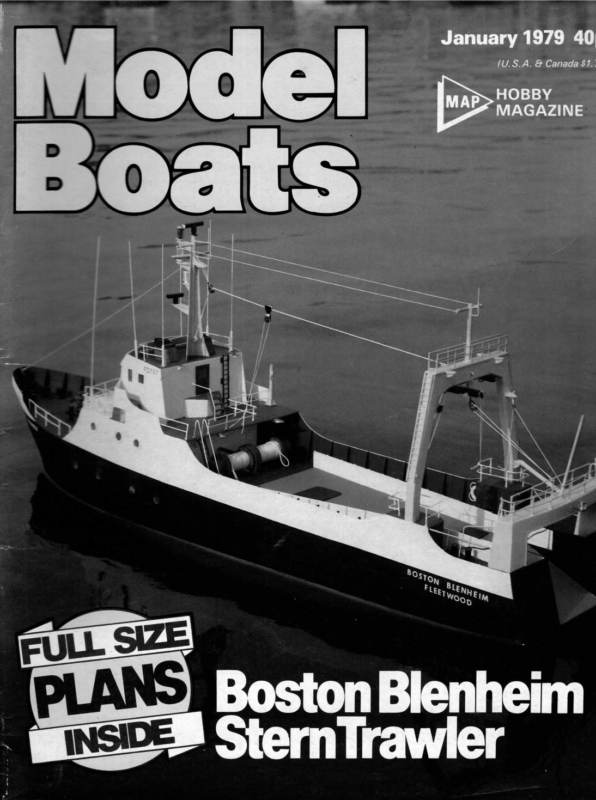
January 1979 40 (U.S.A. & Canada $1. HOBBY MAGAZINE on ) Boston Blenhei gi SternTrawler on nneim
Above, the full fleet at the Ashton 24 Hour; Leeds ahead of Danson round the mark, Top right, Bolton round followed by juniors, starboard at midnight. Left, Barry Axon “Will my battery last 24 hours?” or “Have ampere hours,. will travel!” Below, one hour to countdown. Mark Dicks gets rigged with Mrs Laurie Anderson and son in background. The Ashton 24 Hour. 2nd & 3rd September, 1978 In view of our experience setting up the event last year, our background organisation was much better. The help given by our local Entertainments Officers was much appreciated. The Corporation closed down the boating lake for the Saturday until Sunday afternoon. They loaned us in addition to the floodlights, two very powerful spolights to illuminate the two distant buoys and the course in between, which almost made our illuminated buoys unnecessary. The boathouse was cleared and made available for the boats and their maintenance. We arranged with the cafe for a late evening meal, snacks through the night, and a good solid breakfast. Beer was provided by the club and proved to be popular with all the competitors, club officials and friends. The interest shown by the Corporation for this event was so great that they provided us with road signs giving directions to the lake, and a hundred posters advertising the event were distributed throughout the area, resulting in a constantly moving crowd of spectators, and on the Sunday morning there was a large crowd watching the closing stages of the race. By 10.30 am the course was ready and as the competitors arrived they were greeted with music. This was provided by the Denton Silver Prize Band who blew delightfully stronger than the wind. The clubs represented were as follows: Team Clapham Malcolm Peppiatt Chris Dicks Mark Dicks (13 years) Boat Design Betagen Seager Fantasie Impromptu C. Dicks (One off) Tameside Jack Lee Allan Pollitt Trevor Jones Chubb Cygnus Seahorse Mk. 3 Seahorse Mk. 3 Bolton Squire Kay Paul Metcalfe Derek Priestly Leeds & Bradford Brian Curran Allan Curran Dave Hollom 7.C.4 K.9 Viking Il Capella Seahorse Mk. 3 Seahorse Mk. 3 Ashanti 13 Seahorse Mk. 3 Cleethorpes Paul Gilby Don’t Be Long Pirate Red Roger Emptage (13 years) Leicester Robert Smith Apache Gren Thornhill Pheidippidies Alan Moss Harry Briggs Seahorse Mk. 2 Briggs Ashanti Road Runner Danson Tony Owens David Townsend Dick Owens Focus Lady M Trapper Trapper Junior Team Andrew Hollom (13 years) Eskimo Colin Gregory (15 years) Vespucci Paul Beard (15 years) Ashanti Seahorse Mk. 3 Ashton Barry Jackson Barry Axon Eric Caldecott Kalamari 2 Miss Piggy Seahorse Mk. 3 Seahorse Mk. 3 Red Rum Ormesby Boy Witchcraft Cleveland Eric Nuttall Laurie Anderson lan Hall Seahorse Mk. 3 As you can see from the team list there was an impressive array of talent. It was obvious that the skippers would have to use all their skills and any errors would be taken: advantage of by the opposition, not only fora couple of laps as in a normal regatta, but for hundreds of laps. The racing began at twelve noon, chronometers were set and the battle was on in earnest. There was a gentle breeze and high tops were the order of the day. After an hour, Clapham, Danson and Leeds were within three yards of each other as they passed the Model Boats
marker for 11 laps, and twenty-five yards behind were Ashton, Bolton and Tameside. Leicester, Cleveland and the Juniors were all together on 9 laps after being left behind by the other boats. Cleethorpes followed, their boat having run amok and having been recovered with a badly bent mast, they were soon back on the water with their reserve boat. Between three and four o’clock Bolton and Clapham were leading the field. They were within five yards of each other all afternoon, first one then the other in front. At the quarter stage (6 pm) Cleveland and Danson were neck-and-neck with 83 laps closely followed by Ashton 82 and Leeds 81. They had all managed to get clear of Bolton and Clapham 79 laps followed by Tameside 77.Leicester 70 and the Juniors 69 were about 25 yards apart, and finally Cleethorpes on 55 laps. At about 6.30 pm, having just taken the lead, disaster struck Ashton; they developed an electrical fault, They had been sailing all afternoon without a reserve boat. Fortunately, as they were rescuing Miss Piggy, Barry Jackson arrived and hastily rigged Ka/amari 2 so there was not too much delay.’Wizzo Jackson’ got busy with the electrics and Ashton quickly had a reserve boat. Just after darkness had fallen so did the wind, and the going was much slower, only making five laps or so per hour. Cleveland made a boat change and we were all pleasantly surprised to see that their boat now carried flashing navigation lights. Come 10.30 pm the course and the boats sailing were being run in shifts with minimum staffing. The rest of us went up to the cafe for a little relaxation and a well-earned meal. A féw of our more thirsty skippers had a rather traumatic experience. They laboriously cartied a 43 gallon carton of beer up with them to the cafe, which is not licensed, and not wishing to upset the proprietor left it outside the door to draw on at will. After a gallon or so had been consumed they went out for a refill only to find their ‘liquid gold’ missing. Our local layabouts don’t miss a trick. At midnight, Ashton 128 laps got around the buoy about half a leg in front of Danson and Cleveland, both 127 laps and about two yards apart. Leeds, having dropped back were on 124 followed by Clapham 121 and Tameside 120, who had both overtaken Bolton 117 laps, Leicester 108 and the Juniors 102. Cleethorpes 88 laps had retired for the night and did not commence sailing again until about 6.30 am. They were the ‘wise guys’, only losing ten laps or so. The wind had dropped to a mere whisper, the boats just moving, At about 2.00 am, proceedings were livened up by Dave Hollom giving us a demonstration of ‘Henley’-type rowing in the rescue boat. Having just done a battery change and at the odd moment when there was a puff or two of wind, he had not switched on the receiver before releasing his boat. It was such a mild night that no one availed themselves of the use of the cafe as a rest room. Bodies in sleeping bags were strewn about the quayside and boathouse, and now and then there were a few grunts and snores. 6.00 am and the cold light of dawn. In the light airs during the night Ashton 144 had managed to get a lead on Danson 138, who were just round the mark in front of Cleveland 137, followed by Leeds 135. Tameside 133 had lapped Clapham 131 and both had left Bolton 129 behind; Leicester 120, Juniors 113. Cleethorpes were still sleeping on at 88 laps. The all night session made us all very hungry and the cafe did a roaring trade with bacon, bangers, eggs and tomatoes. It never tasted so good at home! About 6.30 am Cleethorpes re-appeared bright and breezy and to our “Good Mornings” replied “And the top of the morning to you too!” During the morning Bolton came up with a new development: they did their battery changes from the rescue boat, opening up their yacht on the water in the middle of the lake. Not many would have dared to do this, but Squire Kay is confident of his nimble fingers. Ashton tried to save time by taking the reserve boat out with them in the rescue boat, but that was covered in the rules. They had to return and exchange yachts in the approved manner. All the teams were very much on their toes and did not want to waste a second. Every yard of the course was being fought for, it certainly was a keen test of endurance. The wind very gradually improved and the tensions increased. At about 7.00 am Bolton, who had been 2 laps behind Clapham an hour earlier had caught up and passed them. By 9.00 am they were hard after Tameside, 2 laps ahead. An hour later Cleveland had passed and were 1 lap ahead of Danson. Leeds who had gained 2 laps on Danson in the last hour were hard on their heels. Just before 11.00 am Leeds managed to pass Danson. Bolton were still gaining on Tameside, but were 1; laps behind. At 12.00 noon Bolton crossed the line 20 yards ahead of Tameside after 24 hours of non-stop sailing. The final results were: 176 6. Tameside 187 1. Ashton 171 7. Clapham 183 2. Cleveland 156 Leicester 8. 180 Bradford 3. Leeds & 151 9. Juniors 178 4. Danson 120 10. Cleethorpes 176 5. Bolton in were Greenhough, Mrs. and The Mayor and Mayoress of Tameside, Councillor pleasure his expressed and prizes the presented Mayor The hour. last the attendance for that Ashton could attract with this event the highly skilled skippers who were present. He hoped that the publicity that might be obtained in the Press would benefit the sport. Champagne corks were popping and the champagne was freely imbibed by all. The winning team was ceremoniously thrown into the lake. Unfortunately for two or three days afterwards their stomachs rebelled. At the sound of the first splash the Mayor’s security officer rushed up to see that all was well with His Worship. The Mayor remarked “He doesn’t give a hoot if I’m pushed in. He’s only worried about my gold chain of office”. It was a great event, very keenly sailed in very good humour. All the competitors enjoyed themselves and had the maximum sailing possible. A word of praise for the ladies: their accuracy and keenness in checking laps was admirable. The good-humoured banter between skippers and ladies undoubtedly helped to make this into a most enjoy- able meeting, It was very refreshing to see 5 junior competitors, whose average age was under 14 years, sailing with such keenness and determination. As Chris Dicks said: “‘It should give them nearly as much experience as they would get ina season’s sailing”. The care taken in preparing their yachts by the crews and the reliability of present day equipment was very apparent. All 20 boats were in sailing trim after 24 hours competition, Clapham and Danson had prepared battery use and charging schedules. Danson’s colour coded chart was set up above their charger in the maintenance area. The ‘Daily Mail’ sent out a reporter and we were pleased to see that we were givena five column spread with two photographs and write up. Ten days later our local weekly gave us two photographs and write up, three columns by 12 inches. This certainly repaid the Entertainments and Recreation Officers for all the help they had given us. The publicity should benefit us all to spread the gospel of our sport. January 1979 K. Shaw Top, the dog watch or night vigil. Above, the winners with the Armonol Trophy, left to right, Eric Caldecott, Barry Jackson and Barry Axon. Below, baptism or splash down at noon. Eric Caldecott and Barry Jackson receive their just desserts.
a ott Start of race 12 in the Wellworthy Trophy. The two starboard yachts did in fact turn the second and third boats onto the opposit tack, and had they been nearer the start line at “go”, could have dominated the start completely, as it was, the first port tack yacht went through into a commanding lead. Northern District ‘A’ Class Championships, Larkfield Tarn, 16th July 1978 This event took place at the Leeds and Bradford Club’s water in wind conditions which can only be described as very light. The first heat was started at 10.30 am and took until 12.40 pm to complete with boats drifting in all directions. Boats only a few yards from the line were not guaranteed to win, albeit they were a hundred yards in front of their opponents, as what wind there was tended to change direction with the result that many competitors found themselves back on the starting line after getting half the way up the water. Lunch was taken after the first heat in the hope that the wind would strengthen, and the race was restarted at 1.15 pm. The wind was indeed slightly stronger, but unimproved as regards direction, competitors quite often finding they were beating both ways. As it was obvious that the schedule could not be completed in the time available, the OOD announced that he would declare a result at 5.30 pm. As the racing continued, it was evident that John Brookes, sailing Longshot was establishing himself as a clear leader, with only Norman James and Dave Bragg sailing Pentangle, in a position to offer a serious challenge. With what wind there was beginning to fall away again towards the end, the last heat sailed was completed at 5.45 pm and the scores totalled, It was seen that Longshot had 28 pts and Pentang/e had 21 pts, but still with 7 pts to sail for in resails, These results were taken. Pentangle took the points from Silver Jubilee but dropped them toJansu and/ndependence. This left John Brookes as winner of the Championships with Norman James second, and Keith Armour and Martin Jew third with Toffee King. A short prizegiving was held. The trophy was presented to John Brookes who promptly dropped it ! However, he promised to have it repaired before the next Championship, thanked the officials and all concerned in running the event, and took the trophy back with him to Fleetwood. Results 1; Longshot 2 Pentangle N. James 3 Toffee King 4. /ndependence K. Armour/M. Jew 5. J Silver Jubilee (XTC – J. Brookes ( Indubitably cee) Long Pig 28 pts K. Roberts 23 pts D. Latham 16 pts R. Noble 15 pts. 15 pts Brian Barber a Gs Metropolitan and Southern 10 R Individual. Kensington Round Pond. 17th Sep- tember 1978 It was a pity that there were no visitors, which left the two home clubs, MYSA & LMYC to sail the event. Wind was basically north but veering east and west at times, with quite light to strong gusts. In other words dead tricky for all skippers. OOD T. Gurr started racing at 10.30 and other than odd re-sails a good pace of sailing was kept up. By 12.30 the card had almost been completed. Drinks at the pond side proved very much appreciated, on such a warm day. At 1pm. a halt was called for lunch and it was decided not to take re-sails but sail the card through again. Points by then showed two groups, Peter Dunkling leading with three others on his tail. Racing ceased at 4.45; everybody had thoroughly enjoyed a good days sailing. Our thanks to young Richard for tea and coffee just when it was needed. A pity you were not there! Who me? Yes You! Results 1. Aria P. Dunkling 2. Aida 43. 3. Restingia B. Hart 34 The Wellworthy Trophy. September 17th, 1978. After the very bad weather at the Nylet Trophy at Snails Lake, all competitors for the Wellworthy Trophy were very pleased to find good weather, which included a lot of sunshine and strong, direct winds. As all who have visited Snails will know, the access to the sailing water has been somewhat difficult due to steep banks. This, thankfully, has now been altered by the owners, Hall Aggregates, and all banks levelled to 45° giving a much better access and pleasanter aspect. Time will see the growth of grass on these banks and this will make the area very attractive. The water itself, especially now that some trees have been removed and banks levelled, is some of the best freshwater in the country — no weed, direct winds and elevated radio control points, enabling a big course to be sailed easily, being a good test for both skippers and yachts. As the Wellworthy was selected as a league event, all boats accepted were measured and registered, and the sailing was to the new rules. Three incidents occurred encompassed by the new rules, which | think might prove of interest. The third leg of the race included a close reach up to the start line, then coming close hauled to make the next buoy. In this particular incident two close reach yachts were driving side by side up to the start line; thus an overlap position resulted up to the starting buoy. As soon as the yachts were past this mark of the course both came close hauled to reach the next buoy. Immediately the windward boat, which previously had full rights to water at the start buoy, was in a very precarious position, as the lee boat, only inches away, had full rights to luff, once they were past the buoy, with the windward boat having no chance to avoid the collision. The two lines of thought on this situation were (a) that the windward boat should have immediately tacked after the buoy to escape from his bad windward position, and avoid conflict, and (b) that there should be a return to calling for luffing rights, and | think it’s fair to say that the luffing rule has been the most controversial point of the new rules in racing this year. It will be interesting to see what Council finally decide on this matter. The second incident involved one competitor dropping out with radio interference which, after the race finished, was proved to be caused by another skipper. The skipper experiencing problems was given the average of his previous race points over three The third incident was a matter of tactics. In race 14 Tim Fuller and Tony Owens were battling for first place. Tim decided to take Tony’s yacht right out in the third leg before coming across and quickly making for the next buoy. What Tim didn’t notice was the third yacht “sneaking” through on a direct course to that buoy. It’s a common mistake, when two fast and equally matched yachts are jostling for position, that a third yachtis allowed 16 pts T. Armour attachment for mainsail boom and kicking Strap. Pictures by Tim Fuller. races. 18 pts 17 pts B. Anderson Russell Potts from Danson, trims his yacht prior to the race. Note the separate to come through. This cost Tim 5.2 points on an otherwise perfect result. It will be noticed that once again Trappers did very well on the results table, taking four out of the first six places. It will be interesting to see if any of the northern boats, which | am told are now being made by some southern clubs, will prove good competition in the future. The OOD was the New Forest Commodore, Dave Waugh, who ran a strict but very enjoyable day. The only strong protest was concerned with the luffing rule explained previously, penalties being given, with some reservation to the windward yacht, and strictly in accordance with the new rules. The Cup was presented by a director of Wellworthy Engineering to the winner, Tim Fuller. Tim also won the Cup last year with an Ashanti, a boat which in fact finished in equal third place in this year’s trophy race. Results 1 Tim Fuller 2 New Forest Tony Owens Trapper Danson 3 Chris Dicks Trapper Clapham 66.8 Own Design 63.6)Sail 4. Mike Belding 5, John Cleave MYSA 6 MYSA 7 Peter Freeman Ted Croxon Woodley Basildon New Forest New Forest Danson 4. M. Goncalves Mako 32 G. Hallums LMYC 8 Aztex 29 MYSA Chris Eagle 5. 9. 10. T. Martin LMYC Woodspring Force 10 16 Mark Foreman 7. P. Sale LMYC Danson Black Magic 28 Russell Potts 6. J. Parkin Ti. 15 MYSA Vic Cooney Woodley David Townsend Danson 12: 3 T. Gurr Ashanti Trapper Trapper 74 63.6) off 55.2 54.4 48.8 48 46 45.2 42.4 42.4 Tim Fuiler Model Boats
s}e0g jepoy 9S S41 UNWYIpP Buljiles apew ‘spaem YUM ‘YdIYM J@AB] MO] e O} ua}|e4 ‘09€ YBno1y} JeOg ay} UIN} OF Bulaey exe] Aajieg ‘jood Bulwuwims sie uado uo}BulwA7 0} peyiod Ajjeueg ~Sued} pue Jo sem Avied ay] “DAW 1U8/OS YUM a9e1 WY qnjo-s9}UI Ue JO} UOJHuIWAT 0} passos9 s}eOg BAI ‘YIGL ‘JOO UO pue ‘OIpeL 0} Uaxe} Sey ‘YI JO ajs] yi UO ‘DAW EPAy ‘sqnjo Jsapjo ay) Jo auO ‘Y9SP 94} JO Bull 84]U89 84} SSO1D 0} WOO UJeW ay} JO} YBnoUs suJN} }eOg eB usu, (349) 40) 34614 Buruany }UBIOS A espAy ‘yO9P 84} JO aul] 84}U99 BY} SSOJD 0} WOOg UleW 84} 40} YBnous Jou Inq Ya] 40 }YyB14 suin} eo e UaUA ,, SP2P! 8Say} UO SJaddiys 48410 JO SuO!UIdO 4e|Yy 0} Bul}sas9}U! 8q pjnoM }! yng ‘s}sLind ay} W044 1010Y Jo sdseBb asies [IMA pue UO! LdI41|dWIs48A0 Ue Ajqeqoud si siy} |je }eY4} pesijess Si 3 “(QM dejs9aQ) “Ssed 0} }eOg 49y}OUeR Moje 0} esinos Bulbueys9 ‘Aong 3siy 84} 0} Aj}9euIp aiow Bui -JUIOd }B0qg 84} aq Jaye UI PjNOM siy| ‘aul| 9Yy} 0} aieNbs alow S! YOIYM }eOg 94} aul! Bulysiuy 410 Ye}s ay} Bulyoeoudde usu,‘ sey ing ‘Aong e je }e0qg Jay}OUR JO peaye yg eq UBDJeOgYYHUY ‘Fs “4B 1X8U 98} O} Aj}DaLIp ‘y92} pueoqejs uo |jI]s si pue sayjaBoye a1oW Bunjuiod s! yoIym 3e0q ay} Sasinod jUsJayIP UO UBYAA Aong ay} passiw sey ydi4yM jeoq e Aq pasijeued oq ued y0eR} ‘JeOqg JaYy}JOUe Hod 0} peBueyp pue Ajiedoid Aong e papunoisey yoiymyeogy ‘Zz $O }UO41} Ul SI MOq S,jeOq e sasinoo jajjesed AjyBnos uo UayM *‘pesijeued 8q ||QS pue jeog JaYyjJOUe jo peaye de| auo aq ued }eOgGYy Buljsixe ay} jNoge s}ulOd JlejuN je1aAaS a1e 8494} Seap! aseu} Busy ‘seoe|d Bululewe ay} 104 e0eJ-94 ||1M 3j6ue} ay} pulyaq s}eog eu} pue :AjuO 1yBnouy 40} pOOj Se }NO jas Ss! BulmojjO} By] ‘pseoqie}s WOs YO |j9} JouUeD sieddiys Auew se ea6enBue| Aep Aaa ul aq pjnom sua} au} || ‘sa/n4 juaseid ay} ueY} Ajisee a10wW auOp aq ued S14} ING ‘AY914} JIG e Ss! Si4} Bulueg ‘peaye si yoIyM 3e0q eu} SI 941}84 ||IM 3/6ue} ay} Busnes yeog ay, ‘Buloes anuiuoo |jeus s}yoeA pa|Buejue ay} Jo peaye sjeog |je ‘}eoq Aue Aq pajejd -WO9 useq sey de] suo Jaye pajbuejue awiedaq sjeog Om) 4 ‘6 384} ‘9a[qo sj! BAsIYyoe 0} ]SOW BUOP Sey YdIYM }eOq ay} eq 0} ]4yHNnoO S14} Ajains pue Aem jo 1461 aAey jsnw 3eOg aUO }eUy) SNOIAgo SI} ‘S8|N4 x98)dlWU0d AJ@A By} JO SUOD puke sold ay} ‘a0e|d auo dn sAow jjIM }eOg 3&4} puryaq Burysiuy sjeog |je pue s}ulod 9 8409s ||1M ay ysejo1d ane 0} 18dd!ys 8y} JO Ayjiqe ay} OU pue 3e0q ey} Guljjo42U09 UO eq 84} SESO| ay I 1Nq ‘uO |Ies pue Azjeuad e ysajOid Aewuaddnjsy ‘g PINOYs Jude BY | “ales ay} OP pjnoys em AYM UOSe~! OU SI 8484} UP 84} U! |/2y pue sjeog 41984} ezisdeod , sAoq azis-||nj,, ay} asneveq ‘8/481 S,.d00 ay} Wo. paBpni eq |jIM sjeoq jo suolysod jo suolsi9ap jy “2 ysnf ‘|B Jay “sjepowW “9g Aay} asnedsaq eq jsnw sejni juasaid ay} asn am AYM UOsSe—aL ay] *s “SIP $O JaquNU 8y} BdNpal JsnW si4y} psdnpe si Aem jo jYyHu sey *‘payjede4 Si yl! JUaWUOW ay} WO.4 AeM $0 yyB14 OU aAey ||IM }! Ajiea 00} aul] 84} Sessoi9 yeOog e 4) pa}jO1U0D e}OWes 40} pasn aq ‘sjuowaa1Be 24} syjBua| ,s}eoq Z ueYy} e10WwW Aq Aonq e passed aney sjeog jj (‘aweu Aq }eOqg ay} AyUap! pynoys Jeddiys Bujjeo ayy sBul }eO0q & YDIYM U! SUO!}eN}jIS JO JaquNU ay) 4) ZAeme sped QQ sdeuied ‘AOng 12} 84} Bulpunoi ase sjeoq uaym jUsW9esB6e Jo sdUeUD }eEUM -}99lW UAadoO UI! jnq ‘s}eOq YiIM SAdI0A 98}e1I90Sse pjnom suaddiys Buloes qnjo uj) *Ajjeuad e snou! pjnom siy} Op 0O} aunjie4 ‘uin} Ajayeipew! ysnw pue *,,mou ya} 40 1y61 Buiuiny,, |jeo ysnw Os ‘9Ul| W}S 84} UO B1e S}eOg UBYM jJUBsW—aJBesIp Si 8494) ad1j0eId Ul ing ‘aploap 0} Buy} ajduuis Alea e Saas Siy} }I JO 992} By} UD Jaddiys ay} (1/9/40) 14614 usn} 0) Saysim peaye si yoIuUMyeOog es yum Ajajze498q!/ep aptj}Oo 0} Ajdueys usn} JOU YsnW yng BuluLeEM °*Z “1 *SUOHENUS OM} JO BUO LOI} LA}s 0} Jeadde sj}uaWaeasBesip jv “E ‘Z ‘Ayjeuad e indul 40 seajo deay ySNW sjeog 194}0 pue Aem jo 14H sey peaye si ysIyMyeogy ‘PABMI9| JO PIEMPUIM SI 1eOg eB BUISUAA 4O 492} pseoqiejs JO Od UO SI }e0q Be UaYyJeUY “p ‘yeOq JaY4}JOUe ‘Buiusem ynoyym (Ya/ 40) JYB14 usn} 10 asinod aBuey? ued eo Aue sjeoq usemjaq 198}2M Je9/9 Jo syjHue] ,s}eoq ZS! e198u) J] pjnous @say} AYM uosesd) |e9/60] Ou si e104 “Buljies pazis-|jny ul pasn aue ‘peaye aq pjnom Aong ay} 0} }seieauU si YoI4UM }eOgG INOYUM asinod aBueys ued peaye Si YdIYM jeOoqg au} ‘s}eOq UBEMIjaq 19}eM Jea|d JO sy}Hus| ,s}eoq Z UeY} SSaj SI BJ9Yy) 4] “1 pesuy sUuOHIUIVEG ‘| 7848 PUlW 0} Bulids yoiym esou| ‘pajzeullulja aq pjnom yoiyM seins ‘Z “Burjies yo peaysu! BuinBue eu yonw os puads siaddiys AyM JapuoM siojeyeds ayew pue ‘Wods Jno ul Buiulol jo Burjuiyy euodue abeinoosip jsnuw sly “a10jaq 48A9 UBY} UOSeaS Siy} SUOIS -snosip pajeay pue Buliax91q e10lW Uaeq aAeY 0} Saas 3194} Sans VAW Mau au} Bulsn Bullies yo uoseas e pajajduo0o mou Buiaey,, ‘1 ‘AOY 0} J8AQ ZYONW Os ajINb sy sejny peyeye JOU BABY YdIYM SlWa/qOJd sey ssejo siy} Jey} JseBBns Aew 3×8] Ul Yiodas yjNy 4890390 ul yIeq UOObeT anoY je aes dng suoiduieyD py ay} 404 pulm yonu 20N YolyM ‘siequunu ul s}yoeA Wy Bullies Ma} ay} Buowe aie sqnjo omy 9S8Y} +S8/NJ JUG11ND 9Yy} UO UBEy 00} JOU aq 0} poojsuapuN aie OUM ‘DAW 9100q IsuleBbe Ajjuanbey sjies Buiudspoony ‘sqnjo 4840 jo s9Usledxe ay} UIYyIM U9eq aAeY Ae YydIYM pasied aie sjulod aouis Sieddiys Olpes 0} }Sa19}U! JO Jnq ‘anss! jse] ay} U! UONeDI|Gnd 404 832] 00} ‘qnjo Bulidspoojy 8u} Jo ‘suaaaj}s AoY Woy pantie sajni 84} UO JUBLULUOD BLUOS ‘sajny Buljies 9/y ey} Buipiebes uaxe} Used BABY ||IM UOISIDap e Ajqeuinseid pue ‘18A0 aq |IIM WA 84} JO WOY 284} ‘peysijqnd aie sejou s,yjUuOW sy} atu} ay} ng SSIS ON juspuodsali04) ‘V’A’W Jno woud LN WA) SARS SS SE OAS A A ASB. SR oes AAS Mk WA
swimming pool, with fountains, water polo goals, and notice boards, was not without hazards, but the biggest problem was mist, drizzle, and no wind. However, despite the first race taking half an hour, conditions improved after a half-hour break and a brisk working suit westerly sprang up, accompanied by sunshine, which allowed non-stop sailing till 3.15, by which time Ryde has scored 373 and Solent 260. Outstanding among the Ryde boats were Keith Witting’s 247 and George Dowling’s new double-chine original. A tankard was presented to the Ryde Commodore, and a return match will be sailed in the spring at Ryde. The Solent ladies provided a non-stop flow of refreshments, bless them. RM Race of Champions Over the same weekend, thirteen skippers battled it out for the Champions’ Cup at Hove. Conditions could hardly have been worse on the Saturday morning when the OOD, Clive Colsell, gave his instructions to the skippers. Fog, prevalent in the south that day, hung heavily over the lake, and the promised wind forecast of “light airs” had not materialised. With a long schedule of match racing to complete and little prospect of an improvement in either visibility or wind strength, racing commenced at 10.15am, with the proviso that if the far mark of the course became obscured, those races in progress would be abandoned, and restarted upon the re-emergence of the mark from the fog. Races between the pairs of boats progressed slowly and painfully throughout the day. The light airs did come, fitfully, mostly from the east, and the pairs were started, when possible, at one minute intervals. Delays were inevitable, mostly due to yachts being unable to start through lack of steerage way. After five races a pattern had begun to form. Eric Nuttall and Barry Jackson, both sailing Seahorses, were unbeaten, and Peter Freeman with a Jrapper had lost only one race. In heat nine the two top boats sailed each other. Peter Freeman at this time had only one defeat, and Barry Jackson was still unbeaten. The race between the two yachts was very close, with the 7rapper being to leeward on the first windward leg and luffing the Seahorse very successfully to prevent it going ahead. The 7rapper reached the weather mark slightly ahead, and retained the lead throughout the race. At 5.00pm the OOD called a halt for the day, with eleven races uncompleted. This was despite assurances from some competitors that the wind was just around the corner, and was awaiting for sailing to stop, to suddenly fill in and provide a splendid top suit romp. On Sunday morning conditions were much the same, although — one could clearly see the yachts the fog was undoubtedly thinner not moving. The remainder of the match racing schedule was completed by noon. Two races were resailed due to a collision, which was adjudged to be no-one’s fault. John Cleave tacked for water, and nearly a minute later was:hit by Dave Hollom who had responded to the call but having little or no way on was not able to tack. John having committed his boat to the tack could not reverse the slow but inexorable turn he had started. At the end of the match racing two skippers tied for first place, Barry Jackson and Peter Freeman, both having won eleven of their twelve races, and finishing with 91-6%. In third place was Eric Nuttall with 75%. Fleet sailing was started straight away, although wind conditions at this time were slightly worse than they had been earlier in the morning. It was intended to try and complete thirteen races of six boats, although the prospects of doing so seemed remote. However, at about 1.00pm when a lunch break was given, more to allow skippers to change batteries than to provide respite for them, the weather finally relented. A light southerly wind filled in over the lake, veering southwesterly and increasing to about force 2-3. Racing recommenced at a much brisker pace, and very quickly the remainder of the schedule was completed, Barry Jackson consolidated his lead by winning four of his six races, while Peter Freeman found that his choice ofa light keel on Saturday did not produce the best from his boat in the wind conditions on Sunday afternoon. After the six boat races were completed, the OOD sailed two races with all thirteen yachts on the water. The starting line was extended and the one minute countdown began. At the gun there was chaos. Some boats on starboard tack .. . right of way, some boats on port tack… . right direction to the windward mark, some boats in irons on the starting line… right in the way. Penalties were awarded like Green Shield stamps. Two boats which were entangled were freed, and the race was restarted. This time a more orderly battle ensued and the fleet were soon pursuing Dave Hollom’s Ashanti towards the windward mark. Wind conditions seemed ideal for him, and although other yachts closed on the downwind legs, he kept the lead to cross the finishing line first. In the second race he again led the fleet, and improved his score sufficiently to beat Eric Nuttall narrowly to third place overall. There followed a rather long interval while the OOD employed himself in some unaccustomed exercise, addition and percentages. Many willing assistants (self-appointed) offered advice, totals, and corrections. Despite all, the three leading boats were ascertained and the prizes awarded accordingly. The OOD thanked all skippers for the way in which they had contended with the frustrating conditions, and almost guaranteed an improvement on any subsequent visit they might like to make! Another excellent shot sent in by K. Shaw, covering the Ashton 24 Hour regatta reported in detail on page 53. S.O.S. for the rescue boat, Paul Gilby and Harry Brigg at the oars. Final Positions Position No. Boat 2643 Kalamari II 1 2588 Boots 2649 Viking // 3 4 2599 Red Rum 7.0.4 2661 5 Cygnus 2601 6 2477 Mnementh 7 8 9 10 11 12 13 2239 2560 1593 1948 2518 2511 Enigma Futtock Noddy Rides Again Knut Tantrum Goldfinger Name B. Jackson P. Freeman D. Hollom E. Nuttall D. Priestley A. Pollitt C. Dicks Club Ashton Danson Leeds Cleveland Fleetwood Tameside Clapham D. Snelling D. Graham __ A. Ott J. Cleave G. Webb N. Hatfield Basildon Basildon Basildon Clapham Birmingham Basildon Percentages Match Fleet Total 76.8 84.2 91.66 91.6 56.6 74.0 67.9 63.1 58.3 75 50.7 62.8 56.9 57.6 58.3 56.6 53.3 50 36.7 51.7 66.6 41:6 . 38.2 31.5 41.6 39.5 16.6 39.9 36.6 28.1 33.3: 25 0 26:5 23.9 7 ~19.722:8. 14.0 Club Details — New Forest One of the best radio waters in the country is used by New Forest R/C YC near Ringwood. Recent improvements to the banks (including removal of hedges) mean that the lake is open to direct and constant winds; it is 20-30ft deep and has no weed, and it is possible to lay out the largest course likely to be needed. Sailing is excellent at all times of year, and because the water is private, there is little interference from small boys etc. The club mainly sails on Sundays, throughout the year, though the winter months are used more for tuning and experimenting. Most of the boats are RM class, though some R10Rs are beginning January 1979 57
Left: Fritz Jacobsen, ex-I.M.Y.R.U. President in action with his Westwind in that memorable 1973 A Class Championship in which he placed 6th. Mate is his son, Kai. (Photo courtesy J. Browne) Above: new outhaul adjuster by Nylet Ltd. New Fitting Simple outhaul adjuster to fit 9/sin od booms is offered by Nylet Ltd. A Tufnol block is inserted a couple of inches into the boom and grub-screwed in place through a previously-drilled hole. A screwed stud runs through this, rotated by means of a knurled finger-knob outside the boom end; the stud carries a close-fitti ng supporting length of Tufnol rod and aclew hook. Turning the knob moves the Tufnol rod of the clew hook, giving smooth and infinitely variable flow control in the sail foot. Suitable for either main or jib. to appear, and members enter a good number of open events as well as hosting three or four well-known open races, including the Nylet Trophy and Wellworthy Trophy, as well as, usually, one of the Met. and SD Championships; there are also club cups Sailed for by members only. Although there is no clubhouse, monthly meet- IMYRU News With regret, the death is announced of the ex-President of the IMYRU, Fritz Jacobsen of Hamburg. Fritz had a heart attack early this year, was subsequently injured in a car accident, and had just matters are discussed. fatal heart attack. He will be remembered as a model yachtsma n of ings are held at a pub close to the lake, where club and sailing New members are always welcome, and can rely on help and advice if they are novices, or good competition if experien ced. Ring the secretary, Tim Fuller (Southampton 777359) or the Commodore, David Waugh (High Cliffe 4722) any evening for more details. returned to work early in October when he suffered a second and enormous enthusiasm, principally in the A Class, though he also sailed Ms, and all the skippers who knew and sailed against him would, we are sure, wish to join us in expressing sincere sympathy to his family. National authorities can expect to receivea copy of a draught for an amended Constitution in the near future. Changes are relatively few, but the IMYRU Executive Council is conscious of the need to review matters in the light of experience and changes brought about by progress. What worked successfully when racing was NEW RIOR SCIMITAR vane only is not necessarily best now that radio racing commands pores 54” Waterline. Kit includes glassfibre moulded fin and rudder, mast and deck fittings, mast and booms, top suit of sails, adhesive, full instructions, drawings for building, Three RM 50/800 Yachts and two 10 raters to choose from. such a wide following. \ The ground work for the 1980 World R/C Championships, planned for the last full week of July, 1980, in Canada, is already being laid. Since the event is being privately funded, countries required to have entry visas should experience no problems. Lessons learned from previous such meetings should enable the Canadian Association to stage a smooth and fastmoving programm e; for example, a ruling has been made that requires the OOD to aban- don a race if no boat has crossed the finishing line within 20 minutes of the start, resailing the race when conditions permit. It is surely commonsense to provide for conditions where the wind is so faint that not even a light-weather boat can get round in twenty minutes. SAILS by Nylet. Cut to keep you in front. Sails that have the perfect finish. Over 40 years of model sailmaking. Choice of 8 colours. FIRST in the French Nat. RM Champ. 1977 & 78 and world Champ. 1978. in the RM “Naviga’ SURESAIL WINCH-—fast and powerful operation, works direct from 3 or 4 wiresystems. £49.90 + UK p&p £0.90. NYLET AERO MAST with luff groove enables quick sail change, as used with our swivel fitting and Nylet sails by the winning yacht in the World Naviga Championship at Milan 1978. MAST and DECK FITTINGS,WIRES etc. BOOKS, R/C EQUIPMENT World Wide Mail Order. You want it, we sell it, just send to Dept Cl for illustrated catalogue, 30p in UK, outside UK 5 coupon-res ponse international. SS NYLET Ltd. SEND FOR MAIL ORDER CATALOGUE a 118-122 Station Road, Fordingbridge, Hants, SP6 1DG, England Telephone: 0425-53456 ead New 32-page Catalogue now ready with 170 illustrations including all the ships from Fast Sailing Ships, Model Shipways, and the plans drawn by E. N. Wilson and many of those by John Lambert. New additions are German warships including Scharnhorst. Send 50p ($1.50 or 75p abroad) for Catalogue. David MacGregor Plans pe. ms.1s 99 Lonsdale Road, London SW13 9DA Model Boats
RM ‘Yotters start here The Hull The lack of an outstandingly consistent race winning design has proven that there is no ‘one’ hull that is a guaranteed winner. For the first time ‘yotter’ this means that the choice of hull is wide. Any modern design without vices such as nose-diving or broaching will be adequate. It is a good idea to follow the advice given by other club members regarding hull choice, as they are likely to have a good knowledge of what is available, and which design would be most suitable. When building your first ‘RM’ it is very important to keep as close to the design drawings as possible, unless well tried modifications are incorporated to increase the performance. If possible try to copy a boat which is in existence, as by doing this it enables direct measurements etc, to be taken, in addition to those shown on the design drawing, thus reducing the possibility of making mistakes. Also if this is done one can be assured of a boat which is at least as competitive as the original. The first time builder must choose between a glass-fibre or a wooden hull. | Notes for PIVOT. beginners to this popular 8 A class by Andy Shallow Rudder a x7” McCulloch Deep Rudder axe. always recommend glass-fibre since this overcomes many construction problems, and also saves time, which the builder can then spend concentrating on the other aspects of his boat’s construction. Care must be taken to keep the hull reasonably light, i.e. no heavier than 4 Ibs. (ex radio and lead) if at all possible. Above all, the hull must be waterproof — for obvious reasons! The Keel and Fin NEW FIN/ RUDDER SHAPE. The keel on an ‘RM’ has proven to be a very important factor. Areas and depths of fins tend to vary a great deal. Most boats racing today are using fins with areas between 50 square inches and 70 square inches and depths from 13in. to 19in. Most of the latest designs are using about 50 square inches with a depth of between 16in. and 18in. (measured from water line to base of bulb). It seems that the shape and angle of sweep on fins has very little effect on performance, but the depth and area have. In some conditions people have found more extreme fin/bulb configurations to be advantageous, but these should be avoided by the beginner, who should follow the designed plan, or proven modification. The cross sectional shape of the fin is considered important and much research has taken place, especially in the USA to try and find the ideal section. However, to avoid complication the beginner should zim to achieve a simple aerofoil like the January 1979 OLD FIN/RUDDER SHAPE. 59
one sketched here. Fins are most easily made out of a good quality hardwood, ‘ain. or */sin. thick, but glass-fibre, tufnol or glass-fibre sheathed balsa wood are also very suitable. The surface finish in this area should be very good, since together the fin and bulb can total as much as 140 square inches, which can cause quite a lot of drag, right in the place where it will do shape, and size are unimportant. How- ever, this is not true, the shape and size can make the difference between a fast and slow boat. This may sound strange but one must consider the very real problems which occur when racing, especially in heavy weather in confined areas of water. Put simply, it is no use having a fast boat if you can’t tack and gybe quickly, and most harm to boat speed. accurately, in a// weather. Bulb Basically the rudder shape and size is dictated by the type of boat and how it is The manufacture of the lead bulb on modern boats tends to worry many first time yotters, but in practice the casting and fin- ishing is not difficult. Most clubs have a member who ‘specialises’ in lead casting and the like, and the best way to learn is to contact him. When attaching the bulb to the fin care must be taken to fix the lead firmly, and also to get its fore and aft position correct. Its position is ‘correct’ when the boat floats on her designed waterline. As with all the underwater parts of the hull, the finish must be very good to reduce friction. The Rudder The size and shape of rudders seen at open meetings around the country are almost as varied as the designs of boats. To the novice this may indicate that rudder sailed. A ‘stiff’ boat that sails fairly upright can get away with a shallow rudder, maybe about the size shown in (A). But a ‘tender’ boat, that sails at greater angles of heel will need a deep rudder; perhaps the size shown in (B) in order to keep enough blade immersed (when heeled) to maintain steerage. In my opinion all rudders should be ofa semi-balanced ‘spade’ type, be similar to that of the fin. On no account should the rudder blade be made out of thin sheet, i.e. aluminium, since these ‘flat plate’ types are very prone to ‘stall’ which makes them useless. Deck Gear Deck gear should be simple. A boat fitted with simple deck gear will always finish in WHEN PINNED THROUGH £29 ROUND MAST HOLES ——— BOLT THROUGH BOOM. & MOUNTING. ie ook JACKING — ATTACHMENT POINT FOR oING STRAP oy —=——— DECK & STRENGTHENING. 1 : esa no real answer. The only way to decide is to talk to the owners of boats and draw your own conclusions. However, always remember to try and keep your boat as simple as you can. Mast With ‘RMs’ there are only one or two decisions to make. These are concerning the mast diameter, and its stepping arrangements. Everyone who races, has his own most people would agree, that a “sin. than does deck stepping. So, even with this small amount of knowledge we can conclude that to obtain a stiff mast, (which appears to be advantageous), the best way is to install a keel stepped °/sin. dia- meter mast. With a keel stepped mast it is a nice ‘extra’ to have an adjustable ‘ram’, (to move the mast back and forth at deck height), to control the bend characteristics in the fore and aft mode of the mast. To the novice the idea of a ‘stiff’ mast that can bend may sound peculiar, but it must be realised that the shape of the mast plays a great part in determining the mainsail shape, to.such a large degree in fact, that’some sails will simply not ‘set’ on a mast if ithas too much bend init. This isa common problem with the rigs on new boats. To begin with, one should aim to achieve a straight, stiff mast when sailing, not only in the tranquil calm of the living room! One way of testing your boat’s rig, other than racing, is to fully rig the boat and take it out of doors into the wind. This may bring funny looks from the neigh- bours but they soon become used to it! It is very interesting and informative to watch just how the sails work together, and also to see just how the rig flexes. Mast Gear As with deck gear, the key word is simplicity. All attachments to the mast and the stepping mechanics should be very sim- MAST ‘STUB’——l= ALI’ BASE PLATE A used to achieve the same end is fantastic. For the first time ‘yotter’ this poses a problem. Which design of gear to use? There is diameter mast is stiffer than a ‘/2in. one, and that keel stepping as in the diagram, gives far more control over mast bend 800M MOUNTING gear on them, and the variety of methods cross-sectional shape of the blade should the most turning moment. The finish and JACKING’ HOLE & LOCATING ie speed has probably increased as a result. Many boats have original designs of deck idea as to which arrangement is best, but UP HOLE. past few years deck gear has become more and more simple, and overall boat as shown, as for a given area they provide Q— s/s PIN TOHOLD MAST LOCATING front of a highly technical boat with gear which jams every time it tacks! Over the ple. More and more people these days are reverting to the ‘hole and hook’ method of MAST LOCATED IN HOLE IN BASE PLATE. *wooD BONDED TO HULL. attaching shrouds, as shown. Also shroud plates on the boat itself are disappearing. The alternative, a hook bent as shown, is finding favour. Mast steps of the ‘plug into a short stub’ type are now popular, and this type, as shown, combine the convenience of only having one main boom and kicking strap for all the sizes of sails, with bend controlling advantages of what is Model Boats
effectively a keel stepped mast. Also if the stub is cross drilled at small intervals, as shown, and a hole is made in the corresponding place, a short way up the mast side, it can be ‘jacked’ up to tighten the stays by simply pulling the mast upwards A, ~ SIMPLE HOOK. SHROUD TO MAST. SHOOK ek cS until the shrouds and fore stay are tight, then cross pinning with a stainless steel wire pin through the side of the stub (via one of the series of holes) and then through the single hole in the mast itself. —— – “STRENGTHENING. GLASS FIBRE TAPE. SIMPLE DECK SHROUD HOOK Sails Sails are of utmost importance with racing boats of all classes, therefore the setting of the sails on a boat must be done with great care. Most people start with just a working suit of sails. | personally feel that the sooner they acquire a high top suit and a 2nd suit the better, the reason for this | UNDISTUR| BED WATER. DIA. TO SHOW_ HOW. DEEP RUDDER Se CAN COPE WITH GREATER ANGLES OF HEEL. explain later. | also favour a medium top suit which is of a size to fill the gap be- tween working and high top (85in.) suits. simple deck/mast gear leads to quick thinking about starting or even just curi- Much more could be said about sails, but as with all the other aspects | have Editors note. hassle-free sail changing. The reason for requiring all these sails is very simply the fact that it is impossible to control a boat that is over canvassed and therefore heeling greatly. Some top skippers hold on to large sails for a long time tried to cover, one quickly starts to get away from information for the beginner, and into ideas for discussion amongst the experienced racing fleet. As a final point | whilst the wind strength is increasing, (in would very strongly advice any prospec- order to benefit downwind) but this practice requires very good skippering and is definitely not for the beginner. So in order to keep your boat under control you must have the right sails, and use them. Note: FIN SECTION. tive boat builders to contact their local club and get involved with its members. | am sure that they will be most helpful. So, do try to contact them even if you are only LEIGH MODEL CENTRE ous about what its all about. Details of your nearest sailing club can be obtained by dropping an s.a.e. to our offices. Two recommended titles for beginners are Model Racing Yacht Construction by R. Griffin, £1.75 plus 50 pence postage from Argus Books Ltd, Sales Office, P.O. Box 35, Hemel Hempstead, Herts, or Model Yachting by Vic Smeed (see ad. in this issue). 4 QUEEN STREET, LEIGH, Tel: Leigh (0942) 677152 LANCS. Open Monday to Saturday 9a.m.-6 p.m. Wednesday 9 a.m.-! p.m. NEW CATALOGUE 35p POST FREE ALPHA 40 ALPHA 20 * Winner of the 1977 3-5cc British MULTI Championship * Winner of the FIRST 9 races entered. * Fast enough to bea finalistin the British 3-5ec SPEED Championship and yet so stable it has been selected for the 1978 WORLD Multi Championship Eliminatorsin 3-5cc and 6-5cc classes. 3% Has proven to be so STABLE and TIGHT TURNING thatin rough conditions 3% Second in the 1978 World Championships by only one lap (this boat also it speeds up and leaves a!! opposition behind. used a KB2! with our Stage |! tune). post £1.00 post £1.00 price £16.00 Fs rice £16.00 Heavy duty flexible shaft includes ste’t tebe. Special rudder £1.55 post 205. f ALPHA 20 ALPHA 40 coup ¢. skez. £9.25 post 40p. We have developed a slightly modified version of the ALPHA 20 for 6.5cc Multi racing. The hull has been tested in two major Multi 6.5cc competitions where it scored two first places and also at the nationals 6.5cc multi championship where it scored second place in spite of two pit stops to change faulty glow plugs. This is a remarkable achievementand is mainly due to the outstanding stability of the hull. The ALPHA 40’s natural speed plus it’s very tight, safe turning makes it an easy boat to drive even in the roughest water conditions. We have had so many orders from other competitors who have seen the hull performing that we have had to delay advertising for over a month! The Alpha 40 must be used with a parallel drive, the buildinginstructions showing how to set this up. We have been using this season a new type of heavy duty flexible drive which is almost indistructible. (We have never had a breakage even when using metal props!) Price £9.25 We have in stock every com- petition accessory worth hav- ing. FOR ACCESS, BARCLAYCARD OR HOBBY CARD, JUST RING OR SEND YOUR CARD NUMBER WITH YOUR ORDER. H.P. WHILE-UWAIT January 1979 ES HULL/DECK eg atlmader ba Mk, Il Jaguar—6-5cc Mk. Il Mini —‘Scc Cougar 1977-10 … Alpha 3-5 to 6:5cec … Jumbo Jaguar-|0cc Tiger 10cc Silak 60—10cc , Silak 40-6-5cc ‘ Kalisport—3:5cc … Opus Mini-3-5cc… Isotope 19-3-5cc Isotope 40—6-5cc SHG Shadow-3-5cc SX. 100 Tunnel Hull Stingray Tunnel Hull … Glolec 30-3-5-5ce Speed Glolec 27-2:5-3:5ec … Elect 23 for Bullet 30 … Skimmie 25 2:5-3-5cc … Mini Scorpion 3-5ec … 16.00 £16.00 £19.50 £16.00 £20.00 £21.75 £25.92 £19.40 £11.79 £11.79 £14.80 £15.40 £11.79 £32.00 £24,50 £13.50 £12.80 £9.80 £8.50 £9.80 MRH Stand wes … £9.37 SHG Stand £14.95 ENGINE TUNING SERVICE We will rework and blueprint your engine to give a large power increase, longer engine life, and easier starting. Rear induction engines £13.50—Front induction engines £21.50 ENGINES We have over 150 new and secondhand competition engines in stock, Please ring for details. MAIL ORDER CHARGES: Hulls £1.00 UK. All other goods 40p minimum. Send sufficient, balance will be credited. Overseas customers: Goods sent air or surface mail. Cost subject to weight.